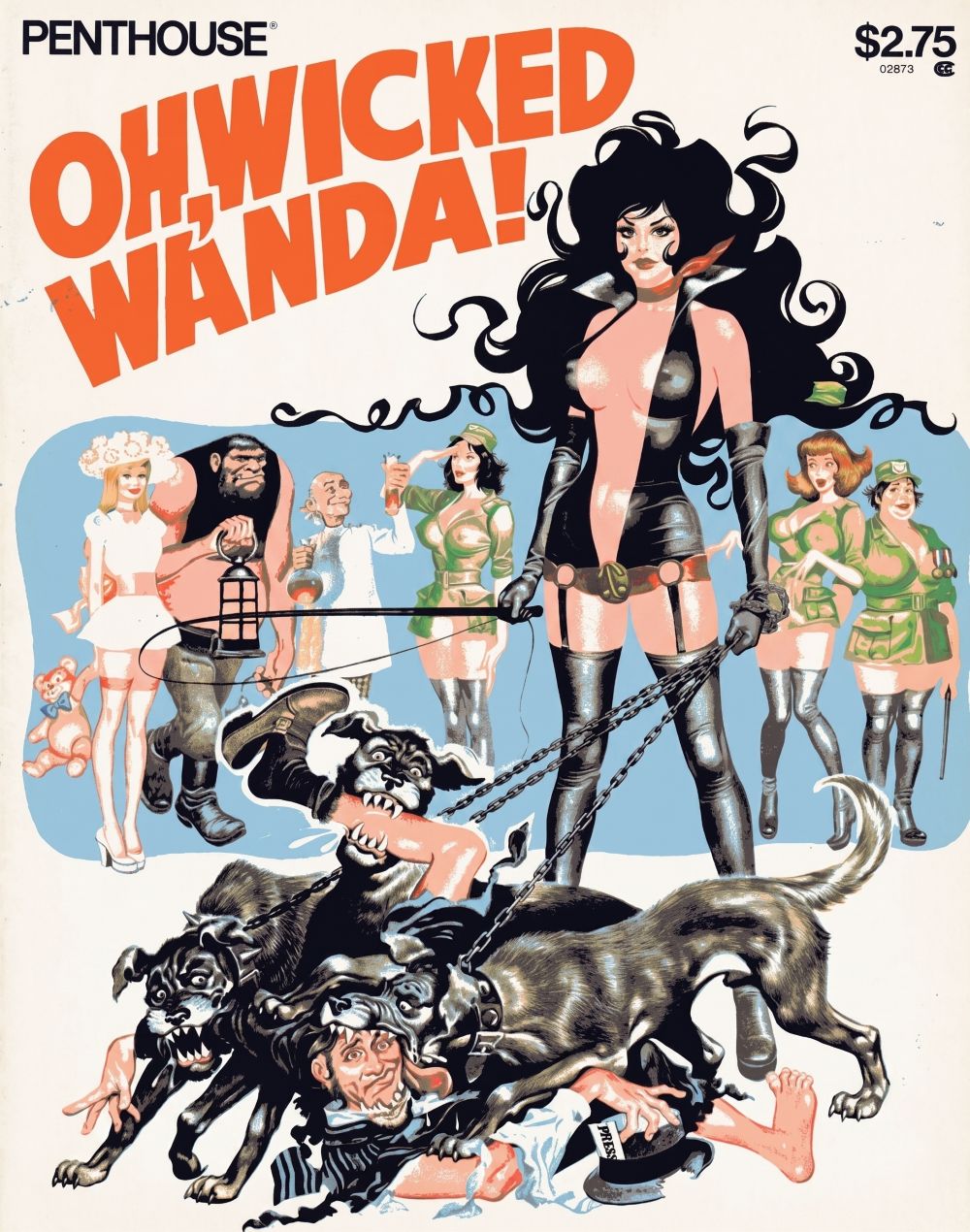
Oh, Wicked Wanda!—later shortened to Wicked Wanda—was Penthouse’s bold, lavish, and often deranged answer to Playboy’s Little Annie Fanny: an adult comic strip that met its competitor’s sexual satire with more cruelty, more eccentricity, more political bite, and startlingly beautiful painted art. Running as a full-color comic from 1973 to 1980, it paired novelist and journalist Frederic Mullally’s caustic scripts with Ron Embleton’s rich watercolor imagery, transforming a prior prose feature into one of the strangest recurring fixtures in 1970s men’s magazines.
Bob Guccione’s reaction to Playboy’s Little Annie Fanny was not merely to imitate it. He wanted Penthouse to have an equivalent feature—and, characteristically, something he considered superior. Playboy’s strip had been a signature showcase for Harvey Kurtzman and Will Elder: a highly polished, densely gagged satire built around the sexually guileless Annie, who repeatedly stumbled into an absurd succession of social fads, political caricatures, pop-cultural parodies, and erotic situations. Guccione saw the commercial and cultural value in such a feature and commissioned Mullally to develop Penthouse’s alternative, ultimately bringing in Embleton, an accomplished British comics artist and painter, to give the strip an unusually lush visual identity.
The crucial difference lies in what each strip thinks its heroine represents. Little Annie Fanny is fundamentally a comic of naïveté. Annie is constantly exploited, ogled, misled, commodified, or swept along by the lunacy of a world more foolish than she is. Kurtzman and Elder’s satire is crowded, busy, and democratic in its ridicule: everyone from hypocrites to celebrities to institutions becomes part of the page’s manic visual clutter. Wicked Wanda, by contrast, has no innocence at its center. Wanda Von Kreesus is a fabulously wealthy, sexually assertive, openly malicious heiress who does not drift helplessly through corruption; she thrives within it. She does not discover the depravity of society. She engineers it, enjoys it, or conquers it.
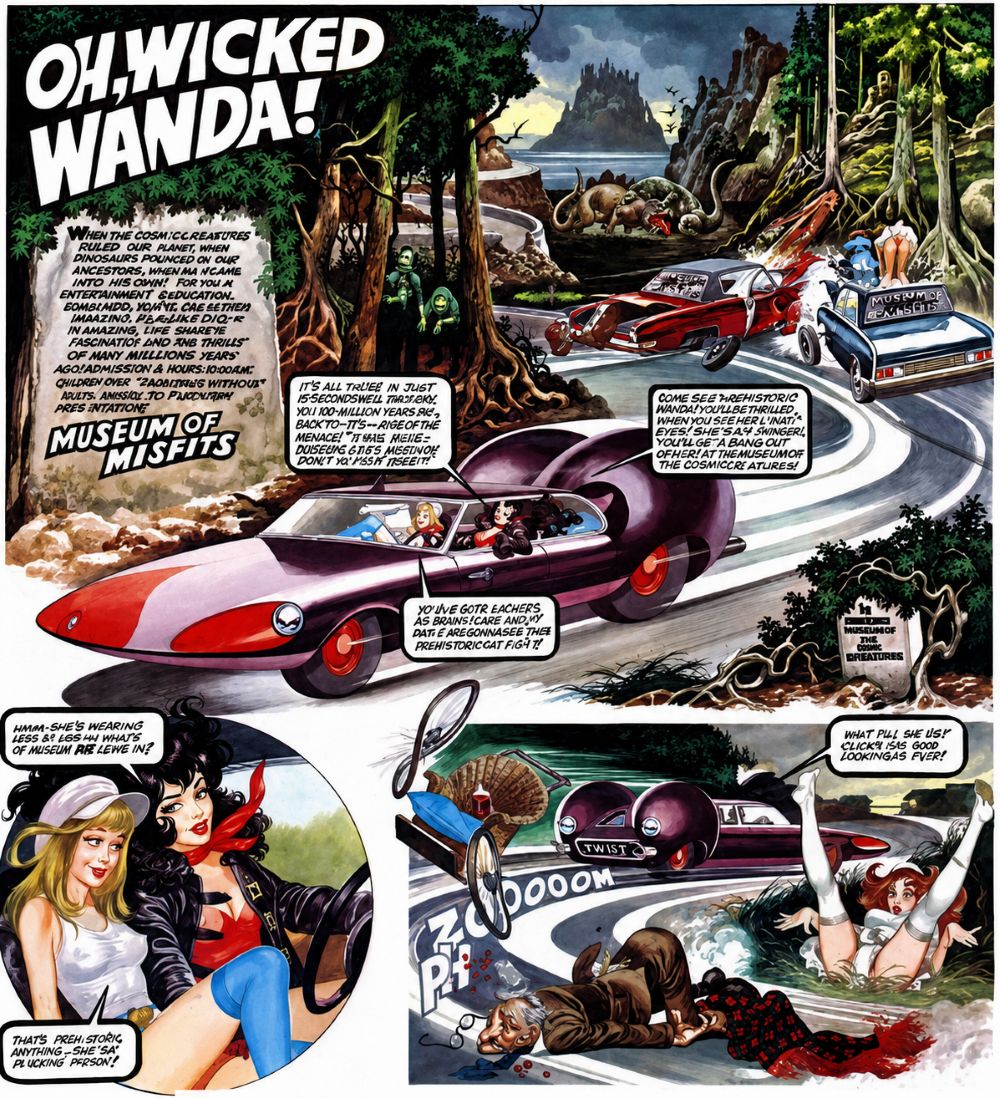
That shift makes Wicked Wanda feel less like a naughty comic romp and more like a grotesque aristocratic fantasy. Wanda is essentially an erotic supervillain, living in a gothic schloss with a bizarre supporting cast that includes her young companion Candyfloss, a brutish servant, a mad scientist, and an all-female private army. The strip’s premise gives Mullally considerable freedom: a Wanda episode can become a spy spoof, a mad-science horror story, a political satire, a time-travel farce, or simply a malicious practical joke played at the expense of a man, a public institution, or a recognizable cultural icon. This is a world in which immense wealth removes moral restraint rather than imposing responsibility.
Mullally’s writing is the source of the feature’s bitter flavor. Its comedy is not merely sexual; it is aggressively satirical, often directed at power, vanity, social respectability, consumerism, and masculine pomposity. Wanda’s money and immunity make her the perfect vehicle for exposing a world already ruled by appetite and status. The joke is frequently that society’s supposedly serious figures are no less ridiculous or depraved than Wanda herself. Rather than giving readers a conventional virtuous point of identification, the strip invites them into complicity with its amoral protagonist. That is a riskier, stranger comic strategy than the more buoyant misadventures of Annie Fanny.
The tone also benefits from the Britishness of Mullally’s sensibility. Wicked Wanda has the acidic air of a satire that distrusts authority at every level, but it is not solemn about that distrust. It is flamboyant, frequently silly, and happy to push a premise toward outright surrealism. Its plots can be crude, and its sexual politics can be distinctly uncomfortable to a contemporary reader, especially in the way the material handles power, coercion, and age. But that ugliness is partly inseparable from the strip’s chosen landscape: Wicked Wanda is a comic about people with too much power and too little conscience. Its excesses are rarely incidental; they are the point.
Embleton’s contribution is what elevates the feature beyond an interesting magazine curio. Unlike the deliberately cartoonish line work associated with Kurtzman and Elder’s Little Annie Fanny, Embleton approached Wicked Wanda with painted realism. He used watercolor for the comic’s panels, giving faces, fabrics, bodies, castles, machinery, landscapes, and elaborate costumes a level of sensual texture unusual for a periodical gag strip. The effect is fascinating because the visual surface is so much more refined than the situations it depicts. A scene may involve broad farce, bondage-inflected spectacle, grotesque parody, or a ridiculous villainous scheme, yet Embleton renders it with the seriousness of a lavish adventure illustration.
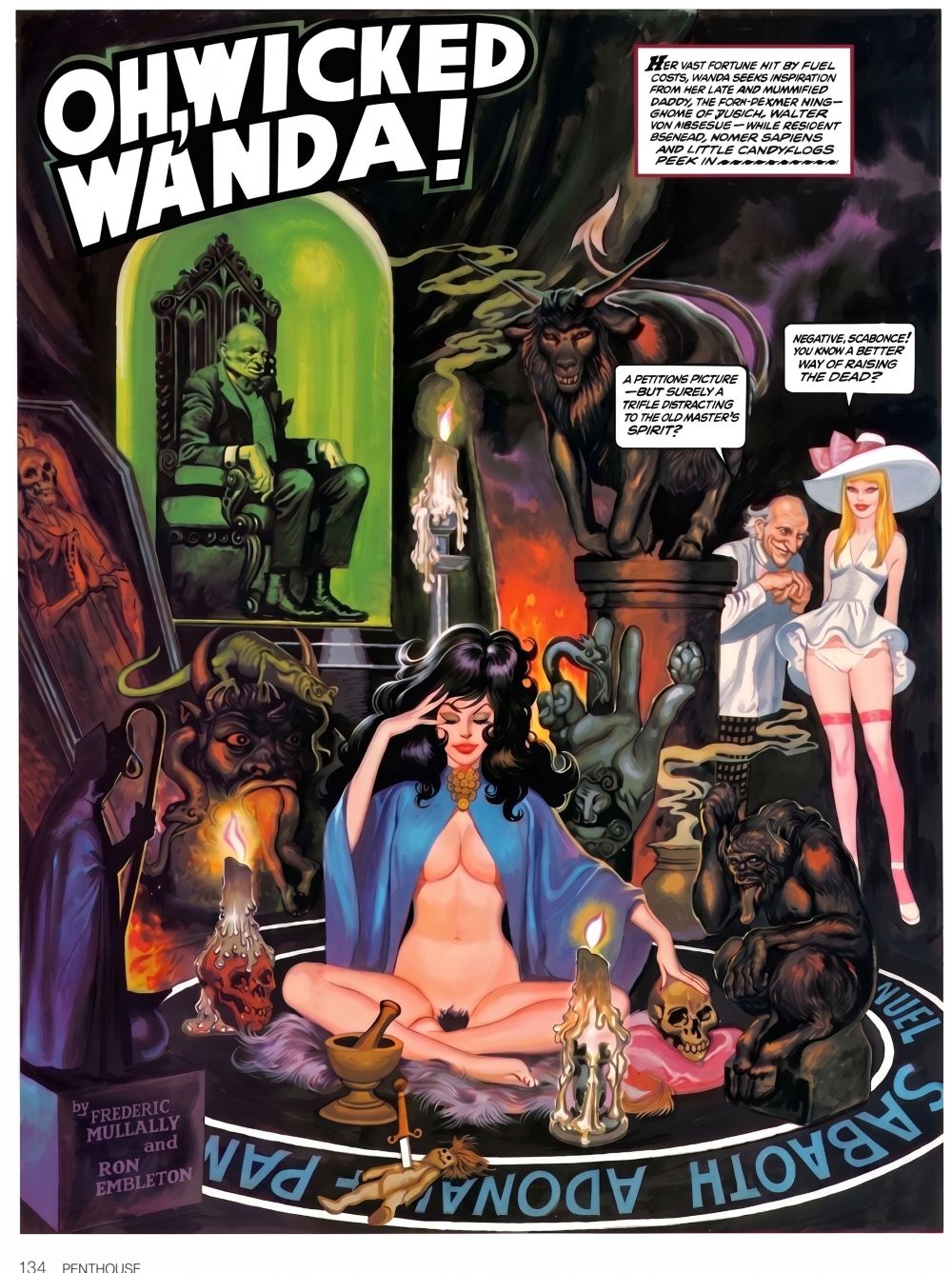
That tension is the strip’s great aesthetic achievement. Wicked Wanda looks expensive, almost prestigious, even when it is being juvenile, vulgar, or gleefully tasteless. Embleton’s polished craft does not sanitize Mullally’s material, but it gives the comic an eerie grandeur. Wanda herself becomes more than a pin-up figure because she is rendered as a commanding, almost mythic presence: elegant, dangerous, detached, and perfectly at home in worlds of luxury and nightmare. The visual vocabulary borrows from horror films, decadent European adventure comics, fashion illustration, and pulp fantasy, helping the strip build an identity that is far more distinctive than its origins as a competitive response to Playboy might suggest.
Its relationship to Little Annie Fanny is made explicit in early jokes that parody Playboy’s heroine, including gags involving artificial breasts or buttocks that deflate when punctured. These are hardly subtle gestures, but their lack of subtlety is revealing. Penthouse was not quietly borrowing Playboy’s format; it was declaring war on it. Where Little Annie Fanny offered a glamorous but comparatively benign sexual farce, Wicked Wanda presented itself as nastier, more confrontational, and more willing to make sex, class, and media fantasy look ludicrous.
Yet Wicked Wanda is not simply “better” than Little Annie Fanny in any universal sense. Kurtzman and Elder’s strip remains the more formally intricate comedic machine, with Elder’s pages packed with visual jokes that reward slow reading. Wicked Wanda is more uneven, more dependent on its period references, and more likely to mistake extremity for wit. But its best material possesses a singular personality. It is an adult comic that does not settle for supplying erotic ornament to a joke; it makes eroticism part of an entire system of domination, fantasy, absurdity, and satirical venom.
When Penthouse ended Wicked Wanda in 1980, it replaced the strip with Sweet Chastity, again illustrated by Embleton and associated with Guccione’s own creative direction. That succession underscores how important the format had become to Penthouse’s editorial identity. Still, Wicked Wanda remains the more memorable artifact: a decadent, politically irreverent, visually sumptuous comic whose villainous heroine gave Penthouse a genuinely different counterpoint to Playboy’s comic-strip institution. It began as Guccione’s competitive answer to Little Annie Fanny, but at its strongest it became something more peculiar and more enduring—a feverish fantasy of wealth, sex, cruelty, and satire painted with astonishing conviction.
Previous Guilty Pleasures
- Half-Baked
- Save The Last Dance
- Every Rose Has Its Thorns
- The Jeremy Kyle Show
- Invasion USA
- The Golden Child
- Final Destination 2
- Paparazzi
- The Principal
- The Substitute
- Terror In The Family
- Pandorum
- Lambada
- Fear
- Cocktail
- Keep Off The Grass
- Girls, Girls, Girls
- Class
- Tart
- King Kong vs. Godzilla
- Hawk the Slayer
- Battle Beyond the Stars
- Meridian
- Walk of Shame
- From Justin To Kelly
- Project Greenlight
- Sex Decoy: Love Stings
- Swimfan
- On the Line
- Wolfen
- Hail Caesar!
- It’s So Cold In The D
- In the Mix
- Healed By Grace
- Valley of the Dolls
- The Legend of Billie Jean
- Death Wish
- Shipping Wars
- Ghost Whisperer
- Parking Wars
- The Dead Are After Me
- Harper’s Island
- The Resurrection of Gavin Stone
- Paranormal State
- Utopia
- Bar Rescue
- The Powers of Matthew Star
- Spiker
- Heavenly Bodies
- Maid in Manhattan
- Rage and Honor
- Saved By The Bell 3. 21 “No Hope With Dope”
- Happy Gilmore
- Solarbabies
- The Dawn of Correction
- Once You Understand
- The Voyeurs
- Robot Jox
- Teen Wolf
- The Running Man
- Double Dragon
- Backtrack
- Julie and Jack
- Karate Warrior
- Invaders From Mars
- Cloverfield
- Aerobicide
- Blood Harvest
- Shocking Dark
- Face The Truth
- Submerged
- The Canyons
- Days of Thunder
- Van Helsing
- The Night Comes for Us
- Code of Silence
- Captain Ron
- Armageddon
- Kate’s Secret
- Point Break
- The Replacements
- The Shadow
- Meteor
- Last Action Hero
- Attack of the Killer Tomatoes
- The Horror at 37,000 Feet
- The ‘Burbs
- Lifeforce
- Highschool of the Dead
- Ice Station Zebra
- No One Lives
- Brewster’s Millions
- Porky’s
- Revenge of the Nerds
- The Delta Force
- The Hidden
- Roller Boogie
- Raw Deal
- Death Merchant Series
- Ski Patrol
- The Executioner Series
- The Destroyer Series
- Private Teacher
- The Parker Series
- Ramba
- The Troubles of Janice
- Ironwood
- Interspecies Reviewers
- SST — Death Flight
- Undercover Brother
- Out for Justice
- Food Wars!
- Cherry
- Death Race
- The Beast Within
- Girl Series
- Gone in 60 Seconds
- Swordfish
- Marked For Death
- The Internship
- The Angry Red Planet
- 2012
- Old School
- No Escape
- In Death Series
- Alligator
- Little Annie Fanny

