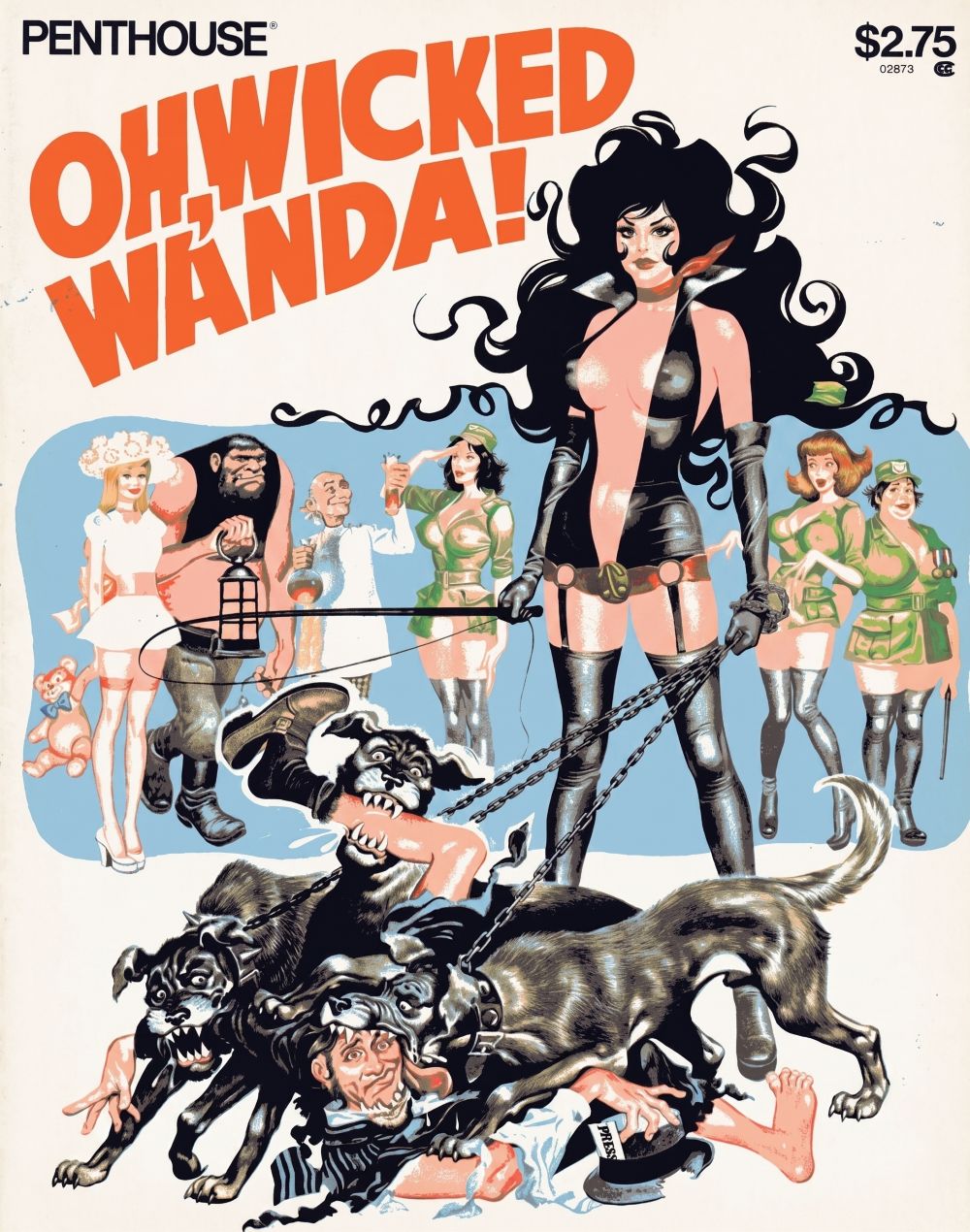
Guilty Pleasure No. 128: Wicked Wanda (by Frederic Mullaly and Ron Embleton)


Oh, Wicked Wanda!—later shortened to Wicked Wanda—was Penthouse’s bold, lavish, and often deranged answer to Playboy’s Little Annie Fanny: an adult comic strip that met its competitor’s sexual satire with more cruelty, more eccentricity, more political bite, and startlingly beautiful painted art. Running as a full-color comic from 1973 to 1980, it paired novelist and journalist Frederic Mullally’s caustic scripts with Ron Embleton’s rich watercolor imagery, transforming a prior prose feature into one of the strangest recurring fixtures in 1970s men’s magazines.

Bob Guccione’s reaction to Playboy’s Little Annie Fanny was not merely to imitate it. He wanted Penthouse to have an equivalent feature—and, characteristically, something he considered superior. Playboy’s strip had been a signature showcase for Harvey Kurtzman and Will Elder: a highly polished, densely gagged satire built around the sexually guileless Annie, who repeatedly stumbled into an absurd succession of social fads, political caricatures, pop-cultural parodies, and erotic situations. Guccione saw the commercial and cultural value in such a feature and commissioned Mullally to develop Penthouse’s alternative, ultimately bringing in Embleton, an accomplished British comics artist and painter, to give the strip an unusually lush visual identity.

The crucial difference lies in what each strip thinks its heroine represents. Little Annie Fanny is fundamentally a comic of naïveté. Annie is constantly exploited, ogled, misled, commodified, or swept along by the lunacy of a world more foolish than she is. Kurtzman and Elder’s satire is crowded, busy, and democratic in its ridicule: everyone from hypocrites to celebrities to institutions becomes part of the page’s manic visual clutter. Wicked Wanda, by contrast, has no innocence at its center. Wanda Von Kreesus is a fabulously wealthy, sexually assertive, openly malicious heiress who does not drift helplessly through corruption; she thrives within it. She does not discover the depravity of society. She engineers it, enjoys it, or conquers it.
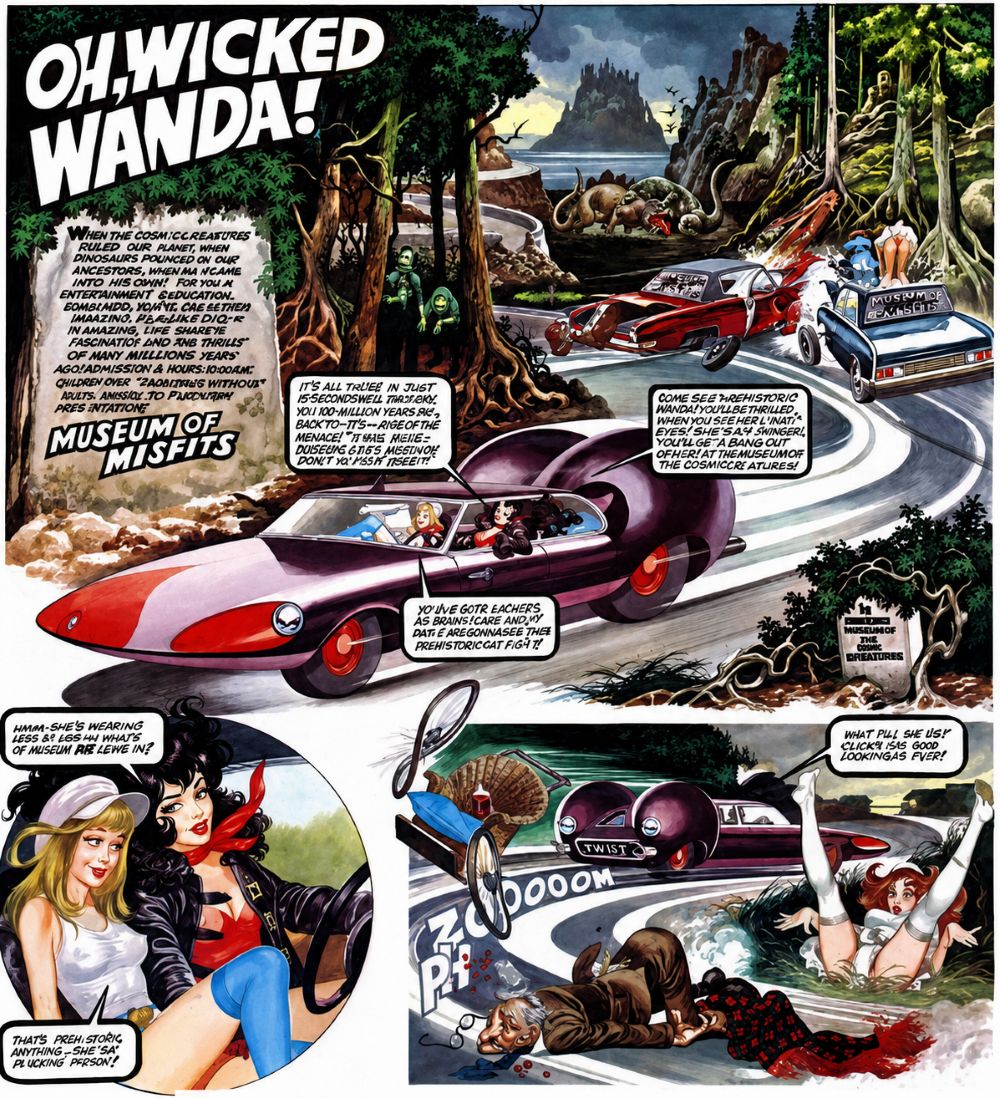
That shift makes Wicked Wanda feel less like a naughty comic romp and more like a grotesque aristocratic fantasy. Wanda is essentially an erotic supervillain, living in a gothic schloss with a bizarre supporting cast that includes her young companion Candyfloss, a brutish servant, a mad scientist, and an all-female private army. The strip’s premise gives Mullally considerable freedom: a Wanda episode can become a spy spoof, a mad-science horror story, a political satire, a time-travel farce, or simply a malicious practical joke played at the expense of a man, a public institution, or a recognizable cultural icon. This is a world in which immense wealth removes moral restraint rather than imposing responsibility.

Mullally’s writing is the source of the feature’s bitter flavor. Its comedy is not merely sexual; it is aggressively satirical, often directed at power, vanity, social respectability, consumerism, and masculine pomposity. Wanda’s money and immunity make her the perfect vehicle for exposing a world already ruled by appetite and status. The joke is frequently that society’s supposedly serious figures are no less ridiculous or depraved than Wanda herself. Rather than giving readers a conventional virtuous point of identification, the strip invites them into complicity with its amoral protagonist. That is a riskier, stranger comic strategy than the more buoyant misadventures of Annie Fanny.

The tone also benefits from the Britishness of Mullally’s sensibility. Wicked Wanda has the acidic air of a satire that distrusts authority at every level, but it is not solemn about that distrust. It is flamboyant, frequently silly, and happy to push a premise toward outright surrealism. Its plots can be crude, and its sexual politics can be distinctly uncomfortable to a contemporary reader, especially in the way the material handles power, coercion, and age. But that ugliness is partly inseparable from the strip’s chosen landscape: Wicked Wanda is a comic about people with too much power and too little conscience. Its excesses are rarely incidental; they are the point.

Embleton’s contribution is what elevates the feature beyond an interesting magazine curio. Unlike the deliberately cartoonish line work associated with Kurtzman and Elder’s Little Annie Fanny, Embleton approached Wicked Wanda with painted realism. He used watercolor for the comic’s panels, giving faces, fabrics, bodies, castles, machinery, landscapes, and elaborate costumes a level of sensual texture unusual for a periodical gag strip. The effect is fascinating because the visual surface is so much more refined than the situations it depicts. A scene may involve broad farce, bondage-inflected spectacle, grotesque parody, or a ridiculous villainous scheme, yet Embleton renders it with the seriousness of a lavish adventure illustration.
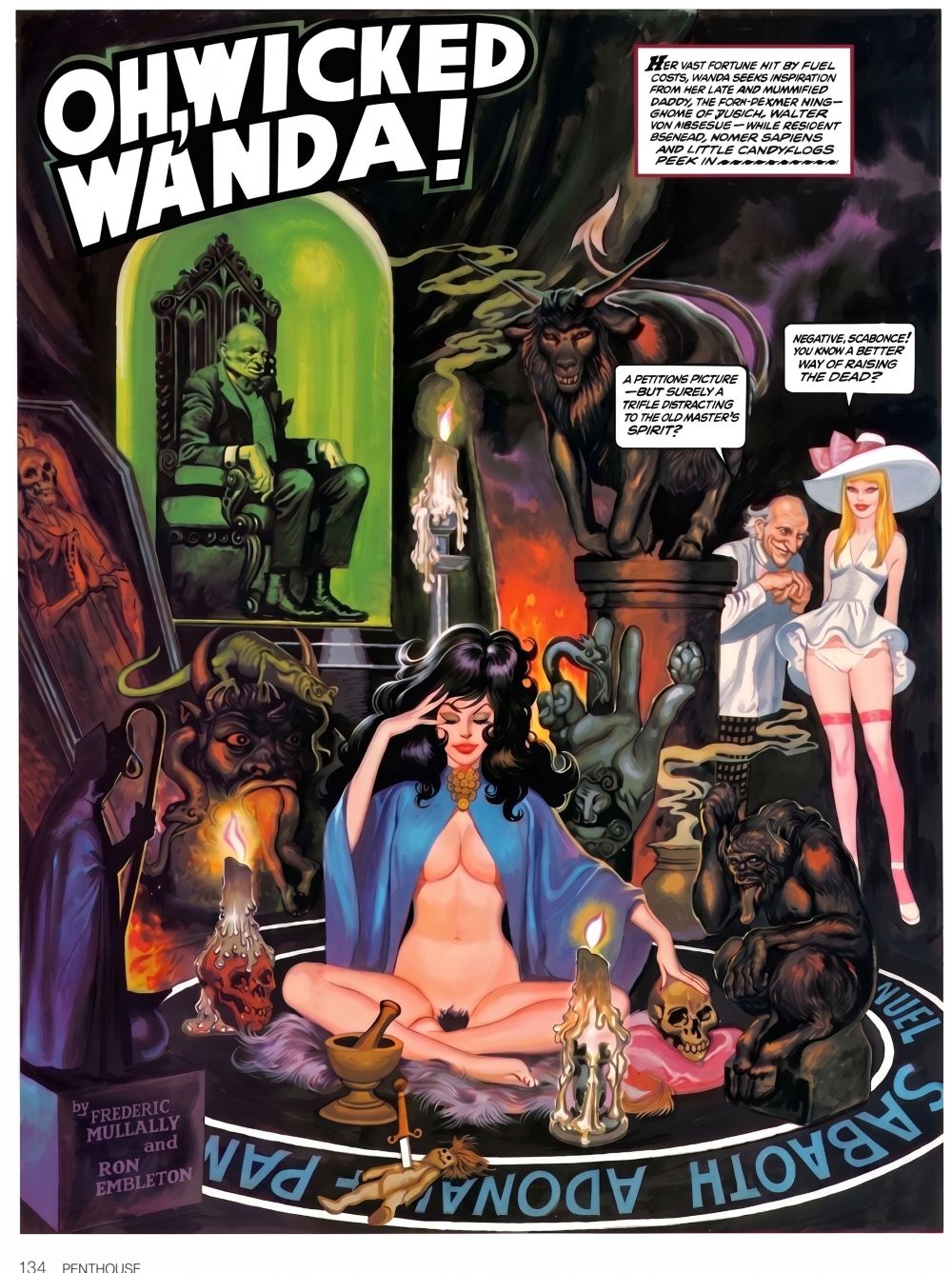
That tension is the strip’s great aesthetic achievement. Wicked Wanda looks expensive, almost prestigious, even when it is being juvenile, vulgar, or gleefully tasteless. Embleton’s polished craft does not sanitize Mullally’s material, but it gives the comic an eerie grandeur. Wanda herself becomes more than a pin-up figure because she is rendered as a commanding, almost mythic presence: elegant, dangerous, detached, and perfectly at home in worlds of luxury and nightmare. The visual vocabulary borrows from horror films, decadent European adventure comics, fashion illustration, and pulp fantasy, helping the strip build an identity that is far more distinctive than its origins as a competitive response to Playboy might suggest.

Its relationship to Little Annie Fanny is made explicit in early jokes that parody Playboy’s heroine, including gags involving artificial breasts or buttocks that deflate when punctured. These are hardly subtle gestures, but their lack of subtlety is revealing. Penthouse was not quietly borrowing Playboy’s format; it was declaring war on it. Where Little Annie Fanny offered a glamorous but comparatively benign sexual farce, Wicked Wanda presented itself as nastier, more confrontational, and more willing to make sex, class, and media fantasy look ludicrous.

Yet Wicked Wanda is not simply “better” than Little Annie Fanny in any universal sense. Kurtzman and Elder’s strip remains the more formally intricate comedic machine, with Elder’s pages packed with visual jokes that reward slow reading. Wicked Wanda is more uneven, more dependent on its period references, and more likely to mistake extremity for wit. But its best material possesses a singular personality. It is an adult comic that does not settle for supplying erotic ornament to a joke; it makes eroticism part of an entire system of domination, fantasy, absurdity, and satirical venom.

When Penthouse ended Wicked Wanda in 1980, it replaced the strip with Sweet Chastity, again illustrated by Embleton and associated with Guccione’s own creative direction. That succession underscores how important the format had become to Penthouse’s editorial identity. Still, Wicked Wanda remains the more memorable artifact: a decadent, politically irreverent, visually sumptuous comic whose villainous heroine gave Penthouse a genuinely different counterpoint to Playboy’s comic-strip institution. It began as Guccione’s competitive answer to Little Annie Fanny, but at its strongest it became something more peculiar and more enduring—a feverish fantasy of wealth, sex, cruelty, and satire painted with astonishing conviction.

Previous Guilty Pleasures

  1. Half-Baked
  2. Save The Last Dance
  3. Every Rose Has Its Thorns
  4. The Jeremy Kyle Show
  5. Invasion USA
  6. The Golden Child
  7. Final Destination 2
  8. Paparazzi
  9. The Principal
  10. The Substitute
  11. Terror In The Family
  12. Pandorum
  13. Lambada
  14. Fear
  15. Cocktail
  16. Keep Off The Grass
  17. Girls, Girls, Girls
  18. Class
  19. Tart
  20. King Kong vs. Godzilla
  21. Hawk the Slayer
  22. Battle Beyond the Stars
  23. Meridian
  24. Walk of Shame
  25. From Justin To Kelly
  26. Project Greenlight
  27. Sex Decoy: Love Stings
  28. Swimfan
  29. On the Line
  30. Wolfen
  31. Hail Caesar!
  32. It’s So Cold In The D
  33. In the Mix
  34. Healed By Grace
  35. Valley of the Dolls
  36. The Legend of Billie Jean
  37. Death Wish
  38. Shipping Wars
  39. Ghost Whisperer
  40. Parking Wars
  41. The Dead Are After Me
  42. Harper’s Island
  43. The Resurrection of Gavin Stone
  44. Paranormal State
  45. Utopia
  46. Bar Rescue
  47. The Powers of Matthew Star
  48. Spiker
  49. Heavenly Bodies
  50. Maid in Manhattan
  51. Rage and Honor
  52. Saved By The Bell 3. 21 “No Hope With Dope”
  53. Happy Gilmore
  54. Solarbabies
  55. The Dawn of Correction
  56. Once You Understand
  57. The Voyeurs 
  58. Robot Jox
  59. Teen Wolf
  60. The Running Man
  61. Double Dragon
  62. Backtrack
  63. Julie and Jack
  64. Karate Warrior
  65. Invaders From Mars
  66. Cloverfield
  67. Aerobicide 
  68. Blood Harvest
  69. Shocking Dark
  70. Face The Truth
  71. Submerged
  72. The Canyons
  73. Days of Thunder
  74. Van Helsing
  75. The Night Comes for Us
  76. Code of Silence
  77. Captain Ron
  78. Armageddon
  79. Kate’s Secret
  80. Point Break
  81. The Replacements
  82. The Shadow
  83. Meteor
  84. Last Action Hero
  85. Attack of the Killer Tomatoes
  86. The Horror at 37,000 Feet
  87. The ‘Burbs
  88. Lifeforce
  89. Highschool of the Dead
  90. Ice Station Zebra
  91. No One Lives
  92. Brewster’s Millions
  93. Porky’s
  94. Revenge of the Nerds
  95. The Delta Force
  96. The Hidden
  97. Roller Boogie
  98. Raw Deal
  99. Death Merchant Series
  100. Ski Patrol
  101. The Executioner Series
  102. The Destroyer Series
  103. Private Teacher
  104. The Parker Series
  105. Ramba
  106. The Troubles of Janice
  107. Ironwood
  108. Interspecies Reviewers
  109. SST — Death Flight
  110. Undercover Brother
  111. Out for Justice
  112. Food Wars!
  113. Cherry
  114. Death Race
  115. The Beast Within
  116. Girl Series
  117. Gone in 60 Seconds
  118. Swordfish
  119. Marked For Death
  120. The Internship
  121. The Angry Red Planet
  122. 2012
  123. Old School
  124. No Escape
  125. In Death Series
  126. Alligator
  127. Little Annie Fanny

The TSL Grindhouse: Caligula: The Ultimate Cut (dir by Tinto Brass)


How many cuts do we need of a bad movie?

Caligula is a film with a long and storied history.  In the mid-1970s, Penthouse publisher Bob Guccione wanted to follow the lead of his rival, Hugh Hefner, and get into the movie business.  His plan was to make an explicit adult film with high production values, one that could be sold as a mainstream feature film.  He decided that the infamously decadent Roman Emperor Caligula would be the subject of his film.  In order to give the project some gravitas, he accepted scripts from both Lina Wertmuller and Gore Vidal.  Ultimately, he chose to go with Vidal’s script because Vidal’s name had more cultural cachet than Wertmuller’s.  It certainly wasn’t because he liked Vidal’s script, which Vidal later said featured a lot of gay sex but only one scene of heterosexual coupling.

With the promise that Caligula would be a classy production that would push the boundaries of cinematic sex without actually being pornographic, Guccione was able to bring together a truly impressive cast of actors.  Malcolm McDowell agreed to play Caligula.  Helen Mirren was cast as Caligula’s wife, Caesonia.  John Gielgud took on the role of Nerva the philosopher while Peter O’Toole was cast as the diseased Emperor Tiberius.  Guccione offered directing duties to John Huston and Lina Wertmuller.  In the end, no matter how much money he was willing to spend or how distinguished a cast he had assembled, Guccione could not find a prominent, mainstream director who was willing to work with him.  Guccione ended up hiring a director he knew little about, an Italian arthouse filmmaker named Tinto Brass.

Brass proceeded to rewrite Vidal’s script.  Brass’s version of the film featured more sex and less politics.  Guccione was happy about that until he discovered that Brass’s plan was to direct the sex scenes to be grotesque and disturbing.  To his horror, Guccione discovered that Brass was essentially parodying the type of film that Guccione wanted him to direct.  Even when Guccione insisted that the latest “Penthouse pets” be cast in the film, Brass tried to keep them in the background.  As Guccione’s demands grew, Brass responded by refusing to emphasize the ornate and very expensive sets that Guccione had paid to have created.  A working ship was built but Brass reportedly chose to put it in a small warehouse so that there would never be room to get a full shot of it.  Guccione responded by taking the film away in post-production and inserting several hardcore sex scenes, which upset the members of the cast who did not sign on to appear in a pornographic film.

As for the film itself, it must be said that Caligula is probably one of the most historically accurate portrayals of ancient Rome.  The city was said to be a mix of dirty streets and ornate palaces and Caligula certainly captured the mix of beauty and sordid decadence that was the Roman Empire.  The film’s plot actually sticks very closely to what was written about Caligula by Roman historians like Suetonius.  Helen Mirren and Malcolm McDowell both give strong performances, even if McDowell later claimed the film ruined his career by typecasting him as a perverse villain.  Peter O’Toole is memorably grotesque as Tiberius.  Exploitation vets John Steiner and Teresa Ann Savoy also make an impression in their roles and one gets the feeling that they both understood what type of film they were appearing in, even if the bigger names in the cast did not.  There are moments of shocking grandeur and visual beauty to be found in Caligula and also moments of such total ugliness that they are difficult to watch.  In many ways, Caligula is what Guccione wanted.  It’s a big, expensive film that tests boundaries and features explicit sex.

But, Good God, is it ever boring!  Seriously, the scene where Caligula visits Tiberius in Capri goes on forever.  Despite McDowell’s strong performance, Caligula is not a particularly compelling character.  He becomes emperor and then he goes mad.  For over two hours, Caligula does one terrible thing after another and there’s only so long that you can watch it before you just want someone to hurry up and kill him.  The film suggests that Caligula was rebelling against the Roman establishment but, in the end, who cares?  He kills his friends.  He has sex with his sister.  In the film’s most disturbing scene, he rapes a bride and then fists the groom.  It just goes on and on and it gets old pretty quickly.

Still, there’s always been a lot of debate over whether or not it would be possible to make Caligula into a good film.  Bob Guccione claimed that he saved the film.  Tinto Brass disagreed and his director’s cut, which takes out Guccione’s hardcore inserts, is considerably better-paced than the Guccione version but the nonstop ugliness still gets rather boring.

That brings us to the latest version of Caligula, the Ultimate Cut.  Assembled without the input of Tinto Brass or the deceased Bob Guccione, Caligula: The Ultimate Cut played at Cannes in 2023 and was given a limited release by Drafthouse Films in 2024.  It was largely assembled out of unused footage and alternate takes.  I’ve read that not a single fame from the original version of Caligula is in The Ultimate Cut but I don’t think that’s quite true.  (The scene with the giant beheading machine appears to be the same footage that appeared in the original version.)  Caligula: The Ultimate Cut removes all of Guccione’s hardcore footage but it also downplays a lot of Brass’s directorial flourishes as well.  Instead, The Ultimate Cut is said to much more closely follow Gore Vidal’s vision of the film.

Is the Ultimate Cut any good?  It definitely looks better than the previous version of Caligula.  The restoration makes Rome into a very colorful city.  There’s a bit more humor to McDowell’s performance in the Ultimate Cut.  While his version of Caligula still becomes a monster (and the wedding rape is still included in the film), he starts out as a clown whose mission is to humiliate the Roman establishment in much the same way that Tiberius used to humiliate him.  In The Ultimate Cut, Caligula is much more of an anarchist.  At the same time, the Ultimate Cut features a bit less of John Steiner as the duplicitous Longinus and that’s a shame because Steiner’s performance was one of the best in the original version.  As well, Helen Mirren’s performance is stronger in the original version than in The Ultimate Cut.  The alternate takes that were used in The Ultimate Cut often seem to favor McDowell over Mirren.

That said, The Ultimate Cut is still a bit of an endurance test.  Caligula’s meeting with Tiberius still goes on forever and the nonstop evil of his reign still gets a bit dull after a while.  It turns out that Caligula the Anarchist is no more compelling than Caligula the Madman.  Brass and even Guccione may have had a point with the original version of CaligulaCaligula is a film that requires a truly sordid and shameless sensibility to be interesting.

In the end, it’s hard not to feel that all of this could have been avoided if Gemellus had been named emperor.

From Caligula To El Topo, Lisa Marie Does Six More Trailers


As I type this, it is freezing outside and I have got such a cold!  Fortunately, I have another edition of Lisa Marie’s Favorite Grindhouse and Exploitation Trailers to keep me occupied while I struggle to regain my health.

1) Caligula

I can’t believe I haven’t featured the trailer from the infamous Caligula yet.  There’s actually several trailers to choose from as this film was released in so many different versions.  I’m going with this one because Bob Guccione’s pompous voice over manages to be amusing, annoying, and yet oddly charming.

2) Caligula: The Untold Story

One of the lesser known facts about Caligula is that, while Caligula was being filmed, Italian director Joe D’Amato decided to get in on all the publicity by making his own low-budget rip-off, this one co-starring his frequent muse Laura Gemser (who had previously starred in the Black Emanuelle series and would later design the goblin costumes in Troll 2).  With all the drama around the production of Caligula, Caligula: The Untold Story actually ended up being released first.

3) Troll 2

I don’t really love this trailer, to be honest.  It’s actually a bit dull and it  doesn’t even allow us to hear the guy with the glasses go, “Oh my Godddddddddd!”  But I’m including it anyway because how can you not include Troll 2?  Plus, I also rewatched the documentary Best Worst Movie a few days ago so I’ve got Troll 2 on the mind.

4) Troll

Now, this is a trailer!  It’s interesting that Troll 2 is a bizarre and busy film with a boring trailer whereas the original Troll is a boring film with a bizarre and busy trailer.  Also, listen carefully to the trailer’s narrator because you don’t want to miss the prophetic Harry Potter reference…

5) Strip Nude For Your Killer

From Andrea Bianchi comes this enjoyably trashy giallo classic.  Only the Italians could make a film called Strip Nude For Your Killer.

6) El Topo

“El Topo is bloody…El Topo is sexual…”  It’s also widely cited as being the first midnight cult film.  It’s also one that I’ve been meaning to review on this site for a while.  However, until then, here’s the trailer.  (By the way, some might debate whether El Topo should be included here.  What they’re forgetting is that a good deal of the 70s Grindhouse fare were actually misunderstood art films.  Plus, El Topo did play almost exclusively in grindhouse theaters until John Lennon saw it and declared it his favorite film of all time.)