Horror Film Review: The Raven (dir by Roger Corman)


“Shall I ever see the rare and radiant Lenore again?” — Dr. Erasmus Craven (Vincent Prince)

“How they Hell should I know?” — Dr. Adolphus Bedlo (Peter Lorre)

This exchange comes from Roger Corman’s 1963 film, The Raven, and it pretty much epitomizes the film.  Very loosely based on the poem by Edgar Allan Poe, The Raven was one of the many Poe adaptations that Corman did with Vincent Price.  As opposed to the other films in Corman’s Poe cycle, The Raven was a flat-out comedy, one that parodied the other films in the cycle.  Reportedly, Peter Lorre improvised his response to Vincent Price’s question about Lenore.  In fact, Lorre improvised a good deal of his performance and his jokes sometimes even took Corman by surprise.  As a result and despite the fact that Richard Matheson did write a script for the film, The Raven is one of those films that feels like it was made up while the camera was rolling.

The Raven is a film about three sorcerers who are always fighting and arguing with each other.  Dr. Erasmus Craven (Vincent Price) spends his time mourning the late Lenore.  The evil Dr. Scarabus (a frail-looking Boris Karloff) has his own castle where he lives with the ghost of the late Lenore (Hazel Court).  Dr. Adolphus Bedlo (Peter Lorre) is a sarcastic ne’er-do-well who saw Lenore in Scarabus’s castle and was transformed into a talking raven as a result.

In raven form, Dr. Bedlo flies over to Craven’s castle and convinces Craven to transform him back into human form.  After informing Craven that Scarabus has Lenore’s ghost in his castle, the heart-broken Craven decides to head over to Scarabus’s castle and get some answers.  Accompanying the group is Craven’s daughter, Estelle (Olive Sturgess) and Bedlo’s son, Rexford (Jack Nicholson, looking somewhat lost in the role of a boring young man).

At the castle, Scarabus puts on an act of being a friendly and gracious host but the opposite soon turns out to be true.  In fact, the entire castle is full of secrets and it quickly turns out that hardly anyone — with the exception of Estelle and Rexford — are who they actually claim to be.  It leads to a battle in magic between Craven and Scarabus.  I nearly described their battle as being “epic” but that’s probably not the right world.  It’s epic by the standards of Roger Corman but actually, the big battle is just as jokey as the rest of the film.

The Raven is definitely not a film that’s meant to be taken seriously.  One gets the feeling that Corman knew that the presence of Price, Karloff, and Lorre would make the film a success no matter what the film was like so he decided to have some fun with it.  (Price and definitely Lorre appear to have been in on the joke while Karloff was perhaps a bit less so.)  To be honest, the film’s only earnest moments come courtesy of Oliva Sturgess and Jack Nicholson but, because Nicholson is Nicholson, you watch those earnest moments waiting for Rexford to arch an eyebrow or flash that devilish grin.  Unfortunately, he doesn’t.  Jack is pretty boring here.

The Raven, if we’re going to be honest, is probably too jokey for its own good but it’s still hard to resist the charm of Price, Lorre, and Karloff.  The film is a chance to see three horror icons acting opposite each other and, as a result, it’s a fun film for horror fans.  Vincent Price breaks the fourth wall at the end of the film and it’s hard not to love it.
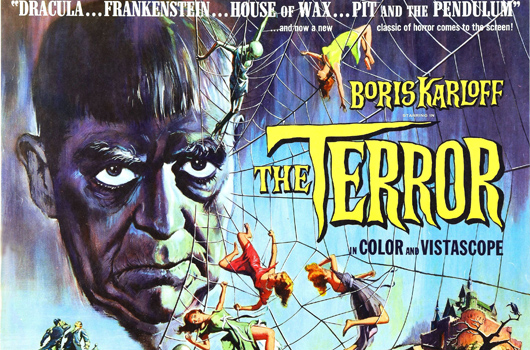
Horror on the Lens: The Terror (dir by Roger Corman, Francis Ford Coppola, Jack Hill, Monte Hellman, Dennis Jakob, and Jack Nicholson)


Have you ever woken up and thought to yourself, “I’d love to see a movie where a youngish Jack Nicholson played a French soldier who, while searching for a mysterious woman, comes across a castle that’s inhabited by both Dick Miller and Boris Karloff?”

Of course you have!  Who hasn’t?

Well, fortunately, it’s YouTube to the rescue.  In Roger Corman’s 1963 film The Terror, Jack Nicholson is the least believable 19th century French soldier ever.  However, it’s still interesting to watch him before he became a cinematic icon.  (Judging from his performance here and in Cry Baby Killer, Jack was not a natural-born actor.)  Boris Karloff is, as usual, great and familiar Corman actor Dick Miller gets a much larger role than usual.  Pay attention to the actress playing the mysterious woman.  That’s Sandra Knight who, at the time of filming, was married to Jack Nicholson.

Reportedly, The Terror was one of those films that Corman made because he still had the sets from his much more acclaimed film version of The Raven.  The script was never finished, the story was made up as filming moved alone, and no less than five directors shot different parts of this 81 minute movie.  Among the directors: Roger Corman, Jack Hill, Monte Hellman, Francis Ford Coppola, and even Jack Nicholson himself!  Perhaps not surprisingly, the final film is a total mess but it does have some historical value.

(In typical Corman fashion, scenes from The Terror were later used in the 1968 film, Targets.)

Check out The Terror below!

Horror Scenes That I Love: Boris Karloff in The Bride of Frankenstein


By most standards, Boris Karloff (who has born William Henry Pratt) was a true Edwardian gentleman, a reserved but polite man who treated people with respect and who was a generous co-star to his fellow cast members.  Early on in his acting career, he played a wide variety of character but, due to his performance as Frankenstein’s Monster and a host of other iconic characters, Boris Karloff would join Bela Lugosi as the first horror star of the sound era.  As opposed to Lugosi, who struggled with his resentment over being typecast and soon found himself ostracized from mainstream Hollywood, Karloff remained a popular character actor and horror star for his entire life.  Karloff’s dissatisfaction with the hours that he was expected to spend in makeup to play both Frankenstein’s Monster and the Mummy led to Karloff serving as one of the founding members of the SAG.

In this scene, from 1935’s The Bride of Frankenstein, Karloff’s monster briefly finds a friend.  Unfortunately, as so often happened, that friendship is quickly ruined by the ignorance of others.

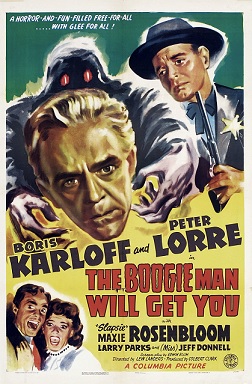
Horror on the Lens: The Boogie Man Will Get You (dir by Lew Landers)


Today’s horror on the lens is a short horror comedy from 1942.  In The Boogie Man Will Get You, Winnie Slade (Miss Jeff Donnell) buys an old house from Prof. Billings (Boris Karloff) with plans to covert it into a hotel.  However, one of the conditions of the sale is that Prof. Billings and his servants be allowed to live on the property.  What Winnie doesn’t know is that Prof. Billings had been conducting experiments on traveling salesman.  He hopes to turn them into supermen who, much like Captain America, can then be sent overseas to fight the Nazis.  However, his experiments have yet to be successful and have mostly just resulted into a lot of salesman being buried out in the rose garden.

However, things start to look up for Prof. Billings when he meets Dr. Lorencz (Peter Lorre), who is not only a doctor but also a mayor, sheriff, and dog catcher.  Seriously, Dr. Lorencz can do it all!

The Boogie Man Will Get You is a fun little time capsule of the time in which it was made.  For horror fans, it is mostly interesting because it features both Boris Karloff and Peter Lorre.  Both Karloff and Lorre appear to be having a lot of fun parodying their usual screen images.

Enjoy!

Horror Film Review: Black Friday (dir by Arthur Lubin)


The 1940 film, Black Friday, opens with Dr. Ernest Sovac (Boris Karloff), a once-respected scientist, being led out of his cell on Death Row and being taken to the electric chair.  As he enters the death chamber, he hands one of the gathered reporters his journal.  Dr. Sovac says that he wants the reporter to know the true story of how he came to be on Death Row.  While the police strap Dr. Sovac into the electric chair, the reporter reads the journal.

It’s flashback time!

Months earlier, Dr. Sovac’s best friend, an befuddled English professor named George Kingsley (Stanley Ridges), is nearly fatally injured when he has the misfortune to get caught in the middle of an attempt to assassinate a gangster.  In order to save George’s life, Sovac performs a brain transplant, giving George part of the gangster’s brain.  George does recover but now he’s got the gangster inside of his head, trying to take control.  Much like Dr. Jekyll, George continually switches identities and becomes a viscous hoodlum who is looking for revenge against those who betrayed him, including gang boss Eric Marnay (Bela Lugosi).

Dr. Sovac, however, is more concerned with the fact that, before he died, the gangster apparently hid a good deal of money somewhere.  Sovac wants that money for himself so that he can build his own laboratory and hopefully help other people with otherwise incurable brain conditions.  Sovac tells himself that, once he gets his hands on the money, he can find a way to rid George of his evil alternative personality.  But until George finds the money, Sovac is content to allow George to continue turning into a murderous gangster.  Things, however, come to a head when George starts to threaten Sovac’s daughter (Anne Gwynne).

Black Friday is yet another Universal Horror Film featuring Boris Karloff was a mad scientist.  What makes Dr. Sovac a compelling character is that he starts out with the best of intentions.  He just wants to save the life of his best friend and Sovac’s desperation is increased by the fact that George himself was just an innocent bystander when he was injured.  Later, when Sovac starts searching for the gangster’s money, his intentions are again not necessarily bad.  He sincerely wants to do some good with that money and he uses those good intentions to justify allowing George to do some very bad things.  In the end, Sovac becomes so obsessed with being able to fund his laboratory that he loses sight of the price that both he and George are having to pay.  Karloff does a great job of playing Sovac, showing how a kind man manages to lose track of his morals until it is too late.  Stanley Ridges is also well-cast as George and does an excellent job of switching back and forth from being a befuddled professor to a ruthless gangster.  There’s an excellent scene in which George, attempting to teach his class, suddenly hallucinates that all of his students have become gangsters.  Ridges does a great job playing it.

Reportedly, the film was originally conceived with Karloff playing George and Bela Lugosi playing the role of Dr. Savoc.  However, Karloff said that he would rather play Savoc and, as such, Lugosi lost a role for which he probably would have been very well-cast.  Since Lugosi was a bit too naturally sinister for the role of George, he instead had to settle for a small role as a gang leader.  Lugosi, it should be said, is a convincing gangster but it’s still hard not to be disappointed that, in this film, he and Karloff don’t share any scenes together.

Previous Universal Horror Reviews:

  1. Dracula (1931)
  2. Dracula (Spanish Language Version) (1931)
  3. Frankenstein (1931)
  4. Island of Lost Souls (1932)
  5. The Mummy (1932)
  6. The Invisible Man (1933)
  7. The Bride of Frankenstein (1935)
  8. Dracula’s Daughter (1936)
  9. Son of Frankenstein (1939)
  10. The Invisible Man Returns (1940)
  11. The Wolf Man (1941)
  12. Ghost of Frankenstein (1942)
  13. Invisible Agent (1942)
  14. Frankenstein Meets The Wolf Man (1943)
  15. Son of Dracula (1943)
  16. House of Frankenstein (1944)
  17. The Invisible Man’s Revenge (1944)
  18. House of Dracula (1945) 
  19. Creature From The Black Lagoon (1954)

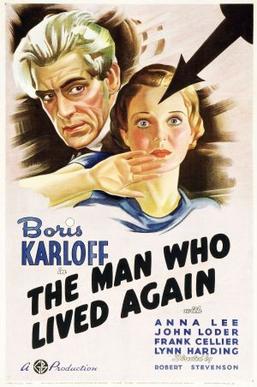
Horror On The Lens: The Man Who Changed His Mind (dir by Robert Stevenson)


In this film from 1936, Anna Lee plays Dr. Clare Wyatt, who leaves behind her reporter boyfriend (John Loder) so that she can accept a job working with the eccentric scientist, Dr. Laurience (Boris Karloff).  Dr. Laurience lives in a spooky mansion with a sarcastic, wheelchair-bound assistant (Donald Calthorp).  It turns out that Dr. Laurience believes that he has discovered how people can switch minds and bodies.  The scientific community ridicules Dr. Laurience but soon, Laurience is putting his theories to the test.  Dr. Laurience finds himself falling in love with Clare but he knows that she’s in love with her suspicious boyfriend.  What if Dr. Laurience changed his mind?

This is an entertaining British production, featuring almost the entire cast playing more than one role as various minds are moved into different bodies.  That said, the film is dominated by the great Boris Karloff, who gives one of his most enjoyable performances as the mad Dr. Laurience.  Though Karloff became a star playing the Monster, he always seemed happier whenever he got to play the mad scientist.

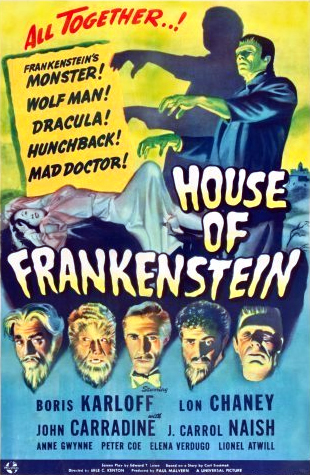
Horror Film Review: House of Frankenstein (dir by Erle C. Kenton)


House of Frankenstein opens in a prison.  Dr. Gustav Neimann (Boris Karloff), the bother of one of Baron Frankenstein’s assistants, has been convicted of robbing graves and attempting to carry on the Baron’s work.  Dr. Neimann’s faithful assistant is the hunchback, Daniel (J. Carroll Naish).  Daniel is loyal to Neimann because Neimann has promised to someday place Daniel’s brain in a stronger body.

When a sudden earthquake allows Neimann and Daniel to escape, they waste no time in getting revenge on Neimann’s enemies.  First, they murder a traveling showman named Prof. Lampini (George Zucco) and steal both his identity and his mobile horror exhibit.  Included in the exhibit is a coffin that Lampini claimed held the skeleton of Dracula.  (There’s even a stake sticking out of the skeleton’s chest.)  When Neimann returns to his original hometown, he removes the stake from the skeleton so that he might use it on the Burgomaster, Hussman (Sig Ruman).  The skeleton transforms into Dracula (John Carradine).  Because he is relieved to have been brought back to life, Dracula does not attack Neimann but instead agrees to help Neimann get revenge on Hussman in return for Neimann looking after his coffin.  Dracula soon learns that he should have thought twice before trusting either Neimann or Daniel.

Neimann moves on, stopping off at Frankenstein’s village and recovering the bodies of both Frankenstein’s Monster (Glenn Strange) and Larry Talbot (Lon Chaney, Jr.) from the frozen chamber in which they were trapped at the end of Frankenstein Meets The Wolf Man.  Revived from suspended animation, Larry immediately starts whining about how much his life sucks.  (I love The Wolf Man but subsequent films turned Larry into the whiniest of the Universal monsters.)  Neimann promises to put Larry’s brain in a new body if he helps to revive the Monster.  Larry agrees.  Meanwhile, Daniel falls in love with a gypsy girl named Ilonka (Elena Verdugo) while Ilonka falls in love with Larry.  Daniel wants Neimann to put his brain in Larry’s body, Larry won’t stop whining about the approaching full moon, and the villagers are getting suspicious!

House of Frankenstein has never been a favorite of critics or horror historians and the film does have its share of flaws.  For instance, though it would have been fun to see Bela Lugosi return to his signature role, John Carradine seems like ideal casting for Dracula.  Unfortunately, Dracula is only in the film for about ten minutes and he comes to an end that really doesn’t feel worthy of a character of his stature.  The film reduces Larry Talbot to just being a dumb lug who won’t stop feeling sorry for himself.  Finally, Glenn Strange has the right physique for the Monster but, much as with John Carradine, he is underused.

That said, I still enjoyed House of Frankenstein.  A lot of that is because of Boris Karloff, who brings a lot of sly humor to his performance as the mad scientist.  (That said, Karloff himself later said that he did the role solely for the money and was bored with the whole thing.)  J. Carroll Naish turns Daniel into a rather sympathetic henchman, one who is so desperate to be “normal” that he’s willfully blinded himself to the fact that Neiman really doesn’t care about anyone other than himself.  (In many ways, he’s the equivalent of the hapless characters that Michael Ripper later played for Hammer Films.)  Finally, Elena Verdugo brings a lot of life to the stock role of the dancing gypsy girl who falls in love with Larry Talbot despite the fact that Larry is kind of a dumb lug.

For a modern viewer, the main appeal of House of Frankenstein is that it is one of the original Universal horror films, even if it came out long after the first Dracula and Frankenstein films.  As such, it has all the things that we associate with and love about those films.  There’s a ruined castle.  There’s angry villagers.  The cast is full of Universal horror mainstays, including Lionel Atwell and Anne Gwynne.  And, yes, the film features a mob descending on the castle with torches.  Flaws and all, House of Frankenstein is an enjoyable time capsule.  It’s a horror film from a far more innocent age and it’s one that remains a fun watch.

Previous Universal Horror Reviews:

  1. Dracula (1931)
  2. Dracula (Spanish Language Version) (1931)
  3. Frankenstein (1931)
  4. Island of Lost Souls (1932)
  5. The Mummy (1932)
  6. The Invisible Man (1933)
  7. The Bride of Frankenstein (1935)
  8. Dracula’s Daughter (1936)
  9. Son of Frankenstein (1939)
  10. The Wolf Man (1941)
  11. Ghost of Frankenstein (1942)
  12. Frankenstein Meets The Wolf Man (1943)
  13. Son of Dracula (1943)
  14. Creature From The Black Lagoon (1954)

10 Oscar Snubs From The 1930s


Ah, the 1930s. America was mired in the Great Depression. FDR was plotting to pack the courts.  The American public, sick of playing by the rules and getting little in return, began to admire gangsters and outlaws.  The horror genre became the new way to vent about societal insecurity. In Europe, leaders were trying to ignore what was happening in Italy, Spain, and Germany. As for the Academy, it was still growing and developing and finding itself. With people flocking to the movies and the promise of an escape from reality, the Academy Awards went from being an afterthought to a major cultural event.

And, of course, the snubs continued.

1930 — 1931: Crime Doesn’t Pay For Little Caesar and The Public Enemy 

When people think about the 1930s, gangsters are probably one of the first things that come to mind.  In the 30s, audiences flocked to movies about tough and streetwise criminals who did what they had to do in order to survive during the Depression.  Unfortunately, the Academy was not always as quick to embrace the gangster genre.  Though The Public Enemy did pick up a nomination for its screenplay, both it and Little Caesar were largely ignored by the Academy.  Not only did the films fail to score nominations for Best Picture but neither James Cagney nor Edward G. Robinson would be nominated for bringing their title characters to life.  It’s a crime, I tells ya.

1930 — 1931: Bela Lugosi Is Not Nominated For Best Actor For Dracula

Admittedly, the 1931 version of Dracula is a bit of a creaky affair, one that feels quite stagey to modern audiences.  But Bela Lugosi’s performance in the title role holds up well, despite the number of times that it has been parodied.  Unfortunately, from the start, the Academy was hesitant about honoring the horror genre.

Frankenstein (1931, dir by James Whale)

1931 — 1932: Boris Karloff Is Not Nominated For Best Actor For Frankenstein

Again, the Academy snubbed an iconic horror star.  Not only was Boris Karloff not nominated for Frankenstein but the film itself was not nominated for Best Picture, despite being infinitely better than at least one of the 8 films that were nominated.  (That film, by the way, was Bad Girl.  When is the last time that anyone watched that one?)  In fairness to the Academy, they did honor one horror film at that year’s awards.  Fredric March won Best Actor for Dr. Jekyll and Mr. Hyde.  Of course, he also tied with Wallace Beery, who was nominated for The Champ.  Obviously, the Academy still had to work out its feelings towards the horror genre, a process that continues to this very day.

1932 — 1933: King Kong Is Not Nominated For Best Picture

Oh, poor King Kong.  Film audiences loved him but the Academy totally ignored both him and his film.  Unfortunately, back in 1933, the Academy had yet to introduce a category for special effects.

1932 — 1933: Duck Soup Is Ignored By The Academy

King Kong was not the only worthy film to be ignored at the 1932-1933 Oscars.  The Marx Brothers’s greatest film also went unnominated.

1934: The Scarlet Empress Is Not Nominated For Best Picture

Josef von Sternberg’s surreal historical epic was totally ignored by the Academy.  Not only did it miss out on being nominated for Best Picture but the sterling work of Marlene Dietrich and Sam Jaffe was ignored as well.  How was the opulent set design ignored?  How did it not even pick up a nomination for costume design?  My guess is that Paramount chose to promote Cleopatra at expense of The Scarlet Empress.  Either the way, the Best Picture Oscar was won by one of my favorite films, It Happened One Night.

1935: Fred Astaire and Ginger Rogers Are Not Nominated For Top Hat

Top Hat scored a best picture nomination but the film’s two stars went unnominated.

1936: My Man Godfrey Is Nominated For Everything But Best Picture

My Man Godfrey, a classic screwball comedy, was nominated for Best Actor, Best Actress, Best Supporting Actor, Best Supporting Actress, Best Director, and Best Screenplay but somehow, it was not nominated for Best Picture.  It’s a shame because My Man Godfrey, along being a very funny movie, is also a film that epitomizes an era.  Certainly, it’s far more entertaining today than the film that won Best Picture that year, The Great Ziegfeld.  (Interestingly enough, William Powell played the title role in both Godfrey and Ziegfeld.)

1937: Humphrey Bogart Is Not Nominated For Best Supporting Actor in Dead End

Dead End featured one of Bogart’s best gangster roles.  As a gangster who returns to his old neighborhood and is rejected by his own mother, Bogart was both menacing and, at times, sympathetic.  Like Cagney and Robinson, Bogart definitely deserved a nomination for his portrayal of what it was like to live a life of crime.  Unfortunately, Bogart was an actor who was taken for granted for much of his career.  It wasn’t until he played Rick Blaine in Casablanca that the Academy would finally nominate him.

The Adventures of Robin Hood (1938, dir by Michael Curtiz)

1938: Errol Flynn Is Not Nominated For Best Actor In The Adventures of Robin Hood

This is truly one of the more shocking snubs in Academy history.  Errol Flynn’s performance as Robin Hood pretty much set the standard for every actor who followed him.  Russell Crowe is undoubtedly a better actor than Flynn was but Crowe’s dour interpretation of Robin could in no way compete with the joie de vivre that Flynn brought to the role.

Agree?  Disagree?  Do you have an Oscar snub that you think is even worse than the 10 listed here?  Let us know in the comments!

Up next: 1940s, in which Hollywood joins the war effort and the snubs continue!

Dead End (1937, dir by William Wyler)

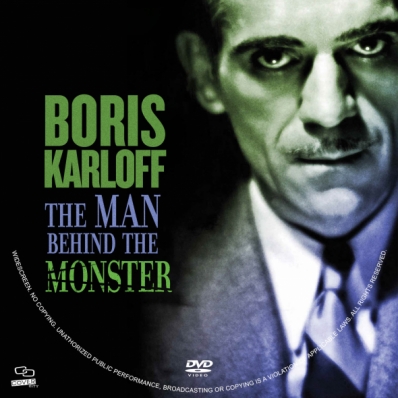
Insomnia File #57: Boris Karloff: The Man Behind The Monster (dir by Thomas Hamilton)


What’s an Insomnia File? You know how some times you just can’t get any sleep and, at about three in the morning, you’ll find yourself watching whatever you can find on cable or Netflix? This feature is all about those insomnia-inspired discoveries!

Ah, the mystery of Boris Karloff.

On screen, Karloff was a horror icon.  He brought Frankenstein’s Monster to life and influenced generations of actors and horror filmmakers.  He was also the Mummy and the first actor to play Sax Rohmer’s international criminal, Fu Manchu and, of course, he won over a whole new generation as narrator of How The Grinch Stole Christmas.  Over the course of his long career, Karloff appeared in movies both good and bad.  He worked for Mario Bava and Roger Corman and James Whale and Peter Bogdanovich.  He was also the host of Thriller, a much-beloved horror anthology series.  At the height of his fame, he was often credited by just his last name.  Everyone knew who Boris Karloff was.

Off screen, Boris Karloff was a quiet and rather dignified gentleman, one who was widely considered to be one of the kindest and most generous men in Hollywood.  Born William Henry Pratt, Karloff’s father was a diplomat and his family assumed that he would follow their career.  Instead, William Henry Pratt immigrated first to Canada and then to California and transformed himself into Boris Karloff.

Boris Karloff: The Man Behind The Monster is a documentary that both explores the mysteries of Karloff’s life and also pays tribute to him as an actor.  It attempts to answer the question of how such a kindly man could also be responsible for some of the greatest moments in horror.  Full of archival footage and interviews with those who worked with Karloff and also those who were influenced by his films (like Guillermo del Toro), the film presents a portrait of a talented actor who was as expressive onscreen as he was somewhat withdrawn in real life.  For Karloff, his roles became a way to escape from the troubles of the real world.  As the film makes clear, Karloff didn’t start his career planning to eventually become a horror actor and, occasionally, he did chafe a bit at being typecast.  However, regardless of what role he was playing, Karloff always gave it his best.  He may have appeared in some bad films but he never gave a bad performance.  The film not only includes clips from his films but also an examination of what made his performances so special.  The analysis of Frankenstein, The Mummy, The Terror, and Targets is especially interesting.

If you’re a fan of horror, this documentary is for you.  It’s currently available on Shudder.

Previous Insomnia Files:

  1. Story of Mankind
  2. Stag
  3. Love Is A Gun
  4. Nina Takes A Lover
  5. Black Ice
  6. Frogs For Snakes
  7. Fair Game
  8. From The Hip
  9. Born Killers
  10. Eye For An Eye
  11. Summer Catch
  12. Beyond the Law
  13. Spring Broke
  14. Promise
  15. George Wallace
  16. Kill The Messenger
  17. The Suburbans
  18. Only The Strong
  19. Great Expectations
  20. Casual Sex?
  21. Truth
  22. Insomina
  23. Death Do Us Part
  24. A Star is Born
  25. The Winning Season
  26. Rabbit Run
  27. Remember My Name
  28. The Arrangement
  29. Day of the Animals
  30. Still of The Night
  31. Arsenal
  32. Smooth Talk
  33. The Comedian
  34. The Minus Man
  35. Donnie Brasco
  36. Punchline
  37. Evita
  38. Six: The Mark Unleashed
  39. Disclosure
  40. The Spanish Prisoner
  41. Elektra
  42. Revenge
  43. Legend
  44. Cat Run
  45. The Pyramid
  46. Enter the Ninja
  47. Downhill
  48. Malice
  49. Mystery Date
  50. Zola
  51. Ira & Abby
  52. The Next Karate Kid
  53. A Nightmare on Drug Street
  54. Jud
  55. FTA
  56. Exterminators of the Year 3000

Horror on the Lens: The Terror (dir by Roger Corman, Francis Ford Coppola, Jack Hill, Monte Hellman, Dennis Jakob, and Jack Nicholson)


Have you ever woken up and thought to yourself, “I’d love to see a movie where a youngish Jack Nicholson played a French soldier who, while searching for a mysterious woman, comes across a castle that’s inhabited by both Dick Miller and Boris Karloff?”

Of course you have!  Who hasn’t?

Well, fortunately, it’s YouTube to the rescue.  In Roger Corman’s 1963 film The Terror, Jack Nicholson is the least believable 19th century French soldier ever.  However, it’s still interesting to watch him before he became a cinematic icon.  (Judging from his performance here and in Cry Baby Killer, Jack was not a natural-born actor.)  Boris Karloff is, as usual, great and familiar Corman actor Dick Miller gets a much larger role than usual.  Pay attention to the actress playing the mysterious woman.  That’s Sandra Knight who, at the time of filming, was married to Jack Nicholson.

Reportedly, The Terror was one of those films that Corman made because he still had the sets from his much more acclaimed film version of The Raven.  The script was never finished, the story was made up as filming moved alone, and no less than five directors shot different parts of this 81 minute movie.  Among the directors: Roger Corman, Jack Hill, Monte Hellman, Francis Ford Coppola, and even Jack Nicholson himself!  Perhaps not surprisingly, the final film is a total mess but it does have some historical value.

(In typical Corman fashion, scenes from The Terror were later used in the 1968 film, Targets.)

Check out The Terror below!