Film Review: The Mean Season (dir by Phillip Borsos)


From the very first few scenes of the 1985 film, The Mean Season, one thing is abundantly clear.  People are dying in Florida.

In itself, that’s probably not a shock.  Death is a part of life, after all.  Add to that, the majority of The Mean Season takes place in Miami, the seventh most populous area of the United States.  It makes sense that the more people you have living in one area, the more people are also going to end up dead.  That’s just the way things work.

Still, Malcolm Anderson is getting tired of all the death.  Played by a youngish and sexy Kurt Russell, Malcolm’s a journalist.  He covers the crime beat for the Miami Herald.  He spends all day reporting on death and violence and he’s finally reached the point where he’s burned out.  He and his girlfriend, a teacher named Christine (Mariel Hemingway), are even planning on moving to Colorado.  Malcolm says that he could be very happy working at a small town newspaper.  His editor (Richard Masur) doesn’t believe him and, quite frankly, neither do we.  Malcolm may say that he wants peace and quiet but it’s hard not to feel as if he’s fooling himself.

One day, Malcolm gets a phone call.  The voice on the other line (which belongs to character actor Richard Jordan) is deceptively calm.  The caller explains that he’s a fan of Malcolm’s work.  The caller also claims to be responsible for a series of murders that have recently taken place.  At first, Malcolm is skeptical.  After all, he gets calls from crazy people all the time.  That’s one reason why he wants to leave Miami, after all.  But then the caller starts to give Malcolm details about the crimes, details that haven’t been released to general public…

The killings continue and, after every murder, the caller contacts Malcolm.  Soon, Malcolm is appearing on the national news, giving carefully calculated interviews about what it’s like to be a celebrity.  Malcolm is soon on the front page of all the papers.  Malcolm’s happy.  His editor is happy.  But you know who isn’t happy?  The killer.  He didn’t go to all the trouble to kill those people just so Malcolm could get famous off of his hard work!  Soon, the killer is no longer content to just call Malcolm.  Now, he wants to meet face-to-face and maybe even get to know Christine as well…

The Mean Season is one of those movies that starts out well but then falls apart towards the end.  It’s not a spoiler to tell you that the killer eventually ends up kidnapping Christine.  You probably figured out that was going to happen as soon as I told you that Malcolm had a girlfriend.  (It doesn’t help that Christine is such an underwritten character that it feels like the only reason she was put in the film was so she could be used for one gratuitous nude scene and then get kidnapped.)   Once the killer kidnaps her, he goes from being a genuinely intriguing menace to just being a typical and overly verbose movie psycho.

That’s a shame because the first half of The Mean Season is really quite good.  The film makes excellent use of its locations, capturing the humid atmosphere of Florida in the summer.  As the killer, Richard Jordan alternates between being coldly calculating and surprisingly vulnerable without missing a beat.  (Interestingly, he appears to be personally hurt when he realizes that Malcolm doesn’t consider him to be a friend.)  Not surprisingly, Kurt Russell is likable as the conflicted Malcolm but his best moments are the ones where he suggests that Malcolm has become so addicted to fame that he’s almost hoping that the killer strikes again.  As the two homicide detectives who are assigned to keep an eye on Malcolm, both Richard Bradford and Andy Garcia are perfectly cast.  A scene where Bradford tries to comfort a child who accidentally gets in the middle of the search for the killer is the best in the film.  “We’re just looking for the bad guys,” he tell the traumatized child.  It’s small moments like this that elevates The Mean Season above the typical mid-80s serial killer film.

Seen today, The Mean Season — with its emphasis on newspapers — feels like a historical artifact.  If the film were made today, Russell would definitely work for either a 24-hour cable news channel or an online news site.  It actually would be interesting to see this story updated and retold for the age of clickbait.  Somebody needs to get on that and, while they’re at it, come up with the type of ending that an otherwise intriguing story like this deserves.

Cleaning Out The DVR: Just The Ticket (dir by Richard Wenk)


(Hi there!  So, as you may know because I’ve been talking about it on this site all year, I have got way too much stuff on my DVR.  Seriously, I currently have 193 things recorded!  I’ve decided that, on January 15th, I am going to erase everything on the DVR, regardless of whether I’ve watched it or not.  So, that means that I’ve now have only have a month to clean out the DVR!  Will I make it?  Keep checking this site to find out!  I recorded the 1999 romantic comedy Just The Ticket off of Epix on October 13th!)

Just The Ticket tells the story of Gary Starke (Andy Garcia).

Gary lives in New York City.  He is a tough, streetwise character, loyal to his friends and quick to anger if he feels that anyone is trying to take advantage of him.  He has no time for pretentious posturing or snobbish social gatherings.  Gary’s a man of the people.  He works with and takes care of an aging former boxer named Benny (Richard Bradford).  He looks after a pregnant, former drug addict named Alice (Laura Harris).  When the slick and dangerous Casino (Andre B. Blake) starts to do business in Gary’s territory, Gary is the only person with the guts to stand up to him.  Having never had a family (he’s never even seen his birth certificate and has no idea who his parents were), Gary has adopted the street people as his surrogate family.

That’s not all.  Gary is also a lapsed Catholic who, when he goes to confession, opens by saying that it’s been 25 years since his last confession and that he’s taken the Lord’s name in vain 20 to 30 times that morning.  Gary needs some help because his girlfriend, an aspiring chef named Linda (Andie McDowell), has left him and Gary wants to win her back.  The priest asks Gary if he can get him tickets to see the Knicks…

Why does he ask that?

You see, Gary is a legendary ticket scalper and…

Okay, I probably just lost you when I used the terms “legendary” and “ticket scalper” in the same sentence.  And I’ll admit that, when I discovered this movie was about ticket scalpers, it nearly lost me as well.  Just The Ticket treats ticket scalping with a dignity and reverence that I’m not quite sure it deserves.  I wasn’t surprised to discover that director/writer Richard Wenk apparently based the character of Gary on an actual ticket scalper that he knew.  A lot of bad movies have been made as the result of a director, writer, or producer coming across some mundane activity and thinking, “Wow, this would make a great movie!”

(That’s one reason why, every few years, we suddenly get a dozen movies about race car drivers.)

However, I was pleasantly surprised to discover that Just The Ticket is not a terrible movie.  Admittedly, it’s totally predictable and there are a lot of scenes that don’t work.  For instance, there’s a lengthy scene where Gary and Linda destroy a snobbish food critic’s kitchen.  I could imagine Gary doing that because he has nothing to lose.  But Linda is actually hoping to become a chef in New York City.  Would she really run the risk of making a permanent enemy at the New York Times?  There’s nothing about Andie McDowell’s performance that suggests she would.  The scenes between Gary and his aging partner also tend to overplay their hand.  Richard Bradford gives a good performance as Benny but we all know what’s going to end up happening to him as soon as he starts crying after Gary insults him.

With all that in mind, Just The Ticket still has an undeniable charm.  Some of it is due to Andy Garcia’s dedicated performance.  He is frequently better than the material and he and Andie McDowell have enough chemistry that you do want to see Linda and Gary get back together.  Some of it is because Just The Ticket is not afraid to shy away from being sentimental.  It’s hard to think of any other romantic comedy in which the Pope plays such an important supporting role.  It’s a sweet movie.  It has a good heart.

There’s something to be said for that.

A Movie A Day #265: Hoodlum (1997, directed by Bill Duke)


1930s.  New York City.  For years, Stephanie St. Clair (Cicely Tyson) has been the benevolent queen of the Harlem underworld, running a successful numbers game and protecting her community from outsiders.  However, psychotic crime boss Dutch Schultz (Tim Roth) is determined to move into Harlem and take over the rackets for himself.  With the weary support of Lucky Luciano (Andy Garcia), Schultz thinks that he is unstoppable but he did not count on the intervention of Bumpy Johnson (Laurence Fishburne).  Just paroled from Sing Sing, Bumpy is determined to do whatever has to be done to keep Schultz out of Harlem.
When I reviewed The Cotton Club yesterday, I knew that I would have to do Hoodlum today.  Hoodlum and The Cotton Club are based on the same historic events and both of them feature Laurence Fishburne in the role of Bumpy Johnson.  Of the two, Hoodlum is the more straightforward film, without any of the operatic flourishes that Coppola brought to The Cotton Club.  Fisburne is surprisingly dull as Bumpy Johnson but Tim Roth goes all in as Dutch Schultz and Andy Garcia is memorably oily as the Machiavellian Luciano.  Hoodlum is about forty minutes too long but the gangster action scenes are staged well.  Bumpy Johnson lived a fascinating life and it is unfortunate that no film has yet to really do him justice, though Clarence Williams III came close with his brief cameo in American Gangster.  (Interestingly enough, Williams is also in Hoodlum, playing one of Shultz’s lieutenants.)

One final note: Hoodlum features William Atherton in the role of District Attorney Thomas E. Dewey.  Atherton plays Dewey as being a corrupt and sleazy politician on Luciano’s payroll.  In real life, Dewey was known for being so honest that Dutch Schultz actually put a contract out on his life after he discovered that Dewey could not be bribed.  I am not sure why Hoodlum decided to slander the subject of one of America’s most famous headlines but it seems unnecessary.

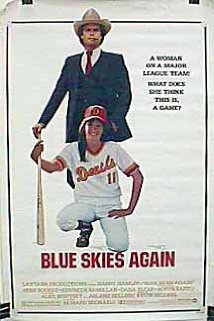
A Movie A Day #85: Blue Skies Again (1983, directed by Richard Michaels)


As Lisa said in her review of Night Game, Erin asked for baseball reviews today and there is no way you can turn down Erin.  So, I watched Blue Skies Again on YouTube.
The Denver Devils is a minor league baseball team that is coming off of its worst season ever.  The new owner (Harry Hamlin) is only concerned with making money and does not know anything about baseball.  The veteran coach (Kenneth McMillan) does not have the respect of his players.  Teammates like Ken (Andy Garcia), Calvin (Joseph Gian), and Wall Street (Cylk Cozart) are worried that they could lose their place on the team at any moment.  The only good news is that two sports agents (Mimi Rogers and Dana Elcar) have found the perfect prospect for the Devils.  This player can play second base.  This player can catch a grounder and turn it into a double play.  This player can hit the ball out of the park.  The only problem?  The player’s name is Paula (Robyn Barto) and she’s a girl!

Robyn Barto was asked to audition after a casting director saw her playing softball for her community college.  Blue Skies Again was her first film role.  In the role of a professional baseball player, Barto was a very convincing softball player.  But Barto was likable and had an engaging screen presence so it’s too bad that this movie was not only her first but also her last.  In the publicity leading up to the release of Blue Skies Again, Barto got to throw out the opening pitch at a Dodger game but that was it for her time in the spotlight.  According to one article that I found that was written ten years after the release of Blue Skies Again, Barto never regretted not having a film career and ended up coaching the softball team at her old high school.

Blue Skies Again was not only the debut of Robyn Barto but also the first feature film for both Mimi Rogers and Andy Garcia.  Garcia does not get to do much but Mimi Rogers shows off the sexy and fun screen presence that always makes me wonder why she never really became a big star.

Blue Skies Again is an okay movie but it does not add up to much.  No one wants to play with a girl but then she gets a hit so everyone changes their mind.  It’s the type of movie that, today, would be made for Hallmark or the Family Channel.  It’s a nice baseball movie but it can’t compare to the real thing.


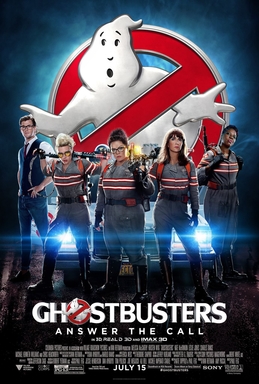
Film Review: Ghostbusters (dir by Paul Feig)


Ghostbusters

If you need any further proof that 2016 is a screwed-up year, just consider the fact that Ghostbusters, an entertaining but ultimately rather mild-mannered and innocuous summer action/comedy, has become the center of one of the biggest controversies of the year.

It all started, of course, when the reboot was first announced.  Fanboys reacted with outrage, offended that Hollywood would even consider remaking a film that was apparently one of the defining moments of their childhood.  Then, it was announced that Ghostbusters would feature an all-female cast and it would be directed by Paul Feig, the director of Bridesmaids.  The howls of outrage grew even louder.  Then that infamous trailer was released and even I felt that trailer sucked.  I wasn not alone because the trailer quickly became one of the most disliked videos in the history of YouTube.  Reading the comments underneath that trailer was literally like finding yourself trapped in a production of Marat/Sade.

Suddenly, in the eyes of very vocal group of internet trolls, the reboot of Ghostbusters went from being simply another dubious idea to being a crime against humanity.  And the trolls were so obnoxious that they managed to turn this big-budget, studio-backed production into an underdog.  Here was a movie directed by one of Hollywood’s biggest directors and starring some of Hollywood’s hottest stars and suddenly, it had become David in a biblical showdown with the Goliaths of internet.

ghostbusters1-800x430

And then it happened.  Earlier last week, Ghostbusters was finally screened for critics.  The first reviews started to come in and they were surprisingly positive.  In fact, they were so positive that I found myself distrusting them.  I found myself wondering if critics were reacting to the film or if they were simply trying to prove that they were better than the trolls who leave obscene comments on YouTube.

Which was true, I wondered.  Was Ghostbusters the worst film ever made or was it the greatest?  Or was it perhaps just possible that Ghostbusters would turn out to be a typical summer film?

With all the controversy, it’s tempting to overpraise a film like Ghostbusters.  Battle lines have been drawn and sometimes, I feel as if I’m being told that failing to declare Ghostbusters to be the greatest and most important comedy of all time is the equivalent of letting the trolls win.

Well, that’s not true.  Ghostbusters is not the greatest or the most important comedy of all time but you know what?  Ghostbusters is good.  Ghostbusters is entertaining.  Especially during the first half, it’s full of laugh out loud moments.  At times, Ghostbusters is everything that you could hope for.

No, it’s not a perfect film.  Paul Feig is a great comedy director but, in this film at least, his direction of the big action sequences often feels uninspired (especially when compared to his previous work on Spy).  The final fourth of the film gets bogged down in CGI and the film goes from being a clever comedy to being just another summer spectacle.  Even the one-liners, which flowed so naturally at the start of the film, feel forced during the final half of the film.  Ghostbusters is good but it never quite becomes great.

ghostbusters-2016-cast-proton-packs-images

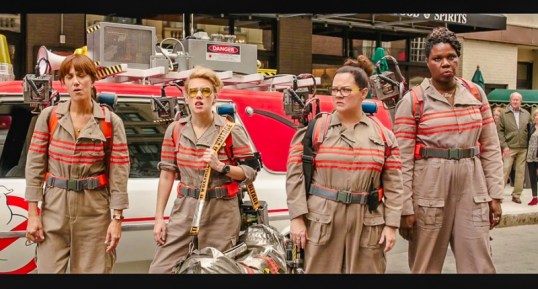
Here’s what did work: the cast.  As he previously proved with Bridesmaids, Paul Feig is a director who is uniquely skilled at creating and showcasing a strong comedic ensemble.  Kristen Wiig plays Erin Gilbert, who is denied tenure at Columbia when it is discovered that a book she wrote on the paranormal has been republished and is being sold, on Amazon, by her former best friend, Dr. Abby Yates (Melissa McCarthy).  When Erin goes to confront Abby, she not only meets Abby’s newest colleague, Dr. Jillian Holtzmann (Kate McKinnon) but she also gets dragged into investigating an actual case of paranormal activity..  Soon, Erin, Abby, and Holtzmann are investigating hauntings and capturing ghosts, all with the secret approval of the Mayor of New York (Andy Garcia).  Of course, for PR reasons, the mayor’s office has to continually disavow the Ghostbusters and occasionally have them arrested.  Working alongside the three scientists are Patty (Leslie Jones), who apparently knows the history of every building in New York, and Kevin (Chris Hemsworth), their adorably stupid receptionist.

As written, both Patty and Kevin are fairly thin characters.  Kevin’s the handsome dumb guy.  Patty is streetwise and sassy.  But both Hemsworth and Jones give such enthusiastic and sincere performances that they transcend the stereotypical nature of their roles.  At times, Kevin runs the risk of becoming too cartoonish for even a Ghostbusters film.  But if you can’t laugh at Chris Hemsworth explaining that he took the lenses out of his glasses because they were always getting dirty, what can you laugh at?

Erin is an interesting character and Kristen Wiig deserves a lot of credit for her performance.  Erin is actually given a fairly affecting backstory, centering around how she was haunted by the ghost of the old woman who used to live next door to her.  Erin is a former believer, someone who, in order to succeed in the “real” world, gave up her beliefs and conformed to the expectations of society.  When she actually meets a ghost, it’s more than just a confirmation of the supernatural.  It’s a chance for Erin to finally embrace who she truly is and what she truly cares about.  When she and the other ghostbusters chase after evil spirits, Erin is not just doing a job.  Instead, she’s finally found somewhere where she belongs.  She no longer has to pretend to be someone that she isn’t.  Wiig plays the role with just the right touch of neurotic wonder.  She grounds the entire film.

Wiig McKinnon

But the true star of the film is Kate McKinnon.  Whether she’s cheerfully smiling as a ghost vomits all over her colleagues or cheerfully explaining how easily their equipment could kill them all, Holtzmann is the greatest character in the film and McKinnon gives the best performance.  If Wiig grounds the film, McKinnon provides it with a truly demented soul.

The first half of the movie, which focuses on the relationships between the characters and features snappy and endlessly quotable dialogue, is wonderful and I was thrilled while watching it, convinced that the entire movie would be as good as the first hour.  However, the second half of the film gets bogged down in a rather predictable plot and the final action sequences could have just as easily been lifted from Pixels or one of The Avengers movies.  The surviving cast of the original Ghostbusters all show up in cameos that are, at best, inoffensive and, at worst, groan-worthy.  The end result is rather uneven.  If the film had maintained the momentum of that first hour, it would be a classic.  But that second half transforms it into just another entertaining but not quite memorable summer action film.

That said, Paul Feig is an excellent comedy director and let’s hope that he never gets so self-important that he ends up turning into Jay Roach.  Hopefully, if there is a sequel, Feig will return to direct it and Kate McKinnon will have an even bigger role.

tumblr_o3h37546Pl1v6mqeeo2_540


Insomina File No. 16: Kill The Messenger (dir by Michael Cuesta)


What’s an Insomnia File? You know how some times you just can’t get any sleep and, at about three in the morning, you’ll find yourself watching whatever you can find on cable? This feature is all about those insomnia-inspired discoveries!

Kill_the_Messenger_poster

Last night, if you were awake and unable to get any sleep at 1:45 in the morning, you could have turned over to Cinemax and watched the 2014 conspiracy thriller, Kill The Messenger.

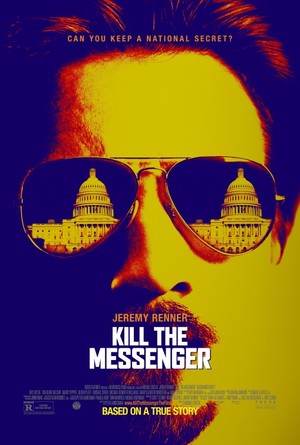
Kill The Messenger opens with one of those title cards that assures us that the movie we’re about to see is based on a true story.  We are then introduced to Gary Webb (Jeremy Renner), a California-based reporter who we know is a rebel because he has a precisely trimmed goatee.  Gary is interviewing a suspected drug smuggler (Robert Patrick) at the smuggler’s luxurious mansion.  Suddenly, the DEA storms the house, shouting insults and roughly throwing everyone to the ground, including Gary.  It’s actually exciting and promising opening, one that perfectly establishes both Gary as a truth seeker and the U.S. government as an invading army that’s fighting a war that’s full of collateral damage.

Gary, of course, has nothing to do with smuggling drugs.  He was just in the wrong place at the wrong time.  If he was treated unfairly by the DEA, it’s just because the government is serious about winning the war on drugs!

Or is it?

Following up on a tip, Gary comes across evidence that, in order to raise money for pro-Amercian rebels in Central America, the CIA not only helped to smuggle drugs into the U.S. but also arranged for the drugs to largely be sold in poor, minority neighbors where, in theory, no one would notice or care.

When the story is finally published, Gary is briefly a celebrity.  Not surprisingly, the government denies his accusations and start tying to discredit him.  However, Gary also finds himself being targeted by his fellow journalists.  Angry over being outscooped by a relatively unknown reporter, The Los Angeles Times and The Washington Post both launch their own investigations.  Instead of investigating Gary’s allegations, they jealously and viciously investigate Gary himself.

Soon, both Gary’s career and his family are falling apart and Gary finds himself growing more and more paranoid…

Remember when everyone was expecting Kill The Messenger to be a really big deal?  It was due to come out towards the end of 2014, right in the middle of Oscar season.  Jeremy Renner was being talked up as a contender for best actor.  Then the film came out, it played in a handful of theaters for a week or two, and then it sunk into obscurity.  Some commentators even complained that Focus Features buried the release of Kill The Messenger and that the film was ignored because of its leftist politics…

Of course, it’s just as probable that Focus Features realized that The Theory of Everything was more likely to charm audiences than a movie that suggested the U.S. government was behind the drug epidemic.

Or it could have just been that, despite telling a potentially intriguing story, Kill The Messenger was an oddly bland film.  Other than one scene in which he admits to cheating on his wife, Gary Webb is portrayed as being such a saint that it actually causes the film to lose credibility.  (Don’t get me wrong.  For all I know, he was a saint.  But, from a cinematic point of view, sainthood is never compelling.)  This is one of those earnest films that gets so heavy-handed that, even if you agree with what the movie is saying, you still resent being manipulated.  (Of course, some of us have grown so cynical about the media that we automatically doubt the veracity any movie that opens with those dreaded words: “Based on a true story.”)  Watching Kill The Messenger, one gets the feeling that a documentary about Gary Webb would probably be more compelling (and convincing) than a fictionalized dramatization.

(Unfortunately, if you think it’s difficult to get an audience to watch a movie that suggested the U.S. government was behind the drug epidemic, just try to get them to watch a documentary about … well, anything.  I know most of our readers would probably happily watch a documentary but that’s because y’all are the best and a thousand times better than the average person.  Love you!)

Here’s what did work about Kill The Messenger: the performances.  Jeremy Renner, who also produced this film, gives an excellent performance as Gary, especially in the scenes where he realizes that both the government and the press are now conspiring about him.  Rosemarie DeWitt has the traditionally thankless role of being the supportive wife but she still does a good job.  And finally, Ray Liotta shows up for one scene and is absolutely chilling in that way that only Ray Liotta can be.

Kill The Messenger doesn’t quite work but, thanks to the cast, it is, at the very least, a watchable misfire.

Previous Insomnia Files:

  1. Story of Mankind
  2. Stag
  3. Love Is A Gun
  4. Nina Takes A Lover
  5. Black Ice
  6. Frogs For Snakes
  7. Fair Game
  8. From The Hip
  9. Born Killers
  10. Eye For An Eye
  11. Summer Catch
  12. Beyond the Law
  13. Spring Broke
  14. Promise
  15. George Wallace

Shattered Politics #59: Night Falls on Manhattan (dir by Sidney Lumet)


Night_falls_on_manhattan_poster

Oddly enough, right after I watched City Hall, I watched yet another 1997 film about politics and police corruption in New York.  And while Night Falls on Manhattan is definitely not one of Sidney Lumet’s best films, it’s still definitely an improvement on City Hall.

Night Falls on Manhattan tells the story of what happens when two veteran detectives — Liam Casey (Ian Holm) and Joey Allegreto (James Gandolfini) — attempt to arrest drug dealer Jordan Washington (Shiek Mahmud-Bey).  Liam ends up getting shot multiple times before Jordan, disguised as a police officer, flees the scene.  As the cops search for Jordan, they accidentally shoot and kill one of their own.

In short, Manhattan has gone crazy and only the prompt capture and conviction of Jordan Washington will set things right.

However, the police don’t have to spend too much time searching for Jordan because, the very next day, he turns himself in.  He’s accompanied by a veteran radical lawyer named Sam Vigoda (Richard Dreyfuss).  Vigoda announces that yes, Jordan is a drug dealer and yes, he did shoot Liam Casey.  However, Vigoda claims that Jordan has been paying off the cops and that Liam and Joey weren’t actually trying to arrest him.  Instead, they were specifically looking for an excuse to execute him.

Flamboyant District Attorney Morganstern (Ron Leibman) know that his office has to convict Jordan.  And luckily, he has a secret weapon.  Liam’s son, Sean (Andy Garcia), just happens to be a former cop and an assistant district attorney.  He assigns Sean to handle Jordan’s prosecution.

Sean, it turns out, has political ambitions of his own and, by prosecuting Jordan, he not only gets revenge for the shooting of his father but he also furthers his own career.  (He also gets a girlfriend, in this case an associate of Vigoda’s who is played by Lena Olin.)  When Morganstern has a heart attack, Sean suddenly finds himself being mentioned as a candidate to replace him in the upcoming election.

However, even as Sean appears to be shoo-in to be the next district attorney, he also discovers that neither Liam nor Joey were as innocent as he originally assumed..

Night Falls In Manhattan is an occasionally diverting legal and political thriller.  As a director, Sidney Lumet had an obvious feel for New York culture and, as a result, the film feels authentic even when the plot occasionally veers into melodrama.  As opposed to City Hall, you never doubt the plausibility of Night Falls On Manhattan.  Though Andy Garcia is a bit an odd choice to play an Irish-American (and it’s particularly difficult to imagine him being, in any way, related to Ian Holm), the rest of the film is well-cast.  Fans of The Sopranos will enjoy a chance to see James Gandolfini playing someone who, because he’s on the “right” side o the law, is actually more dangerous than Tony Soprano and Rob Leibman is thoroughly believable as a bullying crusader against crime.

After I watched Night Falls on Manhattan, I did some checking online and I was surprised to discover that the film is apparently not better known than it is.  While it definitely uneven, Night Falls On Manhattan is an interesting look at crime, ethics, and urban politics.

6 More Film Reviews From 2014: At Middleton, Barefoot, Divergent, Gimme Shelter, The Other Woman, and more!


Let’s continue to get caught up with 6 more reviews of 6 more films that I saw in 2014!

At Middleton (dir by Adam Rodgers)

“Charming, but slight.”  I’ve always liked that term and I think it’s the perfect description for At Middleton, a dramedy that came out in January and did not really get that much attention.  Vera Farmiga is a businesswoman who is touring colleges with her daughter (Taissa Farmiga, who is actually Vera’s younger sister).  Andy Garcia is a surgeon who is doing the same thing with his son.  All four of them end up touring Middleton College at the same time.  While their respective children tour the school, Vera and Andy end up walking around the campus and talking.  And that’s pretty much the entire film!

But you know what?  Vera Farmiga and Andy Garcia are both such good performers and have such a strong chemistry that it doesn’t matter that not much happens.  Or, at the very least, it doesn’t matter was much as you might think it would.

Hence, charming but slight.

Barefoot (dir by Andrew Fleming)

Well, fuck it.

Sorry, I know that’s not the best way to start a review but Barefoot really bothered me.  In Barefoot, Scott Speedman plays a guy who invites Evan Rachel Wood to his brother’s wedding.  The twist is that Wood has spent most of her life in a mental institution.  Originally, Speedman only invites her so that he can trick his father (Treat Williams) into believing that Speedman has finally become a responsible adult.  But, of course, he ends up falling in love with her and Wood’s simple, mentally unbalanced charm brings delight to everyone who meets her.  I wanted to like this film because I love both Scott Speedman and Evan Rachel Wood but, ultimately, it’s all rather condescending and insulting.  Yes, the film may be saying, mental illness is difficult but at least it helped Scott Speedman find love…

On the plus side, the always great J.K. Simmons shows up, playing a psychiatrist.  At no point does he say, “Not my tempo” but he was probably thinking it.

Divergent (dir by Neil Burger)

There’s a lot of good things that can be said about Divergent.  Shailene Woodley is a likable heroine.  The film’s depiction of a dystopian future is well-done. Kate Winslet has fun playing a villain.  Miles Teller and Ansel Elgort are well-cast.  But, ultimately, Divergent suffers from the same problem as The Maze Runner and countless other YA adaptations.  The film never escapes from the shadow of the far superior Hunger Games franchise.  Perhaps, if Divergent had been released first, we’d be referring to the Hunger Games as being a Divergent rip-off.

However, I kind of doubt it.  The Hunger Games works on so many levels.  Divergent is an entertaining adventure film that features a good performance from Shailene Woodley but it’s never anything more than that.  Considering that director Neil Burger previously gave us Interview with the Assassin and Limitless, it’s hard not to be disappointed that there’s not more to Divergent.

Gimme Shelter (dir by Ron Krauss)

Gimme Shelter, which is apparently based on a true story, is about a teenage girl named Apple (Vanessa Hudgens) who flees her abusive, drug addicted mother (Rosario Dawson).  She eventually tracks down her wealthy father (Brendan Fraser), who at first takes Apple in.  However, when he discovers that she’s pregnant, he demands that she get an abortion.  When Apple refuses, he kicks her out of the house.  Apple eventually meets a kindly priest (James Earl Jones) and moves into a shelter that’s run by the tough Kathy (Ann Dowd).

Gimme Shelter came out in January and it was briefly controversial because a lot of critics felt that, by celebrating Apple’s decision not to abort her baby, the movie was pushing an overly pro-life message.  Interestingly enough, a lot of those outraged critics were men and, as I read their angry reviews, it was hard not to feel that they were more concerned with showing off their political bona fides than with reviewing the actual film.  Yes, the film does celebrate Apple’s decision to keep her baby but the film also emphasizes that it was Apple’s decision to make, just as surely as it would have been her decision to make if she had chosen to have an abortion.

To be honest, the worst thing about Gimme Shelter is that it doesn’t take advantage of the fact that it shares its name with a great song by the Rolling Stones.  Otherwise, it’s a well-done (if rather uneven) look at life on the margins.  Yes, the script and the direction are heavy-handed but the film is redeemed by a strong performance from Vanessa Hudgens, who deserves to be known for more than just being “that girl from High School Musical.”

Heaven is For Real (dir by Randall Wallace)

You can tell that Heaven is For Real is supposed to be based on a true story by the fact that the main character is named Todd Burpo.  Todd Burpo is one of those names that’s just so ripe for ridicule that you know he has to be a real person.

Anyway, Heaven Is For Real is based on a book of the same name.  Todd Burpo (Greg Kinnear) is the pastor of a small church in Nebraska.  After Todd’s son, Colton, has a near death experience, he claims to have visited Heaven where he not only met a sister who died before he was born but also had a conversation with Jesus.  As Colton’s story starts to get national attention, Todd struggles to determine whether Colton actually went to Heaven or if he was just having a hallucination.

You can probably guess which side the movie comes down on.

Usually, as a self-described heathen, I watch about zero faith-based movies a year.  For some reason, I ended up watching three over the course of 2014: Left Behind, Rumors of War, and this one.  Heaven is For Real is not as preachy (or terrible) as Left Behind but it’s also not as much fun as Rumors of War.  (Rumors of War, after all, featured Eric Roberts.)  Instead, Heaven Is For Real is probably as close to mainstream as a faith-based movie can get.  I doubt that the film changed anyone’s opinion regarding whether or not heaven is for real but it’s still well-done in a made-for-TV sort of way.

The Other Woman (dir by Nick Cassavetes)

According to my BFF Evelyn, we really liked The Other Woman when we saw it earlier this year.  And, despite how bored I was with the film when I recently tired to rewatch it, we probably did enjoy it that first time.  It’s a girlfriend film, the type of movie that’s enjoyable as long as you’re seeing it for the first time and you’re seeing it with your best girlfriends.  It’s a lot of fun the first time you see it but since the entire film is on the surface, there’s nothing left to discover on repeat viewings.  Instead, you just find yourself very aware of the fact that the film often substitutes easy shock for genuine comedy. (To be honest, I think that — even with the recent missteps of Labor Day and Men, Women, and Children — Jason Reitman could have done wonders with this material.  Nick Cassavetes however…)   Leslie Mann gives a good performance and the scenes where she bonds with Cameron Diaz are a lot of fun but otherwise, it’s the type of film that you enjoy when you see it and then you forget about it.

44 Days of Paranoia #35: A Dark Truth (dir by Damian Lee)


For the latest entry in the 44 Days of Paranoia, we take a look at one of the more obscure films of 2013.  A Dark Truth was briefly released last January and it didn’t get much attention.  Having recently watched the film, I can understand why.

A Dark Truth (subtle name, no?) opens with a lengthy and disturbing scene of men, women, and children being chased through the jungle by machine gun-wielding soldiers.  As we eventually learn, the people fleeing are the citizens of a village in Ecuador and the soldiers are there on a mission to kill every single one of them.  It’s such a disturbing and well-shot sequence that I watched it with a sinking feeling because I knew that there was no way the rest of the film would be able to live up to it.

And it turns out I was right.  Director Damian Lee seemed to realize this as well because he revisits the footage every time his film starts to drag.  Unfortunately, the more we see these violent images, the less powerful they become.  By the end of the film, that whole opening sequence has lost whatever power it had simply because we’ve seen it one too many times.

It turns out that the soldiers were working for a — wait for it! — Big Evil Corporation.  It seems that this Canadian water purification company accidentally poisoned the village’s water and this led to several villagers getting sick.  An executive, who is so villainous that he’s played by Kim Coates, ordered that all the villagers be executed.  Among the few that escaped was a veteran political activist (Forest Whitaker) and his wife (Eva Longoria).

Meanwhile, in Canada, corporate executive Deborah Kara Unger finds out what the company did in Ecuador.  Wracked with guilt, she hires former CIA Agent-turned-talk radio host Andy Garcia to go down to Ecuador and rescue Whitaker.

A Dark Truth, which obviously aspires to be something more than just a conventional action thriller, is a film that starts with an exciting bang but then ends with a whimper that, even if you have managed to stay awake while watching it, you’ll barely hear.  This is one of the slowest films ever made (it certainly feels longer than 105 minutes) and the excessively stylized direction can’t make up for the fact that the film’s plot and dialogue are both painfully predictable.  About the only thing that The Dark Truth has going for it is that, while Longoria is painfully miscast, the film does feature good performances from Garcia, Whitaker, and Coates.  Best of all is Kevin Durand, who plays a hired assassin here.  Durand doesn’t get to say much  but he’s such an intimidating physical presence that he doesn’t need to say much.

Seriously, somebody needs to give Kevin Durand his own action franchise.

Other Entries In The 44 Days of Paranoia 

  1. Clonus
  2. Executive Action
  3. Winter Kills
  4. Interview With The Assassin
  5. The Trial of Lee Harvey Oswald
  6. JFK
  7. Beyond The Doors
  8. Three Days of the Condor
  9. They Saved Hitler’s Brain
  10. The Intruder
  11. Police, Adjective
  12. Burn After Reading
  13. Quiz Show
  14. Flying Blind
  15. God Told Me To
  16. Wag the Dog
  17. Cheaters
  18. Scream and Scream Again
  19. Capricorn One
  20. Seven Days In May
  21. Broken City
  22. Suddenly
  23. Pickup on South Street
  24. The Informer
  25. Chinatown
  26. Compliance
  27. The Lives of Others
  28. The Departed
  29. A Face In The Crowd
  30. Nixon
  31. The Hunger Games: Catching Fire
  32. The Purge
  33. The Stepford Wives
  34. Saboteur

4 Late Quickies With Lisa Marie: Bully, For Greater Glory, Sound of My Voice, To Rome With Love


While I try to review just about every film I see, there are times when I don’t get to review a film as soon as I would like.  Fortunately, in this age of Netflix, DVDs, and Blu-ray, it’s never too late to review a film!  I saw the following four films earlier this year.  These reviews are a little late but here they are.

1) Bully (directed by Lee Hirsch)

This documentary, which follows and tells the story of several bullied teenagers over the course of one year, has the best of intentions and it’s definitely effective as far as making you dislike bullies and feel sorry for their victims.  That said, did anyone really like bullies before this film was released? 

Bully got a lot of attention when it was released earlier this year and a lot of people (who should have known better) said that the film itself was a solution to the problem of bullying.  I doubt that this film (or anything else, for that matter) will solve the issue of bullying but it is a well-made look at what kids do whenever adults aren’t watching (and, sad to say, sometimes when they are). 

One problem I did have with this film is that it chooses to limit itself to schools in small towns and rural communities, which gives the whole enterprise something of an elitist feel.  Are there no bullies up north? 

2) For Greater Glory (directed by Dean Wright)

For Greater Glory is a dramatization of the bizarrely obscure period of Mexican history known as the Cristero War.  In 1920s, Mexican President Plutarco Elias Calles (played in this film by Ruben Blades) started a violent and relentless crackdown on the country’s Catholic faithful.  Churches were burned, priests and nuns were murdered by supporters of the government, and eventually Catholic peasants rose up in violent rebellion.  The Cristero War lasted from 1926 until 1929, eventually ending with a truce that was brokered by the U.S. Ambassador to Mexico, Dwight Morrow (played by Bruce Greenwood).

For Greater Glory set box office records in Mexico but it received some pretty negative reviews from American film critics.  To a certain extent, the negative reviews are not surprising.  The film is long, frequently heavy-handed and melodramatic and it’s also unapologetically pro-Catholic in its storytelling.  (Roger Ebert, who never seems to get tired of apologizing for having been born into a Catholic family, was especially critical of that aspect of the film.) 

With all that in mind, I still enjoyed For Greater Glory.  It’s a well-made and ultimately rather moving film (though I imagine some parts of the film might be a bit confusing if you don’t have at least a little bit of a Catholic background) and it features excellent performances from Andy Garcia and Oscar Isaac as two of the rebel leaders.  In many ways, For Greater Glory feels like a throwback to the epic films of the past and that’s not necessarily a bad thing.

3) Sound of My Voice (directed by Zat Batmanglij)

Like last year’s Another Earth, Sound of My Voice is a science fiction film that stars and was co-written by Brit Marling.  The difference between the two is that Another Earth was a pretentious mess while Sound of My Voice is an effectively creepy little film that puts story and atmosphere above trite pronouncements about the state of existence.

Brit Marling plays a mysterious woman who claims to have been sent from the future.  She has a devoted cult of followers who spend their nights sitting on the floor around her, listening to her talk about the horrors waiting for them in the future.  Two journalists go undercover and infiltrate her cult, hoping to expose her as a fraud.  

Sound Of My Voice keeps the viewer guessing as to whether or not Marling is who she says she is and the film’s ending, while not a total surprise, is still effective enough to inspire debate after the end credits roll.  As opposed to Another Earth, Marling gives an actual performance here and is both creepy and sympathetic at the same time.

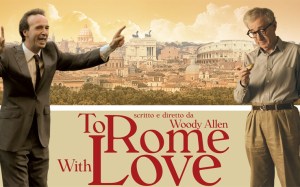
4) To Rome With Love (directed by Woody Allen)

Woody Allen’s follow-up to Midnight in Paris, To Rome With Love tells four separate stories that all take place in Rome.  Despite the fact that the cast features everyone from Alec Baldwin to Roberto Begnini to Penelope Cruz to Ellen Page, the true star of the film is the city of Rome.  I spent the summer after I graduated high school in Italy and this film brought back a lot of good memories.

Unfortunately, the film’s four stories are pretty uneven and the film’s frequent transitions from story to story are pretty awkward.  The worst story features Alec Baldwin meeting his younger self (played by Jesse Eisenberg) and trying to prevent him from falling in love with a neurotic actress (Ellen Page).  The film’s best story is a satiric fable about an ordinary man (played, in an excellent performance, by Roberto Begnini) who wakes up one day to discover that he’s the most famous man in Italy. 

The film doesn’t really work but I still loved to getting to see Rome once again.