Welcome to Late Night Retro Television Reviews, a feature where we review some of our favorite and least favorite shows of the past! On Fridays, I will be reviewing Freddy’s Nightmares, a horror anthology show which ran in syndication from 1988 to 1990. The entire series can be found on Tubi!
Leave the pets alone.
Episode 2.8 “Bloodlines”
(Dir by James Quinn, originally aired on November 26th, 1989)
Woody Burton (Marc Alaimo) breaks out of prison and heads home to try to retrieve some money he stole. The house is occupied by his bitter son, Jack (Chris Nash) and his delusional wife, Joyce (Sheree North). Woody tries to bury his son alive but fortunately, Jack has his gun with him and shoots his father dead.
The episode then jumps forward in time. Jack is now married to Maggie (Ruth de Sosa). Maggie and Jack have “adopted” a daughter named Patty (Irina Cashen). Because Jack had a criminal record, they couldn’t legally adopt so Jack paid a baby broker. Now, Maggie worries that Patty might be possessed by the devil. About 10 minutes into the second story, the family’s cat was killed for a cheap shock and I stopped watching.
From what I saw, this was a pretty crappy episode. The first half was thoroughly unpleasant and didn’t even have any supernatural elements. The second half was a dull Omen rip-off that killed a defenseless house pet.
Yes, I stopped watching when the cat died. I had seen enough.
Welcome to Retro Television Reviews, a feature where we review some of our favorite and least favorite shows of the past! On Fridays, I will be reviewing St. Elsewhere, a medical show which ran on NBC from 1982 to 1988. The show can be found on Daily Motion.
Episode 3.15 “Bye George”
(Dir by Mark Tinker, originally aired on January 9th, 1985)
It’s another busy day at St. Eligius.
The then-Governor of Massachusetts, Michael Dukakis, appears as himself, entering the ER after pulling a muscle while out for his daily run. Fiscus refuses to believe that he’s the governor. Elliot recognizes him, of course.
Three years later, Governor Dukakis ran for President and lost …. big time. Dukakis is still alive and is the earliest living unsuccessful presidential nominee. Because he lost to the first President Bush, he used to show up on the news during the second President Bush’s term. He always came across as being bitter and kind of whiny.
With Tshalla’s kidney transplant having been performed and his clinic at risk due to government corruption, Dr. Wyler finally leaves Boston and heads back to Africa. And really, it’s not a moment too soon. For all the time the show spent assuring us that Dr. Wyler was a modern-day saint, I found him to be a bit full-of-himself and a little annoying. We’ve already got Dr. Westphall and Dr. Craig on this show. We don’t need any more pompous doctors.
Speaking of Dr. Westphall, he’s depressed. Well, what else is new?
Since revealing that he only studied for six months at a fly-by-night medical school, Dr. Morrison is no longer allowed to treat patients or go on rounds. Joan Halloran (played by Nancy Stafford) returns to the hospital (and the show) and announces that she will be defending Morrison in front of the medical review board and that she hopes that Morrison will be able to continue on as a resident. Morrison just kind of shrugs. Morrison is easily depressed as Dr. Westphall.
Joan talks to everyone around the hospital and everyone agrees that Jack Morrison is the kindest, bravest, warmest, most wonderful human being they’ve ever known in their life. When Joan tells Jack that he is universally beloved, Jack seems to cheer up a little. Not much but a little.
Poor Mrs. Hufnagel. She’s finally about to leave the hospital but, before she goes, she asks another patient, stand-up comedian Murray Robbin (Murray Rubin), to marry her. Murray says he’ll think about it and then he promptly dies.
Murray was Elliot’s patient. Depressed by his death, Elliot goes to Westphall for advice. Westphall’s advice is as useless as usual. Given that Westphall can’t even hear the laughter of children without spending the next eight hours obsessing on about how they’re all going to grow up and die someday, he may not be the best person to talk to while feeling down.
Elliot finds Hufnagel in the chapel and they both cry together. It was a touching scene, well-played by Florence Halop and Stephen Furst.
Dr. Ehrlich took Dr. Craig out for dinner! Yay! I love it Ehrlich tries to suck up to Craig because it neve goes well. He takes the Craigs to an incredibly tacky Hawaiian place.
Uh-oh, Ehrlich’s credit card has been declined! Surely the wealthy Dr. Craig will help….
“Start washing dishes, Ehrlich,” Craig says.
As if so often the case, Ellen Craig admonishes her husband for being rude and agrees to help Victor out.
This was a great episode! Yes, Westphall and Morrison were their usual depressing selves but Elliot and Hufnagel finally got to act like real people (as opposed to just caricatures) and the bit with Ehrlich and the Craigs was wonderfully handled. Those who only know William Daniels as the kindly old Mr. Fenney are really missing out. Dr. Craig’s a great character.
I enjoyed this episode. For once, the humor and the drama were evenly balanced. With Peter White dead and the cast clicking as an ensemble, St. Elsewhere appears to have really found its pace.
Welcome to Late Night Retro Television Reviews, a feature where we review some of our favorite and least favorite shows of the past! On Thursdays, I will be reviewing Highway to Heaven, which aired on NBC from 1984 to 1989. The entire show is currently streaming on Tubi and several other services!
This week, we finish up Highway to Heaven.
Episode 5.13 “Merry Christmas from Grandpa”
(Dir by Michael Landon, originally aired on August 4th, 1989)
The final episode of Highway to Heaven is a sad one for a number of reasons.
First off, it’s a Christmas episode but, because NBC never really gave the final season a regular spot on the schedule and instead of just aired the final 13 episodes whenever they needed to fill a hole, the finale didn’t air until August.
Secondly, the episode features Mark and Jonathan going “thirty years into the future,” — in this case to 2018. Mark is stunned to discover that he’s still alive in 2018. Jonathan tells him that it’s because he finally stopped smoking. In real life, Victor French died of lung cancer six months after filming this episode. Again, because of the way NBC handled the final season, French did not live to see the final episode aired.
Finally, the final episode of Highway to Heaven is not one of its strongest episodes. The strength of Highway to Heaven was that Jonathan and Mark spent their time helping ordinary people. Even if you didn’t agree with the show’s theology, it was hard not be touched by the earnest sincerity that lay at the heart of the majority of the episodes. Jonathan and Mark were do-gooders, in the best sense of the term.
That said, there were more than a few episodes that could be a bit preachy and that’s the case with this episode. As was often the case with Highway to Heaven‘s weaker episodes, this episode was inspired by Landon’s own environmentalism. On Christmas Eve, Jonathan and Mark visit three men — a businessman, a farmer, and the President (seriously!) — and bring with them visions of the future. The businessman sees that he has to stop promoting nuclear power. The farmer sees that he has to stop using insecticides. And the President watches as all of his future grandchildren and great-grandchildren vanish from existence as a result of him not doing something to protect the environment.
It’s heartfelt, yes. I don’t doubt Landon’s sincerity. But I just wish the final episode had been a bit more of a traditional episode. I wish that it had featured more of heart and the humor and the Landon/French chemistry that marked the show’s best moments. Of course, again, Landon had no way of knowing that Victor French was going to die. (Apparently, even though French does look noticeable thinner, he did not learn that he had lung cancer until after he filmed his last episode.) If the show had been renewed for another season, it’s doubtful it would have worked without the chemistry between Landon and French.
I’ve enjoyed reviewing this show. Originally, I didn’t think I would. I expected this show would bring out my cynical side with a vengeance and there were a few episodes that did just that. For the most part, though, this show won me over. Watching it, one gets the feeling that Michael Landon truly did want to make the world a better place. Who can’t be touched by that?
Welcome to Retro Television Reviews, a feature where we review some of our favorite and least favorite shows of the past! On Thursdays, I will be reviewing Decoy, which aired in Syndication in 1957 and 1958. The show can be viewed on Tubi!
This week, Casey investigates an underground gambling syndicate.
Episode 1.26 “Earthbound Satellites”
(Dir by Michael Gordon, aired on April 7th, 1958)
After a man shoots himself in the head over a $20,000 gambling debt, Casey goes undercover as a flighty socialite with a gambling problem. She meets George Courtney (Whitfield Connor), a rather dapper man who runs an underground casino. Courtney drives Casey to the casino but, along the way, he switches cars which makes it difficult for the police to tail him.
Later, at a debriefing, Casey expresses frustration that we can launch satellites into space but we can’t follow a car in Manhattan. Her boss is inspired to put a transmitter in her purse so that the police can follower her in Manhattan.
This episode was made at a time when transmitters and satellites were relatively new ideas and, as a result, a lot of time is spent on establishing the reality of technology that viewers today take for granted. That makes for somewhat slow episode and it also means that Casey doesn’t really get to do as much as usual in this episode. If anything, Casey almost comes across as being a bit incompetent, allowing the bad guys to get their hands on both the transmitter and her gun.
This wasn’t the most exciting episode of Decoy but Whitefield Connor did a good job in the role of the charming but amoral George Courtney. Casey seemed to be truly sad at the end of the episode. George had so much going for him but, in the end, he sacrificed his freedom for his own greed.
Welcome to Late Night Retro Television Reviews, a feature where we review some of our favorite and least favorite shows of the past! On Wednesdays, I will be reviewing 1st and Ten, which aired in syndication from 1984 to 1991. The entire series is streaming on Tubi.
Uh-oh. This episode features OJ Simpson doing the real acting.
Episode 3.9 “Call For The Hall”
(Directed by Bruce Seth Green, originally aired on November 4th, 1987)
TD Parker (played by OJ Simpson) has a lot to deal with this week!
The team’s running back has been injured. Buffalo is willing to trade their running back in return for Bubba Kincaid! Nobody wants to say goodbye to Bubba. He’s the heart of the team. He’s the team “poobah,” which means that he gets to wear a stupid horned helmet whenever he’s at that team bar. But the Bulls need a running back. TD is the one who has to tell Bubba that he’s been traded. Jethro is named the new team poobah. Bubba’s wife is not happy about moving to Buffalo because it’s too cold up north. Fortunately, it turns out that Buffalo’s running back has also been injured and the trade is canceled. Bubba is staying!
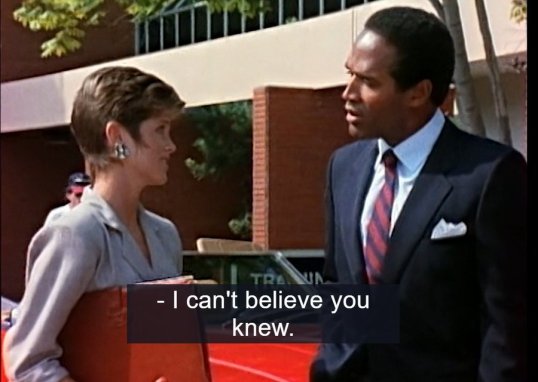
TD has also been voted into the football hall of fame. Should he take his wife and son to the ceremony or should he bring his mistress? TD can’t decide, even though it seems like kind of an obvious decision. Still, TD has to go to the team owner for advice and he is shocked when she reveals that she and everyone else know about TD’s new relationship.
Sorry, TD — everyone knows!
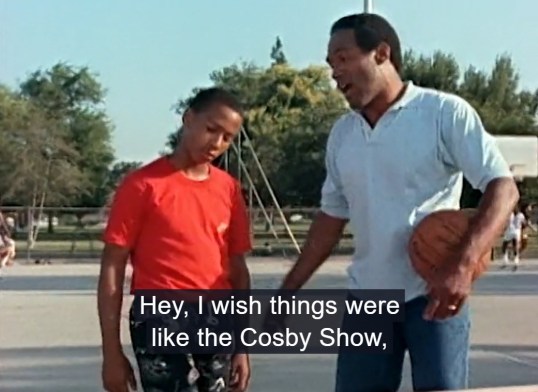
The team owner says that he should probably bring his wife, if just for the sake of appearances. TD then plays basketball with his son and apologizes for not being a better father. This leads to a line of dialogue that so totally epitomizes how much times have changed that it really should be put in a museum.
OJ Simpson apologizes for not being more like Bill Cosby. I think that pretty much sums up this show’s entire third season.
In the end, TD does not take his mistress to the Hall of Fame. But it doesn’t appear that his family attends either. TD gives a speech, thanking his wife and son. Awwww.
This episode features a lot of OJ Simpson acting. As an actor, OJ was mild, bland, and likable. He delivered his lines smoothly but with little sincerity. Of course, nowadays, it’s impossible to listen to him speak without searching for a hidden meaning between the lines. As I watched this episode, I found myself thinking, “Do not make him mad, do not make him mad….”
There was one other storyline in this episode. Dr. Death and Mad Dog stole Coach Grier’s pet mouse. The mouse died. Dr. Death and Mad Dog had to run up and down the stadium stairs as a punishment. The laugh track insists that all of this is funny but I had to disagree. Killing pets is never a good look.
This episode was a lot like OJ’s acting — mild and bland. Unlike OJ, it won’t be getting voted into the Hall of Fame anytime soon.
Welcome to Retro Television Reviews, a feature where we review some of our favorite and least favorite shows of the past! On Wednesdays, I will be reviewing the original Love Boat, which aired on ABC from 1977 to 1986! The series can be streamed on Paramount Plus!
Come aboard, we’re expecting you….
Episode 7.14 “The Last Case/Looking for Mr. Wilson/Love on Strike”
(Dir by Richard A. Wells, originally aired on December 17th, 1983)
This week, an old high school friend of Julie’s is on the cruise. Whenever anyone from Julie’s past shows up, it means drama. Five years ago, when Jan Maddox (Jeanine Wilson) told her boyfriend, Michael, that she was pregnant, he ran out on her. Jan lied to her father, the rigid Colonel Maddox (Claude Akins), and told him that she and Michael had gotten married. For five years, Jan has been telling her father that she’s married. When Colonel Maddox boards the ship and meets his grandson Richie (R.J. Williams) for the first time, Jan continues to lie. She says that Michael got called away on business.
However, when Jan meets a charming single passenger (Tony Dow) and starts to fall for him, she decides to tell her father the truth.
“My grandson is illegitimate?” Maddox says, in a tone more worthy of 1883 than 1983.
Colonel Maddox says that he never wants to see his daughter or his grandson again. Seriously? Okay, good riddance. Colonel Maddox is a terrible person and Jan seems to be doing fine without him. However, Julie mentions to Maddox that Michael walked out on Jan and now the Colonel is doing the same thing. And then Richie tracks him down and yells, “You’re a mean old man and I hate you!” Colonel Maddox sees the error of his ways and that magically fixes everything. Jan forgives him. Richie forgives him. I would not have forgiven him. Then again, I also wouldn’t have lied about being married in the first place.
While this is going on, Jenny (Didi Conn) boards the ship and spends the cruise harassing her ex-boyfriend (Grant Goodeve) and his new girlfriend (Wendy Schaal). Jenny boards with two signs, each declaring that her ex is a louse. She follows him around the ship, chanting about what a louse he is. When she sees him dancing with his new girlfriend, she grabs a microphone and starts to talk about him to all the other passengers. Jenny probably should have been taken into custody and kicked off the boat at the next port-of-call. Instead, everyone acts as if Jenny’s actions are cute. It’s a weird story.
Finally, a mysterious woman known as the Contessa has disappeared from her cabin. Stubing convinces an old friend, retired detective Manfred Benusse (John Hillerman), to investigate. (I would think that the Captain would be required — by law and company policy — to report a missing passenger as soon as it was discovered that she was missing but whatever.) It turns out that there never was a Contessa. The whole thing was a set up, engineered by Benusse’s secretary, Liliane Pendergrast (Allyn Ann McLerie). Lillian didn’t want Benusse to retire and she thought that, if she gave him an unsolvable case, he would change his mind and I presume spend the rest of his days searching for a non-existent human being. I’m not sure how that would have been a good thing but, once Benusse figures it all out, he falls in love with Ms. Pendergrast. When you consider the fact that he could have easily been fired if Benusse hadn’t figured out what his secretary was doing, the Captain is surprisingly forgiving.
This was a really weird episode but the detective storyline was kind of charming in its nonsensical way. Hillerman did such a good job as the detective that it made up for the fact that the other two stories were kind of annoying. The end result was a pleasant cruise.
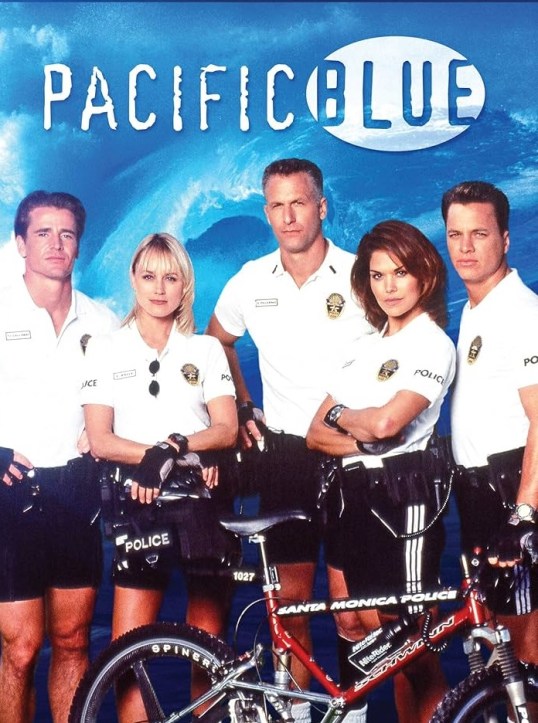
Welcome to Late Night Retro Television Reviews, a feature where we review some of our favorite and least favorite shows of the past! On Tuesdays, I will be reviewing Pacific Blue, a cop show that aired from 1996 to 2000 on the USA Network! It’s currently streaming everywhere, though I’m watching it on Tubi.
This week, infedility is in the air.
Episode 3.20 “With This Ring”
(Dir by Michael Levine, originally aired on April 5th, 1998)
When Cory and Victor find a dead man on the beach, all of the evidence seems to indicate that he was killed as a result of an extramarital affair. His widow previously hired a detective agency to test his fidelity. His killer forced his own wedding ring down his throat. Someone is killing cheaters.
So, of course, Palermo has Cory and Victor go undercover as a married couple.
This isn’t the first episode of Pacific Blue to feature the bike cops going undercover. It’s actually something that has happened fairly frequently during the third season. On the one hand, it gets the characters off of those stupid bicycles. On the other hand, why would a bunch of bike cops be investigating crimes? Bicycle cops are like any other uniformed cop. Their job is to keep general order, issue tickets, and secure crime scenes until the actual detectives can show up. The bicycle cops are police officers but they’re not detectives. At least, that’s the way it works in the real world. In the world of Pacific Blue, the Malibu PD apparently doesn’t have a plainclothes department and all of the work is done by the same 5 bicycle cops.
While Cory and Victor go undercover, TC tries to deal with the fact that his parents are splitting up, He really struggles with the news of their upcoming divorce. TC is also in his mid-30s. Once you’re closer to 40 than 30, you should be able to handle your parents splitting up with a modicum of maturity. The only good thing about this storyline is that wonderful Andy Buckley made one of his far-too infrequent appearances as TC’s older brother.
This episode ended with TC and Chris promising each other that, in 35 years, they would still be together. Those will probably be the 35 most boring years of anyone’s lives.
This was another forgettable episode. At least there’s only two episodes left this season. And starting with season 4, Mario Lopez arrives as a new member of Pacific Blue! It can’t happen soon enough.
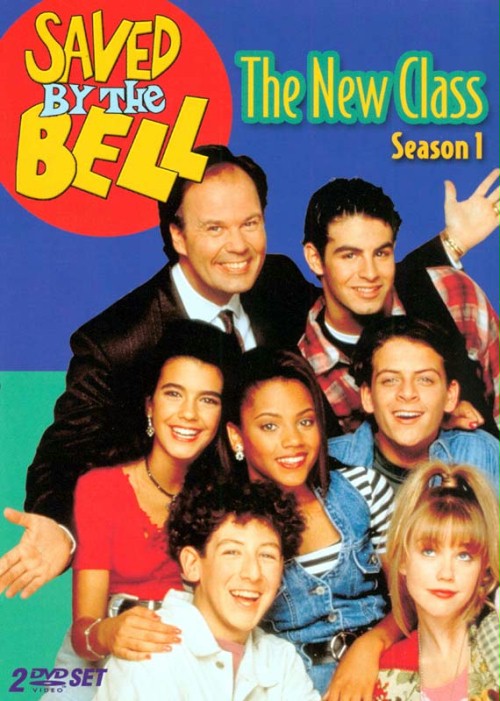
Welcome to Retro Television Reviews, a feature where we review some of our favorite and least favorite shows of the past! On Tuesdays, I will be reviewing Saved By The Bell: The New Class, which ran on NBC from 1993 to 2o00. The show is currently on Prime.
It’s time for the annual school swap meet!
Episode 1.10 “Swap Meet”
(Dir by Don Barnhart, originally aired on November 13, 1993)
It’s time for the Swap Meet, the annual Bayside tradition that has never been mentioned before this week’s episode. All of the students — and Mr. Belding — go to the gym to sell the old stuff that they don’t need anymore. Does anyone in this school actually go to class?
Weasel, Scott, and Tommy D. have their own table, where they are apparently selling random things from Weasel’s garage. Scott desperately needs some money so that he can take Rachel Meyers (Sarah Lancaster, who would become a regular starting with season 2) to the Janet Jackson concert. Scott is not happy when Weasel takes the ten dollars that Scott and Tommy D have made at the table and spends it all on comic books. Fortunately, one of those comic books turns out to be Defender Dog #59, the one with the “famous misprint!” Scott and Weasel go to call the comic book shop to find out how much the comic book is worth. “It’s worth 600 raviolis!” Weasel announces. Huh? Who talks like that?
While Scott and Weasel are dancing in the hallway, Tommy D sells the comic book for nine dollars to Marv and Harv Dorkman (played by Grant Gelt and Karl Michael Maschek).
Marv and Harv, as you guessed, are two of Saved By The Bell‘s stereotypical nerd characters. They refuse to sell the comic book back to Scott. When Scott realizes that Marv and Harv have crushes on Megan and Vicki, he convinces Megan and Vicki to go to the movies with them and to lie about loving comic books. Megan and Vicki think that, by doing this, they’ll get the Defender Dog comic book. Instead, Marv and Harv sell the comic book to Crunch Grabowski (Ryan Hurst) and then use the money that they made to buy necklaces for Megan and Vicki, which Megan and Vicki promptly reject.
“I can’t believe this,” Scott says.
“Getting that comic book back is harder than Chinese square dancing,” says Weasel.
It’s hurting my head just to recap this.
Anyway, Crunch doesn’t want to sell the comic book so Scott convinces Crunch to come to the local comic book shop, which is owned by Honolulu Harry. So, of course, Weasel puts on an old man mask and pretends to be Honolulu Harry and Tommy D. pretends to be a nerd who wants to sell a copy of Defender Dog so that Weasel (as Harry) to tell him that no one likes Defender Dog. Crunch cannot handle being seen with an unpopular super hero so he trades Defender Dog for Lou the Ant. Scott gets the comic book but then the real Honolulu Harry shows up and refuses to buy it from him because he caught Tommy D. in the back of the comic book shop. “You touched my comics!” Harry yells. What are people supposed to do in a comic book store?
Poor Scott! Well, no, not really. There’s a hundred smart things that Scott could have done during this episode and he didn’t do a single one of them. He deserves what he gets….
Oh wait, the Dorkmans spent a lot of money to get four tickets to the Janet Jackson concert. Megan tells them that she and Vicki would love to go to the concert with them. Megan says she’ll hold on to two of the tickets and that she and Vicki will meet them at the concert. The Dorkmans give the tickets to Megan and Vicki and then Megan and Vicki give them to Scott so he can take Rachel to the concert.
“You guys did this for me? You guys are the best.” Scott says.
Rachel shows up to go to the concert with Scott. She asks if the tickets were hard to get.
“No, not when you have really great friends,” Scott says.
Awwwww! the audience replies.
The audience has probably forgotten that Vicki had a huge crush on Scott just a few episodes ago and Megan and Scott were hinted to be a couple-in-the-making at the start of the season. Beyond continuity, the main message here seems to be that, if your friend is a pathological liar, it’s okay to to lie to help him out. The Dorkmans, who apparently spent a lot of money on the tickets that Megan just gave away, are already at the concert waiting on their dates. Vicki and Megan’s actions would perhaps be justified if the Dorkmans were creeps but, for the most part, they’re just two guys who wears glasses and like comic books. And while it is true that the Dorkmans bought those tickets without bothering to ask Vicki and Megan out beforehand, it’s also true that Megan flat-out lied so that she could then give the tickets to Scott.
One thing that I have noticed about Saved By The Bell: The New Class is that it seems to really hate its nerd characters. The original series had stereotypical nerds as well but they were still, more or less, likeable and the show’s characters may not have hung out with them but they weren’t intentionally cruel to them. Saved By The Bell: The New Class, on the other hand, feels as if it was written by the same people who spilled the pig’s blood on Carrie White.
Anyway, this episode was terrible. Thank goodness there’s only three more episodes of the first season to go.
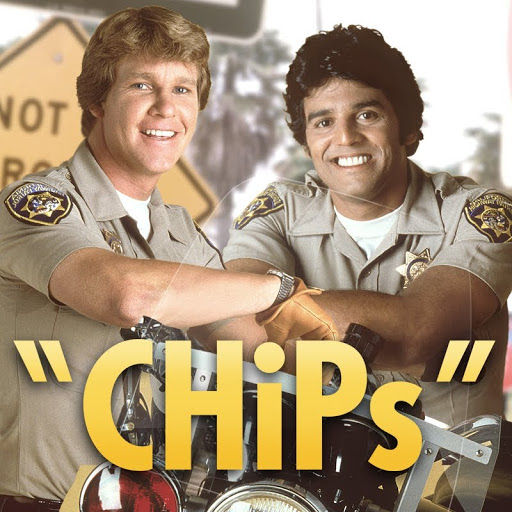
Welcome to Late Night Retro Television Reviews, a feature where we review some of our favorite and least favorite shows of the past! On Mondays, I will be reviewing CHiPs, which ran on NBC from 1977 to 1983. The entire show is currently streaming on Prime!
This week, there’s a big cat on the loose!
Episode 5.14 “Tiger In The Streets”
(Dir by Charles Bail, originally aired on January 10th, 1982)
Ponch and Baker wonder why someone is digging deep holes in the Los Angeles hills and filling them with raw meat. Could someone by trying to capture a tiger that’s recently gotten loose from a wildlife park? Yes, that’s exactly what’s happening! The owner of the park wants to keep the cops from finding out but, when it turns out that the tiger is a mother and is missing her cubs, only the highway patrol can help Animal Control capture her. Baker likes Stephanie, the Animal Control officer. This is one of the rare episodes where Baker actually gets to have a romance while Ponch stands around and looks awkwardly out-of-place.
As for Ponch, he is more concerned with an ex-con who is at the center of a series of violent confrontations involving various car clubs. I’m pretty sure I’ve seen this plot before. CHiPs has been repeating itself a lot during the fifth season. That said, the car chases led to a slow motion wreck and a scene of bouncing hydraulics. I’ve never been in one of those bouncing cars before. It seems like you would get ill riding in one of those.
Finally, Grossie wants to be a comedian. Harlan is a friend of legendary funny man Slappy White. Harlan gives Grossie a bunch of Slappy’s jokes about how black people are different from white people. Needless to say, the jokes don’t go over that well when they’re told be a white guy in a policeman’s uniform.
Welcome to Retro Television Reviews, a feature where we review some of our favorite and least favorite shows of the past! On Mondays, I will be reviewing Miami Vice, which ran on NBC from 1984 to 1989. The entire show can be purchased on Prime!
When is Miami Vice not Miami Vice?
Episode 5.20 “Leap of Faith”
(Dir by Robert Iscove, originally aired on June 28th, 1989)
A crazed college professor named Terry Baines (Keith Gordon) is making his own designer drugs and selling them to the cult-like college students who worship his every move. Terry thinks that the drugs will help people move into a dream state. However, Terry also doesn’t care how many people die as a result of entering that dream state. Terry is obviously crazy but he’s got tenure.
Fortunately, the youthful cops of the Young Victims Unit are able to go undercover as college students and infiltrate Terry’s organization. Joey Harden (Justin Lazard) is the newest member of the squad. He’s a cop who does things his way! Zach (Cameron Dye) is the wild man. He’s from Arkansas! And Ray Mundy (Adam Storke), he’s a surfer from California! Their boss is Lt. Paul Cutter (Kiel Martin). Tania Louis (Laura San Giacomo) is their computer expert. Together, they’re….
….not Crockett and Tubbs!
Crockett and Tubbs appear at the start of the episode and then Crockett appears in another scene, in which it’s established that he and Cutter have a contentious relationship. Otherwise, this really isn’t an episode of Miami Vice. Instead, it’s a pilot for a show about the Young Victims Unit. The pilot never became a series and, watching this episode, one can see why. The three undercover cops are all way too similar. They seem like three different versions of the same guy. Kiel Martin and Laura San Giacomo at least manage to bring some life to their characters but the rest of the cast is just bland. The best performance comes from Keith Gordon and he’s dead by the end of the episode.
Next week …. Miami Vice comes to an end as Tubbs falls in love and Crockett refuses to get a haircut.

 Through the Shattered Lens