Late Night Retro Television Review: 1st & Ten 3.13 “Championship Jinx”


Welcome to Late Night Retro Television Reviews, a feature where we review some of our favorite and least favorite shows of the past! On Wednesdays, I will be reviewing 1st and Ten, which aired in syndication from 1984 to 1991. The entire series is streaming on Tubi.
This week, season 3 comes to an end.

Episode 3.13 “Championship Jinx”

(Dir by Bruce Seth Green, originally aired on December 16th, 1987)

Things have a way of working themselves out on 1st & Ten, especially when the season ends and a lot of plotlines need to be hastily wrapped up.

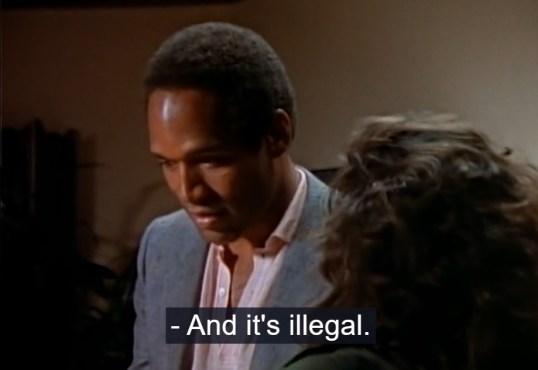
Last week, TD Parker (OJ Simpson) was arrested under suspicion of ticket scalping.  This episode, it turned out that 1) ticket scalping isn’t illegal and 2) TD’s ex-mistress quickly figured out that her boyfriend was trying to frame him.  Someone trying to frame OJ Simpson!?  Like anyone would ever buy that.  Anyway, the main theme here seemed to be that it was a good thing TD cheated on his wife because otherwise, no one would have been around to exonerate him.

Last week, Yinessa was letting fame go to his head.  This week, his father died and the funeral was a media circus.  Yinessa decided to focus on playing football. That’s a good thing, seeing as how the Bulls had yet another championship game coming up.

Zagreb was concerned that he was a jinx after he appeared on the cover of Sports Illustrated.  (Yinessa told him that players who appeared on the cover often lost the spark afterwards.) Luckily, Cliff and Jethro brought in a voodoo priestess (Roxie Roker) to exorcise the jinx.

Before the game, Jill told the team that they weren’t only playing for themselves.  They were playing for the memory of Tom Yinessa’s father.  Unfortunately, the Bulls lost the game at the last minute when Billy Cooper’s game-winning catch was reviewed by the booth and declared to be out of bounds.  So, I guess Yinessa’s father is in Hell now.

And so ends the rather odd third season.  Coach Denardo left after the first episode.  Delta Burke left about halfway through the season, just to be replaced by a new female owner who gave a pre-game speech that referred to all of the previous times she had gone to the Championship Game with the Bulls just to see them lose, despite the fact that she wasn’t even a part of the show’s cast during the previous two seasons.  The season began with a player dying of steroid abuse and ended with OJ Simpson proving his innocence.  Oh!  And Zagreb discovered his father was a CIA agent and then he got married.

Was it a good season?  Not really.  This isn’t a good show.  But season 3 was definitely a lot stranger than the previous two seasons and that’s definitely a point in 1st & Ten‘s favor.

Next week, we start season 4!
Late Night Retro Television Review: 1st & Ten 3.9 “The Brink of Death”


Welcome to Late Night Retro Television Reviews, a feature where we review some of our favorite and least favorite shows of the past! On Wednesdays, I will be reviewing 1st and Ten, which aired in syndication from 1984 to 1991. The entire series is streaming on Tubi.

This week, OJ has some wisdom to share.

Episode 3.8 “The Brink of Death”

(Dir by Bruce Seth Green, originally aired on November 4th, 1987)

There’s a lot happening in this week’s episode.

For instance, Bubba and Jethro now own the bar where all of the Bulls hang out.  To be honest, I thought they always owned the bar but apparently, they didn’t.  As I’ve said a few times in the past, the way these episodes were edited for syndication occasionally makes it a bit difficult to actually follow the storyline.

Wide receiver Billy Cooper (Michael Toland) was kidnapped by Stuart (Richard Tanner), the nerdy guy whose girlfriend Billy stole.  Stuart wrapped up Billy in a straight jacket, forced him to wear a “Dumb Jock” label on his forehead, and then filmed him screaming in fear of a bunch of fire ants.  Billy’s girlfriend dumped him because Stuart was “more interesting.”

But the main plotline dealt with Dr. Death, the defensive player who was played by Donald Gibbs.  While playing against Oakland, many of the Bulls were tackled by Joe “The Terminator” Morgan (Andre Newman), a notoriously dirty player.  Dr. Death decided to get revenge by tackling Joe Morgan during a kick return, even though Joe had signaled for something called a fair catch.  (I guess that meant that no one was supposed to touch Joe.)  Joe Morgan ended up in the hospital.  The owner of the Oakland team pressured Joe to press assault charges against Dr. Death, who was already feeling guilty about injuring Joe as severely as he did.

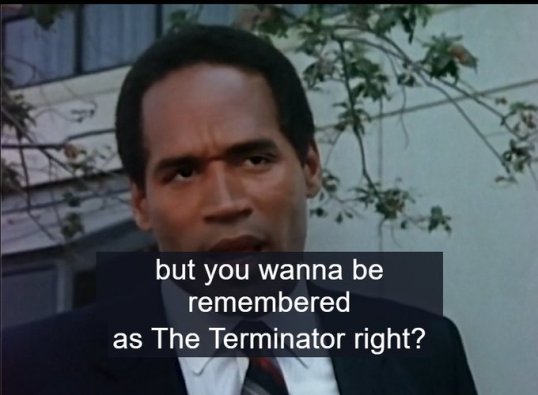
It was up to O.J. Simpson to talk some sense into Joe Morgan.  O.J. went to the hospital and told Joe that football was all about getting injured.  O.J. asked Joe if this was the way he wanted to go out.

By appealing to Joe’s desire to be remembered as a killer football player, OJ is able to convince Joe to drop the charges.

(I should mention that OJ himself was an early contender for the role of the actual Terminator.)

O.J. Simpsons saved the day again!

Late Night Retro Television Review: 1st & Ten 3.5 “Illegal Use Of Love”


Welcome to Late Night Retro Television Reviews, a feature where we review some of our favorite and least favorite shows of the past! On Wednesdays, I will be reviewing 1st and Ten, which aired in syndication from 1984 to 1991. The entire series is streaming on Tubi.

With their best player now dead, the Bull begin their new season.

Episode 3.5 “Illegal Use Of Love”

(Dir by Stan Lathan, originally aired on September 2nd, 1987)

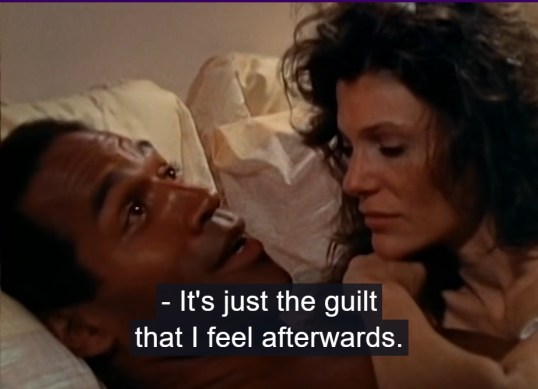
Uh-oh, TD Parker is cheating on his wife with assistant, Kay (Alexa Hamilton).  TD explains that his wife is upset about the amount of time that he’s putting in with the team.  She feels that he’s neglecting his family.  She doesn’t even like football anymore!

Yep, TD has a lot of excuses for cheating on his wife but don’t think that he’s a bad guy or anything.  As he tells his mistress, everything is fine except for….

As I’ve said before, probably the most interesting thing about 1st & Ten is the way that everything that OJ Simpson says now has a double meaning.  At the time this was filmed, OJ was just a former football player who had become a likable if not particularly versatile actor.  Watching it today in 2026 …. well, words land differently.

As the Bulls, the team is in trouble.  Their season opener against Baltimore is a disaster.  Yinessa is still out and demanding a new contract before he’ll play so, instead, he sits in the stands and watch as the backup quarterback throws interception after interception.  Later, he tells Teddy’s daughter, Jill Schrader (Leah Ayres), that all he wants to do is play football.  If that’s the case, why not sign your stupid contract and play football?  Seriously, when did Yinessa get so whiny?

There’s a brief sign of hope during the Baltimore game.  Dr. Death intercept a pass.  But then Dr. Death runs the wrong way and gets tackled behind the other team’s goal line.  A local sports commentator says that Dr. Death and Mad Dog (who blocked while Death was running the wrong way) are idiots.  He’s correct but he retracts his statement after Death and Dog threaten to destroy his car.

The Bulls need a quarterback.  Teddy goes behind Diane’s back and arranges a trade for arrogant Johnny Valentine, the coke-addled quarterback who Diane kicked off the team the previous season.  Diane gets angry but what can she do?  Teddy owns half of the team….

For now!

TD’s mistress shows TD some financial reports that show that Teddy has been making his money through insider trading.  TD is shocked.

If anyone knows about illegal….

It looks like Teddy might be in some trouble.  It also looks like Diane might be in some trouble as well because the other owners think that she’s failed to control the drug use on her team.  (They’re not incorrect.)  We’ll see what happens next week but I have a feeling that a change is coming.

And really, that change can’t come a minute too soon.  Even with the steroid storyline, this season has been a snoozefest so far.  Here’s hoping things perk up next week!

Retro Television Review: St. Elsewhere 2.9 “AIDS and Comfort”


Welcome to Retro Television Reviews, a feature where we review some of our favorite and least favorite shows of the past! On Fridays, I will be reviewing St. Elsewhere, a medical show which ran on NBC from 1982 to 1988.  The show can be found on Hulu and, for purchase, on Prime!

This week, St. Elsewhere makes history.

Episode 2.9 “AIDS and Comfort”

(Dir by Victor Lobl, originally aired on December 21st, 1983)

A city councilman named Anthony Gifford (Michael Brandon) has checked into St. Eligius under an assumed name.  He’s complaining about fatigue.  His lymph nodes are swollen.  His immune system seems to be shutting down.  Dr. White and Dr. Westphall look at the man’s x-rays and Dr. White says that it looks like Gifford might be suffering from a newly discovered disease that no one knows much about.  The name of that disease is AIDS.

“Could he be …. gay?”  Dr. White asks.

Westphall initially scoffs.  He points out that Gifford is married and has two children.  When Gifford is asked directly about his personal life, he admits to having affairs but is quick to say that they were all with women.  Westphall later says that Gifford is either lying or they’ve discovered something entirely new about the virus and they need to call the CDC….

Today, with all we know about HIV and AIDS, it’s a bit jarring to hear some of the dialogue in this episode.  Doing some research, I discovered that this was the first ever episode of network television to deal with the AIDS epidemic and that it aired at a time when there were still a lot of unanswered questions about how the disease was spread.  (For instance, the episode aired shortly after the HIV virus has been discovered.)

When words get out that Gifford is a patient at the hospital and that he has AIDS, panic erupts.  No one donates to the hospital’s blood drive because they’re scared the needles have somehow gotten infected.  Even usually sympathetic characters — like Luther and Dr. Fiscus — refuse to be anywhere near the isolation ward.  Gifford’s doctor, Peter White, requests that Gifford’s case be given to another doctor.  Later, White asks everyone is Westphall is mad at him.  Morrison replies that White acted unethically.  White blames his wife and her fears of him contracting the disease by being in the same room as Gifford.  (Not surprisingly, White is also the one who, because he won’t stop whining about his job, is responsible for word spreading about Gifford having AIDS.)

After spending nearly the entire episode denying it, Gifford finally admits to having had affairs with other men.  As he leaves the isolation ward, he’s besieged by reporters.  Getting in the elevator, he sees that someone has spray-painted “AIDS” on the wall.  Before he leaves, he asks Westphall how long he has.  Westphall grimly replies that most AIDS patients die within two years.

Later, while talking to Dr. Craig and Nurse Rosenthal, Westphall says, “Yeah, I know that’s how I felt about it at first. Then I started to think, Who am I? Why should any of us be penalized, fatally, for choosing a certain lifestyle, especially when you realize that it all boils down to chance anyway? And I tell you something I don’t give a damn for all this talk about morality and vengeful gods and all that. If you have AIDS, you’re sick, you need help. That’s all that matters. And that’s why we’re here, right?”

And yes, it’s a bit jarring to hear Westphall refer to being a gay as a “choosing a certain lifestyle,” but you again you have to consider when this episode aired and that it was also the first network television show to feature a storyline about AIDS.  When this episode aired, saying that “If you have AIDS, you’re sick, you need help …. that’s all that matters,” took a certain amount of courage.  For many viewers, this episode was probably the first they ever really heard about AIDS.

This episode dealt very honestly with AIDS.  It actually helped that all of the character didn’t have the type of “perfect” reaction that television shows often present characters as having.  Even Dr. Westphall, usually presented as being this show’s beacon of moral clarity, had to deal with his own prejudices.  When it comes to a controversial topic, television shows too often portray their lead characters as being saints.  This episode portrayed the staff of St. Elsewhere as being flawed and imperfect and, as such, it was a very effective and thought-provoking hour.