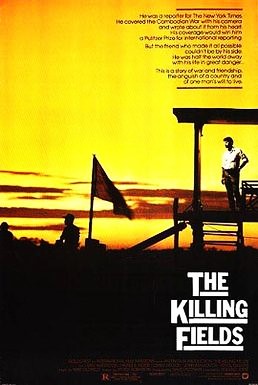
Lisa Marie Reviews An Oscar Nominee: The Killing Fields (dir by Roland Joffe)


1984’s The Killing Fields opens in 1973.  While America is distracted by the growing Watergate scandal and the final battles of the Vietnam War, the nation of Cambodia descends into chaos.  Civil War has broken out between the Cambodian National Army and the Khmer Rouge, a savage communist group led by Pol Pot.  In its desire to return Cambodia to “year zero,” the Khmer Rouge targets anyone who is considered to be too educated or too urban.

Sent to cover the war, journalist Sydney Schanberg (Sam Waterston) meets up with his translator, Dith Pran (played, in an Oscar-winning performance, by Haing S. Ngor).   For two years, Schanberg covers the war in Cambodia, taking pictures of bombed out cities, dead Cambodians, and the bullying teenagers who seem to make up the majority of the Khmer Rouge’s membership.  The Khmer Rouge’s leadership may claim to be creating an equal society but it’s hard not to notice that they act like gangsters, posing with their cigarettes and making a great show over deciding who will live and who will die.  In 1975, when it becomes apparent that the Khmer Rouge have won the war, the press and the diplomats all prepare to evacuate.  Sydney and his colleagues are able to return to their home countries.  Dith Prain’s family escape but Dith Pran himself is left behind in Cambodia where, disguising himself as a disabled beggar, he witnesses the horrors of the Khmer Rouge’s Year Zero.

The Killing Fields is an accidental anti-communist film.  Director Roland Joffe, produced David Puttnam, and screenwriter Bruce Robinson were all men in the left and, in the film, Sydney Schanberg puts the blame for the rise of the Khmer Rouge directly on the American bombing campaign of the early 70s.  The film somehow has the audacity to end with John Lennon’s Imagine, a song that epitomized the worst excesses of the Khmer Rouge’s philosophy, playing over the end credits.

I’ll be the first to admit that the film probably does have a point about the bombing of Cambodia.  The chaos that followed the bombing undoubtedly helped the Khmer Rouge to both organize and to bring in new recruits.  In this film, the Khmer Rouge commanders love to show off their power because, as Cambodians, they had previously been made to feel that they had no control over their destinies.  However, in the scenes with Dith Pran faces the horrors of the reeducation camps and discovers the fields full of skulls and other human remains, the viewer is reminded that it takes more than confusion to lead to this type of concentrated brutality. It takes a group of people brainwashed by a destructive ideology.

(How destructive was the Khmer Rouge’s Maoist philosophy?  The Khmer Rouge’s plan was to return Cambodia to being an agricultural society, one where the State stood in for both family and religion.  To do so, cities were razed.  People who were considered to be intellectuals and free thinkers were tortured and executed.  Doctors were murdered.  Having bad eyesight was considered to be a sign of intelligence and, as such, people who wore glasses were specifically targeted.  As Dith Pran says in the film, the Cambodians who survived were told that they no longer had families, friends, or beliefs.  Now they were to only worry only about serving the organization, the Angkar.)

It’s the scenes of Dith Pran in Cambodia that drive home the powerful anti-communist message that the filmmakers were perhaps not aware that they were delivering.  Haing S. Ngor was not a professional actor when he played Dith Pran.  Instead, he was a gynecologist and an obstetrician who, after the Khmer Rouge came to power, pretended to be dumb to survive.  Like Dith Pran, he was sent to a reeducation camp and he eventually escaped by making his way through the area that Dith Pran called “the Killing Fields.”  Unlike Dith Pran, Ngor’s family did not survive.  (After being sent to work on a rice farm, his wife died in childbirth.)  In the film, when we see Dith Pran discovering the Killing Fields for the first time, we are witnessing Haing Ngor recreating the moment that he discovered them.  The pain and the horror in his eyes is not only Dith Pran’s but also Haing Ngor’s and every other Cambodian who was forced to flee their country to escape the Khmer Rouge.  The film may blame America for the rise of the Khmer Rouge but Ngor’s performance makes it clear that only the Khmer Rouge can be blamed for what happened after they came to power.

It’s a powerful film, though I do think I would be remiss not to mention that Al Rockoff, the photographer played by John Malkovich in the film, has been very critical of the way that the film depicts both Sydney Schanberg and a scene where the journalists attempt to make a phony passport for Dith Pran.  Indeed, the scenes with Schanberg back in New York are considerably less compelling than the scenes of Dith Pran fighting to survive in Cambodia.  When the film’s version of Rockoff accuses Schanberg of using Dith Pran’s tragedy to advance his own career, it’s hard not to agree with him.

The film was nominated for Best Picture of 1984 but lost to Amadeus.  Dr. Ngor did win the Oscar for Best Supporting Actor, becoming the second non-professional (after Harold Russell for The Best Years of Our Lives) to do so.  Ngor went on the appear in a handful of films before being murdered in 1996.  Three members of a street gang were convicted of the murdering Ngor while attempted to rob him.  (Ngor was shot when, after giving them his Rolex, he refused to surrender a locket that contained a picture of his late wife.)  In 2009, Kang Kek lew, a Khmer Rouge official on trial for war crimes, claimed that Ngor’s murder was actually ordered by Pol Pot, the leader of the Khmer Rouge.

The Killing Field was obviously meant to be primarily critical of American foreign policy but, intentionally or not, it has since proven itself to be one of the strongest anti-communist films ever made.
 

Late Night Retro Television Review: Highway to Heaven 5.9 “Choices”


Welcome to Late Night Retro Television Reviews, a feature where we review some of our favorite and least favorite shows of the past!  On Thursdays, I will be reviewing Highway to Heaven, which aired on NBC from 1984 to 1989.  The entire show is currently streaming on Tubi and several other services!

This week, Jonathan and Mark get into the detective business.

Episode 5.9 “Choices”

(Dir by Michael Landon, originally aired on June 30th, 1989)

Working as private investigators, Mark and Jonathan are approached by a Vietnamese couple who are looking for the two sons that they gave up for adoption many years ago.  They gave the boys up so that they could escape Vietnam and live in America, safe from communism.  Now, the father (Dr. Haing S. Ngor) wants to bring his sons back to Singapore, despite the fact that both of them have been adopted by good people and the oldest has been accepted to a prestigious college.

This was an above average episode of Highway to Heaven.  It was undoubtedly heavy-handed and there were more than a few minutes where the dialogue was a bit too spot-on for its own good.  But ultimately, the episode was so earnest and heartfelt that the viewer couldn’t help but forgive the show’s flaws.  This particular episode was very well-acted, especially by Dr. Haing S. Ngor.  A Cambodian who lost most of his family after the Khmer Rogue came to power and attempted to return the country to “Year Zero” by killing off anyone who was considered to be too educated or cosmopolitan, Dr. Ngor survived by disguising the fact that he was an educated doctor.  After the fall of the Khmer Rogue, Ngor made his way to Thailand and eventually to America.  He won an Oscar for playing a character who suffered much as he suffered in The Killing Fields (a film about communist atrocities that has the gall to unironically include John Lennon’s Imagine on the soundtrack).  In this episode, Ngor gives a strong performance as a stubborn man who struggles with the fact that his sons have grown up in his absence.  Tragically, seven years after this episode aired, Dr. Ngor was murdered in his driveway.  Though a group of gang members were arrested and convicted of his murder, it’s always been known that his murder was ordered by Pol Pot, the leader of the Khmer Rogue.

The final season of Highway to Heaven has been uneven but this was a good episode.

Retro Television Review: Miami Vice 3.15 “Duty and Honor”


Welcome to Retro Television Reviews, a feature where we review some of our favorite and least favorite shows of the past!  On Mondays, I will be reviewing Miami Vice, which ran on NBC from 1984 to 1989.  The entire show can be purchased on Prime!

This week, another figure from Castillo’s past comes to Miami.

Episode 3.15 “Duty And Honor”

(Dir by John Nicollela, originally aired on February 6th, 1987)

There is apparently some controversy over what this episode should be called.  When it originally aired in 1987, it was called The Savage, after the serial killer who is pursued by Castillo.  When the episode later turned up in syndication, the title was changed to Duty and Honor, a reflection of the fact that the episode links back to Castillo’s (and, to a lesser extent, Crockett’s) service in Vietnam.  Since the imdb has chosen to go with Duty and Honor, I’ve decided to do the same.

The episode opens in Saigon, in the early 70s.  A clean-shaved Castillo (with a pony tail!) investigates the ritualistic murder of a prostitute.  It’s one of several murders that have occurred over the past few days, with all of the victims being sex workers.  Jump forward to Miami in the 80s and prostitutes are now once again being murdered.  Castillo recognizes the M.O. and soon, Crockett and Tubbs are investigating the local VA.  The doctor (Gary Basaraba) refuses to compromise the confidentiality of what his patients have told him but he does allow Crockett and Tubbs to speak to some of them.  One of the patients talks about a mysterious man who was known as The Savage, who was used as an assassin by the CIA.  The Savage was obsessed with killing and hated women because one violent encounter led to him getting castrated.

Tranh (Haing S. Ngor), who investigated the Saigon murders with Castillo, comes to Miami and shows Castillo that, whenever an enemy or critic of the United States has been assassinated overseas, it’s always coincided with a serial killer targeting prostitutes.  Tranh believes The Savage has come to Miami to assassinate a South American activist who is in town to give a speech.  Tranh and Castillo’s investigation leads them to the Savage’s CIA handler, Jack Colman (Brad Sullivan).  Colman makes clear that he really doesn’t care what The Savage does on his own time.

And yes, The Savage (played by Michael Wright), is indeed in Miami and he is killing prostitutes.  As played by Wright, The Savage is one of the most frightening villains to show up on Miami Vice.  He’s a relentless and sadistic killer who has no control over his impulses.  The CIA turned him into a weapon of war and now that the war is over, he no longer has a place in the real world.  Instead, he’s a nightmare creature who exists to execute anyone who Colman considers to be a threat.

(Around the same time this episode aired, Michael Wright also played the high school gang lord in The Principal.)

Up until the final twist, this episode is Miami Vice at its best — dark, moody, thought-provoking, and morally ambiguous.  After spending most of the season staring at the floor, Edward James Olmos finally gets to be the center of the action.  Unfortunately, the film ends with Tranh revealing that he was actually a spy for North Vietnam and that he’s now a colonel in the Vietnamese army.  He leaves Castillo a note, saying that he hopes they can still be friends and promote the type of peaceful world where nations will not create men like The Savage.  And while I agree that the CIA should not be breeding assassins, I still have to say, what’s up with all the pro-commie crap this season, Miami Vice?

Anyway, other than that, this was a good episode.  I should mention that Helena Bonham Carter briefly appears as Sonny’s new girlfriend.  Apparently, she’ll be the center of next week’s episode.