4 Shots From 4 Films: Special Pete Walker Edition


4 Shots From 4 Films is just what it says it is, 4 shots from 4 of our favorite films. As opposed to the reviews and recaps that we usually post, 4 Shots From 4 Films lets the visuals do the talking!

Today, along with celebrating Independence Day, we are also celebrating the birthday of the great British director, Pete Walker!  Walker is 81 years old today and, if he’s not exactly a household name …. well, he definitely should be.  In fact, if there’s any director from the 70s and the early 80s who is deserves to rediscovered and reappraised, it’s Pete Walker!  He made exploitation films with wit and genuine suspense.  Frightmare is one of the scariest movies that I’ve ever seen.

In honor of Pete Walker’s birthday, here are….

4 Shots From 4 Films

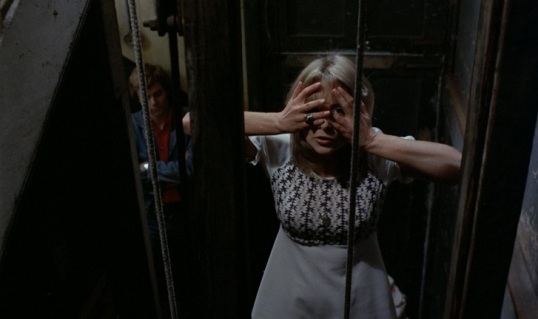
Die Screaming, Marianne (1971, dir by Pete Walker)

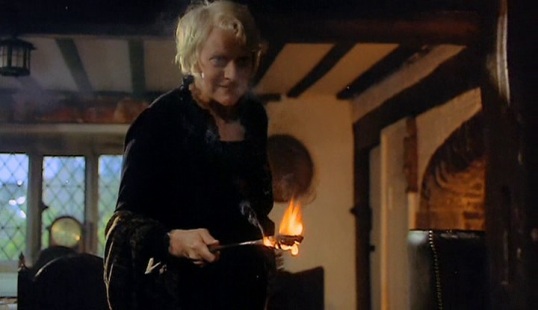
The Flesh and Blood Show (1972, dir by Pete Walker)

Frightmare (1974, dir by Pete Walker)

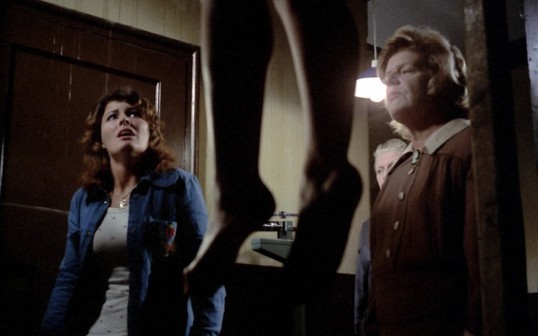
House of Whipcord (1975, dir by Pete Walker)

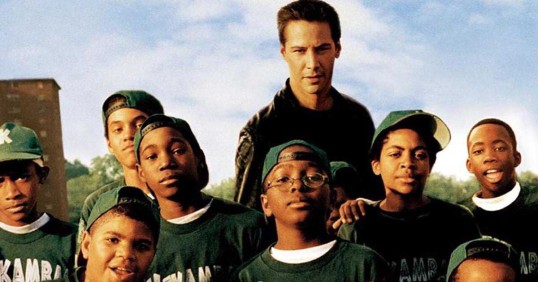
Hardball (2001, dir. by Brian Robbins)


Conor O’Neill (Keanu Reeves) is a gambler who is going to be killed by his bookies unless he can pay off a $6,000 debt.  When he finds out that he can make $500 a week just for coaching a little league team in the Chicago projects, he takes the job.  He’s not planning on caring about the team but, of course, he does.  He doesn’t expect to fall in love but when he meets his team’s 5th grade teacher (Diane Lane), he does.  No one expects him to get his team to the championship but he does.  When tragedy strikes one of his players, Conor and the team have to decide whether to keep playing or to give up.

Hardball is a movie that I wanted to like because Keanu Reeves is in it and the movie tells a good, heart-warming story.  Hardball is really predictable, though, and the movie is so focused on Conor that you never really get to know most of the players on team or what winning the championship would mean to them.  I wanted to know about the members of the team, all of whom were poor, black, and living in the most dangerous neighborhood in Chicago.  (When Conor drops one of them off from practice, he’s told to duck whenever he walks by a window, just in case someone outside is shooting a gun.)  There is one really powerful scene that drives home the reality of the danger that the kids on the team live with on a daily basis but other than that, the movie is almost all about the white coach and his problems.  The team should be the heart of the movie but instead, Hardball focuses everything on Conor and whether or not he’s going to stick with coaching the team even when things get difficult. Even Conor says he’s done, everyone knows he’s not going anywhere.

The other thing that bothered me about Hardball is that, for a baseball movie, there wasn’t enough baseball.  Conor didn’t spend any time discussing strategy with his players or doing any other coaching beyond telling his players not to trash talk each other and to always do their best.  I understand that little league is not the same as major league baseball but I still would have liked to have seen more scenes of Conor actually being a coach and his players actually learning how to play the game.

Hardball‘s not all bad.  It’s got a good heart and it’s got Keanu Reeves.  I just wish it had more baseball.

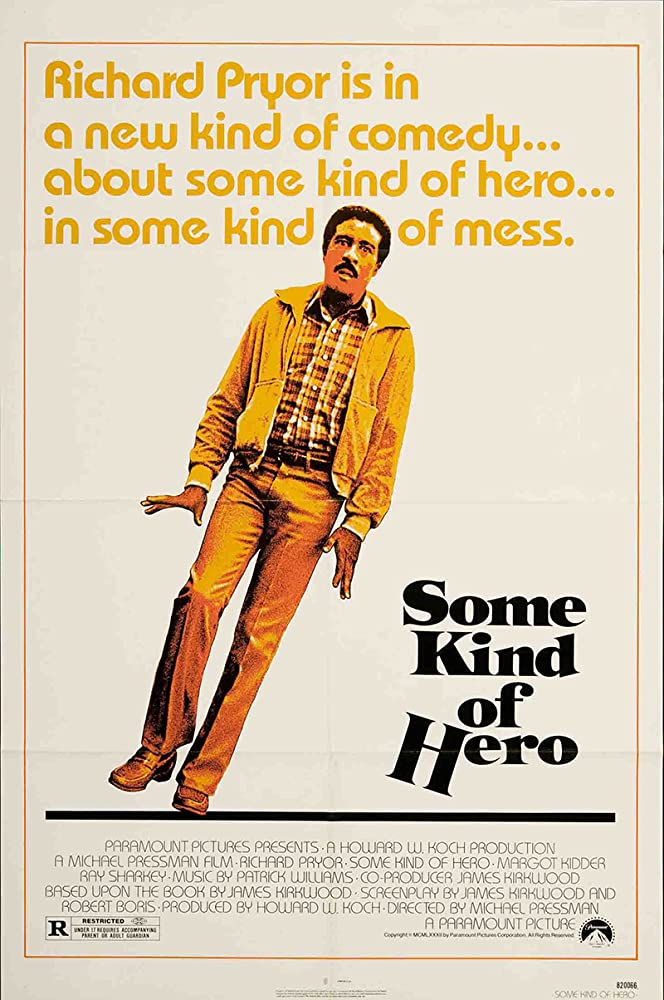
Some Kind of Hero (1982, directed by Michael Pressman)


Eddie Keller (Richard Pryor) is a member of the U.S. Army, serving in Vietnam when he gets captured by the VC and spends the next few years in a POW camp.  During that time, he befriends another POW named Vinnie (Ray Sharkey).  Though the quick-witted Eddie is often able to outsmart his captors and their attempts to turn him into a propaganda tool, he finally snaps when he’s told that Vinnie will be allowed to die unless Eddie signs a “confession” in which he renounces both America and the war.  Hoping to save his friend’s life, Eddie signs the paper.

After 5 long years in the camp, Eddie finally returns to America.  He’s given a momentary hero’s welcome and then he is quickly forgotten about.  After all, everyone wants to move on from Vietnam and Eddie, by his very existence, is a reminder of the war.  However, Eddie can’t move on.  His wife (Lynne Moody) left him for another man while he was missing.  His mother (Olivia Cole) suffered a stroke and is now in a nursing home.  Worst of all, because Eddie signed that confession, the army considers him to be a traitor and is refusing to release his backpay.

What can Eddie do?  How about a rob a bank and then run off with Toni (Margot Kidder), a hooker with a heart of gold?

Like a lot of Richard Pryor’s starring vehicles, Some Kind of Hero is an uneven film.  Pryor was a skilled dramatic actor but he was best known as a comedian and, in most of his starring roles, there was always a conflict between his serious instincts and the demand that all of his films be funny.  Some Kind of Hero starts out strong with Pryor in Vietnam.  The scenes with Pyror and Sharkey in the POW camp are strong.  (In the novel on which the film was based, Eddie and Vinnie were lovers.  In the film, they’re just friends.)  Though there are funny moments during the first half of the film, the humor arises naturally out of the situation.  During the first half of the film, Pryor may make you laugh but he also makes sure that you never forget that he’s on joking to maintain his sanity.  But once Eddie returns to the U.S., Some Kind of Hero awkwardly turns into a heist film and the comedy goes from being darkly humorous to being broadly slaptstick.  Eddie, who could survive being a prisoner of war and who could usually outsmart the VC, is suddenly transformed into a naive klutz.  Richard Pyror does his best but the two halves of the film never seem to belong together.

Unfortunately, Hollywood never really figured out what to do with Richard Pryor as an actor.  Some Kind of Hero at least shows that Richard Pryor could be a strong dramatic actor.  Unfortunately, the film doesn’t really live up to his talents.

Buck Rogers in the 25th Century (1979, directed by Daniel Haller)


In the year 1987, NASA launches it’s final manned mission.  Captain Buck Rogers (Gil Gerard) is sent into space but, while he’s orbiting the Earth, he and his spacecraft fall victim to a strange space anomaly which leaves him in suspended animation.  On Earth, Buck Rogers is believed to be lost.  500 years pass.  Buck’s ship continues to orbit the Earth while, down below, mankind nearly destroys itself in a nuclear war.  Eventually, Earth is reduced to radioactive rubble and what remains of human civilization lives in the city of New Chicago.  (Old Chicago, meanwhile, has been taken over by mutants.)

Finally, in the 25th century, Buck and his ship are discovered by Draconia, a spaceship that belongs to the intergalactic Draconian Empire.  Buck is brought out of suspended animation and meets the beautiful Draconian Princess Ardala (Pamela Hensely) and her second-in-command, an Earthling named Kane (Henry Silva).  Ardala would obviously like to make Buck her prince but, after being in suspended animation for 500 years, Buck just wants to return to Earth.  The Draconians allow Buck to return home.

Upon landing in New Chicago, Buck discovers that the world is much different now.  Everyone wears skintight uniforms and a little robot named Twiki (voice by Mel Blanc) is the only person willing to be Buck’s friend.  Commander Wilma Deering (Erin Gray) is in charge of defending what’s left of human civilization and she’s immediately suspicious of Buck and his story.  When it turns out that Ardala and Kane implanted Buck with a tracking device, Deering want to execute him.  Can Buck prove his loyalty and also thwart Ardala and Kane’s plot to conquer humanity?

Buck Rogers In The 25th Century was originally a pilot for a Glen Larson-produced televisions series.  (Larson was also responsible for the original Battlestar Galactica, another sci-fi show whose pilot was given a theatrical release.)  Hoping to appeal to the same audiences who made Star Wars a monster hit, Universal spent a little extra money to upgrade the special effects, added a few suggestive scenes to prevent the pilot from getting the dreaded G-rating, and then released it in theaters a few months before the TV show premiered.  That was a good idea because the movie did become a minor hit and the TV series went on to run for two seasons.

As the movie itself, it never feels like anything more than an extended episode of a television series.  Gil Gerard is bland in the lead role and most serious sci-fi fans will probably lose interest as soon as the child-friendly robot shows up.  Buck Rogers may have been made to capitalize on the success of Star Wars but it doesn’t have any of the attention to detail or the careful world-building that went into George Lucas’s original space opera.  On the plus side, though, the Dads who took their kids to matinee showings of this film were probably happy to see Erin Gray and Pamela Hensley prominently featured in the film and Henry Silva is a great villain as always.  As with a lot of the sci-fi films that were released in the immediate wake of Star Wars, Buck Rogers In The 25th Century does have a definite camp appeal.  It’s bad but some people will enjoy it on a nostalgic level.

Probably the most memorable thing about Buck Rogers In the 25th Century was its James Bond-inspired title sequence.  Here it is, in all of its glory:

An Offer You Can’t Refuse #16: Love Me or Leave Me (dir by Charles Vidor)


The 1955 film, Love Me or Leave Me, is a biopic about singer Ruth Etting.

Don’t know who Ruth Etting is?  Well, don’t feel too bad.  I didn’t know who she was either, at least not until I watched this movie.  Judging from the trailer that I’ve embedded at the top of this review, she was apparently well-known enough in the 50s for a biopic about her to be a big deal.  Having now watched Love Me or Leave Me and having done some independent research, I know that Ruth Etting was a popular singer in the 20 and 30s and that she was, for a while, married to a gangster named Marty Snyder (played, in the film, by James Cagney).  I also know that, after her marriage to Snyder ended, she married a composer named Johnny Alderman (played by Cameron Mitchell).

I still couldn’t tell you just how closely Love Me or Leave Me actually sticks to the facts of Etting’s life.  I imagine that there was a quite a bit of liberty taken with the truth, if just because the film was made in 1955 and it’s one of those big, glossy productions where all of the sets are ornate and all of the clothes are to die for and all of the dialogue has an edge that’s somehow both tough and sentimental.  It feels less like real life and more like the way that you would imagine life to be.

The film begins in the roaring 20s, with Marty Snyder intervening when Ruth nearly gets fired for kicking an obnoxious admirer.  For Marty, it’s obsession at first sight and, even after Ruth refuses to spend a weekend in Miami with him, Marty continues to help her out in her career.  Marty uses his considerable clout (and the fact that everyone is scared to death of him and his temper) to get Ruth on the radio and then eventually a job with the Ziegfeld Follies.  Despite the fact that Ruth is in love with Johnny and Johnny is in love with her, she ends up marrying Marty because she feels that she owes her entire career to him.  Even after they get married, Marty continues to be obsessively jealous.  It all eventually leads to a shooting, an arrest, and a final song from Doris Day.

It’s very much a film of the 50s.  I imagine that audiences in 1955 thought it made perfect sense that Ruth would feel that she owed it to Marty to marry him despite the fact that she never really asked him to do anything for her.  Seen today, though, Marty comes across as being a stalker and you really want someone to sit Ruth down and have a conversation with her about it and maybe explain concepts like gaslighting and restraining orders to her.

My advise, though, would be to not think too much about it because seriously, the film’s sets are beautiful, the musical numbers are entertainingly excessive, and Doris Day gives a really good performance.  For those who only know her from the romantic comedies that she did with Rock Hudson, Love Me or Leave Me is a revelation.  She’s likable and she’s tough and she sings as if the world depended upon it and watching her in Love Me Or Leave Me, you not only understand why Ruth Etting became a star but also why Doris Day did as well.  James Cagney also gives a good performance as Marty Snyder, bringing all of his swaggering charisma to the role.  As a fan of exploitation films, the most interesting thing about Love Me or Leave Me to me was getting to see Cameron Mitchell play a nice guy for a change.  Mitchell does an okay job with the role, though Johnny is never as interesting a character as Marty.  In the end, it’s an entertaining film, an ornate visual feast that works as long as you don’t think about it too much.

Love Me or Leave Me is an offer that you can’t refuse.

Previous Offers You Can’t (or Can) Refuse:

  1. The Public Enemy
  2. Scarface
  3. The Purple Gang
  4. The Gang That Could’t Shoot Straight
  5. The Happening
  6. King of the Roaring Twenties: The Story of Arnold Rothstein 
  7. The Roaring Twenties
  8. Force of Evil
  9. Rob the Mob
  10. Gambling House
  11. Race Street
  12. Racket Girls
  13. Hoffa
  14. Contraband
  15. Bugsy Malone

4 Shots From 4 Films: Special Olivia De Havilland Edition


4 Shots From 4 Films is just what it says it is, 4 shots from 4 of our favorite films. As opposed to the reviews and recaps that we usually post, 4 Shots From 4 Films lets the visuals do the talking!

Today, I’m thrilled to wish a happy birthday to two of my favorite people!

First off, let’s all wish a happy birthday to Patrick Smith!  Along with being a contributor here on the Shattered Lens, Patrick is also a Snarkalec in good standing and one of the founders of the Late Night Movie Gang!  I’ve been happy to call Patrick a friend for several years now and I’m thankful to have him as part of a team here on the Shattered Lens!  Happy birthday, Pat!

Also born on this day was the one and only Olivia de Havilland.  Olivia is 104 years old today, one of the last remaining stars of Hollywood’s golden age.  Olivia de Havilland, whose career spanned 53 years and who co-starred with everyone from Errol Flynn to James Stewart to Michael Caine, currently lives in Paris and I can’t wait to celebrate her 105th birthday next year.

In honor of a legendary career and life, here are….

4 Shots From 4 Films

The Adventures of Robin Hood (1938, dir by Michael Curtiz)

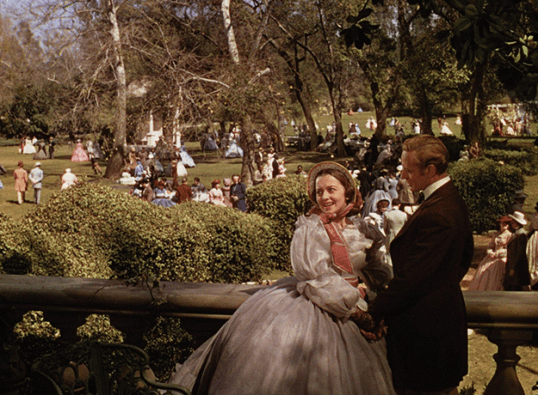
Gone With The Wind (1939, dir by Victor Fleming)

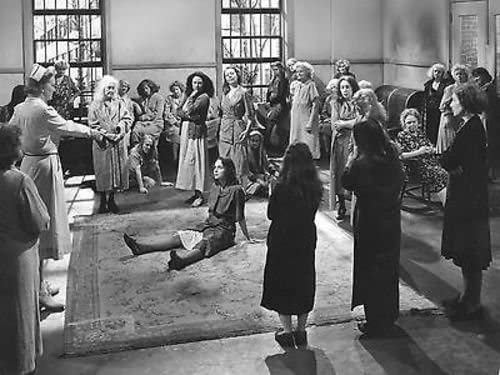
The Snake Pit (1948, dir by Anatole Litvak)

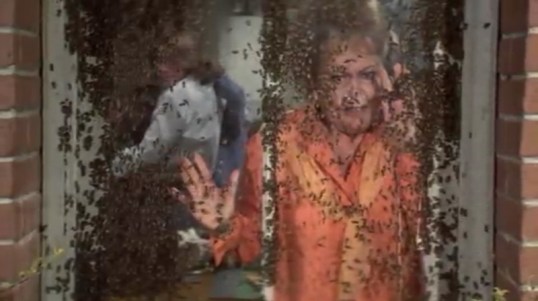
The Swarm (1978, dir by Irwin Allen)

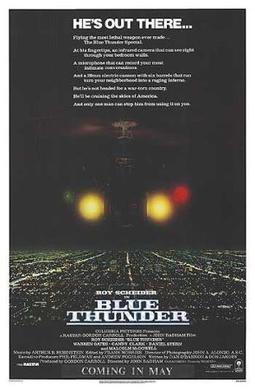
Blue Thunder (1983, directed by John Badham)


Frank Murphy (Roy Scheider) is a Vietnam vet-turned-cop who pilots a police helicopter for the LAPD.  Every night, he and his partner, Richard Lymangood (Daniel Stern) fly over Los Angeles, helping to keep the peace and peeping on anyone undressing in a high-rise apartment.

Murphy is selected to serve as the test pilot for what is described as being the world’s most advanced military helicopter, Blue Thunder.  Blue Thunder is so advanced that the pilot can control the gun turrets just by turning his head and it’s also been supplied with the latest state of the art surveillance equipment.  The pilot of a Blue Thunder can literally spy on anyone while listening to and recording their conversations.  With the Olympics coming up, the city of Los Angeles wants to test out the Blue Thunder as a way to control the crowds and prevent crime during the Games.

Murphy may be impressed by the helicopter but he has his reservations about the program.  He immediately sees that Blue Thunder could be a dangerous tool in the wrong hands.  Those wrong hands would belong to Col. Cochrane (Malcolm McDowell), who was Blue Thunder’s first pilot and also Murphy’s commanding officer during Vietnam.  Murphy is still haunted by the atrocities that he saw committed by Cochrane during the war.

When it turns out that Murphy was right to be suspicious of Cochrane’s intentions, the movie turns into an exciting aerial chase above Los Angeles, with Murphy in Blue Thunder, trying to outrun F-16s, heat-seeking missiles, and eventually Cochrane, who enters the chase in a Blue Thunder of his own.

I’m always surprised that Blue Thunder doesn’t have a bigger following than it does.  It’s an action classic, with a gritty performance from Roy Scheider, a villainous performance from Malcolm McDowell, and comedic relief from the always reliable Daniel Stern.  Even Warren Oates is in the movie, playing Murphy’s LAPD commander!  The script actually does have something relevant to say about the militarization of America’s police forces (and it feels downright prophetic today) and the chase scenes are all the more exciting because they were filmed in the era before CGI and have an authenticity to them that is missing from most modern action films.

Blue Thunder is a perfect example of the “don’t do this really cool thing” style of action film.  The Blue Thunder helicopter is described as being a danger to everyone in the country and the movie even ends with a note saying that real-life Blue Thunders are currently being designed.  But I don’t think anyone who has ever watched this film has thought, “I hope they stopped making those helicopters.”  Instead, this movie makes you want to have a Blue Thunder of your very own.  They’re so cool, who wouldn’t want to fly one of those things?

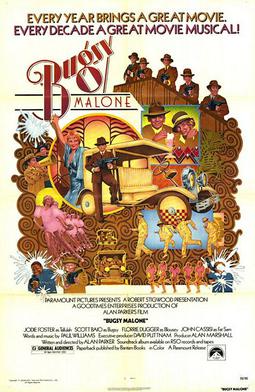
An Offer You Can’t Refuse #15: Bugsy Malone (dir by Alan Parker)


Remember how, a few weeks ago, I said I was going to spend the month of June reviewing 30 gangster movies?  Well, I was doing pretty well but then I got distracted with some things and I ended up falling behind and now, it’s the last day of June and I’ve only reviewed 14 of the 30 films that I was planning on taking a look at.  It’s frustrating but, as any movie blogger can tell you, it happens.  Still, I’m not one to give up so easily!  I promised to review 30 gangster movies and I’m going to keep my word.  Or, at the very least, I’m going to try to…. like, definitely maybe try to….

Anyway, let’s get back to it with 1976’s Bugsy Malone!

Bugsy Malone is an homage to the old gangster movies of the 1920s and 30s.  It’s also a musical, featuring a lot of songs about wanting to make a lot of money, fall in love, and go away to Hollywood.  On top of all that, it’s also a children’s film.  Though they may be playing gangsters and going to war over who will control the rackets, the cast is entirely made up of children.  Though the film does feature a lot of guns, none of the guns fire bullets.  Instead, they shoot custard pies.  Once you get cornered by a rival gangster and you get “splurged,” your career in the rackets is over.  You’re humiliated.  You’re nothing.  You’re just another two-bit hood who couldn’t make it in the big leagues.  You’re just….

Well, you get the idea.

Basically, the plot of the film is that Dandy Dan (Martin Lev) and Fat Sam (John Cassissi) are two rival gangsters who want to take over the Lower East Side.  Fat Sam owns a speakeasy, which means that there’s always a lot of dancing and singing going on in the background.  Bugsy Malone (Scott Baio) is a tough boxer who wants Fat Sam to give a job to Blousey Brown (Florrie Dugger), who dreams of going to Hollywood and becoming a big star.  Tallulah (Jodie Foster) is Fat Sam’s gun moll but she used to go out with Bugsy and she still wants him back.  Bugsy get caught up in the middle of the war between Dandy Dan and Fat Sam and it all eventually leads to a big pie fight and a lot of children covered in custard.  “You give a little love,” the children sing as they realize that their lives don’t have to be defined by gang wars, “and it all comes back to you….”

So, I have to admit that I was absolutely dreading watching Bugsy Malone.  I mean, singing children and custard pie guns?  It all sound just unbearably cutesy.  But, to my surprise, Bugsy Malone actually turned out to be a fun and clever little movie, one that was full of smart dialogue, catchy songs, excellent dancing, and wonderfully non-cutesy performances from its cast.  Even though the film may be about a bunch of children dressing up as gangsters, all of the child actors take their characters seriously and director Alan Parker directs the film as if it were an actual gangster film as opposed to just a children’s musical.  The end result is a film that’s cute but never cutesy.  Believe me, there is a huge difference between the two.

To my shock, Bugsy Malone turned out to be an offer that you can’t refuse.

Previous Offers You Can’t (or Can) Refuse:

  1. The Public Enemy
  2. Scarface
  3. The Purple Gang
  4. The Gang That Could’t Shoot Straight
  5. The Happening
  6. King of the Roaring Twenties: The Story of Arnold Rothstein 
  7. The Roaring Twenties
  8. Force of Evil
  9. Rob the Mob
  10. Gambling House
  11. Race Street
  12. Racket Girls
  13. Hoffa
  14. Contraband

Lisa Marie’s Oscar Predictions For June


Once again, even trying to predict the Oscars this year seems like a fool’s errand.

Our story so far:

  1. COVID-19 shut everything down, including both theaters and production on many of the films that were expected to be contenders for the 2020 Oscars.
  2. The Academy announced that, for this year only, VOD and streaming-only films would be considered eligible for the Oscars.  That’s good news for all of the films premiering on Netflix and Prime right now, right?
  3. It looked briefly as if theaters might start reopening in July.  Tenet awaits!
  4. Oh wait, there’s still a pandemic going on.  Keep those theaters closed.
  5. But what about Tenent!?  Tenet will open in July, no matter what!
  6. Tenet gets moved back to August.  Every other big production gets moved back to August and chances are they’ll get moved back again.
  7. The Academy, meanwhile, throws everything into even more disarray by announcing that they will be extending the eligibility window to the end of February of 2021.
  8. And now, we’re all waiting to see which films will be moved either back or forward to a January or February 2021 opening in order to qualify for the Oscars.

In other words, who knows what’s going to be eligible once the Academy finally gets around to selecting their nominees.  Personally, I wish they hadn’t moved the eligibility window.  It feels like a bunch of studios complained about the having to release all of their big movies via VOD so the Academy said, “Okay, we’ll give you an extra two months.”  With the way things are going, though, it’s totally possible that theaters could still be closed in January and February so joke’s on them.  ENJOY YOUR VOD OSCARS, YA BASTARDS!

Anyway, here are my monthly Oscar predictions.  I did the best I could with what little information is actually out there.  Normally, I would say that the Da 5 Bloods came out too early to be remembered at Oscar time but this is not a typical year.  Despite the best picture victories of 12 Years A Slave and Moonlight, no black director has ever won best director.  If there’s ever a year when the Academy is going to be motivated to rectify that, it will be this year.

Anyway, be sure to check out my equally useless predictions for January, February, March, April, and May!

Best Picture

Ammonite

Da 5 Bloods

The Father

Hillbilly Elegy

News of the World

Nomadland

On The Rocks

Respect

Soul

West Side Story

Best Director

Ron Howard for Hillbilly Elegy

Paul Greengrass for News of the World

Spike Lee for Da 5 Bloods

Steven Spielberg for West Side Story

Chloe Zhao for Nomadland

Best Actor

Benedict Cumberbatch in The Courier

Tom Hanks in News of the World

Sir Anthony Hopkins in The Father

Delroy Lindo in Da 5 Bloods

Bill Murray in On the Rocks

Best Actress

Amy Adams in Hillbilly Elegy

Jennifer Hudson in Respect

Angelina Jolie in Those Who Wish Me Dead

Frances McDormand in Nomadland

Kate Winslet in Ammonite

Best Supporting Actor

David Alvarez in West Side Story

Tom Burke in Mank

Richard E. Grant in Everybody’s Talking About Jamie

Mark Rylance in The Trial of the Chicago 7

Forest Whitaker in Respect

Best Supporting Actress

Abigail Breslin in Stillwater

Glenn Close in Hillbilly Elegy

Ariana DeBose in West Side Story

Saoirse Ronan in Ammonite

Helena Zengel in News of the World

The Stratton Story (1949, dir. by Sam Wood)


Monty Stratton was one of the greats.

He was a Texas farmboy who knew how to throw a baseball.  Recruited by the Chicago White Sox, he spent five years in the majors.  From 1934 through 1938, he compiled a 36–23 record with 196 strikeouts and a 3.71 ERA in 487.1 innings.  In 1937, he won 15 games with a 2.40 ERA and five shout-outs.  The next season, he won another 15 games and completed 17 of his 22 starts.  For those of you who might not speak baseball, that all means that he was a really good right-handed pitcher.

When Stratton wasn’t playing baseball, you could find him down on his farm in Greenville, Texas.  He lived there with his wife, Ethel.  On November 27th, 1938, Monty Stratton was hunting rabbits when he accidentally shot himself in his right leg.  While Stratton survived the shooting, his leg was amputated, bringing Stratton’s major league career to an end.

No longer able to play in the majors, Monty Stratton spent the next few years as a pitching coach and helping to start a semi-pro team in Greenville.  With the help and encouragement of his wife, he continued to practice his pitching and he eventually trained himself to the point where he could transfer his weight effectively onto his artificial leg so that he could effectively throw a baseball.  In 1947, Monty Stratton made a comeback, pitching in the minors and ending the season with an 18–8 record and a 4.17 earned run average.  Stratton spent the next six years pitching in the minors before retiring from the game.  He went on to start the Greenville Little League program.  If you go to Greenville, you can still find Monty Stratton Field near Greenville High School.

The Stratton Story was made in 1949, shortly after Stratton’s comeback and while he was still playing in the minors.  James Stewart plays Monty Stratton while June Allyson plays his wife.  The movie follows Stratton from his early days on the farm through his major league career, his accident, and his eventual comeback.  Though the real Monty Stratton served as a technical advisor to the film, I don’t know how historically accurate it was.  The movie, for instance, seemed to condense the timeline so that it seemed like Stratton went straight from losing his leg to practicing for his comeback when it actually took ten years for Stratton to eventually get signed to a minor league team.  Even if it does take some liberties from the facts, The Stratton Story is still a good movie.  The baseball scenes are great and Jimmy Stewart is convincing when he’s throwing the baseball.  He’s also convincing in the scenes where Stratton sinks into a dark depression after losing his leg.  Stewart was so good in the role that, when Stratton finally started to practice his pitching again, I wanted to jump up and cheer.

I liked The Stratton Story.  It probably helps that I love baseball but it’s also a good movie about an inspiring story.