Scenes I Love: Two Orphan Vampires


Sometimes, I feel that there are only two types of people in the world.  There’s the minority who appreciate the dreamlike atmosphere and sensual obsessions that dominate the vampire films of French director (and genius) Jean Rollin.

And then there’s the majority who don’t.  We refer to this majority as being “the idiots.”

As for me, Jean Rollin is one of my favorite directors.  I’ve previously reviewed his low-budget masterpiece, Night of the Hunted, on this site.  I hope, in the future, to review even more of his films.

For now, I’d just like to share a scene from one of his later films, the hauntingly beautiful and elegiac Two Orphan Vampires. 

Rollin is a director best known for spending the past five decades making films in which he continually and obsessively returns to a few key themes: the importance of memory, a nostalgia for the innocence of youth mixed with the knowledge that youthful innocence could also be destructive, a fascination with the beach, an obvious love of architecture (Rollin films old castles the way that an American director might film an action sequence), and — most notoriously — the use of two female protagonists who are usually portrayed as possessing a very strong, sister-like bond even though it’s rare that they actually are blood-related. 

A good deal of Rollin’s current following comes from men who feel that there’s an erotic element to Rollin’s portrayal of female friendship.  And to an extent, they’re right.  But to an even greater extent, it doesn’t matter.  Regardless of why the relationships between Rollin’s protagonists exists, the important thing is that they are portrayed as sharing an unbreakable bond.  Whether they’re linked by lust, friendship, or just memory, Rollin’s women are bonded by a very true, very real love and that’s what makes his movies special to me.

This is what the scene below is all about.  The two orphan vampires of the title are two teenage sisters.  During the day, they are blind but when the sun goes down, they can not only see but they become vampires as well.  Two Orphan Vampires is a surprisingly sad and haunting look at their attempts to survive in a world that has no place for them.  In the scene below, after failing in several attempts to get the blood they need to continue to live, each sister resorts to drinking the blood of the other.  To me, every thing that Rollin had directed before was leading up to this scene.

(This scene is also prototypical Rollin in that the budget is obviously low, the actors are more than adequate but, at the same time, are obviously not professionals, and the English dubbing is poorly done.  And yet the scene itself — especially when seen in the larger context of both the entire film and Rollin’s movies as a whole — is actually more sincere and memorable than the majority of what is produced by the mainstream.  In short, this is pure Rollin in that you either get it or you don’t.)


Film Review: The Expendables (Dir. by Sylvester Stallone)


I know that I really should have hated The Expendables.  For one thing, it’s a very, traditional, let’s-blow-up-Eric-Roberts-and-save-the-damsel-in-distress action film.  Storywise — well, there really isn’t a story beyond a bunch of inarticulate, muscle-bound men blowing shit up.  The Expendables is perhaps the most hyper-masculine film since Avatar, the type of movie that was obviously not made with anyone possessing a brain or a vagina in mind. 

In short, the Expendables is the type of mainstream, action movie that — based on everything I’ve ever written on this site — I should have hated.  But you know what?  I didn’t hate it.  I’m not saying that I loved the movie (because I certainly did not) but on the whole, The Expendables is a fun movie and sometimes, that’s more than enough.

The Expendables are a group of mercenaries, led by Sylvester Stallone and Jason Stathan.  They are, of course, the best at what they do.  They must be as their existence is apparently a well-kept secret despite the fact that they all have prominent Expendables tattoos and all they drive motorcycles covered with colorful Expendable decals.  So, the question is — can you accept the fact that the movie tells us the Expendables are a secret even though they clearly would never be able to pull that off in real life?  If the answer is yes, read on.  And if the answer is no, please don’t ever talk to me because you probably lack a proper appreciation for the absurd.

Anyway, The Expendables are hired by Mr. Church.  Mr. Church is played by Bruce Willis who, in his very short scene, manages to chew up more scenery than a termite in heat.  (That’s a lot of scenery.)  Mr. Church wants the Expendables to go to a poor, island nation and overthrow the military dictator.  Or something like that.  To be honest, I never really figured out what the exact mission was other than it involved blowing a lot of shit up. 

Oh, I nearly forgot to mention that Eric Roberts is on the island too.  He’s a bad guy.  You know he’s a bad guy because he’s always stopping the action to tauntingly explain his evil plans.  (It also helps that he’s played by Eric Roberts.)  Roberts is a bit of let down as a villain and its hard not to feel that his performance was basically made up of deleted scenes from The Dark Knight.  Then again, in Roberts’ defense, he’s having to compete with memories of Jason Patric playing a similar character in The Losers.

If Roberts’ villain is disappointing, the Expendables themselves are played well enough.  While Sylvester Stallone is hardly a great actor, he knows how to play an action hero and he brings just the right mix of self-aware parody and self-righteous fury to his role.  His second-in-command is played by Jason Stathan who displays something resembling charisma for the 1st time in his odd film career.  The other Expendables don’t get much to do beyond deliver a few quirky lines of dialogue and blow stuff up.  One of them is played by Jet Li who dominates his few scenes even though he doesn’t really get to do much.  Another Expendable is played by the Old Spice Guy who, according to Wikipedia, is actually a pro-athlete named Terry Crews.  However, all of the Expendables appear to enjoy hanging out together.  You get the feeling that they had a good time making this movie and, as a result, you feel almost guilty for worrying about stuff like logic or ambiguity.

The main selling point of The Expendables is that it apparently features every single action star in existence.  Even Arnold Schwarzenegger gets to make a largely pointless cameo and deliver the film’s worst one liners while, in real life, the state he’s supposed to be running descends further and further into financial doom.  While I recognized Stallone, Stathan, Willis, Roberts, Mickey Rourke, and Jet Li, apparently everyone else in the cast used to be someone at some point as well.  Luckily, I saw this movie with my friend Jeff who got very excited as he explained to me who everyone was and why their presence on-screen was making all the men in the audience so positively giddy.  To be honest, I think I probably actually understood a little less than a fourth of the information that Jeff provided me with but he was so incredibly cute trying to explain it all.

(I imagine I probably gave him the same look that he gave me when I attempted to explain Sex and the City 2 to him.)

As I explained at the start of this review, the Expendables is not, technically, a good film but it is a lot of fun.  As opposed to the Avatars of the world, the Expendables is a movie that is at peace with what it is.  There’s no attempt to try to fool the audience into thinking that they’re seeing a work of art.  There’s something to be said for that type of honesty, especially when you consider that we’re approaching that time in the film season when every movie is going to be marketed as a sure-fire Oscar contender.

And if the film is a hyperactive overload of testosterone — well, it is what it is.  After sitting through hundreds of films based on books by Nicholas Sparks, all featuring Miley Cyrus, Emma Roberts, or Amanda Seyfried haunting the beach all to win the love of some sensitive lifeguard eunuch, there’s something undeniably appealing about watching a bunch of guys acting like guys.  Zac Efron might have the heart and soul of poet but can he blow shit up?

A Quickie With Lisa Marie: Twelve (directed by Joel Schumacher)


I’ve seen a lot of reviews for the just-released Twelve that have referred to this movie as just being an extended episode of Gossip Girl, largely because the movie deals with spoiled, rich teenagers and it stars Chace Crawford.  I’m going to venture a guess that the majority of these reviewers have never actually seen an episode of Gossip Girl, which is actually entertaining and self-aware in a way that the ploddingly obvious Twelve could never hope to match.

Crawford plays White Mike.  He’s a recent high school drop out who now makes his living selling drugs — mostly marijuana — to his former classmates.  However, his classmates — not to mention his cousin, Charlie — are more interested in sampling a new designer drug known as twelve.  We’re told that twelve feels like a combination of cocaine and ecstasy.  As this movie struggled to reach its apocalyptic conclusion, I found myself thinking, “That doesn’t sound too bad.  I wonder if I can get some twelve after the movie…”

Anyway, Twelve charts out four days in the life of Crawford and his former classmates.  It starts with Crawford ignoring a pathetic phone call from his junkie cousin and it ends with a shooting rampage at a party that leaves the majority — but not all — of the cast dead.  It’s supposed to be an anti-drug film but, like far too many anti-drug films, it can’t disguise the fact that the characters are a lot more fun to watch when they’re on drugs than when they aren’t.  (For instance, we’re told early on that White Mike doesn’t do drugs, smoke, or drink and just look how miserable he is.)  Director Joel Schumacher gives us a lot of really pretty images but there’s nothing below the surface and as a result, the film’s massacre doesn’t so much feel tragic as it just feels like a poorly planned fashion spread in Elle. 

(As opposed to Nick McDonnell’s original novel, the film Twelve is mainstream enough to only allow unlikable characters to die at the end.)

The cast is almost achingly pretty but, at the same time, largely forgettable, with two major exceptions.  Poor Rory Culkin (who I worry about because he always seems so sad every time he shows up in a movie) brings a lot of pathos to his role as the geeky kid who happens to have the perfect party house, permissive parents, and a psychotic older brother.  Emily Meade is memorable playing a character who, in many ways, is a female version of Culkin’s.  Playing a bipolar girl who discovers a love for twelve, Meade actually manages to overcome the generic plot (the type that demands that she go from being an honor’s student to selling her body to Curtis “50 Cent” Jackson in little over 24 hours) and makes her character compelling.  Plus, she has a fun scene where her teddy bears encourage her to kill people.

Still, the movie ultimately belongs to Keifer Sutherland who never appears on-screen but who gets more dialogue than anyone else in the entire film.  Sutherland plays the narrator.  That’s right, as simplistic as the movie is, Schumacher apparently felt that the movie needed a narrator to tell us what we’ve just seen onscreen.  For instance, we see Crawford selling drugs.  Suddenly, Sutherland’s voice informs us, “White Mike is a drug dealer.”  “Oh,” we say in the audience, “so that’s why he’s exchanging marijuana for money…” 

Even though the narrator is essentially just quoting large chunks of prose from McDonnell’s novel, the use here is technically a mistake.  I say “technically” because it cannot be denied that Sutherland has probably got the sexiest narrator voice around.  Regardless of whether the movie needed it, I needed it.  If nothing else, I will always remember seeing Twleve as the time I heard Keifer Sutherland say, in his purring growl of a voice, “I want to tap that ass,” and I thought, “Well, okay…”

Too Sordid To Ever Be Corrupted


“How could you have possibly enjoyed that movie?”

I hate that question.  I hate the self-righteous tone of it.  I hate the demand that I justify anything that I choose to do with my life.  I hate the implication of the question, the suggestion that somehow there is some sort of moral force at the center of the universe that determines whether or not a movie can be enjoyed.

Unfortunately, no matter how obviously justified I am in loathing that question, it’s still one that I am frequently asked.  How can I not only enjoy watching old school exploitation and grindhouse films (the majority of which were made before I was even born) but also devote a good deal of my time to not only watching these movies but tracking them down and then telling the rest of the world how much I love them?

(Of course, what they’re really asking is what are you doing watching exploitive trash like House On The Edge of the Park or Fight For Your Life when you should be out finding a husband, driving an SUV, and living a life of quiet desperation?)
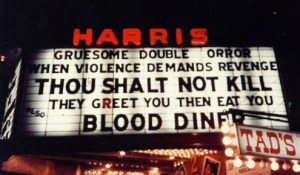
First off, I should confess.  I have commitment issues, I know it.  I realize that, as a result of some personal experiences in the past, that I tend to beg for affection and attention even while I’m putting up my own invisible wall to keep anyone from getting too close.  It’s not easy for me to trust but, after writing for this site since May, I feel like maybe it’s time to share a little bit more about me.  Hi.  My name is Lisa Marie.  I’m 24.  I have three older sisters that I love.  I’m a proud to be an Irish-German-Spanish-Italian-American.  I lived in five different states before I was 13 and I’m rarely amused when people point out the country twang in my voice.  Up until I was 17, ballet was my life but then I fell down a flight of stairs, broke my ankle in two places, and that was the end of that.  I worked very hard to earn a degree in Art History.  Not surprisingly, my current job has nothing to do with art or history.  I have asthma and heterochromia (my right eye is a darker shade of green than the left).  I’m blind without my contacts.  I like cats, driving fast, and being single.  I dislike dogs, needy men, and those tiny little smart cars.  The only thing that can equal my love for the Grindhouse is my hatred for the Mainstream.

Here’s a few reasons why.

1) Before Independent Film, there was the Grindhouse.

Today, if a young director wants to show what he’s capable of doing, he makes his own little film and enters it into various film festivals and, if he’s made something interesting, he might sign a distribution deal and his film might pop up down here in Dallas at the Angelika theater.  In the 70s, that young director would make an exploitation film, hope that it had enough sleaze appeal to make back its budget by playing in a New York Grindhouse (or a Southern drive-in) and, if he had made something interesting, his cheap, exploitation film might eventually end up being released on DVD by Anchor Bay or Blue Underground.  The best Grindhouse films were made by director who were eager to show what they were capable of doing.  These movies were not made by multimillionaires with houses on both coasts of the country.  Grindhouse movies were made by director who had to work to create something memorable, filmmakers who knew that they might never get another chance to put their vision on-screen.

2) The Mainstream Lies.  The Grindhouse is honest.

Mainstream films are just that.  They are films designed to appeal to the widest possible audience.  A mainstream movie is not made for you.  A Mainstream movie is made to appeal to the brain-dead suburbanites who can be easily recruited at the local mall to be a part of a test screening.  A Mainstream movie is made to be inoffensive.  A Mainstream movie is edited and re-edited to remove anything that could possibly negatively reflect on the bottom line.

Grindhouse movies, however, didn’t have time for that.  Grindhouse movies were made to exploit the moment.  As a result, there was no time to worry about appealing to everyone.  There was no time to constantly edit until not a single rough edge remained.  Grindhouse films are messy.  Grindhouse films are not always pleasant.  They don’t always have the perfect ending.  In short, Grindhouse movies are like life itself.

In the end, safe and inoffensive mainstream movies are made to appeal to the who we wish we were.  Grindhouse movies — sordid, sometimes uncomfortable, and always appealing to the audience’s most primal thoughts, fears , and desires — are made to appeal to who we actually are.
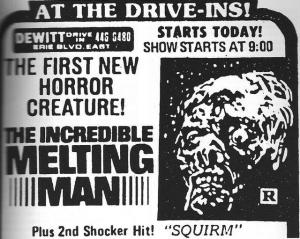
3) The Mainstream is bland.  The Grindhouse is dangerous and unpredictable.

Where else but in a Grindhouse film could you hear a killer who speaks like a duck like in Lucio Fulci’s The New York Ripper?  Because the Grindhouse was free of the need to try to fit in with what the mainstream decreed to be normal, the Grindhouse had the freedom to come up with some of the most brilliantly demented plots in the history of film.  When was the last time that the plot of a Mainstream film really caught you off guard?  I’m not talking about safe, inoffensive surprises like Avatar‘s 3-D effects.  I’m talking about a plot where, halfway through, you look at your fellow viewer and you both say, “What the fuck was that!?”  Anything can happen in the Grindhouse.  As soon as things start to feel safe and a little boring, the Grindhouse has the ability to make things exciting again.  The Mainstream, meanwhile, just asks you to get married.
4) The Mainstream always condescends.  The Grindhouse occasionally empowers.

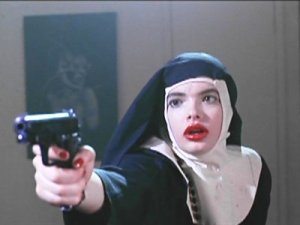
Here’s a story of two movies.  In the mainstream Brave One, Jodie Foster gets a gun after she’s raped and her dog is stolen.  (In typical mainstream fashion, the movie doesn’t seem to be sure which crime is supposed to be worse.)  In the grindhouse Ms. 45, Zoe Tamerlis gets a gun after she’s raped twice in one day.  In the Brave One, Foster passively sits on the New York subway and waits until she threatened with rape a second time before she kills the potential rapist.  In Ms. 45, Tamerlis shoots every man she sees because she knows that every man she sees is a potential rapist.  In The Brave One, Foster gets her revenge by remaining the victim.  In Ms. 45, Tamerlis becomes the aggressor.  Both Foster and Tamerlis act in self-defense but Foster is wracked with guilt because the mainstream cannot risk losing its audience.  Tamerlis becomes stronger and more confident with each murder as, for the first time, she has found a way to control her own destiny.  At the end of The Brave One, Foster is not only rescued by a man but she gets her dog back too.  At the end of Ms. 45, Tamerlis goes on a shooting rampage at a Halloween party and is finally killed by another woman.  The Brave One‘s tag line was “How many wrongs to make it right?”  Ms. 45’s tagline: “She was used and abused and it will never happen again!”

I know this is probably going to be my most controversial argument.  Don’t get me wrong, I’m not advocating that we should just go out and start randomly shooting men.  But, I will say this — in Ms. 45, Zoe Tamerlis refuses to be a victim and she — and the film — refuses to let society off the hook.  When I think about Ms. 45, it doesn’t inspire me to hate men (because, trust me, I don’t) and it certainly doesn’t inspire me to grab a gun and start shooting.  It does, however, inspire me to not allow myself to fall into that never-ending cycle of victimhood.

I’m not attempting to argue that Grindhouse films are secretly feminist films.  Grindhouse films are infamous for exploiting women.  However, so does the mainstream.  (Of the two films, The Brave One features nudity.  Ms. 45 does not.)  Both the Grindhouse and the mainstream obviously get off on victimizing women.  However, in the Grindhouse, women were occasionally (though certainly not often) allowed to fight back with the same aggression and determination that the mainstream, for the most part, usually reserves just for men.

(If The Girl With The Dragon Tattoo had been released in the 70s, it would have played at the Grindhouse.)

5) Lastly, and most importantly, the Grindhouse is still our little secret.

Let’s just admit it — independent films are trendy.  Contemporary independent films have, to a large extent, become the new mainstream.  The earnest film students who had a Sundance hit are now going to Hollywood to make the next Benjamin Button.  Sundance is just ShoWest with more facial hair.  However, the old school grindhouse will never sell out because it no longer exists.  It was destroyed by the morality police before it could sacrifice its soul.  While an independent filmmaker is just a director who will eventually grow up and break your heart, the great Grindhouse films are frozen in time, too sordid to ever be corrupted.  The Mainstream will never embrace the Grindhouse and for that reason, the Grindhouse will always be the ultimate statement of freedom.
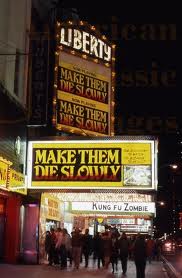
Film Review: Cyrus (dir. by Mark and Jay Duplass)


Last Tuesday night, as we watched the end credits of Cyrus rolling across the screen at the Plano Angelika, a very dear and close friend of mine leaned over and whispered in my ear, “That was a really odd fucking movie.” 

(Actually, it was two weeks ago.  Sorry, I started this review a while ago and only recently returned to finish it.)

And he’s right.  Though the film is worth seeing (though I’d honestly suggest waiting until it comes out on DVD unless you’re just the world’s biggest John C. Reilly or Jonah Hill fan), Cyrus really is an odd fucking movie.

Cyrus is the latest film from Jay and Mark Duplass, the two brothers responsible for 2008’s Baghead, one of the unacknowledged great films of the last decade.  In Cyrus , John C. Reilly plays a character named — appropriately enough — John.  John is a likable loser, a less musical version of the character Reilly played in Chicago.  When the movie opens, John is depressed over the fact that his ex-wife, Jamie (Catherine Keener), is getting married again.  At Jamie’s suggestion, he goes to a party where he proceeds to have too much to drink, flirts awkwardly with every woman he sees, and somehow manages to charm Molly (Marisa Tomei).  Molly is soon sleeping over at John’s house but every morning, John wakes up to discover that she’s either already left or is in the process of sneaking out.  John asks her if she’s married.  Molly replies that she’s not but is still vague about why she never stays the entire night.  Finally, one morning, John follows Molly after she leaves.  He sits out in front of her house and, after she’s left for work, John proceeds to creep around outside the house. 

And, of course, its while he’s doing all of this creepy stalker stuff that he first meets Cyrus (played, of course, by Jonah Hill).  Cyrus is Molly’s 22 year-old son and from the minute he first appears, its obvious that there’s something off about him.  He’s far too friendly and speaks in the oddly stilted cadence of someone who is obviously making an effort to act “normal.”  He  spends all of his time composing New Agey synthesizer music in an elaborate home recording studio.   Of course, the main sign that there’s something odd about Cyrus is that he’s played by Jonah Hill.

However, the main thing that distinguishes Cyrus is just how close he is to his mother.  From the first moment that we see him and Molly interact (he’s playing his music and Molly enters the house and immediately starts dancing to it), its obvious that Cyrus is Oedipus, Norman Bates, and Yanni all wrapped up into one package.  And, obviously, he views John as being competition…

Cyrus is an uneven film, one that starts out strong but — once the title character is actually introduced — suddenly seems to get hit by an identity crisis.  Is it a realistic portrait of sad, lonely people trying to find love in uncertain times or is it an Apatowish mix of stoner sentiment and over-the-top comedy?  Is Cyrus meant to be the emotionally wounded, painfully insecure outsider that he appears to be the movie’s more contemplative moments or is he just a sociopathic comedic device that Reilly has to overcome in order to pursue his relationship with Tomei?  That’s the question that is at the heart of Cyrus and discovering the answer is the film’s entire excuse for existing.  Unfortunately, the Duplass Brothers don’t seem to know the answer themselves and as a result, the entire film feels directionless and we’re left with too many unanswered questions.

For instance, where is Cyrus’s father?  It’s mentioned by both Cyrus and Molly that the father is no longer in their lives but why?  Though its never explicitly stated, its obvious that both Cyrus and Molly have suffered abuse in the past, probably at his hands.  However, the issue itself is never directly confronted and its hard to believe that John wouldn’t have asked about it at some point.  For that matter, beyond her role as Cyrus’s mother and John’s girlfriend, Molly isn’t given any back story whatsoever.  Considering the fact that the entire movie is about how Cyrus and John feel towards her, it’s interesting that she’s never given a scene where she really gets to explain how she truly feels towards either of them.  A good deal of the film’s attitude towards Molly can be seen in the fact that, while a major plot point hinges on her being at her job as opposed to at home, we never find out just what exactly it is that she does for a living.

That’s unfortunate because, in many ways, Cyrus shows a good deal of promise and psychological insight.  One of the subtle pleasures of the film is seeing how all of the various relationships (John and Molly, John and Cyrus, Molly and John, John and his ex-wife, Cyrus and Molly) actually run parallel with each other.  When Molly first flirts with John, John replies, “Are you hitting on me?  I’m Shrek.”  And it seems like he’s got a point until you see Cyrus and Molly together.  It’s at that point that you realize that John probably once looked just like Cyrus and that Cyrus is eventually going to grow up to be John.  It’s hard not to wonder if Cyrus’s father looked like John or if Molly is attracted to John because he reminds her of her son.  On the other hand, much as Cyrus is totally dependent on Molly, John is similarly dependent on his ex-wife (who, as played by Catherine Keener, looks strikingly similar to Marisa Tomei).  In a nice touch, his ex-wife’s new husband seems to have the same opinion of John that John has of Cyrus.

The Duplass Brothers also get a quartet of excellent performances from the film’s leads.  This is all the more exceptional considering that three of them are playing characters that are either underwritten (Tomei and Keener) or else totally inconsistent (Hill).  The film really belongs to John C. Reilly who is such a sympathetic, likable presence as John that he convinces the audience to forgive a lot of the film’s unevenness.  His best moments are to be found in the film’s opening party scene where he essentially acts like a total drunk jackass yet you still feel oddly sorry for him.  He’s just such a nice guy.

As previously stated, Cyrus is an odd film, an uneasy mix of independent and mainstream sensibilities.  Watching it, I found myself wondering if the Duplass Brothers were really sure what type of movie they wanted to make, if they wanted to emulate the cold, detached dry wit of the Coen Brothers or if they were indulging in a little Judd Apatow-style schmaltz.  Both styles attempt to co-exist in Cyrus and the end result is a movie that seems to be struggling to establish its own identity.  Still, Cyrus is worth seeing if just for the performances.  As flawed as the film is, it confirms what Baghead indicated, that the Duplass Brothers as intriguing filmmakers to watch out for in the future.

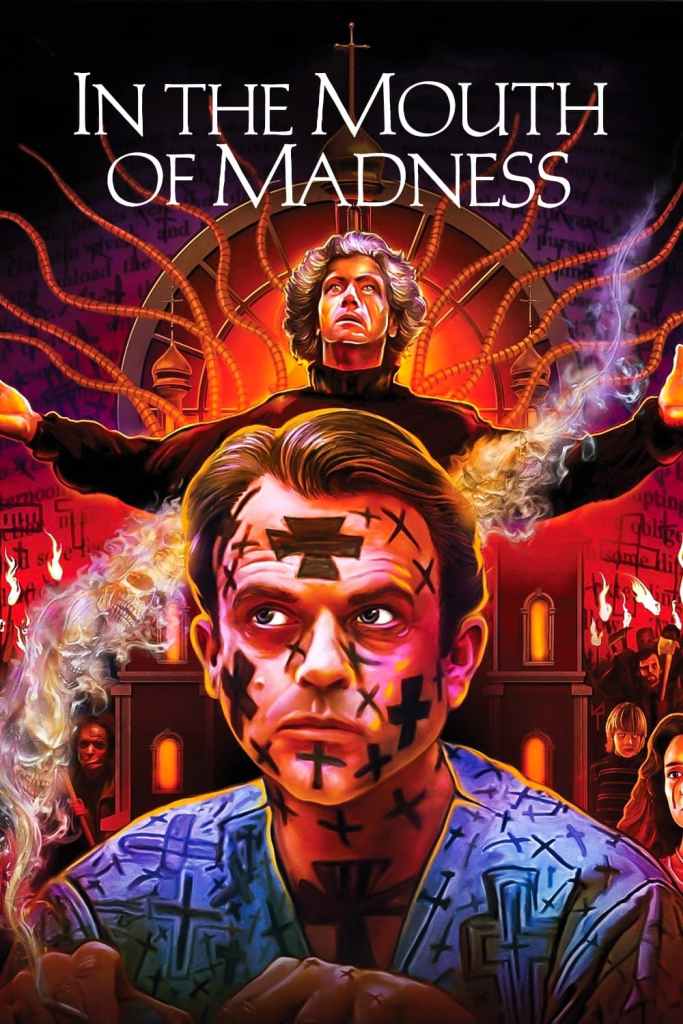
Horror Review: In the Mouth of Madness (dir. by John Carpenter)


“There are things in this world that go beyond human understanding.”

John Carpenter’s reputation as one of the great American horror directors rests on his ability to merge the cinematic with the philosophical—to craft films that stay frightening not because of what they show, but because of what they suggest. Yet by the early 1990s, Carpenter’s once unshakable relationship with audiences had weakened. His influence remained undeniable, but several of his later films seemed to miss the spark that defined Halloween, The Fog, or The Thing. Then arrived In the Mouth of Madness (1995), a work that signaled a late creative resurgence. It paid intelligent homage to two pillars of horror literature—Stephen King and H. P. Lovecraft—while offering a disturbing reflection on authorship, sanity, and the power of belief. The film reasserted Carpenter’s command not only over frightening imagery but also over the psychological territory that underpins enduring horror.

At a narrative level, In the Mouth of Madness follows John Trent (Sam Neill), an insurance investigator known for exposing fraud and deception. His skepticism becomes both his strength and undoing. Trent is hired by publishing executive Jackson Harglow (played by the legendary Charlton Heston) to locate Sutter Cane, a best-selling horror novelist whose disappearance threatens both the company’s finances and the stability of Cane’s obsessed fanbase. Every sign points to something far stranger than a publicity stunt. Cane’s readers are exhibiting troubling behavior, as though the author’s new book has triggered more than just entertainment—it has become contagion.

Carpenter crafts Trent’s descent into uncertainty with meticulous pacing. At first, Neill’s character regards the assignment as routine, dismissing the hysteria surrounding Cane’s novels as marketing excess. But when his investigation hints that the locations and events in Cane’s fiction may correspond to real places and real disturbances, the film begins to twist the rational into the uncanny. The story’s sense of unreality builds with deliberate restraint—incidents grow progressively stranger, but never so overt that Trent can confidently identify what’s madness and what’s truth. Carpenter thrives on this ambiguity, pulling both protagonist and viewer into an atmosphere where logic erodes and fiction itself seems to rewrite reality.

Accompanying Trent on his search is Linda Styles (Julie Carmen), the publisher’s editor assigned to ensure the investigation runs smoothly. While her performance has sometimes been considered subdued, Styles functions as the audience’s second perspective: observant, mildly skeptical, and gradually aware that the world around her no longer behaves according to its former rules. Carpenter positions her as a necessary counterpoint to Trent’s brittle rationalism, highlighting the conflict between recognizing patterns and succumbing to fear. As they move closer to locating Cane, their surroundings take on the familiar haunted quality of an archetypal New England town—Hobb’s End—built from the shared DNA of King’s Castle Rock and Lovecraft’s Arkham. The town becomes more than setting; it is a physical embodiment of literary influence and psychological instability.

The choice of Sam Neill proves essential to the film’s success. His trademark combination of intelligence and emotional vulnerability allows Trent’s transformation from calculating skeptic to disoriented seeker to feel natural rather than theatrical. Few actors could portray a man so evidently rational who nonetheless finds himself seduced by forces his disciplined mind cannot resist. Neill’s body language carries much of the horror; his expressions shift between dry disbelief and quiet terror, suggesting that intellect offers no protection once perception itself begins to betray you. Carpenter exploits this performance with close framing and asymmetric compositions, visually trapping Trent in spaces that subtly curve or distort. The director’s technical command ensures that even ordinary scenes seem charged with quiet wrongness.

While In the Mouth of Madness never references the mythos of Lovecraft by name, its influence saturates the film. Lovecraft’s hallmark—cosmic indifference—exists here not through tentacled gods but through the crumbling borders between fiction and the human mind. The suggestion is that the very act of creating and consuming stories might awaken something ancient and uncontrollable. When Trent confronts the nature of Cane’s work, Carpenter’s direction avoids overstatement. Instead of grand confrontations, he conveys horror through disorientation—the feeling that language, images, and even memory are slipping toward incoherence. Reality itself becomes a character, unstable and untrustworthy.

Jürgen Prochnow’s portrayal of Sutter Cane adds another layer of unease. His calm, confident manner diverges from standard portrayals of deranged genius. Prochnow makes Cane unnerving precisely because he appears so certain of his vision. The author views himself not as a mere storyteller but as a conduit, claiming that what he writes merely reveals a preexisting truth. Through him, Carpenter explores a potent question that haunts all creators: does imagination serve human purpose, or is it an independent force that uses human minds as tools? Cane’s conviction blurs that line, turning the creative process into possession. To audiences familiar with the concept of “mad artists” in literature, his belief offers both fascination and dread.

Carpenter imbues this theme with visual invention. The cinematography and set design combine the mundane with the surreal—painted walls pulse, corridors bend, horizons vanish. Rather than relying on excessive gore or digital spectacle, the director emphasizes textures and shadows, creating optical unease rather than overt shock. The town of Hobb’s End seems perpetually detached from time, its streets looping back on themselves. By employing low, creeping camera movements and deliberate color desaturation, Carpenter evokes a dreamscape decaying from within. The film’s sound design—especially Carpenter’s own pulsating score, co-composed with Jim Lang—heightens that tension with rhythmic basslines reminiscent of a heartbeat slowing to a stop. Every technical choice reinforces the narrative’s central sensation: uncertainty.

Michael De Luca’s screenplay deserves particular credit for its clever structure. The film is framed as a story told from inside an asylum, immediately hinting that the perspective may be unreliable. This framing allows Carpenter to shift between psychological thriller and cosmic horror without losing cohesion. As viewers, we are made complicit in Trent’s investigation but warned not to trust his perceptions. The resulting experience is disorienting yet coherent—a cinematic maze where each turn feels inevitable once taken. The writing never lingers long on exposition, instead suggesting connections through implication and repetition. In this way, De Luca’s script succeeds in translating Lovecraftian dread into visual terms: a fear of knowledge itself.

Very few directors have managed this particular tone as successfully. Lovecraft’s fiction often resists cinematic adaptation precisely because its greatest horror lies in what cannot be shown. In the Mouth of Madness solves this problem by making the act of storytelling itself the subject of terror. By focusing on an author whose imagination reshapes reality, Carpenter transforms literary horror into filmic language. In doing so, he edges close to achieving what decades of other attempts had failed to capture—a true Lovecraftian mood rendered on screen, grounded not in spectacle but in existential dislocation.

Despite its craftsmanship and intelligence, In the Mouth of Madness struggled at the box office upon release. Its ambiguity, self-reflexivity, and intellectual leanings proved challenging for mid-1990s audiences who expected more conventional scares. Yet over time, the film’s reputation has flourished. Today, it is often regarded as the concluding entry in Carpenter’s loosely connected “Apocalypse Trilogy,” following The Thing (1982) and Prince of Darkness (1987). All three films share a fascination with humanity confronting forces it cannot comprehend—scientific, metaphysical, or divine. In each, Carpenter presents apocalypse not as fiery destruction but as revelation: the moment when human understanding collapses under greater cosmic truth. That philosophical core links these works across more than a decade of filmmaking.

Revisiting In the Mouth of Madness now, one is struck by how prophetic it feels. Its concerns about cultural contagion and media-induced madness anticipate contemporary conversations surrounding viral misinformation, fandom extremism, and the blurring between online identity and reality. The “disease” in the film—ideas that rewrite perception—mirrors our present anxiety about the stories and images that shape collective belief. Carpenter’s horror, always grounded in social awareness, here expands into a warning about a world unable to distinguish narrative invention from lived experience.

Even limited in budget, Carpenter demonstrates confident control of visual tone and rhythm. His filmmaking reminds viewers that suggestion often unsettles more deeply than spectacle. Rather than overwhelming audiences with jump scares, he leads them through gradual disintegration, where each logical step seems to justify the next until coherence itself fractures. The film invites reflection rather than relief, leaving viewers haunted by the possibility that the boundaries between art and life are far thinner than comfort allows.

While Carpenter would go on to direct more films after 1995, In the Mouth of Madness stands as one of his last profoundly accomplished achievements. It encapsulates the elements that made his earlier works enduring: tight pacing, minimalist storytelling, and ideas that resonate beneath genre tropes. The film’s legacy continues among filmmakers who explore metafictional or cosmic horror, from Guillermo del Toro’s long-sought adaptation of At the Mountains of Madness (a feat that may never come to fruition outside of concept art and videos) to the psychological labyrinths of contemporary horror auteurs. Though Carpenter’s film never directly adapts Lovecraft, it succeeds where many literal adaptations fail—by preserving the essence of incomprehensible terror rather than translating it into spectacle.

Ultimately, In the Mouth of Madness remains a rare horror film that asks not just what we fear, but why we need fear in the first place. Its central notion—that imagination itself can undo reality—strikes at the heart of storytelling. Carpenter’s mastery lies in letting that idea linger long after the credits roll. What begins as an investigation grows into a philosophical nightmare, compelling viewers to question how much of their world is built from collective belief. In that sense, the film transcends its genre to become one of Carpenter’s most unsettling reflections on human perception. Decades later, its message still resonates: the stories we consume may shape us more profoundly than we realize.

A Few Thoughts On The Girl With The Dragon Tattoo Remake


Have I mentioned how much I loved The Girl With The Dragon Tattoo?  Have I suggested that the late Stieg Larsson, in the Millenium Trilogy, did for Europe what James Ellroy did for America with the American Tabloid trilogy?  Have I gone into the fact I think Noomi Rapace’s performance as Lisbeth in both the original film and its sequels will probably be remembered as one of the greatest film performances of all time?  Have I explained that I think, even beyond Rapace’s performance, Lisbeth herself is one of the best characters in the history of film?  For that matter, have I talked about the hours that I’ve spent standing with my back to a mirror and looking over my shoulder and debating on which shoulder-blade a dragon would look most appropriate?  Personally, I think my left shoulder-blade is a bit nicer than my right but last night, my friend Jeff was telling me that…

Sorry, I’m losing focus here.  Okay, getting the ADD under control.  Anyway, the point of the matter is that I love The Girl With The Dragon Tattoo. 

That’s why I feel a lot of caution about the upcoming, David Fincher-helmed remake.  First off, quite frankly, I really don’t see what can be improved on the original films.  It’s not as if the original film version of the Girl With The Dragon Tattoo failed to do justice to the book (if anything, the book fails to do justice to the film that eventually made from it).  I suppose a remake would give people who can’t handle subtitles the chance to see the story but honestly, who cares about those losers?  Speaking of the story, the rumors I hear seem to indicate that this remake is going to be an “Americanized” version of The Girl With The Dragon Tattoo, which I’m not really sure can be done as the entire book is basically meant to act as a metaphor for Swedish society.  Of course, it is possible that the remake is going to be set in Sweden as well but if that’s the case, what’s the point of the remake?

I know the usual argument to these concerns is that, as a director, Fincher will not allow the film to be Hollywoodized.  At one point that may have been true but, judging from The Curious Case of Benjamin Button, Fincher’s got more Hollywood in him than most people want to admit.  The fact that he’s also teamed up with Aaron Sorkin (an establishment figure if there ever was one) to direct a movie about Facebook doesn’t exactly fill me with confidence but I’ll hold off on judging until the Social Network actually shows up in theaters.

However, I am encouraged by the news (announced yesterday) that Fincher has cast Daniel Craig as the male lead, Mikael Blomkvist (or whatever his name is going to be in the Hollywood version).  Craig’s name had been mentioned for the role ever since the remake was first announced but there were also reports that the role would go to Brad Pitt (who, of course, has already made 3 films with Fincher).  Nothing against Brad Pitt (who I think is a truly underrated actor) but it’s hard to think of a worst choice for the role of Mikael.  Mikael’s defining characteristic is just how ineffectual he is.  He’s the ultimate well-meaning intellectual, the type of guy who wants to fight injustice but is to insulated from the harsh realities of life to effectively do so.  (That’s why he needs Lisbeth, she represents everything he wishes he could do but can’t.)  In short, Mikael is a hero by default and casting an actor like Brad Pitt would throw the entire movie off-balance.

Mikael is not a role for a star.  Mikael is a role for a character actor and, James Bond aside, that’s exactly what Daniel Craig is.  (That’s one reason why Craig’s Bond is dull, regardless of how good a performance Craig gives in the role.)  Not only is Craig the right age, he projects just the right amount of idealistic weariness for the role.  Admittedly, it helps that Craig bears a passable physical resemblance to the original Mikael, Michael Nyqvist which, if nothing else, will make it easier for fans of the original film — like me — to accept him.

(For the record, my personal choice for Mikael would have been Tim Roth.)

Of course, the question now is who will win the role of Lisbeth and why would they want it?  For me, Noomi Rapace is Lisbeth.  She is the girl with dragon tattoo.  It’s hard to think of single mainstream actress in her 20s or early 30s who could hope to match Rapace’s performance.  (Perhaps a young Angelina Jolie could have though physically, Jolie is all wrong for the part.)  However, even beyond what Rapace did with the character, Lisbeth is one of the most vivid and memorable characters in recent literary history.  Even without having to worry about the shadow of Rapace’s previous performance, the role is not an easy one.

Originally, rumor had it that Kristen Stewart was a lock for the role.  At the risk of being burned at the stake as a heretic, I’m going to say that I think Stewart could have been an adequate (though not a great) Lisbeth except for the fact that she’s about ten years too young.  (While Lisbeth is described as looking like a teenager, she also projects a worldliness of someone much older.  Physical appearance can be faked but life experience can not.)  Carey Mulligan, star of An Education (the best film of 2009, by the way), was another actress who was frequently mentioned.

Well, according to Entertainment Weekly, neither Stewart nor Mulligan will play Lisbeth Salander.  Neither will Natalie Portman who, according to EW, was offered the role but turned it down.  The offer to Portman makes sense as she’s physcially right for the role and she’s an undeniably talented actress.  However, much as Pitt could never have been convincing as Mikael, Portman would have been miscast as Lisbeth.  Portman may be a talented actress but she’s also a rather passive one.  Even in her previous “action” roles (Leon, V For Vendetta), Portman essentially played a lost, damaged character (much like Lisbeth) who needed an older male figure to serve as her mentor (which, needless to say, is nothing like Lisbeth).

Again, according to EW, the role of Lisbeth has been narrowed down to four actresses: Rooney Mara, Lea Seydoux, Sarah Snook, and Sophie Lowe.  It’s probably a good sign that none of these actresses are household names exactly.  Competing with the shadow of Noomi Rapace’s Lisbeth is going to be difficult enough without also having to deal with the shadow of their own previous performances.  (For instance, even if Stewart gave a brilliant performance as Lisbeth, it would still be impossible for me to get through the remake without making at least one Twilight joke.)

For me, the real question is not who is going to be cast as Libseth but if Fincher and his producers are going to give us the real Lisbeth — this would be the unapologetically lesbian Lisbeth who can only befriend Mikael once she’s sure that she doesn’t any sort of sexual attraction towards him — or if we’re going to get a more mainstream, Hollywood version of Lisbeth.  Are we going to get the real Lisbeth who needs no one or are we going to get another version of what Hollywood claims to be a strong woman, one who can fight up until the final 30 minutes of the film at which point she’s suddenly rendered helpless by the demands of Mainstream Filmmaking 101.

More than anything, that will be the test that Fincher’s Girl With The Dragon Tattoo will have to pass if it wants to be anything more than an unneeded imitation of the original.

(Incidentally, the perfect Lisebth Salander would be Jena Malone.  End of story.)

A Quickie With Lisa Marie: Blood Freak (dir. by Brad Grinter)


It’s difficult to explain why exactly Blood Freak, a no-budget horror film from 1972, is a movie that you simply have got to see.  I could tell you about how it’ll force you to wonder if the movie was meant to be taken seriously or if it’s all just a huge joke.  I could go on for paragraph after paragraph about how this movie (and its status as one of the great cult films of the last century) represents one of the purest triumphs of independent cinema and how this movie is one of the few American films to ever come close to Lucio Fulci’s theory of “pure film.”  But I fear that even after I do all that, I will not be able to convey just how beautifully odd and wonderful this movie truly is. 

So, instead of doing all of that, I think I’ll just tell you what Blood Freak is about.

Steve Hawkes (a body builder who appeared in several Spanish exploitation films in the late 60s) plays an aimless drifter who, as the movie starts, finds himself in Florida.  He meets a virginal young woman named Angel.  Soon, they are a very clean-cut, chaste couple.  As seen in the clip below, Angel even gets him a job working at the local turkey farm.

However, there’s trouble brewing.  Angel has a sister named Ann.  Ann is Angel’s opposite in every way.  Not only does she stay out for all hours of the night with her sleazy friends but she also introduces our hero to a little drug called marijuana.

Soon, Hawkes discovers that — apparently like most of America in the early 70s — he is now addicted to marijuana! (“I have a feeling I’m hooked!” he explains.)  Of course, we all know what happens when you mix marijuana and repeated exposure to turkeys.  That’s right, our hero ends up falling asleep and then waking up as a blood-crazed man/turkey hybrid,  as seen in the scene below (which, fair warning, has some fake blood in it).

However, if that wasn’t enough, there’s one more thing that makes this movie an absolute requirement for any discerning film lover.  Blood Freak has a narrator.  And our narrator isn’t some wimpy, off-screen guy with a stern voice and a moralistic outlook.   No, our narrator is Brad Grinter, the film’s writer and director.  Grinter pops up every few minutes, sitting behind a desk and explaining the larger social and moral concerns raised by the story of a muscle-bound drifter transformed into a half-Turkey.  Whenever Grinter appears to lose his train of thought (which happens frequently), he holds up what appears to be the film’s script and reads his commentary line-for-line.  While he explains why marijuana is bed (Mmmkay), Grinter puffs away on an ever-present cigarette.  Several times, he has to pause in his commentary in order to hack up a lung.  One of his more inspiring moments can be seen below:

Blood Freak.  See it.

(On a related note, I usually love Something Weird Video but I’m a little bit annoyed with them that they’re apparently only selling the Blood Freak DVD as part of an over-priced box set.  Still, a used copy of the film on DVD shouldn’t be hard to track down.  Why anyone would want to sell their copy of it, I can’t begin to guess but apparently, not everyone recognizes the brilliance of this film in quite the same way as I do.  Their loss.)

10 (Plus) Of My Favorite DVD Commentary Tracks


It seems like I’m always taking a chance when I listen to a DVD commentary track.  Occasionally, a commentary track will make a bad film good and a good film even better.  Far too often, however, listening to a bad or boring commentary track will so totally ruin the experience of watching one of my favorite movies that I’ll never be able to enjoy that movie in the same way again.  I’ve learned to almost always involve any commentary track that involves anyone credited as being an “executive producer.”  They always want to tell you every single detail of what they had to do to raise the money to make the film.  Seriously, executive producers suck. 

However, there are more than a few commentary tracks that I could listen to over and over again.  Listed below are a few of them.

10) Last House On The Left (The Original) — Apparently, there’s a DVD of this film that features a commentary track in which stars David Hess and Fred Lincoln nearly come to blows while debating whether or not this movie should have been made.  The DVD I own doesn’t feature that commentary but it does feature a track featuring writer/director Wes Craven and producer Sean S. Cunningham.  The thing that I love about their commentary is that they both just come across as such nice, kinda nerdy guys.  You look at the disturbing images onscreen and then you hear Cunningham saying, “We shot this scene in my mom’s backyard.  There’s her swimming pool…”  Both Craven and Cunningham are remarkably honest about the film’s shortcomings (at one point, Craven listens to some of his more awkward dialogue and then says, “Apparently, I was obsessed with breasts…”) while, at the same time, putting the film’s controversy into the proper historical context.

9) Burnt Offerings — When Burnt Offerings, which is an occasionally interesting haunted house movie from 1976, was released on DVD, it came with a commentary track featuring director Dan Curtis, star Karen Black, and the guy who wrote the movie.  This commentary track holds a strange fascination for me because it, literally, is so mind-numbingly bad that I’m not convinced that it wasn’t meant to be some sort of parody of a bad commentary track.   It’s the commentary track equivalent of a car crash.  Curtis dominates the track which is a problem because he comes across like the type of grouchy old man that Ed Asner voiced in Up before his house floated away.  The screenwriter, whose name I cannot bring myself to look up, bravely insists that there’s a lot of nuance to his painfully simple-minded script.  Karen Black, meanwhile, tries to keep things positive.  The high point of the commentary comes when Black points out that one actor playing a menacing chauffeur is giving a good performance (which he is, the performance is the best part of the movie).  She asks who the actor is.  Curtis snaps back that he doesn’t know and then gets testy when Black continues to praise the performance.  Finally, Curtis snaps that the actor’s just some guy they found at an audition.  Actually, the actor is a veteran character actor named Anthony James who has accumulated nearly 100 credits and had a prominent supporting role in two best picture winners (In the Heat of the Night and Unforgiven).

8 ) Cannibal Ferox — This is a good example of a really unwatchable movie that’s made watchable by an entertaining commentary track.  The track is actually made up of two different tracks, one with co-star Giovanni Lombardo Radice and one with director Umberto Lenzi.  Lenzi loves the film and, speaking in broken English, happily defends every frame of it and goes so far as to compare the movie to a John Ford western.  The wonderfully erudite Radice, on the other hand, hates the movie and spends his entire track alternatively apologizing for the movie and wondering why anyone would possibly want to watch it.  My favorite moment comes when Radice, watching the characters onscreen move closer and closer to their bloody doom, says, “They’re all quite stupid, aren’t they?”

7) Race With The Devil — Race with the Devil is an obscure but enjoyable drive-in movie from the 70s.  The DVD commentary is provided by costar Lara Parker who, along with providing a lot of behind-the-scenes information, also gets memorably catty when talking about some of her costars.  And, let’s be honest, that’s what most of us want to hear during a DVD commentary.

6) Anything featuring Tim Lucas — Tim Lucas is the world’s foremost authority on one of the greatest directors ever, Mario Bava.  Anchor Bay wisely recruited Lucas to provide commentary for all the Bava films they’ve released on DVD and, even when it comes to some of Bava’s lesser films, Lucas is always informative and insightful.  Perhaps even more importantly, Lucas obviously enjoys watching these movies as much as the rest of us.  Treat yourself and order the Mario Bava Collection Volume 1 and Volume 2.

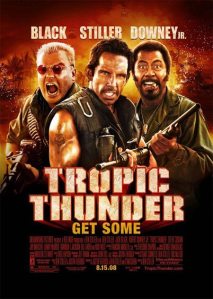
5) Tropic Thunder — The commentary track here is provided by the film’s co-stars, Jack Black, Ben Stiller, and Robert Downey, Jr.  What makes it great is that Downey provides his commentary in character as Sgt. Osiris and spends almost the entire track beating up on Jack Black.  This is a rare case of a great movie that has an even greater commentary track.

4) Strange Behavior — This wonderfully offbeat slasher film from 1981 is one of the best movies that nobody seems to have heard of.  For that reason alone, you need to get the DVD and watch it.  Now.  As an added bonus, the DVD comes with a lively commentary track featuring co-stars Dan Shor and Dey Young and the film’s screenwriter, Bill Condon (who is now the director that Rob Marshall wishes he could be).  Along with providing a lot of fascinating behind-the-scenes trivia, the three of them also discuss how Young ended up getting seduced by the film’s star (Michael Murphy, who was several decades older), how shocked Condon was that nobody on the set seemed to realize that he’s gay, and why American actors have so much trouble speaking in any accent other than their own.  Most memorable is Young remembering the experience of sitting in a theater, seeing herself getting beaten up onscreen, and then listening as the people sitting around her cheered.

3) Imaginationland — As anyone who has ever listened to their South Park commentaries knows, Matt Stone and Trey Parker usually only offer up about five minutes of commentary per episode before falling silent.  Fortunately, those five minutes are usually hilarious and insightful.  Not only are Parker and Stone remarkably candid when talking about the strengths and weaknesses of their work but they also obviously enjoy hanging out with each other.  With the DVD release of South Park’s Imaginationland trilogy, Matt and Trey attempted to record a “full” 90-minute commentary track.  For the record, they manage to talk for 60 minutes before losing interest and ending the commentary.  However, that track is the funniest, most insightful 60 minutes that one could hope for.

2) Donnie Darko — The original DVD release of Donnie Darko came with 2 wonderful commentary tracks.  The first one features Richard Kelley and Jack Gyllenhaal, talking about the very metaphysical issues that the film addresses.  Having listened to the track, I’m still convinced that Kelley pretty much just made up the film as he went along but its still fascinating to the hear everything that was going on his mind while he was making the film.  However, as good as that first track is, I absolutely love and adore the second one because it features literally the entire cast of the movie.  Seriously, everyone from Drew Barrymore to Jena Malone to Holmes Osborne to the guy who played Frank the Bunny is featured on this track.  They watch the film, everyone comments on random things, and it’s difficult to keep track of who is saying what.  And that’s part of the fun.  It’s like watching the film at a party full of people who are a lot more interesting, funny, and likable than your own actual friends.

1) The Beyond — This movie, one of the greatest ever made, had one of the best casts in the history of Italian horror and the commentary here features two key members of that cast — Catriona MacColl and the late (and wonderful) David Warbeck.  The commentary, which I believe was actually recorded for a laserdisc edition of the film (though, to be honest, I’ve never actually seen a “laserdisc” and I have my doubts as to whether or not they actually ever existed), was recorded in 1997, shortly after the death of director Lucio Fulci and at a time when Warbeck himself was dying from cancer.  (Warbeck would pass away two weeks after recording this commentary).  This makes this commentary especially poignant.  Warbeck was, in many ways, the human face of Italian exploitation, a talented actor who probably deserved to be a bigger star but who was never ashamed of the films he ended up making.  This commentary — in which MacColl and Warbeck quite cheerfully recall discuss making this underrated movie — is as much a tribute to Warbeck as it is to Fulci.  Highpoint: MacColl pointing out all the scenes in which Warbeck nearly made her break out laughing.  My personal favorite is the scene (which made it into the final film) where Warbeck attempts to load a gun by shoving bullets down the barrel.  The wonderful thing about this track is that Warbeck and MacColl enjoy watching it too.

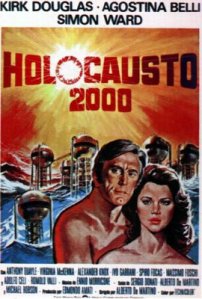
A Quickie With Lisa Marie: Holocaust 2000 (dir. by Alberto De Martino)


Earlier this morning, while suffering from an annoyingly persistent case of insomnia, I decided to spend 2 hours watching a classic Italian exploitation film, Alberto De Martino’s oddly effective Omen rip-off, Holocaust 2000.

In Holocaust 2000, Kirk Douglas plays a businessman who wants to build a gigantic nuclear power plant in the Middle East.  There are a few problems with this plan.  First off, the site that Douglas selects just happens to be right next to a cave that is full of religious artifacts.  Secondly, there’s a handful of angry environmentalists picketing his London office.  And, perhaps the biggest problem, Douglas’ son happens to be the Antichrist.  This fact is obvious to the viewer because not only is his son named Angel (yes, we’re in the land of irony) but he also looks and acts nothing like Douglas.  Not only does Angel have a noticeably weak chin (no cleft to be seen at all) and speak with a rather posh accent but he’s also so extremely English that he’s even played by an actor named Simon Ward.

In other words, the viewer is pretty much in on the game from the beginning.  What makes the movie work is that director De Martino understands that everyone’s going to know that Angel’s the antichrist from the minute he first appears so, as opposed to the Omen films, he doesn’t waste a lot of time playing any “is-he-or-isn’t-he” games.  Instead, in the great tradition of Italian exploitation, De Martino jumps straight into the apocalypse without worrying about things like narrative cohesion and the end result is an enjoyably chaotic film that rarely makes sense but is never boring.  Whereas the Omen films are almost tedious in their attempts to provide theological justification for all the blood that’s spilled on-screen, Holocaust 2000 has a cheerful, let’s-make-it-up-as-we-go-along feel to it that, at times, almost makes the whole thing feel like some long lost Lucio Fulci film.

Holocaust 2000 is probably best known for two sequences.  The first features a helicopter blade very graphically chopping off the top of a man’s head.  If seeing the original Dawn of the Dead made me nervous around helicopters, seeing Holocaust 2000 has ensured that I will never ever step anywhere near one of those things.  Seriously, I’ve seen a lot of gore over the past few years but the decapitation scene in this movie …. well, perhaps it’s best to just shudder and move on.  (For the record, Holocaust 2000 came out before Dawn of the Dead so the helicopter decapitation scene here was not stolen from that film.  If anything, it was simply a more graphic version of David Warner losing his head in the Omen.)

The second sequence is a scene in which a very nude Kirk Douglas (who, it must be admitted, looked a lot better at 61 than most 20 year-olds do today) has a nightmare in which he watches the world literally come to an end.  Set to Ennio Morricone’s intense and memorable score, this sequence manages to be surreal, disturbing, and entertaining all at the same time.  It epitomizes everything that makes Holocaust 2000 such a surprisingly effective work of pure cinematic exploitation.

Like many of the great Italian exploitation films, Holocaust 2000 was released under several titles.  It is currently available on DVD under the title Rain of Fire and a big bleh to Lionsgate for choosing to go with such a boring name.  Admittedly, I can see their logic.  Though the movie was first released in theaters in 1977, it took 31 years for it to show up on DVD.  During that time, 2000 came and went and the world didn’t end (or maybe it did and the last 10 years have just been an extended hallucination, the choice is yours).  But still, Rain of Fire sounds like a substandard country song about a nasty divorce that ends in murder.  On the other hand, a title like Holocaust 2000 — nakedly exploitive and borderline offensive — represents everything that we’ve come to so love about Italian exploitation films.