I have long come to accept that, when it comes to issues of gender equality, most movies are like Iron Man 2. If you’ll remember, that’s the film in which Gwynneth Paltrow said she was better suited to be a secretary than a CEO, Scarlett Johansson beat up an army but only because she was given permission ahead of time by a very manly Samuel L. Jackson, Jr., and the world was saved because Robert Downey, Jr. made peace with the patriarchy. While the inherent sexism of most movies has never ceased to bother me, I’ve come to accept it because I love film.
(For the record, I enjoyed Iron Man 2 even if I did roll my eyes more than once.)
Still, hope continues to rest at the bottom of Pandora’s box. With the year only a little more than a half over, American movie screens have played host to a handful of unusually strong and independent female characters. (It’s the independence that sets them apart.) From Jennifer Lawrence in Winter’s Bone to Katie Jarvis in Fish Tank to even Kristen Stewart and Dakota Fanning in the Runaways, they have challenged the standard movie stereotype of the weak, ultimately helpless female. The best known of them is, of course, Noomi Rapace as Lisbeth in The Girl With The Dragon Tattoo and its sequels. However, if the Girl With the Dragon Tattoo features the strongest woman to appear on American movie screen this year, the just-released Salt features the second strongest.
In Salt, Angelina Jolie plays Evelyn Salt, a CIA agent who is married to Mike (August Diehl), a nice guy who happens to be the world’s leading authority on spiders. On the day of her wedding anniversary, Salt finds herself tasked with interrogating a Russian defector named Orlov. As Salt listens (and her fellow agents watch), Orlov tells a story of how, decades earlier, hundreds of Russian children were secretly smuggled into the U.S. where they served as “sleeper” agents, working their way into American society until such time as they might be activated. Orlov goes to explain that one of these sleeper agents is going to assassinate the President of Russia. That agent, Orlov adds, is named “Evelyn Salt.” While Salt’s co-workers react to this accusation by attempting to arrest her, Salt reacts by escaping from custody and fleeing in an attempt to both find her husband, who has mysteriously disappeared, and prove her innocence.
Or is she? There’s a lot of twists and turns in Salt’s plot and while they don’t always make sense, they’re a lot of fun to watch. Director Phillip Noyce keeps the action moving and, in the lead role, Angelina Jolie brings a wonderful sense of moral ambiguity to the character that you’re never quite sure whose side she is really on. Jolie makes the character seem real even when she’s jumping off a bridge and landing on top of a speeding truck without so much as even a bruise as a result.
Admittedly, I enjoyed Salt for much the same reason that I enjoyed the far superior Girl With The Dragon Tattoo. It was fun to not only see a woman in a movie do stuff that usually only a man is allowed to do but also manage to do all of it a lot more convincingly than most contemporary male action heroes. With the exception of a very intense torture scene at the start of the film, Salt is never shown with tears in her eyes. She is never shown begging for mercy. Most importantly, she is never portrayed as being helpless. Considering just how much importance society puts into the idea of all women being inherently helpless, movies like Salt are a refreshing change of pace.
Of course, that doesn’t change the fact that pretty much everything Salt did in the film was basically done to save her marriage. As strong a character as Salt was, its unfortunate that the film had to make sure we understood that it was all due to the purifying love of one man. It’s as if the filmmakers were worried that if they made Salt too independent, they’d lose the audience and they were probably right.
Still, 2010 may very well be remembered as the year that women in movies were finally allowed to kick some ass. After an eternity of serving as decorations (with their every action governed by some male filmmaker’s infantile Whore/Madonna complex), women are finally being allowed to do something other than scream and wait to be rescued. Will this trend continue? Probably not. It’s a bit much to ask of a country that can’t even bring itself elect a female President. However, while it lasts, I’m enjoying the trend and I’ll miss it once it’s over.
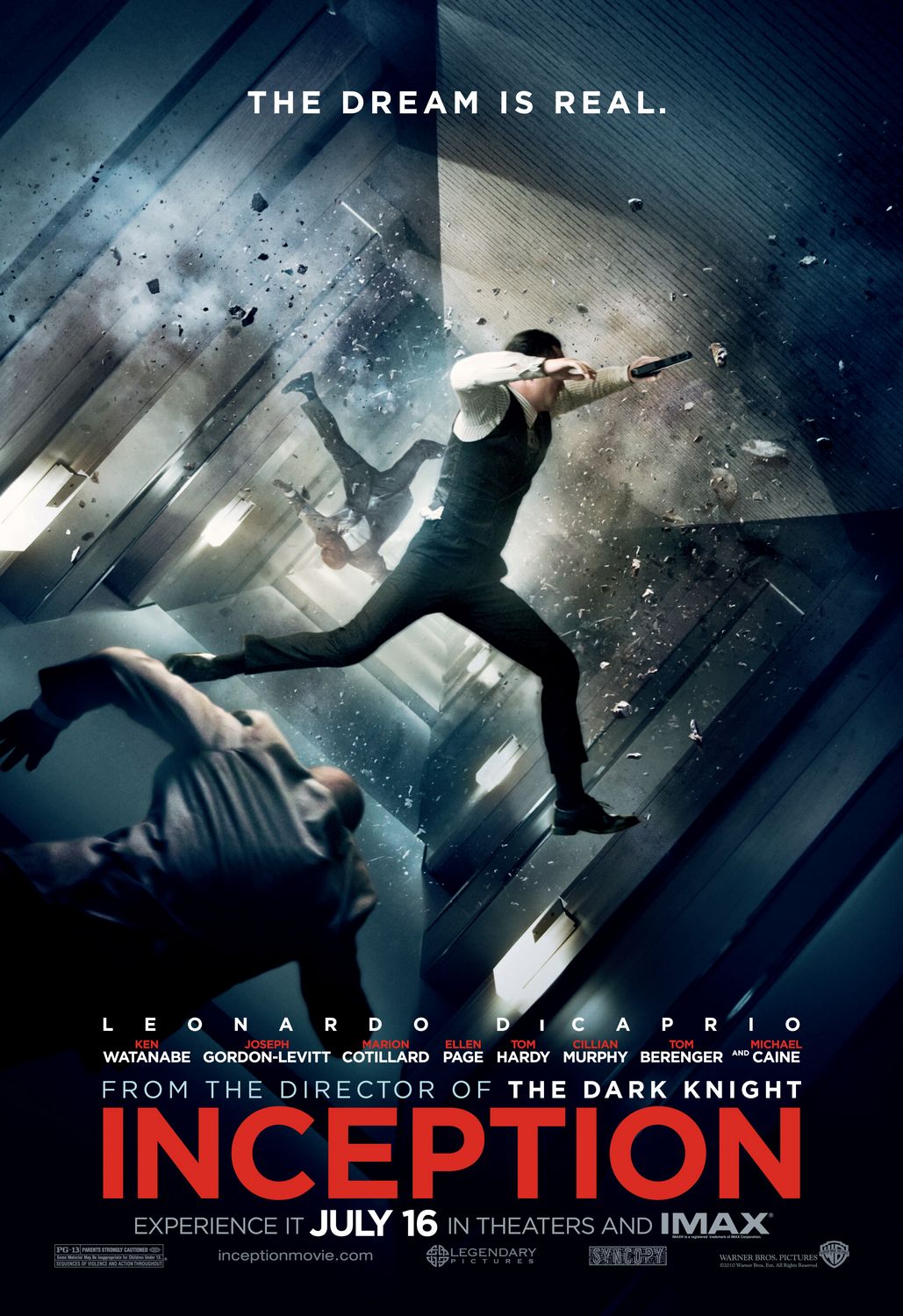
The summer of 2010 has been quite a disappointment. While the films released during this major blockbuster season has been good most have not been able to be that one stand-out which defines a summer season. We’ve had the typical tentpole sequels like Iron Man 2 (good but not great) and Toy Story 3 (also good but not great) to remakes like The Karate Kid to The A-Team. To say that the 2010 summer blockbuster season has been lackluster would be an understatement. Even original films like Splice hasn’t taken in the audience. It now falls to one of the biggest titles for the summer to try and save the season. Whether it will do so financially is still in doubt, but critically the latest from Christopher Nolan may just become the event film of the summer to actually deliver on its hype and the promise of an audience seeing something new, fresh and daring in a sea of mediocrity. Inception comes into the 2010 summer season and delivers on its promises and more than lives up to the hype heaped upon it by critics and fans alike.
A film almost a decade in the making, Christopher Nolan’s epic and sweeping tale of dreams and reality wrapped around a heist film brings the filmmaker one-step closer to becoming the genius filmmaker some of his most ardent followers have dubbed him to be. Nolan as a filmmaker and, more importantly, as a storyteller has always had a fascination with shattered reality and how the subconcious directly affect his protagonists’ sense of the real. We’ve seen this in his film-style of using a disjointed and non-linear structure to his films which goes to creating a sense of confusion in the inattentive viewer. Some have called this style of his as being a gimmick to make a simple story more complex than it really is. I disagree with these individuals and say that Nolan has never done anything to trick an audience with his storytelling style and choices. His films have all the facts laid out before the audience, but in a way that asks the audience to participate in putting the jumbled pieces together. I’ve never seen a red herring used by Nolan in his more personal projects and even in the populist titles he’s done under the rebooted Batman franchise.
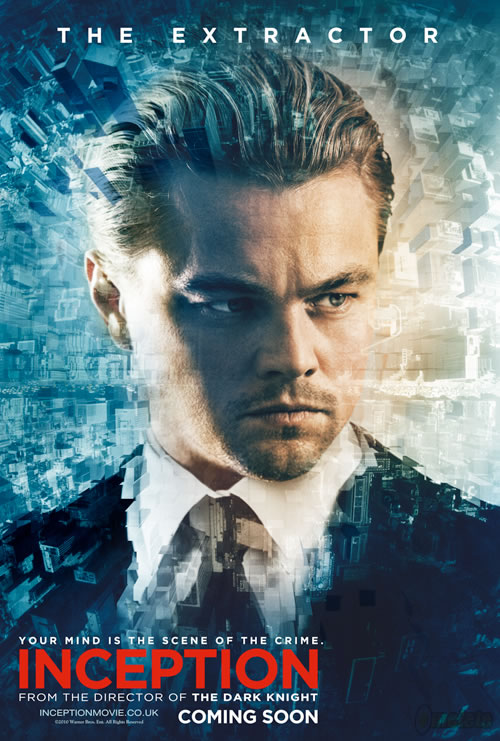
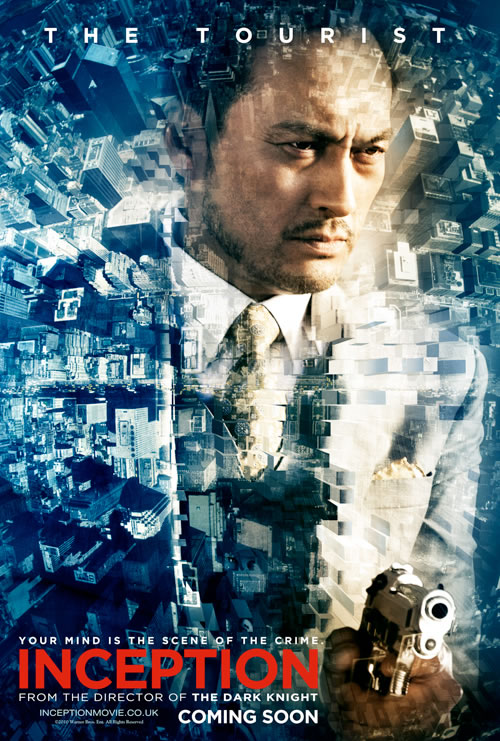
In his latest film, Nolan has refined his non-linear style and used it to successfully create the main setting of the film. Inception is set mostly in the dream world shared by the characters and those they’ve targeted. It is in this shared dream state that the audience learn the rules governing the world of Inception. It is in this dream state that we’re introduced to the first people who would make up an incredible ensemble cast put together by Christopher Nolan and his casting crew. We first meet dream extractor Dom Cobb (played by Leonardo DiCaprio) and his pointman Arthur (Joseph Gordon-Levitt) as they attempt to steal something valuable and important from within the dream of their Japanese-industrialist mark in Saito (Ken Watanabe). We see hints of the rules that will become important for the audience to help them follow the film’s main story as it unfolds. We learn that Saito has already known in advance that he’s in a dream constructed and being shared by Dom and Arthur in their contracted heist by parties unknown. As good as Dom and Arthur are at their job os stealing ideas from a mark through their dreams they have no chance when someone from Dom’s past inserts herself in their plans to sabotage what they’ve worked to accomplish.
It’s in this introductory sequence that we learn of the backstory of Dom and why his latest heist-job didn’t work out too well and has now endangered not just himself but those he has been working with. Saito gives Dom and Arthur a way out of their problems after failing in this job to steal from him by doing a job for him. But unlike previous dream heists Dom and Arthur have done in the past this time Saito doesn’t want something stolen from someone’s mind but to have an idea planted so deep within a mark’s subconscious that the mark believes it to be their very own and not one planted by an outsider. The job doesn’t require Dom to be an extractor of ideas. He’s now to find a way to successfully plant an idea. A job known as “inception” which Arthur and others deem near-impossible to pull off and one quite dangerous not just to the mark but to those involved in the process.
To say anymore about the plot of the film would be to spoil it. Inception works best when as little as possible about the film is known going in. The surprise and awe of the story unfolding is half the fun. It’s like an intricate puzzle or game one tries to solve. It’s ok to know ahead of time how to solve things, but not as fun. While for some people the way Nolan uses non-linear storytelling can be confusing all he asks his audience is to pay attention to the details and clues he’s planting in every scene and piece of dialogue. Let’s be honest this film is not for the inattentive. I won’t say stupid since that implies having low intelligence. It doesn’t take intelligence to pay attention and I’ve known that some of the more intelligent people have a tendency to let their attention wander.
Inception is a film about big ideas and grandiose themes. While the story in of itself when broken down to its simplest common denominator is just a heist film done in a new way, the film allows for layers upon layers of ideas to wrap itself around this simplistic premise. Nolan doesn’t just play with disjointing time for audience. He’s gone and went towards manipulating reality within the subconscious thought to ask the audience a simple question.
Are what we seeing a dream or is it reality?
The film doesn’t trick us using red herrings to make us think one way or another. Everything Nolan has put up on the screen is quite literal and remembering the rules he had set-up in the first hour lays the groundwork for each individual audience to answer that question for themselves. There’s no right or wrong answer to the question, but for some who have seen the film their disappointment seem less to do with the quality of the film, the acting and the direction but more on some of the ambiguous nature of the ending which becomes a dealbreaker for some. Again while I respect their take on this film I find their reasoning for negative criticism to be grounded on thin to non-existent ground. I will get to that ending soon.
While some have called Inception as the anti-Avatar I believe the two filmmaker share similar traits not just in how they create their film, but also in their two latest film. Both Nolan and Cameron are quite known to be very controlling of how their films are made to the point they dabble in every aspect of it. In their latest films they’ve also gone a long way into building a world for their story and characters to inhabit and play around in. While Cameron’s latest was an otherworldly kind in the most literal sense the same could be said for Nolan’s latest but instead inhabits the mind and how anything is possible. From the look of things both film will also share the same sort of near-universal acclaim from the film-going audience with a small, albeit very loud, minority calling Nolan’s film unoriginal, boring and, a word I have loathed for its overuse when something becomes very popular, overrated.
Where the two filmmakers diverge is the way they go about their films. Where Cameron leans heavily in pulling at the emotional strings of the audience through narrative and film sequences in his films, Nolan plies the audiences intellect instead. Cameron for all his technical genius both within the filmmaking sphere and outside of it can be quite the sappy filmmaker and all his films have shown this whether it’s The Terminator or Avatar. For Nolan his films have always felt like an intellectual exercise. An exercise everyone was invited to participate in no matter their level of intellect. He’s been able to marry both his indipendent arthouse sensibilities with the blockbuster the masses seem to crave year in and year out. With Inception he has moved one-step closer to achieving a perfect meshing of the two. This film has all the makings of a great heist and sci-fi thriller wrapped around so many pieces of profound and thoughtprovoking ideas that even after several viewings an audience will find something new to think about. Only one other film I can think of in the last decade or so has accomplished this and that was 1999’s The Matrix by The Wachowski Brothers. While that film was a kick-ass sci-fi action film it also dared to mix in a liberal dose of philosophy both Eastern and Western not to mention subjecting it’s audience to rethink how they see reality.
Christopher Nolan has gone beyond just trying to question the nature of reality. His goal with this film is to deconstruct the nature of the subconscious itself and show how such a thin line separates the dream from the real that at first and, even several glances, one cannot tell the difference. It’s a good thing for the audience watching Inception that Nolan has given them the tools and the rules to follow if they dare. And that’s where I think Nolan will disnguish himself apart from other great directors of his generation and put him up on the level of the true masters in film history. He doesn’t just make films that has worldwide appeal but able to do them while still able to engage his audience to open up their minds to the infinite possibilities his stories offer. While this does make his film a tad cold and distant for some that shouldn’t detract from the high-quality of his work, especially with Inception. The film has heart. It just doesn’t pluck on those particular beats to engage the audience.
I think filmblogger Devin Faraci said it best on his Twitter feed while discussing the film with others. While not exactly verbatim what I got out of it was that he thought it was always easy to engage and/or manipulate the audience through emotional factors, but much harder to engage their intellect. While some have accomplished the former to a great extent and vice versa I think with Inception Nolan has stepped closer than anyone to engage both the heart and the mind of the audience.
This review cannot be too much of a review if I just spoke about the ideas, themes and the inner workings of Nolan’s mind. The film is actually very good. Good enough to that’s close to being perfect. Pick any aspect of the film and those involved have done some of their best work and grown in their craft. As I stated earlier the film sports one incredible ensemble cast. I’ve already mentioned Leonardo DiCaprio and Joseph Gordon-Levitt who both do very great work in their roles. DiCaprio continues to be the go-to-guy when it comes to playing the tortured individual. Similar to his other role in Scorsese’s Shutter Island, DiCaprio as Cobb was quite believable in his personal-made hell in regards to a past event which involved his wife Mal (played with beautiful elegance and malice by Marion Cotillard). But unlike Scorsese’s film Nolan doesn’t reveal this personal issue through a twist in the plot, but let’s it come out naturally with the help of another cast member providing the impetus for Cobb to come clean. This individual is the team’s new dream architect in the form of Ariadne (Ellen Page in her most mature role to date and one that should go a long way from helping her shed the label of being Juno-esque).
Ariadne becomes the proxy by which the audience learns the in’s and out’s of Cobb’s job as a dream extractor and, very soon, inceptor. Through some inventive use of CGI and practical effects we see throught Ariadne’s eyes how the shared dream-state behaves. How specific rules actually exist within this state no matter how many levels of dreams an individual or group goes down into a mark’s subconscious. Some of these scenes people have seen glimpses of in the trailers and tv spots, but even seeing some of them in advance doesn’t detract from how incredible they look when seen on the bigscreen, especially for those lucky enough to see them on IMAX.
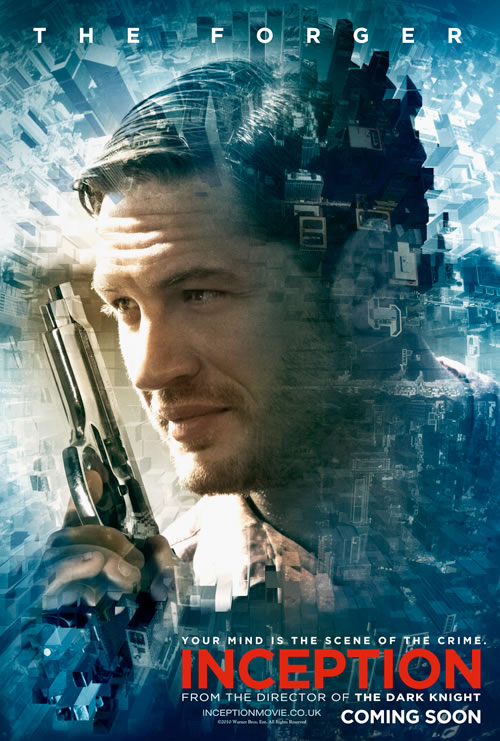
The rest of the cast rounded out by Tom Hardy as Eames the team’s Forger, Dileep Rao as the Chemist in charge of fabricating the compounds needed for the team to enter their mark’s subconscious. Cillian Murphy (starting to become one of Nolan’s regulars) plays Robert Fischer, Jr. their target and mark throughout the film with veteran actors Tom Berenger, Michael Caine and Pete Postlethwaite providing the wise-men roles in the film. It’s Tom Hardy as Eames which stood out in a cast full of extraordinary young and veteran performers. His recent fame as an actor due to his brutal and daring performance in Bronson has made Hardy a hot commodity in Hollywood. His playful character of Eames serves to provide some levity in an otherwise very serious film which allows the audience to come closer to the characters and story instead of remaining distant as Nolan’s detractors like to point out. He nearly pulls off stealing the film from everyone everytime he’s on-screen. It’s a testament to all the actors that he doesn’t as each and everyone have their moments to shine without overshadowing their fellow co-stars.
It would be difficult to review this film without pointing out how beautiful it looks and sounds. The visual part of the film has to go to Walter Pfister who works his magic behind the cameras on this film. Every shot is clear, concise and free of tricks some cinematographers these days have come to rely on too often to make their shots look more dynamic than it really should be. The editing by Lee Smith makes sure that Nolan’s style doesn’t confuse the audience and keeps the non-linear narrative structure easy to comprehend. As for the score one has to look to Hans Zimmer’s growing rapport with Nolan. He’s scored two of Nolan’s film and it looks that Zimmer has tapped into what Nolan wants his film score to sound like. not to dominate or overemphasize particular scenes or beats, but to act as an accompaniment. All three individual do their part as does the actors into making Nolan’s vision of Inception come to life. As great a filmmaker as Nolan is turning out to be these support players have made sure his path towards that goal is done so on smoother ground than not.
Now, there’s going to be some heated and long debates as to the nature of the film because of the final shot. The final shot is of a metal dreidel spinning in the foreground with the camera panning to it. The dreidel is spinning and spinning and looks to keep on doing so. The dreidel is shown earlier in the film as acting as some sort of anchor to tell Cobb whether he is in the real world or in a dream. If it continues to spin and not tip over and fall then he’s still in one. If it spins but ultimately tips over onto its side then he’s out of it. The film ends with the dreidel spinning and for a split second before the film suddenly fades to black we see it wobble.
Many have seen this final shot as being a cop-out by Nolan to play with the audience’s mind. I happen to disagree. I see it as a part of the story itself. nolan has been asking throughout the film what is real and what is a dream. This last shot just emphasizes this question and leaves it up to the audience to decide whether the dreidel continues to spin or eventually tips over. While I lean to the latter in the end it doesn’t detract from the film. The fact that some people have grabbed hold of this scene to negatively criticized the film as a whole tells me just how well-crafted a film Nolan has made that one little sequence lasting no less than 10 seconds becomes a dealbreaker for some when it should stimulate the mind into thinking what it actually means. I see that as the mark of an excellent storyteller.
In the end, Inception has done something this year which most film have so far been unable to do. It has delivered on its high-minded promises of a film that would challenge the audience and not just entertain them. It’s a film which has been overhyped for the last six month but has more than lived up to it and for some surpassed the hype itself. Inception looks to be one of those films which would forever define a filmmaker and this one will definitely define Nolan moving forward no matter what other projects he has in the future. This is a film that dares to appeal not just to the arthouse cineaste crowd but to the general audience who yearn to watch something exciting and original. I won’t say this is Nolan’s best film since he has years upon years to continue making films. Maybe one of those will be his masterpiece, but Inception definitely could be counted as being a nominee for that honor. If nothing else this film has saved what has been a very ordinary and lackluster 2010 summer film season.
Everyone views history in their own individual way. Some people remember past years by what they saw on the evening news (hence, 2004 becomes “the year Bush was reelected”) but I define them by what was playing at the nearest movie theater. Ask me when I was born and I won’t tell you, “1985.” Instead, I’ll tell you that I was born the same year that Terry Gilliam’s Brazil was butchered by Sid Shienberg. For me, the quality of a year is determined by the quality of the movies that were released during those twelve months. You may have hated 2009 because of the economy. I hated it because it was the year of the overrated movie, the year in which otherwise sensible people ignored great films like An Education, A Serious Man, District 9, and Inglorious Basterds (which, praised as it was, deserved considerably more) in favor of Avatar and The Hurt Locker.
2010, however, is shaping up to be a far better year. Though a final judgment can’t be passed on 2010 until 2011, here’s a few thoughts on the year so far.
Best Film (so far):Exit Through The Gift Shop, a quasi-documentary that might just be one of the most perfectly executed mindfucks in modern history. Runners-up: The Girl With The Dragon Tattoo, Fish Tank, Please Give, Winter’s Bone, A Prophet, Toy Story 3, and Inception.
Best Male Performance of the year so far: John Hawkes, in Winter’s Bone. Hawkes has been overshadowed by Jennifer Lawrence but he dominates every scene that he appears in. Just consider the scene where he “talks” his way out of a traffic stop. Runners-ups: John C. Reilly in Cyrus, Ben Stiller in Greenberg, Leonardo DiCaprio in Inception and Shutter Island, and Sam Rockwell in Iron Man 2.
Best Female Performance of the year so far: Noomi Rapace as the Girl With The Dragon Tattoo and The Girl Who Played With Fire. Rapace is my new role model, a Ms. 45 for the 21st century. Runners-up: Jennifer Lawrence in Winter’s Bone, Katie Jarvis for Fish Tank, Rebecca Hall in Please Give, Greta Gerwig in Greenberg, and Chloe Grace Moretz in Kick-Ass.
Best Ending: The final shot of Inception.
Best Horror Film: The Wolf Man, which should have been oh so bad but instead turned out to be oh so good with Anthony Hopkins and Hugo Weaving both giving brilliant supporting performances.
Best Bad Movie: Sex and the City 2. Yes, if I’m going to be honest, it was a horrible movie. But it was fun. the clothes were to die for, and the film managed to bring new depths of shallowness to the examination of the oppression of women in the Middle East.
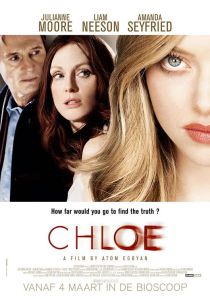
Worst Film Of The Year (so far): Chloe. Oh, Atom Egoyan, poor baby, what have you done, sweetheart? You made a trashy, campy softcore movie and then you forgot that these things are supposed to be fun! Runner-up: Robin Hood, because the entire freaking movie was a lie. However, it did feature Oscar Isaac screaming, “Outlawwwwww!” and that saves it from being named the worst.
Worst Horror Film So Far: The Black Waters On Echo’s Pond. So. Fucking. Bad.
The Get-Over-It-Award For The First Half Of 2010: The makers of Prince of Persia, who just had to try to turn an otherwise entertainingly mindless action film into yet another half-assed cinematic allegory for the Invasion of Iraq. Ben Kingsley will probably be playing thinly disguised versions of Dick Cheney for the rest of his life. I was against the Invasion of Iraq from the start but seriously, I’m so bored with every movie released using it as a way to try to fool the audience into thinking that they’re seeing something more worthwhile than they are.
The Read-The-Freaking-Book-Instead Award: The Killer Inside Me. A lot of viewers are disturbed by the violent way that the main character deals with the women in his life. I’m more disturbed by the fact that all the women in his life are presented as being simpering idiots. The original novel is by Jim Thompson and it is a classic.
The worst ending of 2010 so far: Splice with the Killer Inside Me as a strong runner-up.
Future Film I’m Not Looking Forward To: Roland Emmerich’s Gusher, an ecological thriller based on the BP oil spill, starring Will Smith as the President, Dev Patel as the governor of Louisiana, Paul Bettany as the head of the evil oil company, and Ben Kingsley as Dick Cheney who will be seen cackling as oil-drenched doves wash up on the shores of California. (How did the oil get to California? Emmerich magic.) Of course, the nominal star of the movie will be Jake Gyllenhaal as the young engineer who says stuff like, “This well is going to blow!” and who is trying to reconcile with his estranged wife (played by — does it really matter? Let’s just say Emily Blunt gets the role this time around). And let’s not forget Robert Duvall, who will play a grizzled old-timer who says a lot of grizzled old-timer stuff. Look for it in 2012.
My prediction for which film will be the most overrated of 2010: The Social Network, which has not opened yet but Sasha Stone at awardsdaily.com seems to think that it’s a slam dunk for greatness which is usually a pretty good indication that the end result is going to be a predictable, bourgeois crapfest.
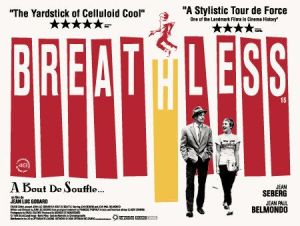
So, that’s 2010 so far. It’s shaping up to be a good year. I’m still looking forward to the release of Blue Valentine, Animal Kingdom, Get Low, The Disappearance of Alice Creed, The Last Exorcism, Wall Street, and the rerelease of Godard’s classic Breathless, which is one of my favorite movies and now I’m going to get a chance to see it in a theater! Life is good.
There are exactly two things that keep Sam Raimi’s otherwise entertaining 2009 horror romp Drag Me To Hellfrom being a classic.
The first is that, about halfway through the movie, Alison Lohman murders her pet kitten. Admittedly, Lohman’s character is trying to thwart a gypsy curse at the time and the action does show just how terrified she’s become. But that doesn’t change the fact that it’s a cute kitten and quite frankly, I’m getting sick of seeing cats being killed in horror films. There’s something truly hypocritical about how far most filmmakers are willing to go to assure an audience that a dog has somehow survived the end of the world while cats are continually killed on-screen without a second thought.
Am I saying that the film would have been better is Lohman had murdered a cute puppy instead? Yes, I am. At least that would have been unexpected. That would have let the audience know that all the rules no longer applied. Quite frankly, whenever you see a cat in a horror film, you know that cat is going to end up either pinned to a door or hanging in the closet. Dogs, however, always make it to the end.
I imagine this is because there’s more “dog people” than “cat people” in the world. People — especially men of a certain age — just love dogs and I’ve never really understood why. I guess there’s a charm to a loud, smelly, slobbering beast eating its own fecal matter that I’ve never been able to pick up on.
The second thing that keeps Drag Me To Hell from reaching classic status is the fact that Bruce Campbell is nowhere to be found, making this the 1st Raimi film not to feature Bruce in at least a cameo. Regardless of how well-made or entertaining the movie may have been, I sat through the entire thing waiting for Bruce to show up and, when he didn’t, it was hard not to feel as if perhaps an era in filmmaking had come to an end.
However, despite these two issues, Drag Me To Hell is probably one of the best horror movies to have been released in the past few years. If nothing else, it proves that, even after directing three Spiderman films, Raimi is still a B-movie director at heart and a brilliant one at that.
In Drag Me To Hell, Alison Lohman plays Christine, a young bank loan officer who, attempting to impress her boss and win a promotion, refuses to give a loan to a decrepit old gypsy woman (played, wonderfully, by Lorna Raver as the type of grotesque character who could only appear in a Raimi film). The gypsy woman responds by promptly dying but before doing so, she puts a curse on Christine. In three days, Christine will be dragged to Hell.
What makes this is so effective is that Raimi, as opposed to a less adventurous director, sets the film up to suggest that perhaps Christine deserves to be dragged to Hell. As disgusting as the old woman is, she clearly doesn’t deserve to be treated as badly as she is by Christine and Christine herself (even before she kills that poor kitten) is a bit of a fake, a former “fat girl” who, when she lets her guard down, reverts back to a country hick accent that she’s obviously spent a lot of time trying to lose.
Lohman does an excellent job in the lead role, giving a likeable performance as an unlikeable character. Speaking as a former country girl who still occasionally feels a twinge of shame when I hear myself say “git” instead of “get,” one of my pet peeves is when an actor or actress trots out an unconvincing, patronizing attempt at a rural accent. However, Lohman captures the accent perfectly and, unlike most actors who try to play country, never allows her performance to just be about doing dialect. Instead, both she and Raimi show how Christine’s insecurities lead to her actions without ever suggesting that they excuse them.
Though absence of Bruce Campbell is painfully obvious, Raimi still surrounds Lohman with a very strong supporting cast who all bring just the right amount of B-movie seriousness to their roles. As Raver’s daughter, Bojana Novakovic appears in one the film’s best scenes in which she tauntingly explains the cure to Lohman. Dileep Rao (who would be wasted later that year in Avatar) steals almost every scene he’s in as a friendly psychic who tries to help Lohman. Lohman’s boyfriend is played by Justin Long (of the “I’m a Mac” fame) and he’s perfect as a somewhat nerdy guy who, quite frankly, seems like he might be a little bit too nice for his own good. Plus, the film’s final scene proves that Long can shed a tear with the best of them. Bruce Campbell would have been ideally cast as Lohman’s boss but, in Campbell’s absence, David Paymer fills the role well enough.
When Drag Me To Hell was first released in 2009, the majority of reviews described it as being an entertaining throwback to the old school horror films of the 50s and 60s. And, in many ways, this is a totally correct assessment. What wasn’t often mentioned was that Drag Me To Hell is one of the very few Hollywood horror films to capture the chaotic spirit of H.P. Lovecraft. Countless filmmakers have attempted to bring Lovecraft’s Cthulhu mythos to the screen and they’ve failed because they could never translate to the screen Lovecraft’s theme of mankind as a bunch of powerless pawns, existing and dying at the whims of a bunch of “demons” whose motivations could never be understood or questioned. Though Drag Me To Hell is not based on Lovecraft’s work, it perfectly captures the feeling of helplessness in the face of metaphysical chaos that runs through Lovecraft’s best stories. As the movie progresses, it becomes apparent that Christine isn’t going to be dragged to Hell so much because of the gypsy curse as much as just because the movie’s demon has decided to drag her to Hell. It’s this theme (and the way that Raimi relentlessly develops it) that takes Drag Me To Hell to a whole other level and which makes its final scene so powerful and effective.
When first released, Drag Me To Hell’s special effects were criticized by some and it is true that the film’s demon, when he does show up, is an obvious CGI creation but who cares? If anything, the obvious fakeness of the demon adds to the film’s exploitation charm (though the demon is probably another role that Bruce Campbell could have done wonders with). If you want perfect CGI devoid of subtext or originality, Avatar’s out on DVD. Me, I’ll take Drag Me To Hell any day.
I was a child of the 80’s. I can’t escape that particular information about my past, but unlike some of those of my generation I wholeheartedly embrace the 80’s both the good and the bad and the oh-so-awful. This is why after watching Hot Tub Time Machine (directed by Steve Pink…quite an 80’s name if there ever was one) I have a much deeper appreciation for the things I went through growing up as a teen during the mid-80’s. Rap was just starting to get real popular. Hairstyles, fashion and pop culture was dictated by the emerging juggernaut that was MTV (when they actually played music videos). This raunchy (and it is pretty raunchy) comedy starring John Cusack, Rob Corddry, Craig Robinson and Clark Duke definitely spoke to my inner 80’s teen self.
The film’s premise could’ve been taken straight out of any 80’s direct-to-video knock-off of Back to the Future meets Porky’s. I mean the title itself pretty much explains the premise of the film. A literal hot tub acts as a time machine which whisks the four actors mentioned above to 1986 where they get to re-live a specific night they all spent together in 1986 (well, except Duke’s character who wasn’t born yet). Talk about space-time continuum and butterfly effect gets bandied about, but in the end the whole film was just trying to insert as much 80’s pop culture references as possible within 90 and plus minutes.
The film definitely got the 80’s vibe by liberally putting in boobs and naked chicks. 80’s icons Chevy Chase, Crispin Glover and William Zabka make appearances and John Hughes moments get replicated. I mean shot literally like it was Sixteen Candles all over again. The performances by everyone involved was great and it seemed like everyone were enjoying themselves. Craig Robinson as Nick had me laughing out loud every time he said something.
One thing good I can say about Hot Tub Time Machine that encompasses everything good about it is that it played like the anti-Judd Apatow comedy. While Apatow laughers I enjoy they’ve gotten to the point that everyone tries to make their comedies sound like his. Plus, any comedy that can have Sixteen Candles and Red Dawn references in the same 30-minute span has to be awesome….Oh yeah, it also used Mötley Crüe’s “Home Sweet Home” power ballad over and over.
In the role of Pam Beesley on the American version of The Office, Jenna Fischer has served as a role model for artistic, red-haired receptionists everywhere. (I write this, of course, as an artistic, red-haired receptionist.) However, before she played Pam on a sitcom disguised as a documentary, she played herself in 2004’s Lollilove, a satire disguised as a documentary.
Lollilove tells the story of Jenna and James Gunn (played by Fischer and her then-husband, Slither director James Gunn), a young, idealistic Hollywood couple of decide that they want to do something good for humanity. After giving it a lot of thought (at one point, we see that Jenna has written “Charity is hard!” in all caps in her diary), Jenna and James decide that their purpose in life is to pass out lollipops to the homeless. Recruiting Hollywood friends like Judy Greer, Jason Segal, and Linda Cardellini (all playing themselves), they set out to make their dream of homeless people sucking on lollipops a reality.
Clocking in at a brisk 64 minutes, Lollilove is like the Office’s slightly more psychotic cousin. In the best tradition of transgressive art, Lollilove is fully committed to its ludicrous story and, to its credit, it never wavers from pursuing its story to its ludicrous (if all too believable) ending.
A large reason why the movie works is because of the lead performances of Fischer and Gunn. Lollilove probably features Fischer’s best work outside of the Office and Gunn proves himself to be as good an actor as a director. Both of them bring a manic sincerity to their crazed alter egos. Mention should also be made of the homeless of Los Angeles who play themselves in the film’s final scene. Yes, when the “fictional” Gunns hand out their inspirational lollipops, they’re giving them to the real homeless.
And, it must be said, some of the homeless do seem to appreciate the gesture.
(As an added bonus: Lloyd Kaufman has a cameo in which he plays a priest and it has to be seen to be believed.)
There has been a complaint which has been getting louder and louder for the past several years from both horror and mainstream film fans. The complaint is that horror films of late have either been remakes or another sequel. While this complaint is not exclusive to the horror genre (non-horror genres have had the same problem) it is more prevalent and happens more often. Once in awhile a film will come out that tries to be different and put out an original story. Spanish director Jaume Collet-Serra has done just that with his second foray into feature filmmaking with Orphan. While the film won’t win many awards and become the critical darling the way Let the Right One In did Collet-Serra’s Orphan does bring a fresh new take on the evil child subgenre. Despite some of the flaws and script problems the film does entertain throughout most of its running time until it loses steam in the final 15 minutes.
Jaume Collet-Serra first got his start directing the 2005 remake of House of Wax. A film more famous (infamous in some people’s eye) for being the first major film of socialite Paris Hilton. A film that deservedly got panned by critics, but still did well enough in the box-office to put horror fans on notice that Collet-Serra might be a filmmaker to keep an eye on. Orphan marks his second full-lenght feature and using the screenplay by David Leslie Johnson, Collet-Serra tries a hand in the evil child subgenre which has more than it’s share of classic titles like The Omen, The Bad Seed and The Good Son. While this subgenre of horror usually means some sort of demonic-possession or some sort of mental or genetic abnormality causing for their psychotic or sociopathic behavior, in Orphan an interesting reason was given to the nature of it’s titual character.
The film begins with a harrowing and quite disturbing scene of the Vera Farmiga’s character pregnant and in labor, but also starting to miscarriage her child. The graphic nature of the scene quickly lays down the hammer that Orphan will not hold things back just because childen will be involved throughout most of it’s running time. We then see Farmiga’s Kate and her husband John (played by Peter Sarsgaard) at the local orphanage as they attempt to fix their family and ease Kate’s emotional turmoil over the miscarriage by adopting a child. They meet Esther a 9-year-old Russian orphan girl who seem to be the perfect child at first glance. Esther’s well-spoken and well-mannered at such a young age. Esther soon becomes part of John and Kate’s young family which consists of a younger deaf daughter named Max and a son named Daniel. While Max accepts Esther as a new older sister Daniel senses something just off-putting about Esther and reacts much more coldly towards his new dopted sister.
The majority of Orphan‘s second and first half of the third and final reel shows Esther’s true nature peek through the facade of Old World genteel and proper behavior. 12-year-old Isabelle Fuhrmann does an excellent job portraying the sociopathic and manipulative Esther. It is difficult to believe that a child actor of her age able to tackle such a dark role and actually pull it off without making the character too over-the-top or campy. In fact, no matter how one thinks of the performances of the rest of the film’s cast (Farmiga does a good job in the Cassandra-role with Sarsgaard an average performance as the hapless and clueless husband) this film is totally Fuhrmann’s and she sticks the landing.
While the film tries to make something original (and most of it is to a point) out of a tried-and-true model of the evil child storyline the script doesn’t hold up through the length of the film. The story itself is quite interesting when one really steps back to look at it, but there’s several leaps in logic the Kate character makes which will illicit more than a few confused reactions (running away from incoming help and into the dark, unknown being a major one). The dialogue itself is serviceable with none of it wince-inducing. There’s just a sense that the film’s reveal in the end of the film as to Esther’s true nature was just handled in a very clumsy manner. The twist is very original but the execution of that reveal after the tense and very brutal 40-50 minutes before it comes off quite flat. Orphan definitely looked like a script which was in need of several more rewrites to reconcile the first 3/4’s of the film with the final part. Yet, despite the ridiculous manner in which the final 10-15 minutes unfolds Collet-Serra manages to keep the film from dragging along through two hours. It actually plays much faster for a film with such a long running time.
In the end, Orphan marks a decidedly better effort from Jaume Collet-Serra, but one which still shows that he has some polishing to do to join the ranks of better horror directors of his generation. The film is enjoyable enough if given a chance. Most horror fans will enjoy the film and some may even embrace it because of the silly ending. Mainstream audiences looking for a change of pace from the strum und drang of the summer blockbuster season could do no worse than Orphan. It is not a perfect film and not even an above-average one, but it is a good horror film that tried to add something new to the genre, but hampered by a storyline that cannot sustain the tension it built-up and the brutality it showcased. In the hands of a much more seasoned filmmaker with a better hashed out screenplay Orphan could’ve become an instant classic.
In my “which movie should I review poll” 1983’s Sole Survivor came in dead last, receiving a total of 3 votes out of the 234 cast. I really wasn’t surprised to see that because Sole Survivor, along with having a dreadfully generic title, isn’t really that well-known. I found the DVD at Half-Price Books where it was being sold for a dollar in the clearance section. If not for the fact that I can’t resist a bargain, I would never have heard of this movie either. Which is a shame because, taken on its own low-budget terms, Sole Survivor is actually a pretty effective horror film.
Written and directed by Thom Eberhardt, Sole Survivor has a plot that should be familiar with anyone who has ever seen any of the Final Destination films. Denise (played by an actress named Anita Skinner) is a neurotic commercial producer who, as the film opens, is the sole survivor of a horrendous airplane crash. (When we first see Denise, she’s still sitting in her seat, surrounded by the remains of her fellow passengers.) Against the advice of just about everyone, Denise insists on dealing with the trauma of the accident by trying to return to her normal life. This is complicated, however, by the fact that she’s still having dreams about the plane crash. Everywhere she looks, she sees mysterious and menacing strangers watching her. And, on top of everything else, she is now being stalked by a mentally unstable former actress who claims to be having nightmarish visions of Denise’s future. Is Denise suffering from survivor’s guilt (as her doctor boyfriend insists) or is she instead being pursued by Death? If you’ve ever seen a horror film, you can probably guess the answer.
As I mentioned previously, its easy to compare Sole Survivor with the Final Destination films. However, a more appropriate comparison would be to the 1962 black-and-white classic Carnival of Souls. Whereas the Final Destination films are largely about coming up with ludicrously convoluted ways for Death to get what he or she wants, Sole Survivor (like Carnival of Souls) is less concerned with how Death gets the job done and more concerned with building and maintaining a growing sense of dread and hopelessness. For the most part, director Eberhardt disdains easy shock effects in order to concentrate on building up a palpable atmosphere of doom. As a result, the film can occasionally seem to be a little slow but it stays with you even after the final credit.
Also, much like Carnival of Souls, Sole Survivor features an excellent lead performance from an actress who, more or less, disappeared from movie screens after the film’s release. Carnival had Candace Hilligoss. Sole Survivor has Anita Skinner. Skinner gives an excellent lead performance, always remaining a sympathetic. According to an interview with the film’s producers, Skinner was uncomfortable with the more excessive side of Hollywood and retired from acting shortly after making Sole Survivor.
Sole Survivor was released on DVD by Code Red, so now people like me can appreciate this neglected movie. The transfer looks great. Unfortunately, the DVD is pretty thin when it comes to extras. Neither Eberhadt nor Skinner are interviewed nor do they contribute to the film’s commentary track. Instead, we have to make due with the film’s producers. In general, producers usually provide the worst DVD commentary tracks with typical insights running along the lines of “We had the same lawyer” and “So, after that, we brought in another screenwriter.” The producers of Sole Survivor aren’t quite that bad but their commentary is still definitely lacking in insight.
But that’s a minor complaint. In the end, what matters is the movie and not the commentary track. And as a movie, Sole Survivor is a an overlooked classic of the horror genre.
First off, a confession of my own. When I’m not reviewing movies or chattering away on twitter, I work in a law office. Before anyone panics, I’m not a lawyer, I just hang out with a couple of them. For the most part, I answer the phone, I schedule appointments, and I keep all the files in alphabetical order. On a few very rare occasions, I’ve accompanied my boss to court and the thing that has always struck me about real-life courtroom drama is how boring it all really is. There are no surprise witnesses, no impassioned closing statements, and those all trail rarely, if ever, jump to their feet and start yelling that they’re innocent. For the most part, real life lawyers are usually just as poorly groomed and bored with their work as the rest of us. Don’t even get me started on the judges, the majority of whom seem to have judgeships because they weren’t really making the grade as an attorney.
As a result, it’s rare that I get much out of seeing lawyer-centric movies or tv shows any more. After seeing the reality of it, I find fictionalized courtroom theatrics to be ludicrous and, for the most part, evidence of a lazy writer. However, I’m happy to say that last night, I discovered that — no matter how jaded I may now be about the legal process — Anatomy of a Murder is still one of my favorite movies.
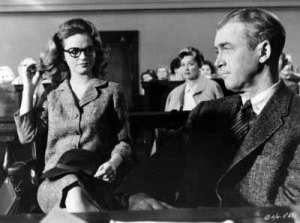
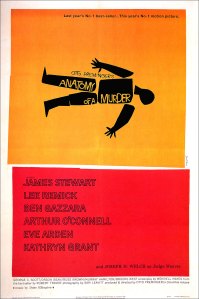
Based on a best-selling novel and directed by the notorious Otto Preminger, Anatomy of a Murder tells the story of Paul Beigler (James Stewart), a former district attorney who is now in private practice after having been voted out of office. Having apparently fallen into a state of ennui, Beigler spends his time drinking with another alcoholic attorney (Arthur O’Connell) and trying to avoid his secretary’s (Eve Arden) attempts to get paid.
However, things change for Beigler when he is hired to defend an army officer named Frederick Manion (Ben Gazzara). Manion has been arrested for murdering a bar own named Barney Quill. Manion says that he was justified in committing the murder because Quill raped his wife, Laura (Lee Remick). Others claim that Manion is himself just a notoriously violent bully and that the openly flirtatious Laura was having an affair with Quill. Despite strongly disliking Manion and disturbed by Laura’s own obvious instability, Beigler takes on the case.
Beigler decides to argue that Manion was temporarily insane when he shot Quill and that he was acting on “irresistible impulse.” As shaky as that line of defense might seem, it’s not helped by the fact that Manion himself is a bit of a brute. Meanwhile, Beigler finds himself facing not the innefectual D.A. in court but instead a young, ambitious prosecutor from the State Attorney General’s Office, Claude Dancer (played by a young and obviously ambitious George C. Scott). As the trial begins, small hints start to appear that seem to indicate that there’s a lot more to the murder of Barney Quill than anyone realizes…
Director Otto Preminger is an odd figure in film history. Up until the early 60s, he was a consistently interesting director who made intelligent, well-acted films that often challenged then-contemporary moral attitudes. However, once the 60s hit, he became something of a parody of the egotistical, old school, autocratic filmmaker and his films seemed to suffer as a result. Like many of the film industry’s top directors, he found himself adrift once the 60s and 70s hit. His decline was so dramatic that, as a result, there’s a tendency to forget that he made some truly great and important films, like Laura, Carmen Jones, The Man With The Golden Arm, and, of course, Anatomy of a Murder.
Anatomy of a Murder represents Preminger at his best. His own natural tendency towards embracing melodrama and shock are perfectly balanced with an intelligent script and memorable performances. Whereas later Preminger films would often come across as little more than big screen soap operas, here he makes the sordid believable and compelling. Preminger has never gotten much attention as a visual filmmaker but here, he uses black-and-white to perfectly capture the grayness of the both the film’s location and the moral issues that the film raises. He keeps the camera moving without ever calling attention to it. As a result, the movie has an almost documentary feel to it.
As previously stated, Preminger gets a lot of help from a truly amazing cast. At first, it’s somewhat strange to imagine a Golden Age icon like Jimmy Stewart appearing in the same film as a dedicated method actor like Ben Gazzara. These are two men who represent not only different philosophies of acting but seemingly from two different worlds as well. However, Preminger uses their differing acting styles to electrifying effect. One of the joys of the movie is watching and contrasting the old style, “move star” turns of James Stewart, Arthur O’Connell, and Eve Arden with the more “naturalistic” approaches taken by their younger co-stars, Gazzara, Lee Remick, and especially George C. Scott. The contrast in style becomes a perfect reflection of the film’s contrast between what is legal and what is correct. All the actors, as both individuals and as an ensemble, give memorable performances. When you look at the cast, you realize that any one of their characters could have been the center of the story without the film becoming any less compelling.
Lee Remick (a notoriously fragile actress who, for years, I knew solely as the poor woman who kept getting attacked by her adopted son in the original Omen) brings out the best in everyone she shares a scene with. Whether she’s making Stewart blush or breaking down on the witness stand, she dominates every scene as an insecure young woman who forces herself to be happy because otherwise, she’d have to confront the fact that she’s miserable. (I should admit that I related more than a bit to Remick’s character. To me, the movie was about her and therefore, about me.)
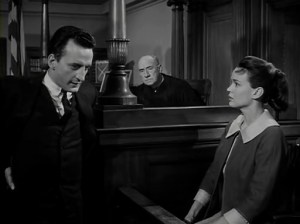
She is perhaps at her best towards the end of the film when she is on the witness stand and is cross-examined by George C. Scott. Starting out as flirtatious and seemingly confident, Remick slowly and believably falls apart as Scott methodically strips away every layer of defense that, until now, she’s spent the entire movie hiding behind. By the end of the scene, Remick has shown as every layer of pain that has built up in Laura Manion over the years. For his part, Scott is simply amazing in this scene. Determined and focused, Scott doesn’t so much cross-examine Remick but seduces her and the audience along with her. As a result, when he suddenly turns off the charm and lunges in for his final attack, it’s devastating for everyone watching. (And, as was correctly pointed out to me by a friend while I was watching the film last night, George C. Scott was quite the sexy beast when he was young.)
Lastly, the film’s judge is played by an actual lawyer by the name of Joseph Welch. Welch wasn’t a great actor but he did make for a great judge.
Of course, it wouldn’t be a Preminger film is a few contemporary morals weren’t challenged and, at the time it was released, Anatomy of a Murder was considered to be very daring because of its frank discussion of topics like rape and spousal abuse. It doesn’t seem quite so daring now but it does seem to be remarkably mature in a way that even most modern movies can’t match. That being said, the film does occasionally embrace the “she must have been asking for it” male viewpoint but still, it’s a remarkably advanced movie for the 1950s.
One of the wonderful things about watching a 51 year-old film is that it provides a chance to see what was considered to be shocking in the years before you or I was born. From watching this movie, I’ve discovered that, in the year 1959, “panties” was apparently a taboo phrase. A good deal of the film’s plot revolves around the panties Lee Remick’s character was wearing the night she was raped and their subsequent disappearance. At one point, there’s even a scene where Welch, Stewart, and Scott struggle to come up with a less offensive term to use when referring to them in the court. (Scott suggests employing a term he heard in France.) Seen 51 years later (in a time when we can not only say “thong” in polite conversation but specifically go out of our way to show off the fact that we’re wearing one), this scene, and the actors’ obvious discomfort whenever they have to say the word “panties”, never fails to amuse me.
Preminger’s other grand challenge to the 50s mainstream was in getting Duke Ellington to compose the film’s jazz soundtrack. At the risk of being called a heretic by some of my closest friends, I’ve never been a big fan of jazz but it works perfectly here. Ellington, himself, makes a cameo appearance and wow, is he ever stoned.
In conclusion, allow me to thank the readers of the site for “ordering” me to watch, once again, a truly classic film. Now, seeing as how close the vote was and that I know, for a fact, that some people voted more than once, I think it would be only fair for me to also rewatch and review the other 9 movies (Lost in Translation, Primer, Hatchet For the Honeymoon, Emanuelle in America, Starcrash, Darling, Sole Survivor, The Sweet House of Horrors, and The Sidewalks of Bangkok) in my poll over the next couple of weeks. I’m looking forward to each and every one of them (well, almost all of them) and, again, thank you for allowing me to start things off with a great film like Anatomy of a Murder.
On January 30th, 1972, in the Bogside area of Derry, Northern Ireland, the British army opened fire on what-was-meant to be a peaceful demonstration. 13 men were killed on the spot, another died later of his injuries. In the months leading up to the demonstration, the British army had been frequently attacked by pro-independence, largely Catholic “nationalist” groups and the Army was quick to claim that the were acting in self-defense and that they had been fired upon. Others, however, pointed out that almost all of the men killed (most were just teenagers) had been shot while fleeing the soldiers and none had any weapons on them. This was the event known that later became known as Bloody Sunday and served as one of the leading catalysts for the decades of “Troubles” that would follow.
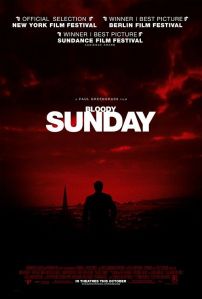
The Bogside Massacre also served as the basis of one of the best (and most important) films of the first decade of the 21st Century, 2002’s Bloody Sunday.
Directed by Paul Greengrass (who would later, of course, direct the final two Bourne films), Bloody Sunday is a disturbing recreation of January 30th, 1972. We watch as the civil rights activist Ivan Cooper (a very likable James Nesbitt) makes his way through the Bogside area of Derry, encouraging people to attend the march while still finding time to beg the local IRA leadership not to start any violence. While most critical attention is, understandably, given to the scenes that recreate the massacre itself, these early scenes are just as important. They establish the idea of the people of Bogside as being a community full of actual individuals as opposed to just a collection of pawns in the war between the nationalists and the unionists.
While Cooper tries to ensure peace, we are given contrasting scenes of the British army preparing for the exact violence that Cooper is trying to prevent. Ironically, in these opening scenes, both Cooper and his military counterparts are motivated by the same basic fear of the IRA. Its only once the demonstration has started and the first shots are fired that Cooper realizes that the establishment is far more dangerous than the insurgents.
Throughout the film, Greengrass directs in his signature, documentary-style, employing hand-held cameras and rejecting any artistic flourishes that might take the viewer out of the “reality” of the situation. Each scene ends with a fade-to-black and, as a result, the viewer gets the feeling that he is literally dropping in on the action. This is not to say that Greengrass is not an artful director. The power of his artistry, however, comes from his ability to hide the technique. As a director, he does not demand attention with a lot of showy tricks. Instead, he earns the attention by perfecting his craft.
Greengrass’s psuedo-documentary style is at its strongest and most devastating during the recreation of the massacre itself. Perhaps because the film was made for British television at a time when there was still official doubt about what set off the Bogside Massacre, Greengrass leaves hazy the exact reason as to why the army starts firing. However, what he does make clear is that the 14 men killed were, essentially, murdered. One of the unfortunate things about being as big a movie fan as I am is that I’ve grown jaded to the sight of people dying on-screen. However, unlike many other similar films, the deaths in Bloody Sunday are not presented as just being plot devices or as an excuse to get an emotional response from the audience. Instead, the deaths in Bloody Sunday hurt because you immediately know that, regardless of which you side you support as far as the Troubles are concerned, none of the deaths were necessary. They were, instead, the product of a nation’s wounded pride. 14 men died so that the British could feel British again.
As you can probably guess, the British don’t come across particularly well in Bloody Sunday and, quite frankly, they shouldn’t. Watching this movie, you’re left with the impression that the Bogside Massacre was the British Army’s attempt to exorcise the demons of the collapse of the British Empire by killing the Irish. (Though, in all fairness, the Irish killed a lot of British in the time leading up to Bloody Sunday.) However, and this is to Greengrass’s credit, individual British soldiers are shown to question the massacre. Its only when those soldiers are forced give up their individuality and function as a collective that they commit (and, at the film’s end, conspire to cover up) murder. For just that, this movie should be required viewing for anyone who insists on claiming that “individualism” is a threat to society.
The film ends on a quiet note as a somber Cooper announces that he no longer sees a “peaceful” solution. This scene gets its power largely from Nesbitt’s own charismatic performance. Playing the closest thing the film has to a central character, Nesbitt makes his early enthusiasm for the march so infectious that its simply devastating to see him after the massacre, angry and disillusioned. It also reminds the viewer that, in the years after Bogside, there was no peace and many more innocent people — on both sides of the conflict — would die. The British army may have thought it was going to scare Northern Ireland into submission but instead, they helped to perpetuate a continuing cycle of death, destruction, and hatred that, regardless of any treaty, continues to this very day.
I should admit that I’m a fourth Irish. My great-grandparents were born and raised in Ardglass, Northern Ireland. Though I’ve never been, I hope to visit Ardglass some day. Though I no longer consider myself to be a member of any religion, I was raised in the Catholic church. As such, I’ve always had an interest in Irish history and the Troubles in particular. I’ve also always been biased towards the nationalist side.
So, it would be fair for someone to ask if I’d have the same reaction to this film if I was a Protestant with family living around London and the honest answer is that I don’t know.
However, the power of Bloody Sunday doesn’t come from political ideology. Instead, the movie serves as a disturbing but powerful reminder of what can happen when people surrender their free will to groupthink. Though the oppressors in Bloody Sunday may be British, recent history has proven that, when actively opposed, those with all the power will always react with the same brutal fury. The forces of oppression remain the same whether they’re in Northern Ireland, Iran, Honduras, or the U.S.A.