Following The Amazon Prime Recommendation Worm #2: Secret Travel (2013), One Thing She Doesn’t Have (2014), Kiss Me, Kill Me (2009), Love Me Not (2006)


Secret_Travel-p1

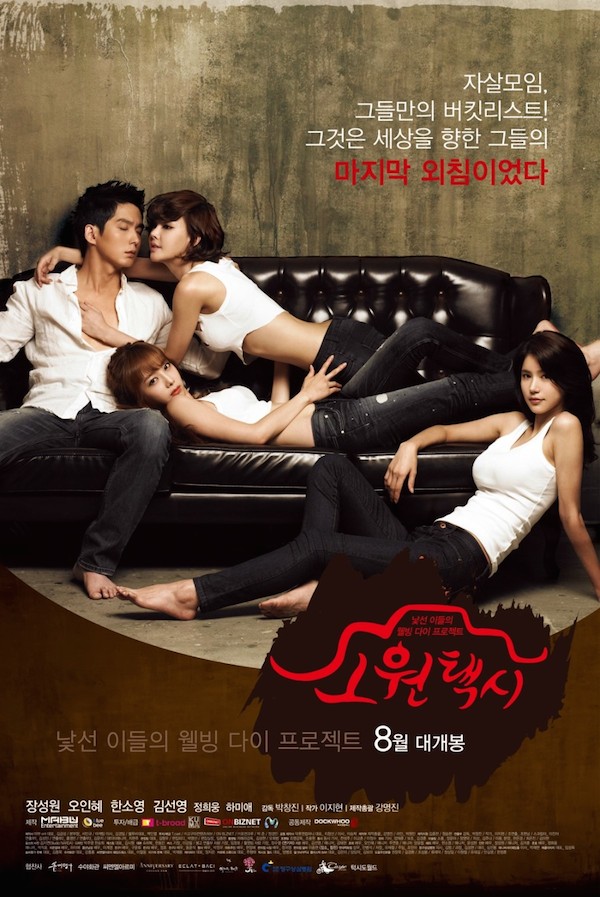
Secret Travel (2013, dir. Park Chang-Jin) – The plot of this film is that a guy starts a suicide club after a female prostitute gets into his cab who is obviously very depressed. Based on that plot would you think this movie is a comedy? Would you think that by looking at that poster? This movie also goes under the title Secret Confessions. Either title tell you it’s a comedy? Only the third title called Wish Taxi betrays that this might be a comedy. No wonder it also uses this as it’s poster.

url

Now that tells you it’s a comedy! The best way I can give you a feel for it is to take Ferris Bueller’s Day Off (1986) and cross it with The Breakfast Club (1985). The guy meets the girl in his cab and decides a way to get close to her is take up her apparent interest in killing herself. Rather morbid. He puts up a post online and two other girls along with her show up. There’s the perky one who is pictured on the right of that poster. The prostitute in the middle who is in the middle as far as depression goes. Then there’s the girl on the far left who in the movie you can tell is actually in danger of offing herself. The idea is that they are going to fulfill their bucket lists before killing themselves together. Again, rather morbid, but it all plays out like a comedy. I would compare it to the film The Bucket List, but I haven’t seen that one yet and it really is like a bunch of kids taking a day off of school who would normally not hang out together, but then get to know each other by having a good time in the city, thus becoming life long friends. In other words, Ferris Bueller’s Day Off crossed with The Breakfast Club.

Overall, I enjoyed it. I’ve said it several times already, but it is kind of morbid considering it’s a suicide club and all. Also, they all end up having sex with him. That’s really not much of a spoiler. One could read a little too much into it and think that having sex with him solves their problems. It really doesn’t. You can also look at it as a guy who gets sex by preying on three emotionally disturbed girls. I think that’s not giving the girls enough credit. He never really takes advantage and they all know what they are doing. It’s easier to argue that The Twilight Saga is about a pedophile considering the entire story can be stripped to a 100+ year old man who gets into a relationship with a teenage girl and freezes her at a young age.

I recommend this one.

MV5BMTUzNjQyMjcwMV5BMl5BanBnXkFtZTgwNzg4ODExNzE@._V1_SY317_CR12,0,214,317_AL_

One Thing She Doesn’t Have (2014, dir. Yu Jeong-Hwan) – This one on the other hand, I can’t recommend. The one thing this film doesn’t have is focus. One minute it wants to be a screwball comedy. Then it’s 8 1/2 (1963). Then it’s Soapdish (1991). Next it’s All About Eve (1950). Next it’s trying to be clever about how sex tapes affect the careers of actors. The cult of celebrity. It’s all over the place. Speaking of Soapdish.

The movie is about an actress whose career is on the downswing. Nobody is taking her seriously. On the other hand, you have a director who is also not doing so good. He is going to do a, what I thought was a movie, but it turns out to be a play. A rather racey play that has pole dancing in it. The actress’ production company encourages her to do it so she does…sort of. Do I have to tell you she’s a total diva? Well, she is. The film is about this play coming together, her using a body double for the pole dancing stuff, and a scandal. I think it fancies itself to be insightful and clever, but it isn’t. It’s all over the place.

Case in point, early in the movie the actress and a friend all but date rape the director to take pictures of him in sexual positions while he is heavily drugged so she can get her way. That is played as if it’s all light and funny. However, later in the film a sex tape gets out of the actress, which the director had nothing to do with, but it’s suddenly something we are supposed to take very seriously. It’s fake too by the way while the pictures are very real. So, the all but date rape is perfectly fine, but this sex tape of someone who is already doing a play where she is pole dancing almost entirely naked is supposed to be meaningful and tragic? Sorry, it doesn’t work. Yes, I know they try to explain this away with her little tale about her early acting career, but I’m sorry, swap the genders of that drugging and people would scream bloody murder. When you can swap gender and suddenly you feel repulsed, then it wasn’t right in the first place.

I don’t recommend this one.

Kiss-me-kill-me

Kiss Me, Kill Me (2009, dir. Yang Jon-Hyeon) – First things first. I can’t possibly be the only one who looks at that poster and thinks of the game Lethal Enforcers with the pink gun.

51v1ELDeHGL._SX425_

Well, with that out of the way. Ever wanted to see Branded To Kill (1967) sorta reworked into a romance between a hitman and a suicidal woman? Neither did I, but that’s essentially what you have here. For those of you who haven’t seen Branded To Kill, then stop reading this and go watch it. You’re in for a bizarre treat. Oh, and here’s the trailer for Branded To Kill which will explain nothing…

because you can’t really make a trailer to Branded To Kill that explains it. I can barely explain it and I’ve seen it. Also, you have probably seen it referenced in other movies. From something like Ghost Dog: The Way Of The Samurai (1999) to that really short-lived trans woman British contract killer TV show Hit & Miss. Yep, Chloë Sevigny with a penis. That’s something that exists in that show. I mean they actually show it several times. What also exists in both that movie, that TV show, and this movie are direct references to the famous butterfly sniper rifle scene. In Branded To Kill the lead played by Jô Shishido misses his target because a butterfly lands on his rifle. In this movie, it’s a leaf that happens to pass in front of the lead’s scope. This causes him to screw up a hit.

The movie starts out by introducing us to the suicidal girl as we see her jump onto the tracks while an oncoming subway train approaches. She lands on the tracks next to the tracks that the train is on before getting up and running away. Comedy? Anyways, she winds up at the scene where the hit is going to go down. There is actually a funny moment here when our contract killer goes to setup his gun on top of a building and notices a police sniper already there on the neighboring roof. The two just kind of acknowledge each other, then our killer goes somewhere else to setup. The girl happens to be there, but he doesn’t really meet her yet.

He’s then hired to kill a guy who is just going to be lying in his bed sleeping. Of course it turns out it’s her and she has hired him to kill her. He doesn’t do it though recognizing she’s suicidal and that’s not his thing. This is when he becomes romantically linked with her by basically just moving in with her. He still is going around killing, but he’s now sort of living with her and I believe his mother too. It reminded me of when the #1 Yakuza killer moves in with the lead in Branded To Kill. There’s even a shot of them just both sitting looking dead at some park like I remember the two killers doing on a couch in Branded To Kill.

Oh, and yes, I know him being hired to kill a woman could also be a reference to Murder By Contract (1958). So here’s that trailer too. Worth seeing even if the ending of the film is disappointing.

Ultimately, the movie has a neat setup, and I kind of like the actor playing the contract killer, but then it just settles into a soap opera. And yes, I’m well aware that soap operas are uber popular in South Korea. If I had forgotten, then the next film I’ll talk about sure reminded me of that fact. I didn’t like it. I kind of wish they had just gone all out and simply remade Branded To Kill. Oldboy (2003) proved the Koreans have what it takes to remake something so bat shit crazy. Unfortunately, after watching the movie I couldn’t satisfy my Jô Shishido fix since I don’t own any of his films. So I had to settle for the final scene from A Colt Is My Passport (1967). Enjoy!

Lovemenot

Love Me Not (2006, dir. Cheol-ha Lee) – It doesn’t look like Amazon Prime is going to let me out of South Korea anytime soon. This makes 6 of them in a row. This one is a straight up Old Hollywood 1950’s weepie. Even has sections with strong use of color that you would expect from a Douglas Sirk movie. Although, the main guy also wears an all white suit at times during some scenes with strong use of color so for all I know that was a reference to Tokyo Drifter (1966). Might as well have two movies in a row that reference a Seijun Suzuki film. Also, this one appears to reference Citizen Kane. I actually took a couple of screenshots here.

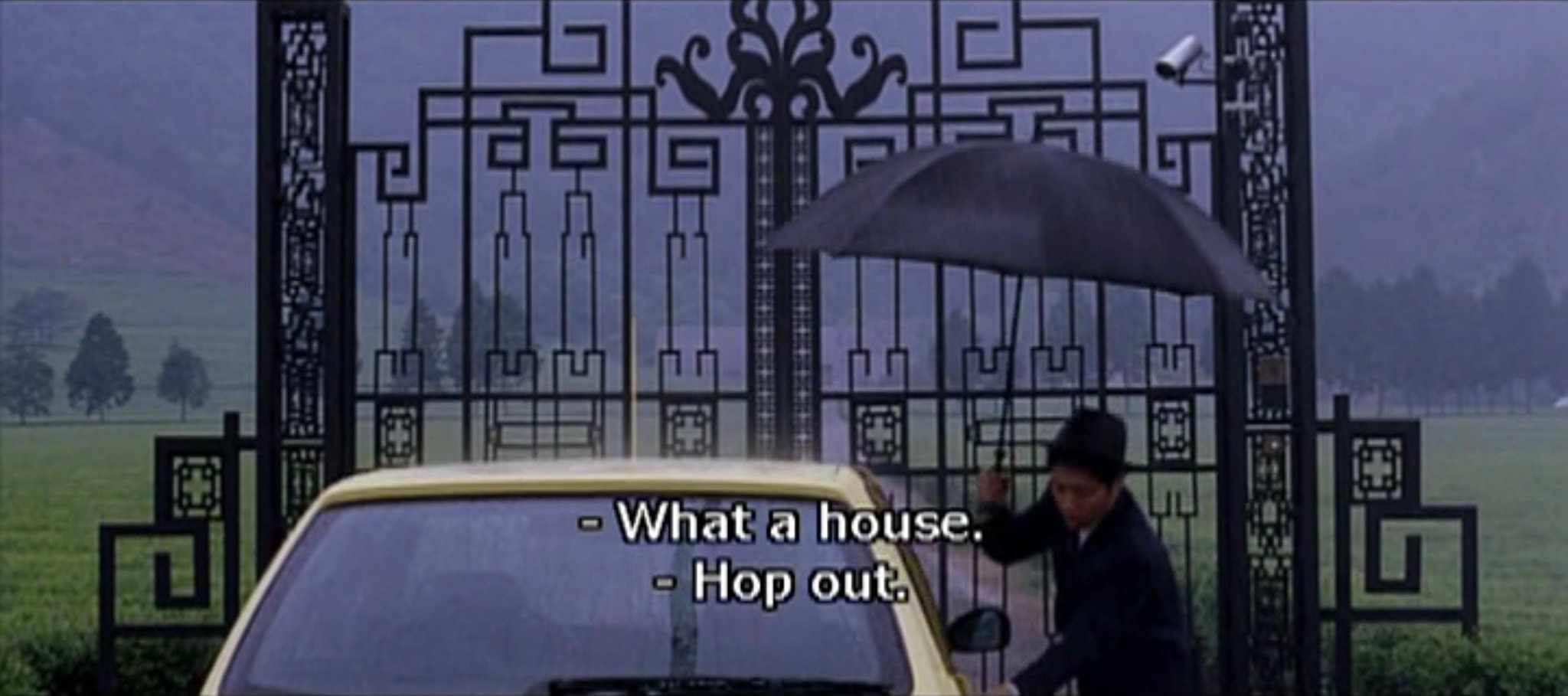
IMG_4323

IMG_4324

The plot here is that they needed an excuse to have a conman spend time with a blind woman who can appear as if she has just lost her sight even though she lost it a long time ago. To do this, they have a guy that suddenly needs massive amounts of money to pay back a debt he owes. He is going to go and pose as the blind woman’s long lost brother in order to get her inheritance since her father recently passed away. We get her acting as if she just went blind because the movie tells us she never left the house after losing her sight. That is until he shows up, then it’s time for the two to go out on the town so we can see her acting pathetic and him growing to love her.

There is seriously nothing else to this. This would have made a perfectly okay 1950s Hollywood romance film. Maybe Cary Grant or Robert Mitchum as the conman and maybe Ingrid Bergman as the blind woman. Actually, Audrey Hepburn is probably a better choice seeing as she was awesome playing blind in Wait Until Dark (1967). That or I needed an excuse to include the trailer for Wait Until Dark here.

I only recommend seeing Love Me Not if you know that Old Hollywood weepies really are your thing, and even more so if you already know the two leading actors: Geun-young Moon and Ju-hyuk Kim. If so, I can tell you that you will most likely enjoy this movie. It’s average, but I didn’t enjoy it because I am really not the intended audience.

And here’s some scenes from Wait Until Dark because I can. You’re welcome! Call it adding a “Scenes That I Love” section to a “Roundup” post.
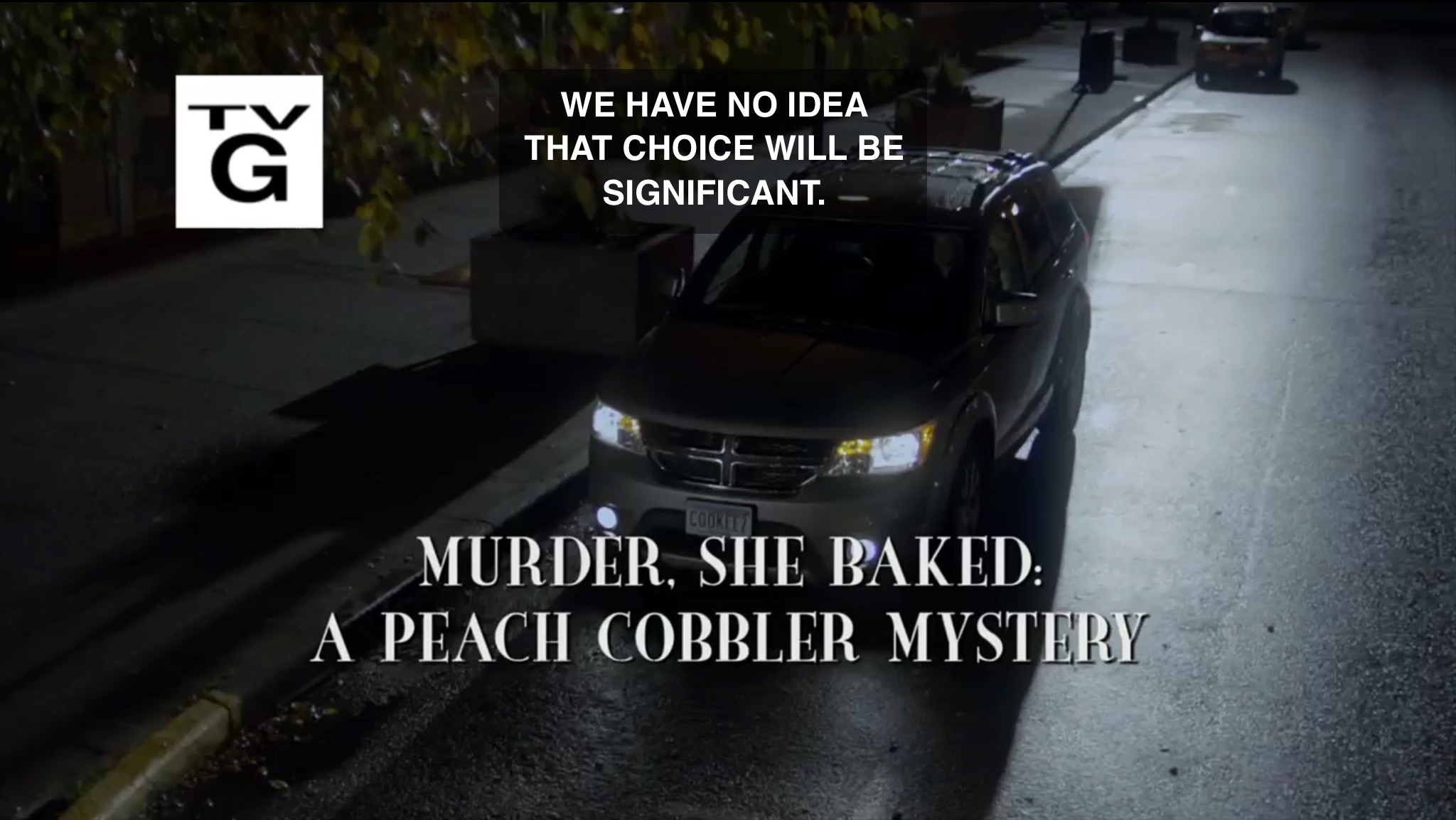
Hallmark Review: Murder, She Baked: A Peach Cobbler Mystery (2016, dir. Kristoffer Tabori)


IMG_2012

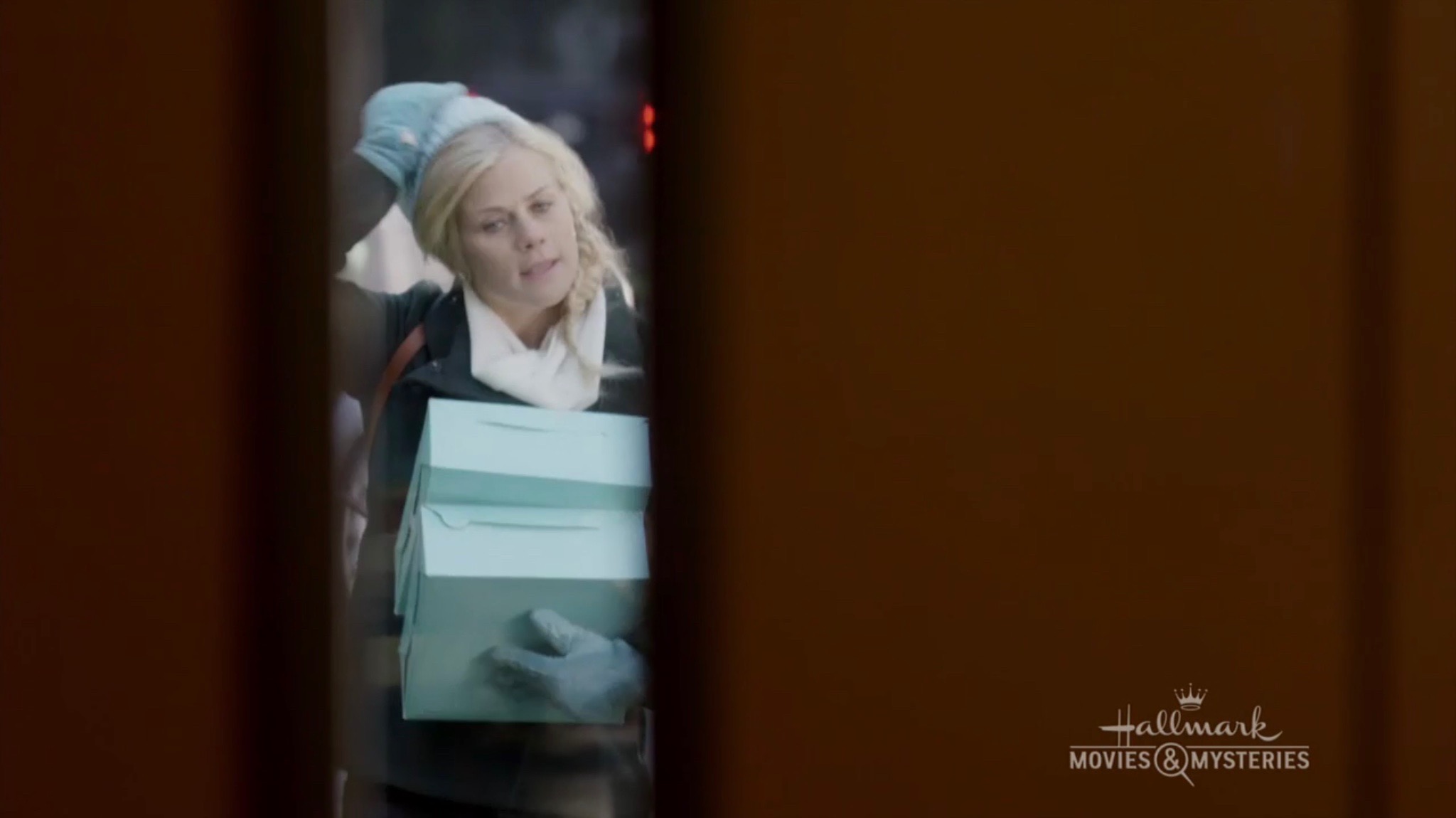
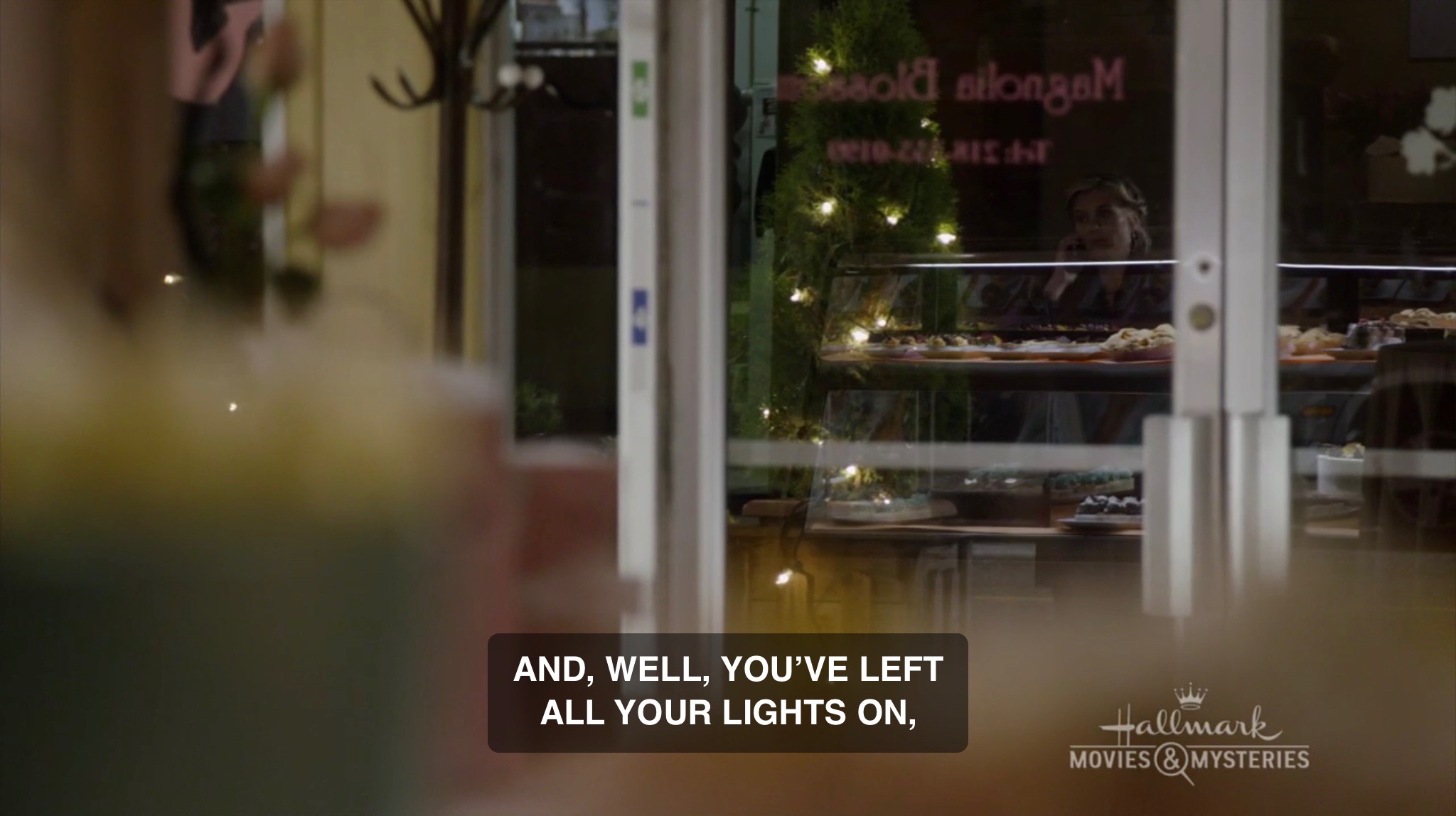
I know he probably didn’t, but seeing as Ron Oliver and David S. Cass Sr. have seen some of my reviews of their Hallmark films, I am going to just assume director Kristoffer Tabori read my reviews of Love On The Air and Murder, She Baked: A Plum Pudding Mystery. I say this because he fixed the problems with the way he shot those two films, but still kept some of the style he seems to be going for with his recent Hallmark movies. He still has a fondness for mirrors.

IMG_2118

IMG_2756

Still doing some framing.

IMG_2225

IMG_2360

The obstructionist stuff in front of the camera is drastically reduced. I’d say it’s only there when it actually does add something to the shot like these parts.

IMG_2431

IMG_2910

Thankfully, there was no repeat of the blinded by the light shot from Love On The Air and Murder, She Baked: A Plum Pudding Mystery. The good framing and composition in depth are used sparingly. It’s not something that seems to have been just thrown into every shot like it was before. That alone makes this way better than the previous Murder, She Baked film. I honestly don’t know why Tabori chose to do it this way this time, but I want to thank him for it.

IMG_2021

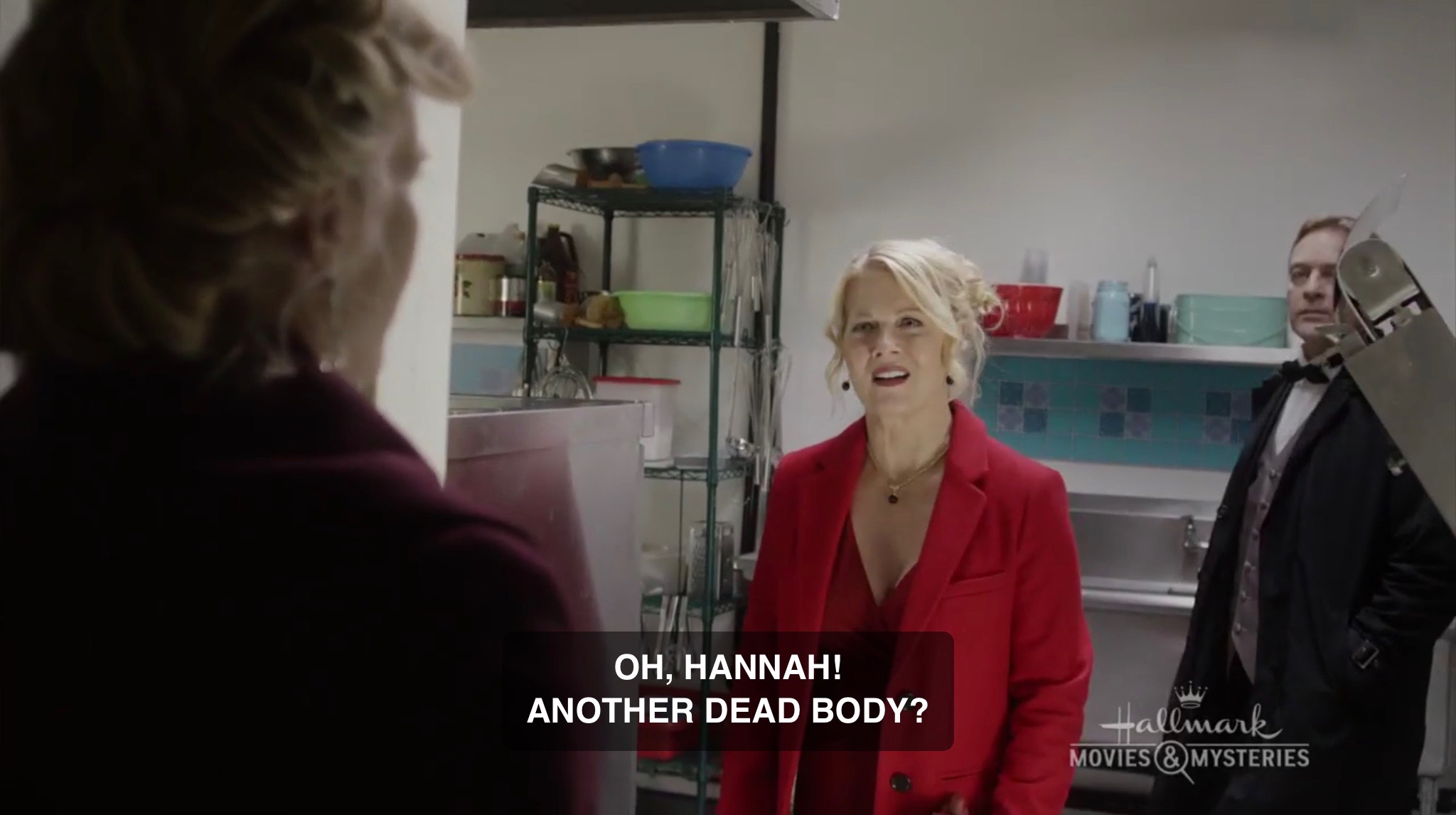
The movie starts off with Hannah (Alison Sweeney) discovering a body in a kitchen after a little film noir voiceover from her. I liked that it chose to open up that way. Then it cuts to a title card telling us: “Two Days Earlier”. This is when the movie reintroduces us to Hannah, the bakery, and the town of Eden Lake. Do I even have to say it anymore? Yes? Okay. And by Eden Lake, they mean Squamish, British Columbia, Canada. I know this because of this shot.

IMG_2503

However, kudos to the production crew for knowing this shot of her cellphone would be onscreen for an extended period of time so they simply removed the SIM card.

IMG_3112

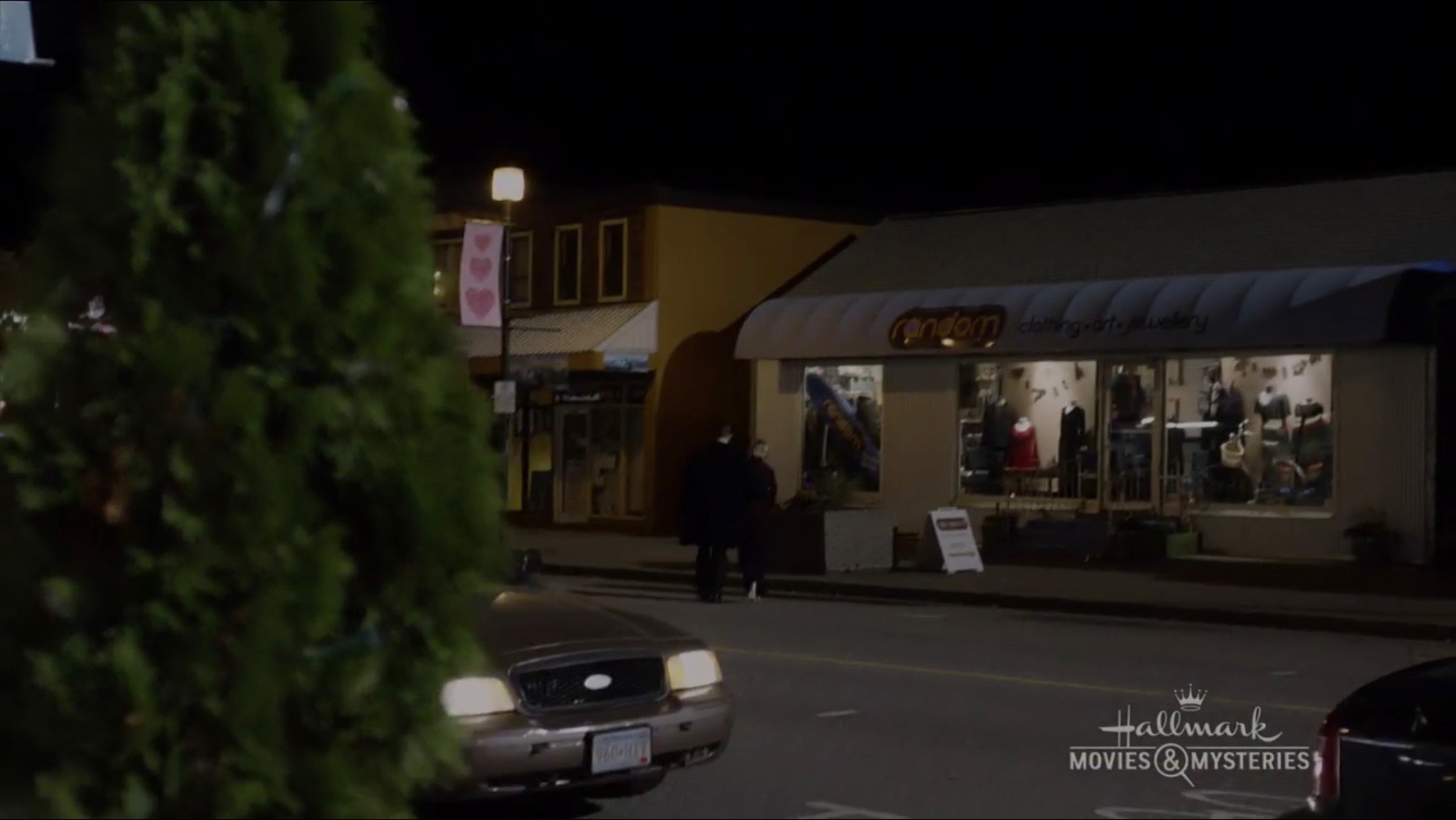
Of course, the rest of the time it’s just Minnesota license plates where the film is supposed to take place.

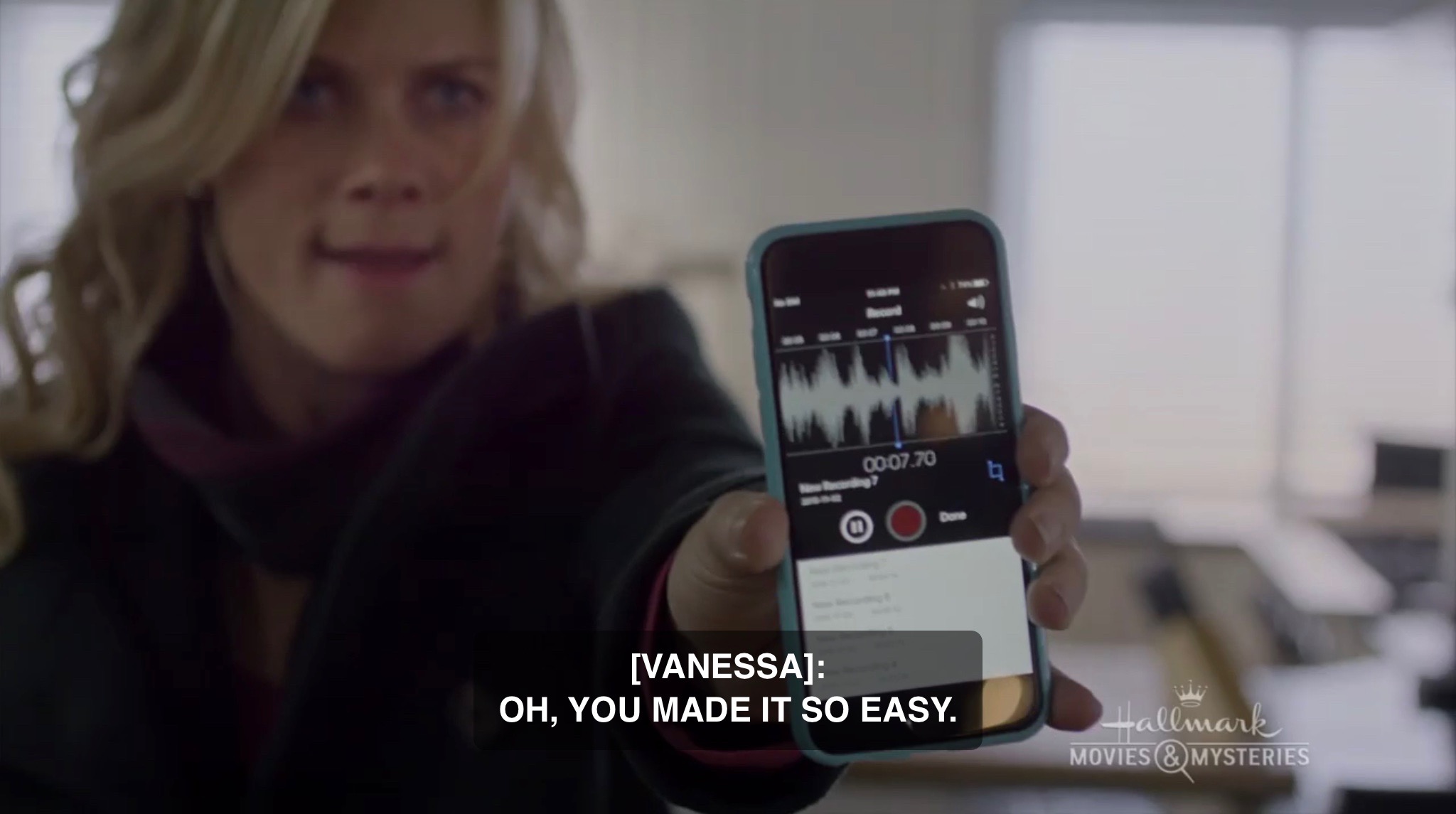
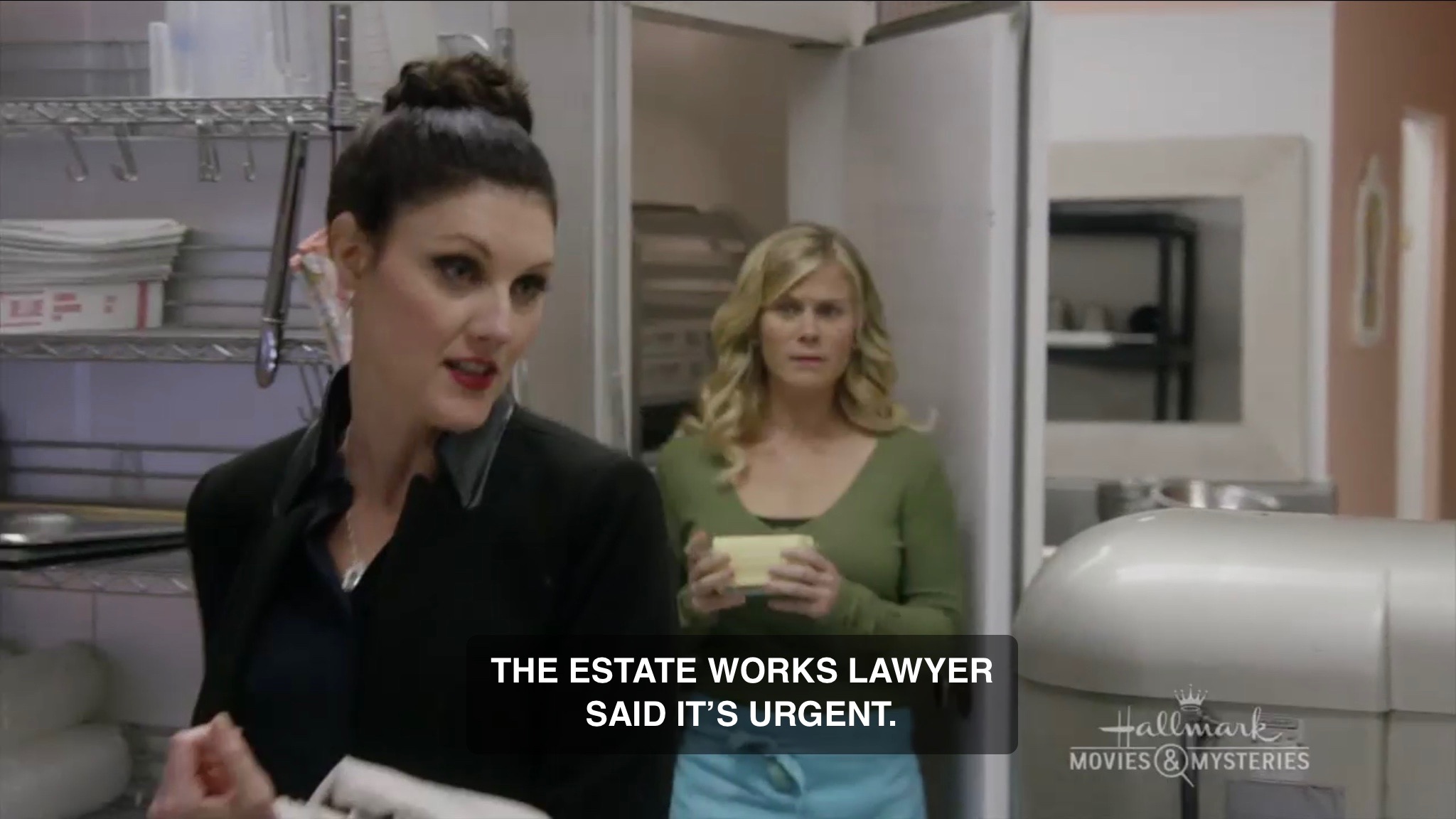
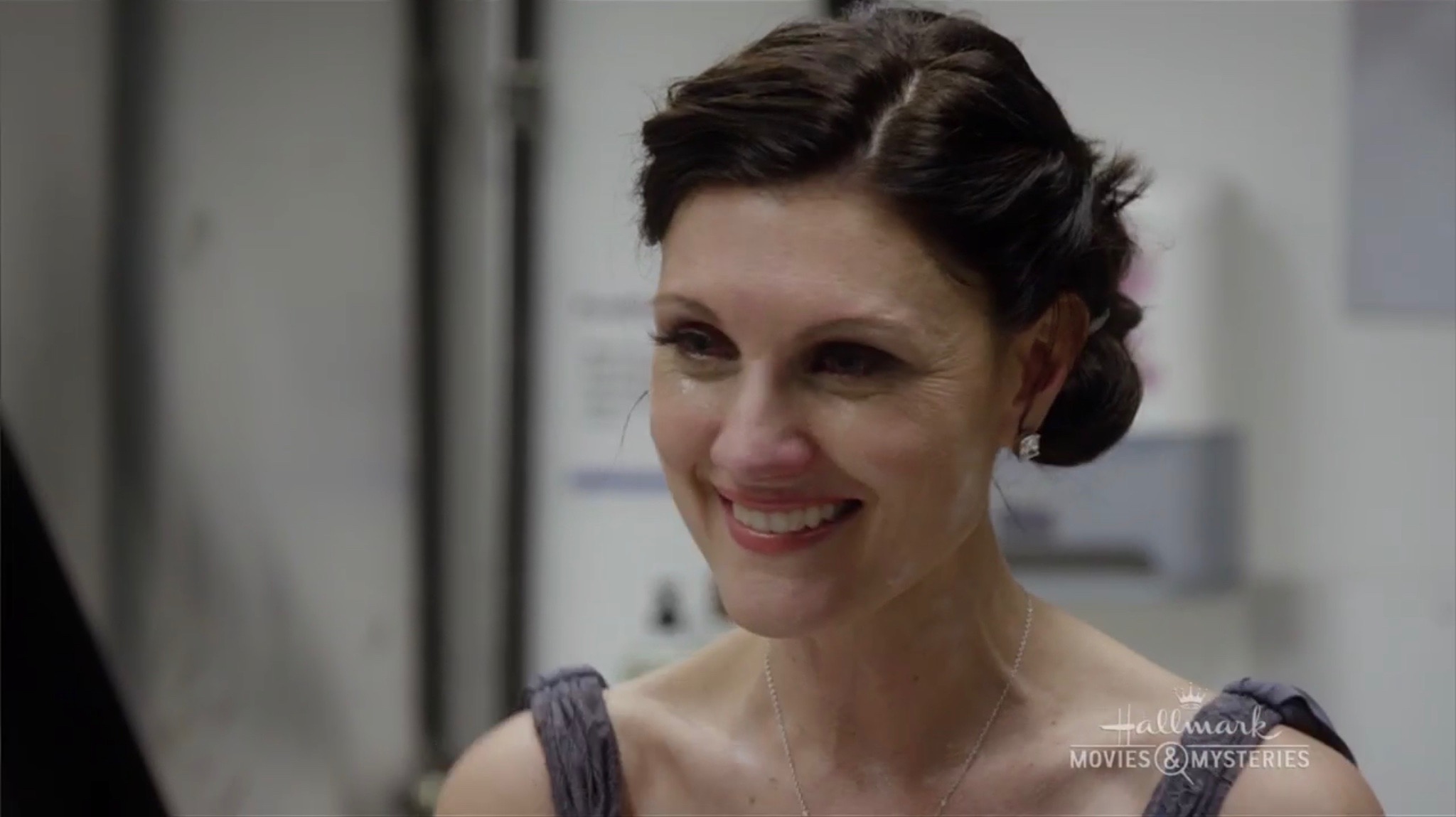
A competing bakery has opened up across the street and is run by Melanie and her sister Vanessa both played by actress Michelle Harrison.

Vanessa

Vanessa

IMG_2314

Melanie

I thought the two sisters looked awfully similar to each other while watching it, but I wasn’t sure they were supposed to be twins. I don’t think the film ever says they are twins. I think they had the same actress play both sisters for the convenience of the murder mystery plot. Can’t give away too much, but having the same actress play both sisters makes it easier to swallow the resolution of the mystery. However, it is a little confusing and provides a red herring that I’m not sure they were going for. Melanie is the one who is murdered. Since both sisters are played by the same actress it’s perfectly reasonable for the viewer to think that the one sister killed the other and swapped places with her. Especially since they don’t seem to like each other. Not sure if that was something the filmmakers intended or not. Something tells me they did though because the reason Melanie has her hair up in that shot above like her sister is because Hannah puts it up that way under the guise of protecting it while she bakes.

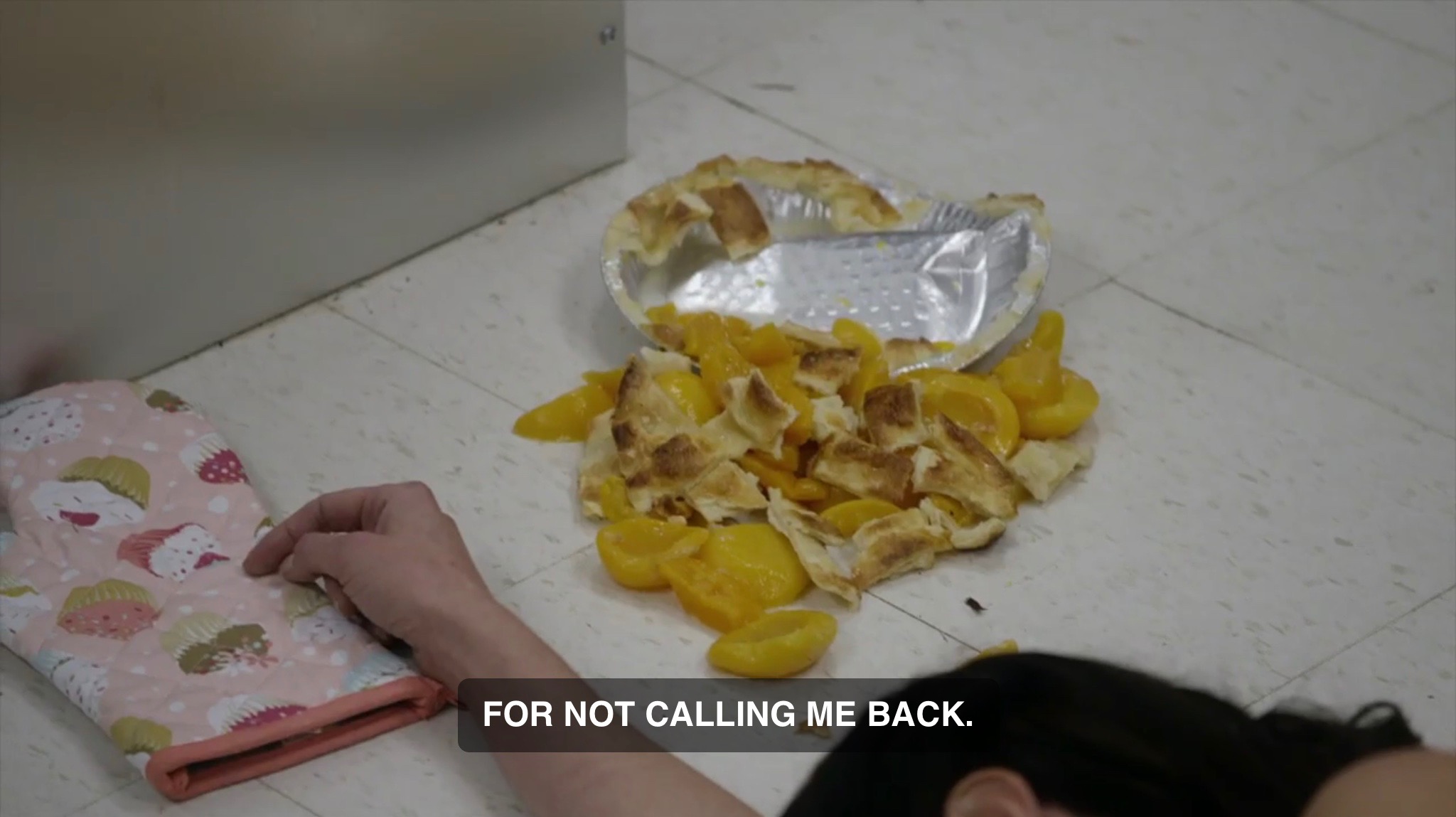
For reasons that don’t matter, Melanie and Hannah end up in a cook off to see who can bake the best Peach Cobbler. It doesn’t even matter who wins either. All that matters is that Hannah discovers Melanie doesn’t know how to bake because she bought her Peach Cobbler at a store. This is how the film gets Hannah to know Melanie as Hannah tries to teach her how to bake and introduces us to Melanie’s mean sister Vanessa. She’s nasty. Then Melanie dies.

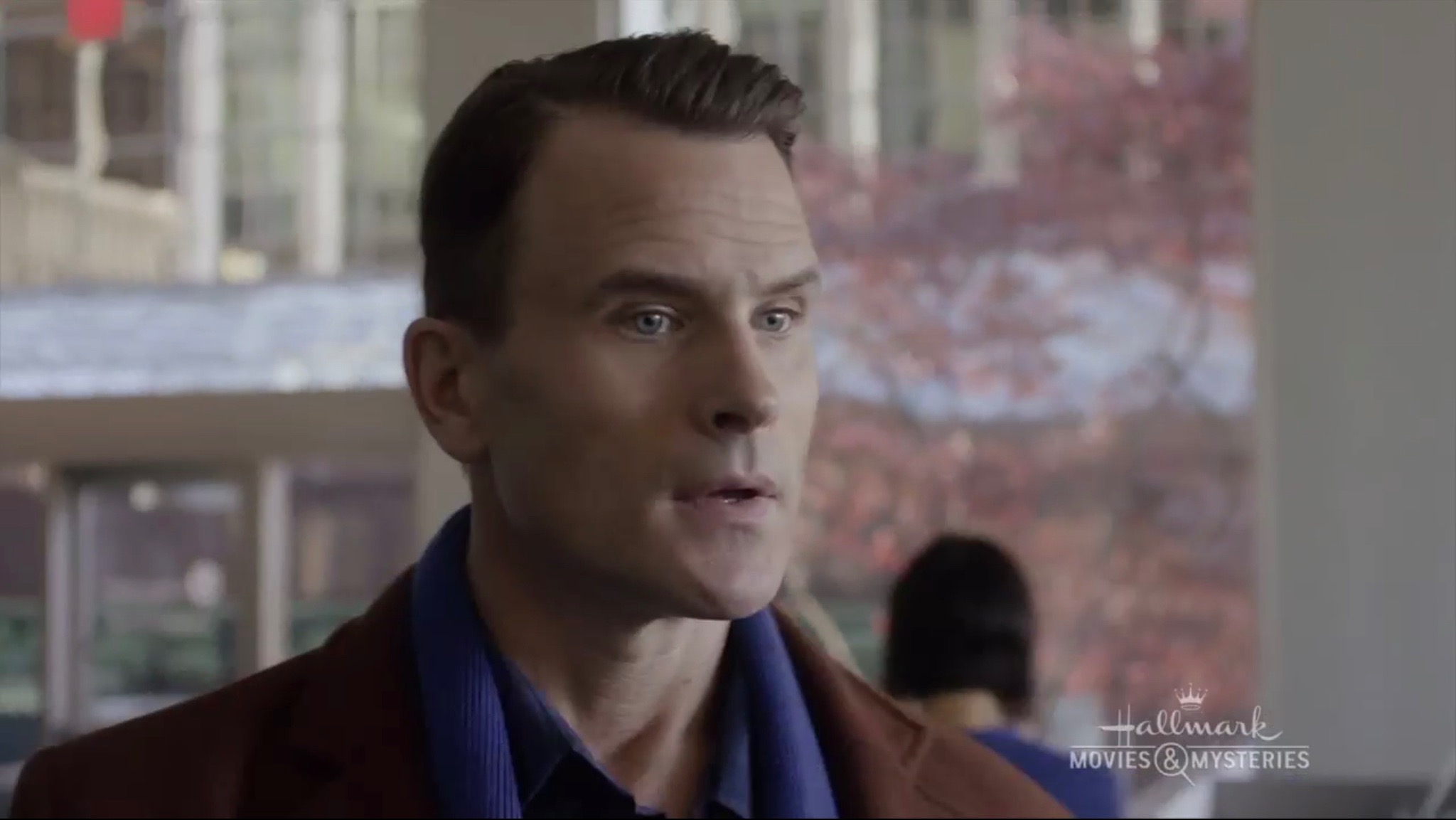
Now here’s something I didn’t notice in the previous film, but it sure was an issue for me this time around. Both this and the previous film have Mike played by Cameron Mathison and Norman played by Gabriel Hogan in them. The problem is that both actors bare a strong resemblance to each other in this movie. I kept confusing the two of them. It really doesn’t affect the movie, but it was part of my experience watching it, so I am passing it on.

Gabriel Hogan

Gabriel Hogan

Cameron Mathison

Cameron Mathison

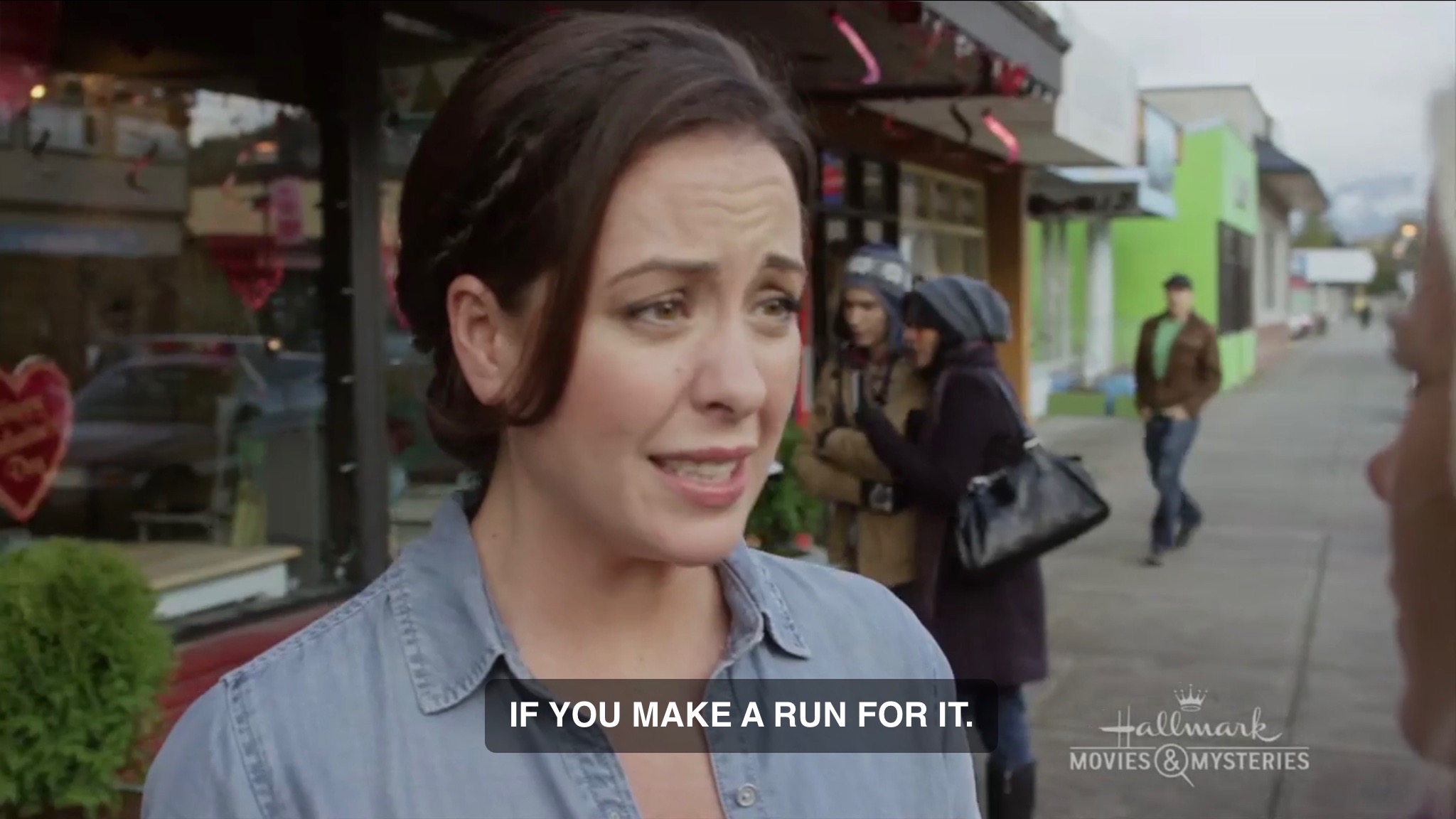
With Melanie dead, Hannah, her mom, and her sister, AKA The Blonde Brigade, begin to work towards solving the mystery. Or better put, Hannah works towards solving the mystery while the other two blondes are around playing their roles in the story. One of the episodes of Murder, She Wrote that I remember the most is when Jessica Fletcher was really suspected as the murderer. That happens here to Hannah. Something else that I know everyone who has watched Murder, She Wrote thinks is that if Jessica comes to town, then RUN!!!! When Hannah discovers the body it’s:

IMG_2518

And this isn’t all there is. Hallmark is well aware that people know they film a lot of this stuff in Canada. I mean it’s spelled out all over the credits for crying out loud. However, it wasn’t until this film that I actually saw them make a joke about it.

IMG_2661

In that scene, she tries to tell Hannah to make a run for it by going to Canada. Of course the in-joke is that they are already in Canada.

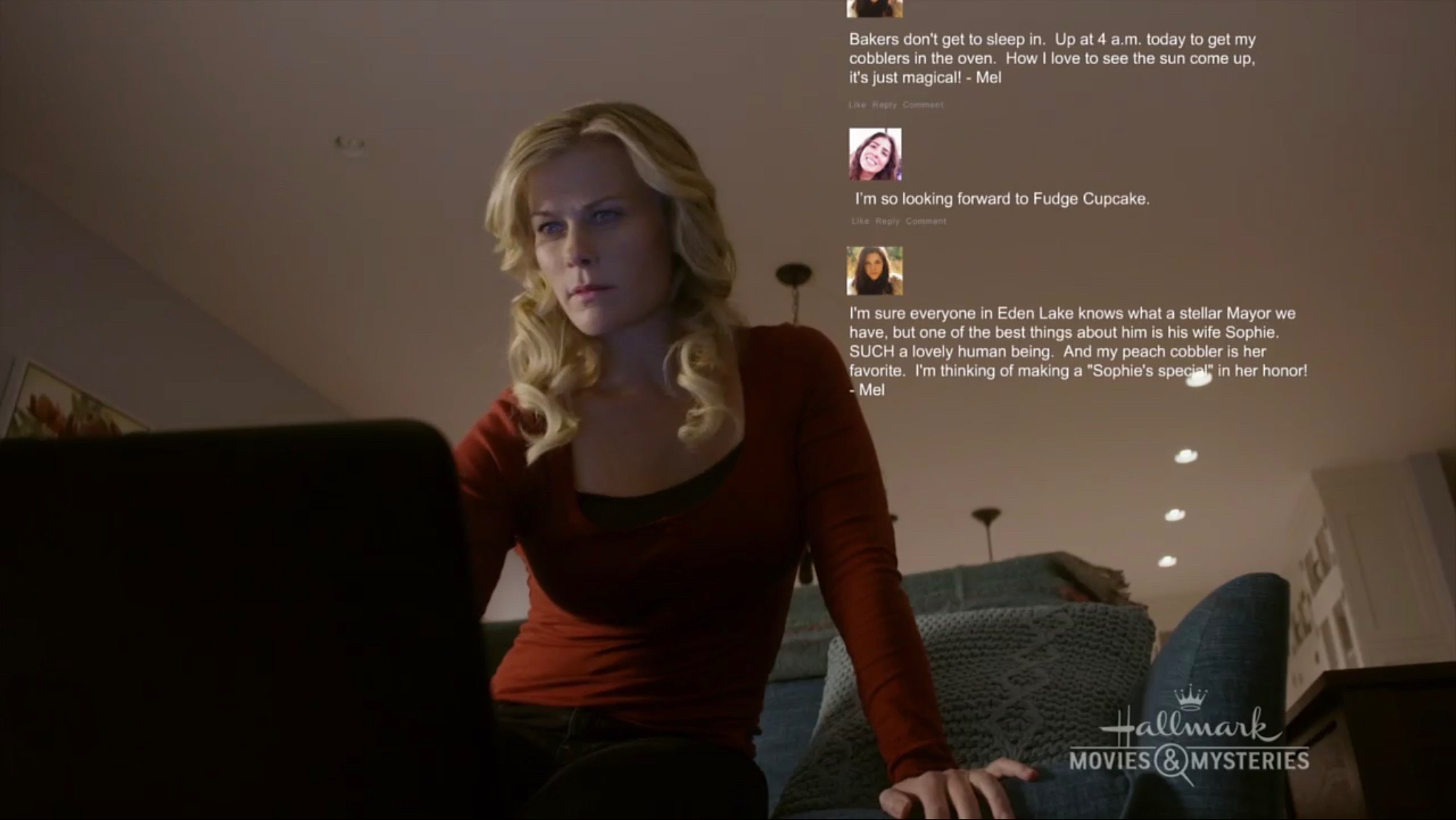
There are also some well done computer screens and Tabori reuses the technique of overlaying some of the computer stuff onto the shot like he did in Love On The Air.

IMG_2634

It’s nice, modern, and has the effect of showing both what’s important on the screen and the character’s reaction to it in the same shot. That helps to keep us engaged rather than having things broken with every cut from the screen to the character and back again.

I also appreciated the scene near the end where Hannah, then Norman, try to social engineer some information out of some people. For me it harkens back to movies like Sneakers (1992) and WarGames (1983), but since this is a murder mystery. It also made me think of The Rockford Files. Rockford socially engineered people all the time and in some episodes even carried around a little printing press to make fake business cards. It’s no wonder that even Kevin Mitnick mentioned The Rockford Files in his autobiography. She also does some dumpster diving.

So with all that babble out of the way, you are probably wondering if the mystery is any good. I could reasonably follow it which is a good thing. However, a section of it is quite obvious. The fact that the other part may be obscured from you till the end doesn’t change that you think you have figured it out from the start, and you basically have. Nevertheless, this installment has changed my opinion on this particular Hallmark mystery franchise. I could go for another one. Even Alison Sweeney who I felt didn’t pull off playing the good character in the previous films finally seemed to settle into the role. That may just be me or that I’ve seen her play the same role three times now, but her performance worked for me. I’d say give this one a shot, but for all the other things I mentioned aside from how well crafted the mystery itself is.

Playing Catch-Up: The Hateful Eight (dir by Quentin Tarantino)


The_Hateful_Eight

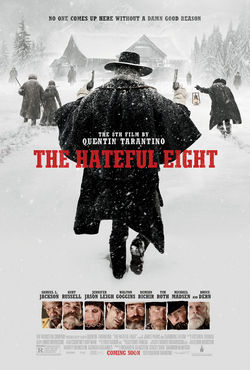
Remember how I said that it was intimidating to admit that The Big Short didn’t do much for me as a viewer?  Well, it’s even more intimidating for me to admit that I felt much the same way about The Hateful Eight as well.

Nearly everyone I know loves The Hateful Eight and, going into it, I really wanted to love it as well.  After all, this is — as the opening credits remind us — Quentin Tarantino’s 8th film!  Tarantino is one of my favorite directors.  I thought his last film, Django Unchained, was a masterpiece and one of the most important films ever made about slavery.  Like many of you, I’ve followed all the details of the making of The Hateful Eight, from the initial script leak to the controversy over Tarantino’s comments on the police.  I was excited because the cast looked great and was full of veteran actors — like Kurt Russell, Jennifer Jason Leigh, and Bruce Dern — who all seemed likely to benefit from the Tarantino touch.  (Say what you will about Quentin Tarantino, it cannot be denied that he’s given good roles to talented actors who are rarely given the opportunities that they deserve.)  When I heard that Ennio Morricone was going to be providing the score, I got even more excited.  Morricone and Tarantino; it seemed like the perfect combination for greatness.

Well, Morricone’s score is spectacular.  There’s talk that Morricone might finally win an Oscar for his work on The Hateful Eight and I certainly don’t have a problem with that.  (Hopefully, Morricone will have learned a lesson from the Golden Globes and, if he is nominated, he will either come to the ceremony himself or arrange for someone other than Tarantino to accept for him.)  And Jennifer Jason Leigh takes full advantage of her role, giving a truly ferocious performance.

But otherwise, The Hateful Eight just didn’t do much for me.  It’s not that I disliked the film.  There was a lot that worked but, for whatever reason, The Hateful Eight never enthralled me the way that past Tarantino films have.  The Hateful Eight left me saying, “Is that it?”

A lot of my reaction to The Hateful Eight has to do with the film’s length.  Taking place, for the most part, in only one location and structured more like a play than a film, The Hateful Eight would be a great 90 minute murder mystery.  Instead, it lasts nearly 3 hours and, at times, the film drags interminably.  As usual, Tarantino plays with time and, at one point, stops the action so that we can see what happened earlier in the day.  Unfortunately, as opposed to other Tarantino films, we don’t really learn anything new from this flashback and you get the feeling that it was included most because flaskbacks are a Tarantino trademark and because he wanted to find a way to work a somewhat pointless Zoe Bell cameo into the film.

As for Tarantino’s widely acclaimed script, I have to admit that I got kind of bored with this talky film.  Yes, the actors were all good and it’s always fun to listen to Samuel L. Jackson be a badass but the dialogue itself was largely repetitive and occasionally, the film itself threatened to turn into Tarantino-on-autopilot.

(Interestingly enough, Tarantino’s script features several creative euphemisms for oral sex and the characters come up with a handful of different ways to point out that Jackson is black but, when it comes to Jennifer Jason Leigh’s character, nobody can come up with anything more imaginative than repeatedly calling her a bitch.  While, unlike some critics, I don’t think The Hateful Eight is a misogynistic movie, I do have to admit that I was rolling my eyes around the fifth time that Leigh’s character was called a bitch and kept rolling them for the entire movie.  For a writer well-known for his ability to come up with colorful and memorable insults, Tarantino’s refusal to come up with anything more imaginative than “bitch” just felt lazy.)

What can I say?  The Hateful Eight just didn’t do much for me.  However, I do think that the film looked great and I certainly hope that Morricone and Leigh are at least nominated for their excellent work.  I look forward to Tarantino’s next film but I doubt I’ll be revisiting The Hateful Eight any time soon.

(By the way, with this review, I am now officially caught up on reviewing the films of 2015!)

Following The Amazon Prime Recommendation Worm #1


I know everyone has been dying for me to do another one of those movie roundup things I used to do. And by everyone, I mean no one. Well, this is gonna be sort of like that again. Late last year I decided to conduct a little experiment. On Amazon Prime you can go to a section marked “Customers Also Watched”. In there is exactly what you think. I thought it might be interesting to pick a movie, then when I finish it, take the first recommendation in that section and keep repeating this until I run out of recommendations. Basically traversing a probabilistic graph like an ant algorithm except there may be no end point and since it’s just me, there’s no convergence on a path. It’s just me following the probabilistic graph generated by what other customers picked to watch after they watched something else. I started on December 18th, 2015. Since I can’t always get around to doing full reviews of things, I thought it would be fun to give you occasional updates with little reviews of each of these films. And boy are there some strange ones. This is going to be a big one with 34 films I’ve watched so far. I’ll try to do these in shorter amounts in the future. We’ll see how long I can keep this up. I will keep poster art out here because of the enormous number of films in this one. Here we go!

  1. Seduction: The Cruel Woman (1985, dir. Monika Treut & Elfi Mikesch) – Last year I watched a film called Female Misbehavior (1992) by Monika Treut. She is a German director who, at least in the 1980s, made really bizarre arty sex movies. This was no exception. While I did enjoy Female Misbehavior quite a bit, this was just weird. But kind of weird in a good way. It follows a woman who runs a place that caters to people’s fetishes. That’s really it. There’s not much to say in retrospect except to make sure you are in that experimental arty mood if you are going to sit down and watch this. If you are, then you could possibly enjoy it. I kind of did.
  2. Satan’s Slave (1976, dir. Norman J. Warren) – This one just wasn’t any good. It was a 1970s British horror film that reminded me of the awful Virgin Witch (1972). It was just plain boring. A girl goes and stays in a house with family and gets caught up in a cult. Or at least that’s the plot summary. It’s just boring stuff that tries to build an atmosphere and has a few “scary” sequences. Not worth your time.
  3. Cruel Passion (1977, dir. Chris Boger) – This in an adaptation of the Marquis de Sade’s Justine. Unfortunately, it’s almost as boring as actually reading the original book. The general story is about a girl who is cast out and goes from place to place being taken advantage of sexually. So wait, that means Lars Von Trier got Dogville from Justine and Nymphomaniac from Anita: Swedish Nymphet (1973). Interesting. Far more interesting than this lousy sexploitation movie. She really doesn’t do a whole lot of wandering. She really isn’t taken advantage of that much either. At least it knew how to end itself properly. By that I mean it had her killed off. You are better off with Justine de Sade from 1972 instead.
  4. Her and She and Him (1970, dir. Max Pécas) – This is one of those movies put out by Audubon Films. They brought a lot of foreign sex related films to the U.S. and dubbed them. This was one of them. It’s actually pretty offensive. A naive exchange student from Sweden shows up in Paris and winds up in a screwed up lesbian relationship with an older woman. Meanwhile, a young man is in a messed up gay relationship. Both the lesbian and the gay guy are portrayed as damaged or just plain weird. Of course the two young people end up together and say some stupid things to imply that being straight is normal, but we should still feel sorry for the homosexuals. Do I even have to say skip this one? Oh, except there is one funny goof in this movie. The young girl goes down on the older lady who is standing in a well lit room. Yet, her lower half must be in a different place cause it’s like nighttime down there.
  5. Virgin Machine (1988, dir. Monika Treut) – This movie is about a German woman who becomes fascinated by sexual things outside the perceived “norms”. As a result, she ultimately winds up in San Francisco. It’s arty for sure, but you can still kind of follow along here. There is the scene where the male impersonator simulates ejaculation with a beer bottle. However, the only thing really worth seeing here are the few scenes with Susie Sexpert/Susie Bright. I didn’t know who she was, but she’s apparently well known in my neck of the woods. You can find her online. She has been known as the “Pauline Kael of Porn”. People probably know her best as playing Jesse in the Wachowski’s movie Bound (1996) as well as being a technical advisor on the film. The few scenes with her are rather interesting. I could have watched a whole movie where the lead character just talked to her. Too bad she doesn’t.
  6. The Immoral One (1980, dir. Claude Mulot) – My advice here is to simply not watch it on Amazon Prime. They edited it heavily. Shouldn’t surprise me I guess since it’s made by the director of the porn film Pussy Talk (1975). It’s about a woman who is in a car accident that recovers from her amnesia by listening to audio tapes. It’s just a thin excuse to show her as a call girl going to her clients. Unfortunately, the second anything starts it just cuts away to the next non-sex scene. It’s really abrupt like you’ve just come to the end of a Godfrey Ho movie. And it’s a real shame to cause the lead actress is very pretty and the movie is well shot. The sex scenes are probably very well done, but you won’t see them on Amazon Prime. Too bad. Also, a little strange considering I believe Her and She and Him had hardcore penetration in one scene. Whatever.
  7. Sexus (1965, dir. José Bénazéraf) – Oh, god! This was terrible. It’s one of those movies where seriously nothing happens. I think Michael Snow’s Wavelength (1967) had more action than this. A girl gets kidnapped and she kind of falls in love with her captors and things fall apart. It’s the worst kind of foreign arthouse garbage. Just stay away from this thing. I really can’t stand Godard. I’m really not even a fan of his first film Breathless. Take Breathless and remove anything enjoyable about it and make it about a kidnapping. That’s this movie.
  8. The Lickerish Quartet (1970, dir. Radley Metzger) – I like my review on Letterboxd: “That was an artsy and pretentious mess.” Yes, it is. It’s about two older people and young man who watch porn films together. Then they go to a carnival and bring a woman back who they think was in a movie they watched. What follows is a film really wanting to be something akin to Alain Resnais’ Last Year at Marienbad (1961). A lot of arty stuff and a lot of stuff that just screams: “You wouldn’t understand if I told you” nonsense. It even tries to get really meta about it all at the end. Don’t bother with this. Go watch Last Year at Marienbad instead. It’s wonderful!
  9. Sweet Ecstasy (1962, dir.Max Pécas) – Back to Max again. This time he brought along Elke Sommer to be in a film that wants to be something akin to Antonioni’s films with Monica Vitti. Except it’s stupid bad foreign upper class stuff that you saw a lot during this period. My biggest problem with this movie, other than that it sucked, is the burning boat scene. There’s a part where the adult children are on a boat having some sort of auction where they have Elke Sommer tied up. The boat catches on fire and they all flee onto lifeboats. They then realize they left Elke behind and rescue her. Afterwards, they try to punish the guy who accidentally set the boat on fire. They make him do stupid childish things. It’s dumb. But what pisses me off is that while people are fleeing the room where Elke is we can clearly see her tied, not gagged, but not screaming for help. Sorry, but once you see it, then you just keep yelling at the screen that it was your own damn fault for letting them tie you up and then saying nothing as the room burned. Regardless, more worthless foreign stuff.
  10. The Curious Female (1970, dir. Paul Rapp) – It took ten of these, but I finally hit one I would recommend. This movie takes place in the future where apparently a master computer rules over everything. However, instead of making everyone “moral”, it makes them all orgy bisexual loving folks. Some of them gather in a place where they can watch old movies that show how people used to live. It’s certainly is weird. They only watch two films. The first is a silent movie where a vacuum salesman shows up and gets screwed by the lady of the house. Then they watch some movie called The Three Virgins. That makes up the rest of the film. It cutting between the film and the folks in the room watching it, who by the way, are also actors within the film they are watching. The Three Virgins thing revolves around a computer dating business and what happens when a guy comes in looking for a virgin. There’s only two things I really want to mention here. One, is the black lesbian character named Pearl. I watched several lesbian movies directed by women at the beginning of last year from the past 10 years or so and this was a much better character. The movies I watched were like Loving Annabelle (2006) or Bloomington (2010). They quickly turned into basically softcore porn, tried to make lesbianism as forbidden as possible, and just wouldn’t stop to let us actually get to know them a little. Pearl is just a girl who figures out that she’s still a virgin at her age because she likes girls instead. That’s it! We get to know her a bit and she just discovers that about herself. Nice, simple, and positive. Then there’s the extremely over the top gay guy who comes into the computer dating place. He’s an odd duck. He’s every stereotype you can think of, but at the same time he stands up for himself and doesn’t take anyone’s crap. He’s interesting. Oh, also we find out that 13 year old girls are taken to the “elderly gentleman” to lose their virginity in the future. Yes, just the girls. It never says where the guys are taken though and they obviously don’t keep their virginity in the future either. I recommend this one.
  11. Days of Sin and Nights of Nymphomania (1963, dir. Poul Nyrup) – This is just an odd sit. It’s a Danish movie that was again brought over by Audubon Films which means more sex stuff. It’s basically a house party with mostly naked women doing whatever it is they were doing in front of the camera. But then near the end it just seems to turn on a dime into a heist movie that ends with a guy killing a girl, I think, and getting arrested. Some of the stuff with the girls is kind of pretty, but there’s just no reason to subject yourself to this.
  12. Chain Gang Women (1971, dir. Lee Frost) – Spoiler alert! There are no chain gang women in chain gang women. It goes for awhile like a gritty look at men on a chain gang before finally letting a couple of them escape. Then they run into two women. One is attached to one of the guys, but the other rapes her. Then they run into a very young girl who is married to a much older man. They sort of take advantage, sort of go to rescue her, but the old man kills them both and keeps the girl. Just a pointless sexploitation film with a title as accurate as 1,000 Convicts And A Woman.
  13. Savage Abduction (1973, dir. John Lawrence) – This one actually goes under three titles: The Bloody Slaying of Sarah Ridelander, Cycle Psycho, and Savage Abduction. Well, Sarah Ridelander is killed at the beginning, but that death is hardly important enough to be called a “Bloody Slaying” or be in the title. Cycle Psycho at least alludes to the fact that a motorcycle gang is in this, but they are hardly psychos. Strangely, Savage Abduction is the most accurate title. The movie is about a crazy guy who blackmails another guy into getting two young girls for him. He does this because he murders the man’s wife at his request. A motorcycle gang with the word “savage” in their names do the abducting. And by abducting I mean simply pick up two stupid young girls who thought hitching a ride with random motorcyclists was a good idea. The rest of the film is just killing time till it decides it has enough minutes in the runtime to have what little climax it has in store for the audience play out. After Savage Island (1985), I’m beginning to think Fred and Ben Savage are the only good things with “savage” in them.
  14. The Torture Chamber of Dr. Sadism (1967, dir. Harald Reinl) – More like dangle Christopher Lee in our face, take him away, then bring him back for the end. This was pretty bad. Most of the movie you follow two guys and two girls on their way to some castle. The girls basically overreact in fear to everything. However, the guys underreact to everything just running towards the obvious danger. What a waste of time. Making it in the first place, and then me watching it.
  15. Sacred Flesh (2000, dir. Nigel Wingrove) – Wanna watch nuns have sex with each other while the Mother Superior argues with Mary Magdalene? No? Neither did I. This is just nunsploitation that tries to give itself some meaning with the Mother Superior/Mary Magdalene stuff. If I want something in that vein, then that’s what Ken Russell’s The Devils (1971) is for. Seriously, go watch it now. It even looks like it’s available on Amazon now. In the past you had to track down a copy online because the film was being sat on by the studio to a ridiculous degree. Skip Sacred Flesh.
  16. Primitive London (1965, dir. Arnold L. Miller) – And by Primitive London, they mean heavy cynicism and a bunch of stripping. It’s a Mondo movie. Nothing ridiculous like the pond scene from Brutes and Savages (1978) or anything like that. The most interesting things are probably the stripper running from club to club to make money and when they talk to Mods and Rockers. Can’t think of a good stripper movie to recommend really, but as for Mods and Rockers, see Quadrophenia (1979) for the Mods and Rocker (1972) for the Rockers. I’m not sure if it’s become easier to find Rocker now years after I tracked down a copy, but it’s worth it. If memory serves, the movie is easy to find, but English subtitles for the German aren’t. Still worth it. This movie is okay. Nothing to seek out.
  17. The Wild Women of Wongo (1958, dir. James L. Wolcott) – There’s a hell of a title for what is a really boring movie. I know I say boring a lot, but that’s because I never took the SATs. Yeah, sure, that’s a good enough excuse for me. I could explain the plot, but there’s no point. It’s just a 1950s primitive exploitation film that is just some nonsense some people thought up to have some attractive women run around in small outfits and that’s it. No reason to watch this at all.
  18. Bad Girls From Mars (1990, dir. Fred Olen Ray) – Ah, good old Fred Olen Ray. This film tries to be meta about the production of a movie because it’s cheap and that way it doesn’t have to build many sets until it settles on an ending that was already tired even before Sleepaway Camp (1983). And I haven’t even seen that movie yet. I’ll get to it eventually along with Fatal Games (1984), but it’s just a slight twist on the ending of Friday the 13th (1980) because Girls Nite Out (1982) already proved that having it be the mother again was done for. I know I’m getting to be a broken record here, but no. Skip it!
  19. The Nude Set (1957, dir. Pierre Foucaud) – Also called The Fast Set and Mademoiselle Strip-tease. Just a whole lot of stripping. Another primitive exploitation film from overseas. These movies are such a waste of time. I can’t even tell you how unbearable some of them are. However, there is something weird that happens near the end of this film. Up until it happens, the movie is just about a girl and some friends visiting strip clubs. Then seemingly out of nowhere a dream sequence happens that looks like it’s straight out of Fred and Ginger 1930s musical. No joke. And it isn’t even clear that it’s a dream at first either. Then the movie just crashes into it’s ending. Onward! Unfortunately, it’s to more stripping.
  20. Lap Dancing (1995, dir. Mike Sedan) – Think this might have been rushed into production to capitalize on Showgirls (1995)? You’re probably right. Especially when one of the guys even bares a resemblance to Kyle MacLachlan. It’s not good, but at least it didn’t hinge it’s success entirely on a single performance that didn’t hold up like Verhoeven’s film did. As you can tell, I’m not one of those revisionist critics who wants to turn Showgirls and Starship Troopers (1997) into misunderstood masterpieces. They’re both garbage. At least Starship Troopers is entertaining garbage and you can tell yourself Verhoeven was trying to make the whole film like it was a piece of propaganda from the fascist regime within the film. However, you’re better off exploring other Verhoeven films such as Soldier of Orange (1977) or Turkish Delight (1971) that he made before coming to the states. Even Black Book (2006) with its spaghetti western archetypes is more worth your time. As for Lap Dancing, it’s kind of bi-polar. Most of the time it’s just stripping, but then it will suddenly go into full on sentimental mode complete with sad music. It’s about a girl who comes to Hollywood looking for fame and ends up at a strip club that looks like the night club from Atom Egoyan’s Exotica (1994). Or at least it did for me. Skip! And apparently, I can’t stop referencing other movies. I think it’s a disease.
  21. From The Head (2011, dir. George Griffith) – Want to see a film that will probably make my gems list at the end of 2016 now? See From The Head. It’s an indie film that takes place entirely inside the men’s restroom at a strip club. The main character is a bathroom attendant. People come in and go out delivering there bits (literally and figuratively). It does start to drag a bit, but it still pulls through. I like when they had the women’s restroom break and the ladies just used the men’s and neither the guys nor the girls really seemed to care one bit about using the same bathroom. As they shouldn’t. But then they take that away by having their bathroom fixed. Honestly, I think it needed that to liven things up more, but like I said, it still pulls through. The lead, played by the director, is interesting, and it’s a job I don’t think I’ve ever seen given the attention of a full movie. Worth seeing.
  22. Las Vegas Story (2015, dir. Byron Q.) – There really isn’t anything to say about this. A lady with kids is a prostitute in Las Vegas and we just see her go about her stuff as she moves towards trying to open a male escort business. That’s really it. The only thing I remember of interest is that apparently a girl playing the slots was acting too suspicious as a prostitute on the casino floor to the lead actress by simply playing the slots, but later she and a friend will just go right up to a lady at a bar to try and sell her on buying an escort from them. Didn’t get that. This is one of those that I can’t recommend, but I can see other people getting more out of this than I did.
  23. Birthday (2009, dir. James Harkness) – This on the other hand. I can’t see getting anything out of this rambling nonsense. It’s one of those movies that feels like you are sitting in a college liberal arts class where people who have no idea what they are talking about say things they think are profound in the hopes somebody will be impressed. The only difference is it’s a brothel with David Lynch lighting and the prostitutes are the ones talking. Yep. Boring as it sounds. I love when people call something like this a meditation on something. I’m sorry, but I’ve seen that done. This isn’t it.
  24. The Case Of Unfaithful Klara (2009, dir. Roberto Faenza) – A guy hires a private investigator to follow around his girlfriend. The guy basically strings him along under the pretense of protecting his client from being hurt which has ties to his own personal life. Nope! Nope! Nope! Boring! I didn’t care about any of this.
  25. Extase (2009, dir. Cheyenne Carron) – Speaking of not caring about any of this. I didn’t care about this either. It’s once again people yacking in a room with artsy shots and sets. This time it has to do with God. Wow! What a surprise there. This is just one of those short indie arty modeled on good foreign films films that I think is made by a director to simply try things out and hopefully go on to make something better, less derivative, more coherent, and original. However, her other films look like they are just taking the sex and religion thing and running with it. Next!
  26. A Swedish Midsummer Sex Comedy (2009, dir. Ian McCrudden) – Oh, boy! You mean I get to watch several storylines between several people play out at a party where Luke Perry is brought in so people will go see the movie and the characters keep switching from Swedish to English and back? Wow! Don’t sign me up. This is one of those movies that you would have expected Hugh Grant to be in back in the early 1990s like Four Weddings And A Funeral (1994). People have some issues, they come out at a party, and things resolve. I don’t know what to say about this movie except that it’s so not worth your time.
  27. Camembert Rose (2009, dir. Barnabás Tóth) – It’s an indie coming of age story from Hungary that’s reasonably good. Nothing amazing here. A kid who wants to see the world has a bit of a nutty dad who still loves the hell out of him. He leaves and goes somewhere else for awhile, then returns home. Not great, but I kind of enjoyed this one.
  28. Please, Please Me! (2009, dir. Emmanuel Mouret) – Wanna see a modern day French director desperately try to make his own Jacques Tati film and fail? I know you don’t, so skip this. It has a stupid beginning and a stupid ending with mostly a party sequence in between that acts like a really lame and childish version of the restaurant scene from Tati’s Playtime (1967). Just go watch a Tati film instead. There’s no reason to settle for this.
  29. Strange Fits Of Passion (1999, dir. Elise McCredie) – I’ve heard the mermaids singing, and they are trying to tell us to stay away from Strange Fits Of Passion. It’s about a girl who you will spend the entire film screaming at to please let her get laid already so she can calm down. She even has two gay friends who can see her festering and having the female equivalent of blue balls, but do nothing about it. I wanted to step into the film and punch them in the crotch. I know very few people will get the reference at the beginning of this, so go watch the movie I’ve Heard The Mermaids Singing (1987) instead of this movie. So much indie! So much indie! My head is going to explode and dancing suns are going to pop out!
  30. Summer Vacation (2012, dir. Tal Granit & Sharon Maymon) – Luckily, the next film was not only a short, but decent too. It’s from Israel and is about a family who is on vacation when the father runs into a former male lover. Not sure if he’s supposed to be gay or bi, but it doesn’t matter. It’s a nice little film that shows the father’s struggle. Nothing more, nothing less.
  31. Cold Blooded (2007, dir. Sylvie Verheyde) – Back to France for more indie. This movie is supposed to be about a messed up girl and a former soldier, but it’s mainly about the soldier. The stuff with her wasn’t really anything I thought was worthwhile. I could have really just done with a movie about the soldier dealing not only with his past, but his present demons. The lead actor kind of made me think of a French Benicio Del Toro. A definite skip, but I liked the actor and wouldn’t mind seeing him in something else.
  32. Enthralled (2014, dir. Chip Tsao) – This is when Amazon Prime launched me into Asia and I’m still stuck there. This comes to us from Hong Kong. It’s supposed to be about some guys who were friends as kids, then we see them as adults, but if I hadn’t read the plot summary then I wouldn’t have made the connection. As for the dialog and the message, it felt like they kept taking a brick and bashing it into my head to drive home its points. The only thing noteworthy here is that a guy sleeps with both the mother and her son.
  33. Desire (2002, dir. Eung-soo Kim) – Wanna watch a movie about lifeless, soulless, and loveless characters made by a director in love with Zhangke Jia, Robert Bresson, and Chantal Akerman’s Jeanne Dielman? If you said yes, then what the hell is wrong with you? This is one of those movies I thought was going to kill me. The only film I can think of that it really reminded me of was Bresson’s The Devil, Probably (1977), but that’s probably just because everything happens with such lifeless acting that Bresson was known for. Heck maybe Marguerite Duras’ India Song (1975) is a more appropriate film to think of based on Desire. I didn’t like either of those movies and they are still better options than Desire. It’s just several people who walk through a series of loveless stuff and empty moments that aren’t what anyone would call life.
  34. Origin Of Monogamy (2013, dir. Min Kyeol) – Sticking with South Korea like Desire, this one was actually not in IMDb at the time. Amazon Prime seems to have a lot of Korean cinema in it, but the titles are alternate and usually not in IMDb. Oh, and of course they don’t subtitle the credits. Heck, even a Korean director quote tweeted me on Twitter, then went on to say that Amazon Prime basically makes Korean cinema more accessible outside of South Korea than it is within the country itself. As for this movie, oh god! The movie begins with a therapist seeing a doctor who tests people for deadly diseases such as AIDS. During the session it comes out that she is manipulating results to make it look like certain men have AIDS which causes them to kill themselves. I’m sure there was more stuff I was supposed to pick up on, but I got stuck on that and that it seemed all the Korean girls wore way too much makeup and lipstick combined with really short dresses. I believe it ends with her deliberately infecting a guy with AIDS so that he will be stuck marrying her. It ends with them in front of a grave stone dressed for a wedding with him looking half dead. I guess that’s where this title comes from. It also goes under the title Sins Of A Marriage.

I got through it! I promise I will try to do this in smaller chunks in the future. Should be interesting to see how long Amazon Prime is going to keep me in South Korea adding these unIMDBd movies into their database.

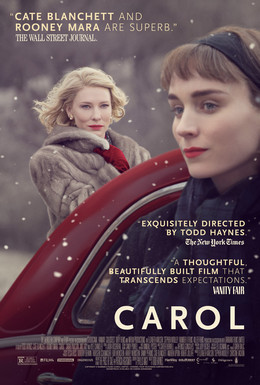
Playing Catch-Up: Carol (dir by Todd Haynes)


Carol_(film)_POSTER

(Minor Spoilers Below)

Carol is the best film of 2015.

I say that without a hint of hesitation or doubt.  2015 was a wonderful year for movies and I would say that there were at least 20 film released that I would call great.  And, out of those 20, Carol is the best.

Carol opens in 1952.  Therese Belivet (Rooney Mara) is young, lonely, and living in New York City.  She’s an aspiring photographer who can’t afford a decent camera, a secret bohemian living in a world where morality and culture are defined by the bourgeoisie.  She has a boyfriend named Richard (Jake Lacey) and he’s eager to marry her and move to France but, try as she might, Therese simply cannot bring herself to feel the same way about him that he feels about her.  Though she lives with him, she refuses to have sex with him.  At one point, she asks him if he’s ever heard of men being attracted to other men and she asks if he thinks the same can be true of women.  Richard says sure, before adding that it’s always the result of “something wrong” psychologically.

It’s Christmas.  Therese gets a temporary job, working at a department store in Manhattan.  From the moment we see Therese surrounded by the Christmas crowds, we realize that she feels totally out-of-place among the rest of the world.  She is withdrawn and quiet and rarely looks anyone in the eye.  That is until she meets Carol (Cate Blanchett).

Carol is searching for a gift for her daughter and accidentally leaves her gloves behind at the store.  When Therese arranges for the gloves to be returned to Carol, Carol thanks her by taking her out to lunch.  Soon, Carol is inviting Therese to spend Christmas at her house in New Jersey and a jealous Richard is complaining that Therese has a “crush” on the older woman.

Carol is going through a difficult divorce.  Her alcoholic husband, Harge (Kyle Chandler), is demanding full custody of their children.  Harge knows that years ago, Carol had a brief affair with her best friend, Abby (Sarah Paulson), and he can’t handle it.  When he stops by, drunk and belligerent, on Christmas, he discovers Therese visiting Carol and he freaks out even more.

(With all the attention being paid to the exquisite performances of Blanchett and Mara, now would be good place to mention that Kyle Chandler does a great job playing a loathsome character.  With his performance here and his role in The Spectacular Now, Chandler has cornered the market on playing abusive alcoholics.)

For New Year’s, Carol and Therese go on a trip and they finally consummate their relationship (in Iowa, of all places).  But what they don’t know is that Harge has hired men to follow them and to get proof of their relationship.  If Carol wants to see her daughter again, she knows that it means seeing a psychotherapist for help with her “problem” and never seeing Therese again…

Carol is an amazing and beautiful film, a portrait of both forbidden love and the struggle to survive in a society that demands total and complete conformity.  In many scenes, director Todd Haynes pays homage to the masters of 50s melodrama, filmmakers like Mark Robson, Douglas Sirk and Nicholas Ray.  The film’s lushly vibrant colors and attention to detail feels reminiscent of the films that Sirk made for MGM, with Cate Blanchett often made up to resemble Lana Turner.  Meanwhile, Rooney Mara often resembles Natalie Wood from Rebel Without A Cause.  One shot in particular, with the shadows of a window bar falling across Blanchett’s face like the bars of a prison cell, immediately brought to mind the end of Ray’s Bigger Than Life.

For the longest time, I have complained about Rooney Mara’s performance in David Fincher’s rehash of The Girl With The Dragon Tattoo.  Well, I’m prepared to stop complaining because Mara is brilliant in Carol.  Her blossoming as an actress mirrors Therese’s blossoming as a woman.  Rooney Mara is being promoted for best supporting actress but make no mistake.  There’s nothing “supporting” about Rooney Mara’s performance.  Carol is all about Therese and it works because of Mara’s wonderful performance.

Regardless of what may or may not happen with the Oscar nominations on Thursday, Carol is the best film of 2015.  It’s a film that we will still be talking about decades from now.

mara_blanchett_carol

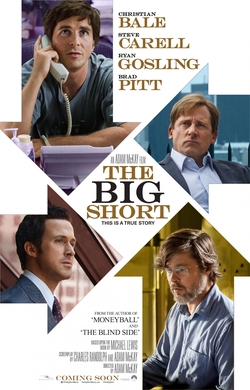
Playing Catch-Up: The Big Short (dir by Adam McKay)


The_Big_Short_teaser_poster

The Big Short is a film that is so critically acclaimed and that has been so passionately embraced by those who enjoyed it that it’s a bit intimidating to admit that it really didn’t do much for me.  (It’s even more intimidating for me to admit that I nearly included it on my list of the 16 worst films of 2015.)  It’s a big, angry movie and, even though it’s not really that good, it definitely taps into the zeitgeist.  It captures the anger, the frustration, and the fears that people (including me) are feeling right now.  It didn’t do much for me but I can understand why others have so passionately embraced it.

As for the film itself, it’s about the housing collapse and the financial crisis of 2008.  The main characters are all people who realized that the economy was about to collapse and who managed to make a profit off of the crisis.  For the most part, everyone gets at least two scenes where they get to rail about how angry they are that they’re making a profit off of other people’s misery.  However, they all still collect their money at the end of the film.

For the most part, our main characters are the type of quirky eccentrics who always tend to pop up in ensemble films like this.  They’re all played by recognizable actors and they all have an identifiable trait or two so we can keep them straight.  For instance, Christian Bale has trouble relating to people socially, plays drums, and looks like he probably has terrible body odor.  Steve Carell has a bad haircut and spends a lot of time yelling at people.  He’s also haunted by the suicide of his brother and he’s married to Marisa Tomei but she only gets to appear in two scenes and doesn’t really do much because this is a film about menfolk, dagnabit.  (I love Steve Carell but this is probably the least interesting performance that he’s ever given.)  John Magaro and Finn Wittrock are two young investors and they especially get upset when they realize that the economy is about to collapse.  Their mentor is played by Brad Pitt.  Since this is an important film, Brad Pitt plays his role with his important actor beard.

And then there’s Ryan Gosling.  Gosling plays a trader and he also narrates the film.  And really, Gosling probably gives the best performance in the film, perhaps because his character is the only one who is actually allowed to enjoy making money.  I think we’re supposed to be outraged when he brags about making money while people lose their houses but Gosling’s so charismatic and the character is so cheerful that it’s hard to dislike him.

(Of course, listening to Gosling’s narration, it’s impossible not to be reminded of The Wolf of Wall Street.  And it’s appropriate because The Big Short is kind of like The Wolf of Wall Street for people who don’t want to have to deal with ambiguity or nuance.)

The film has gotten a lot of attention for Adam McKay’s direction, which is flashy and always watchable but, at the same time, also rather shallow.  For the most part, McKay’s directorial tricks only served to remind me of other movies.  The narration, of course, made me think about The Wolf of Wall Street.  The scenes where characters look straight at the camera and say, “This isn’t the way it really happened,” only reminded me of how much more effective it was when the same thing happened in Michael Winterbottom’s 24 Hour Party People.

And then there’s the celebrity cameos.  These are the scenes where a special guest celebrity is brought on screen to explain to us how Wall Street actually works.  The first time, it’s Margot Robbie in a bubble bath and it works well because it admits the debt that The Big Short owes to Wolf of Wall Street.  (Plus, it ends with Robbie telling the viewers to “fuck off,” which is probably what I would do if a huge group of strangers interrupted my bubble bath.)  If McKay had limited himself to just doing it once, it would have been brilliant.  But McKay drags out three more celebs and, with repeated use, the technique gets less and less interesting.

But I guess it’s debatable whether any of that matters.  The Big Short taps into the way people are feeling now.  It’s a zeitgeist film.  People are rightfully angry and The Big Short is all about that anger.  A decade from now, it’ll probably be as forgotten as Gabriel Over The White House.  But for now, it’s definitely the film of the moment.

Playing Catch-Up With 6 Mini-Reviews: Amy, Gloria, Pitch Perfect 2, Sisters, Spy, Trainwreck


Amy_Movie_Poster

Amy (dir by Asif Kapadia)

Amy opens with brilliant and, in its way, heartbreaking footage of a 14 year-old Amy Winehouse and a friend singing Happy Birthday at a party.  Even though she’s singing deliberately off-key and going over-the-top (as we all tend to do when we sing Happy Birthday), you can tell that Amy was a star from the beginning.  She’s obviously enjoying performing and being the center of attention and, try as you might, it’s impossible not to contrast the joy of her Happy Birthday with the sadness of her later life.

A star whose music touched millions (including me), Amy Winehouse was ultimately betrayed by a world that both wanted to take advantage of her talent and to revel in her subsequent notoriety.  It’s often said the Amy was self-destructive but, if anything, the world conspired to destroy her.  By focusing on footage of Amy both in public and private and eschewing the usual “talking head” format of most documentaries, Amy pays tribute to both Amy Winehouse and reminds us of what a great talent we all lost in 2011.

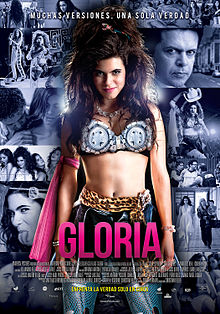
Gloria_(2014_Film_Poster)

Gloria (dir by Christian Keller)

The Mexican film Gloria is a musical biopic of Gloria Trevi (played by Sofia Espinosa), a singer whose subversive songs and sexual image made her a superstar in Latin America and challenged the conventional morality of Catholic-dominated establishment.  Her manager and lover was the controversial Sergio Andrade (Marco Perez).  The movie follows Gloria from her first audition for the manipulative Sergio to her arrest (along with Sergio) on charges of corrupting minors.  It’s an interesting and still controversial story and Gloria tells it well, with Espinosa and Perez both giving excellent performances.

Pitch_Perfect_2_poster

Pitch Perfect 2 (dir by Elizabeth Banks)

The Bellas are back!  As I think I’ve mentioned a few times on this site, I really loved the first Pitch Perfect.  In fact, I loved it so much that I was a bit concerned about the sequel.  After all, sequels are never as good as the original and I was dreading the idea of the legacy of the first film being tarnished.

But the sequel actually works pretty well.  It’s a bit more cartoonish than the first film.  After three years at reigning ICCA champions, the Bellas are expelled from competition after Fat Amy (Rebel Wilson) accidentally flashes the President.  The only way for the Bellas to get the suspension lifted is to win the World Championship of A Capella.  The plot, to be honest, really isn’t that important.  You’re watching the film for the music and the interplay of the Bellas and, on those two counts, the film totally delivers.

It should be noted that Elizabeth Banks had a great 2015.  Not only did she give a great performance in Love & Mercy but she also made a respectable feature directing debut with Pitch Perfect 2.

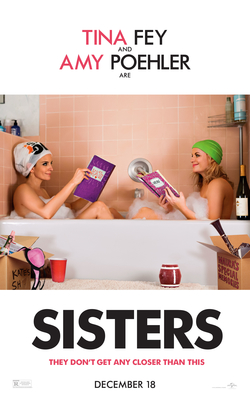
Sisters_movie_poster

Sisters (dir by Jason Moore)

It’s interesting how opinions can change.  For the longest time, I really liked Tina Fey and I thought that Amy Poehler was kind of overrated.  But, over the past two years, I’ve changed my opinion.  Now, I like Amy Poehler and Tina Fey kind of gets on my nerves.  The best way that I can explain it is to say that Tina Fey just seems like the type who would judge me for wearing a short skirt and that would get old quickly, seeing as how I happen to like showing off my legs.

Anyway, in Sisters, Tina and Amy play sisters!  (Shocking, I know.)  Amy is the responsible one who has just gotten a divorce and who wants to make everyone’s life better.  Tina is the irresponsible one who refuses to accept that she’s no longer a teenager.  When their parents announce that they’re selling the house where they grew up, Amy and Tina decide to throw one last party.  Complications ensue.

I actually had two very different reactions to Sisters.  On the one hand, as a self-declared film critic, it was easy for me to spot the obvious flaw with Sisters.  Tina and Amy should have switched roles because Tina Fey is simply not believable as someone who lives to have fun.  Sometimes, it’s smart to cast against type but it really doesn’t work here.

However, as the youngest of four sisters, there was a lot of Sisters that I related to.  I saw Sisters with my sister, the Dazzling Erin, and even if the film did not work overall, there were still a lot of little scenes that made us smile and go, “That’s just like us.”  In fact, I think they should remake Sisters and they should let me and Erin star in it.

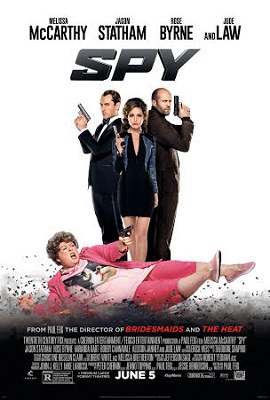
Spy2015_TeaserPoster

Spy (dir by Paul Feig)

There were a lot of very good spy films released in 2015 and SPECTRE was not one of them.  In fact, the more I think about it, the more disappointed I am with the latest Bond film.  It’s not so much that SPECTRE was terrible as there just wasn’t anything particular memorable about it.  When we watch a film about secret agents saving the world, we expect at least a few memorable lines and performances.

Now, if you want to see a memorable spy movie, I suggest seeing Spy.  Not only is Spy one of the funniest movies of the year, it’s also a pretty good espionage film.  Director Paul Feig manages to strike the perfect balance between humor and action.  One of the joys of seeing CIA employee Susan Cooper (Melissa McCarthy) finally get to enter the field and do spy stuff is the fact that there are real stakes involved.  Susan is not only saving the world but, in the film’s best scenes, she’s having a lot of fun doing it and, for that matter, McCarthy is obviously having a lot of fun playing Susan and those of us in the audience are having a lot of fun watching as well.

Spy also features Jason Statham as a more traditional action hero.  Statham is hilarious as he sends up his own macho image.  Seriously, who would have guessed that he could such a funny actor?  Here’s hoping that he, McCarthy, and Feig will all return for the inevitable sequel.

Trainwreck_poster

Trainwreck (dir by Judd Apatow)

There’s a lot of great things that can be said about Trainwreck.  Not only was it the funniest film of 2015 but it also announced to the world that Amy Schumer’s a star.  It was a romantic comedy for the 21st Century, one that defied all of the conventional BS about what has to happen in a romcom.  This a film for all of us because, let’s just be honest here, we’ve all been a trainwreck at some point in our life.

But for me, the heart of the film was truly to be found in the relationship between Amy and her younger sister, Kim (Brie Larson).  Whether fighting over what to do with their irresponsible father (Colin Quinn) or insulting each other’s life choices, their relationship is the strongest part of the film.  If Brie Larson wasn’t already guaranteed an Oscar nomination for Room, I’d demand that she get one for Trainwreck.  For that matter, Amy Schumer deserves one as well.

Seriously, it’s about time the trainwrecks of the world had a film that we could truly call our own.

Playing Catch-Up: The End of the Tour (dir by James Ponsoldt) and Love & Mercy (dir by Bill Pohland)


Two of the best films released last year dealt with troubled artists.

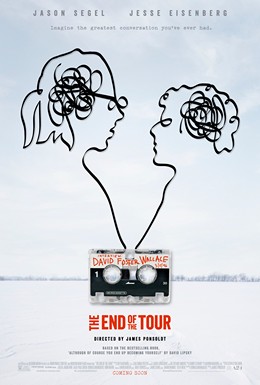
The_End_of_the_Tour

The End of the Tour opens in 2008, with a writer David Lipsky (Jesse Eisenberg) getting a call that the famous and acclaimed author, David Foster Wallace (Jason Segel), has committed suicide.  After learning of the tragedy, Lipsky remembers a few days that he spent interviewing Wallace 12 years earlier.  Wallace had just published his best known work, Infinite Jest.  At the time, Lipsky himself was a struggling writer and he approached Wallace with a combination of admiration and professional envy.  Lipsky hoped that, by interviewing Wallace, he could somehow discover the intangible quality that separates a great writer from a merely good one.

Almost the entire film is made up of Lipsky’s conversations with Wallace.  We watch as both the somewhat reclusive Wallace (who seems both bemused and, at times, annoyed with his sudden fame) warms up to Lipsky and as Lipsky forces himself to admit that Wallace might actually be a genius.  There are a few conflicts, mostly coming from the contrast between the withdrawn Wallace and the much more verbose Lipsky.  Lipsky’s editor (Ron Livingston) continually pressures him to ask Wallace about rumors that Wallace was once a drug addict.  But, for the most part, it’s a rather low-key film, one that’s more interested in exploring ideas than melodrama.  It’s also a perfect example of what can be accomplished by a great director and two actors who are totally committed to their roles.  Jason Segel, especially, gives the performance of his career so far.

The shadow of Wallace’s suicide hangs over the entire film.  Throughout their conversation, Wallace drops hints about his own history with depression.  Much as Lipsky must have done after Wallace’s suicide, we find ourselves looking for clues to explain his death.  But ultimately, Wallace remains a fascinating enigma in both life and death.

Love_&_Mercy_(poster)

Love & Mercy (dir by Bill Pohland)

Love & Mercy opens with Cadillac saleswoman Melinda Ledbetter (Elizabeth Banks) selling a car to a polite but nervous man (John Cusack).  The man sits in the car with her and rambles for a bit, mentioning that his brother has recently died.  Soon, the man’s doctor, Eugene Landy (Paul Giamatti), shows up and Melinda learns that the man is Brian Wilson, a musician and songwriter who is famous for co-founding The Beach Boys.  After having a nervous breakdown decades before, Brian is now a recluse.  He and Melinda start a tentative relationship and Melinda quickly discovers that Brian is literally being held prisoner by the manipulative Dr. Landy.

Throughout the film, we are presented with flashbacks to the 1960s and we watch as a young Brian (Paul Dano) deals with both the pressures of fame and his own relationship with his tyrannical father (who, in an interesting parallel to Brian’s later relationship with Landy, is also Brian’s manager).  As Brian struggles to maintain his grip on reality, he obsesses on creating “the greatest album ever.”

Love & Mercy is an enormously affecting story about both the isolation of genius and the redeeming power of love.  Whether he’s played by Cusack or Dano, Brian Wilson remains a fascinating and tragic figure.  It’s hard to say whether Cusack or Dano gives the better performance.  Indeed, they both seem to be so perfectly in sync with each other that you never doubt that the character played by Paul Dano will eventually grow up to become the character played by John Cusack.  Both of them do some of the best work of their careers in Love & Mercy.

Playing Catch-Up: Straight Outta Compton (dir by F. Gary Gray)


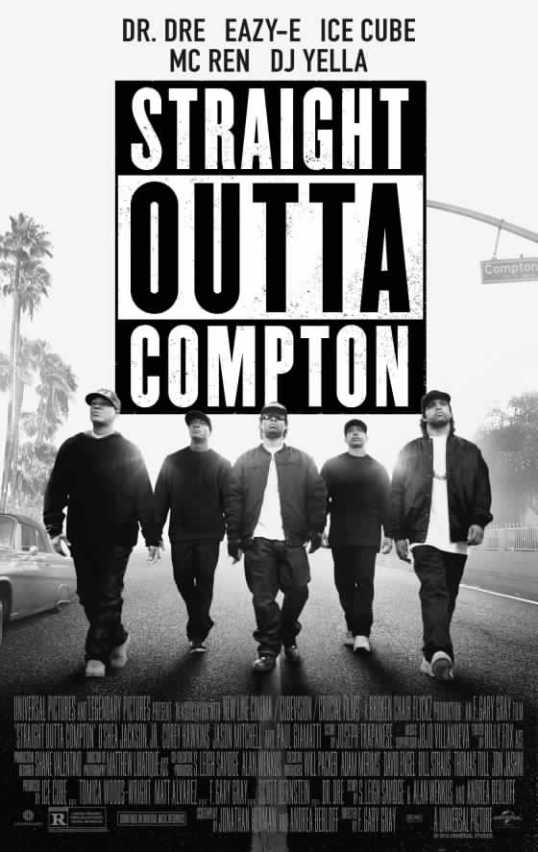
Straight_Outta_Compton_poster

Let’s just start with the obvious.

I am probably the last person who would be expected to appreciate Straight Outta Compton.   In the months leading up to the film’s release last year, I doubt anyone expected me to be a part of the audience.  After all, I’m a Caucasian girl from Texas.  I may have been born in Oak Cliff but, for the most part, I’ve lived in suburbs, small towns, and a few farming communities.  When it comes to music, my taste runs that gamut from EDM to more EDM.  I was less than a year old when NWA formed and I hadn’t even heard Straight Outta Compton or Fuck tha Police until I first heard about this movie.  Going into the movie, I knew who both Ice Cube and Dr. Dre were but, otherwise, I knew nothing about NWA.

And yet, with all that in mind, I was in tears by the end of Straight Outta Compton.  That’s proof of how strong a film Straight Outta Compton truly is.  I went into the film with next to zero knowledge of what I was about to see but from the very first minute, it captured my attention and my emotions. From the minute I saw Eazy-E (Jason Mitchell) fleeing from a police raid at a crack house, Dr. Dre (Corey Hawkins) dreaming of becoming a success, and Ice Cube (O’Shea Jackson, Jr.) being threatened by both gang members and police, I was totally invested in their stories.

Straight Outta Compton is a big film and director F. Gary Gray is obviously interested in a lot more than just telling a conventional musical biopic.  Instead, he uses Straight Outta Compton to explore what it’s like to grow up and live in the shadows of America.  That pre-credits raid on that crack house sets the tone for much of Straight Outta Compton, revealing a world where the only escape comes from money and where the police are essentially an invading army.

The film also deserves a lot of credit for capturing the excitement of creation.  The scene where NWA records their first album is pure exhilaration and even better are the concert scenes, all of which capture chaos in the best possible way.  Perhaps the best sequence comes when a defiant NWA performs Fuck tha Police while a similarly defiant swarm of policeman make their way through the crowd, all holding their badges in the air.  In that scene, Straight Outta Compton captures the feel of a society at war with itself.

Straight Outta Compton is an ensemble film in the best sense of the word, with Hawkins, Jackson, and Mitchell all giving excellent and charismatic performances.  Somewhat inevitably, Paul Giamatti shows up as their manipulative manager, Jerry Heller.  It’s a role that feels as if it was tailor-made for Giamatti and, needless to say, he performs the Hell out of it.

I’ve read that Straight Outta Compton takes some liberties with the historical facts and it’s true that the other two members of NWA — MC Ren and DJ Yella — are both largely portrayed as being bystanders.  (That said, Neil Brown did have some funny lines as DJ Yella.)  Towards the end of the film, whenever Eazy-E said, “I should have listened to Dre and Cube!,” I was reminded of the fact that Straight Outta Compton was produced by Dr. Dre and Ice Cube and not Jerry Heller.

But, historical liberties or not, Straight Outta Compton is an exhilarating and important film and one of the best of the year.


Playing Catch-Up: Room (dir by Lenny Abrahamson)


Room_Poster

Have you seen Room yet?

I ask because I’m debating how much information I should share in this review.  Room came out a few months ago and I’ve been late in reviewing it because watching the film was such an emotionally overwhelmingly experience that I wasn’t sure where to begin.  Now, all of this time has passed and I’m in a hurry to review this film because it’s obviously going to be nominated for some Oscars on Thursday morning and I’m wondering how much I can reveal without spoiling the movie.

It’s always tempting to say “Spoilers be damned!” but I’m not going to do that this time.  Room is a great film and it’s one that deserves to be discovered with a fresh mind.  I imagine that many people who missed the film the first time will see it once Brie Larson has been nominated for Best Actress.  Out of respect for those people, I am going to hold off from going into too much detail about the film’s plot.

Of course, this means that, if you haven’t seen the film, you’re going to have to have a little bit of faith in me.  You’re going to have to trust me.  When I tell you that this is an amazing film that will take you by surprise, you’re just going to believe me.  Because if I ruin those surprises … well, then they won’t be surprises anymore, will they?

When I first heard all the Oscar talk swirling around Room, my initial instinct was to make a joke about Tommy Wiseau finally getting the credit he deserves.  But then I saw Room and, within a few minutes of the film, I was in tears.  It’s hard for me to think of any other film this year that made me cry as much as Room.

Room is narrated by Jack (Jacob Tremblay), a 5 year-old boy whose hair is so long that he is frequently mistaken for being a girl.  Jack lives in a filthy room with Ma (Brie Larson).  The tiny room has only a toilet, a sink, a bed, a small kitchen area, and a cheap television.  There’s also the small closet where Jack sleeps and a skylight in the ceiling.  As quickly becomes apparent from his narration, Jack has never been outside of the room.  All he knows about the outside world comes from TV and the stories told to him by Ma.

Occasionally, a nervous man named Old Nick (Sean Bridgers) enters the room.  Whenever Old Nick shows up, Ma orders Jack to hide in the closet.  However, even in the closet, Jack listens to Ma and Nick talking in the room.  Ma talks about how Nick kidnapped her when she was 17.  Nick talks about how he has recently lost his job and may not be able to continue to take care of his two prisoners.  Fearful for her life, Ma humors the self-pitying Nick.  Nick, meanwhile, plays the victim and complains about how difficult it is to keep her and Jack prisoner.  It quickly becomes apparent that Jack is Nick’s child.

Now that Jack is five, Ma knows that he’s old enough that she can tell him about her plan to escape from Nick.  However, escaping means exposing Jack to a world that he’s never experienced and that Ma fears she no longer remembers.

Meanwhile, Ma’s parents wonder what has happened to their missing daughter.  (It’s from her parents that we learn that, much like a character played by fellow Oscar contender Jennifer Lawrence, Ma’s name is Joy.)  Ma’s mother, Nancy (Joan Allen), is now divorced from Joy’s emotionally repressed father (William H. Macy).  Nancy is now married to the kind and appealingly disheveled Leo (Tom McCamus).  However, still hoping that her daughter will someday return, Nancy hasn’t even touched Joy’s old bedroom.

Finally, the opportunity comes for Ma and Jack to escape and…

…and that’s all I can tell you without spoiling the film.  Room is an emotionally exhausting film, one that will make you cry but which will also leave feeling strangely hopeful for the future.  Brie Larson gives a courageously vulnerable and emotionally raw performance as Joy while Jacob Tremblay is perfectly cast as Jack.  Since Larson and Tremblay are both getting a lot of attention as possible Oscar nominees, I want to take a few minute to single out one member of the cast who, so far, has been overshadowed.  Tom McCamus doesn’t have a lot of screen time but he makes the most of every second he gets, turning Leo into the ideal father figure.

Room made me cry and cry and I can’t wait to see it again.