We have reached October 15th, the final day for individuals to file their income taxes in the United States of America and not be late. For a lot of you, this day means nothing. For a guy who makes his life in the tax business, and who has spent the last couple of months helping his clients get their taxes filed up to the very last minute, this day is a day of freedom! Happy October 15th, my friends. Let the holidays commence!
Tag Archives: Mel Brooks
Scenes That I Love: Putting On The Ritz From Young Frankenstein (Happy Birthday, Mel Brooks!)
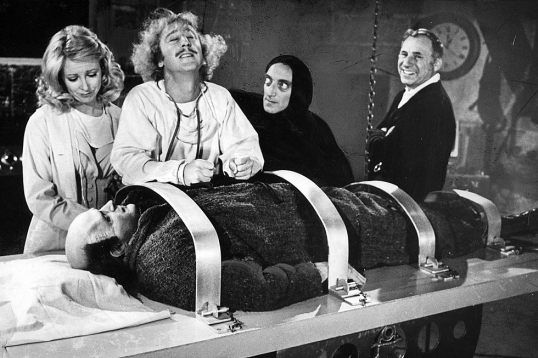
Today, Mel Brooks is 100 years old!
Mel Brooks. What can you say Mel Brooks? Not only did he help to redefine American comedy but he was also responsible for bringing David Lynch to Hollywood. Brooks was the one who hired Lynch to direct The Elephant Man. It can probably be argued that, if not for Brooks, Lynch’s feature film career would have begun and ended with Eraserhead. Brooks not only hired Lynch but also protected him for studio interference. When the execs tried to make Lynch remove two surrealistic sequences from The Elephant Man, Brooks stood up to them. When they requested a more conventional biopic, Brooks defended Lynch’s vision and the result was one of the best films ever made.
Of course, Brooks isn’t listed in the credits of The Elephant Man. Though he produced the film, he went uncredited because he didn’t want people to assume that the movie was a comedy. By doing so, Brooks missed out on an Oscar nomination but he also ensured that the film was taken seriously. It’s hard not to respect someone who was willing to go uncredited to help make the film a success.
Though Brooks, as a producer, was responsible for a number of serious films, there’s a reason why Brooks is associated with comedy. He’s a very funny man and he directed some very funny films. In honor of Mel Brooks, here’s a scene that I love from 1974’s Young Frankenstein.
Happy birthday, Mel Brooks!
4 Shots From 4 Films: Special Mel Brooks Edition
4 Shots From 4 Films is just what it says it is, 4 shots from 4 of our favorite films. As opposed to the reviews and recaps that we usually post, 4 Shots From 4 Films lets the visuals do the talking.
Mel Brooks is 100! It’s time for….
4 Shots From 4 Mel Brooks Films
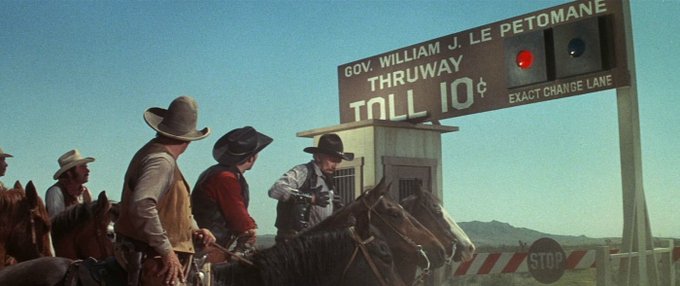
Blazing Saddles (1974, dir by Mel Brooks, DP: Joseph Biroc)
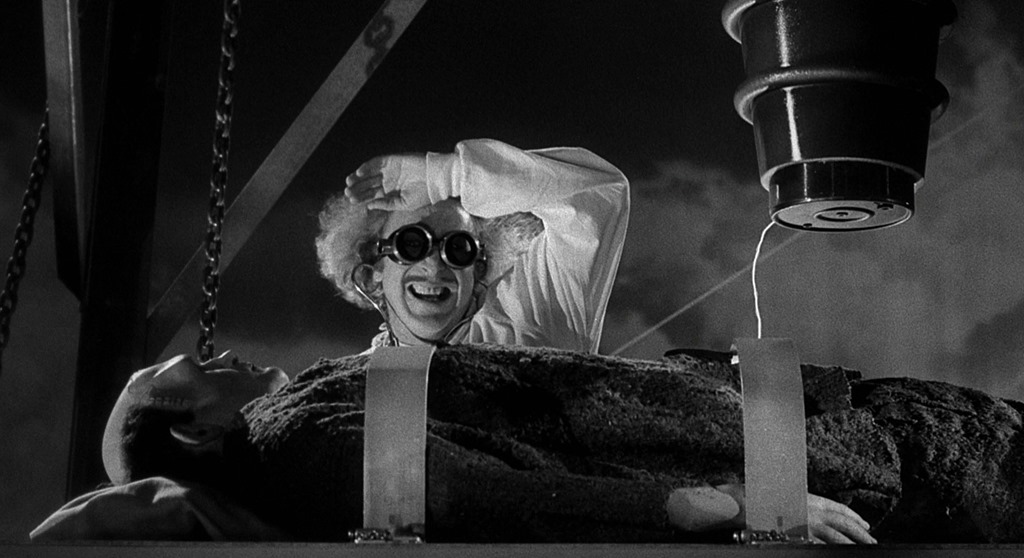
Young Frankenstein (1974, dir by Mel Brooks, DP: Gerald Hirschfeld)

High Anxiety (1977, dir by Mel Books. DP: Paul Lohmann)
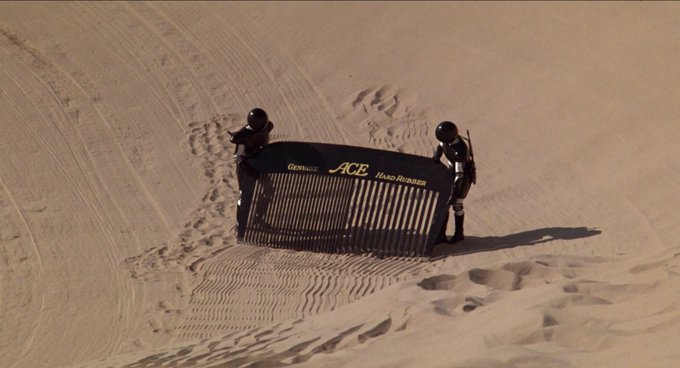
Spaceballs (1987, dir by Mel Brooks, DP: Nick McLean)
The History of the World, Part I (1981, directed by Mel Brooks)
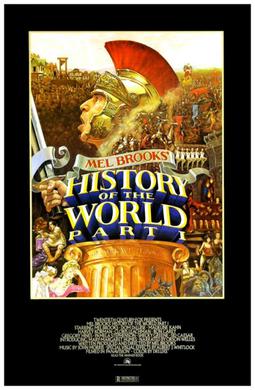 Overlong, wildly uneven, gimmicky too a fault, and often laugh out loud funny with a mix of jokes that range from the crude to the sublimely clever to the surprisingly sentimental, The History of the World, Part I is the ultimate Mel Brooks films.
Narrated by Orson Welles and featuring five historical stories and a collection of coming attractions, The History of the World Part I follows man from his caveman origins to the French Revolution and the thread that ties it all together is that humanity always screws up but still finds a way to survive. Moses (Mel Brooks) might drop and break one of the three tablets listing the 15 Commandments but he’s still able to present the other ten. Stand-up philosopher Comicus (Mel Brooks) might make the mistake of poking fun at the weight of Emperor Nero (Dom DeLuise) but he still makes his escape with Josephus (Gregory Hines), Swiftus (Ron Carey), and Miriam the Vestal Virgin (Mary-Margaret Humes) and ends up serving as the waiter at the Last Supper. (“Jesus!”) The Spanish Inquisition may have been a catastrophe but it also gave Torquemada (Mel Brooks) a chance to show off his performance skills. The French Revolution may have been a bloodbath but the future still held promise. Ask for a miracle and he’ll show up as a white horse named Miracle, no matter what era of history you’re living in.
The humor is very Mel Brooks. During the Roman Empire sequence, Madeline Kahn plays Empress Nympho. Jackie Mason, Harvey Korman, Cloris Leachman, Spike Milligan, Jan Murray, Sammy Shores, Shecky Greene, Sid Caesar, Henny Youngman, and Hugh Hefner all make cameo appearances. Carl Reiner is the voice of God. John Hurt plays Jesus. The film ends with the promise of a sequel that will feature “Jews in Space.” Not every joke lands. The entire caveman sequence feels forced. But when the film works — like during The Inquisition production number — it’s hard not get caught up in its anything-goes style. The entire Roman Empire sequence is probably more historically accurate than the typical Hollywood Roman epic. That’s especially true of Dom DeLuise’s naughty performance as Emperor Nero.
Mel Brooks is 99 years old today and he says that he has at least one more film to give us, a sequel to Spaceballs. I’m looking forward to it! I’m also looking forward to rewatching and enjoying all of the films that he’s already given us. The History of the World, Part I may not have initially enjoyed the critical acclaim of his earlier films but, in all of its anarchistic glory, it’s still pure Mel Brooks.
4 Shots From 4 Films: Special Mel Brooks Edition
4 Shots From 4 Films is just what it says it is, 4 shots from 4 of our favorite films. As opposed to the reviews and recaps that we usually post, 4 Shots From 4 Films lets the visuals do the talking.
Mel Brooks is 99! It’s time for….
4 Shots From 4 Mel Brooks Films
Blazing Saddles (1974, dir by Mel Brooks, DP: Joseph Biroc)
Young Frankenstein (1974, dir by Mel Brooks, DP: Gerald Hirschfeld)
High Anxiety (1977, dir by Mel Books. DP: Paul Lohmann)
Spaceballs (1987, dir by Mel Brooks, DP: Nick McLean)
Scenes That I Love: Putting On The Ritz From Young Frankenstein (Happy Birthday, Mel Brooks!)
Today, Mel Brooks is 99 years old!
Mel Brooks. What can you say Mel Brooks? Not only did he help to redefine American comedy but he was also responsible for bringing David Lynch to Hollywood. Brooks was the one who hired Lynch to direct The Elephant Man. It can probably be argued that, if not for Brooks, Lynch’s feature film career would have begun and ended with Eraserhead. Brooks not only hired Lynch but also protected him for studio interference. When the execs tried to make Lynch remove two surrealistic sequences from The Elephant Man, Brooks stood up to them. When they requested a more conventional biopic, Brooks defended Lynch’s vision and the result was one of the best films ever made.
Of course, Brooks isn’t listed in the credits of The Elephant Man. Though he produced the film, he went uncredited because he didn’t want people to assume that the movie was a comedy. By doing so, Brooks missed out on an Oscar nomination but he also ensured that the film was taken seriously. It’s hard not to respect someone who was willing to go uncredited to help make the film a success.
Though Brooks, as a producers, was responsible for a number of serious films, there’s a reason why Brooks is associated with comedy. He’s a very funny man and he directed some very funny films. In honor of Mel Brooks, here’s a scene that I love from 1974’s Young Frankenstein.
Happy birthday, Mel Brooks!
Life Stinks (1991, directed by Mel Brooks)
 Goddard Bolt (Mel Brooks), the massively wealthy CEO of Bolt Enterprises, wants to buy up a huge area of Los Angeles’s slums and tear them down, transforming the area into a chic neighborhood and moving all of the poor residents and street people out. Rival businessman Vaughn Craswell (Jeffrey Tambor), who grew up in the slum and dreams of destroying it himself, has the same plan. He and Bolt make a bet. If Bolt can survive for 30 days on the streets, Craswell will allow Bolt to have the property. Bolt agrees and soon, he is penniless and sleeping in alleys. While Bolt befriends Sailor (Howard Morris) and Fumes (Theodore Wilson) and falls in love with a former dancer named Molly (Lesley Ann Warren), Craswell schemes to take over Bolt’s company and keep Bolt on the streets permanently.
Life Stinks was one of Mel Brooks’s attempts to make a straight comedy that wasn’t a parody and which had a serious message underneath the laughs. The mix of comedy and drama doesn’t really gel, because the drama is too dark and the comedy is too cartoonish. Life Stinks is often guilty of romanticizing living on the streets. With the exception of two muggers, everyone whom Bolt meets is a saint. It is still interesting to see Brooks creatively at his most heartfelt and humanistic.
Life Stinks does feature some of Mel Brooks’s best work as an actor and it’s also features an excellent turn from Lesley Anne Warren. At first, I thought Warren would be miscast as a woman who spent her days in a soup kitchen and her nights sleeping in an alley. But she actually gives a very sweet and believable performance.
No matter what else, Mel Brooks is a true mensch.
Lisa Marie Reviews An Oscar Nominee: The Elephant Man (dir by David Lynch)
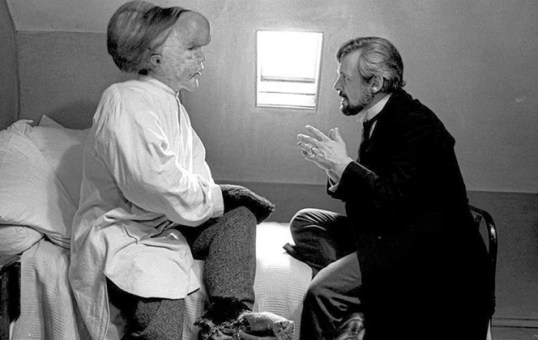
The Elephant Man (1980, dir by David Lynch, DP: Freddie Francis)
David Lynch never won a competitive Oscar.
He received an honorary award from the Academy in 2019. He generated some minor but hopeful buzz as a possible nominee for Best Supporting Actor for his role in Steven Spielberg’s The Fabelmans. He was nominated for Best Director three times and once for Best Adapted Screenplay. But he never won an Oscar and indeed, even his nominations felt like they were given almost begrudgingly on the part of the Academy. In an industry that celebrated conformity and put the box office before all other concerns, David Lynch was an iconoclastic contrarian and the Academy often didn’t do know what to make of him. Of the many worthy films that he directed, only one David Lynch film was nominated for Best Picture and, in my opinion, it should have won.
1980’s The Elephant Man is based on the true story of Joseph Merrick (renamed John for the film), a man who was horribly deformed and terribly abused until he was saved from a freak show by a surgeon named Dr. Frederick Treves. The sensitive and intelligent Merrick went on to become a celebrity in Victorian London, visited by members of high society and allowed to live at London Hospital. (Even members of the royal family dropped in to visit the man who had once been forced to live in a cage.) Merrick lived to be 27 years old, ultimately dying of asphyxiation when he attempted to lie down and, in Treves’s opinion, sleep like a “normal person” despite his oversized and heavy head. In the film, Merrick is played by John Hurt (who gives a wonderful performance that, despite Hurt acting under a ton on makeup, still perfectly communicates Merrick’s humanity) while Treves is played by Anthony Hopkins, who is equally as good as Hurt. (Hurt was nominated for Best Actor but Hopkins was not. Personally, I prefer Hopkins’s performance as the genuinely kind Dr. Treves to any of his more-rewarded work as Dr. Lecter.) The rest of the cast is made up of veteran British stars, including John Gielgud, Wendy Hiller, Freddie Jones, and Kenny Baker.
Lynch’s version of The Elephant Man is only loosely based on the facts of Merrick’s life. It opens with a disturbing fantasy sequence (one which I assume is meant to be from Merrick’s point of view) in which a herd of elephants strike down Merrick’s mother and then appear to assault her. Shot in stark black-and-white and often featuring the sounds of droning machinery in the background (in many ways, The Elephant Man feels like it takes place in the same world as Eraserhead), the first half of The Elephant Man feels like a particularly surreal Hammer film. (Veteran Hammer director Freddie Francis served as The Elephant Man‘s cinematographer.) Merrick is kept off-camera and, when we finally do see his face, it’s in a split-second scene in which Merrick is as terrified as the person who sees him. Before we really meet Merrick, we’ve already heard Treves and the hospital administrator (John Gielgud) discuss all of the clinical details of his condition. We know why he’s deformed. After we see him, we know how he’s deformed. After all of that, the audience is finally ready to know Merrick the human being. Without engaging in too much obvious sentimentality, Lynch shows us that Merrick is a kind soul, one who has been tragically mistreated by the world. Just as with the real Merrick, almost everyone who meets the film’s John Merrick is ultimately charmed by him. In the film, Merrick is kidnapped by his former owner, the alcoholic Bytes (Freddie Jones), who wants again puts Merrick on display in a cage. In the end, it’s Merrick’s fellow so-called “freaks” who set him free and allow him to return to the hospital, where he has one final vision of his mother. This vision is a much less disturbing than the one that opened the film. The film celebrates the humanity of John Merrick but is also reveals the genius of David Lynch. There’s so many moments when the film could have gone off the rails or become too obvious for its own good. But Lynch’s unique style so draws you into the film’s world that even the mysterious visions of his mother somehow feel completely necessary and natural. The Elephant Man is the David Lynch film that makes me cry. Lynch was a surrealist with a heart.
The Elephant Man was only David Lynch’s second film. He was hired to direct by none other than Mel Brooks, who produced the film but went uncredited to prevent people from thinking it would be a comedy. (Lynch, however, did cast Brooks’s wife, Anne Bancroft, as an actress who visits Merrick.) Brooks hired Lynch after seeing Eraserhead and recognizing a talent that many in Hollywood would never have had the guts to take a chance on. (Despite the success of Eraserhead on the midnight circuit, David Lynch was working as a roofer when he was offered The Elephant Man and had nearly given up on the idea of ever making another film.) Reportedly, Brooks stayed out of Lynch’s way and protected him from other executives who fears Lynch’s version of the story would be too strange to be a success. Lynch and Brooks proved those doubters wrong. Acclaimed by critics and popular with audiences, The Elephant Man was nominated for Best Picture and David Lynch was nominated for Best Director. I like Ordinary People. I like Raging Bull. But The Elephant Man was the film that should have won in 1980.
The Elephant Man remains a powerful movie and an example of how an independent artist can make a mainstream movie without compromising his vision. (Of course, I imagine it helps to have a producer who has the intelligence and faith necessary to stay out of your way.) David Lynch may be gone but his art will live forever. The Elephant Man will continue to make me cry for the rest of my life and for that, I’m thankful.
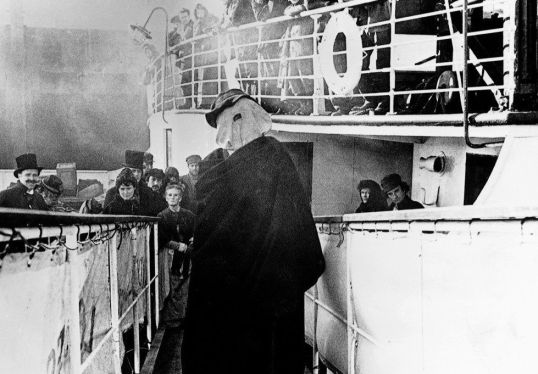
The Elephant Man (1980, dir by David Lynch, DP: Freddie Francis)
Two Scenes From Young Frankenstein (In Memory of Teri Garr)
Today, everyone was saddened to hear about the passing of actress Teri Garr. The veteran actress and dancer, who was best-known for her comedic performances but who also showed that she could handle drama, was 79 years old.
Since this is October, it seem fitting to share two scenes from 1974’s Young Frankenstein, featuring Teri Garr as Inga.
Spaceballs (1987, directed by Mel Brooks)

°ëØ
A long time ago, in a galaxy far far away…
President Skroob (Mel Brooks), the evil and incompetent leader of Planet Spaceball, has squandered all of the air on his planet and is planning on stealing the atmosphere of the planet Druida. To pull this off, he arranges for the idiotic Prince Valium (Jim J. Bullock) to marry Vespa (Daphne Zuniga), the princess of Druida. (All together now: “She doesn’t look Druish.”) Vespa and her droid, Dot Matrix (voice by Joan Rivers), flee Druida with Lord Dark Helmet (Rick Moranis) and Colonel Sandurz (George Wyner) in pursuit.
In debt to the intergalactic gangster, Pizza the Hut (voiced by Dom DeLuise), a mercenary named Lone Star (Bill Pullman) and his associate, the man-dog hypbrid Barf (John Candy), accept a contract from Vespa’s father (Dick Van Patten) to track down his daughter. They take off in their space Winnebago to bring Vespa home. Though they start only interested in money, Lone Star and Barf come to learn about love, freedom, and a mystical power known as the Schwartz. (“No, the Schwartz!”)
Back when I was growing up and just being able to have HBO made you the coolest guy on the block, Spaceballs was one of my favorite movies. I watched it every time that it came on cable. As usual with Mel Brooks, there were a lot of double entendres that went over my young head but there was also enough goofy humor that I could laugh at what was going on. I could quote all the lines. I laughed whenever Rick Moranis showed up in his Darth Vader-costume. I laughed at John Candy’s facial expressions. I laughed when Mel Brooks showed up as Yogurt, the Spaceballs version of Yoda. Pizza the Hut? That’s hilarious when you’re a kid!
I recently rewatched the film. Revisiting it was a lesson in how your memory can trick you. I could still quote most of the lines with reasonable accuracy but nothing was quite the way I remembered it. Rick Moranis and John Candy were still hilarious and, being older, I could better appreciated the frustration felt by George Wyner’s Colonel Sandurz. I also realized what a good performance Bill Pullman gave as Lone Star. While everyone else mugged for the camera, Pullman played his role straight.
I also discovered that a lot of the scenes that I remembered as being hilarious were actually just mildly amusing. Mel Brooks was always hit-and-miss as a director, the type who would toss everything and the kitchen sink into his films. Spaceballs has a lot of hilarious scenes but it’s obvious that Brooks didn’t have the same affection for the source material as he did with Young Frankenstein or Blazing Saddles or even High Anxiety. Brooks is poking fun at Star Wars because it’s popular but he doesn’t seem to have any strong feelings, one way or the other, about George Lucas’s space epic.
I still laughed, though. Even if Spaceballs wasn’t the masterpiece that I remembered it being, I still enjoyed rewatching it. The jokes that hit were funny enough to make up for the ones that missed. Even with his weaker films, Mel Brooks is a national treasure.

