Lisa Reviews An Oscar Nominee: For Whom The Bell Tolls (dir by Sam Wood)


For_whom_movieposter

After I watched The Pride of the Yankees, it was time to watch For Whom The Bell Tolls on TCM.  Based on the classic novel by Ernest Hemingway, the film version of For Whom The Bell Tolls was released in 1943 and, when I first started watching it, I was a little bit worried.

For, you see, For Whom The Bell Tolls is an extremely long film.  It’s a film that takes its time.  It’s also a very talky film and I have to admit that one reason I was worried was because the movie started at 11:30 and it was scheduled to last until 2:15 a.m.  Oh my God, I wondered, as the film started to slowly play out before me, am I going to end up dozing off before this is finished?

Well, I need not have worried.  Yes, For Whom The Bell Tolls does take a while to get started but it all pays off in the end.  By the time the film concludes, you realize why it had to take its time and why we had to spend so much time listening to these characters talk about what they did in the past, why they’re doing what they’re doing in the present, and what they’re hoping for in the future.

Not that all of the characters have a future.  At the start of the film, Robert Jordan (Gary Cooper) gets his palm read by Pilar (Katina Paxinou).  Pilar refuses to tell him what she saw in his future but it’s not difficult to guess.  Robert is on a suicide mission and everyone knows it.  Even when he falls in love with the beautiful Maria (Ingrid Bergman), he does so with the knowledge that he’ll be dead in just a few days.

Robert is an idealistic American who, as the film opens, is in Spain.  It’s the 1930s and Spain is embroiled in a civil war between fascists and guerrillas … well, if you’ve read Hemingway’s novel, you know that the guerrillas are communists.  But this is a Hollywood film so, for the most part, we don’t hear much about ideology.  But, then again, audiences in 1943 undoubtedly remembered the Spanish Civil War and understood that the guerrillas were fighting the forces of Gen. Francisco Franco.  And, for audiences today, all that matters it that the guerrillas are trying to overthrow a government.  Seriously, who doesn’t want to see the government overthrown?

(Full disclosure:  My grandmother on my mother’s side came to this country from Spain and frequently insisted that Franco had not been that bad.  At the time, not knowing one way or the other, I usually just smiled and nodded.)

Robert is fighting on the side of the guerrillas.  In four days, a major offensive is going to be launched against the fascists and, in order to keep fascist forces from pursuing the guerrillas, Robert has been assigned to blow up a mountain bridge.  Robert knows that he won’t survive this mission and, as he waits to die, he camps out with a small guerrilla band that is led by Pablo (Akim Tamiroff).  At first, Pablo refuses to take part in a mission that he considers to be futile but he is overruled by his strong-willed wife, Pilar (Katina Paxinou).

Among Pablo’s group is the beautiful Maria (Ingrid Bergman), a young woman whose family was killed by the fascist forces.  Robert and Maria fall in love, even as Robert prepares for his eventual death.

And then, finally, after two hours of screen time, Robert and the guerrillas head for that bridge and suddenly, we understand why the film took its time to reach this point.  By the time Robert reaches the bridge, we’ve come to know and care about both him and the other guerrillas.  And, as a result, we care about whether or not they survive.  When the fascists launch their own counter attack, every death counts.  We feel the loss of every casualty and we understand what they’re dying for.  After two hours of talk, For Whom The Bell Tolls ends with a genuinely exciting and even moving action sequence.  It all leads up to a final shot that will blow you away in more ways than one.

From Whom The Bell Tolls is a film that will reward those with the patience to stick with it and I’m glad that I turned out to be one of those people.  It was nominated for Best Picture of 1943 but lost to another film about an anti-fascist who fought in Spain, Casablanca.

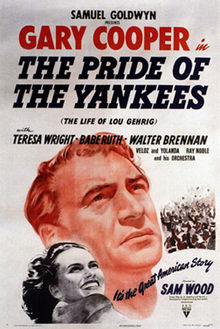
Lisa Reviews An Oscar Nominee: The Pride of the Yankees (dir by Sam Wood)


220px-The_Pride_Of_The_Yankees_1942

“People all say that I’ve had a bad break. But today … today, I consider myself the luckiest man on the face of the Earth.”

— Lou Gehrig (Gary Cooper) at the end of The Pride of the Yankees (1943)

After airing Foreign Correspondent earlier tonight, TCM followed up by showing the 1943 best picture nominee, The Pride of the Yankees.  Knowing that Pride of the Yankees was going to be a baseball film and that I know next to nothing about baseball, I recruited my sister, the Dazzling Erin, to watch the movie with me.  Erin loves baseball and I knew that she would be able to explain anything that went over my head.

Well, I absolutely loved watching this movie with my sister but it turns out that The Pride of the Yankees isn’t really much of a baseball movie.  True, it’s about a real life baseball player.  Several actual players appeared as themselves.  About 85% of the film’s dialogue deals with baseball and probably about 70% of the film features characters playing some form of the game.  But the film never goes into any great detail about baseball or how it’s played.  There’s no talk of strategy or rules or deeper meaning or anything else.  Going into the film, I knew that baseball was a game that involved throwing, swinging bats, and running.  And it turns out that was all that I needed to know.

The Pride of the Yankees is less about baseball and more about celebrity.  It’s a biopic of Lou Gehrig, who today is best known for his battle with ALS, a disease that is also known as Lou Gehrig’s disease.  Lou Gehrig died on June 2, 1941 and The Pride of the Yankees was released just a year later.  Watching the film, it’s obvious that Gehrig was a beloved figure, the type of celebrity who, if he were alive today, would probably be the center of stories like, “Lou Gehrig Did Something This Weekend And It Was Perfect.”  Watching the film, it easy to imagine how traumatic it must have been for the nation when a beloved athlete like Lou Gehrig died at the age of 37.

As a result, The Pride of the Yankees is less a biopic and more a case for canonization.  From the minute that the film’s Lou Gehrig appears on-screen, he is presented as being the type of saintly athlete who, by promising to hit two home runs in one game, inspires a crippled child to walk.  Lou is modest, kind, unpretentious, and never gets angry.  Over the course of the film, he takes care of his mother, displays a worthy work ethic, and marries Eleanor.  He and Eleanor have a perfect marriage without a single argument or a hint of trouble, except for the fact that Lou sometimes gets so busy playing baseball with the local children that he’s late coming home.  There’s not a hint of sadness in their life, until Lou suddenly gets sick.

And really, it should not work.  If ever there’s ever been a film that should be painfully out-of-place in our more cynical times, it would be The Pride of the Yankees.  However, the film still works because Lou is played by Gary Cooper and Eleanor is played by Teresa Wright.  These two excellent performers bring their considerable talents to making overly sentimental scenes feel credible.  Gary Cooper was 40 years old when he made The Pride of the Yankees and there’s a few scenes — especially the ones where Lou is supposed to be a student at Columbia University — where Cooper is clearly too old for the role.  But, for the most part, Gary Cooper did a great job as Lou Gehrig.  Cooper is especially memorable when Lou first starts to show signs of being ill.  Watching Lou struggle to swing a bat, I was reminded of a horse struggling to stand on an injured leg.  It was almost painfully poignant.

The Pride of the Yankees was nominated for 11 Academy Awards, including best picture.  However, it lost to another sentimental film that featured Teresa Wright, Mrs. Miniver.

Lisa Reviews An Oscar Nominee: Foreign Correspondent (dir by Alfred Hitchcock)


ForeignCorrespondent

Before watching a film like 1940’s Foreign Correspondent, it helps to know a little something about history.

Nowadays, when we think about World War II, there’s a tendency to assume that, from the minute that Hitler came to power in Germany and started to invade the rest of Europe, the entire world united against the Nazis.  The truth is actually far more complex.  The world was still recovering from World War I and throughout the 1930s, even as the Axis powers were growing more and more aggressive, respected intellectual leaders and politicians continued to argue that peace must be maintained at all costs.  Pacifism was such a popular concept that otherwise intelligent people were perfectly willing to make excuses for Hitler and Mussolini.  For five years, the UK followed a policy of appeasement towards Nazi Germany.  Even after war broke out between Britain and Germany, the U.S. remained officially neutral.  In the 1940 presidential election, President Franklin D. Roosevelt — running on a platform of neutrality — was overwhelmingly reelected over internationalist Wendell Willkie.

Foreign Correspondent, an American film made by a British director, opens before the start of World War II.  An American newspaper editor, Mr. Powers (Harry Davenport), is frustrated because none of his foreign correspondents seem to be able to understand the truth of the situation in Europe.  They all claim that there is going to be no war in Europe but Mr. Powers feels differently.  He also feels that the newspaper’s most celebrated and respected foreign correspondents are just a bunch of out-of-touch elitists.  Instead of sending another upper class academic, Mr. Powers decides to send a hard-boiled crime reporter to cover the situation in Europe.  Johnny Jones (Joel McCrea) has never been to Europe and that’s exactly why Mr. Powers decides to send him.  In one of the film’s more clever moments, he does, however, insist that Johnny write under the more distinguished sounding name of “Huntley Haverstock.”

(Foreign Correspondent‘s pointed criticism of out-of-touch elitists repeating the establishment line remains just as relevant today as it was in 1940.)

From the minute the brash and tough Johnny arrives in Europe, he finds himself caught up in a huge conspiracy.  He’s been assigned to report on a group known as the Universal Peace Party and, since this film was directed by Alfred Hitchcock, we automatically know that any organization with the word “Peace” in its name has to be up to something shady.  The Universal Peace Party has been founded by Stephen Fisher (Herbert Marshall), who appears to sincere in his desire to avoid war.  Johnny meets and falls in love with Fisher’s daughter, Carol (Laraine Day).

From the minute that Johnny witnesses the assassination of distinguished Dutch diplomat Von Meer (Albert Bassermann), he suspects that things are not how they seem.  Working with Carol and a British journalist named Scott ffolliot* (delightfully played by the great George Sanders), Johnny discovers that Von Meer was not killed at all.  Instead, a double was assassinated and Von Meer was kidnapped by a group of spies.

But who are the spies?  After nearly getting killed by one of Fisher’s bodyguards, Johnny starts to suspect that Stephen Fisher might not be as into world peace as was originally assumed.  Complicating matters, however, is the fact that Johnny is now engaged to marry Carol…

Foreign Correspondent is a wonderfully witty thriller, one that has a very serious message.  While the film is distinguished by Hitchcock’s typically droll sense of humor (eccentric characters abound and the scene where Edmund Gwenn keeps getting interrupted before he can attempt to push Joel McCrea off of a tower is both funny and suspenseful), the film’s message was that America could not afford to stay neutral as war broke out across Europe.  As the all-American Johnny Jones says at the end of the film:

“All that noise you hear isn’t static – it’s death, coming to London. Yes, they’re coming here now. You can hear the bombs falling on the streets and the homes. Don’t tune me out, hang on a while – this is a big story, and you’re part of it. It’s too late to do anything here now except stand in the dark and let them come… as if the lights were all out everywhere, except in America. Keep those lights burning, cover them with steel, ring them with guns, build a canopy of battleships and bombing planes around them. Hello, America, hang on to your lights: they’re the only lights left in the world!”

Foreign Correspondent was nominated for best picture of 1940 but it lost to another far different Hitchcock-directed film, Rebecca.

——

* Yes, that is how he spells his last name.  As he explains, his family dropped the capital name in his surname after an ancestor was executed by Henry II.  Since it was George Sanders doing the explaining, it somehow made perfect sense.

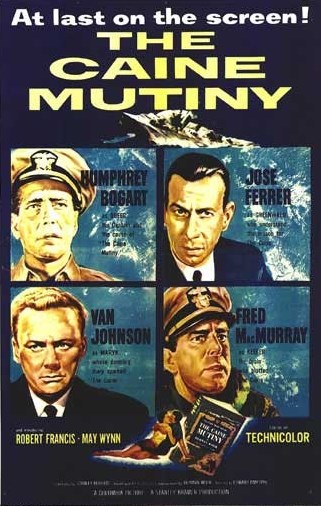
Lisa Reviews An Oscar Nominee: The Caine Mutiny (dir by Edward Dmytryk)


Mutiny_0

It’s the 1940s and World War II is raging.  The U.S. Navy is model of military discipline and efficiency.  Well, except for the U.S.S. Caine, that is.  The Caine is something of a disorganized mess, where no one takes his job seriously and sailors have names like Meatball (Lee Marvin) and Horrible (Claude Akins).  The men love Lt. Commander DeVriess (Tom Tully), largely because he has given up on trying to enforce any sort of discipline.  However, DeVriess has recently been relieved of his command.  As he leaves, Meatball gives him a new watch, a gift from all the men.  DeVriess admonishes them, snapping that the gift is violation of Naval regulations.  He then puts the watch on his wrist and leaves the ship.

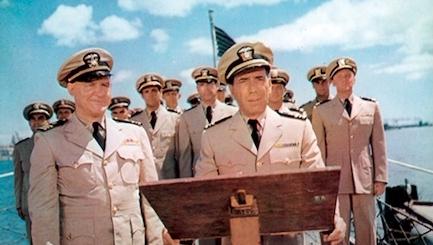
DeVriess’s replacement is Captain Francis Queeg and, at first, we have reason to be hopeful because Captain Queeg is being played by Humphrey Bogart.  Surely, if anyone can get this ship into shape, it’ll be Humphrey Bogart!  From the moment he arrives, Queeg announces that he’s going to enforce discipline on the Caine and if that means spending hours yelling at a man for not having his shirt tucked in, that’s exactly what Queeg is prepared to do.  However, it also quickly becomes apparent that the awkward Queeg has no idea how to talk to people.  He is also overly sensitive and quick to take offense.  Whenever Queeg makes a mistake (and he does make a few), he’s quick to blame everyone else.

the-caine-mutiny-deck

Realizing that the men are turning against him, Queeg even begs his officers for their help.  He asks them if they have any suggestions.  They all sit silently, their heads bowed as Queeg somewhat poignantly rambles on about how his wife and his dog both like him but the crew of the Caine does not.

Queeg’s officers are a diverse bunch, none of whom are quite sure what to make of Queeg or the state of the Caine.  Ensign Willie Keith (Robert Francis) is a wealthy graduate of Princeton University who, at first, likes Queeg but quickly comes to doubt his abilities.  On the other hand, Lt. Steve Marsyk (Van Johnson) has doubts about Queeg from the start but, as a career Navy man, his natural instinct is to respect the chain of command above all else.

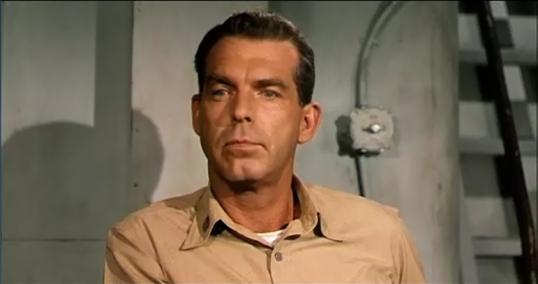
And then there’s Lt. Tom Keefer (Fred MacMurray).  Keefer is a self-styled intellectual, a novelist who is always quick with a snarky comment and a cynical observation.  (If The Caine Mutiny were remade as a B-horror film, Lt. Keefer’s name would probably be Lt. Sardonicus.)  From the minute the viewers meet Lt. Keefer, our inclination is to like him.  After all, he seems to be the only person in the film who has a sense of humor.  If we had to pick someone to have dinner with, most of us would definitely pick the erudite Tom Keefer over the humorless and socially awkward Francis Queeg.  As such, when Keefer starts to suggest that Queeg might be mentally unstable, our natural impulse is to agree with him.

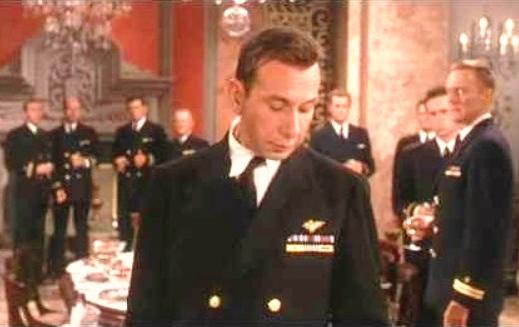
It’s Tom Keefer who first suggests that it may be necessary to take the command away from Queeg.  And yet, when it comes time to take action, it’s Keith and Marsyk who do so while Keefer stands to the side and quietly watches.  And, once the Caine arrives back in the U.S., it Keith and Marsyk who are court martialed.  Will they be found guilty of treason or will their lawyer, Lt. Barney Greenwald (Jose Ferrer), prove that Queeg was unfit for command?

the-caine-mutiny-ferrer

Made in 1954 and based on a novel by Herman Wouk, The Caine Mutiny is one of those big and glossy 1950s productions that holds up a lot better than you might expect.  The film has its flaws.  In the role of Keith, Robert Francis is a bit on the dull side and a subplot in which he courts May Wynn feels unneccessary and only serves to distract from the main story.  But, for the most part, it’s an intelligent and well-directed film.  Humphrey Bogart turns Queeg into a pathetic and lonely figure and you can’t help but feel sorry for him when he talks about how his dog loves him.  Van Johnson also does well as Marsyk, effectively portraying a well-meaning character who is in over his head.  Jose Ferrer gets a great drunk scene at the end of the film and, of course, you can’t go wrong with Lee Marvin as a smirking sailor, even if Marvin only appears for a handful of minutes.

Fred MacMurray The Caine Mutiny

But for me, my favorite character (and performance) was Fred MacMurray’s Tom Keefer.  Technically, Keefer is not meant to be a likable character.  He’s totally passive aggressive.  He’s pretentious.  He’s smug.  At times, he’s rather cowardly.  And yet, Tom Keefer remains the most memorable and interesting character in the entire film.  He gets all of the good one-lines and MacMurray delivers them with just the right amount of barely concealed venom.  (“If only the strawberries were poisoned…” he says as he considers dinner aboard the Caine.)  It’s a great role and Fred MacMurray gives a great performance.  And you know what?  I don’t care how bad a character he may have been.  I still want to read Tom Keefer’s book!

The Caine Mutiny was nominated for best picture of 1954.  However, it lost to On The Waterfront.

Hallmark Review: The Sweeter Side of Life (2013, dir. Michael Damian)


IMG_6722

I remember sitting in a theater back in 1995 watching Clueless for the first time. I really enjoyed it and can still enjoy it today. Cher was certainly pampered, rich, and a bit of ditz, but she never lost her lovability. We could always tell there was a smart and wonderful person just underneath her exterior. We understood and believed her transformation from the superficial to the person we could see from the beginning waiting to spring forth from just under her persona. Even in the poor man’s Clueless that came out last fall on Hallmark called Harvest Moon they created a character that we could find endearing on some level. The Sweeter Side of Life does none of these things.

Just before showing that title card we are introduced to our main character named Desiree Harper (Kathryn Morris). We see her turn off her fancy alarm clock with a fancy watch sitting just next to it. Then we see that she not only sleeps with a sleep mask on but a pillow of sorts that wraps around her neck. Something someone uses for pain problems, but here is supposed to show just how rich she is. Then the typical walk-in closet scene happens while a maid cleans the New York City apartment where she lives. But she’s not unlikable enough yet.

IMG_6747

That’s why we get this scene with her friends at the gym looking at an overweight woman while debating the maximum weight allowed for wearing latex. This is followed by the shopping montage before she sits down at a lunch with her friends. One of them is seeing a guy named Renaldo who they just found out has three kids and a wife back in Argentina. Another friend says, “Who cares as long as his family stays over there, right?” Our lead who is already unbearable says she’d care. That’s the one hint at this point that there might be a decent person in there. I know I can’t really get across how she manages to be so darn unpleasant already, but take a look at her.

IMG_6761

Actress Kathryn Morris may be the nicest person in the world in real life, but her appearance combined with the way she acts in only these first few minutes makes it really hard to warm up to her. She goes home and finds her husband missed their anniversary for a last minute surgery so she gets drunk for the night. Couldn’t care less at this point.
IMG_6780

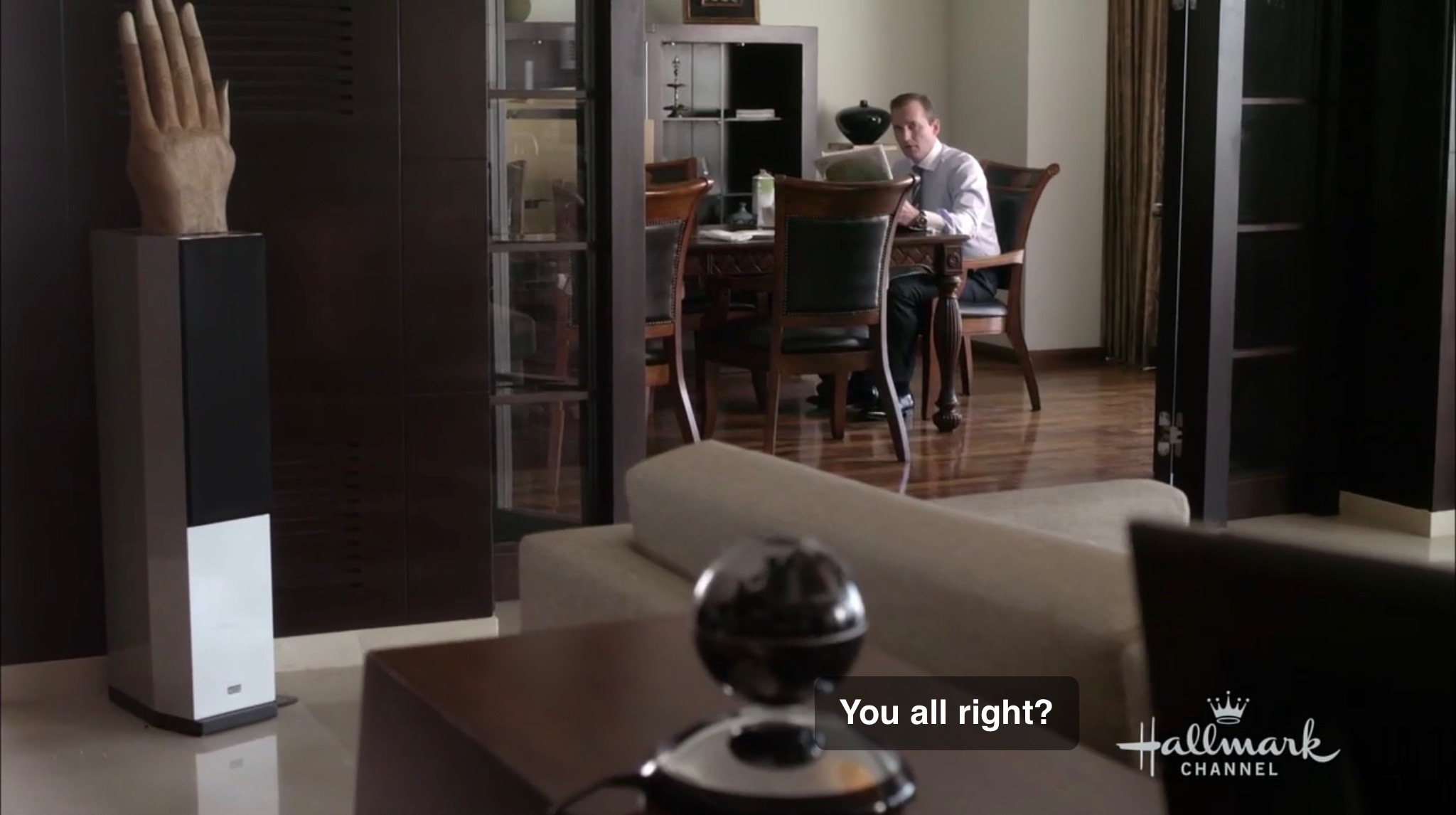
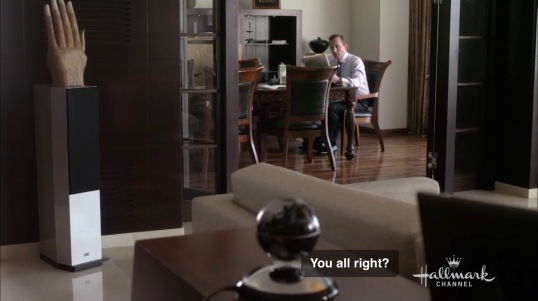
The next morning she finds her husband at the dinner table and we see that they have a giant hand sculpture in the house. That’s interesting. Now we find out that her husband is going to leave her for his 20 year-old acupuncturist Olive. Here’s my requisite joke that he has also been sticking her with a little needle too. Couldn’t let that go. Now we get to the best character of the film.
IMG_6823

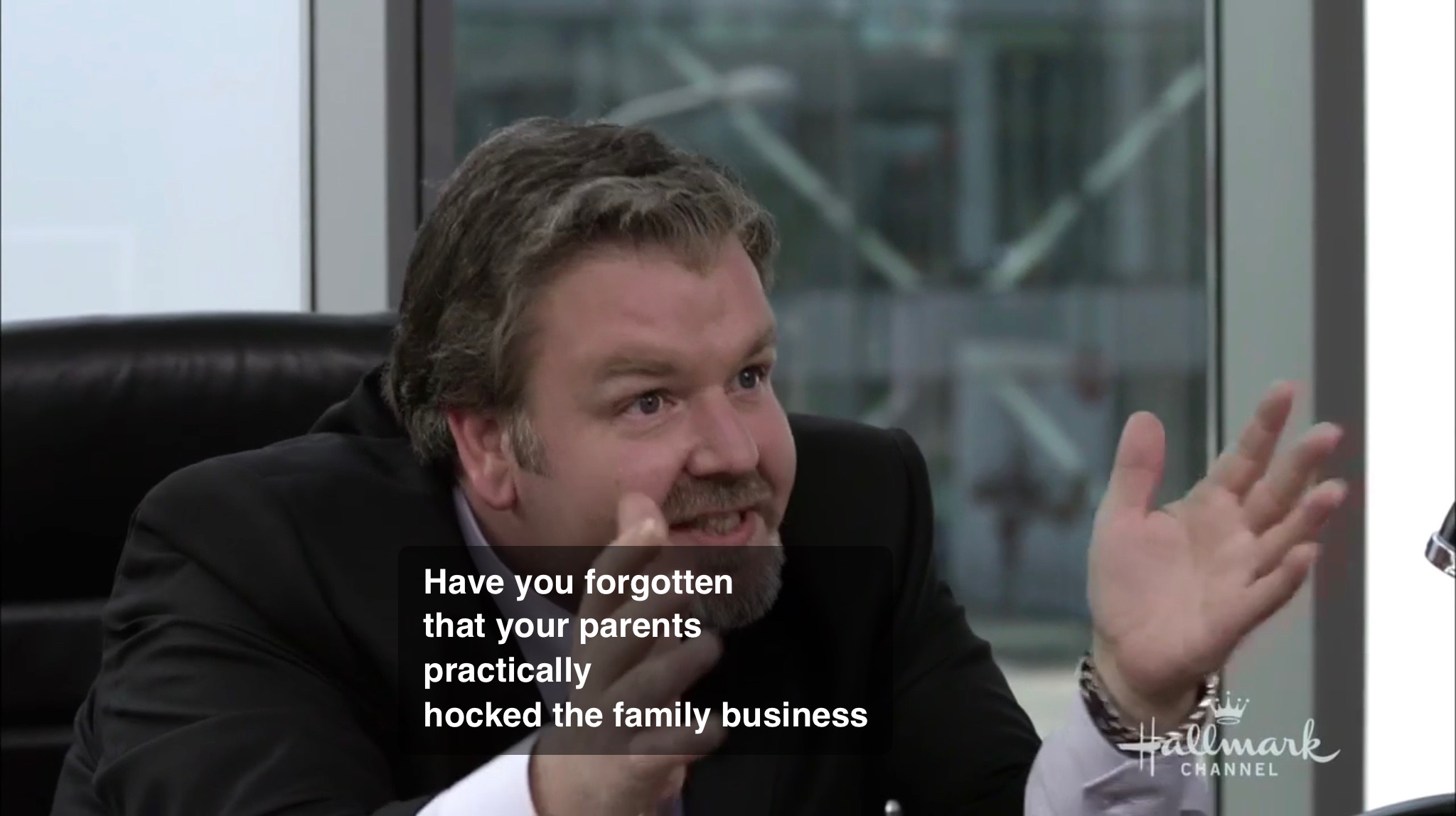
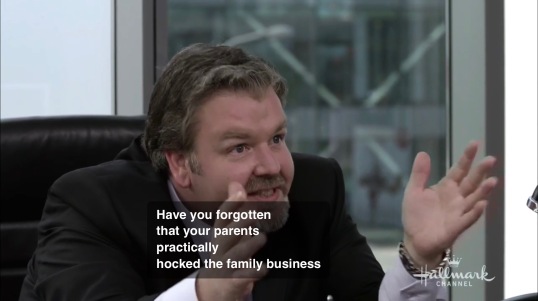
This is her somewhat slimy, comical, and lovable lawyer. If they could make his character this way, then why couldn’t they write her the same way? He’s here to remind her she signed a prenuptial agreement. The movie will never bring up whether the agreement had anything in it about adultery which is weird. He also reminds the audience that her family bent over backwards to send her to Columbia where she obtained an MBA which she never used. She says that the interview would ask her about job experience and that all she has experience in is shopping. There are jobs where that actually is a skill, but they don’t bring that up even though I have seen a Hallmark movie with a personal shopper (12 Gifts of Christmas). He asks her where the girl he knew in elementary school went. However, he doesn’t give us any details which would have been really important so we could see beyond her nasty exterior.

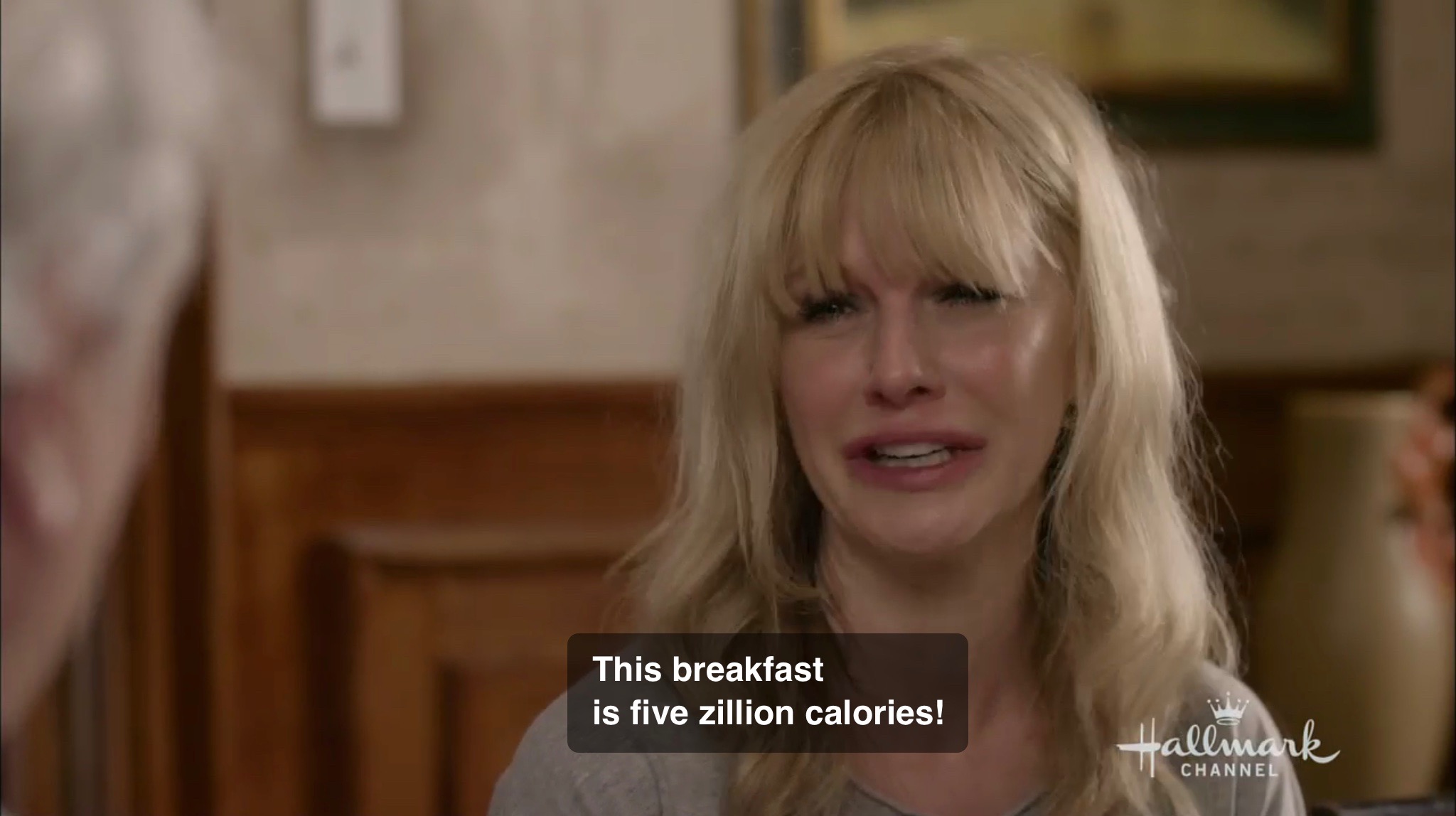
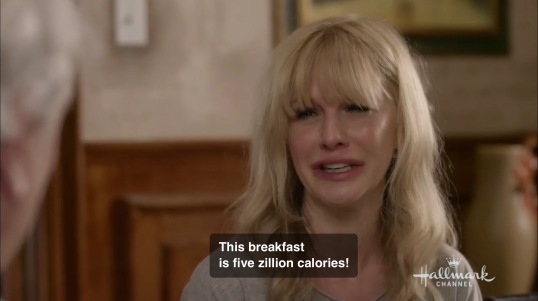
Now of course her credit card is taken away from her, she gets hit by a car, and she wakes up in New Jersey with her dad. Her family hasn’t changed her room since she was little. That’s nice. Her father even has breakfast ready so what are some of those first words out of her mouth?
IMG_6906

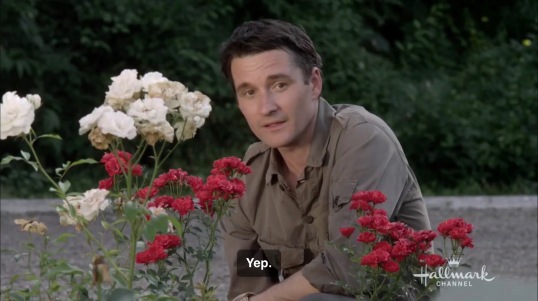
Oh, and the fact that the husband said she shouldn’t drink so much dairy before dumping her doesn’t make this line any more digestible. She moans and groans including that she was a good wife. Could have been helpful for us to see something that hinted at her being a good wife. All I saw was body shaming and shopping. She wonders how she is going to support herself. The father reminds her that she knows how to bake. He runs a bakery. Since she hasn’t been shell shocked enough, we need to have her do some deliveries using the local florist’s car. This really only exists so she can meet a love interest. Yes, this movie will ask us to buy that this guy…
IMG_6984

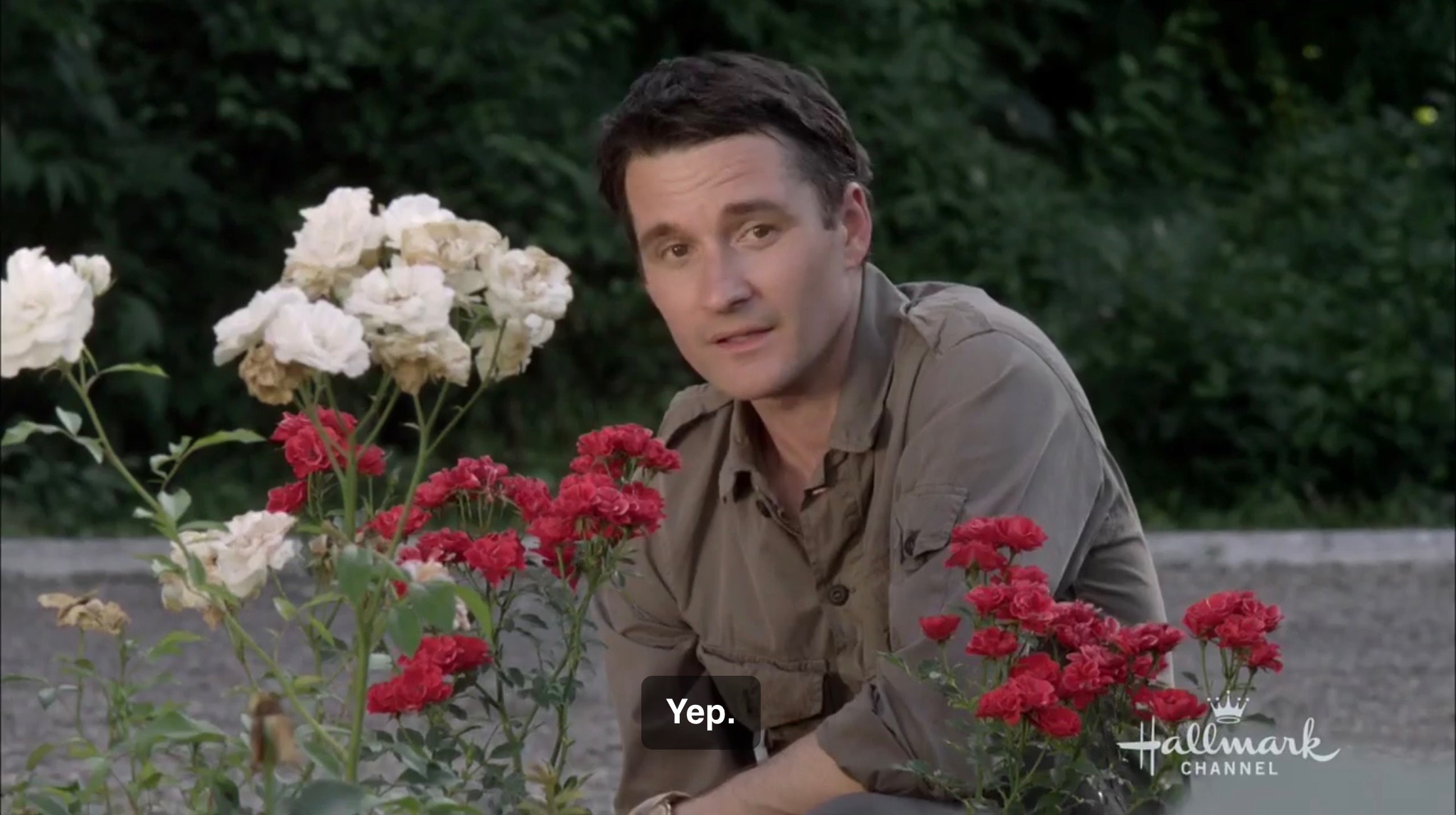
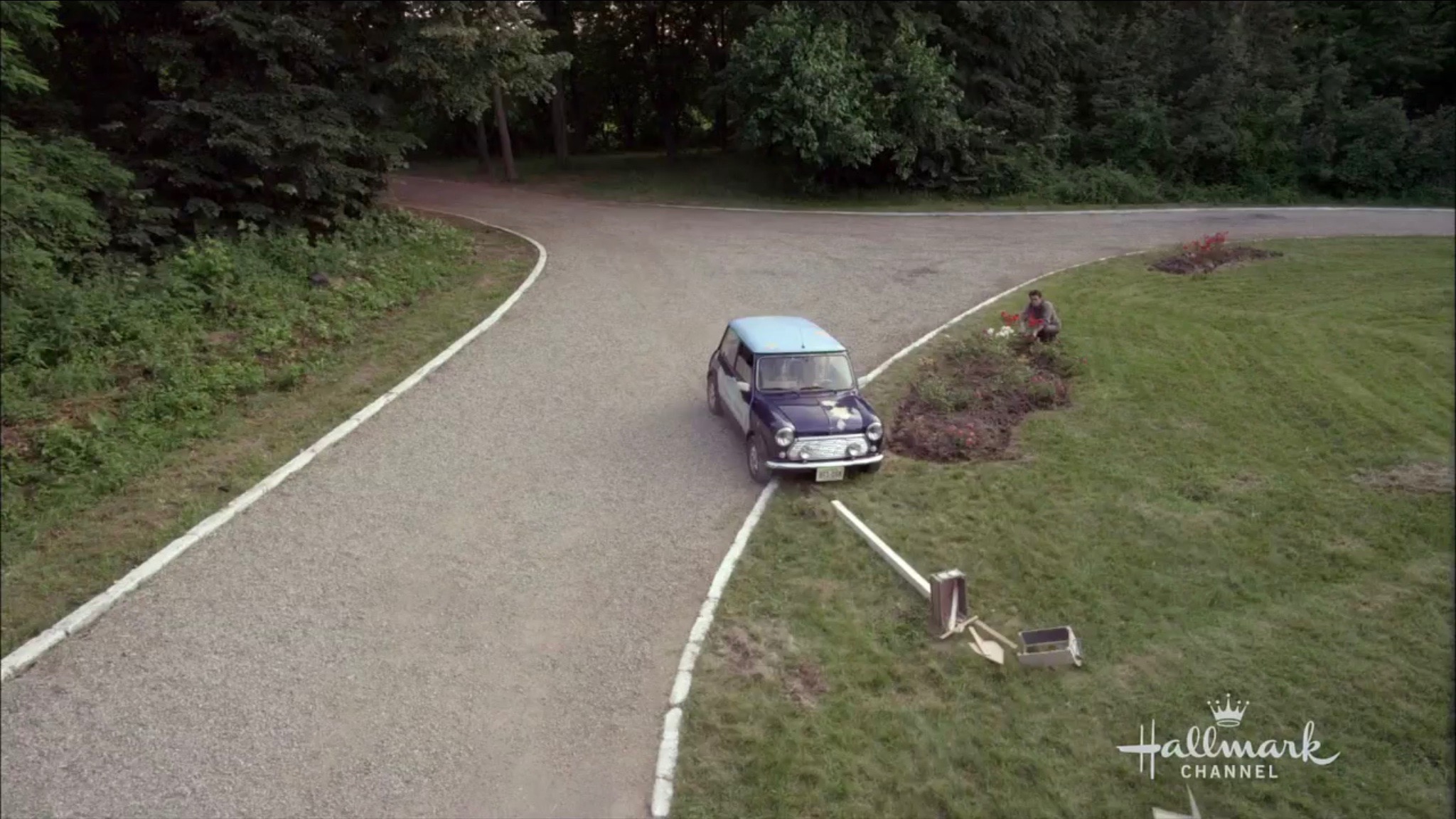
should have any reason to want to be with her, despite only being in a couple of scenes together. He’s rich too. Of course their first meeting has her hitting and knocking down his bird house.

IMG_6978

I think the screenwriters may have seen Clueless. Here she was looking at someone getting into a chopper and saying she wants the rich life back before hitting the bird’s nest. Love?

She makes it back alive and we get a proper introduction to the florist. She is also a reasonably likable character especially because we find out she’s smart and cultured even when it comes to rap music.

Now we get a weird scene. The movie will never follow this scene up either to really explain it. There’s a black kid who works at the bakery. She catches him presumedly stealing from the register, but covering it up by saying that it has just been popping out on it’s own. This is never followed up on even though he asks if he can take on more duties than just cleaning up and that his family needs the money. Is the film saying he was going to steal and that she is helping him or not? And the fact that someone immediately comes up to the register, the drawer pops open, and he says it’s doing that again and needs to be fixed doesn’t help. Was this supposed to say that Desiree was racist? It doesn’t make sense. Especially when we will see her help a black policewoman by giving her one of her outfits a little later. A character that will come around at the end of the film in a relationship with the lawyer. Honestly, the movie would have made a lot more sense had she ended up with the lawyer who bends over backwards for her and has an affection for her. Also, remember Cher’s father was a lawyer in Clueless. I’m sure it’s just a coincidence.

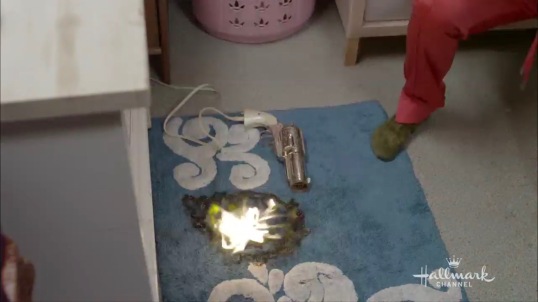
Anyways, it’s time to learn that Desiree is still stuck up because she wants to straighten her hair? I don’t get that at all. But what I really don’t get is why her hair dryer is shaped like a gun.
IMG_7062

Then in case we didn’t know the dad is really supposed to be, dare I say, clueless, he apparently had no idea that some clothes have to be hung to dry and has shrunk one of her dresses. What? He raised her and isn’t gay or anything so he was a married to a woman. Not that there aren’t men’s clothes that aren’t supposed to be put in the dryer as well. It’s just a really stupid scene that just tells us she still hasn’t changed and her dad is supposed to be so different because he is an idiot. Actually, this scene exists just so that the next ridiculous thing can happen on her way to meet with lawyers in the city.
IMG_7097

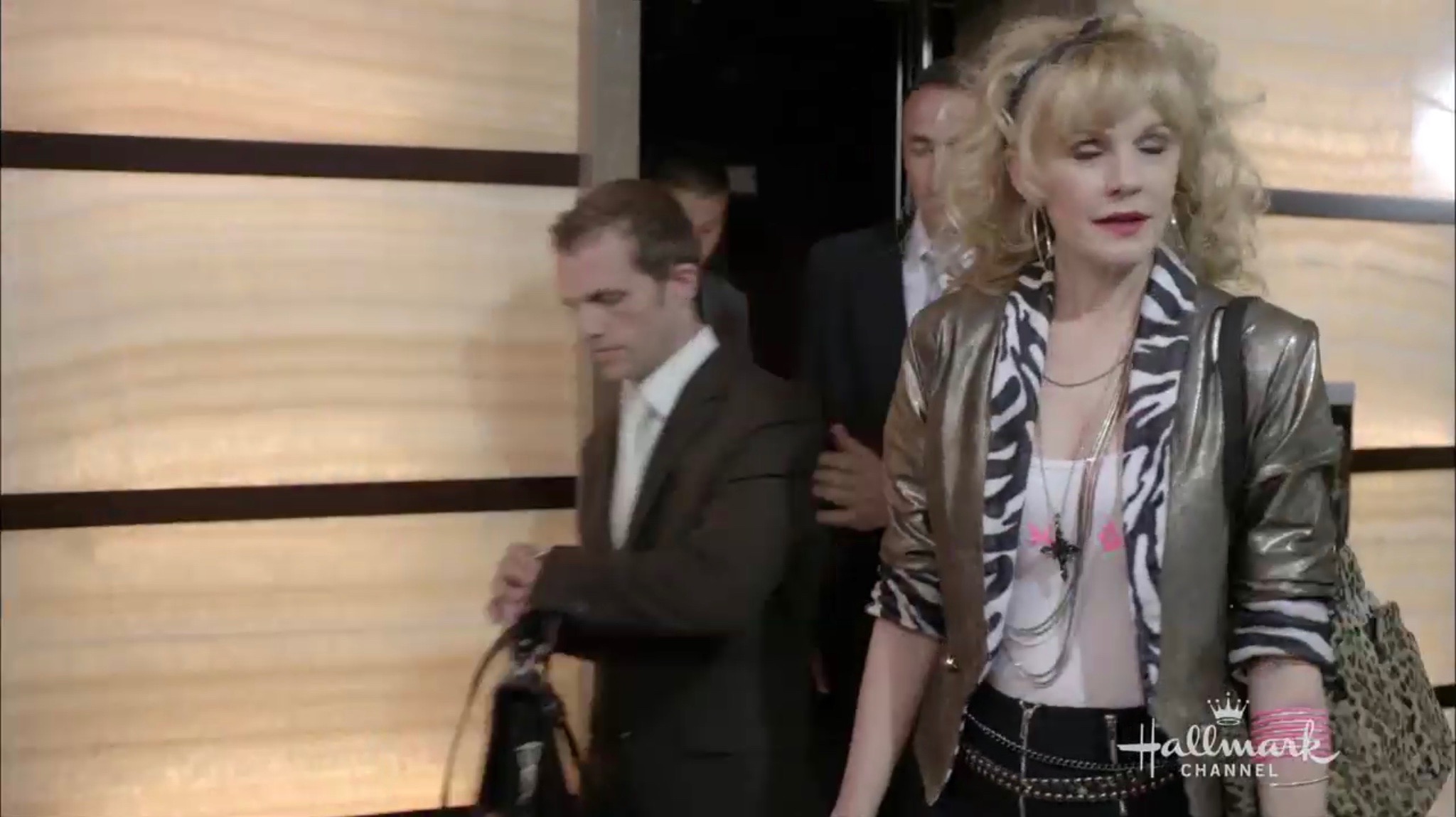
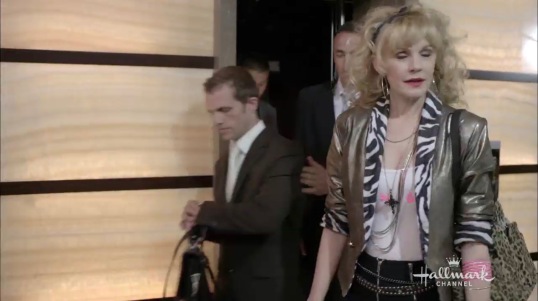
She has to wear the same clothes she wore when she lived with her father back in the 1980s cause she’s wearing the early Madonna clothes. Not funny, and nor did I feel sorry for her when one of her friends brushes her off because of her fall from riches. Oh, and when they have her walking through the crowded sidewalks they do it in slow motion with upbeat I’m going to show them music, but why? She hasn’t changed at all. She shrieked at the reality of having to wear the clothes and just finished complaining about her hair dryer as well as her father’s incompetence. Why use this type of shot that is normally reserved for someone full of confidence? Makes no sense.

Oh, and small complaint, but her former friend tells her the 80’s have come and gone twice after looking at her outfit. Can someone please tell that to all the woman I see with off the one shoulder tops in modern movies? This lady is right. It’s not the 1980s all over again. While we’re here. One of the things that made Clueless so good is that part of Cher’s transformation is to stop seeing and treating her friends as superficial and start to appreciate the good and special things about them. Why is it necessary to lump all her former friends in the trashcan for characters as deep as a puddle who we are supposed to accept as better simply because they live in New Jersey?

She now goes in to meet with her husband’s lawyer and you know why nothing is brought up in her defense? Like the adultery for example. It’s because the lawyer comes in and is stoned after a dental visit. Yep. The only thing of value here is that we find out Olive is pregnant.
IMG_7156

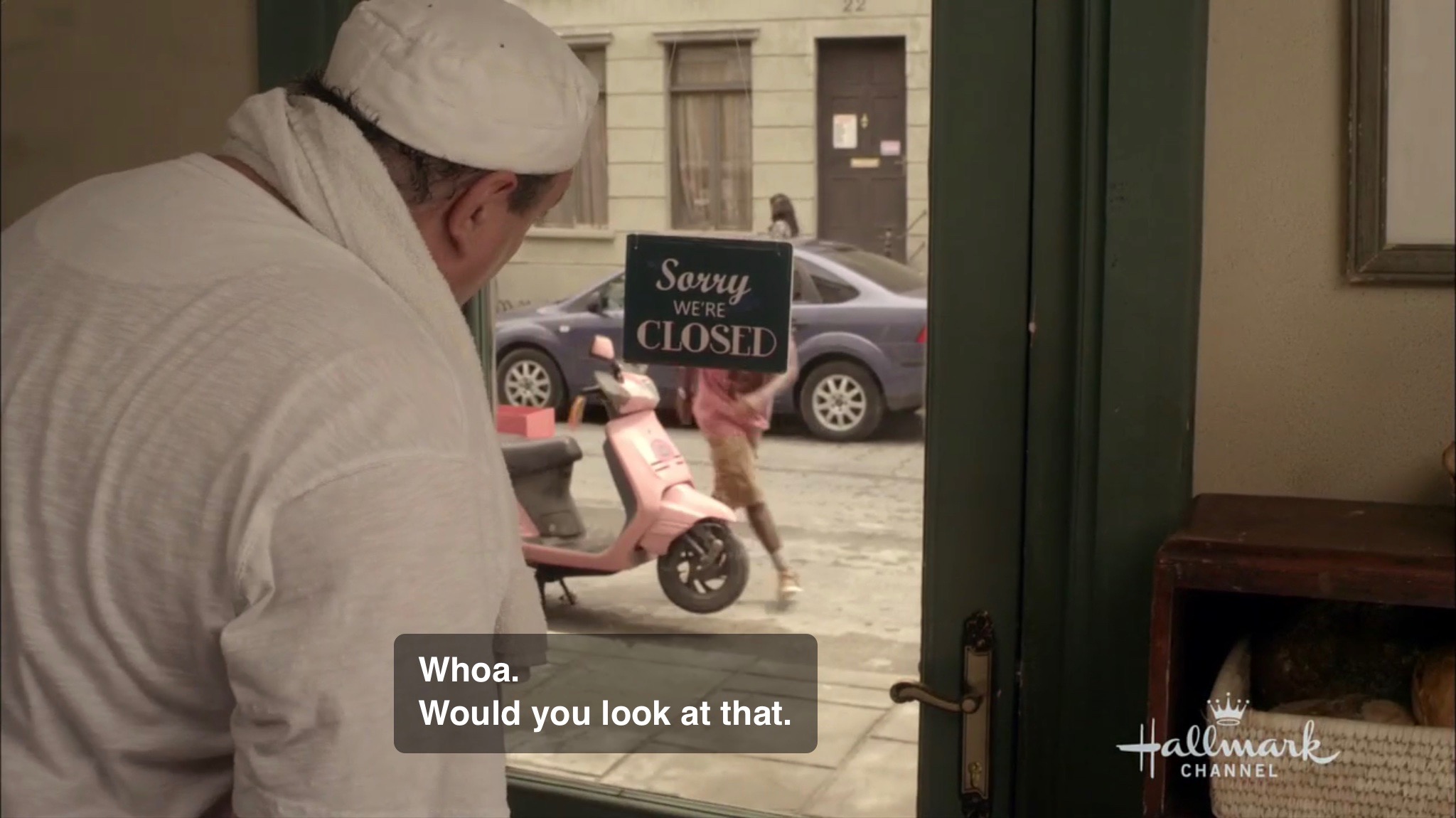
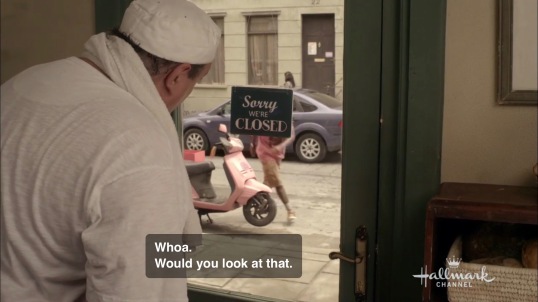
After a kitchen accident which isn’t funny, it’s time to insult the black kid who shows up on a pink scooter. He’s wearing pink too. Just in case we thought this was a meaningless little joke it immediately cuts to two guys at the counter where one says to the other “I want the fruity one” to which the other replies “I pointed to it first.” Yeah, that’s great. They do come across as if they are supposed to be a couple. Wouldn’t have been an issue if they hadn’t just harassed the kid about the pink. In fact, it would have made them seem progressive seeing as they don’t seem to have any reaction to these two guys. If you think I might be reading too much into this, then go watch the Hallmark movies Nearlyweds with it’s really gay stereotype hair dresser or Strawberry Summer where the singer has to assure the country folk that he doesn’t come from “those parts” of New York City but “the good parts.”

After people talk behind Desiree’s back, she gives them a piece of her mind, and a nun pops out of nowhere for comedy, the florist sits down with her to have a heart to heart. And by heart to heart, I mean insult her for standing up for herself. She even says that while they may have deserved it, her father certainly didn’t. Oh, that’s nice except nothing she said was directed at her father, he was there to hear their insults, and he doesn’t defend her after she stormed out, but simply asked who’s next. She then insults her for her supposed lousy work ethic. Really? When? When she did her father’s deliveries even though she knew she was out of practice driving or maybe when she tried baking even though she really has no experience in it. That and covering the counter for him. Yes, lousy work ethic indeed. By the way, Desiree still manages to be unlikable even though she doesn’t deserve this from the florist. We also discover that her father’s business isn’t doing so well. She says she had no idea since why would she. The florist tells her because she didn’t even bother asking. Somewhere during this, when even the audience is given no reason to believe his business is in trouble, she was supposed to ask him about it while also dealing with all these other things. I don’t like her, but cut her a little slack for crying out loud.

Now she seems to take an interest in her father’s business. That’s nice, but now bird house boy named Benny/Benoit stops by. We find out that he’s rich. Yep, she’s going to go from a rich guy in the city to a rich guy in the “suburbs”/”country” of New Jersey. During this scene he hands her a check to settle his account for the month. He’s a major chef and the scene leads us to believe he’s buying his stuff from them seeing as he is giving them a check. Why is the father’s business in trouble? Is this meant as a handout? He asks for her phone number here so is he trying to buy her or lure her to him with his money?

I keep bringing these things up because this movie keeps doing stupid things throughout it. She’s still rather insufferable too.

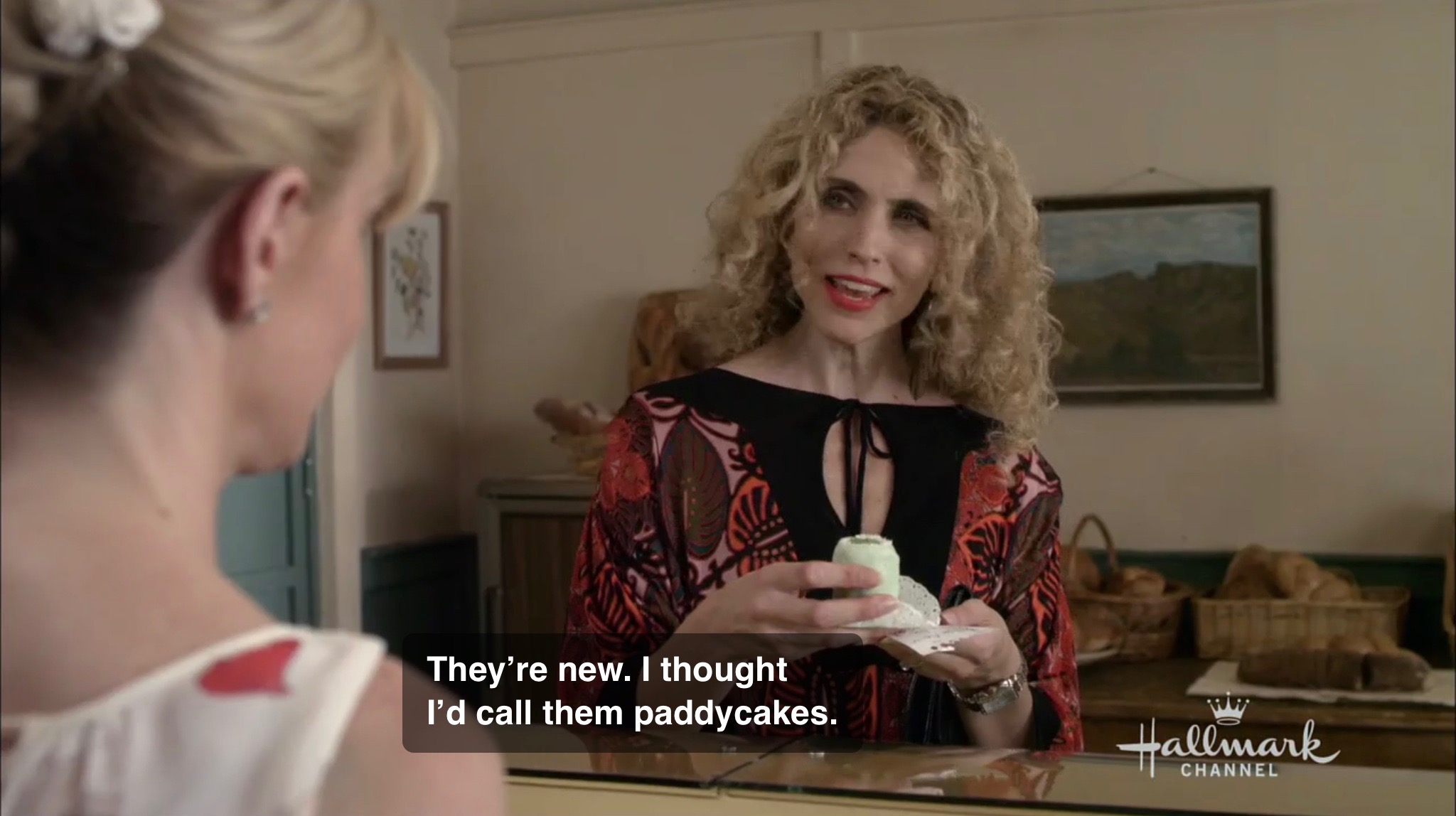
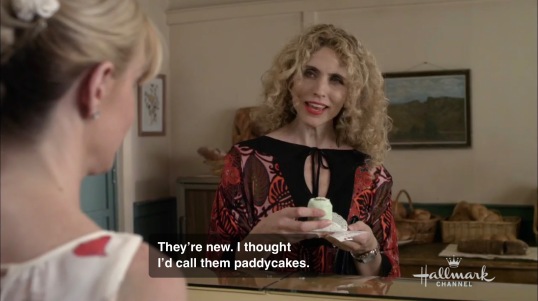
Now out of nowhere she is suddenly making these lovely little pastries that will be called Paddycakes after her father Paddy even though only a few minutes ago she was a disaster in the kitchen. Yes, these paddycakes will be the savior of the bakery. That’s because of this lady.
IMG_7271

She is very impressed, and of course will turn out to be a newspaper writer later on.

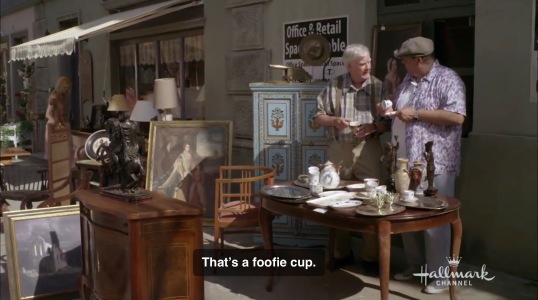
After stupid dancing and shtick, the lawyer shows up again to remind us he really is the only character we enjoy in this movie. Oh, but before that we need to get in another homophobic bit.
IMG_7285

At least the guy says he knows but still likes coffee in a cup like that to which the father responds, “good grief”. The rich guy again shows up to get her phone number and the instant she says he still can’t call her, he just walks away.

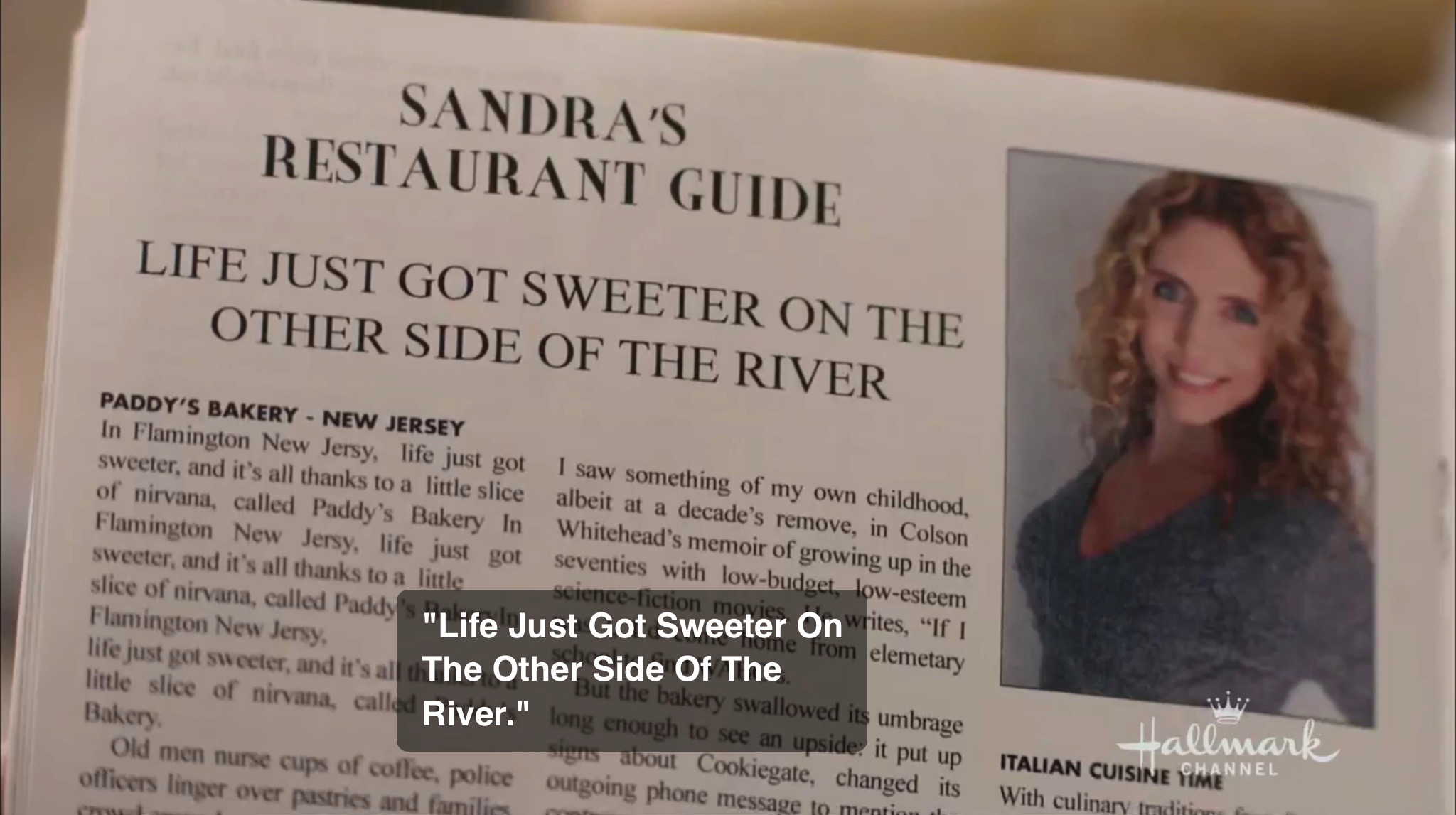
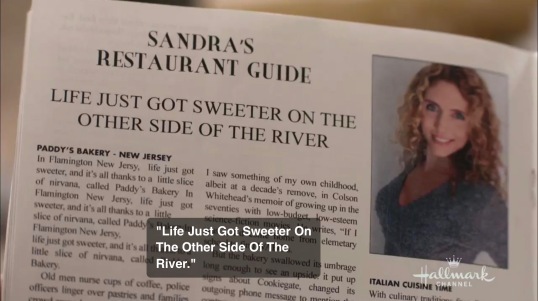
When the lawyer shows up, the joint is apparently doing really well now. Those must be some paddycakes. A few scenes, then the article comes out in the newspaper! Just look!
IMG_7357

The bakery is so great that it had to repeat “In Flamington New Jersy, life just got sweeter, and it’s all thanks to a little slice of nirvana, called Paddy’s Bakery” three times! But what is the rest of the article here? I’m telling you, Darcy from A Gift Of Miracles is everywhere and she can shapeshift into other people too.

-The “Old men nurse cups of coffee, police officers linger over pastries and families…” come from a New York Times article by Rebecca Flint Marx.

-The “I saw something of my own childhood, albeit a decade’s remove, in Colson Whitehead’s memoir of growing up in the seventies with low-budget, low-esteem science-fiction movies. He writes, ‘If I was lucky, I’d come home from elementary school to find WABC’s…” comes from a New Yorker article written by Richard Brody.

-The “But the bakery swallowed its umbrage long enough to see an upside: it put up signs about Cookiegate, changed its outgoing phone message to mention…” comes from a New York Times article by Michael Barbaro.

The second one makes sense…sort of…since the magazine the article is in is supposed to be The New Yorker.

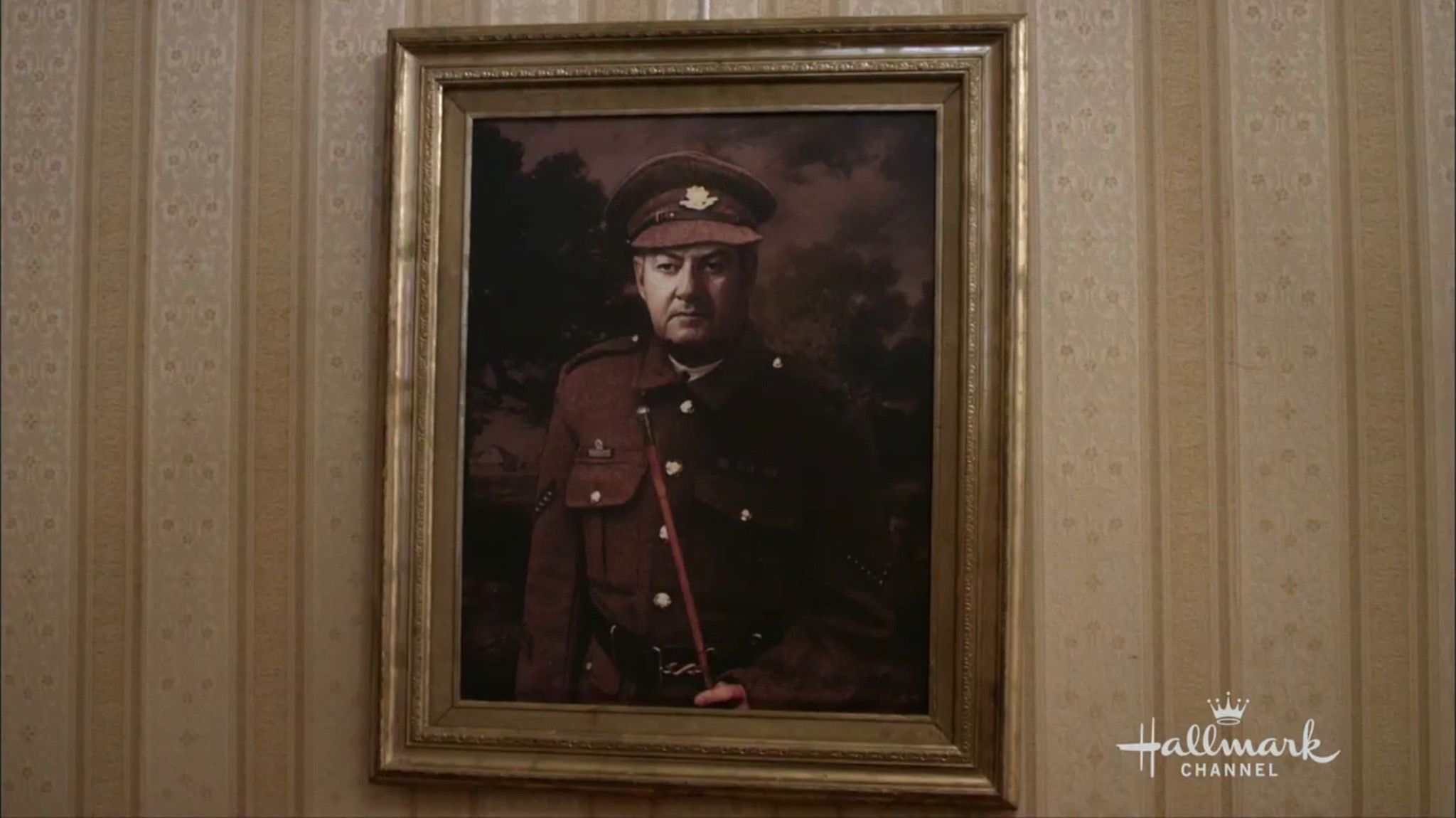
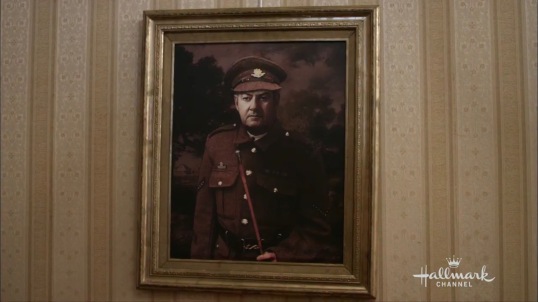
Now it’s off to dinner with Benny. She even fixed his birdhouse. This is when something weird happens yet again. Her and Benny are going down a hallway to have some privacy when she notices an open door with an office inside. He quickly closes it saying she doesn’t want to look at it which she responds with an odd “okay”. Now we find out for sure he’s single. Then they make out. Now she notices this painting as she is pinned against the wall being kissed.
IMG_7402

He says it’s his great uncle. What was all that about? Is this supposed to imply his family was involved with the Nazis via the Vichy regime? I don’t really recognize the uniform. What was the point of the office and painting? It doesn’t make sense and is never brought up again.

After we have a stupid conversation about waiting three days before calling up Benny, the lawyer calls to tell her he has a deal to “franchise the bakery”. The father just sends her. Doesn’t come along at all. I know I can’t possibly get this across, but the movie really hasn’t given us any reason for this. He even corrects her when she says it’s not his bakery, but their bakery. Then doesn’t that mean he should be there even more? I know it’s supposed to show he trusts his daughter, but we don’t have any real reason too as the audience.

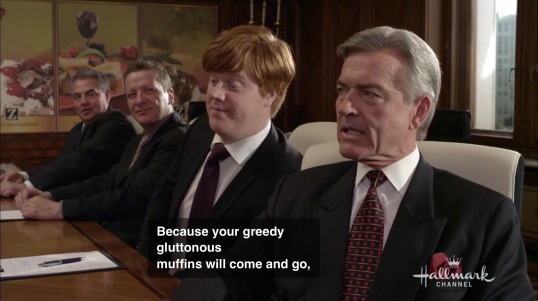
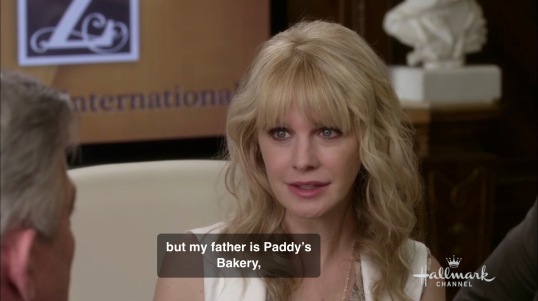
Of course big city folks meddling in small businesses are usually portrayed as evil, so she turns down their deal.
IMG_7482

IMG_7483

You’ll have to take my word for it, but these are the only lines in this that she delivers that are done right. They make sense, we feel that she really believes in what she is saying, and we finally see some believable change in her character. Why couldn’t this have been going on throughout the movie? I don’t get it.

She goes home when the husband shows up. No reason given for why he shows up other than that Olive dumped him and the pregnancy was fake. That’s nice, but the only thing we saw Desiree do prior to being dumped is spend his money in the short time we spent with her prior to the breakup and we could hardly stand her afterwards. Again, it doesn’t make sense. We just are supposed to believe from their really short little exchange that she brought something to the marriage that he would want back. Just a simple scene where we at least see her being used as a trophy wife would have gone a long way.

Obviously she shuts him out, she winds up with Benny, the lawyer shows up with the policewoman from earlier, they dance out the door of the bakery, Desiree and Benny kiss, etc.

This movie sucked. Plain and simple. In the end, she has changed, but it’s too late at that point. Go watch Clueless or Harvest Moon instead.

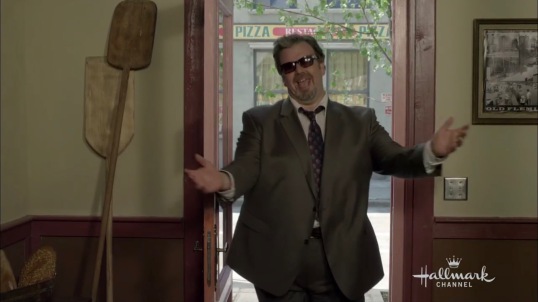
Now a tribute to the best character in the entire film: the lawyer played by Steve Varnom.
IMG_7571

Blast From the Past: A Day In The Death of Donny B (dir by Carl Fick)


Just a few hours earlier, I was going through my DVR and I discovered that I had recorded, off of TCM, a film called A Day In The Death of Donny B.  That title immediately caught my attention (and I imagine that the title is probably what inspired me to record the film in the first place).  A Day In The Death of Donny B sounds like the title of something that would have come out of Andy Warhol’s Factory in the late 60s, maybe starring Joe Dallesandro as Donny B and Edie Sedgwick as herself.

So, of course, I simply had to watch it to discover just who Donny B was and how many days it would take him to die.  Add to that, I also noticed that the film only lasted 15 minutes, making it the perfect viewing experience for someone, like me, who has absolutely no attention span.

Anyway, I watched it and I discovered that it’s not a Warhol film.  However, it was filmed in 1969 and it contains a lot of cinéma vérité-style footage of the slums of New York City, which means that it takrd place in roughly the same world as some of Warhol’s films.  It turns out that The Death of Donny B was produced by the Substance Abuse and Mental Health Services Administration.  It’s an anti-drug film, obviously designed to speak to young and black audiences.

The film follows an African-American addict named Donny B as he wanders through the shadows of New York City and tries to scrounge up enough money to buy heroin.  While we watch him go about his day, we listen to voice overs from former addicts and some of Donny’s family members.  They all agree that Donny is basically a huge loser.  Donny B. is credited as playing himself and he has a definite screen presence, even if he looks a bit too healthy for someone who, we’re told, shoots heroin several times a day.

The film itself is shot in harshly beautiful black-and-white and the soundtrack features a droning song (credited to someone named Harry Holt) that, for the most part, consists lyrically of: “It’s a day in the death of Donny B…” and trust me, that song will get stuck in your head.  Today, of course, the main appeal of The Death of Donny B is that it’s a time capsule of when it was made.  For those of us who might be curious as to what New York was like back in the dangerous 1960s, The Death of Donny B is our time machine.

And you can watch it below!

And if you happen to be Donny B, leave a comment below because we would love to hear from you!

Hallmark Review: Flower Shop Mystery: Mum’s the Word (2016, dir. Bradley Walsh)


IMG_5812

And look at all those American flags!!! Wow! I had no idea that North Bay, Ontario, Canada had a United States appreciation day where they take down all the Canadian flags that normally line the street to put up Old Glory. Actually, the city behind the title card is Littleton, New Hampshire, but the movie was done in North Bay, Ontario, Canada. However, they did take down the Canadian flags that normally line that city’s Main Street. Unfortunately, I don’t know the city they show just before the title card. Only so much I can do.

This time it was really easy to figure out. While they do make sure the license plates are Illinois…

IMG_6607

and American flags are even in the windows of motels…

IMG_5911

they left plenty of local business names just lying around.

IMG_5990 (1)

IMG_5815

They even directly reference this coffee house and it really exists on 473 Fraser Street North Bay, Ontario.

IMG_6264

Figuring out Littleton, New Hampshire goes to the Hunkins & Eaton Insurance Agency, Inc. sign that just barely shows for a second before the camera pans up to the shot at the beginning of this review.

With that out of the way for now. This is Hallmark’s new mystery series. It takes place in the small town of New Chapel, Illinois, which is only about 4,000 km by car from Eden Lake, Minnesota where Hannah Swenson runs her bakery.

It starts off by introducing us to a dead man walking named Elvis. Abby Knight, played by Brooke Shields, once knew the man who has since run on hard times.

IMG_5822

After speaking in exposition dialog to introduce us to her, the flower shop called Bloomers, and her employee, Brooke sits down to have a talk with her daughter. A daughter who, I kid you not, is attending Mills College. Mills College which, according to Brooke’s flower shop friend, is “far enough away to live on campus, but close enough for Mom to drop in.” I had no idea Mills College had moved from the Bay Area to near Illinois, Ontario, Canada.

IMG_5850

Oh, and just in case we thought she was on vacation and not in the middle of classes.

IMG_5855

This scene only exists to tell us that Brooke used to be a lawyer, but stopped when her husband died and opened a flower shop instead because “none of it just seemed as important.” In other words, her husband died so that the character will be able to be a detective and Beth Davenport from The Rockford Files at the same time. Works out because her neighbor Marco Salvare, played by Brennan Elliott, shows up next at the flower shop. He owns a bar and was a PI. Oh, and Brooke’s car got hit by another car that may have been involved with the murder that happens soon.

And by soon, I mean now. Someone turns up dead at the Canadian American flag waving motel, Elvis is a suspect, and Brooke and Brennan are on the case. Not for any real good reason. They are really just busy body snoops, which is one of the reasons I kind of like this series already. Normally that would drive me nuts, but it makes them made for each other in this series. I liked that.

With Brooke on the case, she goes on her iPad to read a screenshot of a newspaper article about the murder, which apparently took place on November 2nd, 2016.

IMG_5944

Then she goes to the family album of her photos on the iPad where we see a picture of her husband who may have died the day before during a fishing trip. Either that or she only got around to importing her family photos onto her tablet the day before on November 1st, 2016.

IMG_5947

Next we are introduced to this series’ version of Norman from Murder, She Baked, but he barely exists in this movie. Then there’s a little girl talk back at the flower shop that I’m pretty sure has no customers that come into it. This is followed by a scene where Brooke sits down with a woman who wants a divorce so that we make sure we still remember she was a lawyer. Oh, and something plot related about a Green Thumb Nursery. I couldn’t care less about the plot because just like watching The Big Sleep (1946), you are watching for the Brooke and Brennan back and forth, not the plot. Also, Beau Bridges is in this as a sounding board and in case we need more exposition. Whatever is needed, you can count on Beau. I mean the man got the scroll weapon and he almost beat mega turtle at the end of level three in Teenage Mutant Ninja Turtles for the NES back in 1989. He can do anything.

Time to hit the “Internet” running locally at file:///C:/Users/Mike/Desktop/sc20-Chicago-GreenTumb/results1.html AKA ExploreNet to look up the Green Thumb Nursery.

IMG_6027

The local URL’s keep popping up in the lower left hand corner as a tooltip while she continues to browse the local filesystem for info on the nursery. I wonder who this Mike is? Did she take actor Michael Vincent Dagostino’s laptop? He plays a detective in the movie.

Anyhow, after Brooke reminds us again she was once a lawyer, she walks pass some street signs to make sure we know this shot took place at the intersection of McIntyre Street and Plouffle Street.

IMG_6057 (1)

Then Brooke and Brennan visit the Green Thumb Nursery to forward the plot and have some more back and forth. Might as well mention now that Brooke has some weird pseudo-feminist lines in this. You know those lines somebody who thinks they are a feminist, but really are just looking for any excuse to pick a fight over say. There’s only a couple of them, but it’s kind of weird. Maybe she can argue with Calista Flockhart about the semantics of calling her Supergirl.

Now they go on a stakeout! By that I mean they have some humorous lines and talk in exposition dialog. Who cares! All you need to know is that with a little more work they could be fun as a mystery solving couple in this franchise. And no, despite being written by Gary Goldstein, there will be no mention of Brooke’s feet. More plot and dead flowers left for Brooke, then finally Elvis is charged with second degree murder.

Plot, plot, plot. Nursery looks awfully shady and we know that’s where the mystery is going to lead us. Now Brooke and Flower Shop Norman take a trip to Partners Billards & Bowling Center on 361 Main St East.

IMG_6442 (1)

After more talking between characters, an inspector shows up and shuts down Brooke’s flower shop. Now it’s personal! I know this because I have almost run out of screenshots. Luckily, I have two more funny things to show before I close up this review. Also, Elvis is found hung dead in his cell. Winding down now.

At the nursery, Brooke noticed that one of the guys carried a gun. She asked him why and he gave a lame answer. No joke, I immediately said to my Dad that he should have said that they carry rare orchids and people try to steal them. So of course she figures out that an orchid bulb is hidden inside a pot of Mum flowers. Yep. This is also when Hallmark popped up to tell us that if we don’t like this series then not to worry cause it can go the way of Wedding Planner Mystery if necessary.

IMG_6619

And now the final goof, and it’s a whopper. She goes online to read an article about expensive orchids. Take a good look.

IMG_6621 (1)

IMG_6623

And here are the excerpts taken to make that article from an SF Gate article from 1995 by staff writer Jim Doyle:

“U.S. inspectors broke the Kolopaking case in 1993, when they discovered he had sent 60 boxes of rare orchids into the United States via the West Coast clearinghouse for international mail in Oakland.”

“Fisher said the biggest threat to orchids is loss of habitat: Each year, millions of acres of rain forest, where billions of orchids live, are cut or burned down for mining, timber, farming and development.

He added that orchids taken from the wild are now growing in greenhouses and new plants including hybrids are made from them. ‘There are a lot of species in greenhouses that don’t exist in the wild any more due to habitat loss.’

Law enforcement officials insist that smuggling can hasten the death of a species. They contend that over-collection often takes place when a rare orchid’s habitat is nearly destroyed.”

I think Brooke Shields should contact Brooke Burns of the SFPD. Her and The Gourmet Detective should get right on this. This clearly means that Darcy from A Gift Of Miracles who plagiarized her PhD research pitch from an actual WWF report was writing under the pseudonym of Samson O’Doyle three years before the events of that film.

Obviously Brooke does figure it all out and brings the criminals to justice. The mystery is okay at best. It’s not too difficult to follow. Take the fact that the majority of this review is made up of jokes to tell you how enthralling the plot is. There’s a fair amount of setup here so don’t expect to escape a lot of those types of scenes and the exposition dialog that comes with them. The promise here is the stuff between Brooke Shields and Brennan Elliott. I really have a feeling this one is heading for the same bin as My Gal Sunday, Wedding Planner Mystery, and The Mystery Cruise, but if not, then I hope they really polish up the dialog and just drop the unnecessary extra guy. That kind of works on Murder, She Baked, but here I didn’t feel it added anything. Just have Abby and Marco hook up so we can enjoy them being screwball comedy murder mystery solvers. Otherwise, I am not looking forward to a poor man’s Murder, She Baked with touches of The Gourmet Detective.

Remembering Chuck Wepner: The Real Rocky (2011, directed by Jeff Feuerzeig)


The Real RockyDuring his professional boxing career, Chuck Wepner had more than a few nicknames.  Some people called him “The Bayonne Brawler,” because he was from Bayonne, New Jersey and he was a street fighter.  After a 1970 loss to Sonny Liston, Wepner became known as “The Bayonne Bleeder” because of the amount of blood that he shed in the ring.  However, after 1976, most people knew Chuck Wepner as “the real Rocky.”

In 1975, the largely unknown and little-regarded Chuck Wepner was given the opportunity to challenge Muhammad Ali for the world’s Heavyweight title.  For the fight, Ali was paid $1.5 million while Wepner received only $10,000.  For Ali, it was supposed to be an easy title defense.  For Wepner, it was not only his biggest payday but also his chance to prove that he belonged in the ring with the champ.

During the fight, Wepner shocked everyone by holding his own.  In the ninth round, Wepner knocked Ali down and it briefly looked as if the Bayonne Bleeder was about to become the world’s Heavyweight champion.  Returning to his corner, Wepner told his manager, “Start the car. We’re going to the bank. We are millionaires!”

His manager replied, “You better turn around.  He’s getting back up and he looks pissed off.”

When Ali got back on his feet, he came at Wepner with everything he had.  Despite getting decisively outboxed and getting his nose broken during the final rounds, Wepner still went 15 rounds with Ali before the referee stopped the fight and declared Ali to be the winner by technical knockout.

CW

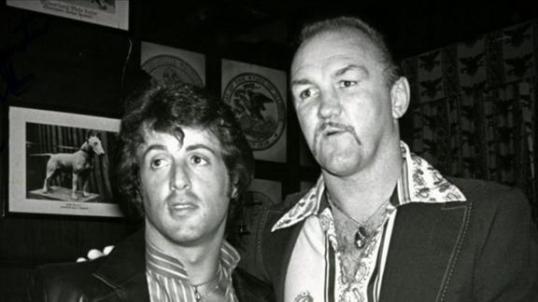
Sitting in a bar and watching the Ali/Wepner fight was a struggling actor named Sylvester Stallone.  A few days after the fight, Stallone wrote the first draft of his screenplay for Rocky and the rest is history.  However, when Wepner would later try to get paid for inspiring one of the biggest box office hits of all time, Stallone claimed that Wepner had not provided any inspiration at all.  Eventually, Wepner took Stallone to court and the case was settled for an undisclosed account.

ESPN Film’s The Real Rocky is an hour-long documentary about Chuck Wepner and his life both before and after Rocky.  Featuring extensive interviews with Wepner himself and a group of veteran boxing journalists, The Real Rocky attempts to answer the two questions that haunt Wepner’s career: Was Chuck Wepner the real Rocky and did Wepner really knock down Muhammad Ali?

After the fight, Muhammad Ali claimed that Wepner did not knock him down but instead that Wepner had tripped him.  In the documentary, Wepner continues to insist that he did knock Ali down and even says that, if asked, Ali will back him up.  However, the documentary features a close-up of a photo that appears to show Wepner throwing a punch while standing on Ali’s foot, which would mean that Ali was right and Wepner did trip him.  The Bayonne Bleeder knocking down Muhammad Ali is a great story but it probably did not happen.

As for whether or not Wepner was the real Rocky, the documentary leaves little doubt that he was.  Along with the obvious parallels between Wepner vs. Ali and Balboa vs. Creed, the documentary reveals that Wepner later fought an exhibition match with wrestler Andre the Giant, a match that was later recreated in Rocky III.  Even after the first movie, Stallone was still borrowing from Wepner’s life.

chuck_03

After his retirement from the ring, Wepner struggled with drug addiction and briefly did some time in prison.  In the documentary’s most bittersweet moment, Wepner talks about being locked up in East Jersey State Prison, just to discover that Stallone was also at the prison, shooting a movie where he played a prisoner.  After being released, Wepner went back to his job as a liquor salesman, a job that he still holds today.

The Real Rocky is an engrossing documentary that allows Wepner to tell his story in his own words.  With Stallone on the verge of winning an Oscar for his latest (and probaly) last performance as Rocky Balboa, now is a great time to watch this documentary and spare a few thoughts for the real Rocky, Chuck Wepner.

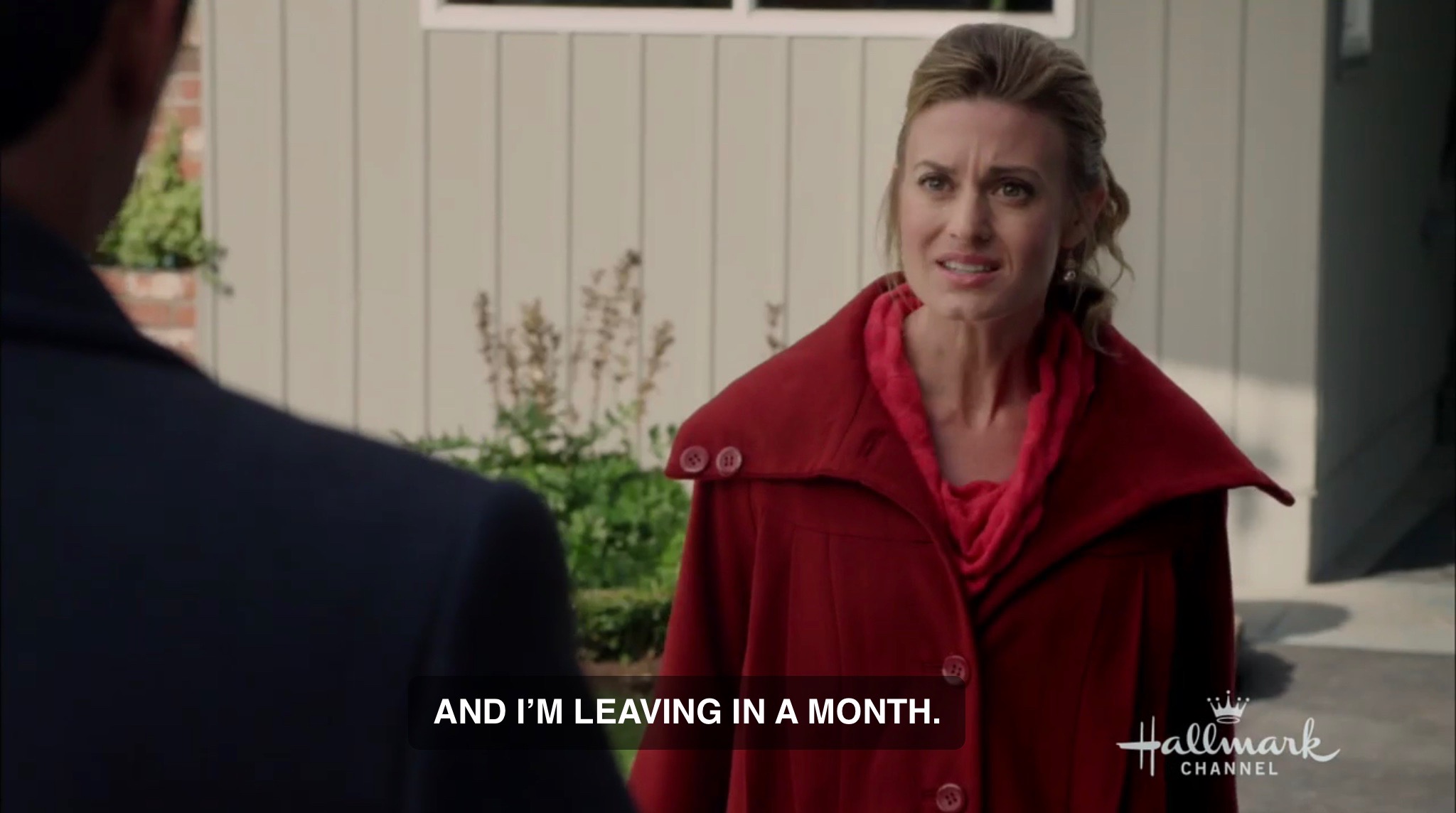
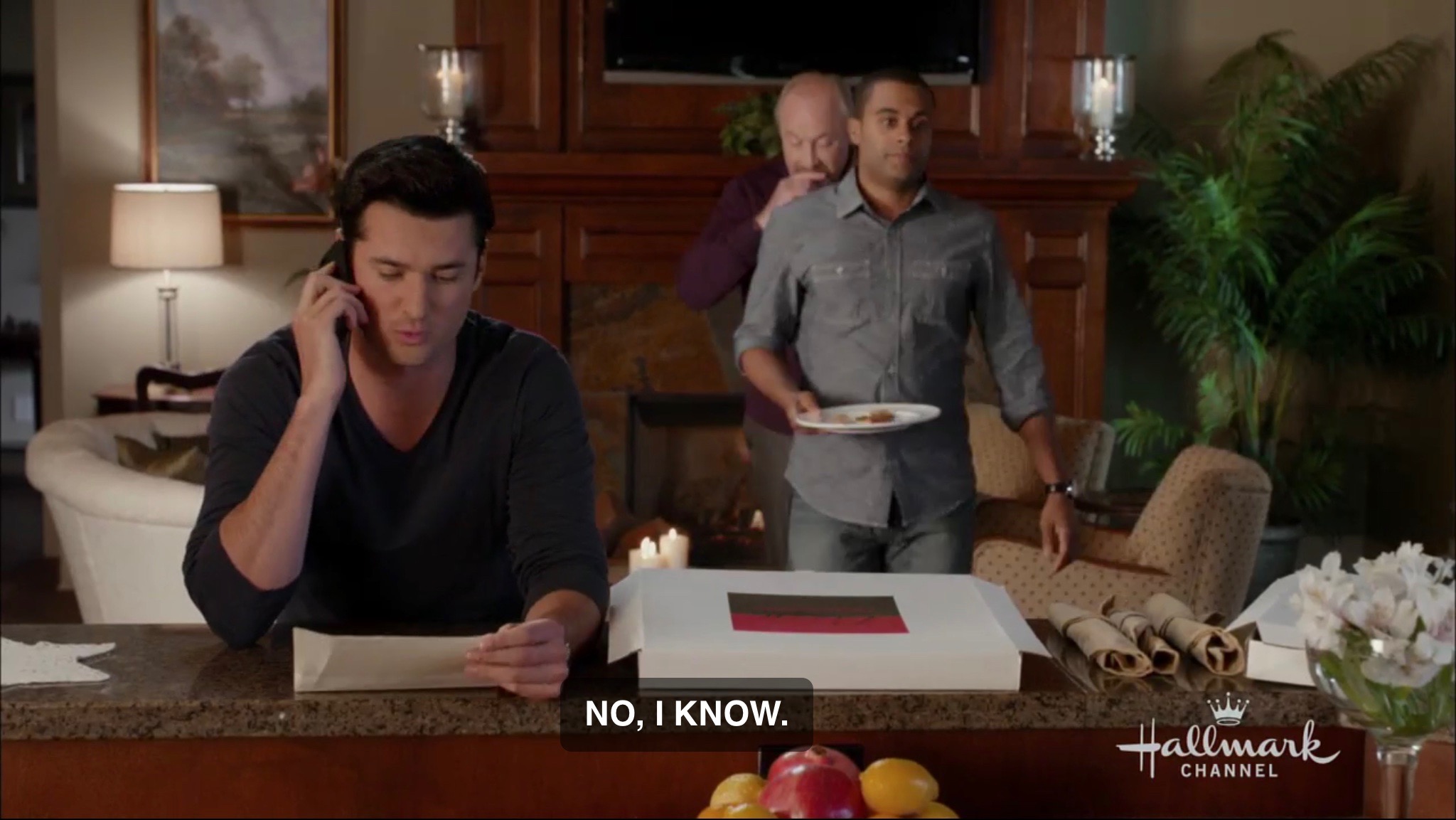
Hallmark Review: June in January (2014, dir. Mark Griffiths)


IMG_4327

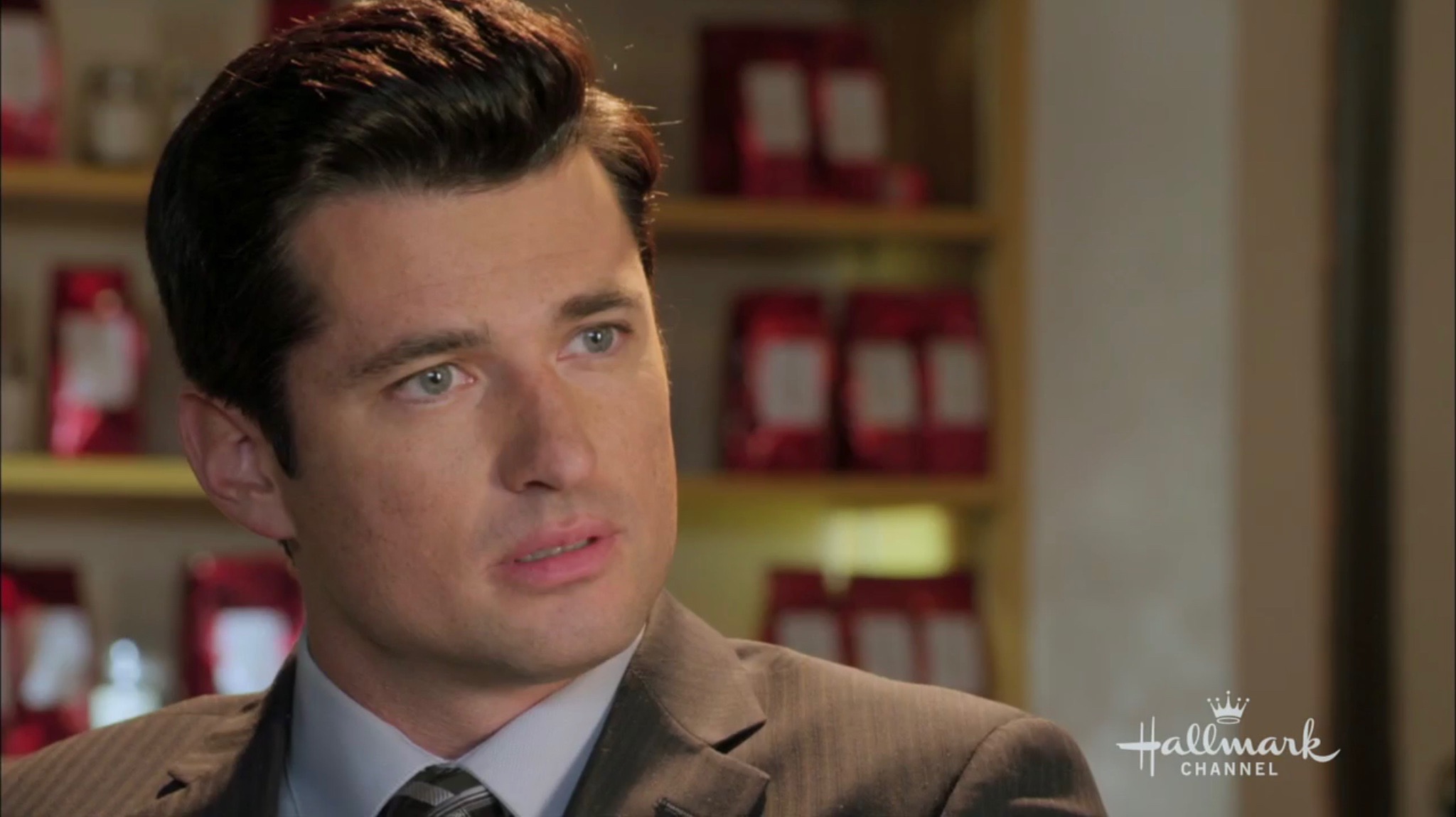
I doubt that people who read my Late Night Cable reviews are the same people who read my Hallmark reviews, but there’s a connection here. There’s an actor named Frankie Cullen who is in a bunch of the movies that wind up on late night cable. The thing is he’s too good for those movies. He really isn’t a bad actor at all and usually raises the quality of the movie by being in them. June in January is the second Hallmark movie i’ve seen with actor Wes Brown and he also raises the quality of the movie just by being in it. I also saw him in Love Under The Stars where he always conveyed a deep sadness and concern for his daughter simply without saying a word. In fact, his words were usually upbeat, but he always made sure we knew what was going on underneath without spelling it out for us. He does that kind of thing in this movie too. Just like Frankie Cullen, Wes Brown is too good for these movies in my opinion.

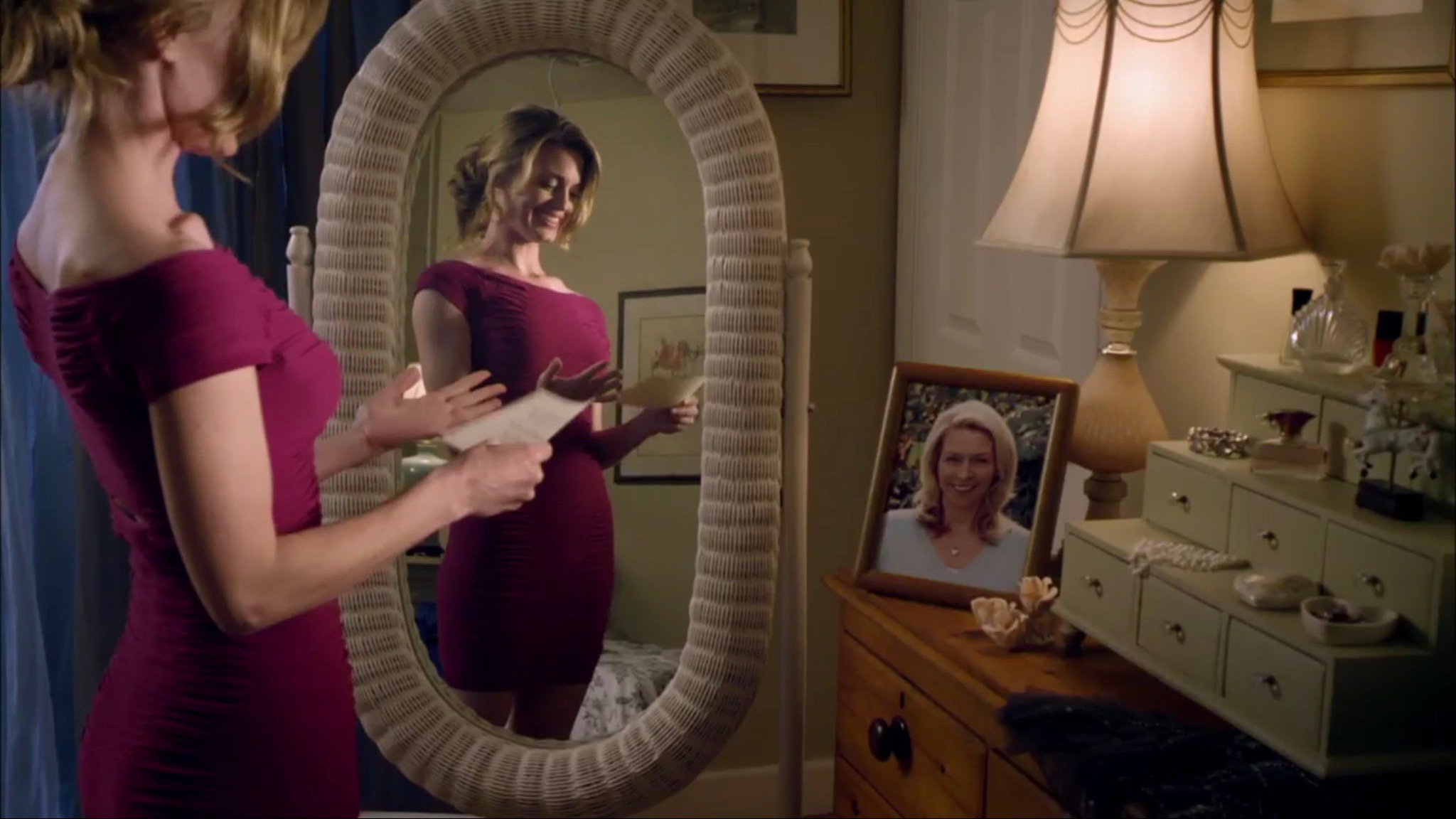
This is also the second film i’ve seen with actress Brooke D’Orsay and she is pretty good here too just like she was in How To Fall In Love. She is possibly one of the few actors i’ve seen on Hallmark that can play against type. She naturally fits the irresponsible ditz, but is good enough to convincingly play other characters despite what her appearance tells us she should be. How To Fall In Love was also directed by Mark Griffiths.

With that out of the way, we start off the movie with D’Orsay and Brown getting ready to go somewhere seeing as they are dressing up. They are doing it in two different places. And as usual the woman in the movie tries on several dresses and always goes with a dress I don’t like.

IMG_4335

Oh, and that’s her mom who was frozen in the picture by evil witches and can only be released when her daughter has the perfect wedding. Just kidding, it’s her dead mom who will be a guiding spirit for D’Orsay through voiceover and flashbacks. Now D’Orsay and Brown go to a party and D’Orsay feels out of place because these are upper-crust people and she’s just a lowly nurse practitioner. Those non practitioner nurses are even worse. They just always sat around doing nothing on ER all the time. Someone actually left a review on IMDb complaining how this film bashes nurse practitioners and more specifically regular nurses even though the villains of the movie say it, but she stands up for herself and we see her helping people in her job.

This is when a Hallmark banner popped up to tell me they have a cannibalism related Valentine’s Day movie coming in February.

IMG_4340

Should be more interesting than The Cabin (2011) which I did watch, but since it didn’t have the Hallmark seal on it before the title card, among other things, I don’t think it is a real Hallmark movie and won’t be reviewing it. Also, it was pretty lousy and felt edited.

Anyways, we now meet Brown’s parents.

IMG_4353

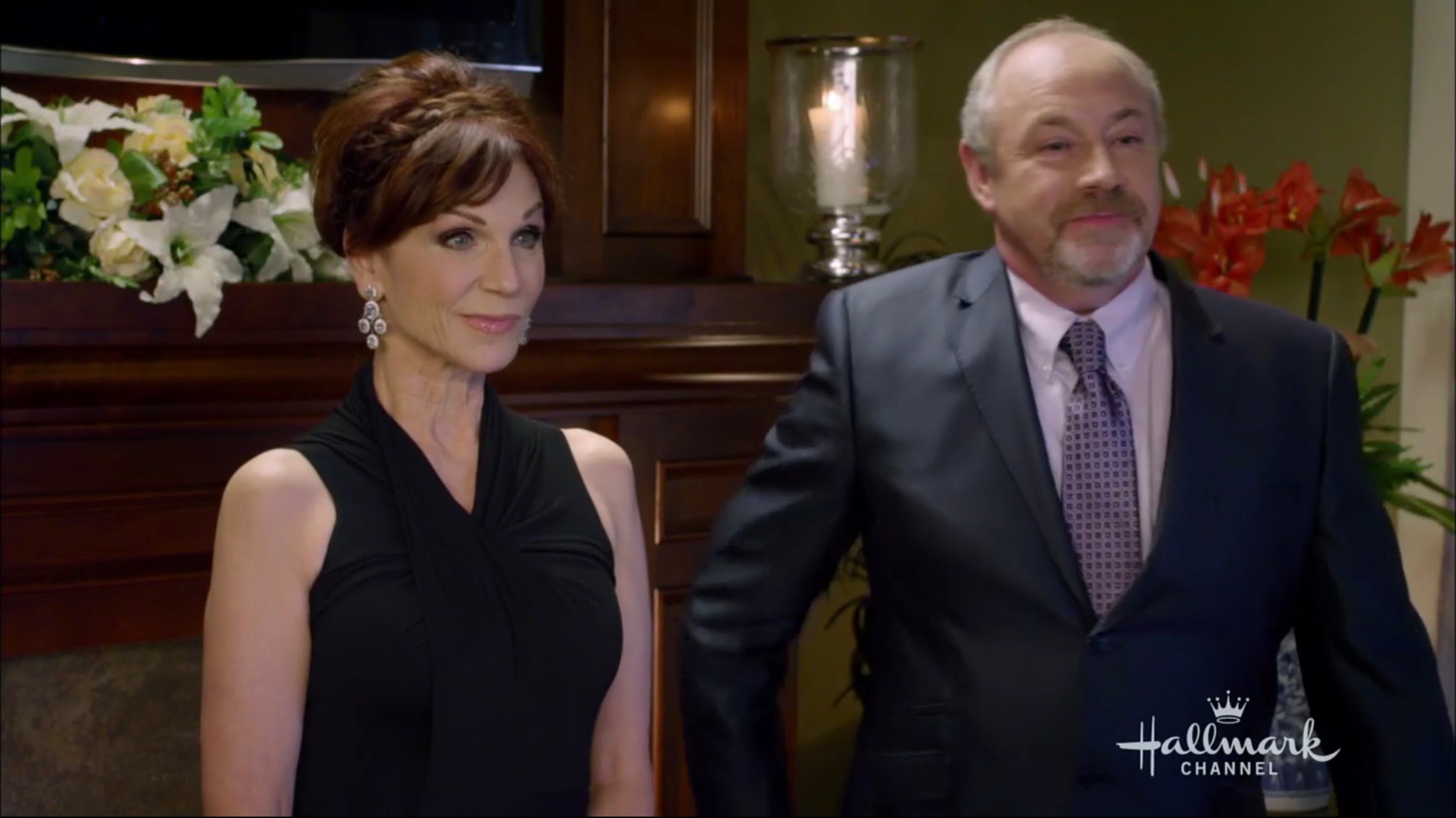
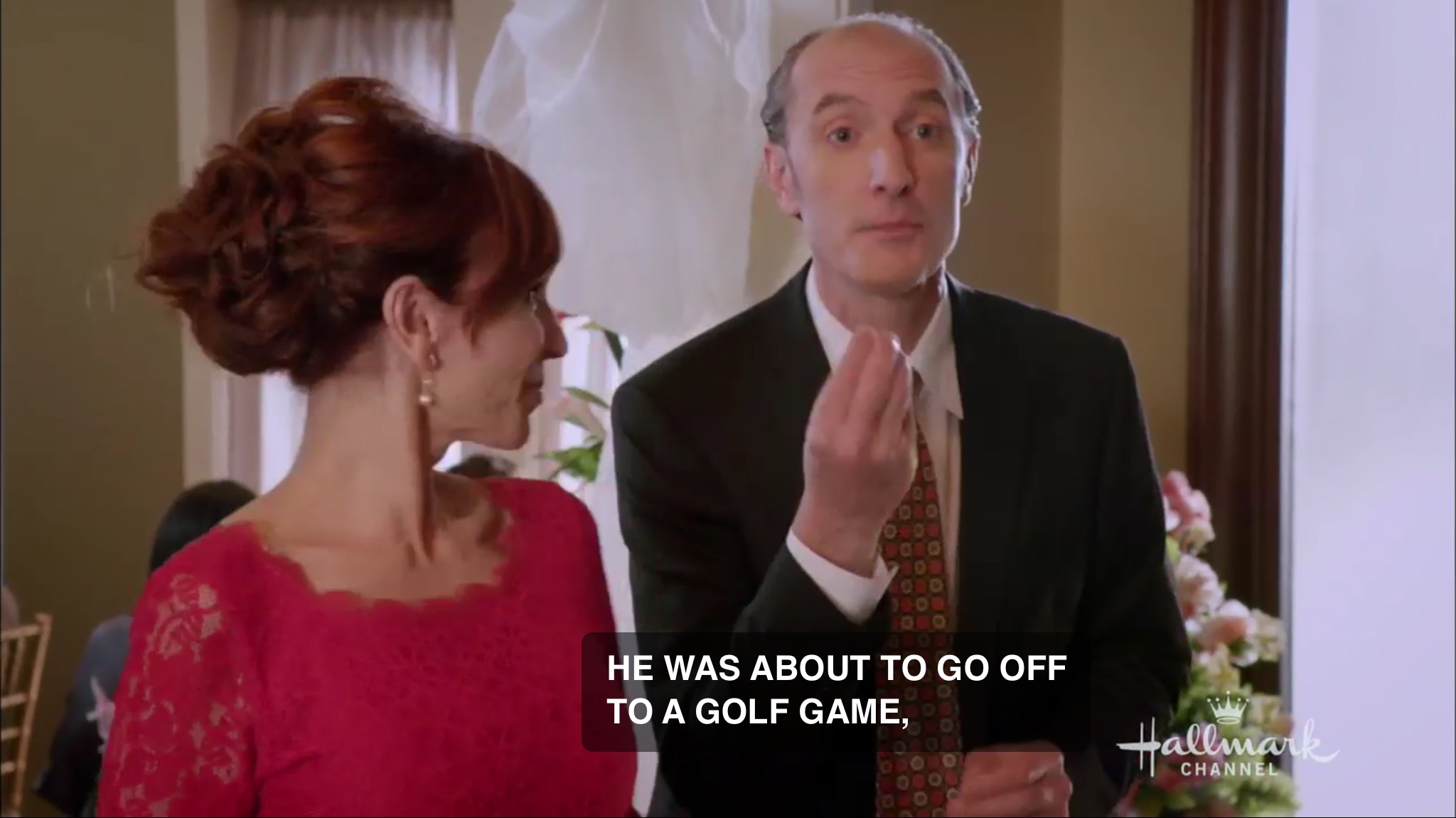
That’s Marilu Henner who will be our Jaclyn Smith from Bridal Wave for this film. D’Orsay is always nervous around her because she feels like she’s always “auditioning for her.”

Meanwhile, this guy is eating a pizza in a bedroom.

IMG_4360

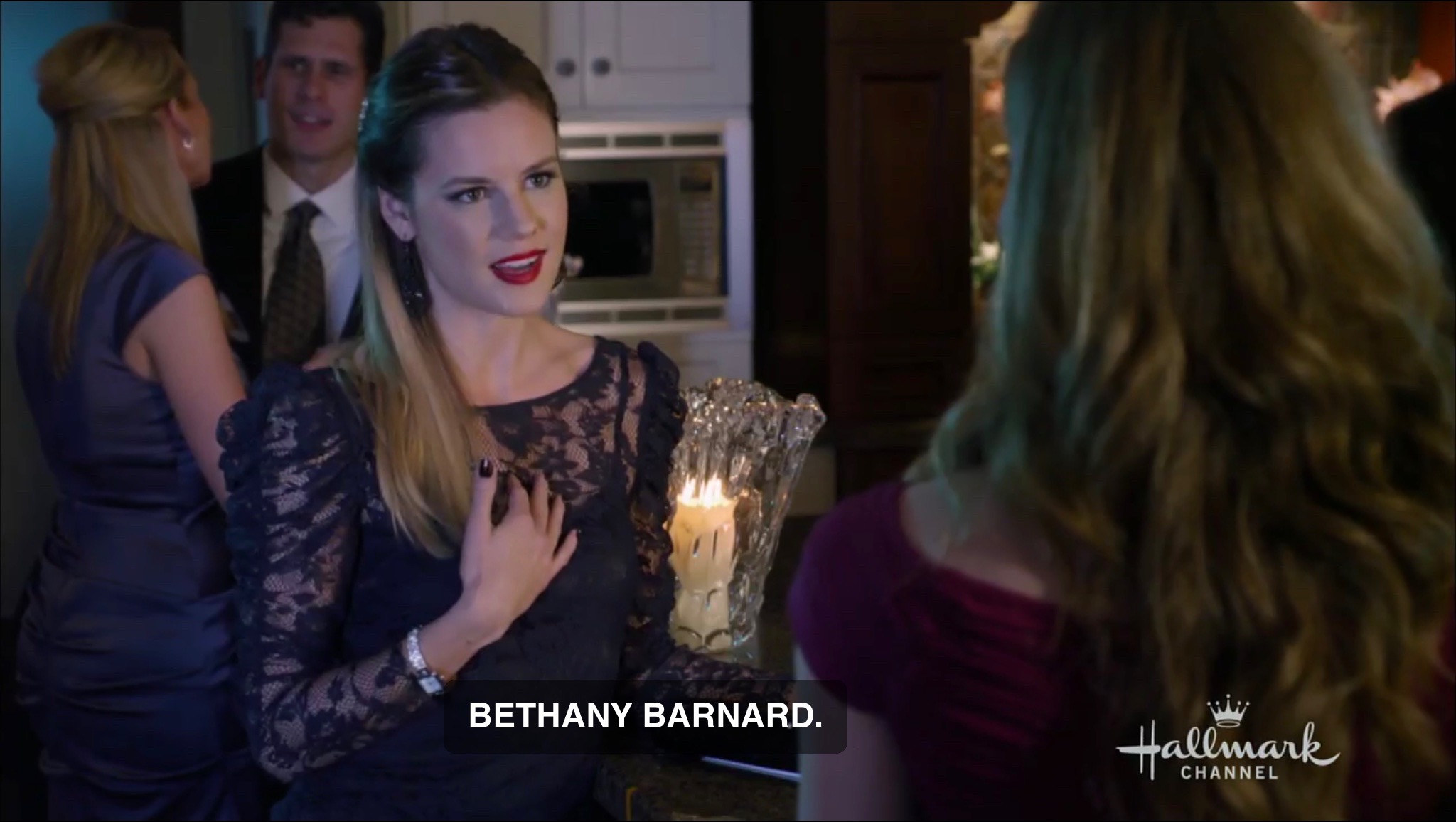
Back at the party, we meet the bitch played by Chelsea Hobbs.

IMG_4369

She just by coincidence also played the bitch in The Nine Lives Of Christmas. Yes, that is the best word to use. Even my Mom who has become rather conservative about cursing as of late started referring to her as such near the end of the film.

IMG_8178

The Nine Lives Of Christmas (2014, dir. Mark Jean)

Also by coincidence, this movie was shot in Fort Langley, British Columbia, Canada just like The Nine Lives Of Christmas. I know that because of this shot.

IMG_5156

What’s hilarious is that if you go to Google Maps Street View right now that building has a big Canadian flag hanging from it.

Anyways, after D’Orsay squats…

IMG_4423

she pulls out a book complete with her dream wedding flowers in it and a flashback to her talking with her mother. Then D’Orsay comes out to show her father herself wearing her mother’s wedding dress. This is probably as good a time as any to tell you that the father’s are both really decent guys in this movie.

Then we cut to D’Orsay at work to see just how damn incompetent nurse practitioners are when she is able to help a man who turns out to have Seasonal Affective Disorder without having to consult a doctor. Totally useless I tell you.

After a few things that are just there to remind us of the importance of their wedding, Brown drops a bomb on D’Orsay. He tells her that he’s actually named Luke McDonald and is a member of an anti-vampire church.

IMG_4500

Actually he’s there to tell her that since her character’s name is June and the film is called June in January, they are going to have to move to Cleveland for a new job he just received and have the wedding now in January. Why they couldn’t move to Cleveland and still have the wedding in June, I have no idea. Luckily, this is not a Hallmark movie that sends the message that her having her dream wedding is more important than marrying someone she loves. That’s extremely refreshing.

Meanwhile, the bitch has been assigned by Marilu Henner to do something about the upcoming wedding. Got to admit, I really thought she was Brown’s sister until late in the movie where she states she is just a friend of the family and works for Henner at her “design” business. Then Brown and D’Orsay check out some of the worst places possible to hold a reception…

IMG_4569

before settling on having the ceremony at Marilu Henner’s place. I say both reception and ceremony in there because while we do see the ceremony at the house in the end, but the places they visit look like where you would hold a reception so I’m not really sure.

Now it’s time to go back to find out that D’Orsay somehow, i’m sure by complete luck, cured the poor guy who was suffering from Seasonal Affective Disorder. Believe it or not, that is one of those things that is terrible to have, but is surprisingly easy to fix. Simply having a special light bulb shine on you for a certain amount of time each day stops it. Rather remarkable. He will actually repay her by saving the day at the end of the film.

Oh, and it’s discovering I have taken screenshots like this that make writing these reviews for you worth it.

IMG_4653

No idea what was going on here.

At this point, the film kind of goes on autopilot. You have D’Orsay starting to panic, but quickly realizing that it’s marrying someone she loves that makes the wedding special. Her mother even left a note after her death for D’Orsay to make sure she remembers that. The fathers do there part to comfort D’Orsay and bring Henner down to Earth. Oh, and this happens.

IMG_4924

IMG_4939

During this scene the bitch tries one last attempt to ruin the marriage by telling Brown that she has a crush on him. Look at Brown’s face. Without saying a word he could have simply gotten up and left and we would have completely understood his feelings on what she was saying. Surprise followed by disgust followed by sheer amazement that she would actually stoop this low. I’m surprised they actually had him say anything. Brown is good enough with his acting to convey everything with his face and body language. And a prenup gets thrown in at the last minute, but that goes nowhere just like any of the normal Hallmark speed bumps which just lead the characters to a better understanding of their love for each other rather than stupid panic.

But the bitch has one last trick up her sleeve after being fired by Henner. She tells the revered that the wedding is off so he won’t show up for the ceremony. However…

IMG_5198

that guy who D’Orsay cured by pure chance has a friend who can marry them and they live happily ever after.

IMG_5256

My summary thoughts on the movie are as these: It’s one of the best Hallmark movies i’ve watched especially considering it’s just about a rushed wedding, Wes Brown is a good actor, D’Orsay is no slouch herself, nurse practitioners and regular nurses deserve a lot of respect, and I carried that one joke on way too long.

Note: I’m aware that the IMDb reviewer’s main point was that the film can appear like it’s saying you have to be a nurse practitioner instead of a regular nurse in order to be taken seriously. I get the same impression from people when I tell them i’m transgender, but not on hormones so I can understand why it bothered her. My jokes still stand though because my point is that it’s ridiculous to look down on nurses as if they aren’t to be taken seriously and the film never really does that.

In Praise of Alan Rickman: The January Man (1989, directed by Pat O’Connor)


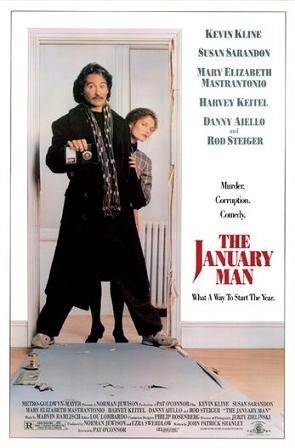
JanuarymanposterLast week, when the world first learned of the death of the actor Alan Rickman, it was shocking to realize just how many great roles he had played.  He made his feature film debut as Hans Gruber in Die Hard.  He played Colonel Brandon in Sense and Sensibility, Severus Snape in the Harry Potter movies, the Sheriff of Nottingham in Robin Hood: Prince of Thieves, Hilly Kristal in CGBG and Marvin the Paranoid Android in Hitchhiker’s Guide to the Galaxy.  He even played Leonard Nimoy Alexander Dane in Galaxy Quest.  But the first time I ever saw Alan Rickman, he was playing Ed the Painter in The January Man.

As The January Man begins, the new year is barely a day old and already Manhattan is in a panic.  Over the past 11 months, a serial killer has terrorized the city, killing one woman per month.  His latest victim, Allison Hawkins (Faye Grant) was murdered on New Year’s Eve.  Now, it’s January and everyone in New York City is waiting for the killer to strike again.

Mayor Flynn (Rod Steiger, bellowing his lines as only an Oscar-winning “great” actor can) is upset because Allison was a friend of his daughter, Bernadette (Mary Elizabeth Mastrantonio).  Flynn orders the police commissioner, Frank Starkey (Harvey Keitel), to put his brother on the case.  Nick Starky (Kevin Kline) was the best detective in New York but Frank framed him on corruption charges.  Now, Nick is working as a fireman and does not want to return to police work.  However, Nick tells Frank that he will investigate the murders on one condition: Nick wants to make dinner for Frank’s wife (and Nick’s former lover), Christine (Susan Sarandon).

After cooking an octopus for Christine, Nick works the case.  His unorthodox methods get on the nerves of Capt. Alcoa (Danny Aiello, bellowing almost as much as Rod Steiger) but also wins him the heart of Bernadette.  Helping him investigate the case (and repainting his office) is his neighbor, Ed (Alan Rickman).  Ed is not only a painter but he’s also a computer expert who figures out exactly where the killer is going to strike next.

The January Man was Alan Rickman’s second film and followed his debut in Die Hard.  Other than sharing a similarly sarcastic sense of humor, Ed the Painter is the exact opposite of Hans Gruber.  Gruber was a murderer who would do anything for money.  Ed is an artist who wants only to paint and hang out with Nick Starkey.

When I first saw The January Man, I was seven years old and I was on an airplane flying to London.  I was too young to really understand what was happening in the movie but I knew that Ed was my favorite character because he was the one who got all the funny lines and he spoke with a British accent.  When he told one of his models “Don’t molest anything,” I thought it was hilarious even though I did not really understand what he was talking about.  (Years later, I would watch The January Man on HBO and I would discover that Ed made his living painting nudes and that Bernadette and Nick were having sex, all information that was edited out of the airplane version.)

After I heard that Rickman had died, I rewatched The January Man for the first time in years.  I discovered that The January Man is a terrible movie that tries to unsuccessfully to mix slapstick comedy with brutal serial killer action but Alan Rickman still gives a really good performance, the best in the film.  (A close second would be Mary Elizabeth Mastrantonio, whose smile lights up every scene in which she appears.  She married the movie’s director so at least she got something good out of appearing in The January Man.)  That Alan Rickman is one of the film’s few bright spots is a testament to his talent as an actor.  Alan Rickman was such a great actor that he even made The January Man watchable.

Alan Rickman

RIP, Alan Rickman.