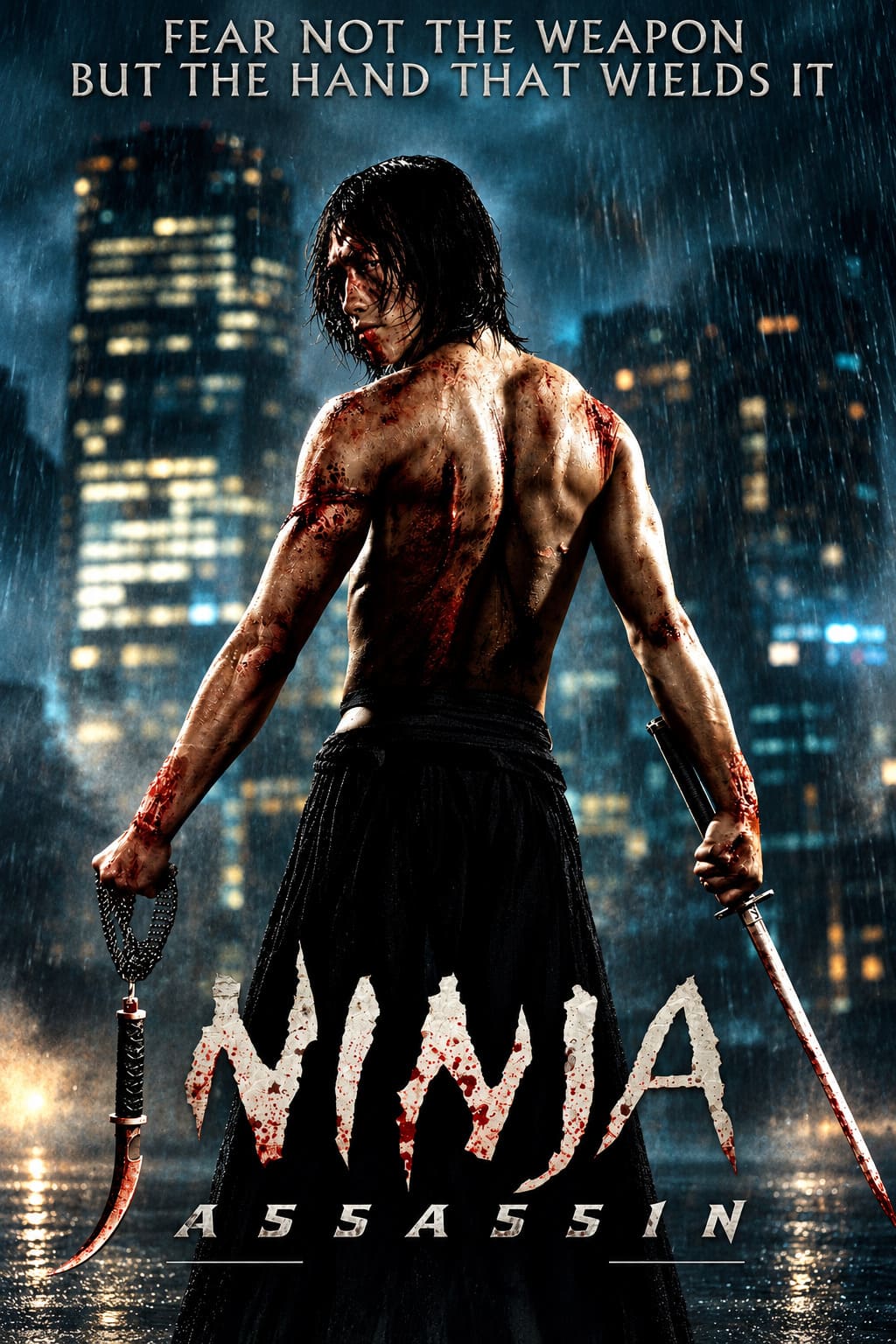
“This is not my family. You are not my father. And the breath I take after I kill you will be the first breath of my life.” — Raizo
Watching Ninja Assassin feels a little like stumbling onto a late-night cable movie that has been given a much bigger budget, a larger blood supply, and zero interest in restraint. It is a blood-soaked, over-the-top revenge movie about a superhuman killer carving his way through an army of shadowy cult ninjas, and it wants blades, bodies, darkness, shredded limbs, dramatic training flashbacks, and a hero so physically intimidating that the camera occasionally seems to pause just to admire how absurdly ripped he is. It is loud, grimy, excessively violent, and frequently ridiculous. It is also, depending on your tolerance for late-2000s CGI carnage and ultra-serious ninja mythology, a pretty entertaining slice of trashy action cinema.
The film stars Korean pop superstar Rain as Raizo, a prodigiously gifted killer raised by the Ozunu Clan, a secret organization that turns stolen children into elite assassins. Raizo is trained from childhood to erase fear, reject compassion, and become basically invisible in the darkness. The clan’s motto might as well be “trauma builds character,” because every flashback involves some new level of horrifying abuse: children fighting one another, training through severe pain, learning to tolerate wounds, and being punished for even the smallest sign of vulnerability. It is all delivered with the straight-faced intensity of a dark comic book, which is probably the best way to approach the movie as a whole.
The present-day story follows Raizo after he breaks from the Ozunu Clan and goes rogue. His target is Lord Ozunu, played by genuine ninja-film legend Sho Kosugi, who runs the entire organization like a supernatural military cult. Raizo’s path crosses with Mika Coretti, played by Naomie Harris, a Europol researcher in Berlin who discovers evidence that a string of political assassinations may be connected to an apparently mythical network of ninja killers. Naturally, nobody believes her, because this is a movie where the phrase “ninja assassins are real” is treated with the same bureaucratic skepticism as an expense-report discrepancy. Once Mika gets too close to the truth, the Ozunu Clan sends people to remove her from the equation, and Raizo enters the picture as both protector and revenge machine.
The plot is not really the point, but it does enough to move the movie from one stabbing to the next. Ninja Assassin has the basic shape of a revenge story, with Raizo torn between the brutal identity he was given and the humanity he is trying to reclaim. The flashbacks fill in his childhood bond with Kiriko, another member of the clan who pays the price for refusing to fully submit to Lord Ozunu’s cruelty. That loss becomes the emotional engine for Raizo’s rebellion, and while the movie does not exactly dig deep into the character’s psychology, it gives Rain a clear enough motivation to work with. He is not just killing bad guys because the script needs more bodies on the floor. He is trying to destroy the institution that made him into a weapon.
Rain is honestly one of the movie’s biggest strengths. He does not have to carry the film through nuanced dialogue or complicated dramatic scenes, and that is probably for the best, because the screenplay does not give him much room for that kind of performance. But he has undeniable screen presence. He looks the part, moves like someone who trained brutally for it, and sells the physical exhaustion of a man who has spent his whole life getting cut, beaten, stabbed, and forced to keep moving anyway. The movie’s action depends on Raizo feeling almost superhuman without becoming completely weightless, and Rain finds that balance most of the time. He is less a conventional action hero than a human weapon who has finally decided to aim himself at the people who built him.
Sho Kosugi is also a welcome presence as Lord Ozunu. He does not get a huge amount of screen time, but he has the kind of weathered, stern authority that makes the role work. Lord Ozunu is not a layered villain; he is an evil master who talks in cold pronouncements about weakness and loyalty, tortures his students, and commands legions of black-clad killers. Still, Kosugi makes him feel more substantial than the usual disposable martial-arts-movie villain. His involvement also gives Ninja Assassin a connection to the ninja-cinema boom of the 1980s, when Kosugi was one of the genre’s biggest names. The film feels like it is trying to combine that old-school ninja-movie sensibility with the slick, digital, hyperviolent style that came out of the Matrix era.
That connection makes sense given the people behind the movie. McTeigue had previously directed V for Vendetta and worked closely with the Wachowskis, who produced Ninja Assassin alongside Joel Silver. You can feel that late-1990s and 2000s action aesthetic all over it: cold blue lighting, rain-slick streets, rapid editing, wire-assisted movement, slow-motion impacts, and CGI blood that erupts in fountains whenever a blade touches skin. The action is often designed less around realism than around visual impact. A ninja does not just stab somebody; he slices through them with enough force to send gallons of digital blood spraying across the frame. Arms come off. Heads come off. Bodies are carved up so thoroughly that the movie sometimes feels like a slasher picture with martial-arts choreography.
When Ninja Assassin is working, that excess is part of the fun. The early sequence in a Bangkok nightclub is a strong example. Gangsters laugh at the idea that ninjas exist, and then the lights go out. Bodies start falling apart in the darkness while unseen attackers move through the room. It is silly, but it is exactly the kind of silly the movie needs to be. The clan’s assassins are framed less like ordinary people than horror-movie monsters: they emerge from shadows, disappear into smoke, and leave mutilated corpses behind. The best moments make ninja combat feel supernatural and frightening rather than simply athletic.
The problem is that the movie sometimes sabotages its own action with its visual style. It is extremely dark, often to the point that it becomes hard to tell who is hitting whom. The rapid editing can also make fights feel more like a blur of limbs, blades, and blood splatter than a clearly staged exchange. There are sequences where the choreography seems like it could be impressive if the camera would just pull back and let the audience see it. Instead, McTeigue often keeps everything moving so fast that the action loses some of its physical clarity. This is particularly frustrating because the film clearly put real effort into Rain’s training and the stunt work.
The CGI is another mixed bag. At times, the exaggerated gore has a knowingly cartoonish quality that fits the movie’s pulpy tone. At other times, it looks like a video-game cutscene from the late 2000s, especially when blood splashes directly toward the camera. The film wants to be nasty and visceral, but the artificial effects can create distance rather than impact. You are rarely shocked by the violence because it is so obviously constructed as spectacle. Then again, nobody should go into a film called Ninja Assassin expecting the sober realism of The Bourne Identity. This is a movie where shadow ninjas attack police officers with chains, blades, and explosive acrobatics. Subtlety was never invited.
Naomie Harris does what she can with Mika, though the character is written mostly as the audience’s entry point into the ninja conspiracy. She gets some decent moments of determination and disbelief, but the film does not give her nearly as much agency as it should. Once Raizo arrives, Mika increasingly becomes someone who needs to be rescued, protected, and dragged through the story’s bloodier sections. Ben Miles is fine as her superior, Ryan Maslow, but the Europol material is the least exciting part of the film. Whenever it cuts away from Raizo’s training, his revenge, or another batch of black-clad assassins, the energy drops.
Still, there is something oddly admirable about how committed Ninja Assassin is to its own trashy premise. It does not pretend to be a prestige thriller, a grounded espionage drama, or a sophisticated martial-arts epic. It is a hard-R revenge movie built around a simple promise: Rain versus an army of ninjas. On that level, it delivers enough mayhem to satisfy viewers who enjoy excessively violent action movies and do not need the script to be smarter than the title.
Ninja Assassin is not a hidden masterpiece, and it has plenty of flaws: thin characters, clunky dialogue, uneven CGI, murky camerawork, and a plot that exists mainly to connect the fight scenes. But it has a strong lead, a memorable villain, a few genuinely cool action-horror moments, and an unapologetically ridiculous energy. It is best enjoyed as a guilty-pleasure throwback to the era when Hollywood action movies believed every problem could be solved with a black mask, a sword, and several gallons of CGI blood.

