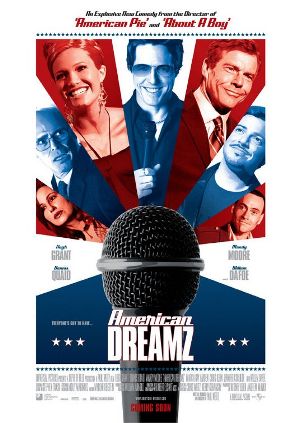
Shattered Politics #78: American Dreamz (dir by Paul Weitz)


Americandreamz

Nothing ages worse than heavy-handed satire and, if you need proof of that, just try watching the 2006 film American Dreamz.  American Dreamz is a satire of two things that are no longer exactly relevant, the presidential administration of George W. Bush and Simon Cowell-era American Idol.

Dennis Quaid plays President George W. Bush Joseph Stanton.  Stanton has just been reelected to a second term.  One morning, he impulsively decides to read a newspaper for the first time in his life and he ends up having a nervous breakdown.  “The world isn’t black-and-white,” he declares, “Instead, it’s gray.”  Sinking into a deep depression, Stanton isolates himself from the American people and his approval rating starts to plunge.  His evil Chief of Staff (William DaFoe, made up to look like Joe Biden but, I’m assuming, meant to be Dick Cheney) comes up with a plan to restore Stanton’s popularity.  President Stanton will serve as a guest judge on his favorite television show, American Idol American Dreamz!

(To be honest, I think Obama would be more likely to show up as a guest judge than Bush.)

The host of American Dreamz is a self-loathing Englishman named Martin Tweed (Hugh Grant).  Tweed hates both the show and himself.  Early on in the film, he’s literally seeing begging for American Dreamz to be canceled.  However, American Dreamz is the number one show in the country and the show must go on.

Along with President Stanton, the latest season of American Dreamz features a group of contestants who all have dramatically compelling backstories.  Sally Kendoo (Mandy Moore) emerges as a favorite, largely do to her ability to manipulate the camera and the fact that her well-meaning but simple-minded boyfriend (Chris Klein) was wounded in Iraq.

Oh wow — reality shows manipulate reality and contestants are rarely as innocent as they seem!?

Tell me more, American Dreamz!

Also competing on American Dreamz is Omer (Sam Golzari), a former jihadist who proved to be too clumsy to take part in the various propaganda videos being shot by his terrorist cell.  Omer was sent to America, where his love for show tunes eventually landed him on American Dreamz.  With the finale rapidly approaching, Omer has been instructed to blow both himself and the President up on national TV.

The satire of American Dreamz really wasn’t all that sharp when the film was first released and now, 9 years later, it feels even weaker.  Quaid and Grant both give good performances but the film’s attempts at humor largely fall flat because they’re all so predictable.  It’s not exactly mind-blowing to say that reality TV is fake or that politics has a lot in common with show business.  The film attempts to add some bite to its message by ending with a surprisingly dark twist but it’s just not enough.  Even a dark ending has to be earned.


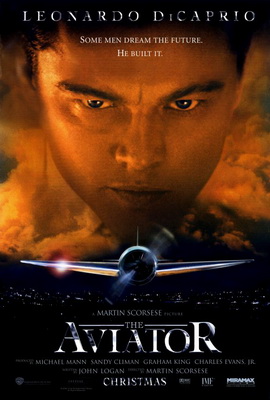
Shattered Politics #74: The Aviator (dir by Martin Scorsese)


The_Aviator_Poster

“The way of the future.” — Howard Hughes (Leonardo DiCaprio) in The Aviator (2004)

As I recently rewatched the 2004 best picture nominee, The Aviator, I realized that, in the film’s scheme of things, Ava Gardner was far more important than Katharine Hepburn.  (Or, perhaps it would be more appropriate to say that Kate Beckinsale’s Ava Gardner was far more important than Cate Blanchett’s Katharine Hepburn.)

Over the course of the film, both Hepburn and Gardner are involved with billionaire-turned aviator-turned film director Howard Hughes (Leonardo DiCaprio).  Throughout the film, Katherine is portrayed as being flighty, pretentious, and overdramatic.  There’s a lot of dark humor to the scene where Katherine breaks up with Howard, largely because Katharine is incapable of not acting as if she’s making a film.  Her every word is so carefully rehearsed that you have to agree when Howard says that she’s incapable of not giving a performance.  Ava, on the other hand, is always direct.  She has a sense of humor.  She has no trouble telling Howard off.  Whereas Katharine put on airs of being an incurable romantic, Ava tells Howard flat out that she doesn’t love him and is only using him to forward her career.

But, while Katharine Hepburn gets more screen time, it’s Ava Gardner who actually saves Howard’s business.  Towards the end of the film, after Howard has had a nervous breakdown and has locked himself in a hotel room, it’s Ava who suddenly shows up, cleans him, and dresses him.  She’s the one who gives Howard the strength to leave his room and to face down the corrupt senator (Alan Alda) who is investigating his business.

Of course, Howard Hughes is best known for once being the world’s richest recluse.  In the 1960s, Howard locked himself away in a hotel room in Las Vegas and spent the next decade laying naked in bed and watching television.  The Aviator doesn’t deal with this period of Howard’s life but it’s full of scenes where we catch glimpses of Howard’s future.  Throughout the film, we watch as Howard obsessively washes his hands.  We watch as he gives precise instructions on how even the simplest of tasks are to be accomplished.  We watch as he grows increasingly paranoid about the germ-filled outside world.  The film suggests that Howard’s obsessive compulsive disorder both served to make him a great engineer and a great filmmaker while, at the same time, ultimately destroying him.

The Aviator was the second film that DiCaprio made with Scorsese.  And, as bad as DiCaprio may have been in Gangs of New York, he’s absolutely brilliant in The Aviator.  As a character, Howard Hughes has so many quirks and tics that it would have been easy for DiCaprio to go overboard.  Instead, he gives a surprisingly subtle performance.  And, even more importantly as far as I’m concerned, he actually sounds authentically Texan when he speaks.

In many ways, much of The Aviator reminds me of Gangs of New York.  Both films are gorgeously produced period epics that try to cover a lot of material.  Both films are absolute cat nip for history nerds like me.  But, whereas Gangs of New York leaves one feeling vaguely dissatisfied, The Aviator actually improves with subsequent viewings.  Whereas the action in Gangs had no center, The Aviator revolves around Howard and the actor playing him.

While the Aviator starts off with Howard making movies and romancing Katharine Hepburn, it’s at its best when Howard appears before a committee chaired by Sen. Owen Brewster (Alan Alda) and passionately defends both himself as an engineer and a businessman and the right of innovators everywhere to freely pursue their passion.  The film suggests that Brewster was bribed by Howard’s main business rival, Juan Trippe (Alec Baldwin, in unapologetic villain mode), and it’s hard not to applaud when Howard stands up for himself.

Speaking of which, it’s odd, so soon after reviewing Alan Alda in The Seduction of Joe Tynan, to see Alda playing a far less ethical politician in The Aviator.  That said, Alda’s corrupt performance in The Aviator is a hundred times better than his cutesy work in Joe Tynan.  If anything, Alda gives a performance here that will remind everyone of why they don’t care much for their congressman.

The Aviator was nominated for best picture but it lost to the far more low-key Million Dollar Baby.  Scorsese would have to wait until the release of The Departed for one of his films to finally win best picture.

A Few Very Late Thoughts On Wes Anderson’s The Grand Budapest Hotel


grand-budapest-hotel

It took me a while to come around to appreciating The Grand Budapest Hotel.

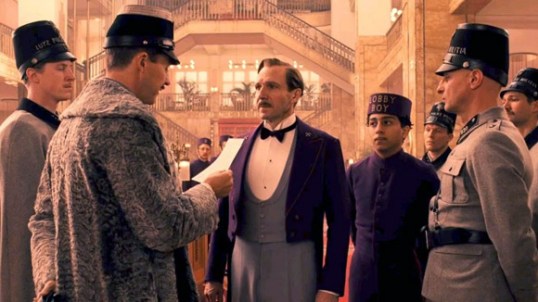
When I first saw Wes Anderson’s latest film, way back in March, I have to admit that I was somehow both impressed and disappointed.  The film’s virtues were obvious.  Ralph Fiennes gave a brilliant lead performance as Gustave, the courtly and womanizing concierge of the Grand Budapest Hotel.  As played by Fiennes, Gustave came to represent a certain type of old world elegance that, I’m assuming, died out long before I was born.  As is typical of Anderson’s film, The Grand Budapest Hotel was visual delight.  Even when the film’s convoluted storyline occasionally grew self-indulgent, The Grand Budapest Hotel was always interesting and fun to watch.

At the same time, I had some issues with The Grand Budapest Hotel.

One of the major ones — and I will admit right now that this will seem minor to some of you — is that halfway through the film, a cat is killed.  The evil Dimitri Desgoffe von Taxis (Adrien Brody) is attempting to intimidate a nervous lawyer, Kovacs (Jeff Goldblum).  Kovacs’s owns a cat and, at one point, Dimitri’s henchman, Jopling (Willem DaFoe), tosses the cat out of a window.  Kovacs runs to window and sees his dead cat splattered on the sidewalk below…

And this is when the audience in the theater laughed and I got very angry.

To me, there was nothing funny about killing that man’s cat.  But the more I’ve thought about it, the more that I’ve come to realize that my reaction had more to do with the audience than the film.  The film was not saying that the cat’s death was funny.  The film was saying that Dimitri and Jopling were evil and dangerous, as their actions throughout the film would demonstrate.  It was the audience that decided, since Grand Budapest Hotel is full of funny moments and has the off-center style that one has come to expect from Wes Anderson, that meant every scene in the film was meant to be played strictly for laughs.  The fact of the matter is that a typical Wes Anderson film will always attract a certain type of hipster douchebag.  They were the ones who loudly laughed, mostly because they had spent the entire movie laughing loudly in order to make sure that everyone around them understood that they were in on the joke.

But that’s not the fault of the film.  Despite what you may have heard and what the Golden Globes would have you believe, The Grand Budapest Hotel is not a comedy.  For all the deliberately funny and quirky moments, The Grand Budapest Hotel is actually a very serious film.  For all of the slapstick and for all of Ralph Fiennes’s snarky line readings, The Grand Budapest Hotel ultimately ends on a note of deep melancholy.

When I first saw The Grand Budapest Hotel, it seemed like it was almost too quirky for its own good.  And, to be honest, I could still have done without some of Anderson’s more self-indulgent touches.  The sequence at the end, where Gustave, who has been framed for murder, gets help from a series of his fellow hotel concierges started out funny but, as everyone from Bill Murray to Owen Wilson put in an appearance, it started to feel less like the story of Gustave and more like the story of all of Wes Anderson’s famous friends.

However, the more I’ve thought about it (and The Grand Budapest Hotel is a film that I’ve thought about a lot over the past year), the more I’ve realized that the quirkiness is only a problem if you made the mistake of thinking that the film is meant to be taken literally.

The more I thought about it, the more obvious it became that the most important scenes in The Grand Budapest Hotel were to be found at the beginning and the end of the film.

The film opens with a teenage girl sitting in front of the grave of a great author.  She opens a book and starts to read.

As soon as the girl starts to read, we flashback 29 years to 1985 where the author (Tom Wilkinson) sits behind his office desk and starts to talk about the time that he visited the Grand Budapest Hotel.  

We flashback again to 1969, where we see how the author (now played by Jude Law) met the owner of the Grand Budapest Hotel, a man named Zero (played by F. Murray Abraham).  Over dinner, Zero tells the author the story of how he first came to the Grand Budapest and how he eventually came to own the hotel.

And again, we go back in time, this time to 1932.  We see how the young Zero (Tony Revolori) first met and came to be the protegé of Gustave (Ralph Fiennes).  We see how Gustave taught Zero how to be the perfect concierge.  Eventually, Gustave would be framed for murdering a guest, Zero would meet and fall in love with Agatha (Saoirse Ronan), and then Zubrowska (the fictional Eastern European country in which this all takes place) would be taken over by fascists who would eventually claim the hotel as their own.

After the story of Gustave, Zero, and Agatha has been told, we suddenly flash forward to the author talking to Zero and then to the old author telling the story to his grandson and then finally back to the teenage reader sitting in the cemetery.

In other words, the Grand Budapest Hotel may be the story of Zero but we’re experiencing it through the memories of the author as visualized by the reader.  Gustave, Zero, and the entire Grand Budapest Hotel are not just parts of a story.  Instead, they become symbols of an old way of life that, though it may have been lost, still exists in the memories of old travelers like the author and the imaginations of young readers like the girl in the cemetery.

As I said at the start of this, I was vaguely disappointed with The Grand Budapest Hotel when I first saw it but, perhaps more than any other movie that I saw last year, this has been a film that I haven’t been able to get out of my mind.  Having recently rewatched the film on HBO, I can also attest that both The Grand Budapest Hotel and Ralph Fiennes’s performance not only hold up on a second viewing but improve as well.

I still stand by some of my original criticisms of The Grand Budapest Hotel.  I still wish that cat had not been thrown out the window, even though I now understand that Anderson’s main intent was to show the evil of Dimitri and Jopling.  And I still find some of the cameos to be jarring, precisely because they take us out of the world of the film.

But you know what?

Despite those flaws, The Grand Budapest Hotel is still a unique and intriguing film.  When I sat down tonight and made out my list of my top 26 films of 2014, I was not surprised that Grand Budapest Hotel made the list.  But I was a little bit surprised at how high I ended up ranking it.

But then I thought about it and it all made sense.

The-Grand-Budapest-Hotel-580


The San Francisco Film Critics and the San Diego Film Critics Have Spoken!


It’s been a busy three days as far as Oscar precursors are concerned so let’s jump straight into things and take a look at the latest victories.  We’ll start with two critics groups from Arleigh’s home state of California!

Yesterday, the San Francisco Film Critics announced their picks for the best of 2014!

Best picture: Boyhood
Best director: Richard Linklater, Boyhood
Best actor: Michael Keaton, Birdman
Best actress: Julianne Moore, Still Alice
Best supporting actor: Edward Norton, Birdman
Best supporting actress: Patricia Arquette, Boyhood
Best screenplay, original: Birdman
Best screenplay, adapted: Inherent Vice
Best cinematography: Ida
Best production design: The Best Grand Budapest Hotel
Best editing: Boyhood
Best animated feature: The Lego Movie
Best foreign-language picture: Ida
Best documentary: Citizenfour

Nightcrawler

Meanwhile, the San Diego Film Critics Society announced earlier today that they really, really love one of my favorite films of the year, Nightcrawler!  You can see a full list of the San Diego nominees by clicking here.  And the winners are listed below!

Best Picture
“Nightcrawler”

Best Director
Dan Gilroy, “Nightcrawler”

Best Actor
Jake Gyllenhaal, “Nightcrawler”

Best Actress
Marion Cotillard, “Two Days, One Night”

Best Supporting Actor
Mark Ruffalo, “Foxcatcher”

Best Supporting Actress
Rene Russo, “Nightcrawler”

Best Adapted Screenplay
“Gone Girl”

Best Original Screenplay
“Nightcrawler”

Best Cinematography
“Nightcrawler”

Best Editing
“Edge of Tomorrow”

Best Production Design
“The Grand Budapest Hotel”

Best Score
“Nightcrawler”

Best Animated Film
“The Boxtrolls”

Best Foreign Film
“Force Majeure”

Best Documentary
“CITIZENFOUR”

Best Ensemble
“Birdman”

Body of Work
Willem Dafoe (“John Wick,” “The Fault in Our Stars,” “The Grand Budapest Hotel,” “A Most Wanted Man,” “Nymphomaniac: Part 2”)

Back to School #77: The Fault In Our Stars (dir by Josh Boone)


fault-poster

Well, we’re wrapping things up as far as Back to School is concerned.  A little over a month ago, I set out with a mission.  I said that I would review 80 of the best, worst, most memorable, and most forgettable high school and teen films ever made.  I said it would be able to do it all in one week.  Needless to say I was wrong.  It’s actually taken me five weeks but the end is in sight and, as much as I’ve enjoyed doing this series, that’s probably for the best.  After all, the back to school sales are over.  The kids have already settled back into the school routine.  Everyone’s looking forward to the winter break.

Add to that, it’s nearly October and that means that it’s nearly time for this site to start devoting itself to horror!

So, we have four more Back to School reviews to go and, keeping with the chronological nature of this series, they are all for films that were released in 2014!

Speaking of which, 2014 has been the year of Shailene Woodley.  Much as how Jennifer Lawrence dominated 2012 by starring in The Hunger Games and winning an Oscar for Silver Linings PlaybookWoodley has proven herself to be both capable of carrying a franchise and starring in a serious film.  Also, much like Jennifer Lawrence in 2012, Shailene has been the subject of several condescending posts  over at AwardsDaily.com.  And, as we all know, you haven’t arrived in this business until Sasha Stone talks down to you.

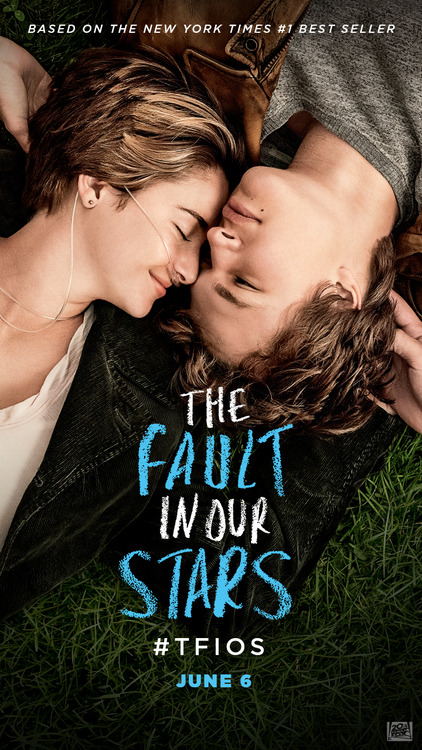
Shailene’s serious film of 2014 was The Fault In Our Stars, which is based on the excellent and heart-breaking novel by John Green.  The book made me cry and cry.  In fact, it made me cry so much that I wasn’t sure whether I would have any tears left over for the film.  Don’t get me wrong.  I knew the film would probably be good.  Just on the basis of her excellent performances in The Descendants and The Spectacular Now, I knew that Shailene Woodley was an ideal pick for the role of the Hazel, a sarcastic 16 year-old who has thyroid cancer and can’t go anywhere without her oxygen tank.  But I wondered, knowing already what was going to happen, would the film still have as strong an effect on me as it would if I was going in with no knowledge as to what was waiting for me.

I really shouldn’t have even wondered.  For that matter, I probably should not have worn mascara on the night that I saw the movie because, seriously, by the end of it, my face was a mess!  The Fault In Our Stars is one of those films that has been specifically made to make you cry.  And yes, it’s undeniably manipulative and I’ll even agree with those critics who have used the dreaded “schmaltz” label while describing the film but so what?  In the end, the tears are earned.  In the end, the film works.

And that’s largely due to Shailene Woodley’s performance as Hazel.  While Ansel Elgort gives an okay performance as Augustus, the boy who has lost a leg to cancer and who Hazel loves, the film really does belong to Shailene.  She gives a fierce performance, capturing both Hazel’s dark humor and, even more importantly, her independence and her inner strength.  It’s the type of performance that more than justifies 2014 being the year of Shailene Woodley.

Probably one of the more critically divisive scenes in the film comes when Hazel and Augustus are taking a tour of the Anne Frank House in Amsterdam.  (They’re in Amsterdam because they’re looking for Hazel’s favorite writer, a drunken recluse who is well-played by Willem DaFoe.)  Over the course of the tour, Hazel has to climb several staircases and ladders and it’s not easy for her.  However, Hazel never gives up and, at the end of the tour, she and Augustus share as kiss.  And, of course, everyone else who was on the tour breaks out into applause.  For many, I think this is the scene where the film says, “You can either take me as I am or you can leave the theater.”  Yes, it is incredibly manipulative and yes, I do think it would have been just as effective without everyone else breaking out into applause.  But, dammit, the scene works!  You have grown to so much care about Hazel that the scene works.  It also helps that, up until this point, the film has been so unsentimental about the horrible reality of cancer that the fact that you’re happy to finally see Hazel get that over-the-top moment of happiness.  Hazel has earned it, the film has earned it, and so has Shailene Woodley.

article-2615535-1D6F756B00000578-679_634x352

Trailer: John Wick


hr_John_Wick_2

I usually have a good idea of upcoming action films once they’ve been announced into production, but I have to admit that Keanu Reeve’s upcoming action film, John Wick, has been quite the ninja. I’ve not heard one thing about this project until I came across the just released trailer earlier today.

The trailer itself pretty much lays out what looks like a basic premise for the film. The title character seems to be some sort of retired badass who is brought out of it to get his revenge on the idiots who killed his cute little dog (given to him by his dying wife) during a home invasion robbery.

I know there are many whose brain starts to wander and/or seize up whenever they hear the name Keanu Reeves. I, fortunately, am not one of those people and I actually think that Reeves has been much-maligned throughout his career. For one thing he does seem to handle action scenes pretty well and this trailer for John Wick just continues to reinforce that thought.

John Wick will be setting wrongs right and bringing killer of dogs their just due this October 24, 2014.

Lisa Marie’s 6 Favorite Super Bowl Commercials


Only one of these commercials made Lisa’s top six.

Yes, I did watch the Super Bowl this year.  I don’t really know much about football but my boyfriend’s from Baltimore so I cheered for Baltimore during tonight’s game and I made sure to wear my favorite purple bra and thong.  (Of course, I was  wearing more clothes than just those two items but apparently, the important thing was that I was wearing at least a little purple.)    However, I have to admit that I was mainly watching the game for the commercials!

Super Bowl commercials have become something of an American tradition, beyond the fact that most of them tend to be overproduced and kinda sucky.  But every year, after the game has been played, people spends weeks debating which commercial was the best.

With that in mind, here are my 6 favorite commercials of Super Bowl XLVII.

6) Samsung Mobile USA — The Next Big Thing

It goes on a little long but I still liked it.

5) E-Trade — Baby Gone Wild

I don’t care what anybody says, I like the E-Trade Baby.

4) Mercedes-Benz — Willem DaFoe is Satan.

It’s really not that much of a shock.

3) M&Ms — I Would Do Anything For Love

I love how upset the M&Ms get over the prospect of being eaten.  They’ve got a point, to be honest.

2) Budweiser — “Brotherhood”

This commercial made me cry.

1) Calvin Klein — “Concept”

You probably already knew this was going to be number one.  This commercial was the perfect antidote to years of creepy GoDaddy commercials.

6 More Films From 2012: 4:44: Last Day On Earth, First Position, Flight, The Paperboy, Red Tails, and The Trouble With Bliss


Continuing my desperate attempt to review all of the 2012 films that I’ve seen but haven’t gotten around to reviewing yet, here’s six more reviews.

1) 4:44: Last Day On Earth (dir. by Abel Ferrara)

Whether it’s because of the Mayan calendar or the fact the Obama got reelected, people seem to be obsessed with the end of the world right now and it’s been the subject of several recent films.  4:44: Last Day On Earth is one of the more low-key entries in this genre.

Willem DaFoe plays a New York-based actor who deals with the impending end of the world by meditating in his loft, having sex with his much younger girlfriend, and having awkward conversations on Skype with his daughter.  As opposed to the characters in several other end of the world films, DaFoe doesn’t use the situation as an excuse to go on a quest for true love.  Unlike 2012, there’s no talk of escaping the apocalypse.  Instead, the world is ending and DaFoe has no choice but to accept it.  From a cinematic point of view, DaFoe’s passivity can be frustrating (4:44 is a film that’s willing to be boring to make its point) but, at the same time, it does force a viewer like me to wonder how she would handle the end of the world in a way that a film like Seeking A Friend For The End Of The World does not.

One interesting thing that distinguishes 4:44 from other end-of-the-world films is that, in 4:44, the world ends specifically because of the actions of mankind.  Whereas films like Melancholia and Seeking A Friend For The End Of The World presented a random apocalypse, 4:44 presents the apocalypse as the fitting punishment for the sins of humanity.  While I could have done without the scenes of DaFoe listening to Al Gore droning on and on about global warming (because, seriously, Gore always sounds like the creepy community college professor who you know is having an affair with one of his students), this still adds an interesting element to the film.

4:44 requires a bit of tolerance and a lot of patience but it’s still a film that’s worthy of being seen.

2) First Position (dir. by Bess Kargman)

First Position is a documentary about ballet so, of course, you know that I loved it.  The film follows six young dancers as they prepare for the Youth American Grand Prix in New York City and it brought back a lot of memories (both good and bad) for me.  First Position captures both the beauty and the pain of both dance and life.

3) Flight (dir. by Robert Zemeckis)

In Flight, Denzel Washington plays a cocky and talented pilot who is also an alcoholic and a drug addict.  In a truly harrowing sequence, the plane that Washington is piloting goes into a nosedive over Atlanta.  After Washington manages to crash-land the plane with only a few fatalities, he finds himself hailed as both a hero and also under investigation.  Working with a union rep (Bruce Greenwood) and a slick attorney (Don Cheadle), Washington tries to cover up his mistakes while, at the same time, romancing a recovering heroin addict (Kelly Reilly).

Flight has a brilliant opening and a strong ending.  Unfortunately, the middle of the film tends to drag.  Flight also suffers from the fact that cinematic addicts are always more fun to watch when they’re under the influence as opposed to when they’re getting sober.  On the plus side, the film itself is well-acted and the cast is always fun to watch even when the rest of the film is getting bogged down.  Washington is brilliant in the lead role and John Goodman has a great cameo as the world’s most helpful drug dealer.

4) The Paperboy (dir by Lee Daniels)

In 1960s Florida, Hillary Van Wetter (an amazingly sleazy John Cusack) is on death row for the murder of a small town sheriff.  His girlfriend, the flamboyant Charlotte Bess (Nicole Kidman), convinces reporter Ward Jansen (Matthew McConaughey) to return to his hometown and investigate the case against Van Wetter.  With the help of his younger brother (Zac Efron) and an arrogant colleague (David Oyelowo), Ward works to get Van Wetter off of death row but it becomes obvious that all of the film’s characters are hiding secrets of their own.

The Paperboy has a few isolated moments where it achieves a certain pulp poetry but, for the most part, Lee Daniels’ follow-up to his Academy Award-winning Precious is a total and complete mess.  Unfortunately, it’s not even all that interesting of a mess.  Nicole Kidman’s vampish performance and her white trash femme fatale outfits are definitely the film’s highlight.  As for Zac Efron, he’s not much of an actor but he’s pipin’, boilin’ hot.  It’s just  too bad the character that he’s playing isn’t that interesting.

In the end, The Paperboy showcases everything that didn’t work about Precious and nothing that did.

5) Red Tails (dir. by Anthony Hemingway)

Red Tails was one of the first “major” releases of 2012 and it’s also one of the most forgettable.  The film, which was executive produced and reportedly co-directed by George Lucas, is based on the story of the Tuskegee Airmen, a group of African-Americans who served in the U.S. Air Force during World War II and who had to not only fight Nazis abroad but racial discrimination at home.  There’s undoubtedly an inspiring story to be told here but Red Tails is such a predictable and corny film that it feels as if Lucas and Hemingway essentially wasted the real life story of the Tuskegee Airmen on a painfully generic movie.

6) The Trouble With Bliss (dir. by Michael Knowles)

Morris Bliss (played by Michael C. Hall) is the type of guy who always seems to show up in quirky independent films.  He has no job, he has no money, and he lives in a tiny apartment with his father (Peter Fonda).  Since there’s nothing more attractive than a middle-aged guy with no future, he finds himself being pursued by an 18 year-old (Brie Larson), who also happens to be the daughter of a former high school classmate, and his married neighbor (played by Lucy Liu).

I have a weakness for quirky indie films but the nonstop quirkiness of The Trouble of With Bliss feels less like narrative imagination and more like total desperation.  Michael C. Hall’s a likable actor but he essentially turns Morris Bliss into Dexter Morgan and, as a result, I kept expected for the trouble with Bliss to turn out to be that he had about a few dozen bodies hidden away in a closet somewhere.

Now that would have been a quirky film!

Quick Review: John Carter (dir. by Andrew Stanton)


John CarterThe First Impression:

John Carter is a cute Disney film that you may enjoy more than you’d thought you would. It’s lively like The Rocketeer was and really has some great moments and interesting characters. Both the leads carry their roles well, and are eye candy for the audience. It’s worthy of all of the love it should get, but obvious comparisons to movies that came before it (even though the story predates those films), along with a shockingly forgettable score by Michael Giacchino may actually hurt it. If you’re expecting blood and guts, not so much. It’s a Disney film. The kids should love it, though the pace of the film in the beginning may seem a little slow for younger audiences. Skip the 3D version and go for the 2D instead.

The Longer Version:

It’s really sad when you see a movie that deserves all the love in the world, but for some reason just doesn’t quite hit the mark. Part of that is due to the way this was marketed. It really didn’t feel to me that Disney was putting their all behind this. When you look at how heavily marketed Tron: Legacy was, this seemed like a “Hey, we made it, just give us money.” kind of push.

As far as John Carter is concerned, maybe it’s better to look at it like this. We tend to compare things to make sense of them:

This object reminds me of that object.

All of James Cameron’s Avatar reminds me of Ferngully.

Remember, Short Controlled Bursts. What movie comes to mind when I say that?

This is ultimately the problem with Andrew Stanton’s John Carter. In watching it, you’ll end up making comparisons to so many other films that came before it. However, knowing that it was based on the stories of Edgar Rice Burroughs, it’s a lot like seeing Lord of the Rings for the first time when all you know of Elves and Dwarves comes from Dungeons & Dragons, The Elder Scrolls games or World or Warcraft. Burroughs’ material predates just about everything it showcases, from a pop culture standpoint. Hell, for all I know, John Carter was probably the original inspiration for the Kwisatz Haderach in Frank Herbert’s Dune (though that’s just my speculation). The problem is, with comparisons being what they are, audiences may view John Carter as a copycat of all the movies that were probably influenced by it.

I didn’t walk into John Carter with a lot of expectations. Andrew Stanton, for me, has the track record of being Pixar’s Dark Horse. This is the same guy that killed off a mother and a hundred of her babies in the opening moments of Finding Nemo. A man who gave a bleak, dirty and desolate future in Wall-E. Yet, both of those films had a theme of love and of heroes that rose to the occasion, so seeing the previews for John Carter told me enough.

John Carter is the story of a man in search of a cave full of gold. He wants no part of anyone’s battles and when he’s asked to join a faction, he does his best to avoid it. This leads him to a situation where he’s transported to another world. Just as it was with Earth, he encounters a number of different factions (all of which seem to feel he could aid them), but he simply wishes to return home. When he meets a fierce female fighter (who also happens to be a scientist), they work on figuring out how he arrived on Barsoom and how to get back.

The beautiful thing about John Carter is that it really feels like one of those old serials, or to make a more modern comparison, like an adventure film on the Indiana Jones level of things. There are a number of scenes where I found myself genuinely laughing at what was on screen. The visuals could be better in some places, but it’s nothing that’s groundbreaking. I look at John Carter as a pop culture lesson. You can see where other stories have used elements in the Burroughs tale. In that, it worked for me. The action scenes were really enjoyable for me, but some of the scenes between that could have been tighter. When you find out the reasoning behind Carters arrival, you may end up wondering why more wasn’t done with it with that story arc (on a technical level, anyway). As I’m unfamiliar with the original John Carter stories, I watched a few interviews of the cast and Taylor Kitsch noted that in the books themselves, Carter was pretty much the same person through every one. Stanton added a bit of character depth to him, with a little help from Spider-Man 2 scribe Michael Chabon. Chabon’s also responsible for the great Wonder Boys and The Adventures of Kavalier and Clay, which I still haven’t finished as of this writing. Carter is a conflicted individual for Disney purposes, but you shouldn’t expect Oscar performances here. It’s far better then Immortals was, in that sense.

Both Taylor Kitsch and Lynn Collins do well with their roles. Having worked together for about a hiccup in X-Men Origins: Wolverine, they have a good chemistry together. Kitsch is gruff with his mannerisms, and I can almost forgive him for playing Gambit. Collins is beautiful, statuesque even, and her character really does a lot of damage, fight wise. She’s very strong in some areas, though later on in the film, it felt like they may have eased that down a bit. Willem Dafoe has an inspired role in the leader of one of the alien groups that find Carter first when he arrives in Barsoom. Of course, no film would be complete without a villain and John Carter features two in Dominic West (Zack Snyder’s “300”) and Mark Strong (who’s almost always a go to bad guy). West’s character is more of the take action baddie, while Strong’s character is more of a calculating, behind the scenes one. Of note are Samantha Morton (“Minority Report”) as Sola and a little creature called Woola, that really reminded me a lot of Dug from Disney / Pixar’s Up. I wouldn’t mind having a few of those around the house.

The music for this film worked when the scenes were slow. However, when it called for action, I really didn’t feel anything special about it. I stayed to watch the credits only to find that it was Michael Giacchino’s work, who’s normally really good. I don’t know, this one seemed like it was phoned in for the action scenes. It’s okay, but I didn’t have that urge to buy the soundtrack afterward (which I have done for more memorable scores after leaving the theatre).

Overall, John Carter was a fun film in the vein of Disney’s earlier movies, but it’s not anything you absolutely have to run out to the theatre for. I’d love to see it do well and hope that there’s a sequel on the way, but when you’re paying a good $15 dollars for a 3D movie ticket ($20 for an IMAX 3D showing), the visual return on investment isn’t all that great. The story was enjoyable and didn’t slow down too much, but you may find yourself thinking that you’ve seen this film before in the way that so many other movies reference Burrough’s tale.

As a bonus, Disney released 10 minutes of the film. Enjoy:

Trailer: John Carter (Official)


Walt Disney Pictures has finally released the first official trailer for their upcoming sci-fi, action-adventure film John Carter (film was originally titled John Carter of Mars). The film is based on the Edgar Rice Burroughs novel, A Princess of Mars, which would go one to become the first in Burroughs’ Barsoom series.

The film will star Taylor Kitsch (last seen in X-Men Origins: Wolverine as Gambit) in the title role and Lynn Collins (also from Wolverine as Silver Fox) as the aforementioned princess from the original novel. John Carter looks to be a mixture of live-action and fully-realized CGI characters who make up some of the inhabitants of Mars.

It will be interesting how Disney will market this film with little to no big stars and with a director more known for directing Pixar animated films like Finding Nemo and Wall-E in Andrew Stanton.

John Carter is set to have a March 9, 2012 release date.