Review: Resident Evil (dir. by Zac Cregger)


“I’ve only used a gun in video games.” — Bryan

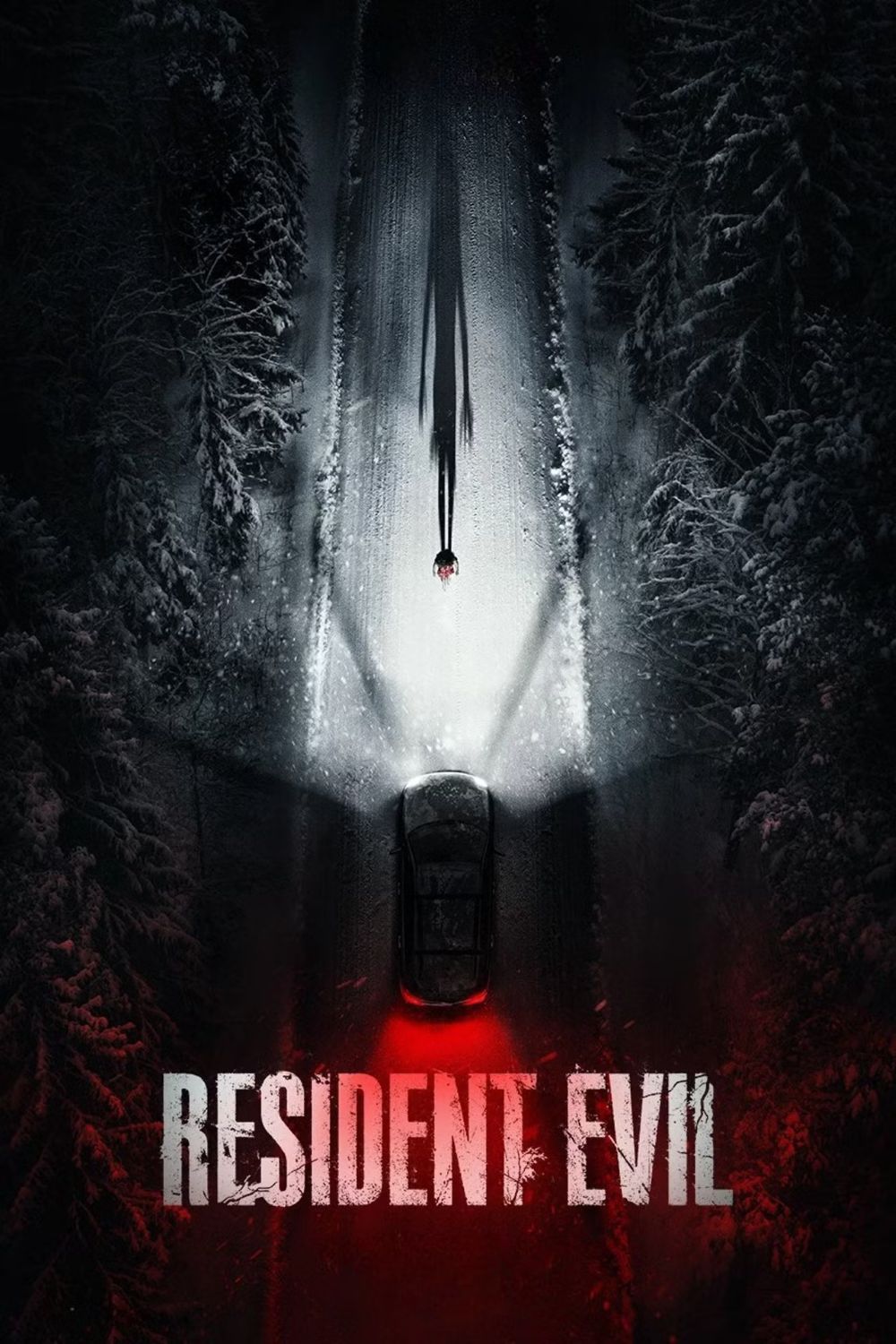
Resident Evil is a smart, tense, and surprisingly faithful reinvention of Capcom’s long-running survival-horror series—not because it tries to copy a single game beat for beat, but because it understands what makes the games unnerving in the first place. Written and directed by Zac Cregger, the film uses the world of Resident Evil as its foundation while telling a new story during the Raccoon City outbreak. Its main character is Bryan, played by Austin Abrams, an ordinary medical courier whose attempt to complete a delivery to Raccoon City General Hospital drops him into the early stages of a biological disaster. He is not a S.T.A.R.S. officer, a government agent, or a pre-established franchise hero. He is simply a guy trying to finish a job and survive a night that becomes more horrifying, chaotic, and impossible with every block he crosses.

That basic setup proves to be one of the movie’s smartest choices. Resident Evil has no shortage of iconic protagonists, from Chris Redfield and Jill Valentine to Leon S. Kennedy and Claire Redfield, but Bryan gives the film a fresh perspective on its apocalypse. He is not entering Raccoon City with a gun, years of training, or inside knowledge of Umbrella. He starts as someone who does not understand why parts of the city are suddenly locked down, why emergency rooms are overwhelmed, or why ordinary people are behaving with terrifying violence. That makes him a natural audience surrogate, but he is not just a blank stand-in. Austin Abrams gives Bryan a nervous, tightly wound energy that fits someone constantly trying to keep pace with a situation that has already moved beyond anyone’s control.

The decision to center an everyman is also a strong way of translating the vulnerability of the games. In a great Resident Evil game, the player might eventually find a shotgun, healing items, and enough ammunition to handle a dangerous enemy, but the first hours are defined by instability. There is never quite enough ammo. There is never a guarantee that the room ahead is safe. You learn the layout of a location because you have to, not because exploration is relaxed. Cregger’s movie cannot reproduce the exact tension of an inventory screen or the anxiety of deciding whether to use a green herb now or save it for later, but it captures the emotional logic behind those mechanics. Bryan makes choices with incomplete information, moves through increasingly hostile spaces, and keeps going even when every instinct tells him to turn around and run.

What makes the film especially interesting is that it does not adapt any one game in the series. This is not a straight retelling of the Spencer Mansion incident from Resident Evil, Leon and Claire’s first night in Resident Evil 2, or Jill’s escape from Nemesis in Resident Evil 3. Instead, Cregger uses the games as backdrop and inspiration for an original story set in the franchise’s universe. The film takes place alongside the Raccoon City outbreak associated with Resident Evil 2, but Bryan’s journey is separate from the established storylines that fans already know. That may disappoint viewers who want an exact cinematic recreation of every familiar character and location, but it is ultimately the movie’s greatest advantage.

A strict adaptation would have to navigate an almost impossible set of fan expectations. If the movie directly followed Resident Evil 2, viewers would be waiting for the exact arrival at the Raccoon City Police Department, the exact early meetings between Leon and Claire, the exact role of Ada Wong, the exact appearances of William Birkin and Mr. X, and the exact descent into Umbrella’s underground facilities. A direct version of the original Resident Evil would carry the same burden with the Spencer Mansion, the S.T.A.R.S. team, the laboratory, and the Tyrant. That approach can quickly make a movie feel less like a story and more like a checklist. Cregger avoids that trap by taking the series’ atmosphere, visual identity, rules, and mythology, then building a new nightmare around them.

That freedom restores a sense of uncertainty. Even viewers who know Resident Evil 2 inside and out cannot assume they know where Bryan’s route will take him, who can be trusted, or when the next threat will appear. The film can nod toward familiar Resident Evil concepts without making them feel like obligatory fan-service stops. A locked facility, an Umbrella insignia, a contaminated corridor, or the emergence of a more elaborate biological threat carries weight because it serves the story first. The pleasure comes from seeing the franchise’s DNA interpreted in a fresh way, not from watching the movie pause so the audience can recognize a collectible reference.

Umbrella is treated as much more than a logo or a few bits of background lore. The company remains the central force behind the horror, and that gives the film a more specific personality than a typical zombie outbreak story. Umbrella is terrifying because it represents private power with no moral limit: a corporation able to hide experiments, manipulate information, weaponize biology, and treat ordinary people as expendable collateral. Its infected victims and bio-organic weapons are not random monsters wandering into the story. They are products. Someone designed them, approved them, tested them, and determined that whatever potential value they offered was worth the risk. That is the darker edge of Resident Evil: the monsters are terrible, but the systems that created them are worse.

Cregger understands that this corporate horror needs to feel physical. A zombie is frightening because it is a person reduced to a violent, decaying shell. A more advanced creature is frightening because it reveals experimentation that has pushed life beyond recognizable limits. The body horror works best when it does not feel ornamental. It should make the audience imagine the research process behind the mutation, the human cost of the experimentation, and the awful combination of arrogance and indifference that allowed it to happen. Resident Evil does not need to constantly escalate into larger monsters merely for spectacle. Its creatures matter when they feel like increasingly disturbing evidence of what Umbrella has been building in secret.

Cregger’s background makes him an unusually strong fit for this material. Barbarian worked because it transformed a familiar location into a space of escalating dread. The house at the center of that film is not just a setting; it becomes a trap, a maze, and a place with its own buried history. Cregger knows how to make architecture feel dangerous. He understands that a corridor, a basement, an unlit stairwell, or a locked door can generate more tension than an explosion if the audience believes something might be waiting just outside the frame. That is basically the visual language of Resident Evil.

The games have always relied on locations that feel compromised. The Spencer Mansion in Resident Evil, the Raccoon City Police Department in Resident Evil 2, and the ruined streets in Resident Evil 3 turn places that should represent order, security, or civilization into traps. A police station becomes a fortress that cannot protect anyone. A hospital becomes a source of infection. A laboratory becomes proof that the disaster was not an accident. Cregger’s film channels that environmental fear well. Bryan’s path through Raccoon City is not just a string of monster encounters. It becomes a worsening descent through spaces that are failing one after another, with every new location offering a possible route forward while also revealing another level of the catastrophe.

The basic premise involving Bryan’s medical delivery gives the movie a focused sense of movement without spoiling the larger story. He has a practical objective, but each step toward completing it pushes him deeper into Raccoon City’s outbreak. The film lets the audience learn alongside him through half-understood warnings, panicked strangers, sealed-off areas, fragments of information, and signs that the official story does not add up. Cregger does not rush to explain every piece of Umbrella’s involvement immediately. He lets the mystery build around Bryan’s immediate need to survive, which is exactly how the strongest Resident Evil games turn scattered notes, hidden rooms, and locked pathways into part of their storytelling.

The influence of Weapons is especially clear in that willingness to let confusion and dread hang in the air. Cregger has shown an interest in narratives where the audience slowly pieces together a larger horror from incomplete perspectives and disturbing details. Resident Evil applies that instinct to a world built around secrecy. Umbrella does not announce itself with a complete explanation. Its presence is felt through the consequences: infected civilians, closed facilities, experiments that have slipped into the open, and the growing realization that Raccoon City’s crisis has roots much deeper than a random medical emergency. That approach turns exposition into suspense. The audience wants answers, but it also understands that every answer is likely to lead somewhere worse.

The film’s tone is another area where Cregger’s sensibility helps. Resident Evil should be scary, but it should not pretend that the series is grounded, ordinary horror. The franchise has always mixed genuine survival dread with B-movie science fiction, action-movie intensity, melodrama, and moments of pure, glorious weirdness. The same series that can make a player afraid of opening a narrow hallway door can also introduce giant mutant reptiles, insects, experimental super-soldiers, and outlandish biological mutations. Cregger seems comfortable operating in that space. Barbarian showed that he can move between dark humor, disgust, shock, and legitimate tension without flattening the experience into parody. That balance is crucial for Resident Evil, which should be intense without becoming embarrassed by its own pulp imagination.

The film is strongest when it lets the strange material land through the characters’ reactions rather than making a joke of it. Bryan does not become an instant action hero who dispatches monsters with effortless confidence. His fear, exhaustion, and disbelief help ground the increasingly bizarre developments around him. When the story introduces threats beyond the initial infected, those moments work because they feel like the next horrible stage of Umbrella’s hidden program rather than a required entry in a franchise encyclopedia. Cregger understands that a recognizable monster or concept only matters if it changes the stakes for the character in front of it.

There is also welcome restraint in the scale of the movie. Raccoon City’s outbreak is huge, but Resident Evil keeps the experience close to the ground. It is not mainly about elite military units, globe-spanning conspiracies, or invincible heroes fighting through armies of infected. It is about one man trying to get through a city that has become a death trap. A blocked street becomes a serious obstacle. A working car becomes a lifeline. A few infected people can be overwhelming when Bryan has limited ammunition, no clear escape route, and no way to know who has already turned. That survival focus lets the film preserve the essential question behind every good Resident Evil scenario: not “How can the hero kill everything?” but “How can the hero make it through the next room?”

Cregger’s narrative choices will probably alienate a certain segment of the fanbase, and that is understandable. Some viewers will want a movie built around Leon, Claire, Chris, Jill, or another established character. Others will want a cleaner adaptation of a specific game, with its canonical set pieces, key relationships, and familiar story beats intact. Those are reasonable desires, especially because Resident Evil has such an enormous cast of beloved characters and such a rich backlog of stories that have never been adapted faithfully. Cregger’s movie is taking a chance by prioritizing an original protagonist and a separate narrative over direct adaptation.

But that risk is also what makes the film work. Fans who go in with open expectations may be surprised by how naturally it fits inside the Resident Evil universe. It does not need to repeat every event from the games to understand their identity. The movie has the oppressive spaces, the escalating survival pressure, the corporate conspiracy, the infection-driven horror, and the feeling that any new revelation will only lead deeper into a nightmare. Bryan’s story feels like a side route through Raccoon City’s catastrophe—a story that could exist in the margins of the games without contradicting the dread, danger, and bizarre biohazard logic that define them. The film asks fans to accept that it is not trying to replace the games they love. It is trying to tell another story that could only happen in this universe.

Ultimately, Zac Cregger’s Resident Evil succeeds because it recognizes that the franchise’s appeal is not limited to familiar names, costumes, creatures, or Umbrella logos. It is about the sickening feeling of being trapped in a hostile place with too little information, too few resources, and no guarantee that the person beside you will still be alive—or human—by the next scene. By making Bryan an ordinary medical courier caught in an outbreak, Cregger gives the audience a vulnerable and compelling guide through Raccoon City. By using the games as inspiration instead of adapting a single title word for word, he gives the story space to surprise viewers who already know the series inside and out.

As a fan of the games, the film more than hits the mark of what a Resident Evil movie should feel like. It has the oppressive locations, slow-burn conspiracy, grotesque biological horror, corporate corruption, and sense of escalating hopelessness that define the series at its best. More importantly, it captures the survival-horror tension that has always been at the heart of the games: the dread of stepping into an unfamiliar room, the suspicion that supplies will not last, and the sinking realization that every answer leads deeper into Umbrella’s nightmare.

As a horror fan, Resident Evil also confirms that Zac Cregger is one of the best filmmakers currently working in the genre. After Barbarian and Weapons, this makes him three for three. Each film has its own identity, but all three display the same gifts: command of suspense, strikingly unsettling imagery, a feel for dark humor that never entirely breaks the danger, and the confidence to take an audience somewhere more disturbing than it expects. Resident Evil turns Raccoon City into a living maze of infection, secrecy, and panic, where every locked door feels like it might lead to an escape—or to the worst possible decision. It is not merely a strong video-game adaptation. It is another major win for Cregger, and a reminder that the right filmmaker can make even one of horror gaming’s most familiar worlds feel frighteningly new.

Review: Send Help (dir. by Sam Raimi)


“We’re not in the office anymore, Bradley.” — Linda Liddle

Sam Raimi’s Send Help is a nasty, funny, and surprisingly romantic little pressure cooker that strands two archetypes—the mousy doormat and the smug rich kid—on a desert island and then slowly turns the screws until the film’s “eat the rich” satire curdles into genuine horror. It is neither the triumphant, all‑timer comeback some fans might crave nor a lazy retread, but a confident mid‑budget horror‑comedy from a director who still knows exactly how to make an audience wince and cackle in the same breath.

Raimi and writers Damian Shannon and Mark Swift build Send Help on a simple but potent premise: Linda Liddle (Rachel McAdams), a meek corporate strategist and survival‑show obsessive, has been promised a promotion by her former boss, only for the new CEO—his son Bradley Preston (Dylan O’Brien)—to hand the job to his frat‑bro buddy Donovan and try to shuffle Linda into a dead‑end role. He finds her embarrassing and even comments on her smell; she swallows the humiliation until a company plane trip to a business summit ends in a violent crash, leaving Linda and Bradley as the only known survivors on a remote island in the Gulf of Thailand. Out here, Linda’s years of reality‑TV survival fandom and wilderness prepper skills suddenly matter, while Bradley’s only proven talents—golf, networking, and cruelty—are exposed as useless.

The first act, set in the office and on the doomed flight, plays as Raimi’s version of workplace horror, pitched somewhere between Drag Me to Hell’s moral fable and a nastier episode of The Office. McAdams leans into Linda’s awkwardness without turning her into a caricature, sketching a woman who has internalized decades of minor humiliations and found solace in parasocial survival fantasies. O’Brien, meanwhile, riffs on the archetype of the tech‑adjacent finance bro, weaponizing charm into something brittle and mean so that every “joke” lands like a micro‑aggression. Raimi shoots these early scenes with brisk, unfussy energy, reserving his more flamboyant camera moves for moments when Linda’s resentment starts to spike; the tonal hint is clear that the island will be where his signature style truly erupts.

Once the plane goes down, Send Help shifts into a survival thriller that gradually becomes a duel, and this is where the film finds its most compelling rhythm. Linda wakes up, builds a shelter, secures water, and—crucially—chooses to help the injured Bradley despite every reason not to, only to be met with the same entitled barking as in the office. She abandons him for days to bake in the sun and dehydrate, only to return at the brink and ration out water on her terms, turning what could have been a straightforward revenge fantasy into a looping series of power reversals. Raimi milks the island setting for physical comedy—failed fire‑starting, slapstick injuries, disgusting food gags—before undercutting the laughs with sudden spikes of cruelty and violence that remind you someone could easily die out here.

Raimi’s direction is where Send Help most clearly announces itself as his homecoming to horror. Even without demons or supernatural curses, he brings back the aggressive visual language: lunging crash zooms, canted angles that seem to tilt with Linda’s shifting moral compass, and kinetic tracking shots that whip around the camp as arguments turn into physical scuffles. The gore is heightened but not constant—geysers of blood appear at key turning points, functioning as exclamation marks on the escalating class war rather than wall‑to‑wall splatter. You can still feel the Three Stooges in the staging; even the nastiest beats often end on a punchline built around bodily fluids, improvised weapons, or the absurd indignity of almost dying because you slipped on a fish.

Tonally, the film walks a provocative tightrope between screwball rom‑com and survival horror, and your mileage will depend on how much whiplash you are willing to embrace. There are scenes that play almost like a twisted date movie—Linda cooking up makeshift dinners, trying to build a semblance of “home,” Bradley begrudgingly softening—only for the dynamic to swerve back into emotional manipulation or outright brutality. The film clearly flirts with the tradition of 1930s battle‑of‑the‑sexes comedies, but here the gender and class politics are sharper, and the potential for lethal violence never disappears. For some viewers, this constant oscillation will feel thrillingly unstable; for others, it may make the film’s ultimate stance on these characters’ relationship and culpability feel muddier than intended.

Narratively, Send Help borrows its class‑flipped survival template from the kind of satirical, wealth‑skewering stories where workers suddenly control the only skills that matter. The formerly “lowly” employee—in this case Linda rather than a bathroom janitor or ship’s cleaner—suddenly dictates the terms of existence, upending the old hierarchy once the corporate infrastructure is gone. Where broader ensemble satires linger on systemic critique, Raimi narrows the focus to a two‑hander and uses genre excess to explore how vengeance, desire, and survival blur together when the rules are erased. This narrower scope sometimes makes the class commentary feel schematic—you can spot each new reversal coming like a story beat in a screenwriting manual—but it also gives McAdams and O’Brien ample room to shade their roles.

Performance‑wise, McAdams is the film’s anchor and secret weapon. She charts Linda’s evolution from shy, apologetic office drone to ruthless island operator without losing sight of the character’s essential decency, so that her darker choices land as both cathartic and unsettling. O’Brien has the flashier arc in some ways, modulating Bradley from cartoonish jerk to scared, dependent man‑child and, eventually, something more morally ambiguous as he learns how to play the island power game himself. Their chemistry thrives on friction; the film is at its best when it lets them volley insults, bargains, and threats in long, increasingly twisted negotiations over food, shelter, and the possibility of rescue.

Where Send Help falters is largely in its final stretch, where Raimi has to decide just how far he’s willing to push the “eat the rich” fantasy and what that means for Linda’s soul. Without spoiling specifics, the climax leans into brutal spectacle and a last‑minute moral turn that some may read as a cop‑out and others as a necessary corrective to pure revenge porn. The thematic through‑line—that capitalism warps everyone it touches and that power corrupts even the formerly powerless—is coherent enough, but a few late plot contrivances and cameo‑style appearances from supporting players feel more functional than organic.

Ultimately, Send Help plays like a spiritual cousin to Drag Me to Hell: a small, mean moral tale about how a single workplace injustice can metastasize into something monstrous once the trappings of civilization fall away. It may not reinvent survival horror or class satire, and viewers hoping for the wild supernatural invention of Evil Dead II or the operatic sweep of Spider‑Man 2 might find it comparatively contained. But as a brisk, roughly 100‑minute showcase for Raimi’s enduring flair, anchored by a terrific McAdams performance and a gleefully ugly sense of humor, it is a welcome return to the genre that made his name—and a reminder that sometimes the scariest demons are just your coworkers, stripped of HR and given a machete.

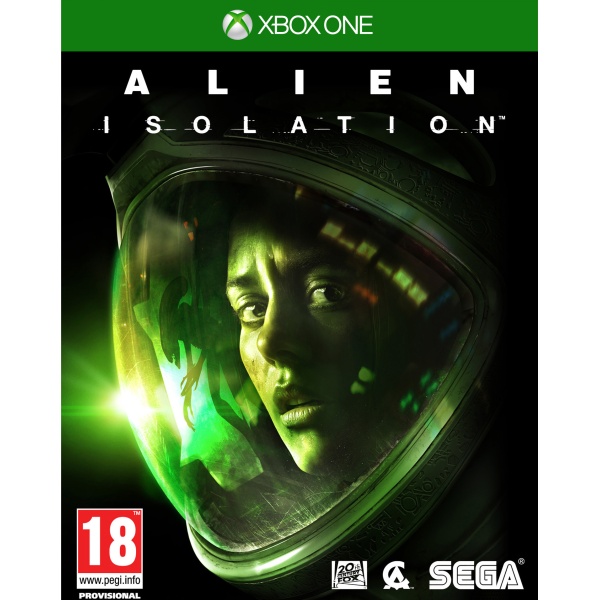
Horror on the Lens: Alien Isolation (Dev. by Creative Assembly, Published by Sega)


Alien-IsolationThere’s a quote from one of my old White Wolf books – I think Richard Dansky wrote it in Wraith:The Oblivion – that goes like this:

“The other aspect of horror is its sense of finality and the inability of a character to change it. If terror is the moment when the monster charges down the hall, horror is the instant you discover your feet are rooted to the spot.” 

Everyone who’s seen Ridley Scott’s Alien remembers the scene where Lambert is cornered by the Alien. Yaphet Kotto’s Parker is yelling at her to get out of the way so that he could use his Flamethrower, but she replies, crying..”I can’t!” I always thought that all she had to do was just kind of jump down and crawl or roll and then Parker could blast the damn thing. The movie would end. There’d be a gaping hole of acid in the Nostromo, but our heroes would get in the lifeboat and leave.

And yet, in playing Sega and Creative Assembly’s “Alien Isolation”, I found myself in almost the exact same position, huddled inside of a locker minutes after being introduced in the Alien and utterly terrified to move. Even worse, I’ve had situations where it appeared and I’m frozen in place, completely drawing a blank on my next move. I owe both Brett and Lambert an apology, rest their characters souls.

In the game you play Amanda Ripley, daughter of Ellen Ripley in the Alien films. In the special edition of James Cameron’s Aliens, there’s a brief scene between Burke and Ellen Ripley mentioning her daughter. For you trivia fans, the image used in that film was actually Sigourney Weaver’s actual mother. Anyway, It’s been 15 years since the disappearance of the Nostromo and Amanda is searching for any kind of clue that will help her find her mother or find out what happened to her. Supposedly, the flight recorder for the Nostromo was recovered and taken to Sevastopol station, a ship of roughly the same size. Basically, it’s a starship the size of Hogwarts. After finding herself separated from her crew, she has to both get her answers and find her way out of the station.

Easier said than done, of course. This game knows no mercy, even on it’s easiest setting.

The lighting effects are wonderful in next gen (especially PC). That molotov will only make the Alien mad.

The lighting effects are wonderful in next gen (especially PC). That molotov will only make the Alien mad.

The first rule of Alien Isolation is knowing that there are no safe places. Where most games have mechanics that allow you to take a breather to gear up and plan ahead or pause to get out the right weapon, Isolation will keep flowing as you take action. In Metal Gear, your game pauses when you use your backpack to look through your weapons. In Resident Evil (at least the earlier renditions), you had areas that were designated Save Rooms, places where the monsters couldn’t get at you. Alien Isolation does just the opposite.  Unless you’re checking your map for your next location, the game doesn’t pause. I’ve died while reading information on a workstation. I’ve died while rewiring a door. I’ve even died while putting myself in a locker and walking away from the console for food. It’s a strange kind of game design that forces you to keep one eye on what you’re doing and the other scouting around you to make sure you’re not being stalked. You essentially become a meerkat, poking its head up and going..”Did you hear something?”

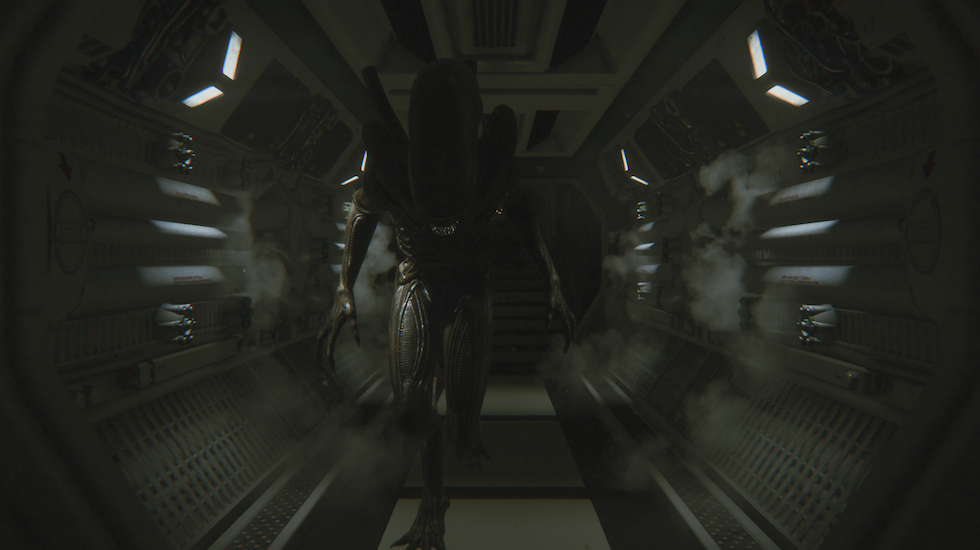
And the sound is downright fantastic, especially where the Alien is involved. This is where the true horror lies. Anyone who is familiar with the Alien franchise knows what a Xenomorph looks like. We’ve seen so many of them over the years that they’ve lost that fear factor. The horror doesn’t come from having it charge you, but knowing how close it can be before everything gets to that point. There are tons of playthrough videos out there, and it’s great to see the reactions of players as they navigate this. If I worked at Creative Assembly, I’d chuckle at some of them with pride.

Case in Point: In one area, I open a door to a hallway. It’s clear, but I hear something behind me, causing me to duck behind some boxes. Taking out a noisemaker, I figure I can throw the noisemaker out the way I came (before the door closes) and quickly make my way towards my objective. As I slowly step backwards and to my left ready to pull a Romo-like pass, I just happen to turn to look at the direction I need to go.

The Alien is right there in that entraceway, standing at full height and is peering into the room behind me. There’s a collective “Holy shit!” from everyone in the room I’m in, and I freeze. It must have shot up a vent and came down a vent behind me somewhere. The Xenomorph doesn’t see me, and goes into the room it was looking at. This frees me to make my way down the hallway I need to travel, leaving a trail of fresh urine in my wake.

Heavy footsteps echo in the dark, and when it moves from the ground to the vents, there’s a distinct difference. The game begs to be played either on an extreme surround sound system or noise canceling headphones. If you even more courageous, you can enable your Xbox’s Kinect or PS3/4’s Camera – the microphone in both will pick up the sounds of your room. So, if you’re hiding in a locker with the Xenomorph outside and a friend yells out…”Are we ordering Chinese tonight?!”, the Alien will assume you’re a tender morsel dipped in duck sauce and take you out.

From a control standpoint, Alien Isolation is simple enough that you might not forget what to do when in a panic. For the more complex acts, like lighting a flare and throwing it, you’re given on screen instructions to help you follow through. This becomes a hit or miss at first. While you’re learning that action, there’s always a chance you’ll find yourself under attack by the Xenomorph. A training room feature would be nice here, but at the same time, you’re figuring out what to do with these items just as Ripley does. You’ll find yourself scouting safe areas (and by this, I mean under a table somewhere for a minute) ahead of time to craft different items out of the spare parts you find. At your disposal are flares, medkits, EMP’s, Noisemakers, Smoke Bombs, and more. Of course, before these items can be made, you’ll have to search around for the actual blueprints (which can be anywhere). The game will thankfully teach you how to use items as you get them (if you pay attention). Eventually, you’ll get Molotovs and Flamethrowers, but the Alien understands the nature of fire. To quote Newt, “It won’t make any difference.”

As Ripley turned the corner for a bite to eat from the lunchroom, she suddenly lost her appetite.

As Ripley turned the corner for a bite to eat from the lunchroom, she suddenly lost her appetite.

Saving the game can also be a nuisance at times. Rather than having an autosave, the system incorporates the added task of having to find Save Stations disguised as phone booths to save your progress. Just as with everything else, you have the ability to die if any enemy happens to be near. It can become annoying if you’re in an area where you have a large task and find yourself all the way back at previous place once you die. It’s a drawback, indeed, but it also inspires the player (or it did for me anyway) to treat these stations like an oasis in the middle of a long stretch of desert. You’d think you were playing Ninja Gaiden sometimes, without all the flipping.

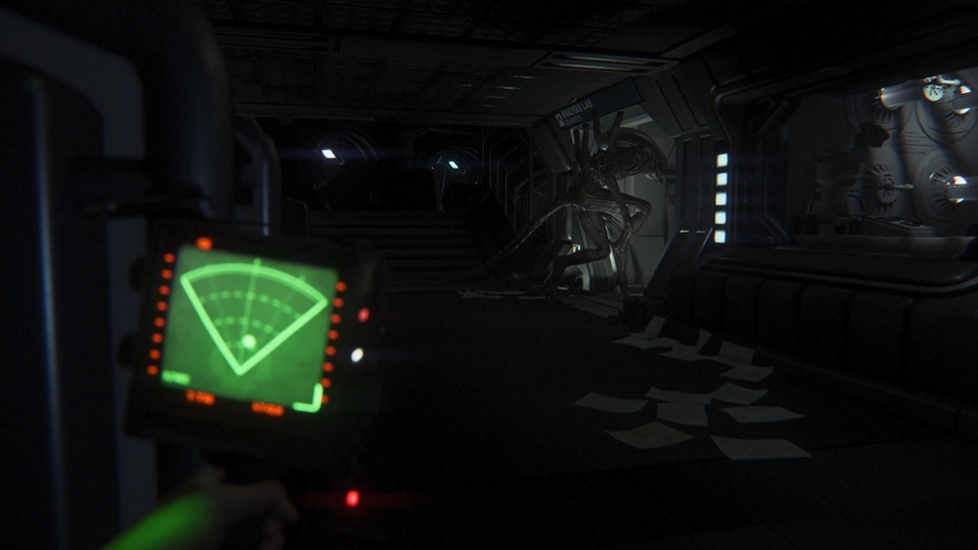
Navigating Sevestopol is done in a Metroid / Metal Gear like fashion. Basically, some areas will be locked to you without the right tool. Once you find it (be a blowtorch or a wrench), you can come back to that area. I’m not exactly sure how I feel about this just yet. It’s not exactly linear in that sense, but at the same time, I stopped playing Metroid Prime for almost the same reason. If it works for you, you’ll love it. If not, you might find yourself groaning in agony. If you’re lost, your handy Motion Tracker will help you find your nearest objective by way of a marker on the outside of your display.

4

Even in Space, the Alien can hear that beep. Put that Motion Tracker away if you have it in your line of sight. Note the marker on the outer edge telling you where to go.

Alien Isolation is slow. I mean………slow. Not in the story so much, but in the movement. You’ll want to run from point A to Point B, but with the enemies around, you’ll will sneak around for nearly the entire duration of the game (from what I’ve played so far). Don’t even bother sprinting, especially on the hardest difficulty. If you feel you’ve enough patience to play the game in this fashion, it’s a treat. If you’re hoping for something more Splinter Cell / Metal Gear like in that you’re stalking prey, it’s not happening here. Alien Isolation may have On Site Procurement of weapons, but you’ll find these are to be used sparingly, either due to the lack of ammunition / fuel, or from the echoing boom from firing the weapons. In using them you’re indirectly screaming “Hey! I’m right here on the southwest corner of the 3rd floor, kill me now! Do it!! I’m Here!!”

There are other threats on Sevastopol. You have the remaining humans on board who are just trying to survive, synthetics that can swarm you (like Bishop or Ash but not as technologically advanced), but these are enemies that can be defeated depending on what you have on you, and even then, they’re formidable. The Xenomorph, however is an 8 foot beast who delivers a one hit kill to you every time. Its presence will have you hiding in a locker frantically checking your motion tracker – but note that even enemies can sometimes hear the beep coming from it. You may even contemplate how long it’ll take for you to adjust to living in said locker for the rest of your days. According to Creative Assembly, the Alien was built with an adaptable AI that changes on the fly. I’ve had strange interactions in my experiences:

The Alien has no set patrol patterns as far as I can tell. You can watch it walk into a side room from a hiding point at the other end of the room, only to find it double back to the next room you enter. Despite how slow or silent you can be, the doors you move through still make noise, so as you progress, you never really “lose” the Alien so much as you throw it off for a minute or two.

The senses on this thing are creepy. If you are walking fast enough to hear your own feet on the floor, I absolutely guarantee you the Alien knows, too. Again, the Motion Tracker is your friend when it’s at a distance, but it’s also a problem if you’re close. My rule of thumb is that if I have a visual on it, the Motion Tracker isn’t necessary. Even then, use it sparingly to find where you need to go.

Vents. I can’t even tell you how many times I’ve had a chance to escape via a vent and chose a closet or death over it. I’m told you can use these to move around and escape even, but I haven’t even bothered.

Visually, I’ve played this on both the PS3 and the PS4. There’s nothing wrong with the PS3’s version of the game graphically (which is amazing), but if you have access to one, the lighting engines are just better on the next gen consoles. Shadow affects are nice between the two, but there’s a better gradient on the PS4’s newer hardware and smoke / fire effects are that much stronger on that system. Also note that the PS3 runs the game at about 720p, while the PS4 easily handles a 1080p playthrough. I am told that there can occasionally be some glitches where in crawling, you can fall through a room, but I have yet to run into these.

Renderings of the Sevastopol feel like they’re taken right from the first Alien film, as Creative Assembly was pretty much given as much access as they could get to 20th Century Fox’s archives. If you ever wondered what it would feel like to walk those dark halls of the Nostromo with a giant man sized Bone Dragon at your heels, this is the game for you. From the title sequence alone, you get an idea that CA were fans of the first film, and tried to design a game that does its best to immerse you into that universe. It doesn’t get everything right, but it does present the player with a sense of fear and stress unlike anything I’ve played before. Perhaps it’s just me.

In terms of drawbacks, one of the problems comes in the renderings of humans. They don’t seem to have the same sense of care that the Alien gets, most of them walking around with “dead eye” syndrome (like in Final Fantasy: The Spirits Within). The voice acting is okay, but isn’t particularly memorable. It’s like watching a Friday the 13th film. Do you really remember Kevin Bacon’s last lines before he was killed? Maybe, maybe not, but you do remember how he died.

ps4_online_preview_screen001_copy

If this is what you see from your Point of View, you’re probably already dead.

 Part of the soundtrack is built off of Jerry Goldsmith’s original score, and the same also features that weird “space wind” sound occasionally, which is so damn eerie. This may actually be (despite it’s flaws) the best movie tie-in/adaptation I’ve ever played. Most movie related games are either rushed projects (I’m looking at you Gearbox. I love Borderlands, but I remember the bad taste of Aliens: Colonial Marines) or fail to completely capture the feel of the movie. I’m very eager to see what Creative Assembly does next, Alien related or not. I’ve truly had fun with this game, despite it being as frustrating as Dark Souls.

Overall, Alien Isolation is a solid game for any fan of the original film. It’s the closest you’ll get to experiencing that universe (or at least playing the ultimate version of Cat & Mouse), even though the slow pace, saving mechanic and unforgiving AI may prove frustrating / unexciting to some.

Trailer: Dead Rising 3 (Gameplay Trailer)


DeadRising3I will admit that zombie entertainment will always catch my attention. Yes, it probably has reached oversaturation, but guess what…I don’t care. I’ve always enjoyed the apocalyptic, Last Man On Earth possibilities that zombie entertainment has offered gamers, readers and viewers. This was the case with the first Dead Rising by Capcom and then by it’s sequel Dead Rising 2 a couple years ago.

Dead Rising 3 has now been announced as an exclusive title for the Xbox One and it looks to take the power of the One to upgrade the graphics, gameplay and overall experience of the title. This time around instead of set inside a mall or a Las Vegas strip-style location we have a game that’s more akin to Grand Theft Auto or Saints Row in terms of open-sandbox gameplay. This looks to be a natural progression for a franchise that seem to get bigger and bigger with each each release.

This gameplay trailer during the Microsoft E3 Presser just shows how much bigger and interactive Dead Rising 3 than it’s two previous predecessors.

Dead Rising 3 is set to be a launch title for the Xbox One.

Trailer: Resident Evil 6 “No Hope Left” Cinematic Live-Action


I haven’t been as big a fan of Capcom’s Resident Evilsurvival horror game franchise (weird considering that zombie fiction and entertainment is like catnip to me), but the upcoming and latest entry in the series has me excited. Resident Evil 6 looks to return the series to its zombie roots after spending the last two titles veering away from it.

While the gameplay still looks to be just something upgraded and tweaked from games past the story itself looks like something that I would find interesting as it moves the danger from being localized to something more global in scope. I’m really hoping that this title brings me back to the franchise which was great in the beginning then began to lose steam and ideas in it’s latest offerings.

This latest trailer takes a page out of the Halofranchise’s marketing book by making it live-action. It might be only 90 seconds but getting a glimpse of how a world reacts to the onset of a zombie apocalypse makes for a nice, brief piece of entertainment.

Resident Evil 6 is set for an October 6 release for the Xbox 360, PS3 and Windows PC.

E3 Trailer: Resident Evil 6 (Official)


Another game which seem to have gotten a huge positive reaction from the pre-E3 pressers on Monday was Capcom’s latest entry in its very popular and lucrative survival-horror series, Resident Evil (Biohazard in Japan). This is a series that goes back over a decade and through several console lifetimes and still remains as popular now as when it first began.

The game looks to bring back several well-known faces from the previous games in the series like Leon S. Kennedy, Chris Redfield, Ada Wong and Sherry Birkin. One thing the latest game brings back that’s been missing in the last two games was the main antagonist that started it all and that’s the Umbrella Corporation. The game also looks to expand the locales where the game takes place in. In previous titles in the series the location tend to be very localized with some international jet-setting here and there, but from the looks of the trailer it seems that Resident Evil 6 will be going global.

I haven’t played a Resident Evil game in years, but it looks like this cold streak may just end with Resident Evil 6.

Resident Evil 6 is set for an October 2, 2012 release date.

E3 2011: Dead Island (Exclusive Trailer and Gameplay Demo)


Just a little under four months ago the announcement trailer for the Techland and Deep Silver zombie survival horror title, Dead Island, premiered to much acclaim. The trailer was like a short film and really tugged at the emotions of those who saw it for the first time. The trailer itself didn’t show what the game was all about other than a paradise resort becoming the setting for a zombie survival horror game with open-world gameplay.

A couple more trailers using gameplay scenes came out since then, but it’s now E3 and gamers want more info on just how the game plays. Techland and Deep Silver didn’t disappoint. In addition to a new trailer made exclusively for this year’s E3, the game also was available in demo form for attendees to check out and play. The two-part video below is one such example of someone playing the demo.

From what I could tell from the gameplay demo this game seems to be a much more serious version of the campy and over-the-top Capcom zombie horror title Dead Rising. Weapons seem to be mostly melee types like machete, knives, steel bars and such with the random rifles and pistols to be found during the game. Dead Island looks great from what I could see from the demo. Hopefully, more details about the gameplay and the co-op multiplayer will be released between E3 and the game’s release.

Dead Island is set for a September 6, 2011 for the U.S. and September 9, 2011 for the rest of the world.