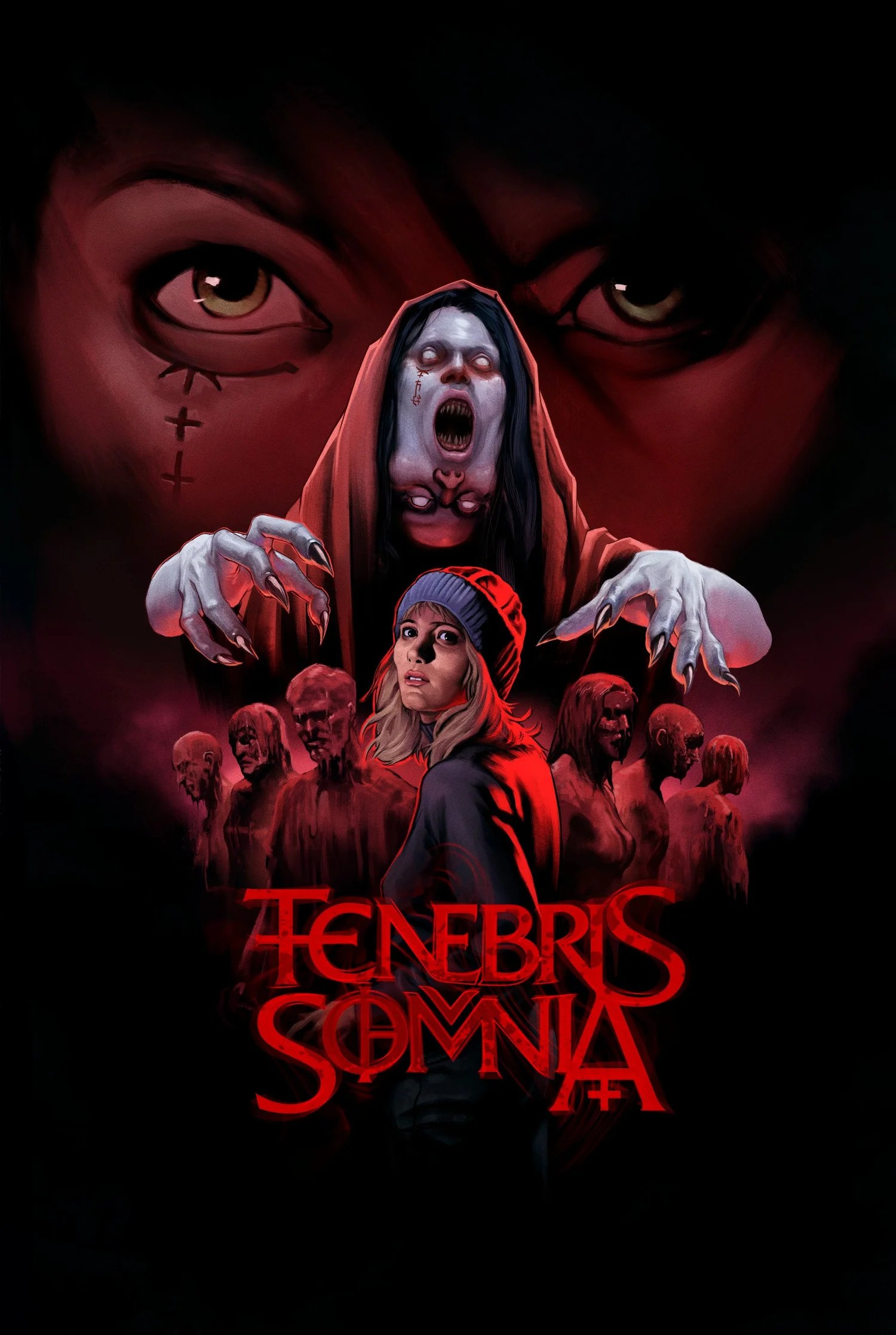
“What if they aren’t just nightmares…” — Tenebris Somnia
A breakup can leave plenty of unfinished business, but fighting monsters in your ex’s apartment is a pretty extreme way to deal with it. That’s the uncomfortable territory Tenebris Somnia explores, turning lingering concern and shared history into the foundations of a supernatural nightmare. Developed by Andrés Borghi, Tobías Rusjan, and Saibot Studios, this indie horror game pairs retro 8-bit-style gameplay with live-action sequences. The combination gives it an immediately recognizable identity, but the relationship underneath keeps it from feeling like a technical experiment. Its strongest idea is that leaving somebody behind doesn’t necessarily mean escaping the life you built together.
Julia, a filmmaker, returns to her ex-boyfriend Ivan’s apartment after recurring nightmares show him being attacked by horrific creatures. Checking on him seems reasonable enough, even if revisiting their former home already promises an awkward conversation. Unfortunately, Ivan’s involvement with a mysterious cult has made the situation considerably worse than Julia expects. She becomes caught in spaces distorted by memory and supernatural forces, where their shared past is no longer something she can keep at a comfortable distance. Concern gets her through the door, but understanding what’s happening requires confronting more than the immediate danger.
Their background in filmmaking makes that history more interesting than a generic troubled romance. Creative collaboration has become tangled up with affection, ambition, and resentment, leaving Julia and Ivan’s personal disappointments difficult to separate from their artistic ones. Revisiting the relationship means questioning what they wanted from each other and how those expectations changed. Julia also has her own convictions, which keeps her from becoming a passive visitor inside Ivan’s breakdown. She has an emotional stake in the memories being uncovered, and the story benefits from treating their history as something both characters experienced rather than something only he gets to define.
That tension between recognition and discomfort carries into the presentation. During gameplay, the retro 8-bit-style pixel art reduces rooms, characters, and monsters to relatively simple forms. It’s a deliberate choice, but not one everyone will enjoy. Players accustomed to hyper-realistic CG graphics may find the chunky sprites and limited detail more distancing than frightening, especially if visual realism is central to their enjoyment of horror. The game asks you to let your imagination finish the picture. If that aesthetic leaves you cold, the live-action footage won’t necessarily make the playable sections more appealing.
For players willing to embrace it, though, the contrast does more than provide a novelty. A creature that looked unpleasant in pixel form suddenly has texture, weight, and a disturbingly physical presence. Recognizable details connect the two styles, making the filmed sequences feel like a closer view of the same nightmare. Careful framing and expressive performances help maintain that connection, with Clara Kovacic giving Julia a human presence beyond her small playable sprite. The practical and digital effects also benefit from relatively clear footage. Without artificial VHS damage constantly obscuring the image, the monsters have nowhere to hide—and neither do you.
Between those sequences, Tenebris Somnia follows a familiar survival-horror routine of searching rooms, collecting objects, solving puzzles, and managing limited supplies. The sound design reinforces the uncertainty through harsh effects and recognizable monster noises, making danger a concern before it necessarily appears on-screen. Puzzles encourage you to understand the environment rather than simply move through it. Strange connections suit a setting distorted by memory, provided the clues establish enough logic. Progress becomes less satisfying when an easily overlooked item or interaction point sends you circling the same room. Careful investigation builds atmosphere; repeatedly checking everything because one detail barely registers tends to drain it.
Combat is less assured, largely because its survival-horror intentions are more convincing than its execution. Melee attacks, firearms, and evasive movement give Julia options, while limited ammunition makes fighting a decision rather than a reflex. Removing an enemy might make exploration safer, but those bullets could be more valuable later. That’s an effective source of tension when encounters cooperate with it. The problem is that stiffness can shift your attention away from resource management and toward the basic difficulty of carrying out your plan. Instead of worrying about whether an attack is worth attempting, you can end up worrying about whether it will behave as expected.
Cramped spaces make that friction more noticeable because there’s less room to recover when an attack or evasive movement goes wrong. Horror benefits from making a protagonist vulnerable, but vulnerability still needs consistent rules. Otherwise, the fear of getting hurt gives way to irritation about how the damage happened. Boss encounters expose those weaknesses more clearly. Their designs make a strong first impression, but some fights demand more precision and repetition than the mechanics comfortably support. Checkpoints soften failure without making every retry engaging. The creatures are often more compelling as disturbing presences than as opponents you have to repeatedly bring down.
Those shortcomings keep Tenebris Somnia from being an effortless recommendation, particularly for players who need polished combat or dislike retro graphics. Still, its relationship drama, filmmaking background, and mixed-media presentation reinforce one another in a way that gives the experience genuine personality. The monsters aren’t the only reason Julia’s return feels uncomfortable; they make an already complicated reunion physically dangerous. For horror fans drawn to atmosphere and unsettling imagery, that combination has plenty of appeal. The visit begins with concern for someone Julia once loved, then becomes a reminder that caring about a person and understanding what they’ve become are very different things.

