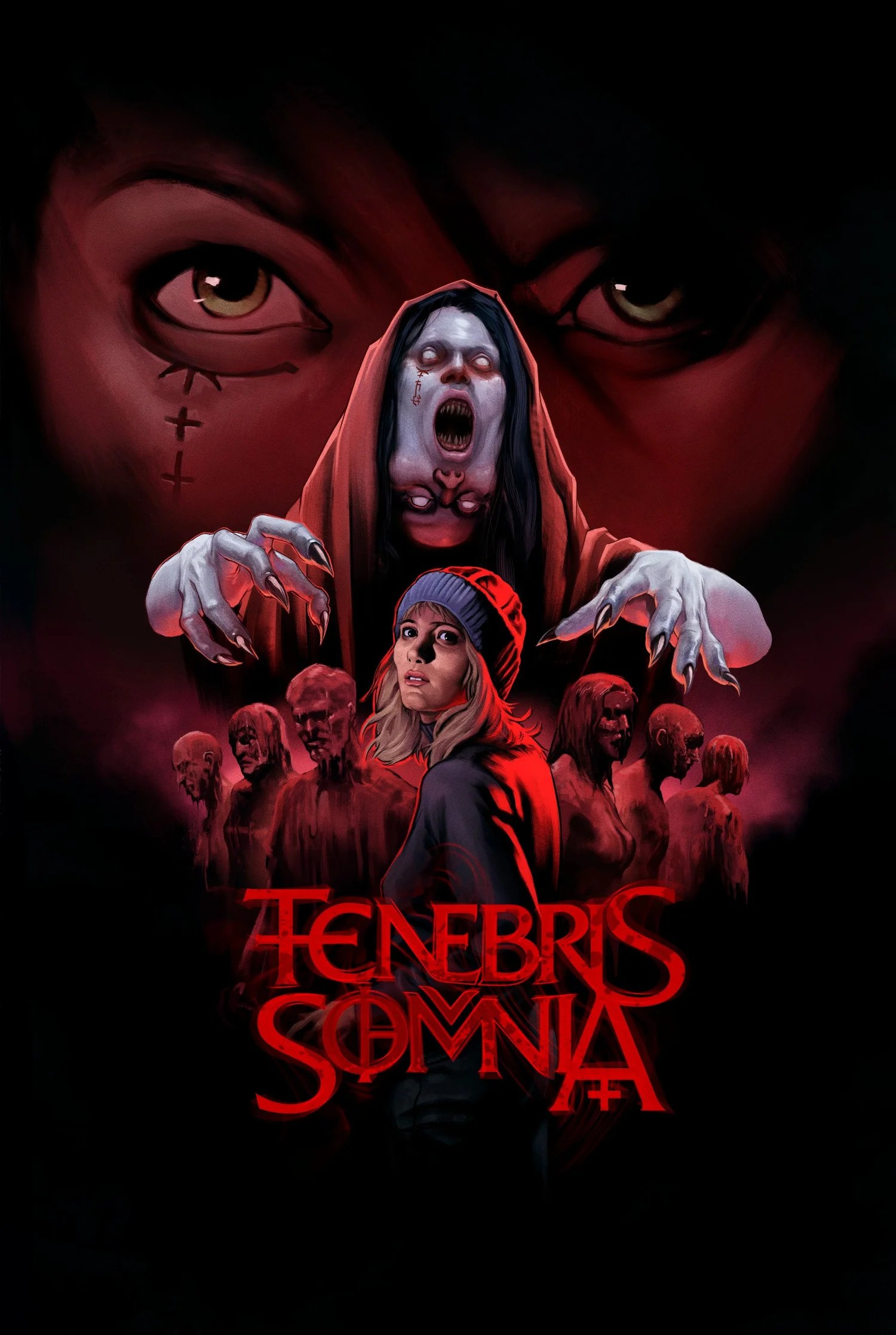
Horror Game Review: Tenebris Somnia (by Andrés Borghi, Tobías Rusjan & Saibot Studios)


“What if they aren’t just nightmares…” — Tenebris Somnia

A breakup can leave plenty of unfinished business, but fighting monsters in your ex’s apartment is a pretty extreme way to deal with it. That’s the uncomfortable territory Tenebris Somnia explores, turning lingering concern and shared history into the foundations of a supernatural nightmare. Developed by Andrés Borghi, Tobías Rusjan, and Saibot Studios, this indie horror game pairs retro 8-bit-style gameplay with live-action sequences. The combination gives it an immediately recognizable identity, but the relationship underneath keeps it from feeling like a technical experiment. Its strongest idea is that leaving somebody behind doesn’t necessarily mean escaping the life you built together.

Julia, a filmmaker, returns to her ex-boyfriend Ivan’s apartment after recurring nightmares show him being attacked by horrific creatures. Checking on him seems reasonable enough, even if revisiting their former home already promises an awkward conversation. Unfortunately, Ivan’s involvement with a mysterious cult has made the situation considerably worse than Julia expects. She becomes caught in spaces distorted by memory and supernatural forces, where their shared past is no longer something she can keep at a comfortable distance. Concern gets her through the door, but understanding what’s happening requires confronting more than the immediate danger.

Their background in filmmaking makes that history more interesting than a generic troubled romance. Creative collaboration has become tangled up with affection, ambition, and resentment, leaving Julia and Ivan’s personal disappointments difficult to separate from their artistic ones. Revisiting the relationship means questioning what they wanted from each other and how those expectations changed. Julia also has her own convictions, which keeps her from becoming a passive visitor inside Ivan’s breakdown. She has an emotional stake in the memories being uncovered, and the story benefits from treating their history as something both characters experienced rather than something only he gets to define.

That tension between recognition and discomfort carries into the presentation. During gameplay, the retro 8-bit-style pixel art reduces rooms, characters, and monsters to relatively simple forms. It’s a deliberate choice, but not one everyone will enjoy. Players accustomed to hyper-realistic CG graphics may find the chunky sprites and limited detail more distancing than frightening, especially if visual realism is central to their enjoyment of horror. The game asks you to let your imagination finish the picture. If that aesthetic leaves you cold, the live-action footage won’t necessarily make the playable sections more appealing.

For players willing to embrace it, though, the contrast does more than provide a novelty. A creature that looked unpleasant in pixel form suddenly has texture, weight, and a disturbingly physical presence. Recognizable details connect the two styles, making the filmed sequences feel like a closer view of the same nightmare. Careful framing and expressive performances help maintain that connection, with Clara Kovacic giving Julia a human presence beyond her small playable sprite. The practical and digital effects also benefit from relatively clear footage. Without artificial VHS damage constantly obscuring the image, the monsters have nowhere to hide—and neither do you.

Between those sequences, Tenebris Somnia follows a familiar survival-horror routine of searching rooms, collecting objects, solving puzzles, and managing limited supplies. The sound design reinforces the uncertainty through harsh effects and recognizable monster noises, making danger a concern before it necessarily appears on-screen. Puzzles encourage you to understand the environment rather than simply move through it. Strange connections suit a setting distorted by memory, provided the clues establish enough logic. Progress becomes less satisfying when an easily overlooked item or interaction point sends you circling the same room. Careful investigation builds atmosphere; repeatedly checking everything because one detail barely registers tends to drain it.

Combat is less assured, largely because its survival-horror intentions are more convincing than its execution. Melee attacks, firearms, and evasive movement give Julia options, while limited ammunition makes fighting a decision rather than a reflex. Removing an enemy might make exploration safer, but those bullets could be more valuable later. That’s an effective source of tension when encounters cooperate with it. The problem is that stiffness can shift your attention away from resource management and toward the basic difficulty of carrying out your plan. Instead of worrying about whether an attack is worth attempting, you can end up worrying about whether it will behave as expected.

Cramped spaces make that friction more noticeable because there’s less room to recover when an attack or evasive movement goes wrong. Horror benefits from making a protagonist vulnerable, but vulnerability still needs consistent rules. Otherwise, the fear of getting hurt gives way to irritation about how the damage happened. Boss encounters expose those weaknesses more clearly. Their designs make a strong first impression, but some fights demand more precision and repetition than the mechanics comfortably support. Checkpoints soften failure without making every retry engaging. The creatures are often more compelling as disturbing presences than as opponents you have to repeatedly bring down.

Those shortcomings keep Tenebris Somnia from being an effortless recommendation, particularly for players who need polished combat or dislike retro graphics. Still, its relationship drama, filmmaking background, and mixed-media presentation reinforce one another in a way that gives the experience genuine personality. The monsters aren’t the only reason Julia’s return feels uncomfortable; they make an already complicated reunion physically dangerous. For horror fans drawn to atmosphere and unsettling imagery, that combination has plenty of appeal. The visit begins with concern for someone Julia once loved, then becomes a reminder that caring about a person and understanding what they’ve become are very different things.

Review: Final Fantasy VI


“It’s not the result of one’s life that’s important. It’s the day-to-day concerns, the personal victories, and the celebration of life… and love. It’s enough if people are able to experience the joy that each day can bring…” – Terra Bradford

Final Fantasy VI is one of those JRPGs that feels bigger than the cartridge it shipped on, and even now it earns its reputation as both a high point of the 16-bit era and a blueprint for what narrative-driven RPGs could become. It is dense, melodramatic, occasionally clunky, but consistently ambitious in ways that still feel relevant to the genre’s modern landscape, blending theatrical storytelling with flexible mechanics and a structure that dares to rethink its own world midway through. Revisiting it reveals not just a classic, but a foundational text whose echoes show up in everything from ensemble casts to customizable skill systems in later titles.​

The opening hours set the tone with impressive confidence, dropping you right into a steampunk-flavored world where magic has been industrialized into a tool of conquest. Terra, a half-human, half-Esper whose mind is shackled by an imperial slave crown, marches through snowy mountains in powered Magitek armor toward the mining town of Narshe, instantly hooking you with her vulnerability amid high-stakes espionage. This personal thread weaves into a broader guerrilla war between the Gestahlian Empire—led by the scheming Gestahl and his unhinged general Kefka—and the ragtag Returners resistance, but the real genius is how the story quickly pivots from standard “rebels vs. empire” to a sprawling ensemble piece that trusts no single hero to carry the weight.

​

That cast of fourteen permanent party members is the game’s boldest swing, each layered with backstories, quirks, and mechanical identities that make them stick. Terra grapples with her monstrous heritage and search for belonging, Celes wrestles betrayal and isolation after defecting from the Empire, Locke chases redemption for a lost love, Cyan buries himself in grief over his family’s slaughter, Sabin roams as a free-spirited brawler, Edgar plays the charming king-turned-inventor, and Setzer brings cynical gambler flair—it’s a roster that juggles melodrama like opera-house soliloquies and doomed romances with quieter, human moments that land surprisingly hard even today. Some inevitably get shortchanged if you beeline through the back half, feeling more like vivid archetypes than deep dives, but the sheer ambition of giving everyone a mini-arc amid the chaos set a new bar for character work in JRPGs, influencing how later games like the Persona series built entire identities around tight-knit parties and personal subplots.​​

Kefka anchors the escalating stakes as few villains do, evolving from a clownish psycho prone to war crimes like poisoning a town into a nihilistic force who hijacks the god-like Warring Triad, shatters the planet, and rules the resulting apocalypse as a tyrant-god cackling over the ruins. Midway through, he doesn’t just threaten doom—he delivers it, wiping cities off the map and thrusting the story into the World of Ruin, a time-skipped wasteland where survivors scrape by amid decay and despair. This pivot isn’t a cheap shock; it’s a structural earthquake that shifts the tone to post-apocalyptic reflection, forcing each character to confront whether they even have a reason to fight on, with Celes’ suicidal low point on a lonely island giving way to gradual reunions that feel earned because you choose the order. That willingness to let the bad guy win—and make the heroes rebuild emotionally as well as literally—rippled through the genre, showing JRPGs could handle survivor guilt, loss, and fragile hope without hand-waving the darkness.​

Structurally, it’s like two games fused together: the linear World of Balance builds your crew through set pieces like infiltrations, multi-party defenses, and the iconic opera sequence, then explodes into a semi-open World of Ruin where you roam a shattered map, tackling side dungeons and personal vignettes at will. Pacing can wobble if you stray off-path early or grind too hard later, but the freedom to prioritize arcs—like Cyan’s haunted family dreams or Terra’s village sanctuary—mirrors the themes of recovery, prefiguring how modern titles blend cosmic plots with player-driven character priorities.​

Combat nails a sweet spot with the Active Time Battle system, where gauges fill in real-time for flexible pacing—toggle “Active” for pressure or “Wait” to strategize—and row positioning adds tactics, frontliners tanking full hits while backrow slings safer damage. Character-unique commands keep it fresh: Sabin’s Blitz commands mimic fighting-game inputs, Edgar’s Tools hit formations, Cyan charges sword techs, Gau Rages as monsters, Setzer gambles on slots—making swaps feel playful and deliberate. The Esper system elevates this, letting anyone equip magical summons to learn spells via Magic Points and snag level-up bonuses, blending fixed identities with modular builds in a way that blurred roles late-game but normalized customization as core to JRPG fun.​

This philosophy—strong personalities atop teachable, recombinable abilities—quietly reshaped the genre, with Persona‘s demon/persona fusion, Lost Odyssey‘s memory-tied skills, and similar systems in Clair Obscur owing a debt to Espers as a bridge from rigid classes to player-sculpted parties without erasing narrative flavor. Dungeons mix it up too, from pincer ambushes and gimmick bosses like the shell-hiding Whelk to timed escapes and that charming opera blending inputs with spectacle, though some late hauls drag with random encounters exposing 16-bit limits.​

Visually, it’s pixel art at its peak: expressive sprites, detailed industrial backdrops, and a palette flip from Balance’s vibrancy to Ruin’s sickly decay, with ruined landmarks and evolving NPC lines selling irreversible change. Bosses escalate to surreal, painterly horrors fitting the finale’s otherworldliness, proving art direction trumps raw fidelity.​

Nobuo Uematsu’s soundtrack is legendary for good reason, weaving leitmotifs—Terra’s theme, Kefka’s manic laugh, Celes’ aria—into a narrative spine that evolves with the story, from triumphant fanfares to haunting piano and faux-choral dread, all within SNES constraints. It established JRPG scores as orchestral-caliber storytelling tools, influencing fully symphonic later works and live concerts.​

Final Fantasy VI‘s legacy permeates JRPGs today, its DNA visible in the way Persona weaves school-life bonds with supernatural showdowns, how Lost Odyssey probes immortal grief through written vignettes, or how ambitious indies like Clair Obscur chase painterly melancholy and hope amid ruin—the ensemble healing, world-shattering pivots, and trauma-to-recovery arcs all trace back here, proving a 16-bit game could set emotional and structural templates still in play. Hironobu Sakaguchi crystallized as the modern JRPG’s godfather through this title, fusing mechanical innovation like Esper flexibility with mature themes of identity and despair that Final Fantasy VII and beyond amplified into global phenomena, his vision elevating the genre from quest logs to profound, character-soaked epics.​

​

The Final Fantasy VII Remake‘s blockbuster success—reimagining a classic with modern graphics, cinematic flair, real-time twists, and expanded character beats—has only intensified fan campaigns for VI to get similar lavish treatment, from a fully voiced, motion-captured opera house to a destructible world rendered in heartbreaking detail and Ruin reunions that hit even harder with modern intimacy. Yet Square Enix leadership has flagged the project’s nigh-insurmountable scale: the fourteen-character sprawl, mid-game reset, player-driven nonlinearity, and web of optional stories demand a development odyssey that could dwarf even VII‘s trilogy, risking dilution of what makes the original a personal, unpredictable journey if forced into rigid cinematic lanes.​

Flaws persist—sappy dialogue dates it amid earnest monologues, sidelined characters like Gau or Strago need deliberate hunting for payoff, Espers can shatter balance into spell-spam routs, and marathon dungeons fatigue under random encounter spam—but these 16-bit quirks pale against a boldness that endures. Final Fantasy VI isn’t frozen nostalgia; it’s a living cornerstone, its sprawling heart, tinkering joy, musical sweep, and unyielding ambition still sparking JRPG evolution, demanding replays not as history homework but as a masterclass in what the genre can feel like when it swings for the fences and connects. Decades on, it whispers to every ambitious RPG dev: let your world break, let your cast breathe, let your systems invite play—and watch players find reasons to care long after the credits roll.