Mitch Taylor (Gabriel Jarrett) is a teenage genius who is recruited by Prof. Jerry Hathaway (William Atherton) to study at Pacific Tech University. The real reason why Hathaway has recruited Mitch is because Chris Knight (Val Kilmer), another genius, has been slacking on developing the power source for an experimental laser called “crossbow.” Hathaway hopes that Mitch can get Chris to take his work seriously and to focus on the project. Instead, Chris teaches Mitch that he has to learn how to enjoy life or his great intelligence will become a burden and he’ll end up burned out and living in the tunnel underneath the university. That’s what happened to Laszlo Holyfield (Jon Gries). That’s what nearly happened to Chris. Chris is determined not to let it happen to Mitch.
Real Genius combines college hijinks with a serious examination of the pressures of being a “real genius.” Mitch knows everything about laser physics but he still misses his parents and cries after getting yelled at by Prof. Hathaway. He’s just a kid, no matter how smart he is. Chris proves himself to be a good friend, encouraging Mitch to relax and enjoy life. Just because you’re a genius doesn’t mean that you can’t have fun. As played by Val Kilmer, Chris Knight is the best friend that everyone wishes they could have, whether they’re a genius or not. Even when the film gets sophomoric, Kilmer plays his role seriously and never loses sight of Chris’s humanity or why it’s so important to Chris that Mitch not become consumed by the pressure of being smarter than almost everyone else in the room. This is one of the early Val Kilmer performances that showed just how good an actor he truly was. With Chris’s encouragement, Mitch pursues a romance with Jordan Cochran (Michelle Meyrink) and gets revenge (more than once) on the arrogant Kent (Robert Prescott).
Eventually, Chris and Mitch realize that their research is being used to construct a weapon for the CIA and this leads to the film’s famous ending. Ever since this movie came out, there’s been a debate over whether or not a laser could be used to make popcorn and, even more importantly, whether or not a gigantic amount of popcorn could actually destroy someone’s house. I don’t know the answers to those questions but I’d like to think that Real Genius got it right and I have no interest in any evidence that suggests otherwise. Sometimes, you owe it yourself to believe in the power of lasers and popcorn. The next person who takes advantage of your hard work, destroy his house with popcorn and then sing Everybody Wants To Rule The World. Learn the lessons of Real Genius.
Finally, when I was growing up, Real Genius was one of those films that seemed to be on HBO all the time. Somehow, I always turned it on right when the popcorn started popping. That popcorn-filled house, followed by Everybody Want To Rule The World, was a huge part of my childhood. Real Genius will always bring back good memories for me.
Welcome to Retro Television Reviews, a feature where we review some of our favorite and least favorite shows of the past! On Sundays, I will be reviewing the made-for-television movies that used to be a primetime mainstay. Today’s film is 1972’s Playmates! It can be viewed on YouTube.
Playmates tells the story of two divorces.
Marshall Barnett (Alan Alda) is an attorney. He went to Yale and Harvard. He has a successful career. He has rich and educated friends. He has a nice bachelor pad. He also pays hundreds of dollars in alimony. He and Lois (Barbara Feldon) got divorced 3 years ago and Marshall is still bitter. He’s bitter that he has to pay her so much money. He’s bitter that he only gets to see his son on the weekends. He’s bitter that he can’t seem to start a new, meaningful relationship with anyone. He’s bitter that his wife still asks him to critique her modernist paintings.
Kermit Holvey (Doug McClure) is a blue collar welder. He has only been divorced for a few months and his relationship with ex-wife Patti (Connie Stevens) is nowhere near as contentious as Marshall’s relationship with Lois. Still, Kermit is struggling to adjust to being single and to only seeing his son on the weekends.
Marshall and Kermit meet one weekend while they are both taking their sons to the Kiddieland Amusement Park. Marshall is so overjoyed to meet someone else who is dealing with divorce that he comes on a bit strong in trying to get to know Kermit. Kermit, however, does eventually get over his initial weariness and soon, he and Marshall are best friends. It doesn’t matter that Marshall has a tendency to be a little bit condescending and that Kermit often can’t follow what Marshall is talking about. They spend most of their time talking about their ex-wives.
But then Kermit meets Lois and he discovers that her paintings really aren’t as bad as Marshall made them out to be. And Marshall meets Patti and he discovers that she’s not as dumb as Kermit made her out to be. Soon, Kermit is secretly dating Lois and Marshall is secretly dating Patti and anyone who has ever watched a comedy before knows that there is a big mess waiting in the future.
Playmates was one of those films that pretended to be a lot naughtier than it actually was. For all the winking and the occasional sly smiles, all that happens is that Kermit and Marshall both end up going out with women with whom they really don’t have much in common. And while it’s tempting to read a lot into how quickly Kermit and Marshall become friends and how they both end up dating the other’s female equivalent, I think that might be giving this film too much credit. (If it were made today, things might be different.) In the end, the film really has more to say about class than it does marriage, as both Marshall and Lois obviously view spending time with Kermit and Patti as being a way of slumming and building up some working class bona fides without actually having to be working class. Patti, to her credit, calls Marshall out on this. Marshall admits that she has a point but he still come across as if he’s talking down to her, largely because he’s played by Alan Alda, an actor who is a master at being somehow both likable and condescending at the same time.
Playmates is a well-acted film and there are some funny lines. The four main characters are all ultimately likable, even if they all have their moments where you can tell why they would be difficult to live with. It deserves some credit for following its story through to its natural conclusion, with one couple realizing that they still love each other while the other realize that they are better off divorced. The film may not be as radical as it pretends to be but it still doesn’t cop out on the ending. In the end, Playmates is probably best watched as a time capsule. It’s here if you ever want to experience 1972 firsthand.
What’s an Insomnia File? You know how some times you just can’t get any sleep and, at about three in the morning, you’ll find yourself watching whatever you can find on cable or streaming? This feature is all about those insomnia-inspired discoveries!
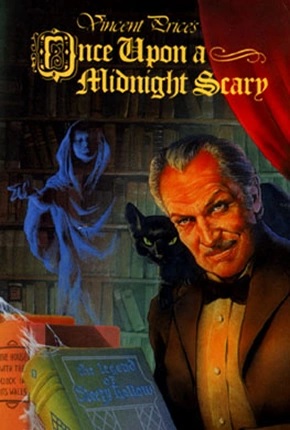
If you were having trouble getting to sleep last night, you could have gone over to YouTube and watched 1978’s Once Upon A Midnight Scary.
Made for CBS and featuring Vincent Price as the sardonic, cape-wearing host, Once Upon A Midnight Scary was a special designed to encourage young viewers to pick up a book and read. Price introduced three different stories, each centering around ghosts and each based on a book. In the first story, based on the book The GhostBelonged To Me, a young farmboy discovers a ghost hiding in a barn and becomes a hero when the ghost warns him about an impending disaster. The second story is an adaptation of The Legend of Sleepy Hollow and it features Rene Auberjonois as a rather neurotic Ichabod Crane, who finds himself being pursued by the headless horsemen. The third and longest story is an adaptation of The House With A Clock In Its Walls, featuring Severn Darden and a rather annoying child actor.
One thing you immediately notice about this show is that the special doesn’t actually reveal how any of the stories end. Instead, each story is basically a recreation of the most exciting or interesting parts of the larger story but, whenever it appears that we’re heading for a conclusion, Vincent Price suddenly appears and says, “What happened next, you ask? Read the book!” This special basically casts Vincent Price as the world’s most devilish book salesman and while that might be annoying if you’re watching the special because you want to see how the stories turn out, it’s a lot of fun if you’re just watching the show to watch Vincent Price act like Vincent Price. Vincent is not in the special as much as you might want but he still shows off his unique charm. It’s impossible to be in a bad mood while watching Vincent Price.
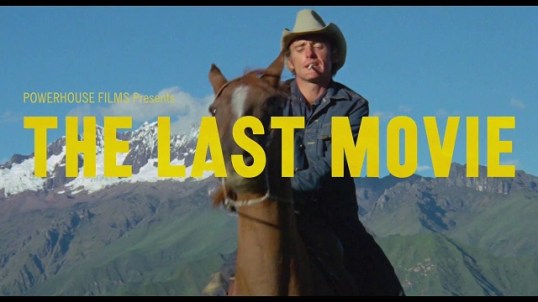
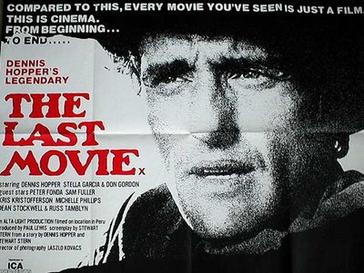
The story behind the making of 1971’s The Last Movie is legendary. It’s also a bit of a cautionary tale.
In 1969, Hollywood was stunned by the box office success of an independent, low-budget counter-culture film called Easy Rider. Easy Rider not only made a star out of Jack Nicholson but it was also the film that finally convinced the studios that the way to be relevant was not to continue to crank out big budget musical extravaganzas like Doctor Doolittle and Hello, Dolly! Instead, it was decided that the smart thing to do would be to hire young (or, at the very least, youngish) directors and basically just let them shoot whatever they wanted. The resulting films might not make much sense to the executives but, presumably, the kids would dig them and as long as the kids were paying money to see them, everyone would continue to get rich. Because Dennis Hopper had directed Easy Rider, he suddenly found himself very much in demand as a director.
Of course, almost everyone in Hollywood knew Dennis Hopper. Long before he became an icon of the counter-culture, Dennis Hopper had been a part of the studio system. John Wayne even referred to Hopper as being his “favorite communist.” Everyone knew that Dennis could be a bit arrogant. Everyone knew that Dennis was very much into drugs and that, as a result, he had a reputation for being a bit unstable. Everyone knew that Dennis Hopper deliberately cultivated an image of being a bit of a wild man and a revolutionary artist. But Dennis Hopper had just directed Easy Rider and Universal was willing to give Hopper some money to go down to Peru and direct his follow-up.
The Last Movie was a film that Hopper had been planning on making for a while. The film’s original script told the story of an aging and broken-down stuntman named Kansas who retires to Mexico and searches for a gold mine with a friend of his. Hopper first tried to get the film going in 1965, with Montgomery Clift in the lead role. After Clift died, Hopper tried to interest John Wayne in the starring role but, though Wayne enjoyed having Hopper in his films so that he could threaten to shoot him whenever Abbie Hoffman said something shocking, he had no interest in being directed by him. When Universal finally agreed to put up the money for the film, Hopper offered the lead role to Jack Nicholson. Nicholson turned it down and told Hopper that it was obvious that Dennis wanted to play the role himself. Dennis decided that he agreed with Nicholson and he cast himself as Kansas. Dennis also made the fateful decision to not only change the story’s setting to Peru but to also film on location.
Dennis and a group of friends flew down to Peru, which, at that time, was the cocaine capitol of the world. Drug use was rampant on the set, with Dennis reportedly being one of the main offenders. The cast and crew filmed during the day and partied at night and no one was particularly sure what the film was supposed to be about. Amazingly, Hopper finished filming on schedule and within budget but, much as he did with Easy Rider, he also overfilmed and ended up with 40 hours of footage. Not wanting to be bothered by the studios, Hopper edited the footage in his compound in Taos, New Mexico. Working slowly and continuing to consume a large amount of drugs and alcohol, Hopper still managed to put together a film that had a straightforward storyline. When Hopper showed his initial cut to filmmaker Alejandro Jodorowsky, the director of El Topo accused Hopper of being too conventional in his approach, which led to Hopper chopping up the film and reassembling it. Finally, after spending over a year working with the footage, Hopper turned in his final edit.
Universal had no idea what to make of the film that Hopper delivered to them. Still, they released it with the hope that the same crowd that loved Easy Rider would embrace The Last Movie. While the film did win an award at the Venice Film Festival, critics hated it and, even worse, audiences stayed away. The film’s reception was so overwhelmingly negative that Hopper found himself largely exiled from Hollywood, with only a few directors (like Francis Ford Coppola) willing to take the chance of working with him. It wasn’t until the 80s, when he finally got clean and sober, that Dennis Hopper was able to reestablish himself as a character actor and, ultimately, a beloved cultural institution.
But what about The Last Movie? Was is it really as bad as the critics claimed? Or was it, as some more recent reviewers have suggested, an unacknowledged masterpiece that was ahead of its time? I recently watched The Last Movie to find out for myself.
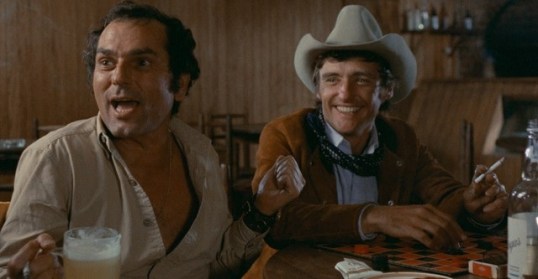
Despite its reputation, The Last Movie gets off to a pretty strong start. Samuel Fuller (playing himself) is directing a hilariously over-the-top and violent western in the mountains of Peru. Kansas (Dennis Hopper) is working as a stuntman. He’s fallen in love with a local sex worker named Maria (Stella Garcia). Kansas is meant to be an aging Hollywood veteran, someone who has broken a lot of bones and who carries a lot of aches as a result of his line of work. (One can see why Hopper initially imagined an actor like John Wayne in the role.) He knows that this is going to be his last job and, as we see over the first 25 minutes of the film, he feels alienated from the rest of the cast and crew. Admittedly, Hopper does appear to be a bit too young for the role. The ideal Kansas would have been someone like Ben Johnson, L.Q. Jones, or perhaps Warren Oates. But, still, Hopper does a good job of capturing Kansas’s mixed feelings about the western that’s being filmed around him.
A lot of familiar faces pop up in the film’s fictional western. Dean Stockwell plays an outlaw. Jim Mitchum, Russ Tamblyn and Kris Kristofferson plays his associates. Peter Fonda is the youthful sheriff. Michelle Phillips is the daughter of the town’s banker and apparently, she’s also the girlfriend of one of the outlaws. We watch as the actors pretend to shoot guns and kill each other while the cameras are rolling, just to get up off the ground once “Cut” is yelled. When a local Indian who has been cast as an extra grows upset at the violence, an assistant director explains to him that no one really dies while the cameras are rolling. When shooting wraps, the film company goes home but Kansas stays behind with Maria. One day, the local priest (Tomas Milian) warns Kansas that the local indigenous people have moved into the abandoned film set and are trying to shoot their own movie. Kansas discovers that they have built wooden cameras and wooden boom mics and that their chief is giving orders in the style of Sam Fuller. They’re also firing the guns that the Americans left behind.
The first part of the film works quite well. Hopper’s camera captures the beautiful and isolated Peruvian landscape. The violent western is a pitch perfect and affectionate parody of a generic studio film. Though Hopper is a bit too young for the role, he still does a good job of capturing Kansas’s alienation from his fellow Americans. Even more importantly, the first part of the film seems to have an identifiable theme. The American film crew invaded an isolated part of Peru and changed the culture of the natives without even realizing it. Now, they’ve left but the natives are still dealing with the after effects of the American “invasion.” It’s easy to see, within that part of the story, a critique of both American culture and American foreign policy.
The second part of the film is where things start to fall apart. Kansas meets an old friend named Neville (Don Gordon). Neville has discovered a gold mine in the Peruvian mountains. With Kansas as his partner, he tries to get a businessman named Harry Anderson (Roy Engel) to invest in it. Kansas and Neville try to impress Harry and his wife (Julie Adams, best-known for being stalked by The Creature From The Black Lagoon). Kansas and Neville take the Andersons to a brothel and, in the process, Kansas offends Maria. Kansas then paws Mrs. Anderson’s fur coat and mentions that human beings are covered in hair. For all of their efforts, Harry will not invest, no matter how desperately Neville begs him to reconsider.
The second part of the film drags, with many of the scenes being obviously improvised between Hopper, Gordon, Garcia, Engel, and Adams. Unfortunately, the improved conversations aren’t particularly interesting and they tend to go on forever. Usually a reliable character actor, Don Gordon ferociously chews the scenery as Neville and it doesn’t take long before one grows tired of listening to him yell. (Gordon was far more impressive in Hopper’s Out of the Blue.) With the use of improvisation and overlapping dialogue, the second half of the film tries to feel naturalistic but instead, it’s a migraine-inducing method exercise gone wrong. It’s also during the second part of the film that a “scene missing” title card flashes on the screen, an indication that the discipline that Hopper showed as a director during the beginning of the film is about to be abandoned.
Finally, the third part of the film — well, who knows? The final 25 minutes of the film is collection of random scenes, some of which may be connected and some of which may not. The natives have decided that the only way to properly end their “film” is to kill Kansas. Kansas is shot several times and rides away on his horse. Suddenly, Kansas is back at his home and Maria is taunting him for getting shot. Then, Kansas is riding his horse again. Then suddenly, Dennis Hopper and Tomas Milian are laughing at the camera. A script supervisor tries to get Dennis to look at the shooting schedule while Dennis drinks. This happens:
Milian points out that the blood on Hopper’s shirt is dry. Hopper looks at his shoulder, where Kansas was previously shot, and says that someone needs to add his scar before he can shoot the scene. Ah! So, now we’re acknowledging that it’s all just a movie. Thanks, Dennis! Suddenly, Dennis is Kansas again and he’s collapsing over and over again in the dust. He appears to be dead but no, now he’s Dennis again and he’s standing up and smiling at the camera. And now, he’s singing Hooray for Hollywood. And now, suddenly, Kansas and Neville are talking about The Treasure of the Sierra Madre and then….
Well, let’s just say that it goes on and on before finally ending with a scrawled title card.
It’s a disjointed mess and it’s all the more frustrating because the first 30 minutes of the film is actually pretty good. But then, Dennis apparently remembered that he was supposed to be the voice of the counter-culture and he gave into his most pretentious impulses. Of course, just because a film is a mess, that doesn’t mean that it can’t be entertaining. And again, the first part of the film is entertaining and third part of the film is weird enough that it’ll hold most people’s attention for at least a few minutes. But the middle section of the film is so slow and pointless that it pretty much brings down the entire film.
In the end, what is The Last Movie about? In The American Dreamer(a documentary that was filmed while Hopper was editing The Last Movie in New Mexico), Hopper spends a lot of time talking about revolution and taking over Hollywood but The Last Movie is hardly a revolutionary film. The film is at its most alive when it is focused on the shooting of its fictional western. For all the satirical pokes that The Last Movie takes at the studio system, it’s obvious that Hopper had a lot of affection for Old Hollywood and for directors like Sam Fuller. Kansas may say “Far out,” but he’s hardly a hippie. Even the film’s jumbled finale seems to be saying, “It’s all Hollywood magic!” In the end, the film’s call for a new style of cinema is defeated by its love for the old style of cinema.
Instead, I think The Last Movie works best when viewed as a portrait of paranoia. Hopper himself admitted that he was naturally paranoid and the heavy amount of drugs that he was doing in the 70s didn’t help. One reason why Hopper filmed in Peru and edited in New Mexico was so the studios couldn’t keep track of him and, while directing, he worried about being arrested by the Peruvian secret police. As an actor, Hopper plays Kansas as being someone who views the world with caution and untrusting eyes. He doesn’t trust the other members of the film crew. He loves Maria but he’s still convinced that she’s going to betray him. Even the natives ultimately try to destroy him and the script supervisor tries to get him to stick to the shooting schedule. The film works best as a disjoined portrait of one man’s paranoid and fatalistic world view.
The Last Movie pretty much ended the studio’s attempts to harness the counter-culture by giving money to self-described revolutionaries. The new wave of directors — like Spielberg and Lucas — may have shared Hopper’s then-politics but they weren’t looking to burn down the system. (Hopper himself later became a Republican.) The Last Movie may not have been the literal last movie but it was, for a while at least, the last of its kind.
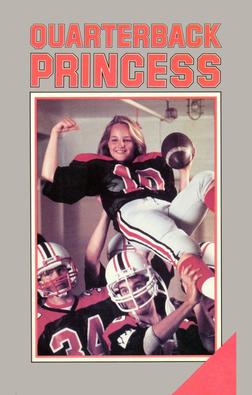
Welcome to Retro Television Reviews, a feature where we review some of our favorite and least favorite shows of the past! On Sundays, I will be reviewing the made-for-television movies that used to be a primetime mainstay. Today’s film is 1983’s Quarterback Princess. It can be viewed on YouTube!
Quarterback Princess begins with Ralph Maida (Don Murray) dropping in on the coach of a high school football team in the small town of Minnvile, Oregon. Ralph explains that he and his family are going to be relocating to the town from Canada. His eldest child wants to play football and Ralph is curious as to when the team will be holding the tryouts. The coach asks what position Ralph’s son plays. Ralph explains that Tami is his daughter and she plays quarterback. After an awkward moment of silence, the coach explains that he’ll have to talk to the school board.
Yes, Quarterback Princess is one of those films. It’s an only girl on the team film, in which an athletic teenager has to convince not only her male teammates but also all of the stodgy old people that she can play just as well as the boys. On the one hand, films (and shows, as Degrassi had an entire storyline about Jane trying to get on the school’s football team) like this are usually entertaining because it’s fun to watch a girl succeed while all of the men sputter with outrage until the team starts winning. On the other hand, they’re always a little bit difficult for me to relate to because I would honestly have no interest in doing what Tami’s doing and it’s hard for me to understand why anyone else would either. I mean, seriously why would anyone want to live in Oregon when Montana’s just a short drive away?
Quarterback Princess is based on a true story. In real life, Tami Maida was 14 year old when she joined her high school football team as their quarterback. That season, the team had a record of 7-1 and they won the state championship. Tami was also elected Homecoming Queen that seem year. The parts of the movie that seem like the type of thing that only a screenwriter could come up actually happened. Helen Hunt, who was 20 years old at the time, plays Tami. When I watched the film, I thought Hunt did a good job in the scenes off field but I thought she was a bit unconvincing when she was actually playing the game and throwing the ball. Fortunately, I did some research before I actually wrote this review and I discovered that Tami served as Helen Hunt’s stand-in during the film and, in most of the game scenes, that actually is Tami throwing the ball and running around the field. That shows you how much I know about football.
Quarterback Princes is definitely a made-for-television production. These are the only high school football players in existence who neither drink nor curse. For that matter, the coaches are surprisingly nice as well. That said, it isn’t bad. The best scenes are the ones that feature Tami and her family adjusting to Tami’s sudden fame. Daphne Zuniga gives a sympathetic performance as Tami’s sister, who is not particularly happy about how Tami’s sudden fame has changed everyone’s lives. The always likable John Stockwell plays Tami’s boyfriend and the two of them are a believable couple. Noel Black, who also directed Pretty Poison, does a good job of keeping the action moving at a steady pace. Probably the worse thing you can say about this film is that it was a bit predictable but, in this case, all of the predictable stuff actually happened so what can you do?
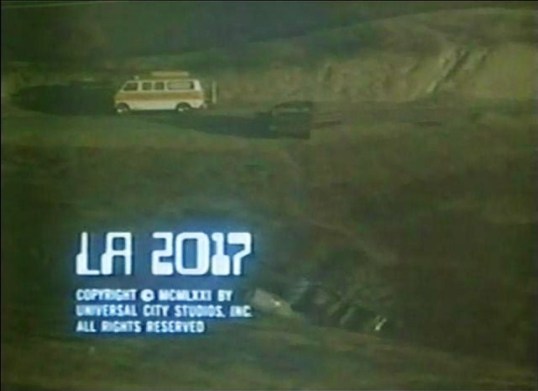
L.A. 2017 is the Steven Spielberg film about which you’ve probably never heard.
To a certain extent, that’s understandable. Spielberg was only 24 when, in 1971, he directed L.A. 2017. It was a film that he directed for television. In fact, it was only his third directorial assignment. As opposed to the huge budgets that we tend to associate with a typical Spielberg production, L.A. 2017 was made for about $300,000. The entire film was shot in about 12 days. In fact, with a running time of only a scant 69 minutes, L.A. 2017 hardly qualifies as a feature-length film. L.A. 2017 has never been released on DVD or Blu-ray, making it a true oddity in Spielberg’s filmography. Despite the fact that Spielberg has credited L.A. 2017 with opening a lot of doors for him, it’s an almost totally forgotten film.
Of course, some of that is because L.A. 2017 really isn’t a film at all. Instead, it was an episode of a television show called The Name of the Game. The show was about Glenn Howard (Gene Barry), a magazine publisher, and the reporters who worked for him. L.A. 2017 was unique in that it was the show’s only excursion into science fiction. In fact, from everything that I’ve read about the show, it appears that L.A. 2017 was nothing like any of the other episodes of The Name of the Game. This episode was also unique because Spielberg directed it as if he was making a feature, as opposed to just another installment in a weekly series. If not for the opening credits (which announce, among other things, that we’re watching a Robert Stack Production), one could easily imagine watching L.A. 2017 in a movie theater, perhaps as a double feature with Beneath The Planet Of The Apes.
L.A. 2017 opens with Glenn driving down a mountain road in California. He’s heading to a pollution summit and, as he drives along, he awkwardly dictates an editorial into a tape recorder. Glenn worries that society may have already ruined the environment to such an extent that the Earth cannot be saved. As if to prove his point, Glenn starts to cough as he’s overcome by all of the smog in the air. His car swerves into a ditch and Glenn is knocked unconscious.
Welcome to the future
When he wakes up, he finds himself being rescued by men wearing wearing protective suits and masks. The sky is a sickly orange and an ominous wind howls in the background. Glenn’s rescuers take him to an underground city where he discovers that, somehow, he has traveled through time. The year is now 2017, which in this film looks a lot like the 70s except that everyone’s now underground and the landline phones are extra bulky. (Needless to say, watching 1971’s version of 2017 in 2019 is an interesting experience.) It turns out that the pollution got so bad that the surface of the planet became uninhabitable. The U.S. is now run by a corporation that is headquartered in Detroit. (Presumably, the Corporation is a former car company.) The U.S. is also at war with England, for some reason. No mention is made about what’s happened to Canada but, if Detroit’s still around, I assume at least some of Canada managed to survive as well.
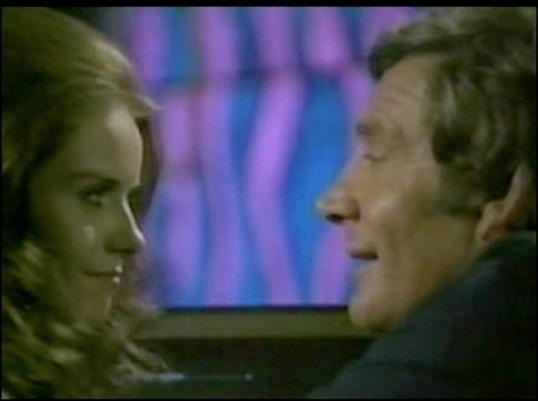
The …. uh, Future.
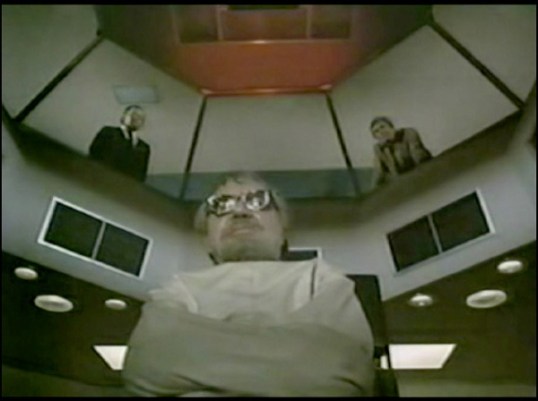
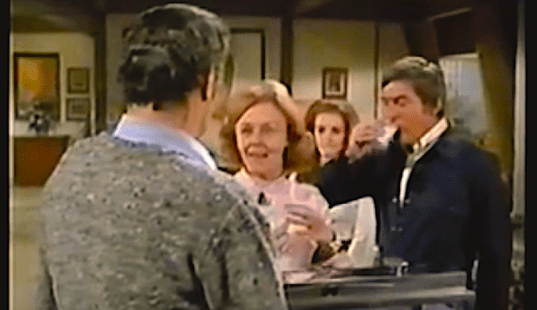
Everyone in the future drinks a lot of milk and, when they’re not listening to cheerful announcements, they’re listening to the soothing music that the Corporation provides for them. Everyone in the future is also very friendly. We know this because everyone keeps assuring Glenn that he’s surrounded by friends. In fact, everyone in the future refers to one another by their first name because “it’s friendlier.” It’s also the law. It turns out that there’s a lot of laws in the future. In fact, the underground cities are pretty fascist in the way that they handle things. There are constant announcements encouraging people to pursue a career in law enforcement and anyone who disagrees with the Corporation ends up in a straight jacket. Glenn feels that maybe he’s been brought to the future so he can start a new magazine and challenge the status quo. The Corporation disagrees….
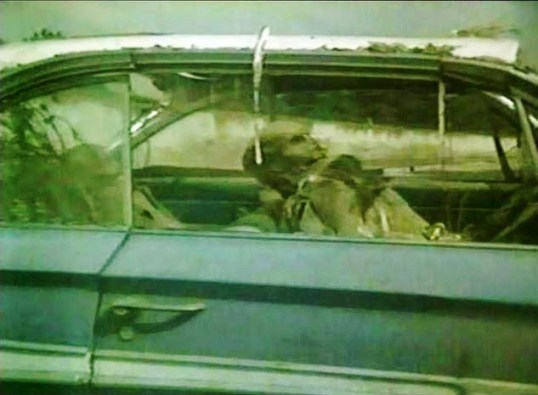
This is what happens when you don’t go underground in the future.
Okay, so there’s nothing subtle about L.A. 2017. From the villainous corporation to the heavy-handed environmental message, there’s nothing here that you haven’t seen in dozens of other sci-fi films. But the lack of subtlety doesn’t matter, largely because Spielberg directs with so much energy and with such an eye to detail that it’s impossible not to get sucked into the story. As opposed to the somewhat complacent Spielberg who has recently given us rather bland and safe blockbusters like Lincoln, The BFG, and The Post, the Spielberg who directed L.A. 2017 was young and obviously eager to show off what he could do with even a low budget and that enthusiasm is present in every frame, from the wide-angle shots of Glenn driving his car to the scenes of Glenn looking up at the shadowy executives and scientists who are staring down at him when he’s first brought to the underground city. As opposed to the sterile vision of so many other future-set films, Spielberg’s future feels as if it’s actually been lived in. When Glenn finds himself in a new world, it comes across as being a real world as opposed to just a narrative contrivance.
Of course, because L.A. 2017 was just one episode in a weekly series, Glenn couldn’t remain in the future and L.A. 2017 returns Glenn to the present in the most contrived and predictable way possible. Still, L.A. 2017 remains an entertaining example of what a young and talented director can do when he’s determined to be recognized. Watching the film, it’s easy to draw a straight line from Spielberg doing L.A. 2017 to doing Duel and then subsequently being hired for Jaws.
Incidentally, Joan Crawford is somewhere in this film. Crawford worked with Spielberg when he directed her in the pilot for Night Gallery and she was one of his first major supporters in Hollywood. Apparently, in L.A. 2017, she plays one of the people staring down at Glenn when he’s first brought into the underground city. I haven’t found her yet but she’s apparently there somewhere.
Unfortunately, L.A. 2017 has never been released on DVD or Blu-ray but it is currently available on YouTube.
People are turning up dead. Well, what else is new? That’s pretty much been the plot of every Kolchak episode so far. However, this time, they’re turning up dead while covered with Spanish moss!
Oh my God, could it be the Cajuns?
Well, as a matter of fact, it is. As Kolchak discovers when he investigates, all of the dead people were somehow connected to a comatose Cajun….
Richard Kiel, who played the monster in the previous episode of Kolchak, returns here to play yet another monster.
The episode originally aired on December 6th, 1974!
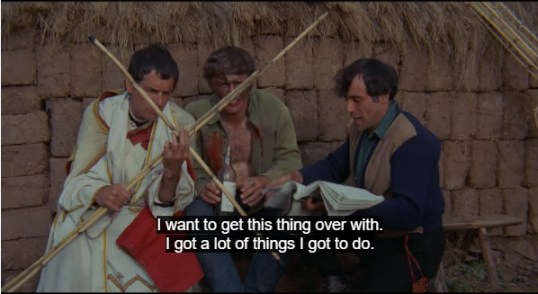
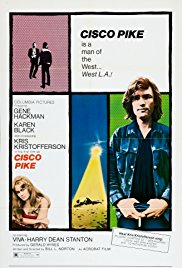
Yesterday, the great character actor Harry Dean Stanton passed away at the age of 91. Cisco Pike is not one of Stanton’s best films but it is a film that highlight why Stanton was such a compelling actor and why his unique presence will be missed.
Cisco Pike (Kris Kristofferson) is a musician who has fallen on hard time. After having been busted several times for dealing drugs, Cisco now just wants to spend time with his “old lady” (Karen Black) and plot his comeback as a musician. However, a corrupt narcotics detective, Leo Holland (Gene Hackman), approaches Cisco with an offer that he cannot refuse. Holland has come into possession of 100 kilos of marijuana. He wants Cisco to sell it for him and then Leo plans to take the money and retire. Cisco has the weekend to sell all of the weed. If he doesn’t, Holland will arrest him for dealing and sent him back to prison,
About halfway through this loose and improvisational look at dealers, hippies, and squares in 1970s Los Angeles, Harry Dean Stanton shows up in the role of Jesse Dupree, an old friend and former bandmate of Cisco’s. Jesse is a free-living wanderer, too old to be a hippie but too unconventional to be a member of the establishment. Unfortunately, Jesse also has a nasty heroin habit. Jesse Dupree is a prototypical Harry Dean Stanton role. Like many of Stanton’s best roles, Jesse may be sad and full of regrets but he is not going to let that keep him from enjoying life. Stanton may not appear in much of the film but he still takes over every scene in which he appears.
Stanton is, by far, the best thing about Cisco Pike. As always, Gene Hackman is entertaining, playing the inverse of The French Connection‘s Popeye Doyle and Karen Black is her usual mix of sexy and weird. The weakest part of the movie is Kris Kristofferson, who was still a few years away from becoming a good actor when he starred in Cisco Pike. It is interesting to consider how different Cisco Pike would have been if Stanton and Kristofferson had switched roles. Stanton may not have had Kristofferon’s movie star looks but, unlike Kristofferson, he feels real in everything that he does. With his air of resignation and his non-Hollywood persona, Stanton brought authenticity to not only Cisco Pike but to every film in which he appeared.
Along with Stanton, several other familiar faces appear in Cisco Pike. Keep an eye out for Roscoe Lee Browne, Howard Hesseman, Viva, Allan Arbus, and everyone’s favorite spaced-out hippie chick, the one and only Joy Bang.
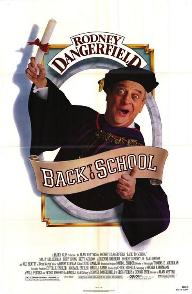
Thornton Melon (Rodney Dangerfield) started with nothing but through a combination of hard work and chutzpah, he started a chain of “Tall and Fat” clothing stores and made a fortune. Everyone has seen his commercials, the one where he asks his potential customers, “Do you look at the menu and say, ‘Okay?'” He has a new trophy wife named Vanessa (Adrienne Barbeau) and a chauffeur named Lou (Burt Young). Thornton never even graduated from high school but he gets respect.
However, his son, Jason (Keith Gordon), doesn’t get no respect. No respect at all. Jason is a student at a pricey university, where he is bullied by Chas Osborne (William Zabka) and can’t get a date to save his life. Jason’s only friend is campus weirdo Derek Lutz (Robert Downey, Jr.). When Thornton sees that his son isn’t having any fun, he decides to go back to school!
Back to School is a predictable but good-natured comedy. It is like almost every other 80s college comedy except, this time, it’s a 65 year-old man throwing raging parties and making the frat boys look stupid instead of Robert Carradine or Curtis Armstrong. On the stand-up stage, Dangerfield always played the (sometimes) lovable loser but in the movies, Dangerfield was always a winner. In both Caddyshack and Back to School, Dangerfield played a self-made man who forced his way into high society and showed up all of the snobs. While Back to School is no Caddyshack, it does feature Rodney at his best.
Rodney may be the funniest thing about Back to School but a close second is Sam Kinison, who owed much of his early success to Rodney Dangerfield’s support. Kinison plays a history professor, who has some very strongly held views about the Vietnam War and who punctuates his points with a primal screen.
Also, keep an eye out Kurt Vonnegut, playing himself. Rodney hires him to write a paper about Kurt Vonnegut for one of his classes. The paper gets an F because Rodney’s literature professor (Sally Kellerman) can tell that not only did Rodney not write it but whoever did knows absolutely nothing about the work of Kurt Vonnegut.
“If I was a psychiatrist, which I am, I would say that I was turning into some sort of paranoid personality, which I am!” — Dr. Sidney Schaefer (James Coburn) in The President’s Analyst (1967)
Let’s just be absolutely honest about something. Judging from what they regularly get caught saying and from some of the policies that they support, a good deal of politicians could probably use some sort of professional help. That’s probably especially true of the men who sit in the Oval Office. It can’t be easy to have to hide so many secrets, tell so many lies, and be constantly aware of how close the government is to actually collapsing. We’ve had 44 Presidents and I imagine all of them probably could have used someone to talk to.
But here’s the thing. We spend so much time worrying about the well-being of the President that we often don’t stop to think about the people who have to listen to them speak on a daily basis. I imagine that being the President’s therapist must be a thankless job. Not only do you have to spend hours listening to someone who you may not have voted for but, at the same time, you can’t share any of the information that you’ve learned.
That would certainly seem to be what’s happening with Dr. Sidney Schaefer (James Coburn), the title character of the wonderfully psychedelic 1967 satire, The President’s Analyst. At the start of the film, Sidney is a supremely confident psychiatrist. He can calmly and rationally deal with all of his patients problems and, in order to keep from getting overwhelmed, he has his own analyst (Will Geer).
One of his patients is Don Masters (Godfrey Cambridge), an agent for the Central Enquiries Agency (CEA) who is first seen casually murdering a man on the streets of New York. (When Sidney discovers that Don is an assassin, he’s thrilled and impressed to discover that Don has managed to channel all of his hostility into his job.) What Sidney doesn’t realize is that Don is testing him to see if he’s up to the job of serving as the President’s analyst.
At first, Sidney is thrilled with his new position but he soon discovers that being the closest confidante of the leader of the free world has its downside. For one thing, Sidney is viewed by suspicion by Henry Lux (Walter Burke), the head of the Federal Bureau of Regulation (which, in this film, is exclusively staffed by people who are less than 5 feet tall). Even beyond being targeted by the FBR, Sidney struggles with not being able to see his own therapist and discuss what he’s been told by the President. Soon, Sidney is becoming paranoid and is even convinced that his girlfriend is a spy.
(And, of course, she is.)
So, Walter does what any sensible and paranoid person would do. He makes a run for it. Pursued by the FBR, the CEA, and a Russian assassin (a funny performance from Severn Darden, who also played Kolp, the sadistic torturer in Conquest of the Planet of the Apes), Sidney hides out with everyone from a group of hippies to a family of heavily armed, karate-trained, middle class “militant liberals.”
(The father of the militant liberal family is played by William Daniels, who decades later would play Mr. Feeney in Boy Meets World.)
Of course, there’s an even bigger conspiracy at work than even Sidney realizes. The real threat is the TPC and I’m not going to tell you what that stands for. You need to see the movie.
And really, The President’s Analyst is a film that you really should see. What makes this film truly special — beyond the clever dialogue and the excellent performances and the great direction — is that it’s both a product of when it was made and a timeless portrait of power and paranoia. It’s a time capsule that still feels incredibly relevant.
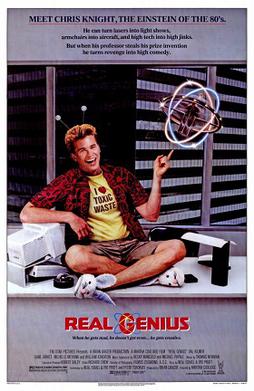 Mitch Taylor (Gabriel Jarrett) is a teenage genius who is recruited by Prof. Jerry Hathaway (William Atherton) to study at Pacific Tech University. The real reason why Hathaway has recruited Mitch is because Chris Knight (Val Kilmer), another genius, has been slacking on developing the power source for an experimental laser called “crossbow.” Hathaway hopes that Mitch can get Chris to take his work seriously and to focus on the project. Instead, Chris teaches Mitch that he has to learn how to enjoy life or his great intelligence will become a burden and he’ll end up burned out and living in the tunnel underneath the university. That’s what happened to Laszlo Holyfield (Jon Gries). That’s what nearly happened to Chris. Chris is determined not to let it happen to Mitch.



 Yesterday, the great character actor Harry Dean Stanton passed away at the age of 91. Cisco Pike is not one of Stanton’s best films but it is a film that highlight why Stanton was such a compelling actor and why his unique presence will be missed.
 Thornton Melon (Rodney Dangerfield) started with nothing but through a combination of hard work and chutzpah, he started a chain of “Tall and Fat” clothing stores and made a fortune. Everyone has seen his commercials, the one where he asks his potential customers, “Do you look at the menu and say, ‘Okay?'” He has a new trophy wife named Vanessa (Adrienne Barbeau) and a chauffeur named Lou (Burt Young). Thornton never even graduated from high school but he gets respect.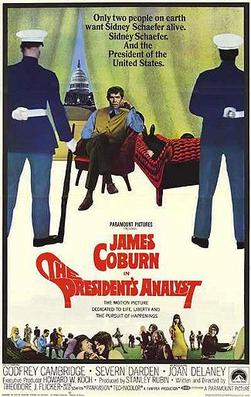
 Through the Shattered Lens