Review: Aguirre, The Wrath of God (dir. by Werner Herzog)


“For here on this river, God never finished his creation.” — Balthasar

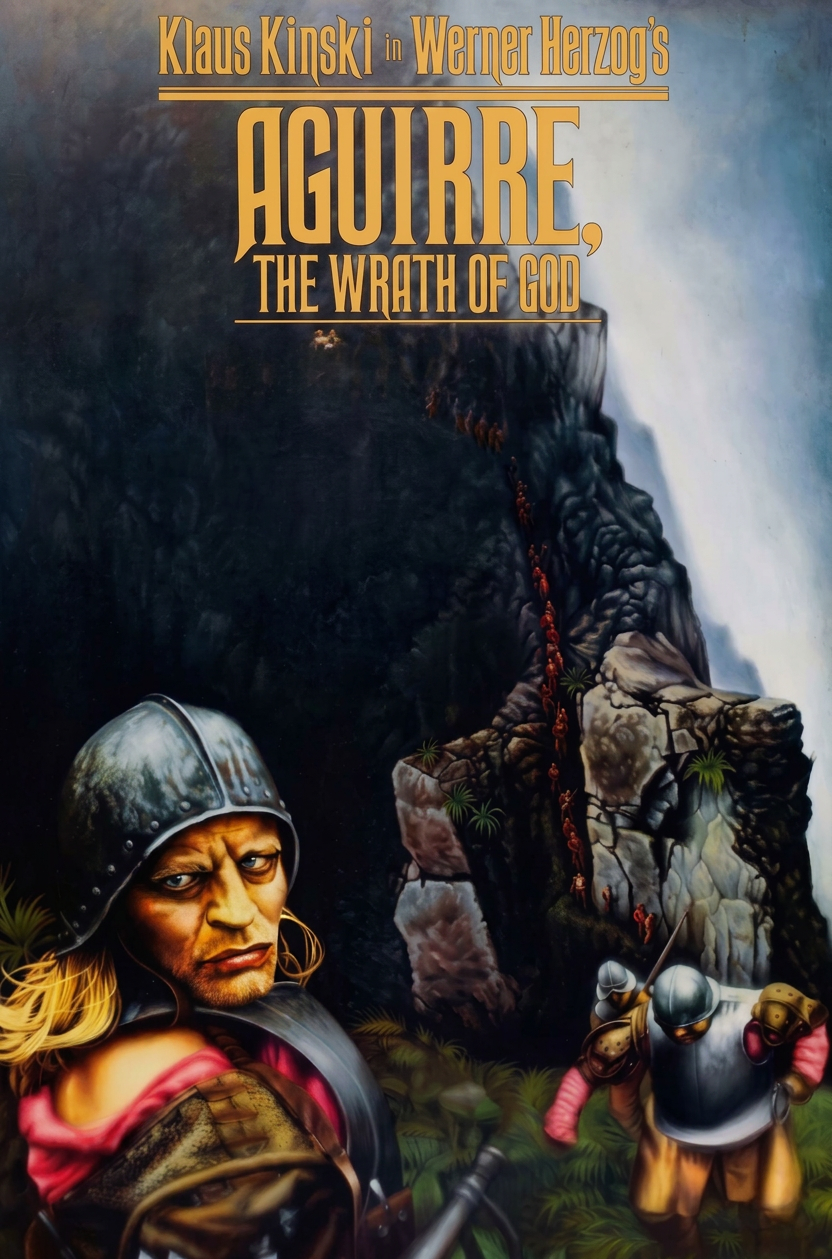
Werner Herzog’s Aguirre, the Wrath of God opens with one of the most hypnotic sequences in cinema: a column of Spanish conquistadors and indigenous slaves snaking down a fog-shrouded Andean pass, cannon winched separately. From that first frame, you sense you’re watching not a historical adventure but a fever dream. The film is loosely based on the real-life Lope de Aguirre, a Basque mutineer who searched for El Dorado in the 1560s. But as Herzog later confirmed, historical accuracy was never the point. Aguirre is fiction—a myth sculpted from jungle heat, river currents, and one actor’s maniacal commitment. Remarkably, the production itself became a hellish mirror of the narrative: shot deep in the Peruvian rainforest under conditions so brutal that the line between making a movie and surviving an ordeal vanished.

The plot is simple. In 1560, a Spanish expedition descends into the Amazon basin, searching for the golden city of Manoa. When rapids prove too treacherous, a smaller party is sent ahead under the noble but hapless Don Pedro de Ursúa (Ruy Guerra). Among them is Aguirre (Klaus Kinski), a wiry, half-mad soldier who immediately undermines authority. After Ursúa is murdered, Aguirre seizes control, declaring himself “the Wrath of God” and proclaiming a new monarchy. What follows is not a rousing conquest but a slow hallucinatory unraveling: rafts stuck on looping rivers, starvation, arrows from invisible natives, and the collapse of every civilizing impulse. This is one man’s battle against nature and his personal crisis of faith—a crisis the production team would come to know intimately.

Herzog’s storytelling prioritizes mood over plot. The narrative drifts through long takes of jungle canopy, close-ups of Kinski’s hollow eyes, and Popol Vuh’s otherworldly score. But the film’s raw authenticity comes from its production: a near-literal trek through jungle hell. Herzog took a small cast and crew into the Peruvian rainforest with no insurance, no backup equipment, and no evacuation strategy. The Urubamba River was unpredictable, with hidden rocks and stretches local guides refused to navigate. Rafts capsized. Food spoiled. Actors began unraveling for real. When a soldier in the film announces, “We are walking in circles,” it is both scripted and a genuine observation from an extra who’d passed the same fallen tree three days running. Herzog left that take in. The boundary between fictional madness and documentary collapse dissolved completely.

And then there was Klaus Kinski. If the jungle was one monster, Kinski was another. The conflict between Herzog and his star is the stuff of legend. Kinski arrived volatile, prone to screaming fits, threatening to abandon the production. At one point, a native chief offered to kill Kinski for free. Herzog declined—he still needed the actor alive. On another occasion, Herzog reportedly held Kinski at gunpoint during an attempted walkout. Kinski stayed. That friction bleeds into every frame. Kinski’s rage and paranoid stillness aren’t simulated; they’re the genuine product of a man frayed by heat, isolation, and his own demons. That is not method acting in a safe studio. It’s a man on the edge, pointed at a director who refused to flinch.

What lifts Aguirre into high art is its philosophical dread, earned through real suffering. And at its heart is Aguirre himself, a character who feels less like a historical figure and more like a literary archetype. As played by the manic Kinski, Aguirre is a remarkable fusion: the tragic Miltonian rebel and the obsessive Melvillean monomaniac. Like Satan in Paradise Lost, Aguirre defies divine and imperial order, preferring to reign in hell than serve in heaven. His self-coronation and final soliloquy echo Milton’s antihero—magnificent in defiance, hollowed by pride. But Herzog drains the grandeur, leaving only the fall without the poetry. Simultaneously, Aguirre is pure Ahab from Moby-Dick: another obsessive dragging a reluctant crew into the void on a suicidal quest. El Dorado is his white whale, an obsession that obliterates loyalty, love, and sanity. Both are swallowed by their obsession—Ahab by the sea, Aguirre by the jungle. But where Melville gives Ahab a thunderous final confrontation, Herzog gives Aguirre a whimper: a circle of monkeys, a drifting raft, and a whispered promise of a dynasty that will never come. Kinski holds both archetypes in suspension—Satan’s pride and Ahab’s fixation—and grinds them into something unrecognizable, belonging only to Herzog’s fever dream.

In the film’s most famous scene, Aguirre stands alone on a raft littered with corpses, small monkeys crawling over his armor, and whispers, “I will be the Wrath of God. Who else is with me?” No one. The jungle has swallowed everyone. Herzog frames this as the logical end of both the Miltonian and Melvillean arcs: absolute power in absolute isolation. The scene was shot in one take—not for artistry but because the raft was about to be swept away. The monkeys were real, biting the crew and defecating on Kinski’s armor. He didn’t break character. He couldn’t afford to. That’s the difference between a film that describes madness and one that embodies it.

Visually, Aguirre is a masterclass in low-budget grandeur. Cinematographer Thomas Mauch’s handheld camera glides through the jungle like a ghost. The opening descent feels supernatural. Rivers fill the frame until you lose direction. A galleon stuck in high branches—a leftover from a previous flood—becomes the film’s central metaphor: even empire is helpless against nature’s chaos. That chaos was logistical as well as thematic.

If there’s a weakness, it’s that the pacing can feel punishing. This film doesn’t build to a climax; it decays. Characters die offscreen or vanish. There is no redemption, no final battle. Some viewers may find this anticlimactic, but that’s the point. Herzog isn’t telling a story about winning or losing. He’s documenting a psychic meltdown from the inside, and meltdowns don’t follow three-act structure. The production’s own meltdown—hunger, disease, screaming matches on muddy riverbanks—only reinforces that vision. Aguirre is not a film about a man battling nature and losing his faith. It’s a film that became that battle, in real time, with real stakes, and somehow survived.

Years after release, Herzog clarified that Aguirre bears only the loosest resemblance to the historical Lope de Aguirre. He claimed he dreamed the film during a hike in the Alps. That dream-logic explains why Aguirre feels less like a period piece than a prehistoric vision. History is just a costume; the real subject is the human capacity to mistake madness for destiny. And that destiny, filtered through Kinski, is neither strictly Miltonian nor Melvillean but a nightmare hybrid: a fallen angel who keeps hunting the whale long after the ship has sunk.

In the end, Aguirre, the Wrath of God remains a towering, unsettling achievement. It influenced everything from Apocalypse Now to Resident Evil 4, but no imitation has matched its specific, waterlogged power. Despite the leeches, dysentery, gun threats, and screaming, the film that emerged is haunting, mesmerizing—a surreal trip into one man’s battle against nature and his crisis of faith. Herzog wanted “ecstatic truth” rather than mere fact. Aguirre is ecstatic truth: a fiction that feels more real than reality, a portrait of a madman that makes you understand why sanity is fragile, and a warning about conquest that remains urgent half a century later. Watch it on the biggest screen you can find, late at night, alone. The monkeys will be waiting. And somewhere in the jungle, Herzog and Kinski are still arguing.

14 Days of Paranoia #3: The Passover Plot (dir by Michael Campus)


First released in 1976 and based on a book that had come out ten years previously, The Passover Plot is a film that asks, “What if Jesus was a political revolutionary who faked his own death?”

Even when the film was first released, that wasn’t a particularly novel or new theory.  Ever since the Crucifixion, there have been conspiracy theorists who have claimed that the entire thing was staged.  Indeed, the early days of the Church were defined by conflicts between different sects debating the true nature of Jesus, with those who believed that he was the son of God and that he had risen from the dead eventually winning out over sects who claimed that Jesus was not divine or that he had actually escaped from the Romans and was instead hiding out in Egypt or even on the island that would eventually become known as Britain.  (The fact that so many Gnostics and other heretics were executed by the Church and their texts suppressed only served to lend them credibility with future theorists.)  Still, every few decades, some new book or film will claim that Jesus faked his death or married Mary Magdalene and gullible people will act as if this is somehow a new argument.  It’s been over 20 years since all of that Da Vinci Code nonsense convinced bored suburbanites across America that they could be experts on both boxed wine and historical conspiracy theories.  We’re about due for a new version of the old story.

As for The Passover Plot, it features Zalman King as Yeshua of Nazareth, an angry young man who dreams of the day when Judea will be free of the Romans.  Having a knowledge of the prophecies of a messiah and also knowing that he is descended from King David, Yeshua specifically patterns his life after the prophecies and presents himself as being not just another revolutionary but instead as being sent by God.  However, he is also aware that it will be necessary for him to “die” and “rise from the dead,” so he goes out of his way to force the hand of Pontius Pilate (Donald Pleasence).  Having seen plenty of crucifixions when younger, Yeshua arranges for the local revolutionaries to drug him so that he’ll appear to be dead.  When he later wakes up, everyone will believe that he has returned from the dead.  The film ends with several title cards, all arguing that the Gospels were written long after Yeshua’s death (“Mark lived in Italy!” one title card proclaims with almost comical indignation) and were subsequently rewritten by “unknown” hands.

The Passover Plot is a weird combination of biblical epic and conspiracy thriller.  Scenes of Yeshua preaching feel as if they could have come from any traditional Biblical epic but they are awkwardly placed with scenes of Yeshua having secret, melodramatic meetings with various conspirators.  It would make for an interesting contrast if not for the fact that the film itself is so slowly paced and boring.  Zalman King, who is best-known for his subsequent career as a softcore filmmaker, spends a lot of time yelling and smoldering intensely but he still doesn’t have the charisma or screen presence necessary to be convincing in the role.  In the scene were he’s meant to be passionate, he shrieks with such abandon that he makes Ted Neeley’s performance in Jesus Christ Superstar feel restrained.  This film asks us to believe that people would not only abandon their previous lives to follow Yeshua but that they would also take part in an elaborate conspiracy that could have gone wrong at any time.  For that to be believable, Yeshua needs to be played by someone who doesn’t come across like the drama student that everyone dreads having to do a scene with.  Far more impressive is Donald Pleasence, whose portrayal of a ruthless and unfeeling Pilate is a marked contrast to some of the more sympathetic interpretations of the character that tend turn up in the movies.

On the plus side, the film does look good.  It was shot on location in Israel and there is a certain authenticity to the film’s recreation of the ancient world.  Along with Pleasence, character actors like Scott Wilson (as Judas!) and Dan Hedaya get a chance to shine.  But otherwise, The Passover Plot is too slowly paced and kooky for its own good.  Conspiracy theorists never seem to understand that the more elaborate a conspiracy theory becomes, the less convincing it is to anyone who isn’t already a true believer.  In the end, how one feels about the film’s conclusions will probably be connected to how one already views Jesus and the Church.  The Passover Plot is not a film that’s going to convince anyone who wasn’t already convinced.

14 Days of Paranoia:

  1. Fast Money (1996)
  2. Deep Throat II (1974)

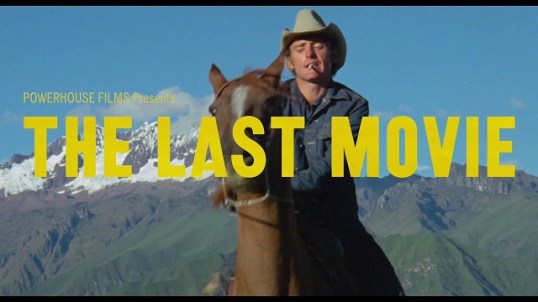
Icarus File No 9: The Last Movie (dir by Dennis Hopper)


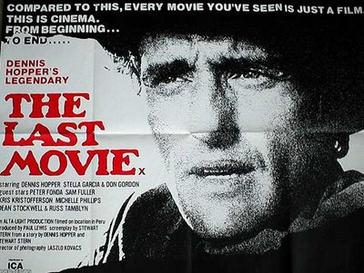
The story behind the making of 1971’s The Last Movie is legendary.  It’s also a bit of a cautionary tale.

In 1969, Hollywood was stunned by the box office success of an independent, low-budget counter-culture film called Easy Rider.  Easy Rider not only made a star out of Jack Nicholson but it was also the film that finally convinced the studios that the way to be relevant was not to continue to crank out big budget musical extravaganzas like Doctor Doolittle and Hello, Dolly!  Instead, it was decided that the smart thing to do would be to hire young (or, at the very least, youngish) directors and basically just let them shoot whatever they wanted.  The resulting films might not make much sense to the executives but, presumably, the kids would dig them and as long as the kids were paying money to see them, everyone would continue to get rich.   Because Dennis Hopper had directed Easy Rider, he suddenly found himself very much in demand as a director.

Of course, almost everyone in Hollywood knew Dennis Hopper.  Long before he became an icon of the counter-culture, Dennis Hopper had been a part of the studio system.  John Wayne even referred to Hopper as being his “favorite communist.”  Everyone knew that Dennis could be a bit arrogant.  Everyone knew that Dennis was very much into drugs and that, as a result, he had a reputation for being a bit unstable.  Everyone knew that Dennis Hopper deliberately cultivated an image of being a bit of a wild man and a revolutionary artist.  But Dennis Hopper had just directed Easy Rider and Universal was willing to give Hopper some money to go down to Peru and direct his follow-up.

The Last Movie was a film that Hopper had been planning on making for a while.  The film’s original script told the story of an aging and broken-down stuntman named Kansas who retires to Mexico and searches for a gold mine with a friend of his.  Hopper first tried to get the film going in 1965, with Montgomery Clift in the lead role.  After Clift died, Hopper tried to interest John Wayne in the starring role but, though Wayne enjoyed having Hopper in his films so that he could threaten to shoot him whenever Abbie Hoffman said something shocking, he had no interest in being directed by him.   When Universal finally agreed to put up the money for the film, Hopper offered the lead role to Jack Nicholson.  Nicholson turned it down and told Hopper that it was obvious that Dennis wanted to play the role himself.  Dennis decided that he agreed with Nicholson and he cast himself as Kansas.  Dennis also made the fateful decision to not only change the story’s setting to Peru but to also film on location.

Dennis and a group of friends flew down to Peru, which, at that time, was the cocaine capitol of the world.  Drug use was rampant on the set, with Dennis reportedly being one of the main offenders.  The cast and crew filmed during the day and partied at night and no one was particularly sure what the film was supposed to be about.  Amazingly, Hopper finished filming on schedule and within budget but, much as he did with Easy Rider, he also overfilmed and ended up with 40 hours of footage.  Not wanting to be bothered by the studios, Hopper edited the footage in his compound in Taos, New Mexico.  Working slowly and continuing to consume a large amount of drugs and alcohol, Hopper still managed to put together a film that had a straightforward storyline.  When Hopper showed his initial cut to filmmaker Alejandro Jodorowsky, the director of El Topo accused Hopper of being too conventional in his approach, which led to Hopper chopping up the film and reassembling it.  Finally, after spending over a year working with the footage, Hopper turned in his final edit.

Universal had no idea what to make of the film that Hopper delivered to them.  Still, they released it with the hope that the same crowd that loved Easy Rider would embrace The Last Movie.  While the film did win an award at the Venice Film Festival, critics hated it and, even worse, audiences stayed away.  The film’s reception was so overwhelmingly negative that Hopper found himself largely exiled from Hollywood, with only a few directors (like Francis Ford Coppola) willing to take the chance of working with him.  It wasn’t until the 80s, when he finally got clean and sober, that Dennis Hopper was able to reestablish himself as a character actor and, ultimately, a beloved cultural institution.

But what about The Last Movie?  Was is it really as bad as the critics claimed?  Or was it, as some more recent reviewers have suggested, an unacknowledged masterpiece that was ahead of its time?  I recently watched The Last Movie to find out for myself.

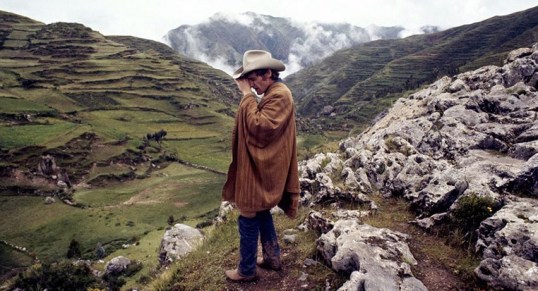
Despite its reputation, The Last Movie gets off to a pretty strong start.  Samuel Fuller (playing himself) is directing a hilariously over-the-top and violent western in the mountains of Peru.  Kansas (Dennis Hopper) is working as a stuntman.  He’s fallen in love with a local sex worker named Maria (Stella Garcia).  Kansas is meant to be an aging Hollywood veteran, someone who has broken a lot of bones and who carries a lot of aches as a result of his line of work.  (One can see why Hopper initially imagined an actor like John Wayne in the role.)  He knows that this is going to be his last job and, as we see over the first 25 minutes of the film, he feels alienated from the rest of the cast and crew.  Admittedly, Hopper does appear to be a bit too young for the role.  The ideal Kansas would have been someone like Ben Johnson, L.Q. Jones, or perhaps Warren Oates.  But, still, Hopper does a good job of capturing Kansas’s mixed feelings about the western that’s being filmed around him.

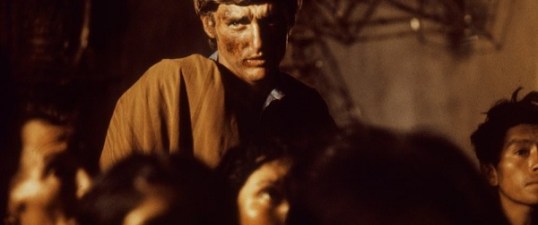
A lot of familiar faces pop up in the film’s fictional western.  Dean Stockwell plays an outlaw.  Jim Mitchum, Russ Tamblyn and Kris Kristofferson plays his associates.  Peter Fonda is the youthful sheriff.  Michelle Phillips is the daughter of the town’s banker and apparently, she’s also the girlfriend of one of the outlaws.  We watch as the actors pretend to shoot guns and kill each other while the cameras are rolling, just to get up off the ground once “Cut” is yelled.  When a local Indian who has been cast as an extra grows upset at the violence, an assistant director explains to him that no one really dies while the cameras are rolling.  When shooting wraps, the film company goes home but Kansas stays behind with Maria.  One day, the local priest (Tomas Milian) warns Kansas that the local indigenous people have moved into the abandoned film set and are trying to shoot their own movie.  Kansas discovers that they have built wooden cameras and wooden boom mics and that their chief is giving orders in the style of Sam Fuller.  They’re also firing the guns that the Americans left behind.

The first part of the film works quite well.  Hopper’s camera captures the beautiful and isolated Peruvian landscape.  The violent western is a pitch perfect and affectionate parody of a generic studio film. Though Hopper is a bit too young for the role, he still does a good job of capturing Kansas’s alienation from his fellow Americans.  Even more importantly, the first part of the film seems to have an identifiable theme.  The American film crew invaded an isolated part of Peru and changed the culture of the natives without even realizing it.  Now, they’ve left but the natives are still dealing with the after effects of the American “invasion.”  It’s easy to see, within that part of the story, a critique of both American culture and American foreign policy.

The second part of the film is where things start to fall apart.  Kansas meets an old friend named Neville (Don Gordon).  Neville has discovered a gold mine in the Peruvian mountains.  With Kansas as his partner, he tries to get a businessman named Harry Anderson (Roy Engel) to invest in it.  Kansas and Neville try to impress Harry and his wife (Julie Adams, best-known for being stalked by The Creature From The Black Lagoon).  Kansas and Neville take the Andersons to a brothel and, in the process, Kansas offends Maria.  Kansas then paws Mrs. Anderson’s fur coat and mentions that human beings are covered in hair.  For all of their efforts, Harry will not invest, no matter how desperately Neville begs him to reconsider.

The second part of the film drags, with many of the scenes being obviously improvised between Hopper, Gordon, Garcia, Engel, and Adams.  Unfortunately, the improved conversations aren’t particularly interesting and they tend to go on forever.  Usually a reliable character actor, Don Gordon ferociously chews the scenery as Neville and it doesn’t take long before one grows tired of listening to him yell.  (Gordon was far more impressive in Hopper’s Out of the Blue.)  With the use of improvisation and overlapping dialogue, the second half of the film tries to feel naturalistic but instead, it’s a migraine-inducing method exercise gone wrong.  It’s also during the second part of the film that a “scene missing” title card flashes on the screen, an indication that the discipline that Hopper showed as a director during the beginning of the film is about to be abandoned.

Finally, the third part of the film — well, who knows?  The final 25 minutes of the film is collection of random scenes, some of which may be connected and some of which may not.  The natives have decided that the only way to properly end their “film” is to kill Kansas.  Kansas is shot several times and rides away on his horse.  Suddenly, Kansas is back at his home and Maria is taunting him for getting shot.  Then, Kansas is riding his horse again.  Then suddenly, Dennis Hopper and Tomas Milian are laughing at the camera.  A script supervisor tries to get Dennis to look at the shooting schedule while Dennis drinks.  This happens:

Milian points out that the blood on Hopper’s shirt is dry.  Hopper looks at his shoulder, where Kansas was previously shot, and says that someone needs to add his scar before he can shoot the scene.  Ah!  So, now we’re acknowledging that it’s all just a movie.  Thanks, Dennis!  Suddenly, Dennis is Kansas again and he’s collapsing over and over again in the dust.  He appears to be dead but no, now he’s Dennis again and he’s standing up and smiling at the camera.  And now, he’s singing Hooray for Hollywood.  And now, suddenly, Kansas and Neville are talking about The Treasure of the Sierra Madre and then….

Well, let’s just say that it goes on and on before finally ending with a scrawled title card.

It’s a disjointed mess and it’s all the more frustrating because the first 30 minutes of the film is actually pretty good.  But then, Dennis apparently remembered that he was supposed to be the voice of the counter-culture and he gave into his most pretentious impulses.  Of course, just because a film is a mess, that doesn’t mean that it can’t be entertaining.  And again, the first part of the film is entertaining and third part of the film is weird enough that it’ll hold most people’s attention for at least a few minutes.  But the middle section of the film is so slow and pointless that it pretty much brings down the entire film.

In the end, what is The Last Movie about?  In The American Dreamer (a documentary that was filmed while Hopper was editing The Last Movie in New Mexico), Hopper spends a lot of time talking about revolution and taking over Hollywood but The Last Movie is hardly a revolutionary film.  The film is at its most alive when it is focused on the shooting of its fictional western.  For all the satirical pokes that The Last Movie takes at the studio system, it’s obvious that Hopper had a lot of affection for Old Hollywood and for directors like Sam Fuller.  Kansas may say “Far out,” but he’s hardly a hippie.  Even the film’s jumbled finale seems to be saying, “It’s all Hollywood magic!”  In the end, the film’s call for a new style of cinema is defeated by its love for the old style of cinema.

Instead, I think The Last Movie works best when viewed as a portrait of paranoia.  Hopper himself admitted that he was naturally paranoid and the heavy amount of drugs that he was doing in the 70s didn’t help.  One reason why Hopper filmed in Peru and edited in New Mexico was so the studios couldn’t keep track of him and, while directing, he worried about being arrested by the Peruvian secret police.  As an actor, Hopper plays Kansas as being someone who views the world with caution and untrusting eyes.  He doesn’t trust the other members of the film crew.  He loves Maria but he’s still convinced that she’s going to betray him.  Even the natives ultimately try to destroy him and the script supervisor tries to get him to stick to the shooting schedule.  The film works best as a disjoined portrait of one man’s paranoid and fatalistic world view.

The Last Movie pretty much ended the studio’s attempts to harness the counter-culture by giving money to self-described revolutionaries.  The new wave of directors — like Spielberg and Lucas — may have shared Hopper’s then-politics but they weren’t looking to burn down the system.  (Hopper himself later became a Republican.)  The Last Movie may not have been the literal last movie but it was, for a while at least, the last of its kind.

Previous Icarus Files:

  1. Cloud Atlas
  2. Maximum Overdrive
  3. Glass
  4. Captive State
  5. Mother!
  6. The Man Who Killed Don Quixote
  7. Last Days
  8. Plan 9 From Outer Space