Battlestar Galactica (1978, directed by Richard A. Colla and Alan J. Levi)


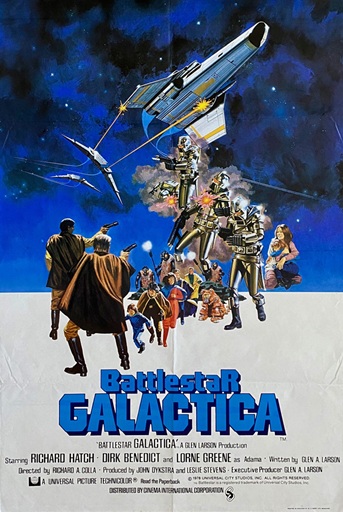
In a distant galaxy, the humans and the robotic Cylons have been at war for a thousand years.  Due to the diplomacy of Count Baltar (John Colicos), it appears that a peace agreement has finally been reached.  On their homeworld, President Adar (Lew Ayres) and the leaders of humanity prepare to welcome to the Cylons to a signing ceremony.  Amongst the commanders of the fleet of ships that orbit and defend the homeworld, only Commander Adama (Lorne Greene) fears that the Cylons may be plotting a sneak attack.

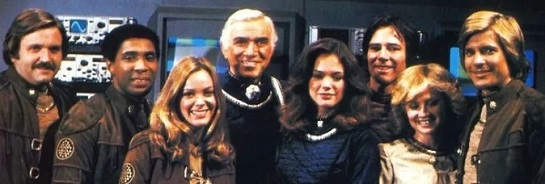
Adama turns out to be correct.  Baldar betrays humanity and the Cylons launch a sudden attack, wiping out the human leadership and almost the entire fleet of Battlestars.  Only Adama’s Galactica survives.  After picking up the refugees who survived the attack, the Galactica sets out to find a legendary planet that might be home to more humans.  With the Cylons pursuing and brave men like Starbuck (Dirk Benedict) and Adama’s son, Apollo (Richard Hatch), fighting to protect the last of the human refugees, the Galactica searches for Earth.

With Star Wars still a cultural phenomenon in 1978, it made sense that a television network like ABC would greenlight a science fiction series.  When producer Glen A. Larson pitched the idea for Battlestar Galactica, ABC was eager to move forward with it.  However, when the pilot cost $8,000,000 to produce (which was then a record-setting amount for a television show), ABC decided to recoup their costs by releasing an edited version of the pilot in theaters.  In Canada and the United States, the “film” hit theaters before it was subsequently aired on television.  The film was then later released in Europe, where it was a huge hit.

In fact, it was such a hit that 20th Century Fox sued Universal Studios, claiming that Battlestar Galactica stole the majority of its ideas from Star Wars.  Universal responded by filing a countersuit, claiming that Star Wars stole the majority of its ideas from Flash Gordon.  The case was eventually settled in 1983, long after the original Battlestar Galactica television series had been canceled.

And while that is all very interesting, it doesn’t answer the question that is probably on your mind right now.  Is the edited theatrical release of the Battlestar Galactica pilot any good?

Yes and no.  The first part of the movie, which deals with the Cylon sneak attack and Starbuck and Apollo rescuing the human refugees is an excellent work of science fiction, a space opera that can stand up with the best of them.  Even after all this time, the special effects are still effective as is Lorne Greene’s authoritative performance as Adama.  Richard Hatch and Dirk Benedict are also strong as the two main fighter pilots, even if both of them are obviously meant to be television versions of Luke Skywalker and Han Solo.  (Benedict’s Starbuck was the coolest character on Battlestar Galactica.  He was the best pilot, he was the best poker player, and he even smoked a cigar.)  The Cylons are chilling victims and the pilot even features some effective human drama along with all of the space battles.  After the Cylon attack, the story follows the Galactica as it makes a stop on a planet that’s also a casino that’s being run by untrustworthy space insects.  That part betrays the film’s television origins and feels like one of those episodes of Dr. Who that people try to forget.  The pilot features everything that made Battlestar Galactica work but, unfortunately, it also features everything that didn’t work.

Watching it today, though, it’s impossible not to feel the welcome pull of nostalgia.  In a time of cynicism, the pure idealism of Battlestar Galactica and its quest for Earth provides a nice and needed relief.  To quote Commander Adama:

“Fleeing from the Cylon tyranny, the last battlestar, Galactica, leads a ragtag fugitive fleet on a lonely quest… a shining planet known as Earth.”

Retro Television Reviews: Live Again, Die Again (dir by Richard A. Colla)


Welcome to Retro Television Reviews, a feature where we review some of our favorite and least favorite shows of the past!  On Sundays, I will be reviewing the made-for-television movies that used to be a primetime mainstay.  Today’s film is 1974’s Live Again, Die Again!  It  can be viewed on YouTube.

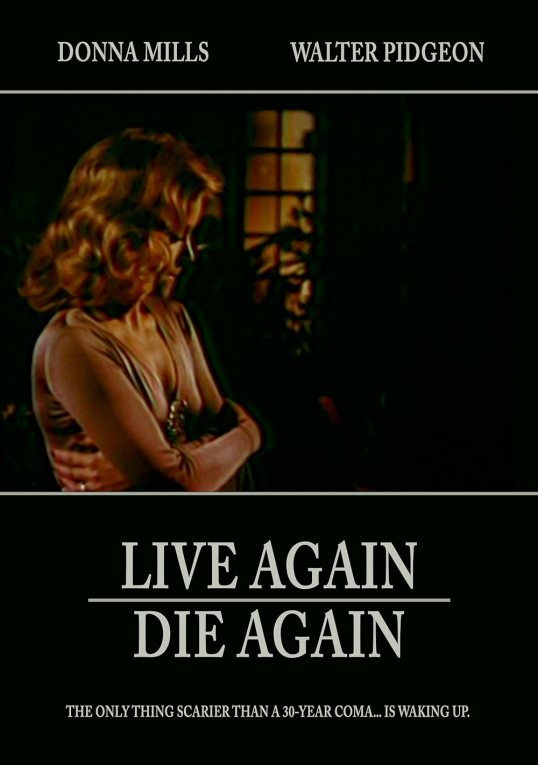
30 years ago, Caroline Carmichael (Donna Mills) died.

Except, she really didn’t.  Instead, when on the verge of death, she was put into cryogenic suspension.  She has spent the last three decades in suspended animation and, as a result, she has not aged in all that time.  In fact, her hair still looks perfect.  (I have some doubts about the scientific validity of any of this but let’s just go with it.)  As this movie begins, Caroline Carmichael finally wakes up.

Caroline has an entirely new world to discover.  At a party to celebrate her awakening, Caroline is shocked to discover that, while she still appears to be young, all of her friends are now in their 60s. Her husband, Thomas (Walter Pidgeon), is now old and sickly.  Her beautiful home is now looked after by a strict and suspicious housekeeper (Geraldine Page).    Her two children (played by Mike Farrell and Vera Miles) both appear to be older than her.  In fact, her daughter was so traumatized by Caroline’s “death,” that she is now terrified of being left alone with her mother.

You might expect that this film would be dedicated to Caroline adjusting to the world of the 70s and that it might feature some thoughts on whether it’s ethical to keep someone in suspended animation for 30 years.  And there are elements of that.  Caroline is amazed by all the tall buildings.  Her daughter’s reaction to Caroline’s return is hardly heart-warming and even Caroline’s whiny son doesn’t seem to be quite as happy about it as one might expect.  Her husband has spent the last 30 years of his life waiting for Caroline to wake up and it’s hard not to consider how many opportunities for happiness or success that he missed as a result.

That said, the film itself quickly becomes more of a gothic murder mystery, as Caroline comes to realize that someone is trying to kill her.  That’s kind of a shame because I actually found all of the cryogenic stuff to be much more interesting and the idea that one could basically just stop aging for 30 years was an intriguing one.  It’s an interesting question.  If it could save your life at some undetermined point in the future, would you be frozen?  Myself, I think I would be reluctant to do so because you never know what type of world you might wake up in.  Caroline is lucky enough to wake up wealthy in the 70s but what if you woke up and discovered that your entire family had died while you were in your coma?  What if you woke up and discovered that your country had become some sort of socialist Hellhole?  Imagine if someone went into hibernation in 1994 and then woke up in 2024?  They would probably want to go back to sleep.

The film was written Joseph Stefano, who also did the script for Psycho and was one of the producers behind The Outer Limits.  Not surprisingly, the script is full of snappy dialogue and the cast features two Psycho cast members, Vera Miles and Lurene Tuttle.  Director Richard Colla keeps the action moving and, early on in the film, he does a good job of depicting Caroline’s disorientation with finding herself in an entirely new world.  The film is well-acted by the entire cast, with Donna Mills especially doing a good job as Caroline.  This was an intelligent, well-made, and — most importantly — short made-for-TV movie.  At a time when almost all movies and TV shows seem to be too long for their own good, it’s hard not appreciate Live Again, Die Again‘s 73-minute runtime.

Retro Television Reviews: Miami Vice 1.5 “Calderone’s Return: The Hit List”


Welcome to Retro Television Reviews, a feature where we review some of our favorite and least favorite shows of the past!  On Mondays, I will be reviewing Miami Vice, which ran on NBC from 1984 to 1989.  The entire show is currently streaming on Tubi!

This week, the squad loses a member!

Episode 1.5 “Calderone’s Return: The Hit List”

(Dir by Richard A. Colla, originally aired on October 19th, 1984)

This episode opens with Sonny Crockett …. shaving!

That’s right.  After four episodes featuring Sonny with stubble, he finally shaves in this one.  Tubbs is shocked to see it.  However, Sonny has a good reason for shaving because he is due in divorce court, where he hopes that he can keep his soon to be ex-wife from taking his son to Georgia.

At the courthouse, Sonny and Caroline (Belinda Montgomery) take one look at each other and realize that they don’t want to give up on their marriage.  They cancel the hearing and fire their attorneys.  Caroline says that she’ll find a job in Miami and the Crockett family will stay together.

Yay!  It’s a good thing Sonny shaved.

Unfortunately, the pilot’s main bad guy, Calderone, wants to return to Miami and he’s sent an assassin (Jim Zubiena) to not only take out his potential rivals but also to kill the cops who he blames for his downfall.  When Tubbs and Rodriguez discover that Crockett is the 8th name on the assassin’s hit list and that six of the previous names are already dead, Rodriguez orders Crockett to go into productive custody.  Knowing that Crockett has trouble with following orders, Lt. Rodriguez personally escorts Sonny to his boat so that Sonny can pack.  When Rodriguez spots the reflection of a muzzle on a nearby building, Rodriguez pushes Sonny out of the way just as the Assassin pulls the trigger.  Rodriguez takes the bullet that was meant for Sonny.

And I have to admit that I was a bit upset by Rodriguez getting shot, despite the fact that Rodriguez wasn’t a particularly well-developed character.  He was the typical tough chief with a secret heart of gold and, for the most part, his brief role on the show consisted of barking at Sonny to do things by the book.  But still, Gregory Sierra was a likable actor and, as a result, Rodriguez always came across as being nice even when he was angry at Crockett.  Technically, the reason Rodriguez sacrificed his life was because Sierra requested to be written off the show.  In the world of Miami Vice, though, Rodriguez’s death gave both Crockett and Tubbs even more motivation to seek revenge on Calderone.

But, before Crockett and Tubbs can head down to the Bahamas to get Calderone, they have to take care of the Assassin.  After an hour of chases, misdirections, and one wonderfully over-the-top nightclub brawl, Crockett and the Assassin face each other in Crockett’s house, firing bullets at each other while Crockett’s wife and son cower in another room.  It’s an exciting fight, containing one particularly memorable moment when the Assassin appears to be firing his machine gun directly at the camera.  The Assassin was played by Jim Zubiena, who is a professional marksman and was a gun advisor on the set.  The Assassin doesn’t say one word but he’s still terrifying precisely because he obviously knows how to handle a gun.  In the end, it takes the entire Vice Squad to gun him down and it’s nice to see Crockett and Tubbs finally being helped out in a gunfight by Gina, Trudy, Switek, and Zito.

The Assassin may be dead but Calderone still lives.  After Crockett tells his shaken wife that he’ll reschedule their divorce hearing, he and Tubbs head for the Bahamas as part one of Calderone’s Revenge comes to a close.

Goodbye, Lou Rodriguez.  You will be missed.

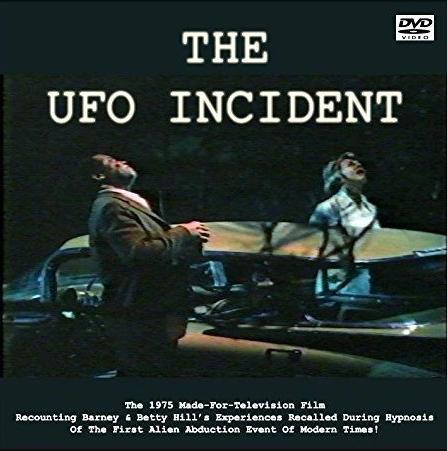
The Story of the Hills: The UFO Incident (1975, directed by Richard A. Colla)


Betty and Barney Hill (played by Estelle Parsons and James Earl Jones) are a happily married couple living in New Hampshire in the mid-60s.  They are both haunted by something that happened two years previously, while they were on vacation.  They both remember something appearing in the sky over their car but they can’t remember anything that happened afterwards.  They are both haunted by nightmares and a strong feeling that something terrible most have happened to them.  Finally, they meet with Dr. Benjamin Simon (Barnard Hughes), who places them both under hypnosis.  Only then does a clear picture start to emerge of what Betty and Barney believe happened as they both describe being abducted and experimented upon by aliens.

The UFO Incident is a very sober and serious account of the Hills’s abduction.  It never takes a clear side as to whether Betty and Barney are remembering something that actually happened or if they’re just remembering elaborate dreams.  That works to the film’s advantage, though it might disappoint those looking for a more dramatic take on the subject.  This is a made-for-TV movie so don’t expect much from the special effects and the alien costumes look disappointingly cheap.  The important thing, though, is that the film treat the Hills and their story with respect and James Earl Jones gives one of his best and most relatable performances as Barney.  The film is as much about how even a good marriage can be threatened by stressful times as it is about the UFOs.

The UFO Incident is based on the non-fiction book, The Interrupted Journey by John G. Fuller, which purported to tell the story of the Hills and their abduction.  The Hills were two of the first people to come forward with a story about being abducted by aliens.  Much of the common elements that can be found in stories about alien abductions, like the little grey men, the medical experimentation, and the amnesia afterwards, began with the Hills’s account of what they believed happened to them in 1961.  The Hills, who were active and highly respected in their community, were considered to be unusually credible witnesses, though Dr. Simon ultimately decided that Barney’s recollections of being on the UFO were probably influenced by Betty’s descriptions of her nightmares.  Barney, himself, died in 1969, three years after the book was published.  Betty remained active in the UFO community until her death in 2004.

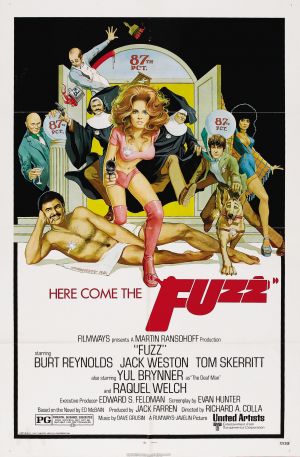
A Movie A Day #212: Fuzz (1972, directed by Richard A. Colla)


Detective Eileen McHenry (Raquel Welch) has just been given her new assignment and she is about to find out that there is never a dull day in the 87th Precinct.  How could there be when the precinct’s top detectives are played by Burt Reynolds, Tom Skerritt, and Jack Weston?  Or when Boston’s top criminal mastermind is played by Yul Brynner?  There is always something happening in the 8th Precinct.  Someone is stealing stuff from the precinct house.  Someone else is attacking the city’s homeless.  Even worse, Brynner is assassinating public officials and will not stop until he is paid a hefty ransom!

Based on the famous 87th Precinct novels that Evan Hunter wrote under the name Ed McBain, Fuzz has more in common with Robert Altman’s MASH than The French Connection.  (Skerritt and Bert Remsen, who plays a policeman in Fuzz, were both members of Altman’s stock company.)  Much like Altman’s best-regarded films, Fuzz is an ensemble piece, one that mixes comedy with tragedy and which features several different storylines playing out at once.  Scenes of homeless men being set on fire are mixed with scenes of Reynolds and Weston going undercover as nuns.  (Of course, Burt does not shave his mustache.)  Since it was written by Hunter, the film’s script comes close to duplicating the feel of the 87th Precinct novels.  Unfortunately, Richard A. Colla was a television director and Fuzz feels more like an extended episode of Police Story or Hill Street Blues than a movie.  Unlike Altman’s best films, Fuzz‘s constantly shifting tone and the mix of comedy and drama often feels awkward.  Fortunately, Fuzz does feature good performances from Reynolds, Westin, Skerritt, and Brynner, along with a great 70s score from Dave Grusin.  Raquel Welch is never believable as cop but she’s Raquel Welch so who cares?