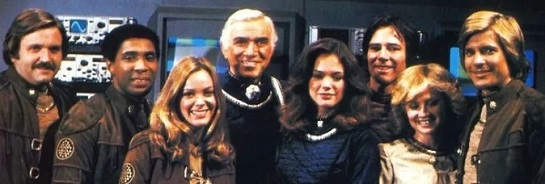
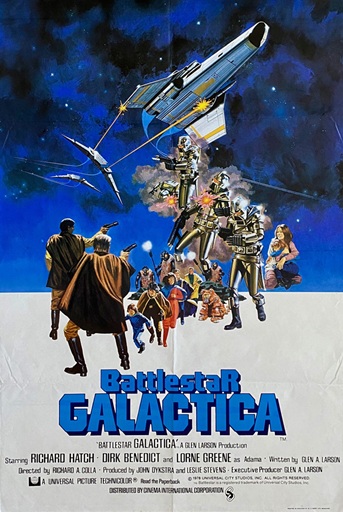
 In a distant galaxy, the humans and the robotic Cylons have been at war for a thousand years. Due to the diplomacy of Count Baltar (John Colicos), it appears that a peace agreement has finally been reached. On their homeworld, President Adar (Lew Ayres) and the leaders of humanity prepare to welcome to the Cylons to a signing ceremony. Amongst the commanders of the fleet of ships that orbit and defend the homeworld, only Commander Adama (Lorne Greene) fears that the Cylons may be plotting a sneak attack.
Adama turns out to be correct. Baldar betrays humanity and the Cylons launch a sudden attack, wiping out the human leadership and almost the entire fleet of Battlestars. Only Adama’s Galactica survives. After picking up the refugees who survived the attack, the Galactica sets out to find a legendary planet that might be home to more humans. With the Cylons pursuing and brave men like Starbuck (Dirk Benedict) and Adama’s son, Apollo (Richard Hatch), fighting to protect the last of the human refugees, the Galactica searches for Earth.
With Star Wars still a cultural phenomenon in 1978, it made sense that a television network like ABC would greenlight a science fiction series. When producer Glen A. Larson pitched the idea for Battlestar Galactica, ABC was eager to move forward with it. However, when the pilot cost $8,000,000 to produce (which was then a record-setting amount for a television show), ABC decided to recoup their costs by releasing an edited version of the pilot in theaters. In Canada and the United States, the “film” hit theaters before it was subsequently aired on television. The film was then later released in Europe, where it was a huge hit.
In fact, it was such a hit that 20th Century Fox sued Universal Studios, claiming that Battlestar Galactica stole the majority of its ideas from Star Wars. Universal responded by filing a countersuit, claiming that Star Wars stole the majority of its ideas from Flash Gordon. The case was eventually settled in 1983, long after the original Battlestar Galactica television series had been canceled.
And while that is all very interesting, it doesn’t answer the question that is probably on your mind right now. Is the edited theatrical release of the Battlestar Galactica pilot any good?
Yes and no. The first part of the movie, which deals with the Cylon sneak attack and Starbuck and Apollo rescuing the human refugees is an excellent work of science fiction, a space opera that can stand up with the best of them. Even after all this time, the special effects are still effective as is Lorne Greene’s authoritative performance as Adama. Richard Hatch and Dirk Benedict are also strong as the two main fighter pilots, even if both of them are obviously meant to be television versions of Luke Skywalker and Han Solo. (Benedict’s Starbuck was the coolest character on Battlestar Galactica. He was the best pilot, he was the best poker player, and he even smoked a cigar.) The Cylons are chilling victims and the pilot even features some effective human drama along with all of the space battles. After the Cylon attack, the story follows the Galactica as it makes a stop on a planet that’s also a casino that’s being run by untrustworthy space insects. That part betrays the film’s television origins and feels like one of those episodes of Dr. Who that people try to forget. The pilot features everything that made Battlestar Galactica work but, unfortunately, it also features everything that didn’t work.
Watching it today, though, it’s impossible not to feel the welcome pull of nostalgia. In a time of cynicism, the pure idealism of Battlestar Galactica and its quest for Earth provides a nice and needed relief. To quote Commander Adama:
“Fleeing from the Cylon tyranny, the last battlestar, Galactica, leads a ragtag fugitive fleet on a lonely quest… a shining planet known as Earth.”