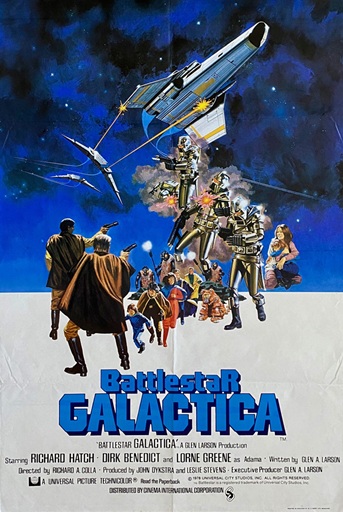
Battlestar Galactica (1978, directed by Richard A. Colla and Alan J. Levi)


In a distant galaxy, the humans and the robotic Cylons have been at war for a thousand years.  Due to the diplomacy of Count Baltar (John Colicos), it appears that a peace agreement has finally been reached.  On their homeworld, President Adar (Lew Ayres) and the leaders of humanity prepare to welcome to the Cylons to a signing ceremony.  Amongst the commanders of the fleet of ships that orbit and defend the homeworld, only Commander Adama (Lorne Greene) fears that the Cylons may be plotting a sneak attack.

Adama turns out to be correct.  Baldar betrays humanity and the Cylons launch a sudden attack, wiping out the human leadership and almost the entire fleet of Battlestars.  Only Adama’s Galactica survives.  After picking up the refugees who survived the attack, the Galactica sets out to find a legendary planet that might be home to more humans.  With the Cylons pursuing and brave men like Starbuck (Dirk Benedict) and Adama’s son, Apollo (Richard Hatch), fighting to protect the last of the human refugees, the Galactica searches for Earth.

With Star Wars still a cultural phenomenon in 1978, it made sense that a television network like ABC would greenlight a science fiction series.  When producer Glen A. Larson pitched the idea for Battlestar Galactica, ABC was eager to move forward with it.  However, when the pilot cost $8,000,000 to produce (which was then a record-setting amount for a television show), ABC decided to recoup their costs by releasing an edited version of the pilot in theaters.  In Canada and the United States, the “film” hit theaters before it was subsequently aired on television.  The film was then later released in Europe, where it was a huge hit.

In fact, it was such a hit that 20th Century Fox sued Universal Studios, claiming that Battlestar Galactica stole the majority of its ideas from Star Wars.  Universal responded by filing a countersuit, claiming that Star Wars stole the majority of its ideas from Flash Gordon.  The case was eventually settled in 1983, long after the original Battlestar Galactica television series had been canceled.

And while that is all very interesting, it doesn’t answer the question that is probably on your mind right now.  Is the edited theatrical release of the Battlestar Galactica pilot any good?

Yes and no.  The first part of the movie, which deals with the Cylon sneak attack and Starbuck and Apollo rescuing the human refugees is an excellent work of science fiction, a space opera that can stand up with the best of them.  Even after all this time, the special effects are still effective as is Lorne Greene’s authoritative performance as Adama.  Richard Hatch and Dirk Benedict are also strong as the two main fighter pilots, even if both of them are obviously meant to be television versions of Luke Skywalker and Han Solo.  (Benedict’s Starbuck was the coolest character on Battlestar Galactica.  He was the best pilot, he was the best poker player, and he even smoked a cigar.)  The Cylons are chilling victims and the pilot even features some effective human drama along with all of the space battles.  After the Cylon attack, the story follows the Galactica as it makes a stop on a planet that’s also a casino that’s being run by untrustworthy space insects.  That part betrays the film’s television origins and feels like one of those episodes of Dr. Who that people try to forget.  The pilot features everything that made Battlestar Galactica work but, unfortunately, it also features everything that didn’t work.

Watching it today, though, it’s impossible not to feel the welcome pull of nostalgia.  In a time of cynicism, the pure idealism of Battlestar Galactica and its quest for Earth provides a nice and needed relief.  To quote Commander Adama:

“Fleeing from the Cylon tyranny, the last battlestar, Galactica, leads a ragtag fugitive fleet on a lonely quest… a shining planet known as Earth.”
Retro Television Reviews: Miami Vice 1.12 “Little Prince”


Welcome to Retro Television Reviews, a feature where we review some of our favorite and least favorite shows of the past!  On Mondays, I will be reviewing Miami Vice, which ran on NBC from 1984 to 1989.  The entire show is currently streaming on Tubi!

This week, Crockett and Tubbs once again end up with a case that leaves them wondering what it all means.

Episode 1.12 “Little Prince”

(Dir by Alan J. Levi, originally aired on December 14th, 1984)

If nothing else, this episode of Miami Vice has a brilliant opening.

As Relax by Frankie Goes To Hollywood plays on the soundtrack, Gina and Trudy stumble down a Miami street.  Trudy is shaking and sobbing and saying that she desperately needs a fix.  A drug dealer named Luther (played an amazingly young and charismatic Giancarlo Esposito) steps out of the shadows and invites them to come back to his shooting gallery for a fix.  Gina accuses Luther of being a cop.  Luther smiles and points to a tear drop that’s been tattooed under his eye.

Gina and Trudy go to Luther’s shooting gallery, which they discover is full of strung-out people.  (Luther calmly mentions that there’s at least two dead people in the apartment.)  Of course, Gina and Trudy aren’t there to score drugs.  They are there to make a bust, which they do as soon as Tubbs and Crockett arrive.  (Tubbs and Crockett had to beat up an informant to find out where Luther’s shooting gallery was and, as a result, they’re running a little late.)  Guns are fired.  Gina gets to shoot yet another man.  (Go Gina!)  One junkie jumps out a window.  Crockett says that the junkie probably landed on the fire escape.  He looks out the window.

“No fire escape,” he says.

It’s a great opening.  Unfortunately, it’s pretty much all downhill from there.  This is the first episode of Miami Vice that just didn’t work for me.

One of the junkies arrested at the shooting gallery turns out to be Mark Jorgenson, Jr. (Mitchell Litchenstein), the son of the very wealthy Mark, Sr. (Paul Roebling).  Mark, Jr. loves to play polo and he’s hooked on heroin.  Because they’re convinced that he can be intimidated into giving up his dealer, Crockett and Tubbs put pressure on him.  Crockett starts showing up at all of Mark, Jr.’s polo matches.  He even meets Mary McDermott (Maryann Punkett), who is Mark Sr’s girlfriend and the closest thing that Mark Jr. has to a mother.

Over the course of the investigation, Crockett and Tubbs come to realize that Mark, Sr. is actually a big-time money launderer and drug boss.  When they raid one of his warehouses, they discover that Mary is the one who handles all of the business transactions.  After Mary turns up dead, Mark Jr. agrees to help the cops expose his father.  Mark Jr. wears a wire, just for his father to finally tell him that he loves him before confessing to Mary’s murder.  Mark, Sr. is arrested and Mark, Jr.’s life is ruined and Sonny wonders if it was all really worth it.

As I said, this episode didn’t work for me.  Neither Mark Jr. nor Mark Sr. were particularly compelling characters and neither actor could do much with their underwritten characters.  In particular, Mark, Jr. came across as being so spoiled and whiny that I really didn’t care whether his life was ruined or not.  Brilliant opening aside, this was a forgettable episode.

A Movie A Day #145: The Incredible Hulk: A Death In The Family (1977, directed by Alan J. Levi)


Following the events of The Incredible Hulk and with the world convinced that he is dead, Dr. David Banner (Bill Bixby) is hitchhiking his way across California, hoping to reach a hospital where research is being done on the effects of gamma radiation.  When he stops off in an orange grove, he spots a young, crippled woman named Julie (Laurie Prange).  When Julie faints, David carries her back to her mansion.  It turns out that, after the mysterious death of her father, Julie stands to inherit millions.  David suspects that her doctor (played by William Daniels) may be poisoning her and he gets a job working on the grounds of her mansion.  At first, David thinks that his biggest problem is going to be the head groundskeeper (Gerald McRaney), who is jealous of David’s relationship with Julie.  But, actually, it’s Julie’s stepmother (Dorothy Tristan) that David has to watch out for.  When David tries to protect Julie and a bitter hermit (John McLiam) from the stepmother’s evil plans, he soon finds himself being pursued through the swampland by both men with guns and tabloid journalist Jack McGee (Jack Colvin).  They are all making David Banner angry and they’re about to discover that they wouldn’t like David Banner when he’s angry.

This was the second pilot for The Incredible Hulk.  It aired a week after the first pilot and, like that one, it was also given a theatrical release in Europe.  While the first movie established David Banner’s backstory and explained why he transformed into the Hulk whenever he bumped his head on a door frame or twisted his ankle, A Death in The Family is more typical of the series that would follow.  Like every subsequent episode, A Death In The Family opens with David Banner finding an odd job and ended with him walking down the road with his thumb stuck out.  In between, Banner helps a special guest star.

Watching the second pilot, it’s easy to see why CBS took a chance on The Incredible Hulk even though, at the time, comic book adaptations were considered to be a risk.  Both Bill Bixby and Lou Ferrigno really throw themselves into playing Banner and his alter ego and the show takes the idea seriously.

There’s nothing special about the pilot’s story.  The stepmother and the doctor are obviously guilty from the start.  But the plot (and the 90 minute running time) does allow for four appearances by the Hulk.  David Banner even gets attacked by a grizzly bear, which brings the Hulk right out.  David Banner always had the worst luck with wild animals and barbed wire.  The Hulk, though, just throws the grizzly bear over into the next pond.  The bear is not harmed.  The Hulk may have been angry but he was never really dangerous.

Finally, for the record, Death In the Family featured the first of many aliases that David Banner would assume over the next four years.  This time, he’s David Benton.