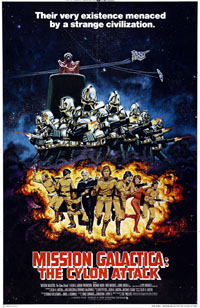
Mission Galactica: The Cylon Attack (1979, directed by Vince Edwards and Christian Nyby II)


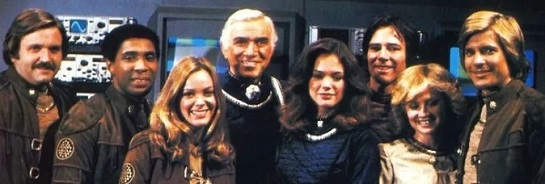
While on a routine scouting patrol, Starbuck (Dirk Benedict) and Apollo (Richard Hatch) are captured, not by Cylons but instead by the crew of the Battlestar Pegasus.  The Pegasus and its legendary commander, Cain (Lloyd Bridges), were assumed to have been lost during the Cylon sneak attack but instead, Cain survived and the Pegasus has been in deep space ever since, waging his own war against the Cylons.  At first, both Cain and Adama (Lorne Greene) are both happy to discover that the other is still alive.  But it turns out that Adama and Cain both have very different plans and visions for the future.  Adama wants to steal fuel from a nearby Cylon base so that he and his fleet can continue their journey to Earth.  Cain wants to launch a full-out attack on the Cylons and he expects the Galactica to help him.  Though they both share the same enemy, the crews of the Galactica and Pegasus find themselves divided over which commander to follow.  Is it better to go down fighting or to survive to find a new home?

Sold overseas as a sequel to the first Battlestar Galactica feature film (which itself was just an edited version of the show’s pilot), Mission Galactica was cobbled together from three episodes of the television series.  Because the TV show was expensive to produce and not the ratings hit that NBC was expecting, the show’s producer, Glen Larson, was asked to edit several episodes together so that they could be released as movies in Europe and Asia.  Larson took a two-part episode featuring Commander Cain and added some scenes from an unrelated episode that featured an injured Apollo undergoing surgery while a fire raged in the Galactica.  All things considered, Larson did a good job of cleanly assembling the movie without making it too obvious that it was stitched together out of three episodes, though some of the best parts of Cain’s storyline did get left on the cutting room floor.

How does Mission Galactica work as a movie?  Even though it opens with a voice-over narration explaining the Cylon attack and the Galactica’s mission to find Earth, I imagine that someone watching this with no previous knowledge of the show would be lost.  As well, it’s obvious that the special effects were designed with the small screen of television in mind.  However, Lloyd Bridges transcends the script’s limitations as the charismatic but obsessive Command Cain.  This is actually one of Bridges’s best performances and his scenes with Lorne Greene work surprisingly well.  They’re both believable as two proud commanders who are both convinced that they’re doing the right thing.  The rest of the cast is adequate.  I’ve always liked Dirk Benedict’s performance as Starbuck, even if he was essentially just playing a variation on Han Solo.  For all of its flaws as a series, Battlestar Galactica usually did a good job of capturing the vastness of space and the epic scope of Galactica’s journey and that’s the case here.  Mission Galactica doesn’t escape its television origins but, for fans of the series, it’s an enjoyable space opera.

In the end, I recommend watching the original episodes that were used for this movie — Parts One and Two of The Living Legend and Fire In Space.  The Living Legend was the original Battlestar Galactica at its best.
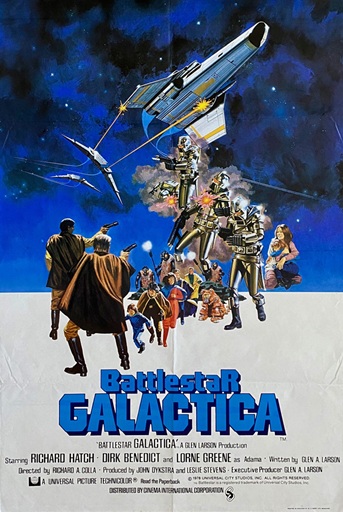
Battlestar Galactica (1978, directed by Richard A. Colla and Alan J. Levi)


In a distant galaxy, the humans and the robotic Cylons have been at war for a thousand years.  Due to the diplomacy of Count Baltar (John Colicos), it appears that a peace agreement has finally been reached.  On their homeworld, President Adar (Lew Ayres) and the leaders of humanity prepare to welcome to the Cylons to a signing ceremony.  Amongst the commanders of the fleet of ships that orbit and defend the homeworld, only Commander Adama (Lorne Greene) fears that the Cylons may be plotting a sneak attack.

Adama turns out to be correct.  Baldar betrays humanity and the Cylons launch a sudden attack, wiping out the human leadership and almost the entire fleet of Battlestars.  Only Adama’s Galactica survives.  After picking up the refugees who survived the attack, the Galactica sets out to find a legendary planet that might be home to more humans.  With the Cylons pursuing and brave men like Starbuck (Dirk Benedict) and Adama’s son, Apollo (Richard Hatch), fighting to protect the last of the human refugees, the Galactica searches for Earth.

With Star Wars still a cultural phenomenon in 1978, it made sense that a television network like ABC would greenlight a science fiction series.  When producer Glen A. Larson pitched the idea for Battlestar Galactica, ABC was eager to move forward with it.  However, when the pilot cost $8,000,000 to produce (which was then a record-setting amount for a television show), ABC decided to recoup their costs by releasing an edited version of the pilot in theaters.  In Canada and the United States, the “film” hit theaters before it was subsequently aired on television.  The film was then later released in Europe, where it was a huge hit.

In fact, it was such a hit that 20th Century Fox sued Universal Studios, claiming that Battlestar Galactica stole the majority of its ideas from Star Wars.  Universal responded by filing a countersuit, claiming that Star Wars stole the majority of its ideas from Flash Gordon.  The case was eventually settled in 1983, long after the original Battlestar Galactica television series had been canceled.

And while that is all very interesting, it doesn’t answer the question that is probably on your mind right now.  Is the edited theatrical release of the Battlestar Galactica pilot any good?

Yes and no.  The first part of the movie, which deals with the Cylon sneak attack and Starbuck and Apollo rescuing the human refugees is an excellent work of science fiction, a space opera that can stand up with the best of them.  Even after all this time, the special effects are still effective as is Lorne Greene’s authoritative performance as Adama.  Richard Hatch and Dirk Benedict are also strong as the two main fighter pilots, even if both of them are obviously meant to be television versions of Luke Skywalker and Han Solo.  (Benedict’s Starbuck was the coolest character on Battlestar Galactica.  He was the best pilot, he was the best poker player, and he even smoked a cigar.)  The Cylons are chilling victims and the pilot even features some effective human drama along with all of the space battles.  After the Cylon attack, the story follows the Galactica as it makes a stop on a planet that’s also a casino that’s being run by untrustworthy space insects.  That part betrays the film’s television origins and feels like one of those episodes of Dr. Who that people try to forget.  The pilot features everything that made Battlestar Galactica work but, unfortunately, it also features everything that didn’t work.

Watching it today, though, it’s impossible not to feel the welcome pull of nostalgia.  In a time of cynicism, the pure idealism of Battlestar Galactica and its quest for Earth provides a nice and needed relief.  To quote Commander Adama:

“Fleeing from the Cylon tyranny, the last battlestar, Galactica, leads a ragtag fugitive fleet on a lonely quest… a shining planet known as Earth.”

The TSL Horror Grindhouse: Abby (dir by William Girdler)


Some films are a hundred times more entertaining than they have any right to be and that’s certainly the case with 1974’s Abby.

A blaxploitation take on The Exorcist and Rosemary’s Baby, Abby opens with Bishop Garrett Williams (William Marshall, star of Blacula) taking a peaceful stroll with his students at seminary.  Garrett talks about how he will miss them all when he is off on archeological dig in Nigeria.  One of his students asks him some questions about Eshu, one of the spirits of the Yoruba religion.  Bishop Williams explains that Eshu is a trickster and a force of chaos and carnal excess.  Yes, the Bishop explains, he does believe that demons are real.

And indeed, no sooner has the Bishop gone to Nigeria and opened up a small puzzle box adorned with the symbols of Eshu than a demon claiming to be Eshu travels from Africa to Louisville, Kentucky.  Louisville is the new home of the Bishop’s son, Reverend Emmett Williams (Terry Carter).  Reverend Williams is a good and god-fearing man and his new wife, Abby (Carol Speed), is a devout Christian who sings in the choir, speaks out against drugs, and never curses.  That changes, however, once the demon claiming to be Eshu gets inside of her.  Soon, Abby is speaking in a very deep voice, laughing at inappropriate moments, demanding constant sex, and plunging a knife into her arm.  When the now possessed Abby disappears into the sordid nightlife of Louisville, Reverend Williams and his brother-in-law, Det. Cass Potter (Austin Stoker), try to find her.  Eventually, Bishop Williams joins them in their search, knowing that even if they find Abby, it will fall to him to perform the exorcism to save her life and soul.

Abby has so much in common with The Exorcist that Warner Bros. actually ended up suing the film’s producers and distributor for plagiarism.  That lawsuit is one reason why it’s not particularly easy to see Abby today.  Indeed, I had to resort to watching a washed-out upload on YouTube.  Of course, Abby was hardly the first or the last film to rip off The Exorcist.  Almost every horror released in the wake of William Friedkin’s classic shocker owes something to The Exorcist.  Abby, however, was one of the more finanically successful rip-offs of the film, or at least it was until the lawsuit led to it being removed from theaters.  It’s unfortunate that Abby is so difficult to see because it’s actually one of the more entertaining Exorcist rip-offs out there.

A lot of that is due to the confrontation between the dignified and stately William Marshall and the far more hyperactive Carol Speed.  Carol Speed gives a performance of amazing energy, whether she’s happily cackling after a woman drops dead of a heart attack or if she’s kicking her husband in the groin.  Carol Speed holds nothing back and basically tears through every scene like a force of uncontrollable nature.  She provides the perfect counterbalance to Marshall’s more measured performance as the Bishop.  Marshall delivers his lines with such authority and conviction that the viewer has no doubt he could probably scare the devil out of everyone.  Carol Speed, meanwhile, is so good at playing wild that the viewer wonders how, even if they can get Eshu out of here, Abby will ever be able to go back to being a demure preacher’s wife.  Setting Marshall and Speed loose in the seedy nightclubs of Loiusville leads to an occasionally horrific, occasionally silly, but always entertaining between good and evil.

Abby is an entertaining horror film.  It’s just unfortunate that we will probably never get to see a good print of it.  But then again, maybe that’s for the best.  The graininess of the version that I saw actually added to the experience of watching the film.  It made me feel like I was in some small theater in the middle of nowhere, watching a print of the film that had taken a long and difficult journey just so it could be seen and appreciated.