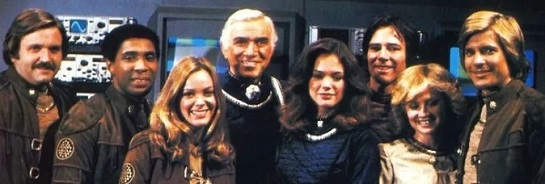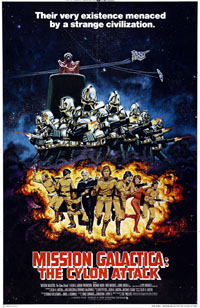
Mission Galactica: The Cylon Attack (1979, directed by Vince Edwards and Christian Nyby II)


While on a routine scouting patrol, Starbuck (Dirk Benedict) and Apollo (Richard Hatch) are captured, not by Cylons but instead by the crew of the Battlestar Pegasus.  The Pegasus and its legendary commander, Cain (Lloyd Bridges), were assumed to have been lost during the Cylon sneak attack but instead, Cain survived and the Pegasus has been in deep space ever since, waging his own war against the Cylons.  At first, both Cain and Adama (Lorne Greene) are both happy to discover that the other is still alive.  But it turns out that Adama and Cain both have very different plans and visions for the future.  Adama wants to steal fuel from a nearby Cylon base so that he and his fleet can continue their journey to Earth.  Cain wants to launch a full-out attack on the Cylons and he expects the Galactica to help him.  Though they both share the same enemy, the crews of the Galactica and Pegasus find themselves divided over which commander to follow.  Is it better to go down fighting or to survive to find a new home?

Sold overseas as a sequel to the first Battlestar Galactica feature film (which itself was just an edited version of the show’s pilot), Mission Galactica was cobbled together from three episodes of the television series.  Because the TV show was expensive to produce and not the ratings hit that NBC was expecting, the show’s producer, Glen Larson, was asked to edit several episodes together so that they could be released as movies in Europe and Asia.  Larson took a two-part episode featuring Commander Cain and added some scenes from an unrelated episode that featured an injured Apollo undergoing surgery while a fire raged in the Galactica.  All things considered, Larson did a good job of cleanly assembling the movie without making it too obvious that it was stitched together out of three episodes, though some of the best parts of Cain’s storyline did get left on the cutting room floor.

How does Mission Galactica work as a movie?  Even though it opens with a voice-over narration explaining the Cylon attack and the Galactica’s mission to find Earth, I imagine that someone watching this with no previous knowledge of the show would be lost.  As well, it’s obvious that the special effects were designed with the small screen of television in mind.  However, Lloyd Bridges transcends the script’s limitations as the charismatic but obsessive Command Cain.  This is actually one of Bridges’s best performances and his scenes with Lorne Greene work surprisingly well.  They’re both believable as two proud commanders who are both convinced that they’re doing the right thing.  The rest of the cast is adequate.  I’ve always liked Dirk Benedict’s performance as Starbuck, even if he was essentially just playing a variation on Han Solo.  For all of its flaws as a series, Battlestar Galactica usually did a good job of capturing the vastness of space and the epic scope of Galactica’s journey and that’s the case here.  Mission Galactica doesn’t escape its television origins but, for fans of the series, it’s an enjoyable space opera.

In the end, I recommend watching the original episodes that were used for this movie — Parts One and Two of The Living Legend and Fire In Space.  The Living Legend was the original Battlestar Galactica at its best.
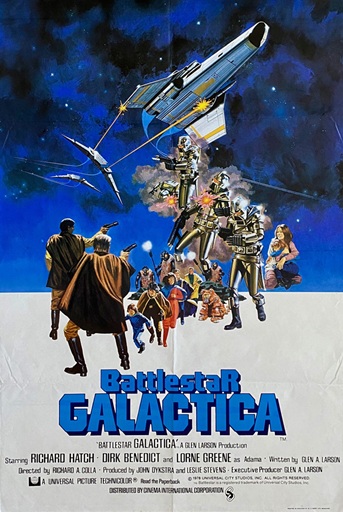
Battlestar Galactica (1978, directed by Richard A. Colla and Alan J. Levi)


In a distant galaxy, the humans and the robotic Cylons have been at war for a thousand years.  Due to the diplomacy of Count Baltar (John Colicos), it appears that a peace agreement has finally been reached.  On their homeworld, President Adar (Lew Ayres) and the leaders of humanity prepare to welcome to the Cylons to a signing ceremony.  Amongst the commanders of the fleet of ships that orbit and defend the homeworld, only Commander Adama (Lorne Greene) fears that the Cylons may be plotting a sneak attack.

Adama turns out to be correct.  Baldar betrays humanity and the Cylons launch a sudden attack, wiping out the human leadership and almost the entire fleet of Battlestars.  Only Adama’s Galactica survives.  After picking up the refugees who survived the attack, the Galactica sets out to find a legendary planet that might be home to more humans.  With the Cylons pursuing and brave men like Starbuck (Dirk Benedict) and Adama’s son, Apollo (Richard Hatch), fighting to protect the last of the human refugees, the Galactica searches for Earth.

With Star Wars still a cultural phenomenon in 1978, it made sense that a television network like ABC would greenlight a science fiction series.  When producer Glen A. Larson pitched the idea for Battlestar Galactica, ABC was eager to move forward with it.  However, when the pilot cost $8,000,000 to produce (which was then a record-setting amount for a television show), ABC decided to recoup their costs by releasing an edited version of the pilot in theaters.  In Canada and the United States, the “film” hit theaters before it was subsequently aired on television.  The film was then later released in Europe, where it was a huge hit.

In fact, it was such a hit that 20th Century Fox sued Universal Studios, claiming that Battlestar Galactica stole the majority of its ideas from Star Wars.  Universal responded by filing a countersuit, claiming that Star Wars stole the majority of its ideas from Flash Gordon.  The case was eventually settled in 1983, long after the original Battlestar Galactica television series had been canceled.

And while that is all very interesting, it doesn’t answer the question that is probably on your mind right now.  Is the edited theatrical release of the Battlestar Galactica pilot any good?

Yes and no.  The first part of the movie, which deals with the Cylon sneak attack and Starbuck and Apollo rescuing the human refugees is an excellent work of science fiction, a space opera that can stand up with the best of them.  Even after all this time, the special effects are still effective as is Lorne Greene’s authoritative performance as Adama.  Richard Hatch and Dirk Benedict are also strong as the two main fighter pilots, even if both of them are obviously meant to be television versions of Luke Skywalker and Han Solo.  (Benedict’s Starbuck was the coolest character on Battlestar Galactica.  He was the best pilot, he was the best poker player, and he even smoked a cigar.)  The Cylons are chilling victims and the pilot even features some effective human drama along with all of the space battles.  After the Cylon attack, the story follows the Galactica as it makes a stop on a planet that’s also a casino that’s being run by untrustworthy space insects.  That part betrays the film’s television origins and feels like one of those episodes of Dr. Who that people try to forget.  The pilot features everything that made Battlestar Galactica work but, unfortunately, it also features everything that didn’t work.

Watching it today, though, it’s impossible not to feel the welcome pull of nostalgia.  In a time of cynicism, the pure idealism of Battlestar Galactica and its quest for Earth provides a nice and needed relief.  To quote Commander Adama:

“Fleeing from the Cylon tyranny, the last battlestar, Galactica, leads a ragtag fugitive fleet on a lonely quest… a shining planet known as Earth.”

Film Review: Silent Madness (dir by Simon Nuchtern)


1984’s Silent Madness opens in a mental hospital in New Jersey.  In order to cut down on costs, the hospital’s administrators have been giving early release to some of their patients.  Dr. Joan Gilmore (Belinda Montgomery) has only been on staff for a few months but even she knows that there’s a risk that a truly dangerous patient could be released.  Dr. Gilmore’s worries come true when a homicidal patient named Howard Johns (Solly Marx) disappears from the hospital.  Apparently, a computer errors led to Howard being released instead of a patient with a similar name.

Oh, someone screwed up big time!

Or, at least, that’s what Joan believes.  In a scene that has to be seen to be believed, the arrogant Dr. Kruger (Roderick Cook) attempts to convince Joan that Howard Johns actually died a while ago and that’s why he’s not in the hospital anymore.  Joan demands to see a death certificate.  Dr. Kruger is like, “Oh, I don’t know where it is.  We’ll have to look for it.”  Yeah, that’s the same thing I used to say in college whenever I was running behind on my paying my credit card.  “Really?  I never received that bill.  Can you send it again?”

Knowing that Howard was imprisoned after committing several murders at a sorority house in upstate New York, Joan theorizes that he’s heading back to the college so that he can pick up where he left off.  Pretending to be a former member of the sorority, Joan meets the aging house mother, Mrs. Collins (Viveca Lindfors).  Mrs. Collins — who often refers to younger women as being “whores” — tells a story of how a hazing ritual gone wrong led to handyman Howard grabbing a nail gun and wiping out a pledge class.  When Joan actually spots Howard on campus, she tries to get the sheriff (Sydney Lassick) to do something about it.  The sheriff replies that Joan must be seeing things because the hospital called and reported that Howard is deceased.  The sheriff than has a beer because he’s the best character in the entire film.

Howard, needless to say, is not dead.  He’s hiding out in the sorority house and he’s continuing in his murderous ways.  We don’t really learn much about Howard.  As the title suggests, he’s a silent killer.  That works to the film’s advantage.  A silent killer is far more intimidating than one who spends all of his time coming up with bad puns.  Because Silent Madness was originally filmed in 3D, Howard enjoys throwing axes and firing nail guns, often straight at the camera.

Silent Madness is a thoroughly ludicrous film but it’s enjoyable as a product of its time.  It’s hard not to smile at the thought of a theatrical audience ducking as Howard throws an axe at the camera in 3D.  Howard is a properly intimidating killer but the film is totally stolen by Roderick Cook, Viveca Lindfors, and Sydney Lassick, three veteran actors who knew better than to even try to be subtle while appearing in a film like this.  Lassick’s performance as the cowardly sheriff is especially enjoyable.  We all know that law enforcement is useless in a slasher film.  Lassick’s sheriff seems to understand this as well.  He’d rather just stay in his office and who can blame him?

Silent Madness is silly and kind of dumb but it’s undeniably entertaining.