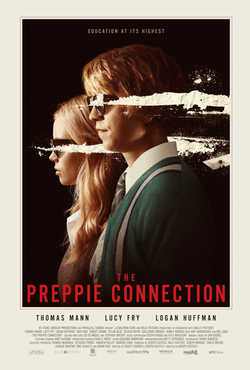
The Preppie Connection, which is currently playing On Demand and in limited release, has got a 0% rating at Rotten Tomatoes. That seems a little bit harsh to me. I mean, The Preppie Connection isn’t exactly a good movie but it’s still not a disaster. It’s main sin is that it’s generic and forgettable and squanders a potentially interesting story. That’s definitely not a good thing but still, The Preppie Connection is still better than some of the other films that currently have a zero score on Rotten Tomatoes.The Preppie Connection may not be great but it’s still better than Bucky Larson: Born To Be A Star andA Thousand Words.
0%?
Not hardly.
More like 25%.
Anyway, The Preppie Connection is apparently based on a true story. Tobias Hammel (Thomas Mann) is a poor kid who wins a scholarship to an exclusive private school. At first, Tobias struggles to fit in. He doesn’t know how to relate to his wealthy classmates and he’s embarrassed when his friends from the old neighborhood show up on campus. When he is instructed to sign a 200 year-old book, he accidentally knocks the book to the floor. As a result, the other students beat him up.
Fortunately, for Tobias, everyone assumes that — since he’s poor — he’ll be able to get them drugs. At first, everyone is satisfied with weed but, since this movie is taking place in the 80s, everyone soon starts to pressure Tobias to get them cocaine. Fortunately (and conveniently), Tobias has befriended the son of the Colombian ambassador. Soon, Tobias is making regular trips to Colombia and returning with bags of cocaine hidden away in his travel bag.
Usually, I love films about wealthy drug addicts. There’s usually a few good scenes of drug-fueled decadence and, since they’re rich, everyone’s usually dressed nicely. But no… sorry. The Preppie Connection just doesn’t work. Visually, the film is flat and, even worse, it appears that the budget was too low to be able to afford the rights to any period music. I was hoping to hear at least a few classic 80s songs but instead, the film only offered some generic synthesizer-fueled music.
Speaking of generic, Thomas Mann narrates nearly the entire film and it’s some of the most vapid narration that I’ve ever heard. I mean, I understand that everyone loves Goodfellas and Casino but that doesn’t mean that every period gangster film has to feature nonstop narration.
Ultimately, The Preppie Connection is such an incredibly forgettable film that I really can’t even come up with more than 400 words to type about it. That said, Logan Huffman and Lucy Fry both give good performances as two of Tobias’s customers and they’re good enough to bump the film up to at least a score of 25 out of 100.
Last night, as I watched Dead 7, I could not help but think about the 2001 film, On The Line. Don’t get me wrong, On The Line does not feature any zombies and there’s next to no violence. However, much like Dead 7, it does feature quite a few boy banders. In fact, with the exception of JC Chasez, every member of *NSYNC makes an appearance in On The Line. Lance Bass stars in the movie. Joey Fatone plays his best friend. Finally, at the end of the film, in a scene that is so homophobic that it practically screams 2001, Justin Timberlake and Chris Kirkpatrick show up as a flamboyant makeup artist and an even more flamboyant hairstylist.
Lance plays Kevin, a shy and somewhat nerdy advertising exec who lives in Chicago. Kevin falls in love easily but he’s always been too shy to have a serious relationship. One day, Kevin is returning home from work on the train when he starts talking to Abbey (Emanuelle Chriqui). It turns out that they both love the Chicago Cubs and Al Green! (Oh my God! Who would have guessed that two people living in Chicago would both love the local sports team!?) It also turns out that both Kevin and Abbey can name all the Presidents in order! Obviously, they are meant to be! The universe arranged for them to both be on the train at the same time so that they can get married, have children, and discuss the presidency of Rutherford Hayes while watching the Cubs and listening to Al Green.
Unfortunately, despite being a single guy who has just totally hit it off with a single girl who is obviously attracted to him, Kevin forgets to get her phone number. The movie explains this by saying that Kevin is shy but if he’s so shy that he can’t even give out his phone number then how did he ever find the courage to tell Abbey that he loves Al Green in the first place?
(Actually, Abbey isn’t really single but her fiancée is such a jerk that she might as well be. Anyone who has ever seen a movie knows that Abbey is not meant to marry a guy who spends all of his time on the phone, yelling, “Sell! Sell!”)
Of course, if Kevin had gotten her phone number, there wouldn’t have been a movie. So, instead, he recruits his loser friends (including Joey Fatone) to help him track down Abbey. He puts up flyers all over Chicago. A story about him appears in the newspaper. Soon, the entire city is obsessed with whether or not Kevin will find this girl that he talked to for ten minutes. However, Abbey apparently never watches TV or reads the newspaper because somehow, she doesn’t know all of this is going on…
There’s an interesting subtext to On The Line. Lance Bass himself produced the film. Five years after On The Line flopped at the box office, Lance officially came out as gay (and, it must be said, that whenever Kevin talks to Abbey, he comes across less like a future lover and more like every girl’s ideal gay best friend). Lance has said that he was still deeply closeted when he made On The Line and there are times when the film seems to be almost desperate to convince us of Kevin’s (and, by association, Lance’s) heterosexuality. In this context, that end credits scene with Chris and Justin, limp-wristed and speaking in exaggerated falsetto, is even ickier. “Gay?” the film says to be saying, “If there was a gay person in On The Line, would Justin Timberlake be playing a makeup artist? Would Chris Kirkpatrick be willing to appear as a hairdresser named Angelo?”
On The Line is not a particularly good film and yet, oddly, it’s one that I always find myself watching whenever I come across it on cable. Lance may be miscast and he’s obviously uncomfortable in the majority of his scenes but he’s also likable. You never believe for a second that Kevin and Abbey will last as a couple but Lance seems like a nice guy and Emmanuelle Chriqui is so pretty that you’re happy that they at least got to go on a date or two before breaking up and never seeing each other again. They’re both pretty and it’s fun to watch pretty people talk to each other, even if they do lack a certain romantic chemistry. As well, though his character is pretty obnoxious, Joey Fatone is still always fun to watch.
On The Line is no Dead 7 but it’s still watchable in its own stupid way. I would suggest, however, skipping the end credits
The latest film from the geniuses at the Asylum (and I mean that as a compliment because there is definitely a strain of genius at the heart of The Asylum’s madness), Dead 7 premiered on SyFy last night. I watched it. My friends, the Snarkalecs, watched it. And about a million boy band fans watched it. As usual, the Snarkalecs and I attempted to live tweet the film. Unfortunately, for every genuinely witty tweet from me and my friends, there were a few thousand tweets from people begging Nick Carter to retweet them. A lot of wonderful snark got lost in the deluge of fangirl exhortations.
But I can’t really blame the fangirls. If I hadn’t discovered the joys of snark and if not for the fact that I have too much self-worth to beg anyone (no matter how hot or famous) for a retweet, I might have been there with them. Dead 7 is many things but it will probably best be remembered as the movie that featured a lot of former boy band members fighting and being eaten by zombies. (As more than one tweeter put it, Dead 7 was like watching all of your childhood cruses die a terrible and bloody death.) Not only was the film’s story conceived by Backstreet Boy Nick Carter but he also starred in it and convinced a lot of other boy banders to join the cast. Of course, neither Justin Timberlake nor Lance Bass are anywhere to be found in the film. (For that matter, I was surprised that Aaron Carter didn’t show up.) But the film does feature three Backstreet Boys, two from *NSYNC, Jeff Timmons from 98 Degrees, and O-Town.
Yes, O-Town.
(Fortunately, super creepy, super sleazy, and super imprisoned Lou Pearlman did not have a cameo. I imagine that he was one of the first people to be eaten during the zombie apocalypse.)
As for the film itself … well, it’s not exactly easy to describe. The plot was not always easy to follow and there was a surprisingly large amount of backstory for an Asylum zombie film. The apocalypse has come and gone and now, the world has been transformed into the old west. What remains of humanity lives in tiny and isolated communities. Gunslingers wander through the desert. High atop a mountain, a mad woman named Apocalypta (super scary Debra Wilson) breeds zombies and holds the town below hostage. Sheriff Cooper (Jon Secada) recruits a group of warriors to take out Apocalypta and her hordes.
(Incidentally, Apocalypta’s main henchman is named Johnny Vermillion. Johnny wears clown makeup and giggles uncontrollably. He also gouges out a man’s eye. Johnny is played by A.J. McClean of the Backstreet Boys and he makes for a surprisingly effective villain.)
Despite the fact that Cooper and his impressive sideburns are later eaten by a zombie horde, the warriors still go after Apocalypta. They are the Dead 7, not quite magnificent and almost all dead by the end of the film.
O-Town’s Erik Michael Estrada is Komodo. He’s a samurai. He kills a lot of zombies with a sword. Watching the movie last night, we all really loved Komodo but I think we mostly just liked the sword.
Carrie Keagan is Daisy Jane, who I liked because she was a woman who kicked ass. (Plus, Carrie Keagan was a good sport and replied to a few of my snarky tweets.) Daisy’s boyfriend is Billy, who is played by 98 Degrees’s Jeff Timmons. Personally, I think Dead 7 needs a prequel that will focus exclusively on Daisy Jane or Billy.
Joey Fatone is Whiskey Joe. Whiskey Joe is boisterous and always seems to be having a good time. He’s also always drinking whiskey but when he explained that he can blow himself up if he ever finds himself overwhelmed by zombies, I cringed a little because it was such obvious foreshadowing. If nothing else, Dead 7 forces you to consider whether a world without Joey Fatone is a world worth living in.
Whiskey Joe’s partner is the Vaquero (played by Howie Dorough). The Vaquero is good with a rifle and, at one point, calls Whiskey Joe “estupido.”
Sirene (Lauren Kitt-Carter, who is married to Nick in real life) is a mysterious woman who shows up nearly halfway through the film. She doesn’t say much but she’s good at killing zombies.
And finally, Nick himself played Jack. Jack is a man of few words, a stoic gunslinger who always does the right thing. Nick Carter does a surprisingly effective Clint Eastwood impersonation.
By the end of the film, only one member of the Dead 7 will still be alive. Can you guess who?
Beyond the cast (and former boy banders play even the smallest roles), the most interesting thing about Dead 7 is how seriously it takes itself. This is not another Sharknado3. There’s very little intentional camp to be found in Dead 7. Instead, it’s a gory and violent film, one in which characters die terrible deaths while howling in pain. The juxtaposition of boy banders and blood makes for an odd viewing experience.
Fortunately, I like odd things. Dead 7 may not be perfect (the editing occasionally feels rushed and haphazard and, as a result, the story isn’t always easy to follow) but when it concentrates on zombie mayhem, it works well enough.
Keep an eye out for Dead 7!
(Just make sure that AJ McLean does snatch it out of your head…)
(Because of the nature of the 1986 pseudo-slasher film, April Fool’s Day, it’s impossible to really talk about the film without talking about the film’s ending. As a result, this review will have spoilers. The ending will be revealed. The entire plot will be spoiled. Do not read on if that’s going to be an issue for you.)
(Did you read the warning above?)
If not for the way that the film ends, April Fool’s Day would probably be a forgotten film. It’s a slasher film that doesn’t feature much blood, sex, or any particularly flamboyant kills (though there’s a good reason for that). Compared to most low-budget slasher films from the mid-80s, April Fool’s Day does have a surprisingly charismatic and likable cast but it’s rare that anyone watches a holiday-themed slasher film for the acting. Up until the final ten minutes or so, April Fool’s Day is professionally done but somewhat generic…
But then you hit that ending and it totally changes the whole film. It’s not a perfect ending. In many ways, it’s probably one the most imperfect endings that I’ve ever seen. It requires a massive suspension of disbelief. It makes no logical sense. But dammit, I love it. Almost despite itself, it’s a great ending and it confirms that April Fool’s Day is meant to be a satire and not a straight horror film.
For the first 80 minutes or so, April Fool’s Day plays out like the 100th variation on And Then There Were None. Heiress Muffy St. John (Deborah Foreman, giving a wonderfully odd performance) invites a group of college friends to her island mansion. They arrives on April Fool’s Day and they spend the first night dealing with Muffy’s strange sense of humor. (Actually, Muffy and I both find the same things funny but I’ve been told that I have a strange sense of humor so, therefore, I assume that Muffy must have one too.) Harvey, who prefers to be called Hal (Jay Baker), smokes an exploding cigar and discovers his bedroom has been decorated with newspaper articles about a car accident that he was involved in. Jock Arch Cummings (Thomas F. Wilson) finds steroids hidden away in a medicine cabinet. Nikki (Deborah Goodrich) comes across handcuffs in a dresser. Nan (Leah Pinset), a serious-minded drama student, hears a baby crying in the distance and is reminded of her abortion, something that she believes that only Muffy knows about.
The next day, Muffy is now wandering around in a daze and her brother, Skip (Griffin O’Neal), has vanished. Kit (Amy Steel, playing a similar role to her character in Friday the 13th Part Two) and Rob (Ken Olandt) think that they see Skip’s decaying body floating under the boathouse. As the day progresses, Arch and Nan vanish and later turn up at the bottom of a well. Harvey is found hanging from a rope. Chaz (Clayton Rohner) is castrated and, while we’re not quite sure what exactly happens to Nikki, we do see that it involves a large puddle of blood. Kit and Rob discover Muffy’s head in the basement and realize that they are being stalked by Muffy’s crazy twin, Buffy.
(Deborah Foreman is great in both of the roles. As Muffy, she delivers all of her lines with just a hint of sarcasm and constantly seems to be silently laughing at a private joke that only she understands. And when she’s Buffy — well, she’s totally batshit crazy.)
Being pursued by a knife-wielding Buffy, Kit runs through the mansion and finds herself in the drawing room. And who is waiting for her but all of Buffy’s victims? No, they’re not dead! Instead, they’re alive and they’re all in a very good mood. And Buffy is not Buffy. She’s Muffy and she’s been Muffy all along.
That’s right, it’s all a huge elaborate joke! Muffy does spend a few minutes explaining how the whole weekend was a dry run for her plan to turn her estate into a resort, one that will offer a weekend of fake horror. But, ultimately, it all comes down to the entire movie being an elaborate joke. I know, just from perusing some of the comments at the imdb, that there are some horror fans who hate the ending of April’s Fool’s Day. But, really, that’s the only “honest” way that a film like April Fool’s Day could end. If the movie was called Thanksgiving, I could understand being upset. But this is an April Fool’s Day movie! It has to be a joke.
Of course, if you think about it too much, the ending makes no sense. Muffy specifically states the no one was in on the joke until the last minute. Whenever one of her friends would wander off on their own, Muffy would grab them, explain the joke, and get them to play along. When you consider the size of the island and where, at various points, the victims are in relation to the other characters, Muffy must be a very fast explainer, as well as being very persuasive. (As well, Harvey brings a gun with him to island. Muffy jokes about nearly getting shot by him but imagine if he had been successful?) Even if you accept that all of the friends — even Arch and Harvey, who are both kinda dumbasses — would be able to play along without screwing things up, you have to wonder why Muffy thought it would be a good idea to use dark secrets from everyone’s past.
If you search far enough online, you can find all sorts of rumors about the film that April Fool’s Day was originally meant to be. In the finished film, Skip is a bit of a cipher but, in the original script, he was a much more complex character. While Muffy was busy playing her elaborate prank, Skip was planning on killing Muffy and claiming their parent’s inheritance for himself. The crying baby, the drugs, the incriminating newspaper articles; all of them were originally meant to be the work of Skip. While Skip’s subplot was dropped, the dark secrets of the past were not. As a result, Muffy comes across as being a lot more cruel than was originally intended.
Originally, the film was also meant to end with Skip killing Muffy but the ending was apparently changed at the last-minute. (Reports differ on whether or not the original ending was ever filmed.) Instead, the film now ends with Muffy stumbling into her bedroom, playing with a jack-in-the-box, and then getting a knife drawn across her throat by Nan. It’s just another elaborate practical joke and, once Muffy realizes that she’s not dying, Nan gives her a quick kiss and smiles enigmatically.
(A lot of imdb commenters — mostly males — have read a lot into that kiss, obsessing on a subtext that really isn’t there. As opposed to being the homage to Blue Is The Warmest Colour that many commenters appear to believe it to be, it’s really just a friendly kiss, a way of saying, “I got you.” Sorry, guys, that’s all there is to it.)
It’s an ending that would never be done today. Today, all horror films have to end with the promise of a sequel. Muffy might still get away with pulling an elaborate prank but Nan would definitely have killed her at the end of the film. Her little smile would have said, “Wait for the sequel.” And the modern version of that ending definitely would not be as effective. In fact, it would be so expected that it would be damn near infuriating. Instead, the ending of April Fool’s Day is good-natured and likable, which is appropriate because April Fool’s Day is a surprisingly good-natured and likable film.
After Nan’s final joke, April Fool’s Day ends with a song. And here it is! Enjoy and I hope everyone had a great April Fool’s Day!
I know that everyone’s excited about Batman v. Superman being released this weekend but before you go off and spend your money to watch two comic book titans beat up on each other for six hours (or however long that damn movie is supposed to last), you should ask yourself, “Have I seen 10 Cloverfield Lane?”
If the answer to that question is no, you need to go out and see it now. Yes, even before you see Batman v. Superman. Batman v. Superman is going to be around for a while. 10 Cloverfield Lane has already been out for a couple of weeks and, though it’s done well enough, it still hasn’t quite become the blockbuster that it deserves to be.
Most of the talk about 10 Cloverfield Lane has centered around the twist ending. I’m not going to spoil the ending, even though you probably already know what it is. Oddly enough, as much as I liked the film, the ending didn’t really work for me. I liked the idea behind the ending more than I liked the actual execution. Add to that, it added an element of hope to a film that, up until that point, had been wonderfully and defiantly hopeless. The film’s ending also set things up for a sequel, one that will probably not be as interesting as the original.
Fortunately, the first 83 minutes of 10 Cloverfield Lane are so strong and well-executed that I can overlook any minor quibbles that I had with the final 20. Mary Elizabeth Winstead plays Michelle. Michelle lives in New Orleans and, when we first meet her, she’s breaking up with her fiancée. (Though we never actually see him, the fiancée is played by Bradley Cooper. What is Michelle thinking!?) Leaving the safety of her apartment, Michelle goes for a drive in the country. (Going off to the middle of nowhere in the middle of the night? It might not be a good decision but hey, we’ve all been there.) Suddenly, she starts to hear weird things on the radio. Cities across America are suffering from blackouts. She gets a call from her fiancée but before she can answer the phone, there’s a sudden a flash of light. Something crashed into her car from behind and Michelle blacks out.
When Michelle awakens, she’s in an underground bunker. Her host is Howard (John Goodman), a doomsday prepper who tells her that he saved her life. He explains that something has happened on the surface. The air is poisoned. The world is ending. The only safe place is in the bunker. Fortunately, Howard has an extensive collection of old VHS tapes, several teen magazines (“The quizzes have already been done,” Howard apologetically says), and a lot of food. He also has a change of clothes for Michelle to wear. Howard explains that the clothes once belonged to his daughter.
From the minute we meet him, it’s obvious that Howard is unstable. The only question is how unstable. The film makes brilliant use of John Goodman’s persona. When we see John Goodman, our automatic instinct is to like him. We’re used to seeing him playing good guys. What we forget, however, is that John Goodman has played his share of villains as well. He can be intimidating, as Michelle quickly realizes. Howard is unpredictable. One minute, he’s watching Pretty In Pink for the 100th time. The next minute, he’s threatening to dunk someone in acid.
It turns out that Howard and Michelle are not alone. The slightly dim but good-natured Emmett (John Gallagher, Jr.) is also in the bunker. Unlike Michelle, Emmett believes Howard’s claims about something terrible happening on the surface. Emmett also believes that, no matter how correct he may be about the end of the world, Howard still might be totally crazy.
So, is Howard crazy? You bet he is. That’s obvious from the minute we meet him. The brilliant thing about 10 Cloverfield Lane is that, even as it convinces us that Howard’s insane and dangerous, it still makes us wonder if he might be right. Director Dan Trachtenberg expertly captures the claustrophobic tension of life in that underground bunker and the script has a nicely satirical subtext. (The film’s best moments are when Howard attempts to play the role of patriarch to those who he is forcing to be his new family.) The film is brilliantly acted, especially by Mary Elizabeth Winstead who perfectly portrays both Michelle’s fear and her inner strength. As for John Goodman — well, you’ll probably never quite look at him the same way again.
10 Cloverfield Lane is an intelligent and well-crafted thriller. Don’t wait for Netflix. Don’t go to the dollar theater. If you haven’t already, see it now!
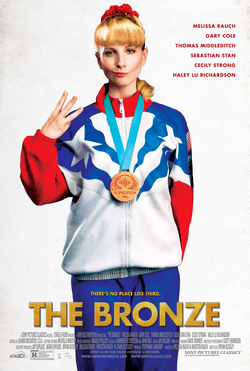
The Bronze has been getting terrible reviews since it first premiered at Sundance last year. Telling the story of an Olympic bronze medalist who has grown up to be bitter and angry, The Bronze has been unfavorably compared to Bad Santa, Bad Words,Bad Teacher and … well, bad anything. (You know you’re in trouble when your film gets compared to Bad Teacher because most critics have an irrational hatred for that film. I actually enjoyed it.) The Bronze was originally scheduled to be released last July and then it was pushed back and then, for a little while, it vanished all together as it was traded between different distributors. Finally, last Friday, Sony Pictures Classics released The Bronze with all the fanfare of a community theater announcing their annual production of Forever Plaid.
Well, after hearing how terrible it was, there was no way that my BFF Evelyn and I could resist the temptation to experience it for ourselves. (We both enjoy watching and commenting during bad movies. That’s what led to us watching that Tyler Perry movie about the adulterous matckmaker .) We caught a 10:15 showing last night at the AMC Valley View and the theater was almost totally deserted. (Admittedly, not many people are brave enough to go to Valley View Mall past 9:00 but Evelyn and I fear nothing.) We were expecting to see a thoroughly mediocre film but you know what?
We were both kind of surprised to discover that The Bronze was not the terrible film that we had been led to expect.
Melissa Rauch (who co-wrote the script) plays Hope Ann Gregory, a former Olympic gymnast who won the Bronze medal at the Summer Olympics. She won the medal despite competing on an injured ankle. Unfortunately, her injury ended her competitive career but it also briefly made her a national celebrity. 12 years later, most of the country may have forgotten Hope but the people of hometown of Amherst, Ohio still love her.
When we first meet Hope, she’s masturbating while watching footage of herself competing at the Olympics. She then proceeds to steal money from her father’s mail route so she’ll have enough money to buy weed. Hope is rude to almost everyone and yet, no one in the town seems to notice. Or maybe they are so happy to be in the presence of a minor celebrity that they just don’t care how terribly she treats them. The movie is actually somewhat vague on this point but still, the contrast between Hope’s reality and the opinion that others have of her is one of the best things about the film. Intentionally or not, it perfectly satirizes that way that we idealize our celebrities.
When Hope’s former coach commits suicide, her final request is that Hope agree to train an up-and-coming gymnast, Maggie (Haley Lu Richardson). At first, the jealous Hope tries to sabotage Maggie but eventually, Hope starts to take her job as coach seriously. (When Maggie first shows up, she seems to be a one-note, excessively perky character but eventually, she reveals some needed, if not exactly surprising, complexity.) Hope also develops an unexpected relationship with Maggie’s assistant coach, Twitchy (Thomas Middleditch). (Twitchy is called Twitchy because he blinks a lot.)
The Bronze is not a great film. Instead, it’s an extremely uneven film, one that often seems to be trying too hard. It never manages to find the right balance between its raunchy comedy and the occasional and surprisingly subtle moments when it suddenly becomes a character study.
And yet, at the same time, it’s not as terrible as you’ve heard. There are moments that work surprisingly well. Some of them are moments like an enjoyably over-the-top sex scene between two gymnasts. But then there are moments like the scene where Hope talks about the first time she learned that, as a result of the injury she sustained while winning her Bronze, she would never be able to compete again. There are scenes like the one where Hope proves herself to be surprisingly loyal to the citizens of Amherst or where her long-suffering father (Gary Cole) confronts her about her behavior. Though these moments may be few and far between, they still work surprisingly well. It’s during these moments that The Bronze drops the protective mask of outrageousness and reveals some unexpected depth. It helps that, along with writing the script, Melissa Rauch totally commits herself to the role. At her best, she’s like a force of stoned nature.
Is The Bronze really worth seeing on the big screen? Probably not. It’s too uneven to really be successful. But when it shows up on Netflix, I predict that a lot of people are going to be surprised to discover that The Bronze isn’t as terrible as they’ve been told.
I really hate to start my review with such a negative statement but seriously, after watching Allegiant today, I am now convinced that the Divergent movies are perhaps the least interesting film franchise since the Paranormal Activity sequels. Not only are the films so derivative of The Hunger Games that I’m always surprised that Donald Sutherland isn’t lurking around in the background but they’ve also managed to waste the talents of some of the best actors of my generation. When you’ve got performers like Shailene Woodley and Miles Teller at your disposal, there’s no excuse not to be interesting.
I watched Allegiant with my BFF Evelyn and I’ll admit right now that we talked throughout the entire movie. We laughed at the most serious of moments. When Jeff Daniels showed up, we had a very long discussion about how, when he’s good, Jeff Daniels is really good but when he’s bad, he manages to come across as being the most boring man on the planet. When Miles Teller betrayed his allies, Evelyn said, “Again!?” and then she had to remind me that Miles Teller always ends up betraying everyone in every Divergent film.
(It makes you wonder why the Tris (played by Shailene Woodley) and Four (Theo James) always bring Miles Teller with them as opposed to just killing him. I suppose some of it might have to do with the fact that he’s Miles Teller and he’s a badass. In fact, he probably should be playing Four. He certainly has more chemistry with Shailene Woodley than Theo James does. In fact, Theo James always looks like he’d rather be doing anything other than appearing in another goddamn Divergent film.)
And yes, Evelyn and I did get a few dirty looks from some people in the audience but you know what? I fully understand that it’s rude to talk through a movie but oh my God, we had to do something. Allegiant is such a boring movie. The film moves slowly, as if the filmmakers don’t understand that everyone in the audience has seen enough YA adaptations to already know everything that’s going to happen. If you want to truly understand what film critics mean when they say that a film is “draggy,” try to watch an entire Divergent film without standing up to stretch your legs or get something to drink. Perhaps the biggest mistake you can make while watching Allegiant is to actually concentrate on what’s slowly playing out on screen.
The Divergent films aren’t terribly complicated and yet, I always find myself struggling to follow them. They’re so bland and forgettable that I can never remember what happened in the previous film. As Allegiant started, I was like, “Why is Naomi Watts in charge of Chicago now? Oh yeah, Kate Winslet did die at the end of the last movie!” And then I remembered that Evelyn was Four’s mother.
And then my BFF Evelyn (as opposed to the film’s Evelyn) said, “Four is a stupid name,” and I started laughing way too hard. In fact, we made many jokes about Four’s nickname and then eventually, I remembered that he was called Four because he only has four fears. But it took me a while to remember and, once I did remember, I couldn’t help but think about how stupid a backstory that was.
Anyway, the plot of the film is that the movie’s Evelyn is now in charge of Chicago but she’s turning out to be just as bad as the system that she’s replacing. So, Tris, Four, and friends escape from Chicago and explore the barren landscape that surrounds the city. Eventually, they are found by the Bureau of Genetic Welfare. The Bureau is headed up by a boring guy named David (Jeff Daniels). At first, David seems to be a good guy but then it turns out that the Bureau was behind the whole Faction experiment. And now the Bureau wants to attack Chicago, wipe the slate clean, and start the experiment all over again.
Will Four and Tris go along with David’s plan or will they try to stop him?
At this point, who cares?
The thing that’s annoying about the Divergent films is that the storyline has potential. At the heart of it all, the battle between the Factions and the Factionless has the potential to be a powerful, if simplistic, metaphor. But the films are so plodding and take such an obvious approach that most of that potential is wasted. Add to that, Shailene Woodley is a great actress. In fact, I think it can be argued that she actually has more range than Jennifer Lawrence. (Just check out her performance in The Spectacular Now.) But the franchise has never known what to do with her uniquely off-center style. Instead, it simply gives her speeches that feel as if they’ve been lifted from every other dystopian YA franchise. The films insist on trying to make Shailene Woodley predictable and she deserves better on that.
As is typical of big franchise films nowadays, Allegiant is just part one of the Divergent finale and even the “to be continued” ending feels annoying because it’s so obviously lifted from every other franchise finale that’s ever been produced. As with all the Divergent films, Allegiant never escapes the shadow of The Hunger Games. The best that can be said about this franchise is that it will be over soon. Hopefully, Shailene Woodley will be able to move onto a film more worthy of her considerable talents.
For those following at home, Lisa is attempting to clean out her DVR by watching and reviewing 38 films by the end of today!!!!! Will she make it? Well, it depends on whether or not she can finish the review below!)
Before I talk too much about the 1934 film It Happened One Night, I want to tell a story about legs.
I’ve always been insecure about having a slightly large nose and once, when I was 17 years old, I was giving my mom a hard time about the fact that I had basically inherited it from her. I was going on and on and being fairly obnoxious about it. (Yes, believe it or not, I can occasionally be obnoxious…)
Finally, my mom held up her hand and said, “Yes, you got your nose from me but you also got my legs so stop crying!”
And you know what? I glanced down at my legs and I realized that she was right and that made me feel a lot better. Ever since then, I’ve taken a lot of pride in having a good pair of legs.
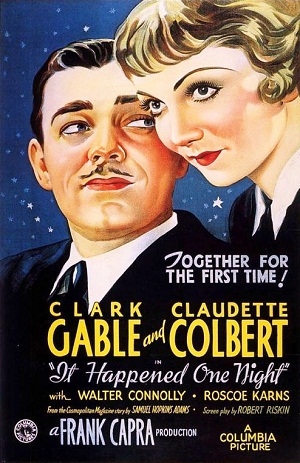
Now, you may be asking yourself what that has to do with It Happened One Night. Well, It Happened One Night is one of the ultimate “good legs” movies. That’s because It Happened One Night features the famous scene in which Claudette Colbert teaches Clark Gable the proper way to hitchhike. (If I ever take up hitchhiking, I’m planning on using the same technique.)
That’s the scene that It Happened One Night is justifiably famous for. However, It Happened One Night is more than just a film about hitchhiking.
It’s also a romance, one that features Claudette Colbert at her wackiest and Clark Gable at his sexiest. Reportedly, the sell of undershirts plummeted after Clark Gable took off his shirt and revealed that he wasn’t wearing one.
It was one of the first road movies and it was such a success that it remains influential to this very day. Any time you watch a movie that features two seemingly different characters getting to know each other on a road trip, you’re watching a movie that exists because of It Happened One Night. (And yes, that includes Tom Hardy and Charlize Theron in Mad Max: Fury Road.)
Frank Capra won his first Oscar for directing this film and It Happened One Night remains one of his most likable and least preachy films. Just compare the unpretentious, down-to-Earth style of It Happened One Night to Meet John Doe.
Perhaps most importantly, It Happened One Night was the first comedy to win the Oscar for best picture. It Happened One Night is a film that announces that a film doesn’t have to be a self-serious, pretentious epic to be great. Before the victory of It Happened One Night, the top prize was exclusively reserved for films like Cimarron and Calvalcade. (Seriously, just try watching some of those early winners today.) It Happened One Night‘s Oscar victory was a victory for the future of entertainment.
(By the way, as I sit here typing up this review, I keep accidentally typing It’s A Wonderful Life instead of It Happened One Night. That’s the power of Frank Capra.)
It Happened One Night tells the story of Pete Warne (Clark Gable). Pete is an out-of-work reporter. Though he may be down on his luck, he’s still confident and lovably cocky in that way that only Clark Gable could be. While riding on a bus from Florida to New York, Pete recognizes one of his fellow passengers as Ellie Andrews (Claudette Colbert), an heiress who has recently eloped with a buffoonish big game hunter named King Westley (Jameson Thomas). Ellie’s father wants to get the marriage annulled and has people all over the country searching for his daughter. Pete agrees not to call Ellie’s father if Ellie will agree to give him an exclusive story when she meets up with Westley in New York.
For the rest of the film, we follow Pete and Ellie as they cross the United States, spending awkward nights in motel rooms, getting kicked off of buses, and hitchhiking. Ellie gives lessons on how to get a car to stop. Pete delivers a long monologue on the proper way to undress before going to bed. Along the way, Pete and Ellie fall in love. It also becomes obvious that Ellie’s father is right about Westley only marrying her for her money.
They also meet a large cast of increasingly eccentric characters. Whether they’re dealing with the passengers on the bus or the cranky people staying at a rest stop or a motorist who won’t stop singing, Pete and Ellie do noy meet anyone who doesn’t have at least one odd quirk. Like many classic screwball comedies, It Happened One Night takes place in a world where everyone — from a bus driver to a desk clerk to a group of women waiting to use a shower at a rest stop — has something to say about everything. Some of the film’s funniest moments come from watching the normally smooth Pete have to deal with the increasingly crazy world in which he’s found himself.
(For her part, Ellie is at her happiest when things are at their strangest. Ellie’s the best.)
The other great moments come from simply watching Gable and Colbert interact. They have an amazing chemistry and it comes through in their performances. It’d odd to read that apparently neither Gable nor Colbert were happy to be cast in It Happened One Night because their performances are so much fun to watch. A love story only works if you love the characters and the love story in It Happened One Night definitely works.
As I stated above, It Happened One Night was the first comedy to win Best Picture. Beyond that, it was also the first movie to win all of the top 5 Oscars: Picture, Director, Actor, Actress, and Adapted Screenplay. (Those were also the only 5 nominations that It Happened One Night received.) For once, the Academy got it right. It Happened One Night remains a delightful film.
(Oh my God, y’all, I did it! That’s 38 films reviewed in 10 days and my DVR now has space to record all sorts of things! And making it all the better is that I finished this project by reviewing a truly wonderful comedy like It Happened One Night!)
(For those following at home, Lisa is attempting to clean out her DVR by watching and reviewing 38 films by the end of today!!!!! Will she make it? Keep following the site to find out!)
Poor Cecil Vyse.
The 1986 film A Room With A View is a love story. It’s about a young woman who meets a young man in Florence, Italy and then, upon returning to England, she discovers that the same young man and his father are now her neighbors. From the minutes they meet, it’s obvious that the young man and the young woman are destined to be together. The only thing that’s standing in their way is the strict culture of conformity of Edwardian England. That and the fact that the young woman is engaged to Cecil Vyse.
Cecil represents the establishment. He comes from a good family. He’s well-educated. He talks about the right subjects. He holds all the right opinions. He’s not an exciting man but he’s a good man who is destined to have successful but not very interesting life. From the minute that we meet him, we know that our heroine is not meant to stay with Cecil.
And it’s heart-breaking because the film goes out of its way to show that Cecil is not a bad person. In his own befuddled way, he’s one of the most likable people in the entire film. He may not have an interesting mind but he does have a good heart. When the moment comes that Cecil’s heart is broken, the film treats him with respect.
Of course, it helps that Cecil was played, in one of his first roles, by Daniel Day-Lewis. Day-Lewis plays the role with a quiet dignity. Instead of just turning Cecil into a mere nuisance that has to be pushed out of the way in the name of love, Day-Lewis emphasizes Cecil’s humanity. There’s a quiet scene where the recently heart-broken Cecil ties his shoes that is an example of truly great acting.
As for the two young lovers, Lucy Honeychurch is played by Helena Bonham Carter while George Emerson is played by Julian Sands. Both of them are achingly beautiful and, even more importantly, they both look as if they belong in Edward England and with each other. Still, seeing this film today, it takes a little while to adjust to seeing both Bonham Carter and Sands playing such … normal characters. We’re so used to seeing Helena killing people in Tim Burton movies that it’s nice to see her getting to rather sweetly fall in love for once.
The entire film is full of great British actors, all at their best. Denholm Elliott plays George’s father and gets to deliver a rousing defense of both true love and free thought. Maggie Smith plays Lucy’s overprotective aunt while Rosemary Leach is Lucy’s supportive mother. And then you’ve got Simon Callow as an eccentric vicar. (Because every British film needs an eccentric vicar.) Lucy’s younger brother is played by an actor named Rupert Graves and he’s so adorable that I kind of found myself wishing that he could have had a spin-off movie of his own.
A Room With A View is a wonderfully romantic film, one that I could easily see myself spending days just watching over and over again. A Room With A View was nominated for best picture but it lost to the far less romantic Platoon.
(For those following at home, I now have one more review to go to reach my goal of reviewing 38 films in 10 days!)
(For those following at home, Lisa is attempting to clean out her DVR by watching and reviewing 38 films by the end of today!!!!! Will she make it? Keep following the site to find out!)
It’s becoming a new annual tradition. Every January, Lifetime airs a biopic about a singer. As I watched Toni Braxton: Unbreak My Heart, I found myself thinking about what makes a good biopic. Unfortunately, good lives rarely make good biopics. After all, we watch biopics for the drama behind-the-scenes. When someone has lived a successful life and has basically lived her life with intelligence and integrity, it makes them a role model. But it doesn’t necessarily make them into a fascinating subject for a movie.
Now, I have to admit that, before watching this movie, I didn’t know much about Toni Braxton. My musical taste tends to run from EDM to more EDM. I had heard the name Toni Braxton, of course. I knew that there was a reality show called Braxton Family Values, though I’ve never seen an episode. But I didn’t know much about her or her life.
So, as I watched, I kept waiting for the inevitable moment when Toni Braxton would first be pressured into trying cocaine or when she would end up in an abusive marriage or when she would eventually end up going through a Hellish rehab experience. But none of that happened, largely because Toni Braxton appears to have been pretty intelligent when it came to making her life decisions.
Oh, there’s certainly some drama. She had some financial difficulties early on her career. Some members of her family get jealous of her success but not so jealous that they can’t be totally supportive. She gets married but the marriage ends — not because of infidelity or abuse but just because sometimes marriages end. And really, Lifetime should be commended for the way it handled the end of Braxton’s marriage because sometimes, marriages just don’t work out and it’s not anyone’s fault. Finally, Toni discovers the she has Lupus. Lupus is a serious disease and both Toni and the movie deserve full credit for educating the public.
In the end, Toni Braxton: Unbreak My Heart is a well-made and perfectly pleasant film but it’s not particularly memorable Lex Scott Davis does a good as Toni and the film provides good roles for a lot of talented African-American performers. But, as a movie, Toni Braxton: Unbreak My Heart never quite reaches the memorable heights of last year’s Whitney.