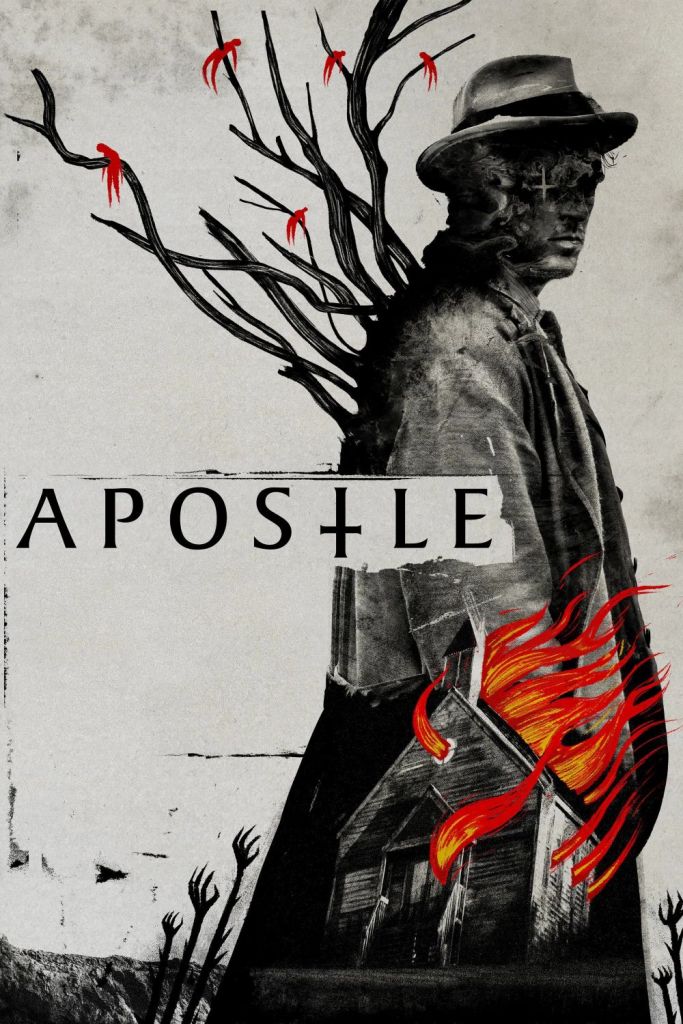
Review: Apostle (dir. by Gareth Evans)


“She’s no god. She’s just a machine.” — Quinn

Apostle is one of those films that feels like Gareth Evans deliberately swerved away from the kinetic precision of The Raid and The Raid 2, as if to test whether he could still dominate the screen without back‑to‑back martial‑arts set pieces. The result is not a clean crowd‑pleaser, but a grim, blood‑soaked folk‑horror descent that trades velocity for dread, atmosphere, and the slow peeling away of civilized surfaces until what’s left is pure cruelty. It’s ambitious, dense, and at times unwieldy, but it is never the kind of hollow, algorithm‑friendly Netflix original that feels assembled by committee. The film leans into a slow‑burn approach, letting its cult setting and religious unease simmer before it erupts into something truly grotesque.

Set in 1905, Apostle follows Thomas Richardson, played by Dan Stevens with the exact right mix of haunted intensity and bruised arrogance, as he infiltrates a remote island cult to rescue his kidnapped sister. That setup sounds straightforward enough, but Evans uses it as a trapdoor into a much uglier story about faith, coercion, exploitation, and the grotesque systems people build when belief curdles into power. The cult is not merely spooky window dressing; it’s a functioning social organism with labor, hierarchy, punishment, and ritual, which gives the film a more grounded menace than a simple haunted‑house scenario. The island’s wrongness is not just in its rituals, but in the way ordinary domestic life has been turned into a kind of ongoing penance.

What makes Apostle compelling is how patiently Evans allows the island to breathe before he starts tearing it apart. The first half is almost methodical in the way it maps the place: the political tension within the cult, the uneasy alliances, the daily routines, the controlled scarcity, and the sense that every face hides some compromise. That slow construction is crucial, because once the film starts revealing what the island is actually built on, the horror lands with more force. It does not chase jump scares; it lets the audience sit inside the wrongness until the wrongness starts to feel inevitable. The film’s real horror is in the way it treats belief as a system of control rather than a source of comfort.

Michael Sheen is the other major pillar here, and he gives the film a wickedly slippery center as Malcolm, the island’s charismatic prophet. Sheen plays him as part messiah, part salesman, part exhausted tyrant, which is exactly the right tone for a character whose authority depends on performance. He isn’t merely loud or theatrical; he’s persuasive, and that is much scarier. The film understands that the most dangerous religious figures are often not the ones who snarl the loudest, but the ones who can make oppression sound like purpose. Dan Stevens plays beautifully against that energy, keeping Thomas in a state of wary observation until desperation forces him into action. The two actors give the movie a dramatic spine sturdy enough to support all the blood and theology around them.

Evans’ direction is, unsurprisingly, the film’s great technical asset. Even when Apostle feels overloaded, it never feels careless. He stages the island as an environment of mud, wood, fog, and decay, and his eye for spatial clarity keeps the film legible even when the narrative starts layering on secrets and hidden machinery. If The Raid was about velocity and geometry, Apostle is about pressure and contamination. The violence, when it arrives, still carries the director’s unmistakable talent for framing brutality on screen: every blow lands with a clarity and weight that makes the gore feel integral rather than gratuitous. But in Apostle he deftly dips his filmmaking talents into the world of gothic folk horror, slotting his sensibility alongside classics like The Wicker Man, Witchfinder General, and The Witch. The island’s rituals, its mix of agrarian dread and religious paranoia, and its sense of a sealed community preparing for a bloody reckoning all echo those earlier works, while Evans colors them in his own grimy palette.

There’s also something interesting about how the film handles world‑building. It is overstuffed, yes, but it is overstuffed in a way that feels earned rather than random. The island has systems, factions, and ugly little bureaucracies of suffering, and the film keeps revealing new layers of control and corruption until the whole place feels like a machine designed to consume bodies and faith at the same time. Some viewers will see that density as a flaw, and they’re not entirely wrong; Apostle can feel a little overextended, as if Evans has too many ideas he wants to wring out of the same pressure cooker. But it could also be argued that the excess is part of the film’s personality. It’s not elegant horror. It’s horrified by its own abundance.

Thematically, Apostle works best when it treats religion not as a decorative taboo, but as a field of contesting desires. The film isn’t interested in simple anti‑faith provocation. Instead, it examines what happens when belief becomes a resource to be managed, weaponized, and monetized. The cult claims to reject corruption from the outside world, but its inner life is every bit as predatory, which makes the island feel less like an isolated aberration and more like a compressed version of the larger world Thomas came from. That’s one of the movie’s smartest ideas: the mainland and the island are different expressions of the same rot. The difference is only one of scale and visibility.

As a horror film, Apostle is strongest when it is patient and weakest when it has to juggle too many moving parts at once. The final stretch escalates into an effectively feral confrontation, but the movie occasionally risks losing the eerie precision of its setup in favor of sheer attritional chaos. Still, even that chaos has a purpose. Evans is not just trying to shock; he’s trying to show what happens when systems of belief collapse under the weight of their own lies. The result is messy, unpleasant, and often very good. It is also one of the more distinctive Netflix originals of its era, precisely because it refuses to be easy or tidy.

Apostle feels like a filmmaker known for kinetic precision making a movie about spiritual and social collapse, and the contradiction works in its favor. Even as he steps into the domain of gothic folk horror, Evans never loses his gift for filming violence or his sense of where the camera should sit in relation to pain. It has the rough edges of an ambitious film reaching for too much, but those edges are part of what makes it memorable. Part of the reason the film is underappreciated as quietly as it is may be that it arrived with a reputation attached: if Evans did not already have a name as a master of action filmmaking, Apostle might be celebrated more openly as a standalone horror achievement. Sometimes moving out of one’s comfort zone and still succeeding is exactly what gets held back by one’s reputation for what they’re “supposed” to be good at.

Between the bleak atmosphere, the commanding performances, the grim folk‑horror imagery, and Evans’ refusal to soften the ugliness of his subject, Apostle stands as a smart, vicious, and unusually committed piece of genre filmmaking. It may not be the Gareth Evans movie action fans expected, but it is very much the one horror fans deserved.
Playing Catch-Up With Four Biopics From 2017: All Eyez On Me, Maudie, A Quiet Passion, and Victoria and Abdul


Continuing with my efforts to get caught up on the major films that I saw in 2017, here are my reviews of four biopics!  Two of them are very good.  One of them is so-so.  And the other one … well, let’s just get to it…

All Eyez on Me (dir by Benny Boon)

All Eyez On Me is a movie that I think a lot of people had high hopes for.  It was a biopic about Tupac Shakur, who died over 20 years ago but remains one of the most influential artists of all time.  Starring Demetrius Shipp, Jr. (who, if nothing else, bore a strong physical resemblance to Tupac), All Eyez on Me followed Shakur from his youth as the son of activist Afeni Shakur (Danai Gurira), through his early stardom, his political awakening, his time in prison, his eventual association with Suge Knight (Dominic L. Santana), and his still unsolved murder in Las Vegas.  Along the way all of the expected people pop up.  Kat Graham plays Jada Pinkett and tells Tupac that he’s wasting his talent.  Someone who looks nothing like Dr. Dre is introduced as being Dr. Dre.  Another actor wanders through a scene and says his name is Snoop Dogg.  The film last 2 hours and 20 minutes, with some scenes feeling oddly rushed while other drag on interminably.

The main reason why All Eyez On Me fails is that, unlike Straight Outta Compton, All Eyez on Me never figures out how translate Tupac’s legacy into cinematic form.  For instance, when I watched Straight Outta Compton, I probably knew less about NWA than I knew about Tupac Shakur when I watched All Eyez On Me.  But then there was that scene where NWA performed “Fuck That Police” while surrounded by the police and, at that moment, I understood why NWA deserved their own movie.  There’s no comparable scene in All Eyez On Me, which gets so bogged down in going through the usual biopic motions that it never really comes to grips with why Tupac is such an iconic figure.  Combine that with some less than stellar performances and some amazingly awkward dialogue and the end result is a film that is massively disappointing.

Maudie (dir by Aisling Walsh)

Maudie tells the story of Maud Lewis, a Canadian woman who found fame as a painter despite suffering from crippling arthritis.  Working and living in a one-room house with her husband, a fisherman named Everett (Ethan Hawke), Maud Lewis’s paintings of flowers and birds eventually became so popular that one was even purchased by then-Vice President Richard Nixon.

Maudie is a very special movie, largely because of the incredibly moving performance of Sally Hawkins in the role of Maud.  As played by Hawkins, Maud may occasionally be meek but she never surrenders her dream to create something beautiful out the often harsh circumstances of her life.  Hawkins not only captures Maud’s physical struggles but she also captures (and makes compelling) the inner strength of this remarkable artist.  Ethan Hawke also gives a remarkable performance as the gruff Everett.  When you Everett first appears, you hate him.  But, as the film progresses, Hawke starts to show hints of a sensitive soul that’d hiding underneath all of his gruffnes.  In the end, Everett is as saved by Maud’s art as is Maud.

Directed by Aisling Walsh, this is a low-key but all together remarkable and touching film.  If Sally Hawkins wasn’t already certain to get an Oscar nomination for Shape of the Water, she would definitely deserve one for Maudie.

A Quiet Passion (dir by Terrence Davies)

You would be totally justified in assuming that this film, a biopic of poet Emily Dickinson, would have absolutely nothing in common with The Last Jedi.  However, believe it or not, they actually do have something very much in common.  They are both films that, on Rotten Tomatoes, scored high with critics and not so high with audiences.  When last I checked, it had a 93% critical score and a 51% audience score.

Well, you know what?  Who cares?  The idea that you can judge a film’s worth based on an arbitrary number is pure evil, anyway.

Personally, I’m not surprised to hear that audiences struggled with A Quiet Passion.  It’s a very challenging film, one that is more concerned with mood than with traditional narrative.  The film is much like Dickinson herself: dark, uncompromising, sharply funny, and, on the surface, unconcerned with what people might think.  Much as how Dickinson retreated into her Amherst home, the film retreats into Dickinson’s head.  It’s not always the most pleasant place to hide out but, at the same time, it’s so alive with creativity and filled with such a sharp wit that it’s tempting never to leave.

In the role of Emily, Cynthia Nixon gave one of the best performance of the year, bringing Emily to uncompromising life.  Neither the film not Nixon ever make the mistake of sentimentalizing Dickinson.  Her pain is just as real as her genius.  Ultimately, though, both Nixon’s performance and A Quiet Passion stands as a tribute to Emily’s own quiet passion.

Much like Emily Dickinson’s poetry, A Quiet Passion will be appreciated with time.

Victoria & Abdul (dir by Stephen Frears)

If there’s ever been a film that deserves to be known as “generic Oscar bait,” it’s Victoria & Abdul.

Don’t get me wrong.  It’s not a bad movie or anything like that.  Instead, it’s a very respectable film about Queen Victoria (Judi Dench) and her servant, Abdul Karim (Ali Fazal), an Indian Muslim.  While the rest of the royal court is scandalized by Victoria’s close relationship with the foreigner, Karim teaches the Queen about the Koran and encourages her to enjoy life.  The royal court is played by the usual collection of distinguished actors who always appear in movies like this: Simon Callow, Tom Pigott-Smith, and Michael Gambon.  Victoria’s heir is played by Eddie Izzard, which should tell you all you need to know about how the future Edward VII is portrayed.

As I said, it’s not a bad movie as much as it’s just not a very interesting one.  You know that Abdul and Victoria are going to become close.  You know that the Royal Court is going to be a bunch of snobs.  You know that Victoria is going to get a chance to express anti-colonial sentiments that she must surely never actually possessed.  Indeed, whenever the film tries to make any sort of larger statement, all of the characters suddenly start talking as if they’re from 2017 as opposed to the late 1800s.

This is the second time that Judi Dench has played Victoria.  Previously, she played the Queen in a film called Mrs. Brown, which was about Victoria’s friendship with a Scottish servant.  Apparently, Victoria got along well with servants.


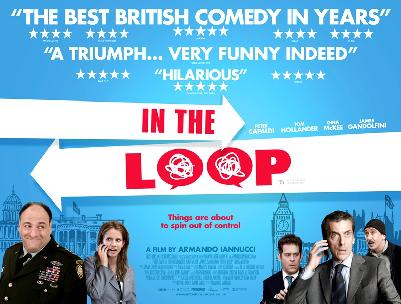
Shattered Politics #85: In the Loop (dir by Armando Iannucci)


In_the_Loop_poster

First released in 2009, In The Loop is one of the most brilliant political satires ever made.

The film opens in London, as a slightly ridiculous man named Toby (Chris Addison) starts his first day as the special assistant to the Secretary of State for International Development, Simon Foster (Tom Hollander).  And what a day to start!  Both the President of the United States and the British Prime Minister are eager to invade the Middle East and, during an interview the previous night, Simon accidentally announced that war was “unforseeable.”  This has led to people accidentally assuming that Simon is anti-war (Simon really doesn’t seem to have an opinion one way or the other) but it also means that the Prime Minister’s compulsively profane assistant, Malcolm Tucker (Peter Capaldi), is now running around the office and threatening people.

(I doubt that there’s any way that I can do justice to Capaldi’s performance here.  You simply have to see him.  He is a force of nature, a tornado of nonstop profanity and aggression.)

Not every government official in the U.S. is enthusiastic about going to war.  Both Assistant Secretary of State for Diplomacy Karen Clarke (Mimi Kennedy) and her former lover, Gen. George Miller (James Gandolfini) are opposed to the war.  Karen’s assistant, Liza (Anna Chlumsky), has even written a paper that explains why a war in the Middle East could not be won.  Karen hopes to use Simon as a spokesman to keep the British out of the war and, therefore, America as well.

(Toby, meanwhile, just wants to have sex with Liza.)

However, there are a few factors that complicate things.  First off, Malcolm is determined to make sure that the Prime Minister gets what he wants and if that means bullying and scaring everyone into supporting an unwinnable war, that’s exactly what he’s going to do.  Secondly, U.S. Assistant Secretary of State For Policy Linton Barwick (David Rasche) is eager enough to start a war that he’s actually started a secret committee to find a way to get into the war.  (The committee, of course, has been called the Committee For Future Planning.)  Third, and perhaps most importantly, Simon is an idiot.

Along with being both a satire of American-British relations (my favorite moment comes when a random American tourist tells Malcolm to stop cursing in public) and the lead-up to the Iraq War, In The Loop is also a devastating look at how government works.  In the Loop makes a good case that, for all the titles and the committee and the talk about doing what’s right, most government policy is the result of a combination of stupidity and needless aggression.  As played by Capaldi, Malcolm has no ideology or core beliefs.  He simply makes sure that the Prime Minister gets what he wants.

And if that means going to war, then Malcolm will do whatever it takes to push Britain into war.

Director Armando Iannucci is probably best known for creating two political comedies, the Thick of It and Veep.  And while I’ve never seen The Thick Of It, I absolutely love Veep.  From what I’ve read, all three projects share the same fictional universe.  (Capaldi’s Malcolm was the main character on The Thick Of It.)

Though, actually, I think it’s debatable just how fictional that universe is.  Ultimately, In The Loop is probably one of the most plausible satires that I’ve ever seen.