Retro Television Review: Law & Order 8.6 and Homicide 6.5 “Baby, It’s You”


Welcome to Retro Television Reviews, a feature where we review some of our favorite and least favorite shows of the past!  On Sundays, I will be reviewing Homicide: Life On The Street, which aired from 1993 to 1999, on NBC!  It  can be viewed on Peacock.
This week, Homicide crosses over with Law & Order.

Law & Order 8.6 “Baby, It’s You”

(Dir by Edwin Sherin, originally aired on November 12th, 1997)

Homicide 6.5 “Baby, It’s You”

(Dir by Edwin Sherin, originally aired on November 14th, 1997)

In New York City, Lennie Briscoe (Jerry Orbach) and Rey Curtis (Benjamin Bratt) find themselves investigating the death of a 14 year-old model named Brittany Janeway.  The daughter of plastic surgeon Steven Janeway (Tom Tammi) and his wife Gayle (Maureen Anderman), Brittany died after complaining to her father about abdominal pain.  The medical examiner determines that, two weeks before her death, Brittany was sexually assaulted with such severity that it resulted in internal injuries that led to toxic shock.

When the detectives learn that Brittany was in Baltimore two weeks earlier, they call Lt. Giardello and ask if he can send two of his detectives to check on the family’s Maryland home.  The job falls to Detective Munch, who is still angry over the fact that Briscoe once slept with his first wife.  Munch asks Falsone (ugh!) to accompany him.  When Munch and Falsone learn that the son of the Janeways’s New York housekeeper was seen in Baltimore on the night that Brittany was raped, they have a suspect.  Danvers sends them to New York with one mission.  Arrest the guy and bring him back to Baltimore to stand trial.  Jack McCoy (Sam Waterston) is not happy about that.  Because Brittany died in New York, he feels that it’s his case to prosecute.  Because the rape that led to Brittany’s death happened in Baltimore, Danvers claims that it’s his case.

Of course, once the suspect is arrested, it turns out that he wasn’t the perpetrator.  Instead, he was a witness.  According to him, Brittany had already been raped by the time he arrived at the house.  The suspicion immediately shifts to Dr. Janeway.  When the doctor is arrested in Baltimore, McCoy heads down to Maryland to argue that the case should be tried in New York.  Judge Andahl (Sagan Lewis), who was last seen getting Elijah Wood off of a murder charge, disagrees.  However, she allows McCoy to be co-counsel with Danvers.

In a twist that will not surprise anyone who has ever seen an episode of Law & Order, it turns out that Brittany was not assaulted by her father.  Instead, she was assaulted by her mother.

The last time Law & Order and Homicide did a cross-over, the emphasis was on Pembleton and Bayliss and their unorthodox interrogation technique running up against McCoy’s need for admissible evidence.  This time, when McCoy goes down to Baltimore, he quickly befriends and starts to discuss life with — you guessed it! — Detective Paul Falsone!  In fact, Pembleton and Bayliss are barely present in this cross-over.  While Munch does get to engage in some fun passive-aggressive banter with Lennie Briscoe, this cross-over is ultimately all about Paul Falsone, the super detective who never makes a mistake.

Good Lord, why?  WHY DOES EVERYTHING HAVE TO BE ABOUT FALSONE?  Falsone is a boring character.  We are five episodes into the sixth season and Falsone has been a major part of four of them.  The veteran Homicide actors were pushed to the side so that Jon Seda could wander around and mutter his lines.  I get that show was trying to appeal to fans of more action-orientated cop shows with the character of Falsone but, in what I’ve seen so far, Seda has not shown a hint of charisma in the role. The fact that Homicide keeps insisting that Falsone is the greatest detective in the history of detectives does not make the character any more intriguing.

This crossover was a disappointment,  The story, which was obviously based on the JonBenet Ramsey case, was sordid simply for the sake of being sordid and the big reveal that the murderer was the mother was not quite the shocking moment that it was bult up to be.  Anyone familiar with Law & Order could have guessed who the murderer was going  to be.  And then, on top of everything else — FALSONE!

This was not a good one.
A Blast From The Past: You Can’t Take It With You (dir by Kirk Browning and Ellis Rabb)


Our regularly scheduled review of St. Elsewhere will not be posted today so that we may bring you this special presentation….

My retro television reviews will return next week but for now, check out this 1984 production of You Can’t Take It With You, starring the great Jason Robards.  Back in 1938, this play served as the basis of a perfectly charming Frank Capra film.  (It also won best picture of the year.)  This filmed version of the play’s Broadway revival is just as charming.

And now, without further ado, here is You Can’t Take It With You….

Retro Television Review: St. Elsewhere 1.3 “Down’s Syndrome”


Welcome to Retro Television Reviews, a feature where we review some of our favorite and least favorite shows of the past! On Fridays, I will be reviewing St. Elsewhere, a medical show which ran on NBC from 1982 to 1988.  The show can be found on Hulu!

This week, we get to know a very bad doctor.

Episode 1.3 “Down’s Syndrome”

(Dir by Mark Tinker, originally aired on November 16th, 1982)

St. Eligius is home to several doctors, some of whom are good at their job and some of whom are really, really bad.

One of the bad ones appears to be Dr. Peter White (Terrence Knox), a resident who was in the background during the previous two episodes but who was at the center for a good deal of this episode.  Peter has a terrible bedside manner, absolutely no social skills, and his knowledge of medicine appears to be subpar at best.  When a homeless man comes in and complains of pain, Peter gives him a dose of potassium that nearly kills him.  (Only the quick thinking of Dr. Ehrlich — who himself hardly appears to be the perfect doctor — keeps the patient alive.)  Dr. White seems to be overwhelmed and it certainly doesn’t help that his wife is constantly calling the hospital and demanding to speak to him about every little thing.  That said, it’s hard to have much sympathy for Dr. White.  Yes, he’s overwhelmed but his mistakes nearly kill a man.

I have to admit that, as I watched Dr. Peter White on this week’s episode, I kept thinking about some of the doctors who treated my father after he had his car accident in May.  Whenever I spoke to them, they would brusquely answer my questions, usually in technical language that reflected that it had been a long time since they talked anyone who hadn’t gone to medical school.  At the time, I made the same excuses for them that I just made for Dr. White.  They were young, they were busy, and they were overwhelmed.  After my father died, though, I stopped making excuses for them and I instead just accepted that they weren’t very good at their job.  And perhaps Dr. White should admit the same.

It doesn’t help that Dr. White is contrasted with Dr. Auschlander, a kind and elderly liver specialist who is battling cancer but who still manages to treat all of his patients with kindness and respect.  The episode made it clear that all of the residents should hope to become a doctor like Dr. Auschlander.  While Peter snaps at his patients and nearly kills a man, Auschlander takes the time to play cards with a woman who is dying.  We should all be so lucky as to have an Auschlander in our life.

Finally, Brian Whitehill (Tony Bill) and his pregnant wife, Denise (Maureen Whitehill) are informed that their baby will be born with Down’s Syndrome.  In a scene that brings to mind Icelandic eugenics, Brian suggests that Denise get an abortion but Denise refuses, especially when she learns that she’s going to have a son.  (She already has two daughters.)  A day later, Brian comes home from work and tells Denise that he’s realized that she’s right and he’s prepared to be the father of a special needs child.  Denise replies that she had the abortion earlier in the day.  Seriously, what a depressing story!  That said, I respected what the show was doing here.  The patients are just as important as the doctors.

(And while Denise is getting an abortion, Dr. Morrison is learning that he’s going to be a father and, in contrast to Brian Whitehill, joyfully cheering in the hospital stairwell.)

As with the previous episode, there was a lot going on in the background.  Dr. Beale attempted to analyze terrorist Andrew Reinhardt (Tim Robbins), who is still basically acting like an arrogant prick.  Kathleen McAllister, the victim of Reinhardt’s attack, is still in a coma.  Dr. Westphall gave a tour of the hospital to two community leaders who both suggested that St. Eligius should shut down and move its operations to a wealthier neighborhood.  Dr. Fiscus got a blow job in an elevator from Kathy Martin.  (“Going down?” Fiscus asked the next guy who got on the elevator.)  It was a busy day at the hospital!  It was a good episode, even if it didn’t really have any of the big wow moments that the previous two episodes featured.  This episode was more about following a few days in the life of a hospital and the emphasis was on the nonstop flow of patients and doctors, some of whom were doing their best and some of whom were on the verge of giving up.  In the end, the main thing I took away from this episode was that there may not be enough Aucschlanders to make up for all the Peter Whites.


Film Review: Cocaine and Blue Eyes (1983, directed by E.W. Swackhamer)


When San Francisco-based private investigator Michael Brennen (O.J. Simpson) gives a ride to Joey Crawford (John Spencer) on Christmas Eve, he doesn’t know that it’s going to lead to the biggest case of his career.  When Joey asks Michael to help him track down his ex-girlfriend, Michael assumes that Joey would never be able to pay for his investigative services.  But one week later, Michael gets something in the mail from Joey.  Inside the envelope, there’s a picture of both Joey’s ex and a thousand dollar bill.  Ever after he discovers that Joey was mysteriously killed the night before, Michael decides to take on the case.  His investigation will take him not only to Joey’s ex but it will also lead to him uncovering a drug ring that involves one of San Francisco’s most prominent families.
Simpson not only starred in this made-for-TV movie but he also served as executive producer.  Watching the movie, it’s obvious that it was meant to serve as a pilot for a Michael Brennen TV series and it’s also just as obvious why that series never happened.  O.J. Simpson was not a terrible actor but, ironically for someone who set records as an NFL player, there was nothing tough about him.  Simpson may be playing a two-fisted, cash-strapped P.I. but, in every scene, he comes across like he can’t wait to hit the golf course.  Simpson’s pleasant demeanor may have served him well in other areas of his life but it didn’t help him with this role.  Whenever Simpson has to share a scene with John Spencer, Candy Clark, Cliff Gorman, or any of the other members of this film’s surprisingly talented supporting cast, Simpson’s bland screen presence and lack of gravitas becomes all the more apparent.

Of course, when seen today, the main problem with Cocaine and Blue Eyes is that it’s impossible to watch without thinking, “Hey, didn’t the star of this movie get away with killing his wife and an innocent bystander?”  Even the most innocuous  of lines take on a double meaning when they’re uttered by O.J. Simpson.  It doesn’t help that the movie opens with Michael visiting his estranged wife and their children on Christmas Eve and getting chased around the neighborhood by a guard dog.  When the movie was made, this scene was probably included so that O.J. could show off some of the moves that made him a star at UCLA and with the Bills.  Seen today, the scene takes on a whole different meaning.

Without O.J. Simpson, Cocaine and Blue Eyes could easily pass for being an extended episode of Magnum P.I., Simon and Simon, or any other detective show from the 80s.  With Simpson, it becomes a pop cultural relic.  I don’t think it’s ever been released on DVD but it is available on YouTube, where it can be viewed by O.J. Simpson completists everywhere.

Shattered Politics #44: The Seduction of Joe Tynan (dir by Jerry Schatzberg)


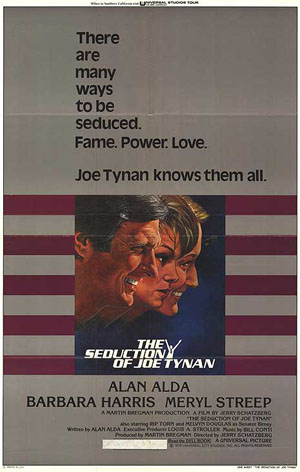
The Seduction of Joe Tynan (1979)

You know how sometimes you see a film and you can just tell that it was probably a big deal when it was first released but now, in the present day, it’s just not that interesting?  That’s the way that I felt when I saw 1979’s The Seduction of Joe Tynan on Netflix.  This is one of those film’s that you just know was probably praised for being adult and mature when it was first released but seen today, it’s just kinda bleh.

Joe Tynan (Alan Alda) is a Democratic senator from New York, a committed liberal who is also an ambitious pragmatist.  As quickly becomes apparent, Joe is happiest when he’s at work.  He struggles to talk to his rebellious teenage daughter (Blanche Baker).  While he may love his wife (Barbara Harris), she’s also one of the few people in his life who isn’t always telling him how great he is and, to an extent, she resents having to live in his shadow.  At times, it seems like the only thing holding Joe’s family together is the possibility that Joe could soon be nominated for the presidency.

When a Southern judge is nominated for the Supreme Court, Joe is asked by his mentor, Sen. Birney (a great Melvyn Douglas), to not oppose the nomination.  While Joe originally agrees to keep quiet, he soon changes his mind when he’s approached by lobbyists who make it clear that, if he goes back on his word to Birney, they’ll be willing to support Joe for President.

Leaving behind his family, Joe heads down south where he meets a researcher named Karen Traynor (Meryl Streep).  With Karen’s help, Joe discovers that the judge actually is a racist.  He also discovers that, politically, he has a lot more in common with Karen than he does with his own wife and soon, they’re having an affair.

The Seduction of Joe Tynan is an odd film.  As written, Tynan is a decent but flawed man.  He may do the right thing but he does so largely because of his own ambition.  That’s not a problem, of course.  If anything, that would seem to be the making of a great political film.  Some of the greatest film characters of all time have been morally ambiguous.  But then, Alan Alda (who also wrote the script) gives a performance that would seem to indicate that he was scared of being disliked by the audience.  Alda is believable when he’s being a self-righteous crusader but, whenever he has to play up the pragmatic and ruthless side of Joe Tynan, he almost seems to have zoned out.  It’s interesting to compare Alda’s lukewarm performance here with the far more nuanced performance that he would give, as a less idealistic Senator, decades later in The Aviator.  As far as the film’s senators are concerned, Melvyn Douglas and Rip Torn (playing a libertine colleague) are far more believable than Alda.

The film’s best performance is delivered by Meryl Streep.  That might not sound shocking but actually, Streep’s performance here is surprising because it’s far more natural and less mannered than some of her more acclaimed performances.  Believe it or not, you actually forget that you’re watching Meryl Streep.

Ultimately, you have to respect the fact that the film attempted to tell an adult and mature story about politics but that doesn’t make The Seduction of Joe Tynan any less forgettable.