Retro Television Review: Law & Order 8.6 and Homicide 6.5 “Baby, It’s You”


Welcome to Retro Television Reviews, a feature where we review some of our favorite and least favorite shows of the past!  On Sundays, I will be reviewing Homicide: Life On The Street, which aired from 1993 to 1999, on NBC!  It  can be viewed on Peacock.
This week, Homicide crosses over with Law & Order.

Law & Order 8.6 “Baby, It’s You”

(Dir by Edwin Sherin, originally aired on November 12th, 1997)

Homicide 6.5 “Baby, It’s You”

(Dir by Edwin Sherin, originally aired on November 14th, 1997)

In New York City, Lennie Briscoe (Jerry Orbach) and Rey Curtis (Benjamin Bratt) find themselves investigating the death of a 14 year-old model named Brittany Janeway.  The daughter of plastic surgeon Steven Janeway (Tom Tammi) and his wife Gayle (Maureen Anderman), Brittany died after complaining to her father about abdominal pain.  The medical examiner determines that, two weeks before her death, Brittany was sexually assaulted with such severity that it resulted in internal injuries that led to toxic shock.

When the detectives learn that Brittany was in Baltimore two weeks earlier, they call Lt. Giardello and ask if he can send two of his detectives to check on the family’s Maryland home.  The job falls to Detective Munch, who is still angry over the fact that Briscoe once slept with his first wife.  Munch asks Falsone (ugh!) to accompany him.  When Munch and Falsone learn that the son of the Janeways’s New York housekeeper was seen in Baltimore on the night that Brittany was raped, they have a suspect.  Danvers sends them to New York with one mission.  Arrest the guy and bring him back to Baltimore to stand trial.  Jack McCoy (Sam Waterston) is not happy about that.  Because Brittany died in New York, he feels that it’s his case to prosecute.  Because the rape that led to Brittany’s death happened in Baltimore, Danvers claims that it’s his case.

Of course, once the suspect is arrested, it turns out that he wasn’t the perpetrator.  Instead, he was a witness.  According to him, Brittany had already been raped by the time he arrived at the house.  The suspicion immediately shifts to Dr. Janeway.  When the doctor is arrested in Baltimore, McCoy heads down to Maryland to argue that the case should be tried in New York.  Judge Andahl (Sagan Lewis), who was last seen getting Elijah Wood off of a murder charge, disagrees.  However, she allows McCoy to be co-counsel with Danvers.

In a twist that will not surprise anyone who has ever seen an episode of Law & Order, it turns out that Brittany was not assaulted by her father.  Instead, she was assaulted by her mother.

The last time Law & Order and Homicide did a cross-over, the emphasis was on Pembleton and Bayliss and their unorthodox interrogation technique running up against McCoy’s need for admissible evidence.  This time, when McCoy goes down to Baltimore, he quickly befriends and starts to discuss life with — you guessed it! — Detective Paul Falsone!  In fact, Pembleton and Bayliss are barely present in this cross-over.  While Munch does get to engage in some fun passive-aggressive banter with Lennie Briscoe, this cross-over is ultimately all about Paul Falsone, the super detective who never makes a mistake.

Good Lord, why?  WHY DOES EVERYTHING HAVE TO BE ABOUT FALSONE?  Falsone is a boring character.  We are five episodes into the sixth season and Falsone has been a major part of four of them.  The veteran Homicide actors were pushed to the side so that Jon Seda could wander around and mutter his lines.  I get that show was trying to appeal to fans of more action-orientated cop shows with the character of Falsone but, in what I’ve seen so far, Seda has not shown a hint of charisma in the role. The fact that Homicide keeps insisting that Falsone is the greatest detective in the history of detectives does not make the character any more intriguing.

This crossover was a disappointment,  The story, which was obviously based on the JonBenet Ramsey case, was sordid simply for the sake of being sordid and the big reveal that the murderer was the mother was not quite the shocking moment that it was bult up to be.  Anyone familiar with Law & Order could have guessed who the murderer was going  to be.  And then, on top of everything else — FALSONE!

This was not a good one.
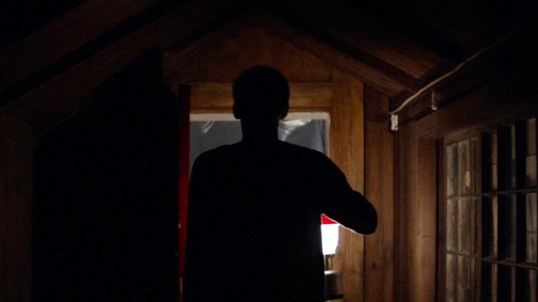
Horror Film Review: It Comes At Night (dir by Trey Edward Shults)


It Comes At Night is yet another film about people waiting for the end of the world.  In this case, the end is due to the outbreak of a mysterious disease.  It Comes At Night is a film that I meant to see in theaters when it originally released but I never got a chance.  It Comes At Night was acclaimed by critics but generally hated by audiences.  (Some of the comments on twitter, from people who had just returned from seeing the film, were incredibly angry.)  To be honest, it’s really not surprising that audiences didn’t embrace the film.  Having recently watched the film myself, I can tell you that It Comes At Night is one of the most depressing movies ever made.

Seriously, remember how depressing the Arnold Schwarzenegger/Abigail Breslin zombie film Maggie was?  Well, compared to It Comes At Night, Maggie might as well have been a musical comedy.

It Comes At Night opens with a former school teacher named Paul (Joel Edgerton) executing his father-in-law.  Paul’s wife, Sarah (Carmen Ejogo), and his teenage son, Travis (Kelvin Harrison, Jr.) understand that Paul had no choice.  There’s been an outbreak of a disease and the old man was infected.  The only way to keep everyone else in the family safe was to kill him and burn his body.

Paul and his family live in an isolated cabin.  At all times, the front door remains locked.  Only Paul and Sarah are allowed to carry the key.  No one is allowed to leave the house at night and under no circumstances are strangers allowed to enter the house.  Sometimes, after the sun goes down, Travis thinks that he can hear sounds in the surrounding woods.  It’s a reminder that people are out there but the majority of them are either slowly dying from the disease or scavengers trying to survive.

Paul ruthlessly enforces the rules but then, one night, a man named Will (Christopher Abbott) attempts to break into the house.  Will swears that he’s not infected.  He was just trying to find food for his wife, Kim (Riley Keough) and his son, Andrew (Griffin Robert Faulkner).  After Paul determines that Will does not have the disease, he agrees to let Will and his family stay with them.  If the house is ever attacked, Paul and Sarah figure, Will and Kim will provide an extra layer of defense.

And, for a few weeks, everything is fine.  The two families bond.  But Travis is still having vivid nightmares in which he sees men and women who have been infected and who are living in the woods.  And he is still hearing sounds at night…

The inevitability of death hangs over minute of It Comes At Night.  From the film’s first scene, you know that things are probably not going to end well.  When the two families do start to surrender to their paranoia, it’s upsetting but not particularly shocking.  It’s depressing because it all seems very plausible.  I think we all know that, if the world really was ending, it wouldn’t bring about peace or reflection.  Instead, people would keep fighting until the final second.  That’s just human nature.  What makes It Comes At Night so sad and disturbing is that there are no traditional heroes or villains.  There’s just six people trying to live their lives in a world that’s rapidly coming to an end.  They think they can beat the darkness surrounding them but the audience knows better.

I know, I know.  You just read that paragraph and you thought, “Yeah, Lisa, that sounds like a really fun movie.”

And you’re right.  It’s not a fun movie.  I would seriously warn anyone struggling with depression to be careful about watching It Comes At Night.  It’s definitely not going to cheer you up.  I spent the first half of thid 90 minute film convinced that I was probably going to stop watching because it was just too dark.  But I ended up watching it to the end because, even if it was depressing, it was also a very well-made film.  It sucks you in, even though you might not want it to.  The entire cast does a good job but special praise has to be given to Kelvin Harrison, Jr., who gives a searingly vulnerable performance as Travis.

It Comes At Night is a well-made, disturbing, and heartbreakingly sad movie and probably not one that I’ll have any desire to watch again for quite some time.