Retro Television Review: St. Elsewhere 4.13 “To Tell The Truth”


Welcome to Retro Television Reviews, a feature where we review some of our favorite and least favorite shows of the past! On Fridays, I will be reviewing St. Elsewhere, a medical show which ran on NBC from 1982 to 1988.  The show can be found on Daily Motion.
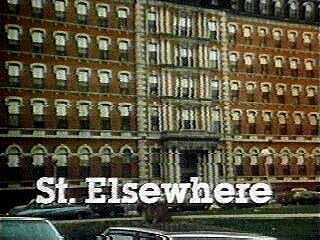
Has John Doe finally discovered his real identity?

Episode 4.13 “To Tell The Truth”

(Dir by Mark Tinker, originally aired on January 15th, 1986)

Last week’s episode ended with an abortion protester hiding a bomb in a custodial cart. The majority of this episode features various characters pushing that cart around the hospital, leaving us to wonder if and when the bomb is going to go off. At one point, even Dr. Craig gives the cart a frustrated shove. When the bomb finally does go off, it’s sitting outside the hospital gift shop. The hospital survives. An orderly is seriously injured. And Morrison gets to yell at the bomber (Rob Garrison).

Fiscus isn’t in the hospital when the bomb goes off. Instead, he’s out doing his Westphall-mandated community service. Fiscus is sent out on house calls, visiting elderly patients in their homes and doing follow-up exams. Fiscus hates it, and it’s easy to see why. For the most part, the old people are stereotypes. This episode is a rare case of St. Elsewhere trying too hard to be sentimental.

(And yes, when Fiscus complains, you can be sure that Westphall is ready with a long monologue about the time he spent in Ethiopia.)

The Valeres (George DelHoyo and Deborah May) are both getting frustrated with their inability to conceive. With Dr. Turner currently visiting her hometown in Mississippi, Ehrlich and Chandler have taken over the case. Ehrlich recommends that the Valeres consider adoption. Chandler, however, tells them that they should continue with IVF.

After a long day in court, Lucy slaps Helen, declares them to be even, and then drops her lawsuit.

Finally, Ramsey Headley (Ellis Rabb) and Lucinda Ferrare-Headley (Carrie Nye) show up at the hospital and claim that John Doe No. 6 is their long-lost brother and the heir to their family’s fortune. John Doe No. 6, who had been experimenting with being Shakespeare, says that he knows them and that he now realizes that he is Thomas Headley of New Orleans. Auschlander is happy that John has found his identity, but he’s still sad to see him go. (Auschlander does not seem to notice that the Headleys all speak like characters in a bad Tennessee Williams play.) After John leaves, the hospital gets a call from a “New Orleans sanitarium,” informing them that two of their patients have escaped and are heading to Boston. Yikes! If John returns next week, this will be a funny little incident. If he doesn’t, I’m never going to forgive Auschlander for letting him leave with two obvious charlatans.

This week’s episode was .… well, it was okay. It had its good moments, like the suspense with the custodial cart and the John Doe storyline. But it also got a bit too sentimental with the old people, and I’m at the point where I’m going to scream if I have to listen to another Westphall lecture about life in Ethiopia.

Let’s just be happy that the show didn’t kill Santa Claus again.
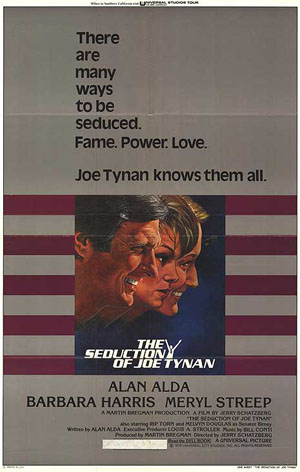
Shattered Politics #44: The Seduction of Joe Tynan (dir by Jerry Schatzberg)


The Seduction of Joe Tynan (1979)

You know how sometimes you see a film and you can just tell that it was probably a big deal when it was first released but now, in the present day, it’s just not that interesting?  That’s the way that I felt when I saw 1979’s The Seduction of Joe Tynan on Netflix.  This is one of those film’s that you just know was probably praised for being adult and mature when it was first released but seen today, it’s just kinda bleh.

Joe Tynan (Alan Alda) is a Democratic senator from New York, a committed liberal who is also an ambitious pragmatist.  As quickly becomes apparent, Joe is happiest when he’s at work.  He struggles to talk to his rebellious teenage daughter (Blanche Baker).  While he may love his wife (Barbara Harris), she’s also one of the few people in his life who isn’t always telling him how great he is and, to an extent, she resents having to live in his shadow.  At times, it seems like the only thing holding Joe’s family together is the possibility that Joe could soon be nominated for the presidency.

When a Southern judge is nominated for the Supreme Court, Joe is asked by his mentor, Sen. Birney (a great Melvyn Douglas), to not oppose the nomination.  While Joe originally agrees to keep quiet, he soon changes his mind when he’s approached by lobbyists who make it clear that, if he goes back on his word to Birney, they’ll be willing to support Joe for President.

Leaving behind his family, Joe heads down south where he meets a researcher named Karen Traynor (Meryl Streep).  With Karen’s help, Joe discovers that the judge actually is a racist.  He also discovers that, politically, he has a lot more in common with Karen than he does with his own wife and soon, they’re having an affair.

The Seduction of Joe Tynan is an odd film.  As written, Tynan is a decent but flawed man.  He may do the right thing but he does so largely because of his own ambition.  That’s not a problem, of course.  If anything, that would seem to be the making of a great political film.  Some of the greatest film characters of all time have been morally ambiguous.  But then, Alan Alda (who also wrote the script) gives a performance that would seem to indicate that he was scared of being disliked by the audience.  Alda is believable when he’s being a self-righteous crusader but, whenever he has to play up the pragmatic and ruthless side of Joe Tynan, he almost seems to have zoned out.  It’s interesting to compare Alda’s lukewarm performance here with the far more nuanced performance that he would give, as a less idealistic Senator, decades later in The Aviator.  As far as the film’s senators are concerned, Melvyn Douglas and Rip Torn (playing a libertine colleague) are far more believable than Alda.

The film’s best performance is delivered by Meryl Streep.  That might not sound shocking but actually, Streep’s performance here is surprising because it’s far more natural and less mannered than some of her more acclaimed performances.  Believe it or not, you actually forget that you’re watching Meryl Streep.

Ultimately, you have to respect the fact that the film attempted to tell an adult and mature story about politics but that doesn’t make The Seduction of Joe Tynan any less forgettable.