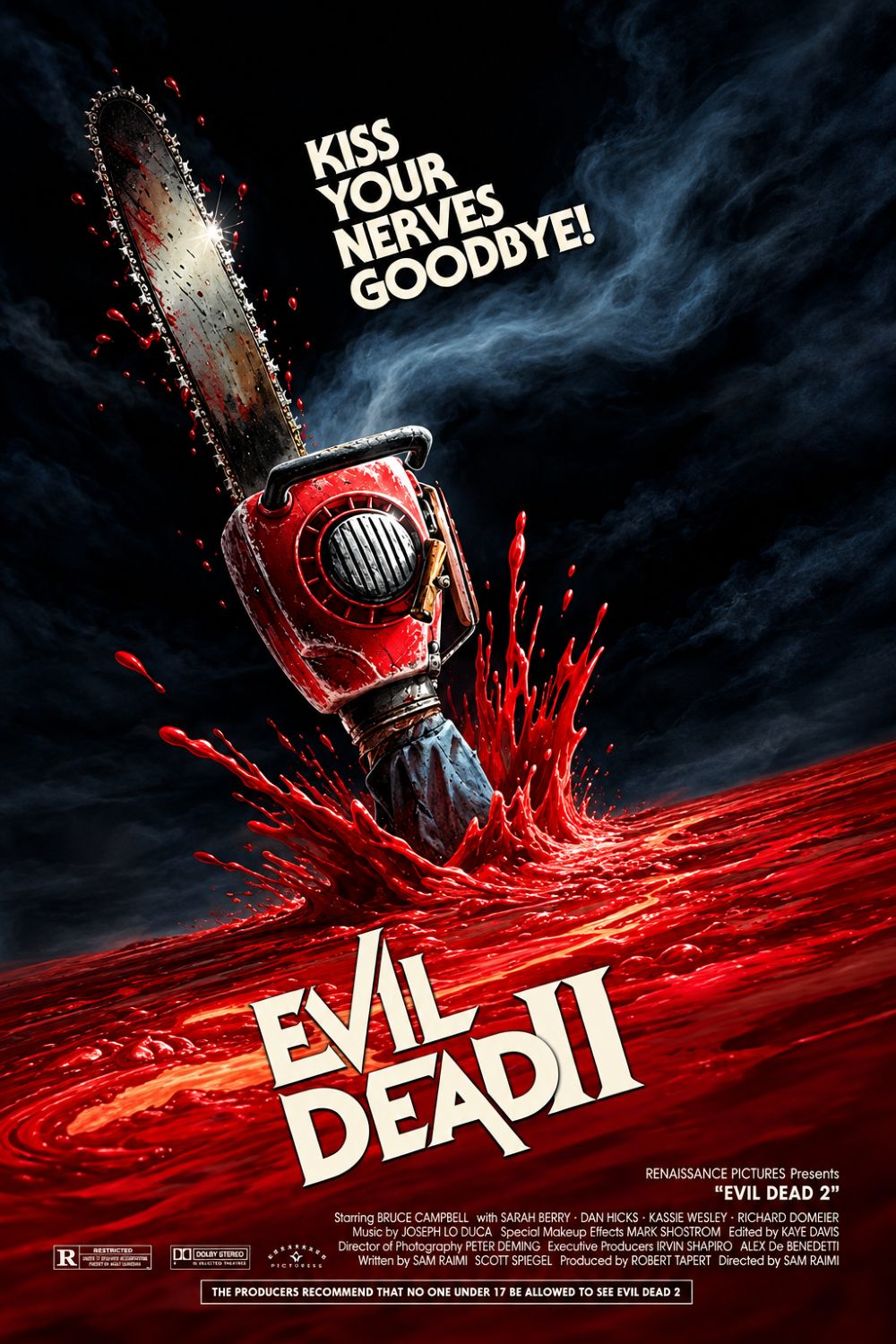
Horror Film Review: Evil Dead II (dir. by Sam Raimi)


“Swallow this.” — Ash Williams

With Evil Dead II, Sam Raimi took the basic cabin-in-the-woods nightmare of The Evil Dead and turned it into a frantic horror-comedy fever dream. Released in 1987, the film occupies a strange and wonderful place between a genuine continuation of The Evil Dead and a wildly exaggerated reimagining of it. It is nastier, funnier, more technically ambitious, and considerably more confident than its predecessor, yet it retains the homemade, anything-can-happen energy that made the original such a cult landmark. If The Evil Dead was a lean, rough-edged cabin-in-the-woods nightmare made by young filmmakers determined to prove themselves, Evil Dead II is Raimi and star Bruce Campbell returning with more resources, sharper instincts, and a total willingness to push every idea until it becomes cartoonishly grotesque.

The film begins with Ash Williams and his girlfriend Linda arriving at the infamous isolated cabin in the woods. It does not take long for them to stumble across the Necronomicon, the ancient book responsible for awakening flesh-hungry Deadites. What follows is an escalating barrage of possession, bodily mutilation, flying blood, demonic laughter, severed limbs, possessed household objects, and increasingly deranged attempts by Ash to survive the night. On a basic story level, it is familiar material. A group of people trapped in a remote location awaken evil forces and become possessed one by one. Raimi’s great achievement is that he never treats the formula as a limitation. Instead, he turns it into a delivery system for visual invention, slapstick timing, and creative violence.

The question of whether Evil Dead II is a sequel, a remake, or both has followed the movie for decades, and the honest answer is that it is effectively a sequel with a condensed remake-style opening. Raimi could not simply reuse footage from The Evil Dead, so the beginning retells the essential premise of the first film with Ash and Linda as the only characters at the cabin. That recap changes details, leaves out the original group of friends, and presents a shortened version of Ash’s first encounter with the Deadites. Once Ash survives the opening stretch and the evil returns, the movie continues beyond the events of The Evil Dead, making it a genuine sequel. Still, because the first act recreates so much of the original’s setup in a more polished and heightened form, it understandably feels like a remake before it becomes a continuation.

Bruce Campbell is the center of everything, and his performance is a huge part of why the film remains so beloved. Ash begins as an ordinary, frightened guy in over his head, but Campbell slowly transforms him into the character audiences recognize today: bruised, filthy, angry, absurdly resilient, and just arrogant enough to make his suffering hilarious. One of the movie’s most impressive qualities is how long Campbell can hold the screen almost entirely by himself. For substantial stretches, Ash has no real human companion to play off. He is acting opposite fake hands, props, stop-motion creatures, splattering fluids, camera movements, and the hostile architecture of the cabin. Campbell has to sell physical terror while also land jokes with the precision of a silent-film comedian.

The famous scene in which Ash’s possessed hand attacks him is probably the clearest example of what makes Evil Dead II special. In another horror movie, a man losing control of his hand might be played as disturbing body horror. Raimi turns it into a manic live-action cartoon. Ash battles his own hand with plates, books, a mousetrap, and anything else within reach, while Campbell throws himself around the room with astonishing commitment. The scene is funny because it is so excessive, but it never entirely stops being gruesome. Ash is still bleeding, suffering, and increasingly losing his mind. That balance is essential to the movie. Raimi does not abandon horror for comedy; he makes the comedy emerge from the intensity of the horror.

The cabin itself becomes one of the film’s great characters. In The Evil Dead, the location feels claustrophobic and decayed, a believable place that happens to become a site of supernatural violence. In Evil Dead II, it becomes something closer to a haunted funhouse. The walls seem alive, furniture appears to mock Ash, mounted animal heads laugh at him, and the entire building seems to participate in his breakdown. The sequence where Ash starts laughing alongside the room’s objects is especially memorable because it captures the film’s unstable tone. It is visually ridiculous, but there is genuine unease underneath it. Ash may be seeing a supernatural manifestation, losing his sanity, or both. Raimi keeps the audience off-balance by making laughter and fear feel almost inseparable.

Raimi’s direction is ferocious. The camera is constantly moving, rushing through forests, crashing into rooms, swooping toward characters, and creating the impression that the evil itself is an invisible force with a point of view. The “demon-cam” technique, in which the camera races through the woods toward its victims, returns from the first film but feels even more aggressive here. It gives the Deadites a strange presence despite the fact that they are often unseen. You do not merely hear something approaching; you feel the camera barreling toward Ash as if the movie has become possessed.

The practical effects remain a major reason to watch the film. They are intentionally messy, tactile, and sometimes obviously artificial, but that artificiality is part of the charm. The Deadites look like diseased puppets dragged out of a nightmare, their faces stretching into exaggerated masks of rot and rage. Blood does not behave like blood; it sprays in impossible volumes and bizarre colors. Bodies deform, heads spin, limbs detach, and tiny monsters swarm the frame. Rather than striving for realism, the effects aim for maximum impact. They create a world where physical rules have broken down, which suits a story about ancient evil invading the ordinary world.

The film’s humor also deserves credit for never making Ash too cool too early. Later installments, especially Army of Darkness, would lean more heavily into the swaggering, wisecracking version of the character. In Evil Dead II, he earns every bit of confidence through suffering. He is not a superhero with a chainsaw hand; he is a man forced to improvise a grotesque solution because he has no better option. When he straps the chainsaw onto his stump and prepares for battle, it is triumphant, but it is also the result of one of the most painful and grotesque scenes in the movie. The iconic image works because Raimi lets the audience experience the desperation behind it.

The supporting cast arrives later than expected, including Annie Knowby, daughter of the archaeologist connected to the Necronomicon, along with several others whose involvement predictably goes terribly wrong. They are not developed with the same attention as Ash, but that is not really the point. Their function is to give the Deadites fresh bodies to possess, create new complications, and help move the story toward its gleefully chaotic finale. Sarah Berry gives Annie an appealing mix of intelligence and panic, while Ted Raimi’s Henrietta becomes one of the movie’s most monstrous creations. The cellar scenes involving Henrietta are nasty, darkly funny, and among the strongest reminders that Raimi still knows how to make the audience uncomfortable even amid all the comedy.

By the time the film reaches its ending, Evil Dead II has become larger than its cabin setting. Its final twist sends Ash somewhere no viewer could reasonably have expected, turning what began as a contained survival-horror story into the launching point for the more openly fantasy-driven Army of Darkness. Yet the ending works precisely because the entire film has trained us to expect escalation. Every scene somehow finds a way to become more exaggerated than the last. A possessed girlfriend becomes a dancing corpse. A severed hand becomes a homicidal creature. A cabin becomes a carnival of insanity. A man with a chainsaw becomes an accidental hero.

More than three decades later, Evil Dead II still feels alive because it has a personality that no polished studio production could replicate. Its effects are physical, its performances are fearless, and its direction is so energetic that the movie seems ready to burst through the screen. It is gross, loud, silly, inventive, and sincerely scary in flashes. Raimi understands that horror can be horrifying and hilarious without weakening either quality. Evil Dead II is not merely a cult classic because people quote Ash or remember the chainsaw. It is a cult classic because it transforms limitations, madness, and handmade craftsmanship into a one-of-a-kind cinematic experience.
Late Night Retro Television Review: Highway to Heaven 4.9 “Why Punish the Children?”


Welcome to Late Night Retro Television Reviews, a feature where we review some of our favorite and least favorite shows of the past!  On Thursdays, we will be reviewing Highway to Heaven, which aired on NBC from 1984 to 1989.  The entire show is currently streaming on Amazon Prime, Tubi and other services!

Episode 4.9 “Why Punish the Children?”

(Dir. by Michael Landon, originally aired on November 25th, 1987)

In this Thanksgiving episode, Jonathan Smith (Michael Landon) and Mark Gordon (Victor French) take on roles as history teachers in a women’s prison. It seems a compassionate social worker named Melanie Canner (Sally Spencer) has been fighting hard to improve the lives of the women on the inside and has been getting close to nowhere with prison warden Thomas Inman (Bruce French). The first positive step that Melanie has been able to secure for the inmates from the warden are these history classes. Once on the inside, we meet inmates like Maria Rojas (Tasia Valenza), a young woman who’s just about to have her first baby, and Reba Williams (Bebe Drake), a mother of five. Both women want to straighten out their lives in order to give their children a better chance in life. It soon becomes clear that Jonathan, Mark, and Melanie are on a mission to convince the warden to open up more opportunities for the women to improve their lives and spend more quality time with their kids. The warden isn’t an easy case, as he seems convinced that the women shouldn’t be given any real favors as they pay their debts to society. As you might imagine, Jonathan has a couple of divine tricks up his sleeve.

I liked this episode of HIGHWAY TO HEAVEN even if it’s not the most realistic story you’ll ever see. Each woman we meet has 100% accepted the error of their ways and are determined to be a productive member of society if they can get just one more chance. The cynical part of me has to overcome this unrealistic element of the story, and the “women in prison” movie lover in me would have enjoyed a couple of good catfights. Alas, this is HIGHWAY TO HEAVEN and director Michael Landon is not in the business of going for complete realism or providing B Movie fan service! Rather, Landon is interested in creating a world where basically good people have done wrong, honestly regret how their choices negatively impact those they love, and vow to do better for their children. This series built its five seasons on the prospect of people turning their lives around, and I’ll admit I got pretty emotional again with this one. This episode really focuses in on a mother’s love for her children, and I certainly want to believe that these women would do anything for theirs. Each mother is given a beautiful moment, at Thanksgiving no less, and the chance that they need to be the mom their children deserve. I’m getting a little misty just thinking about it as I type these words. The character of the warden is there to learn the lesson that we all need to learn, which is to try to see situations from different points of view. He gets a little angelic help in this area, which is quite heavy handed and completely in line with the show’s expectations.

Overall, I again enjoyed this episode as a nostalgic trip down memory lane with a series I grew up watching with my mom. The fact that I got a little emotional is also no surprise because the older I get the more I cry when watching movies and TV shows. The fact that I was bawling in my office while I watched the show at work could have been a little hard to explain… luckily, nobody came by during those waterworks moments.

Film Review: Miracle Mile (dir by Steve De Jarnatt)


Last night, as I was watching the 1988 film, Miracle Mile, I found myself thinking about the fact that this film literally could not be made today.

No, it’s not because the film itself is about the treat of nuclear war.  Though nuclear war may no longer be as much of a cultural obsession as it apparently was back in the 80s, the fact of the matter is that the U.S., Russia, the UK, France, and China all still have nuclear weapons.  Pakistan, India, and North Korea all claim to have nuclear weapons.  It’s believed that Israel also has a few.  Iran is apparently working on developing an arsenal.  It’s estimated that there are currently 13,865 nuclear weapons in existence, 90% of which are divided between the U.S. and Russia.  That’s not even counting the threat of a terrorist group setting off a nuclear device.  In short, the threat of nuclear war is still very much a real one.

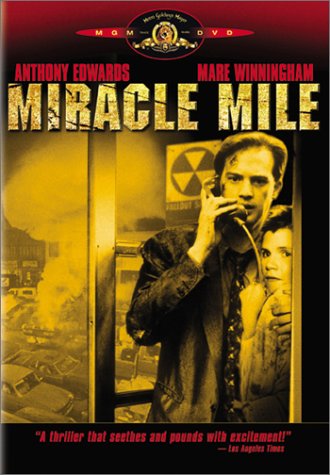
Instead, what truly makes Miracle Mile stand out as a film of its time, is the fact that almost the entire plot revolves around the character of Harry (played by Anthony Edwards) answering a Los Angeles pay phone at four in the morning.

Why is Harry answering a pay phone at 4 in the morning?  It’s because, earlier, he met Julie (Mare Winningham) at the La Brea Tar Pits and they fell instantly in love.  After spending most of the afternoon together, they made a date to meet at the local diner where Julie worked as a waitress.  Julie’s shift ended at midnight.  Harry went home to get a quick nap before picking her up.  Unfortunately, a power failure — one that was largely caused by Harry carelessly tossing away a cigarette — resulted in Harry’s alarm not going off.  At midnight, while Julie was standing outside the diner, Harry was asleep.

Harry doesn’t wake up until well-past 3 a.m.  After hastily getting dressed, Harry drives down to the diner.  When he arrives, he bumps into a tree and three rats fall off the branches and land on his car, which is a bit of an ominous omen.  (After watching the movie, I did a Google search and discovered that it’s actually not uncommon for rats to hang out in palm trees after dark.  I had no idea.  I’m glad I don’t live near any palm trees.)

By the time Harry arrives, Julie’s already gone.  From the payphone outside the diner, Harry calls Julie and leaves an apologetic message on her answering machine.  (Julie sleeps through it.)  Within minutes of Harry hanging up, the pay phone rings again.  Harry answers it, expecting to speak to Julie.  Instead, he finds himself talking to a panicked soldier who was trying to call his father but who dialed the wrong area code.  The soldier says that a war is about to break out and that everyone is going to die.  Suddenly, Harry hears what sounds like a gunshot.  Another voice gets on the phone and tells Harry to go back to sleep and forget about the call.

Of course, the reason why this story couldn’t take place in 2020 is pretty obvious to see.  No one uses pay phones anymore.  If the movie were made today. Harry would have just Julie on his own phone and then waited for her to call him back.  The soldier would never have misdialed his father’s area code.  Harry never would have gotten the message that the world was about to end and most of the subsequent events in Miracle Mile never would have happened.  Harry would have just sat in the diner and had a cup of coffee and waited for Julie to call until the inevitable happened.  In 2020, that would have been the movie.

So, let’s be happy that this film was made in 1988. during the time when pay phones were everywhere, because Miracle Mile is an excellent film.  Miracle Mile starts out as a romantic comedy, with Anthony Edwards and Mare Winningham making for an incredibly adorable couple.  Then, after Harry answers that pay phone, the movie grows increasingly grim as Harry desperately tries to make his way to Julie and arrange for the two of them to board a plane that a mysterious woman (Denise Crosby) has charted for Antarctica.  The problem, of course, is that in order to reach Julie, Harry is going to need the help of the type of people who are typically up and wandering around at 4 in the morning in Los Angeles.  Several people die as Harry tries to make it to Julie and, smartly, the film doesn’t just shrug off their deaths.  For the majority of the film, Harry isn’t even sure if there’s actually going to be an attack and it’s possible that he’s not only panicking over nothing but that he’s causing others to panic as well.  People are dying because of that phone call and Harry doesn’t even know whether it was real or not.  Even when full scale rioting breaks out, Harry doesn’t know if it’s because the world’s ending or because of a bad joke that he took seriously.  Transitioning from romantic comedy to dark comedy, Miracle Mile eventually becomes a nightmare as it becomes obvious that, even if Harry does reach Julie, escaping the city is not going to be easy.  The sun is rising and the truth is about that phone call is about to revealed….

Miracle Mile is a film that will get your heart racing.  On the one hand, Anthony Edwards and Mare Winningham have such a wonderful chemistry and they’re both just so damn likable that you want them to find each other and stay together.  Even if it means running the risk of being incinerated in a nuclear explosion, you want Harry and Julie to be with each other.  At the same time, you watch the movie with the knowledge that, even if they do manage to reunite, it might not matter because the world’s going to end.  Remarkably, almost everyone who Harry talks to about the phone call believes him when he says that a war is about break out.  Almost all of them have a plan to escape and, as a viewer, you get so wrapped up in the film that it’s only later that you realize that none of their plans made any sense.  Hiding out in Antarctica?  How exactly is that going to work?  Antarctica’s not exactly a place to which you impulsively move.  If there is truly no way to escape the inevitable, perhaps we should just be happy that Julie and Harry found love, even if it was right before the apocalypse.