Review: The Last Starfighter (dir. by Nick Castle)


“Alex! Alex! You’re walking away from history! History! Did Chris Columbus say he wanted to stay home? No! What if the Wright Brothers thought that only birds should fly?” — Centauri

The Last Starfighter is one of the most purely enjoyable science-fiction adventures of the 1980s: earnest, inventive, occasionally corny, and driven by the kind of wide-eyed imagination that modern blockbusters too often confuse with sheer scale. Directed by Nick Castle, the 1984 film builds an entire intergalactic adventure around a premise that could have been dismissed as a gimmick: an arcade champion discovers that his favorite game is actually a recruitment test for a real war in space. Instead of treating that premise ironically, the film commits to it wholeheartedly, and that sincerity is ultimately what makes it endure.

Lance Guest stars as Alex Rogan, a teenager living in the Starlite Starbrite trailer park with his mother and younger brother, Louis. Alex is smart, resourceful, and visibly restless. He wants to get out of his small-town surroundings, attend college, and build a better future, but financial strain and family responsibility keep making those ambitions seem less realistic. His one reliable escape comes from an arcade machine outside the local store called The Last Starfighter. Alex plays constantly, eventually achieving a record score that attracts the attention of the game’s mysterious creator, Centauri.

Robert Preston’s Centauri is one of the film’s great pleasures. He is an interstellar recruiter who behaves like a flamboyant carnival salesman, arriving in Alex’s life with a strange vehicle, flashy clothes, a rapid-fire sales pitch, and a proposition that sounds completely insane. Centauri reveals that The Last Starfighter is not merely a video game; it is a test designed to identify young people with the reflexes, tactical instincts, and courage needed to become Gunstar pilots for the Rylan Star League. Alex has not just beaten a difficult arcade game. He has qualified to defend an entire civilization from the Kodan Armada.

That central idea remains the movie’s strongest asset. It transforms a familiar adolescent fantasy into something emotionally resonant. Alex is not gifted with a magical sword, superpowers, or an ancient royal lineage. He is selected because he became exceptionally skilled at something the adults around him would probably regard as a waste of time. His ability to master a video game becomes proof that he has discipline, intelligence, hand-eye coordination, and the ability to make decisions under pressure. For anyone who grew up playing arcade games, it is an irresistible fantasy: the thing you are good at for fun might one day turn out to matter more than anyone realizes.

The film understands, however, that being offered a larger life is not the same as being ready for it. Alex initially reacts to the truth with disbelief and fear rather than instant heroism. He wants to return home. He assumes there has been a mistake. That response helps ground the movie, because Alex is not a prepackaged action hero. He is a teenager who has dreamed of escaping his circumstances but has never seriously considered the sacrifices that escape might require. It is easy to want a more exciting future when it is only an idea. It is harder when that future involves leaving your family, crossing the galaxy, and possibly dying in a war you barely understand.

Lance Guest gives Alex enough insecurity and frustration to make his eventual growth satisfying. Alex can be impatient and occasionally self-centered, but he never comes across as unlikable. He feels trapped, and the film makes that frustration understandable. His conflict is not simply whether he can destroy enemy ships; it is whether he can accept that he deserves a larger destiny than the one he has assumed is available to him. By the time he decides to fight, he has moved beyond wanting adventure as an escape. He has chosen to take responsibility for something greater than himself.

Catherine Mary Stewart is also appealing as Maggie Gordon, Alex’s girlfriend. Maggie is not given an enormous amount to do, but she has more personality than the standard passive romantic interest in many 1980s adventure films. She cares deeply about Alex, yet she also has every reason to be hurt and confused when he suddenly disappears and begins acting strangely. Her scenes with Beta Alex, the android duplicate sent to take Alex’s place on Earth, provide some of the movie’s most amusing moments. Beta Alex looks exactly like him, but his behavior is just strange enough to create an entertaining mixture of comedy and unease.

The Beta Alex subplot is one of the film’s cleverest touches because it allows the story to explore Alex’s absence without simply abandoning the Earthbound characters. Beta Alex is a convincing physical duplicate, but he cannot quite replicate the nuances of being human. His overly literal responses, awkward attempts at social interaction, and bizarre behavior around Maggie make him a memorable comic creation. The device also reinforces the contrast between Alex’s old life and the extraordinary new situation he has been pulled into. While the real Alex is in space facing a galactic conflict, the people at home are left trying to make sense of a version of him that seems familiar but fundamentally wrong.

Robert Preston’s performance gives the entire movie energy whenever Centauri appears. He could easily have become an irritating eccentric, but Preston makes him funny, charismatic, and unexpectedly warm. Centauri sees Alex’s potential before Alex sees it himself. Beneath the fast talking and theatrical mannerisms is a real belief in the people he recruits. He does not merely need another pilot; he genuinely wants Alex to become the person he is capable of being. Preston’s presence adds an old-fashioned show-business charm to a film otherwise built around futuristic hardware and computer-generated spacecraft.

Dan O’Herlihy is equally important as Grig, the reptilian alien navigator assigned to work with Alex. Grig initially seems like the typical stern mentor figure, but he gradually becomes one of the movie’s most likable characters. He has experience, discipline, and a personal history with the war that gives the conflict some added seriousness. His partnership with Alex works because they begin from very different places. Grig is a hardened veteran who has seen the cost of battle, while Alex is an overwhelmed rookie who still wants to go home. As they learn to trust each other, their relationship becomes the heart of the space-adventure material.

The villains are broad but effective. Xur and the Kodan Armada are not psychologically complex antagonists, yet the movie does not need them to be. Their purpose is to represent a threat large enough to force Alex into a defining choice. Xur’s willingness to betray the Star League and sacrifice innocent lives for power makes him an appropriately clear villain for this kind of adventure. The conflict is straightforward: a small group of defenders must stand against an overwhelming enemy force, and Alex must decide whether he will be one of those defenders.

The visual effects are perhaps the most historically fascinating part of The Last Starfighter. The film was an early showcase for computer-generated imagery, using digital effects for its spacecraft, alien environments, and space-combat sequences. At the time, this was revolutionary. Seen today, the visual effects are obviously dated. The ships have a smooth, artificial quality, the textures are basic, and the movement lacks the weight and complexity audiences expect from modern computer animation. Yet there is still something charming about them. They represent a major transitional period in science-fiction filmmaking, when filmmakers were beginning to discover what computers could do for cinematic spectacle.

The early CGI gives the movie a distinctive visual identity rather than simply making it look obsolete. The Gunstar fighter, the Kodan fleet, and the distant alien landscapes have the clean, geometric appearance of an advanced arcade game brought to life. That is fitting for a story about a teenager whose gaming skills translate into real combat ability. The computer-generated imagery may not have the tactile realism of the practical miniature work seen in films such as Star Wars or Blade Runner, but it has an important place in the history of visual effects. The movie was imagining a future that the technology of its day could only partially create, and that ambition remains visible in every digital battle.

The Gunstar itself is a memorable piece of science-fiction design. It looks futuristic while still retaining the simplicity of a classic arcade spaceship, and the cockpit scenes effectively sell the sensation of Alex being thrown into something far beyond his experience. The climactic use of the “Death Blossom” maneuver is especially satisfying because the film treats it as a genuine last resort. It is the cinematic equivalent of unleashing a devastating power-up at the exact moment an arcade game seems impossible to win. The sequence is flashy, uncomplicated, and immensely fun.

What makes The Last Starfighter last is not its special effects alone, nor is it just nostalgia for the arcade era. The movie works because it is fundamentally optimistic. It believes that potential can emerge from unlikely places and that someone who feels ignored, trapped, or underestimated may still possess the ability to do something remarkable. Alex is not chosen because he is already fearless. He becomes heroic because he eventually chooses to act despite being afraid.

The film is not perfect. Its dialogue can be cheesy, some characters are thinly developed, and the dated effects may be difficult for viewers accustomed to modern CGI. Even so, those imperfections are part of its charm. The Last Starfighter is colorful, sincere, and unashamedly enthusiastic about its own premise. It remains a lovable science-fiction adventure because it takes the dreams of a video-game-playing teenager seriously. It asks viewers to imagine that the skill everyone dismisses, the hobby that feels like an escape from ordinary life, might actually be the first sign that they are capable of something far greater.
Musical Film Review: The Apple (dir by Menahem Golan)


1980’s The Apple takes place in the future!

Well, actually, it takes place in 1994.  The film imagines that, by the year 1994, the world would be a decadent, cynical, and soulless place where everyone listened to the mindless corporate music of Mr. Boogalow (Vladek Sheybal).  Really, the film’s version of the future wasn’t that far off.  It was more 2014 than 1994 but still….

Anyway, at the 1994 Worldvision Music Contest, Boogalow cheats to make sure that the latest shallow offering from BIM defeats a painfully earnest love song that is performed by Alphie (George Gilmour) and his girlfriend, Bibi (Catherine Mary Stewart).  Boogalow decides to sign Alphie and Bibi to a recording contract.  Alphie has visions of earthquakes and imagines being taken to Hell by Boogalow.  Alphie refuses to sign the contract.  Bibi, having had no such visions, signs the contract and soon, she is a part of the decadent Boogalow world.  Alphie, meanwhile, ends up living in a park with Mr. Topps (Joss Ackland) and a bunch of overage hippies.  Eventually, the Rapture occurs, largely because something had to happen to finally end this stupid movie.

The Apple was a film that I had heard a lot about before I actually sat down and watched it.  Just from what I had heard, I expected it to be bad-but-enjoyable, a disco campfest in the style of Sgt. Pepper’s Lonely Hearts Club Band In fact, I would have been happy if it had just been as silly as Skatetown USA.  Unfortunately, The Apple can’t compare to either of those two films.  The Apple may be campy but it’s also mind-numbingly dull.  It’s only has an 87 minute running time but it feels considerably longer.  With one big exception, the music is forgettable.  Catherine Mary Stewart probably gives as good a performance as could be expected under the circumstances but George Gilmour is a bland hero.  Even Vladek Sheyball, who was so memorable as the villainous chess master in From Russia With Love, makes for a forgettable bad guy.

Now, I did mention that there is one big exception when it comes to the forgettable music and that’s a song that Bibi sings after she’s signed with Boogalow and given up her soul to be a star.  The song is called Speed.  “America, the land of the free/Is shooting up with her energy/and everyday she has to take more/…. SPEEEEEED!”  Bibi performs the song on a stage while a bunch of backup dancers writhe on motorcycles and, for about three minutes, The Apple actually becomes the spectacle that it so obviously wants to be.  The song may be about drugs but it’s also about American culture.  America is a country that is on the mood.  We don’t need any of that fashionable European ennui.  We’re all about speed, which is one reason why I love this country.  At our most mellow, we still get more done in a day than the average European.  No trains for us!  We’re a motorcycle nation!

Other than that one scene, though, The Apple feels like a middle school production.  We’re told that Boogalow International Music is a decadent company but, in this film, that just means that people speak in an arch tone.  It’s a teenager’s impression of what it means to be decadent.  We’re meant to turn against BIM when its employees laugh at Alphie for being a boring straight guy.  But the fact of the matter is that Alphie is a boring straight guy and his music sucks.  The film takes a stand about corporate music but the 0nly alternative that it come up with is boring folk music.

Don’t listen to those who tell you that The Apple is so bad that it’s good.  It’s just bad.

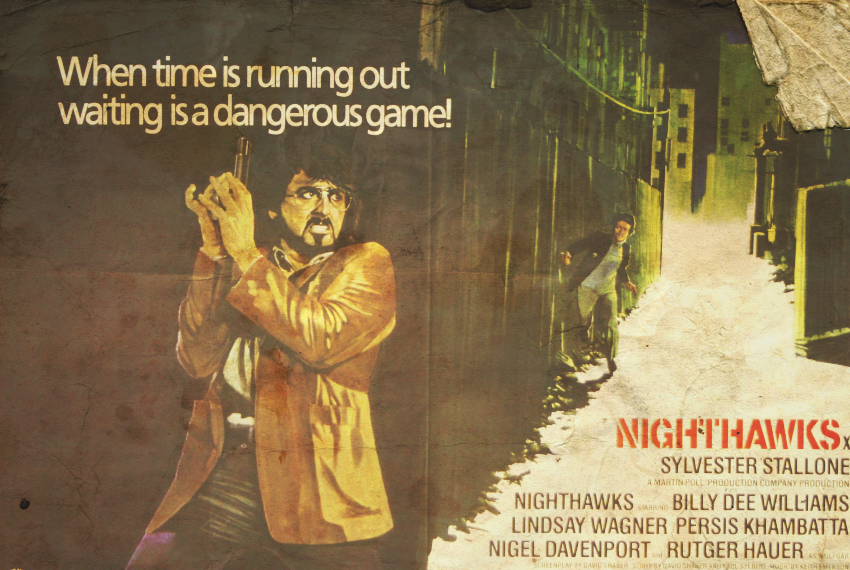
#SundayShorts with NIGHTHAWKS!


Since Sunday is a day of rest for a lot of people, I present #SundayShorts, a weekly mini review of a movie I’ve recently watched.

Deke DaSilva (Sylvester Stallone) and Matthew Fox (Billy Dee Williams) are two badass New York City Cops. Wulfgar (Rutger Hauer) is one of the most dangerous terrorists in the world. When it’s suspected that Wulfgar is in New York City, DaSilva and Fox are transferred to an elite anti-terrorist squad, led by the British expert Peter Hartman (Nigel Davenport). Will they be able to find Wulfgar and stop him before it’s too late?

I’m a big fan of NIGHTHAWKS. The performances from Stallone, Williams, and Hauer are all excellent. Hauer is especially good as the terrorist, Wulfgar. He knocks it out of the park. The action is hard hitting at times, and the tension builds nicely throughout the film, leading to its audience pleasing conclusion. Definitely recommended for fans of action movies and the stars!

Five Fast Facts:

  1. Dutch actor Rutger Hauer was a huge star in the Netherlands when NIGHTHAWKS was made. This is his American film debut.
  2. Sylvester Stallone and Rutger Hauer clashed early and often while making NIGHTHAWKS. The first day on the set, Rutger Hauer had to film a violent action scene. While filming the sequence, Hauer was injured when a cable that would yank him to simulate the force of being shot was pulled too hard, straining his back. Afterward, Hauer discovered that the cable was pulled with such force on Sylvester Stallone’s orders. Hauer threatened Stallone that he would “break his balls” if he ever did something like that again. Reportedly, they clashed often on the film from this point forward.
  3. The director of NIGHTHAWKS, Bruce Malmuth, played the ring announcer of the All-Valley karate tournament at the end of THE KARATE KID. I was 12 years old when I saw THE KARATE KID, and I wanted to be the karate kid. It’s one of my favorite movies, leading to a lifetime crush on Elizabeth Shue.
  4. Reportedly, during the exciting subway chase sequence, Rutger Hauer continually outran Stallone, who is known for his competitive streak. This is one of my favorite sequences in the film, and Hauer does look extremely fast.
  5. If you’re looking for a reason to upgrade to the Shout! Factory blu ray…the Universal Pictures widescreen DVD omits the use of “Brown Sugar” by The Rolling Stones and “I’m a Man” by Keith Emerson. The 2016 Blu-ray release from Shout! Factory adds them back.

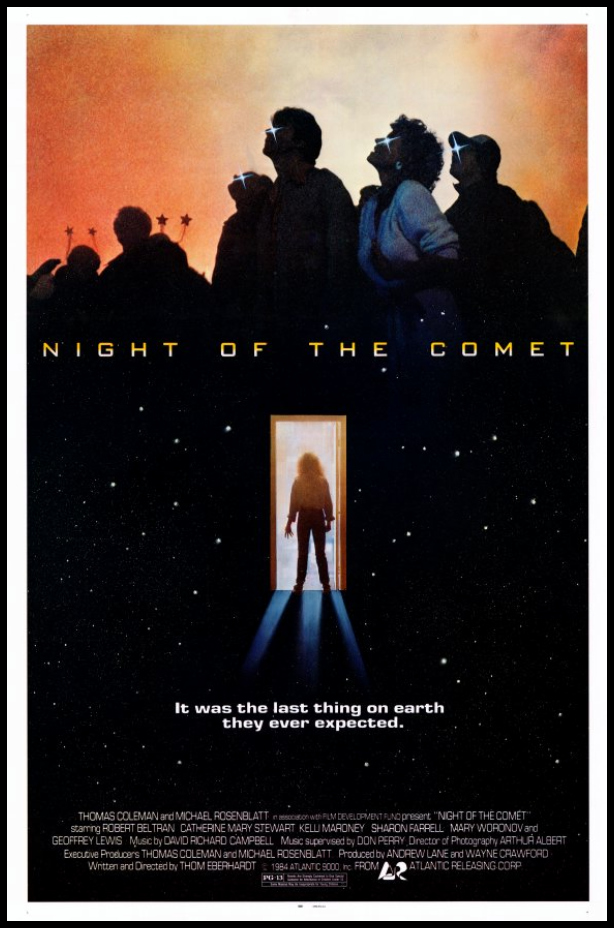
Horror Film Review: Night of the Comet (dir by Thom Eberhardt)


The 1984 film, Night of the Comet, begins with the end.

The end of the world, that is!

When the Earth passes through the tail of a comet, the end result is that the majority of the world’s population is reduced to red dust.  Those who are exposed to the comet but not turned immediately into dust face an even worse fate.  They are transformed into mindless zombies.  Fortunately, 18 year-old Reggie (Catherine Mary Stewart) and her 16 year-old sister, Sam (Kelli Maroney), both managed to avoid getting exposed.  Sam was in a steel shed, hiding from their abusive stepmother.  Reggie was in a theater projection room with her boyfriend.  When Reggie and Sam wake up in the morning to discover that they are two of the few people left alive on the planet, they do what anyone would do.

They go to the mall!

Which is probably the same thing that me and my sisters would have done if we had found ourselves in a similar situation.  That’s one reason why Night of the Comet holds up so well.  It’s one of the few films to be honest about how most people would probably react to the end of the world.  Instead of giving a big dramatic monologue or having a breakdown or getting into a fight about who is to blame and what it all means, Reggie and Sam try to have a little fun.  Of course, they also grab some guns while they’re at the mall.  They’re not stupid.  They know the situation is grim and they need to be prepared.  But still, there’s no reason why they shouldn’t try on all the clothes that they previously would not have been able to afford.  And why shouldn’t they treat the mall as their own personal playground?  They’re young and they’ve survived the end of the world.  They deserve to enjoy themselves.

Of course, just because Reggie and Sam survived, that doesn’t mean the world is a safe place.  Along with the zombies, there’s also a crazed group of former stockboys who now view the mall as being their own personal kingdom.  And then there’s the scientists, who claim that they’re benevolent but who are actually looking for healthy specimens on which they  can experiment.

Night of the Comet is a terrifically fun horror movie, a real treat for anyone who has ever imagined what they would do if they were among the last people on Earth.  Catherine Mary Stewart, Kelli Maroney, and Robert Beltran (who plays another survivor) brings a lot of energy to their likable roles while Mary Woronov and Geoffrey Lewis are properly menacing as the two main scientists.  The zombies, with their crazed eyes and their decaying faces, are genuinely frightening.  Director Thom Eberhardt wisely doesn’t overuse the zombies.  Indeed, the whole point of the film is that the world is now nearly empty of people, whether they’re zombies or not.  But because the zombies aren’t present all of the time, it makes it easy to forget about them and it also makes all the more frightening when they suddenly show up.

Night of the Comet is an enjoyable mix of horror and comedy, one that holds up well nearly 40 years after it was first released.

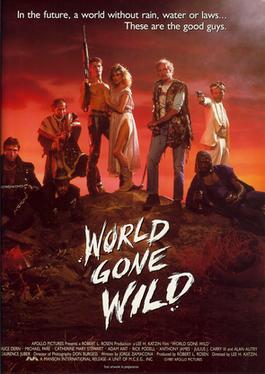
The TSL’s Grindhouse: World Gone Wild (dir by Lee H. Katzin)


“World Gone Wild!?  What’s that about?”

Don’t ask me.  I just watched the movie and I’m not particularly sure what the point of it all was.  Released in 1987, World Gone Wild is one of those films that was made to capitalize on the post-apocalypse boom of the 70s and 80s.  Basically, imagine a Mad Max film that sucks and you’ll have a pretty good idea of what World Gone Wild is like.

There’s been a nuclear war.  Civilization has collapsed and now, there are just tiny outposts of humanity who are trying to survive.  It hasn’t rained in decades.  Old-timer Ethan (Bruce Dern) is in charge of a town called Lost Wells.  He remembers what rain was like and he also remembers what rock music used to sound like, too.  As for Lost Wells, it’s one of those dreary little desert communities that always tend to pop up in movies like this.  Angie (Catherine Mary Stewart) teaches the community’s children in an abandoned school bus.  They have a bunch of books on etiquette.  One little girl can recite every word ever written by Emily Post.  That gets annoying fast.  Emily Post didn’t live on a school bus in the desert.

That etiquette doesn’t do much good when it comes to protecting Lost Wells from Derek Abernathy (Adam Ant), a cult leader who dresses in all-white and who wants to take control of Lost Wells away from Ethan.  (In a somewhat clever twist, it turns out that Ethan learned how to become a cult leader by reading a book about Charles Manson.)  Knowing that the majority of the people in his town are too obsessed with Emily Post to fight off Derek and his army, Ethan recruits a group of mercenaries led by George Landon ( who is played by Michael Pare, who looks like he was absolutely miserable while shooting this movie).  George and his men agree to protect Lost Wells from Derek and, in the process, they regain some of their lost humanity and they start to believe in the possibility of rain.  Or something like that.  Fortunately, one of George’s mercenaries is played by the supercool character actor Anthony James.  He doesn’t get to do much but hey, it’s still Anthony James and Bruce Dern in the same movie!  Yay!

For a film called World Gone Wild, this is a strangely low-key affair.  Even the most unimpressive of Mad Max rip-offs will usually have an exciting car chase or two.  At the very least, there’s usually a big battle where people sacrifice their lives for the future of humanity.  In World Gone Wild, the mercenaries pretty much just go to Lost Wells and then wait for Derek to come back.  And when Derek returns, there’s a few explosions and some gunfire but that’s pretty much it.  Neither side really puts up much of a fight, which leads me to wonder if Derek really even cared about Lost Wells.

On the plus side, the film has got Bruce Dern, doing his wild-eyed old-timer bit.  That’s always fun to watch and, if nothing else, Dern appears to be having fun in this movie.  At the very least, he’s having more fun that Michael Pare and Catherine Mary Stewart, both of whom seem to spend the majority of the movie looking for a way to make a quick escape.  And I suppose the film does win some novelty points for casting Adam Ant as the main villain, even though Derek ultimately turns out to be not much of a threat.

In the end, World Gone Wild‘s greatest strength is Bruce Dern.  He’ll make you believe in the rain again.

Val’s Movie Roundup #12: Hallmark Edition


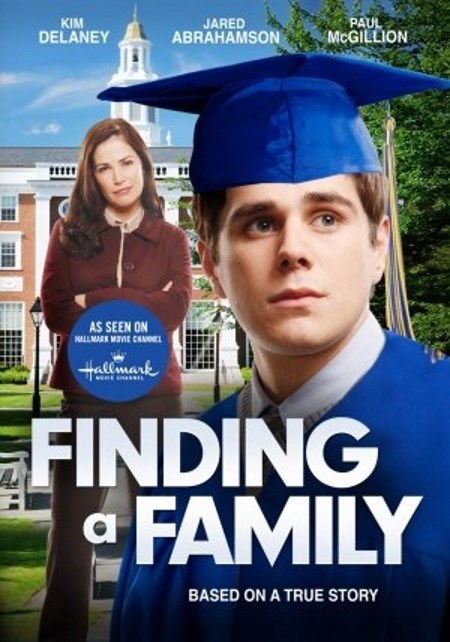
finding-a-family.7565

Finding A Family (2011) – This movie is about a kid named Alex (Jared Abrahamson) whose mother has serious mental problems. She has a great degree, but her mental problems absolutely cripple her. As you can guess, they create major issues for her son who has to live with her day after day. Ultimately, Alex has himself emancipated. He wants to go to Harvard and works hard in school to make this work while not forgetting his mother. Then he decides that he really does want a family and starts writing to people asking them to take him in. It’s a nice story that really only had one issue and a minor personal complaint.

The issue is that I have some experience in this area and the depth to which his mother’s mental problems should affect him, don’t. Don’t get me wrong, it’s not like The Blind Side (2009) where they gutted and flattened two amazing people, but it’s noticeable. The other thing is a minor complaint. In the old days you did receive a letter from colleges you applied to telling you whether you were accepted or not. However, I applied in 2006 and we was never sent a letter. You checked their website to find out whether you were accepted or not. This film was made in 2011. I know it’s more dramatic and familiar to go with the letter thing, but it’s time to move on.

You’ve seen it all before, but if you want to see again, then check this one out.

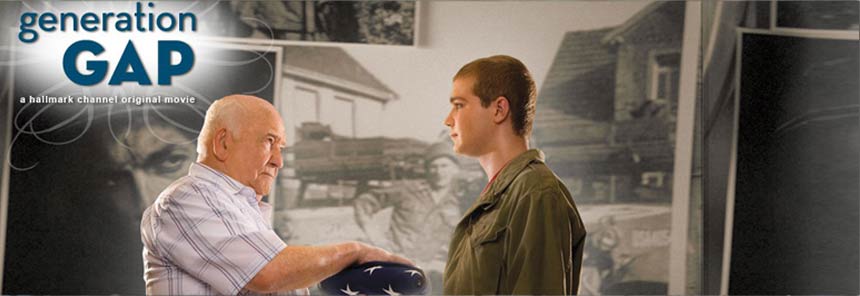
banner_gengap

Generation Gap (2008) – There really isn’t much to talk about here. You’ve seen this plot a million times before. We meet Dylan (Alex Black) who is just too much for his mother because of a few scenes of rebellion. His Mom, played by Catherine Mary Stewart, calls up her father played by Ed Asner and dumps Dylan on him. After a few scenes of Asner acting like a dick, which he seems to think he is entitled to do because he’s old, both him and the kid calm down. The film does three things: 1. Asner and the kid come to realize that despite being different ages, they both occupy the same time and place on Earth, 2. Asner hooks up with Rue McClanahan who sounds weird without her Southern accent, 3. The kid also gains a romantic interest.

The only other noteworthy things are that they age Asner by about 10 years to have his character able to have been in WWII. The other is that the kid walks in on Asner and three other guys playing Halo. Pretty funny. Remember that scene in The Wizard (1989) where Beau Bridges is supposedly playing Teenage Mutant Ninja Turtles, but we now know thanks to AVGN that he was probably playing Winter Games for the NES? Well, they actually show that Halo is what is being played and I wouldn’t be surprised if Asner and the others were actually playing.

This one is cliched, but okay.

MV5BMTgyODAzNjUzOV5BMl5BanBnXkFtZTcwMDY3MzgxMw@@._V1_SY317_CR3,0,214,317_AL_

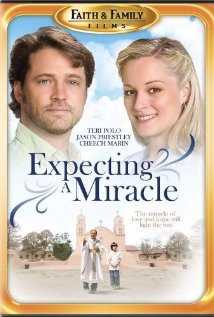
Expecting A Miracle (2009) – This is a weird movie. It seems to be nice and have it’s heart in the right place, but there are some odd bits. It introduces us to a couple played by Jason Priestley and Teri Polo who have been trying to get pregnant. It seems that the couple has tried IVF several times, but there doesn’t seem to be any mention of sex whatsoever. Did they try that?

To try and calm down, they take a vacation and wind up in a small Mexican town that seems to consist only of a courtyard. Cheech Marin is here along with some other characters who conveniently speak English. There is a kid who has something wrong with his leg and is convinced that a special ceremony is going to fix it. This is the kind of place populated with people who are like the magic negro/eccentric characters that turn your life around simply by coming into contact with them.

Polo is told a line that basically says God decides whether you will have kids or not. Okay, but does that mean God also controls the adoption process which is brought up numerous times during this film. Maybe it’s the film’s way of saying that God sometimes is trying to tell you that it’s not necessary to pass on your genetic material, but instead to save a poor kid who needs a family and people who will love them.

The rest is harmless and kind of nice, but then comes the ending. The kid in the village is miraculously cured of a condition with his leg during a ceremony. The couple talk about adopting him. At the very end, they are at home working through the adoption process, talking about how much paperwork there is to adopt a kid. The wife goes to the bathroom and takes a pregnancy test. She’s pregnant! Then there are the credits. Did they have sex? Was it IVF again? Did they still follow through and adopt the kid? No answers.

It’s nice and everything, but I can’t honestly recommend it. Just a little too weird and relies on people’s assumptions about the nobility and happiness about simple rural communities.

Murder101_IfWishesWereHorses_0001.jpg

Murder 101: If Wishes Were Horses (2007) – Another Hallmark murder mystery, but just like Murder 101, this was good. As always, I’m terrible about following the plots of these movies. It all begins when a horse is kidnapped. Once again, Dick Van Dyke is brought in to help with the case. Barry Van Dyke is back again as well, but this time Shane Van Dyke joins in on the fun. This is your standard murder mystery movie in the vein of Diagnosis Murder, Murder, She Wrote, and Mystery Woman as opposed to recent movies like Wedding Planner Mystery and Garage Sale Mystery. This one’s fine.

Val’s Movie Roundup #8: Hallmark Edition


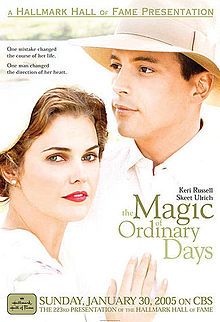
220px-MagicofOrdinaryDays

The Magic of Ordinary Days (2005) – Okay, pro tip for watching Hallmark movies. Do not watch Hallmark Hall of Fame movies on Hallmark. These were specially made TV Movies that had higher production values and unusual runtimes for TV Movies. Unfortunately, Hallmark is editing them down to make them shorter. I didn’t realize that when I watched this so it was probably not the ideal viewing experience. I did notice it when I tried to watch Follow The Stars Home (2001). If that thing wasn’t edited, then it’s one of the worst put together films I’ve attempted to watch in a while. I stopped pretty quickly. I’m going to get it on DVD so I’ll find out for sure. As for this movie, the version I watched on Hallmark gets sidetracked too much with a plot involving Japanese internment camps. It should have remained focused on the couple played by Keri Russell and Skeet Ulrich. I have a feeling that problem doesn’t disappear with a greater running time. Keri Russell plays a woman pregnant out of wedlock who is married off to Ulrich that lives in the country. It takes place in the 1940’s. It’s decent. The higher production values shine through. This is not a standard Hallmark TV movie. It’s kind of night and day in that sense. The only other problem I noticed was that Russell has a little too much of a modern look, but far from Tom Cruise in The Last Samurai (2003). Ulrich blends in pretty well except at one point. Late in the film they put him in a plaid shirt and suddenly there’s 90’s Skeet Ulrich. See this one uncut.

LiesBetweenFriends_gabrielleanwar_thumb

Lies Between Friends (2010) – I’m going to cut the crap here. You see that thing in the picture above. That awful looking wig on Gabrielle Anwar’s head will drive you mad! It is terribly artificial looking. And it’s onscreen almost the entire film. What were they thinking!!! It is so distracting that you just can’t pay attention. And this is a murder mystery mind you. Just wow! Also, I found Gabrielle Anwar’s performance to have as much depth as a puddle. But it’s the wig that single-handedly ruins the movie. You’d think someone would have noticed. Even if Anwar had a bald head, then it would have been better to write that into the character rather than having that phenomenon of fakery on display. For masochists only.

565c7d693fbe88bd5f0cd4654630ec9f

Class (2010) – The plot and characters are extremely predictable. You know exactly what is going to happen from the get go. Nothing is surprising in the slightest. This movie is about a guy who is assigned by a professor at law school to help a young single mother who is having trouble. Do I have to say more? Of course not. The real problem is the casting. Not Catherine Mary Stewart. I could watch her sit in a chair reading and would be happy. Okay, I have a crush on her still after all these years. The leading actors are the problem. She looks like the Tiffani-Amber Thiessen from Beverly Hills, 90210 type, which doesn’t fit her character. He also looks like he could have been on that show. He would have played the frat boy that even Ian Ziering’s character would have found contemptible. Again, doesn’t fit his character. Neither acts well enough to pull off not instantly looking the part. It just doesn’t work.

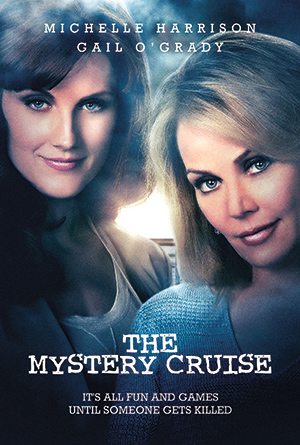
Mystery_Cruise_revised_final_300x445

The Mystery Cruise (2013) – Over the weekend I played through River City Ransom on NES with a friend. It’s basically an RPG version of Double Dragon. If you double tap left or right, then you’ll run in that direction. When your attack gets greater, then you can come to a new screen, run, and in an instant put an enemy to the ground. The start of this movie is like being on the receiving end of that punch. Honestly, it’s like you came back from commercial in the middle of a TV show except it’s the beginning of the movie. Talk about cut to the chase. In fact, it does start at the end of a chase. Sadly, this is the best part of the movie. It’s zany and stupid. Then the movie spells out that it’s supposed to start a new TV series. Then it shows exactly why that never panned out. This is an example of messy writing and editing. You jump around from conversation to conversation, but it’s like the glue and the transitions are missing. It’s about two ladies, one of which wants to start a detective agency with the other, who go on a mystery cruise. Everyone plays a part and someone has to figure out who the murderer is. Of course reality comes in the form of a lady who is really trying to kill her husband. If you must watch something that has “The Mystery Cruise” in it, then you’re better off watching a Let’s Play of Detective Barbie: The Mystery Cruise. Out of these four movies, definitely go with The Magic of Ordinary Days, but an unedited version.

Back to School #36: Mischief (dir by Mel Damski)


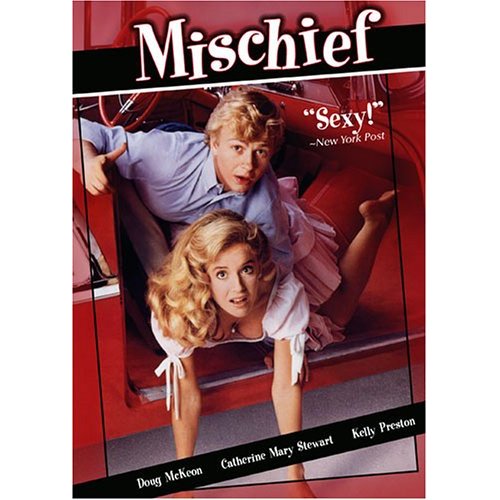
Mischief

Have you ever noticed how, occasionally, a totally obscure film that was made several decades ago will suddenly show up on either Starz or Encore and, the next thing you know, it’s only like every other day?  That was the case a few months ago when, at times, it seemed as if the only thing playing on cable was a teen comedy from 1985 called Mischief.

After I saw it listed in the guide a few dozen times, I thought to myself, “Somebody at that station must really like that movie.”  So, one night, I actually took the time to watch it and discovered why that mysterious person loved this movie.  Mischief may not be as well-known as some of the other films in this series of Back to School reviews but it’s still a pretty good movie.

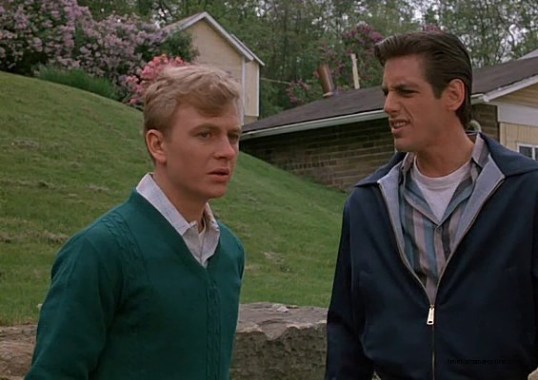
Like so many of the teen films that were released in the 70s and 80s, Mischief takes place in the 1950s.  (I assume that’s because most films about teenagers are made by adults who want to both relive and perhaps change the past.  I suppose that’s one reason why so many films released today are set in the 1990s.  In another ten years or so, all of the new high school films will be set in 2003.)  The very shy and clumsy Jonathan (Doug McKeon) has a crush on the beautiful but unattainable Marilyn (Kelly Preston).  Fortunately, Jonathan is befriended by Gene (Chris Nash) who is the prototypical rebel without a cause.  Gene wears a leather jacket.  Gene rides a motorcycle.  Gene doesn’t get along with his alcoholic, violin-playing father (Terry O’Quinn, in full asshole mode here).  Gene even stands up to the school bully (D.W. Brown) and starts dating the bully’s ex-girlfriend, Bunny (Catherine Mary Stewart).  Most importantly, Gene helps Jonathan finally develop the confidence necessary to ask Marilyn out.

And, for a while, Gene & Bunny and Jonathan & Marilyn make for the perfect foursome.  But, as we all know, perfection can never last in a coming-of-age story.  Jonathan starts to discover that he and Marilyn are not quite as compatible as he originally assumed that they were.  As for Gene, he has to deal with his increasingly violent and drunken father…

That last paragraph probably makes Mischief sound a lot more dramatic than it actually is.  Make no mistake about it — while Mischief does deal with some serious issues — it is primarily a comedy and a pretty good one at that.  McKeon is endearingly clumsy in his initial attempts to get Marilyn to notice him and Nash — even though he’s playing a very familiar character — is likable as well.  Perhaps the smartest thing that Mischief did is that it made Gene cool but it didn’t make him too cool.  The film’s best scenes are the ones where Gene momentarily surrenders his rebel facade and reveals that he’s just as confused as everyone else.  Catherine Mary Stewart and Kelly Preston are well-cast as well, with Preston especially doing a good job at making a potentially unsympathetic character likable.

In many ways, Mischief is a pretty predictable film.  I think it features probably every single cinematic cliché that one would expect to see in a film about the 50s.  But the film itself is so likable and good-natured that it doesn’t matter if it’s predictable.  It’s just a good, enjoyable movie and what’s wrong with that?

(Incidentally, the screenplay for Mischief was written by Noel Black, who also directed the previously reviewed Private School.)

1327550371_1447726

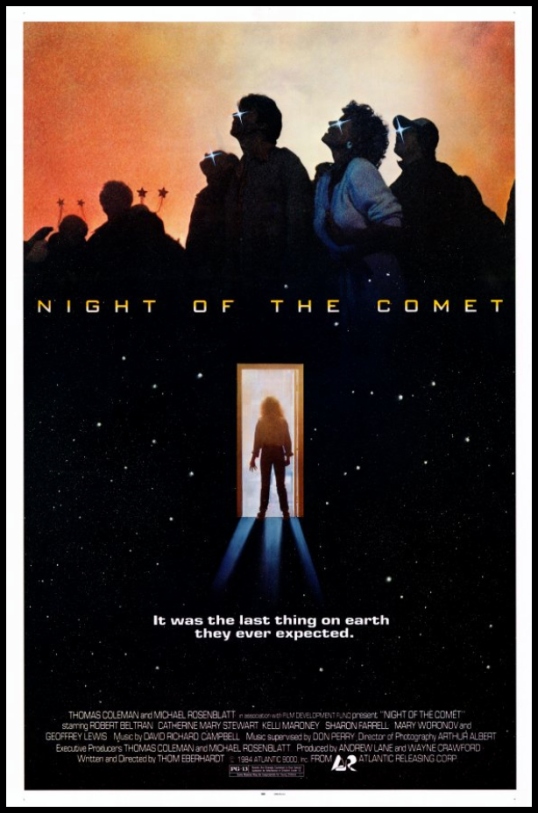
Quickie Review: Night of the Comet (dir. by Thom Eberhardt)


Night of the Comet took advantage of the return of Halley’s Comet hype which ran through nation and pretty much most of the world throughout most of 1984 and into 1985. Hollywood being the opportunist industry that it was (and still is) were quick to produce and release a movie about the return of Halley’s Comet over the planet as soon as possible. The 1980’s was a good decade for the low to mid-budgeted horror and sci-fi movies which had a quick death at the box-office but which gained success and cult status in the many displays racks of the tens of thousands of video rental places. 1984’s Night of the Comet was one of these films and it typifies the cheesiness that was 1980’s scifi horror.

The film opens up with everyone partying the arrival of Halley’s Comet which could be seen in the night sky every 75-76 years. This time around the planet will pass through the comet’s tail which has only happened once and that was 65 million years in the past. People are out on the streets as night falls celebrating the Comet’s arrival and we meet two of the main characters in the film in the form of Regina (80’s genre icon Catherine Mary Stewart) and Samantha (Kelli Maroney). Two sisters who truly epitomizes the mall and valley culture of 1980’s Southern California, Regina and Samantha are not enjoying the night of the comet as Regina ends up working the night shift at the local theater she works at and Samantha is stuck at home with her stepmother and all the partygoers attending her stepmom’s party. In the span of a few sequences both Regina and Samantha end up locking themselves up somewhere quiet and safe to get away from the party going on around them.

While they stew in their own little, steel-lined hideaways the comet makes its pass over the planet with everyone who can see looking up to take a peek of the returning comet. What happens next sets up the rest of the movie. The comet seem to have turned anyone not protected behind heavy steel structures into red dust and those only half-protected end up turning into zombie-like creatures. Luckily for the two sisters they were inside such heavy steel structures when the comet did its pass over and were well-protected. The rest of the movie deals with Regina and Samantha dealing with the possibility that they may be the last people on the planet (though this soon get shotdown with the arrival of Commander Chakotay of Star Trek Voyager…I mean Robert Beltran) and trying to keep themselves from being eaten by the zombie survivors and being tested upon by shady, secret government scientists.

Night of the Comet won’t win any awards even from horror and science-fiction groups, but it will entertain to a point. For those who grew up during the 80’s the movie will bring back fond, if painful memories of just how cheesy that decade was in terms of pop culture. Catherine Mary Stewart as Regina would be seen in more cheesy horror flicks of the era. In fact, she pretty much became the PG-13 version of 80’s Scream Queen Linnea Quigley. Where Ms. Quigley wasn’t against gratuitious nudity and sex in the movies she was in, Ms. Stewart was very chaste and very girl next door in her roles.

Would I recommend this movie to people? Yes, I would but buying the dvd might be more for the hardcore horror and scifi completist since one can easily see Night of the Comet on regular and cable TV. In the end, the movie is a fun romp back through time to a weird and different era. The movie is not great, but it’s not bad either.