In Chicago, three men all live in the same house and try to avoid growing up. Rick (John C. McGinley) and Mike (Jon C. Tenney) are old friends while Danny (Tom Sizemore) works on stolen cars. When Mike’s estranged cousin, John (Peter Gallagher), moves in with them, John is drawn into a steadily escalating game of pranks. The game is called “Watch It” and the rules are simple. No one can take anything personally and each prank must be followed by another, bigger prank. While the four men takes turns trying to one up each other, they also deal with women who wish that they would all just grow up. When John starts to date Mike’s ex-girlfriend, Anne (Suzy Amis), the men are forced to come to terms with their extended adolescence.
Watch It is an awkward combination of two stories. One half of the film deals with the pranks, which get so outlandish that it is impossible to believe that a group of blue collar roommates in Chicago could pull them off. One of John’s pranks involves imitating a police detective on a local news broadcast and saying that Danny has had a warrant issues for his arrest. Even if John could pull that off, it seems like he would get in so much trouble that it would not be worth the effort. (Never mind that the city of Chicago now thinks that Danny is wanted by the police.) At the same time, Watch It also wants to be a fairly realistic relationship dramedy, with Suzy Amis and Cynthia Stevenson trying to get Gallgher and McGinley to grow up. Despite some very good performances, Watch It is too uneven to work. The best thing about Watch It is that it offers a chance to see actors like McGinley, Tenney, Sizemore, and Gallagher all playing quasi-normal, relatable people for once.
How far would you go if all you had to do was follow orders? That is the question posed by The Belko Experiment.
A violent and disturbingly plausible social satire/horror film, The Belko Experiment was released into theaters on March 17th. It was one of the best films of the first half of 2017 but, as so often happens whenever a genre film subverts the traditional narrative, The Belko Experiment is also one of the most overlooked films of 2017. It got mixed reviews, with most critics focusing on the fact that the script was written by James Gunn. (Though Gunn may be best known for directing Guardians of the Galaxy, his non-MCU work has always been distinguished by a subversive, often transgressive sensibility.) A few critics dismissed it as being just another lurid celebration of violence, showing once again that you can always count on certain mainstream critics to unfairly categorize any film that doesn’t neatly fit into their preconceptions. Yes, The Belko Experiment is violent. And yes, it is gory and sometimes hard to watch. However, to dismiss The Belko Experiment as merely being that latest entry in the torture porn genre is to totally miss the point.
Mike Milch (John Gallagher, Jr.) is one of the many employees of Belko Industries. He’s a nice enough guy. In fact, if I worked for Belko Industries, Mike would probably be one of my favorite co-workers. He’s friendly. He’s funny. He’s not unattractive. He’s kind of a less smirky version of The Office‘s Jim Halpert. I’d want to be his friend. Since Belko’s offices are located in a remote area of Colombia, I would want to make all the friends that I could.
(Early on in the film, we’re informed that every employee of Belko Industries has been required to get a tracking device implanted at the base of their skull. They’re told that this is because there’s always the risk that one of them will be kidnapped by drug traffickers. Of course, as the film plays out, we discover that it’s actually for a totally different reason.)
When The Belko Experiment begins, it’s a day like any other. People show up for work. Some people actually do work. Some people slack off. Everyone tries to look busy whenever the boss, Barry Norris (Tony Goldwyn), wanders by. The maintenance workers (Michael Rooker and David Dastmalchian) do their thing. A few employees sneak up to the roof of the office building and get high. Everyone tries to avoid Wendell Dukes (John C. McGinely), a pervy executive. The security guard (James Earl) watches the door. The newest employee (Melonie Diaz) learns about her new job and coworkers.
Of course, there are a few strange things. Some new security guards have shown up and they don’t appear to be particularly friendly. They turn away all of the locals who work at the office, only allowing in the American employees. Everyone agrees that it’s strange but, instead of thinking about it too much, they just keep going about their day.
Then, the steel shutters slam down, effectively sealing the building off.
Then a voice (Gregg Henry) demands that they select two co-workers to die. When the employees of Belko Industries refuse (with several dismissing the whole thing as being a tasteless prank), tracking devices start to randomly explode until four employees are dead. The voice goes on to say that, unless 30 employees are killed in the next two hours, 60 people will be randomly killed…
Some of the co-workers refuse to kill their friends but many more do not. And soon, even those who refused to take part in the murders, are forced to start killing just to keep from being killed themselves…
The Belko Experiment wastes no time in establishing that anyone can die at any moment. It doesn’t matter how funny you were a few seconds ago or how likable you may be. If the unseen voice decides to flip your switch, that “tracking device” will explode and it’ll take your head with it. And, even if the unseen voice doesn’t get you, your coworkers might.
That, by itself, would be disturbing enough. However, The Belko Experiment ultimately succeeds as a work of horror because it illustrates a truth that many people would prefer to ignore. When the employees of Belko Industries start to kill each other, it feels all too plausible. Culturally, human beings are conditioned to follow orders. We like to have an authoritarian around to tell us what to do. It’s a good way of avoiding responsibility for our own actions. (“I was following orders.” “I was following protocol.” “I’m just doing my job.”) As The Belko Experiment demonstrates, most people would never dream of hurting someone else … unless they were ordered to do so. The characters in The Belko Experiment start the movie as individuals but, as the experiment unfolds, all quirks and differences vanish. All that is left are drones who slavishly do what they’re told.
Making the nightmare scenario feel all the more believable is a large and strong cast of familiar faces. As the closest thing that this film has to a hero, John Gallagher, Jr. is likable and you find yourself hoping that he’ll somehow manage to survive all of this with his humanity intact. Tony Goldwyn brings some interesting shades to his role while John C. McGinley is memorably creepy as Wendell. Micheal Rooker, Abraham Benrubi, Sean Gunn, Josh Brener, Melonie Diaz, Brent Sexton, and Adria Arjone all shine in smaller roles. To be honest, you really don’t want to see any of these people suffer, which makes their inevitable fate all the more disturbing.
The Belko Experiment is ultimately a portrait of how easily people can be persuaded (or ordered) to surrender their humanity. It’s the exact mentality that we currently see everyday, with people willingly becoming slaves to one ideology or another and then tossing around terms like “treason” whenever anyone dares to do something other than obey. It’s the exact mentality that leads to people accusing you of being “selfish” when you refuse to surrender your right to self-determination. Our real-life Belko Experiment has been going on for several years now and it doesn’t appear to be ending anytime soon. This movie is frightening because it’s real.
What’s an Insomnia File? You know how some times you just can’t get any sleep and, at about three in the morning, you’ll find yourself watching whatever you can find on cable? This feature is all about those insomnia-inspired discoveries!
Whenever I look at my cable guide, I always notice that channel 834 is listed as being “MorMax.” For some reason, I always assume that MorMax stands for Morman Max and I’m always expecting that it’s going to show movies about Joseph Smith and Brigham Young. But actually, MorMax stands for More Cinemax.
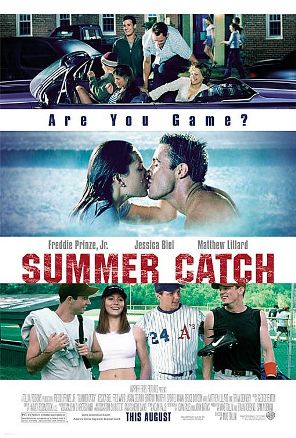
Anyway, last night, if you were having a hard time sleeping around midnight (though why anyone would ever try to go to sleep before midnight is beyond me), you could have turned on MorMax and watched the 2001 romantic comedy Summer Catch!
Though it may be hard to believe today, there was a time when Freddie Prinze, Jr. was a pretty big deal. From 1997 to 2001, Prinze appeared in 179 movies. Well, actually, he only appeared in 10 but since they were all aimed at teenage girls and played on cable constantly, it felt like 179. (Seriously, there was a time when I could not get through an entire day without seeing at least a few minutes of She’s All That.) For the most part, all of these films were pretty much the same. Freddie Prinze, Jr. plays a kind of dumb guy who falls in love with a girl. Prinze’s character was usually from a working class family and had at least one wacky friend. The girl was usually from a rich family and had one bitchy friend who would be an ex-friend by the end of the movie. There was usually at least one scene set on the beach or at a swimming pool, the better for Freddie to remove his shirt and his costar to chastely strip down to her underwear. There was usually a falling in love montage and at least one big misunderstanding. Freddie would always flash the same goofy smile whenever the misunderstanding was cleared up. Even at the time that the films were being released, nobody was ever under the impression that Freddie Prinze, Jr. was a particularly good actor. But he was likable, unthreatening, and hot in an oddly bland sort of way.
(Speaking of oddly bland, check out the titles of some of Prinze’s films: She’s All That, Down To You, Boys and Girls, Head over Heels, and, of course, Summer Catch.)
Summer Catch opens with Ryan Dunne (Freddie!) explaining that he’s just a working class kid from Massachusetts but this summer, he’s going to be playing amateur baseball in Cap Cod and hopefully, he’ll get signed to a professional contract as result. (Freddie adopts an inconsistent “pahk ya cah by the bah” accent and its kind of endearing to see him trying so hard.) Ryan, of course, is just a local guy who mows lawns for a living but he’s determined to succeed. He just has to stay focused.
However, that’s going to be difficult because he’s just met Tenley Parrish (Jessica Biel). The Parrishes own a vacation home on Cape Cod and they are so rich that they can afford to name their oldest daughter Tenley. Soon, Tenley and Ryan are a couple but Tenley’s father wants Tenley to marry a rich boy and Ryan’s father is too busy being all surly and working class to appreciate Ryan’s dreams.
(Tenley’s father, incidentally, is played by Bruce Davison because all snobbish WASPs of a certain age are played by Bruce Davison. Ryan’s father is played by Fred Ward because Summer Catch was made in 2001.)
Because every Freddie Prinze, Jr. movie needs a hyperactive and wacky sidekick, Ryan’s best friend on the team is a catcher named Billy Brubaker (Matthew Lillard.) Billy is known as “Bru.” There’s a lot of scenes of people saying stuff like “Yo, Bru,” and “Come on, Bru!” After a while, I found myself hoping for a scene where Bru went crazy and started shouting, “My name is Billy, dammit! BILLY! DAMN YOU ALL TO HELL!” Instead, however, we get a subplot about how Billy can’t get any hits until he has sex with and wears the thong underwear of a local baseball fan.
Anyway, Summer Catch is an extremely predictable film. It’s not surprising that this was one of Freddie’s final star vehicles because, other than his heroic effort to maintain a Massachusetts accent, even he seems to be bored with it all. Perhaps the most remarkable thing about Summer Catch is that there’s next to no actual conflict in the film. Oh sure, Ryan and Tenley have a few misunderstandings but it’s never anything serious.
If there’s an unheralded hero to Summer Catch, it’s the uncredited guy who we hear providing commentary during the games. Seriously, I would have been so lost if not for him constantly saying stuff like, “This is Ryan Dunne’s chance to show what he can do,” and “Billy Brubaker needs to get a hit here…” They should have made the entire movie about him and his efforts to remain up-to-date on all the players.
Because Summer Catch was a baseball film, I begged my sister Erin to watch it with me so that she could explain all the baseball stuff to me. For the record, Erin says that the game scenes were okay (and I personally liked all of the totally gratuitous slow motion) but that the film wasn’t really a deep examination of baseball. To be honest, I really wasn’t expecting that it would be. I just wanted to make my sister stay up late and watch a movie with me.
A frequently asked question: When is John Hawkes going to win an Oscar?
Ever since I first saw Winter’s Bone back in 2010, I’ve wondered just when exactly John Hawkes is going to finally win an Oscar. Unfortunately, he did not win for Winter’s Bone and his chilling work in Martha Marcy May Marlene was ignored. This year, however, he’s back with The Sessions. In this film, Hawkes plays a 38 year-old man who is confined to an iron lung and who is attempting to lose his virginity with the help of William H. Macy and Helen Hunt.
The Sessions has been getting a lot of buzz since it premiered on Sundance. That, quite frankly, makes me wary because I’ve come to learn that you have to take Sundance acclaim with a grain of salt. If Cannes is where people go to be insanely critical, Sundance has a deserved reputation for going overboard when it comes to praise. However, I will take a chance on anything featuring John Hawkes and, just judging from the trailer, it looks like both The Sessions and John Hawkes could be contenders when it comes time to hand out Oscar nominations.
A less frequently asked question: When is Tyler Perry going to win an Oscar?
Most people would probably answer that question by replying, “Never,” and they could very well be correct. I have to admit that I’ve never actually sat through any of Tyler’s Perry’s films and, to be honest, I’ve never really had any desire to. That said, I’ve always been fascinated by Perry’s success and I can’t help but admire the fact that he’s not shy when it comes to self-promotion.
In the upcoming Alex Cross, Tyler Perry will step into a role that was previously played by Morgan Freeman and, if nothing else, it’ll add fuel to the debate as to whether or not Perry is a legitimate acting talent or just a smart businessman. To be honest, the trailer for Alex Cross plays less like a movie trailer and more like a commercial for a movie on Chiller. I think that’s largely because of the presence of TV-movie mainstays like Matthew Fox and John C. McGinley. Still, chances are, Alex Cross will be the first exposure that I (and a lot of other people) get to Tyler Perry as an actor as opposed to just a personality.
My weekend was full of sleep, coughing and just vegetating in front of my bedroom tv as I tried to get better from my bout of the cold and flu. For some reason or another AMC channel decided to hold a mini-marathon of David Fincher’s classic neo-noir thriller, Seven, and I must say that I probably saw all three straight showings before sleep finally took over. It surely made for some very unusual, drug-induced dreams.
I’ve always seen Seven as Fincher at his most exploitative best. If there was ever a modern grindhouse exploitation film of the past twenty years I would have to consider Seven as one of them. From start to finish the film just felt grimy and made one feel dirty just for having seen it. Take away all the gloss and veneer afforded Fincher due to modern film technology and techniques this film was grindhouse to its core. No better scene exemplifies and solidifies Seven as a grindhouse exploitation film than it’s shocking, nihilistic ending which bucked traditional Hollywood happy ending (or at least and ambiguous one).
It’s been made famous due to the powerful performances from the three leads who dominate the scene. It is almost played off like a stage play with some gorgeous camera work from cinematographer Darius Khondji switching from Morgan Freeman to Kevin Spacey to Brad Pitt with mathematical precision as the scene unfolds through very strong dialogue by screenwriter Andrew Kevin Walker.
The performances shown by Spacey is both chilling and otherworldly as the sociopathic John Doe urging Pitt’s Det. Mills to become wrath and punish him for his sin of envy. Looking helpless and desperate is Freeman’s Det. Somerset trying to talk some sense and decency to the rapidly unraveling Mills who has just learned that what is inside the box he’s been screaming for is his wife’s head.
The fact that the unfolded and ended the way it did honors the grindhouse sensibilities of past exploitation films where the good guys never always win and even when they do it’s at a very heavy cost to the victor. This climactic ending to Seven is so nihilistic that when the film was first shown in 1995 many walked out grumbling at such a dark and heavy ending. Where was the Hollywood happy ending everyone was so used to. There was no cavalry charging last second to save the day. No deus ex machina intervening to show that Mill’s wife was still alive. No, Fincher and crew knew they had something special in their hands and went full tilt to see it through.
It’s no wonder I still consider Seven to be David Fincher’s best film to date.
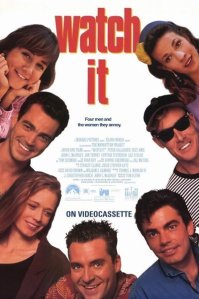 In Chicago, three men all live in the same house and try to avoid growing up. Rick (John C. McGinley) and Mike (Jon C. Tenney) are old friends while Danny (Tom Sizemore) works on stolen cars. When Mike’s estranged cousin, John (Peter Gallagher), moves in with them, John is drawn into a steadily escalating game of pranks. The game is called “Watch It” and the rules are simple. No one can take anything personally and each prank must be followed by another, bigger prank. While the four men takes turns trying to one up each other, they also deal with women who wish that they would all just grow up. When John starts to date Mike’s ex-girlfriend, Anne (Suzy Amis), the men are forced to come to terms with their extended adolescence.