No, not that time! That time ended two days ago. I’m talking about the fact that it’s time for me to once again share my monthly Oscar predictions. Thanks to the festival circuit, we’ve finally gotten some advance word on the big Oscar contenders that will be coming out over the next few months.
Belfast, as of right now, sounds like the prohibitive favorite to win it all. At first, it seemed like the reaction to The Power of the Dog was a bit mixed but later reactions were almost overwhelmingly positive. It sounds like the type of film that will be nominated even if it won’t necessarily win. Maggie Gyllenhaal’s The Lost Daughter is coming on strong, as is Spencer. For me, the biggest surprise has been the amount of acclaim that Dune has been getting. I was a bit dismissive of its Oscar chances earlier this year but now it definitely sounds like it will be in the hunt.
West Side Story has been seen by no one but I continue to list it because it’s a Spielberg film and, with all the musicals that are being released this year and which have subsequently struggled with either critics or audiences or both, it still seems the most likely to pick up a nomination. I’m a little bit skeptical on whether or not Nightmare Alley is going to be an “Oscar picture” but the trailer was nice to look at so I’m giving it the benefit of the doubt. House of Gucci is three hours long and full of stars so it’s either going to be an Oscar nominee or a complete bomb.
You may notice a lack of predicted nominations for Licorice Pizza. Licorice Pizza is a film that I fully expect to love but the trailer definitely feels a bit more like Inherent Vice than The Phantom Thread. I still think that the actors could get nominated but the rumor right now is that Bradley Cooper’s role is actually very small. That’s why I no longer have him listed as a supporting actor nominee.
Again, keep in mind that I’m not an expert. The picture is a bit clearer but I don’t claim to have any inside information or anything like that. These are just my guesses, for better or worse. To see how my thinking has evolved, check out my predictions for March and April and May and June and July and August!
It’s time for me to do my monthly Oscar predictions. Again, as I’ve said in the past, the majority of these predictions are based on a combination of instinct and wishful thinking. However, the picture may become a bit clearer as early as the end of this week. With the Venice and Telluride film festivals right around the corner and Toronto also swift approaching, critics are finally going to get a chance to see some of the contenders and, as the early reviews come in, it should be easier to pick the probable nominees from the also-rans.
Personally, I will curious to see how people react to Jane Campion’s The Power of the Dog. Among the other possibilities that we’ll be hearing about: Spencer, King Richard, Dune, The Lost Daughter, The Last Duel, and Belfast.
If you’re curious to see how my thinking has developed, check out my predictions for March and April and May and June and July!
Event Horizon, a sci-fi/horror hybrid from 1997, is one of those films that starts out with a series of title cards:
“2015 First permanent colony established on moon.”
Wait … 2015? How did I miss that?
” 2032 Commercial mining begins on Mars.”
Yay! Only 16 more years to wait until we’re finally on Mars!
“2040 Deep space research vessel ‘Event Horizon’ launched to explore boundaries of Solar System. She disappears without trace beyond the eighth planet, Neptune. It is the worst space disaster on record.”
Wow, that sucks. But things happen…
“2047 Now…”
Alright, let’s get this story going!
Seven years after it disappeared, the Event Horizon suddenly sends out a distress signal. It turns out that it didn’t blow up like everyone assumed. Instead, it’s still out in space. The surly crew of the Lewis & Clark is called off of leave and sent on a rescue mission. (And when I say surly, I do mean sur-ly! Seriously, nobody on the Lewis & Clark is in a good mood … ever!) Accompanying the crew is Dr. Weir (Sam Neill), the scientist who designed the Event Horizon. Captain Miller (Laurence Fishburne) may not be happy about having Dr. Weir on his ship but, then again, Captain Miller always seems to be annoyed about something.
The Event Horizon appears to be deserted. The walls are covered with blood. The captain — at least it appears to be the captain — has been crucified and left on display. Dr. Weir explains that the Event Horizon was designed to create an artificial black hole and it’s possible that the ship went into another dimension and that it may have brought something back with it. Other crew members speculate that the Event Horizon may have accidentally been transported to Hell. Either way, it’s not a good thing but, after the Lewis & Clark suffers some damage, the crew find themselves stranded on the Event Horizon.
Soon, the crew members are having hallucinations. The ship’s doctor (Kathleen Quinlan) sees her son running through the ship. Captain Miller sees the burning corpse of a friend that he had to abandon during a previous mission. Another crewman appears to be possessed and attempts to commit suicide by opening up the airlock. Dr. Weir has visions of his dead wife. Things get darker and darker. People die. Eyes are ripped out of sockets. A video of the original crew is found and it’s like something out of a painting by Hieronymus Bosch. Miller wants to blow up the Event Horizon. Dr. Weir replies, “We are home!”
Agck!
Seriously, Event Horizon is a curious film. I’ve seen it a few times and I have to admit that it’s never quite as good as I remembered. If you want to get really technical about it, Event Horizon is a poorly paced film that is overly derivative of the Alien franchise and it features perhaps the worst performance of Laurence Fishburne’s career.
(Yes, even worse than his performance in Contagion…)
But, at the same time, even if I’m always somewhat disappointed with the film, Event Horizon is also a movie that stays with you. Whatever flaws the film may have, it is genuinely scary and disturbing. Director Paul W.S. Anderson does a good job of turning that spaceship into the ultimate floating haunted house and, even more importantly, he keeps you off-balance. This is one of the few horror films where literally anyone can die, regardless of whether they’re top-billed or have an Oscar nomination to their name. Whatever the evil is that has possessed the Event Horizon, it is ruthlessly and sadistically efficient.
Plus, there’s that video. If you’ve seen the movie, you know what I’m talking about. Anderson has complained that the studio made him cut a lot of footage out of the video but what remains is disturbing enough. Seriously, you’ll never want to hear another Latin phrase after watching Event Horizon.
I think I’m going to start writing Stockholm, Pennsylvania fanfic. It’s not that I’m a fan of this particular movie. It’s just that, after watching it last night, I’m convinced that I could probably write a better version of the same story. At the very least, I could come up with a better ending.
(And who knows? Pennsylvania is technically close enough to Canada that I could do a Degrassi/Stockholm crossover.)
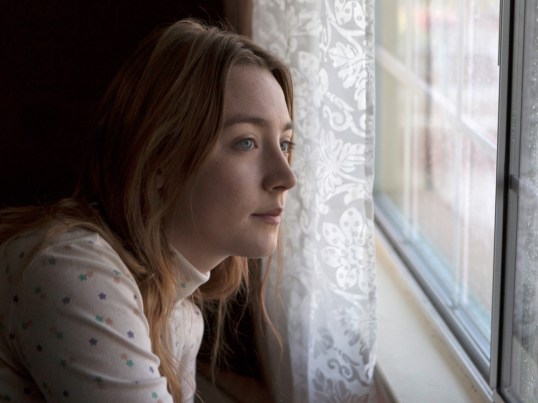
Stockholm, Pennsylvania premiered on Lifetime last night and, as a result, it will always be known as being a Lifetime movie. However, unlike such excellent films as Babysitter’s Black Bookand Fab Five: The Texas Cheerleader Scandal, Stockholm was not originally made for television. Instead, it was meant to be the feature film directorial debut of playwright Nikole Beckwith. Earlier this year, it played at the Sundance Film Festival, where it received some memorably mixed reviews and the film’s star, Saoirse Ronan, received more attention for her work in Brooklyn. And while Brooklyn was picked up by Fox Searchlight and declared an early Oscar contender, Stockholm, Pennsylvania was ultimately purchased by the Lifetime network.
Unfortunately, Stockholm, Pennsylvania is not the type of film that is served well by premiering on television. For the first 45 minutes or so, it’s a low-key film that moves at its own deliberate and moody pace. The film doesn’t have the right rhythm to remain compelling when combined with frequent commercial interruptions. And make no mistake about it — the interruptions were frequent! The 99 minute film was padded out with enough commercials so that, on television, it ran for 2 hours and 30 minutes.
Or, as I put it on twitter when I discovered that the movie wasn’t as close to being finished as I had originally assumed:
OMG, there's 35 minutes of this crap left!? I mean, no offense to anyone enjoying #StockholmPennsylvania but… Lol.
— Lisa Marie Bowman (@LisaMarieBowman) May 10, 2015
The film opens with kidnapping victim Leanne (Saoirse Ronan) being returned to her parents after spending 17 years living in the basement of Ben McKay (Jason Isaac). As we see in flashbacks, Ben kept Leanne isolated from the rest of the world and raised her as his own daughter. Ben also renamed her Leia but, at the same time, he apparently never let her watch any movies. (“He said I was named after a princess,” Leia cluelessly says at one point.) Ben also taught Leia to regularly pray to the Universe (“Dear Universe…”) and … well, that’s all we really learn about Leia’s relationship with Ben. And while I love cinematic ambiguity, the ambiguity of Stockholm, Pennsylvania just feels lazy.
Having been rescued (under circumstances that are left ambiguous because this is a lazy fucking movie), Leia is reunited with her parents, Marcy (Cynthia Nixon) and Glen (David Warshofsky). Leia doesn’t remember either of them and resists all of Marcy’s awkward attempts to force any sort of emotional relationship.
And, for the first half of the film, it’s actually fairly interesting. Nixon gives a good performance and Ronan proves again that she’s one of the best actresses working today. The film is moody and properly creepy and I was really interested in seeing what would happen…
And then, out of nowhere, an entirely different movie started. Suddenly, Marcy’s character completely and totally changed. Nixon stopped giving a good performance and instead became shrill and one-note. Ronan continued to give a good performance but the entire film crashed and burned around her. It all led up to quite possibly one of the worst endings that I have ever seen. It was seriously one of those endings that made me want to throw my high heels at the TV.
Seriously, it was terrible. In fact, it was so terrible that it didn’t matter that the first 45 minutes of the movie were not neccesarily bad. It did not matter that Saoirse Ronan was giving a great performance. It did not matter … well, nothing mattered.
Once I saw that ending, all I could think of was that I had just wasted two hours and 30 minutes on a film that was apparently made by someone who studied both Martha Marcy May Marlene and We Need To Talk About Kevin without ever understanding what made those two films worth studying in the first place.
Saoirse Ronan saved the film from being a complete disaster. It truly says something about her talent that she can give a good performance even when appearing in something like Stockholm, Pennsylvania (or Lost River for that matter). She’s like Meryl Streep without the condescending attitude.
I’m looking forward to seeing Saoirse Ronan’s work in Brooklyn. But Stockholm, Pennsylvania is best forgotten.
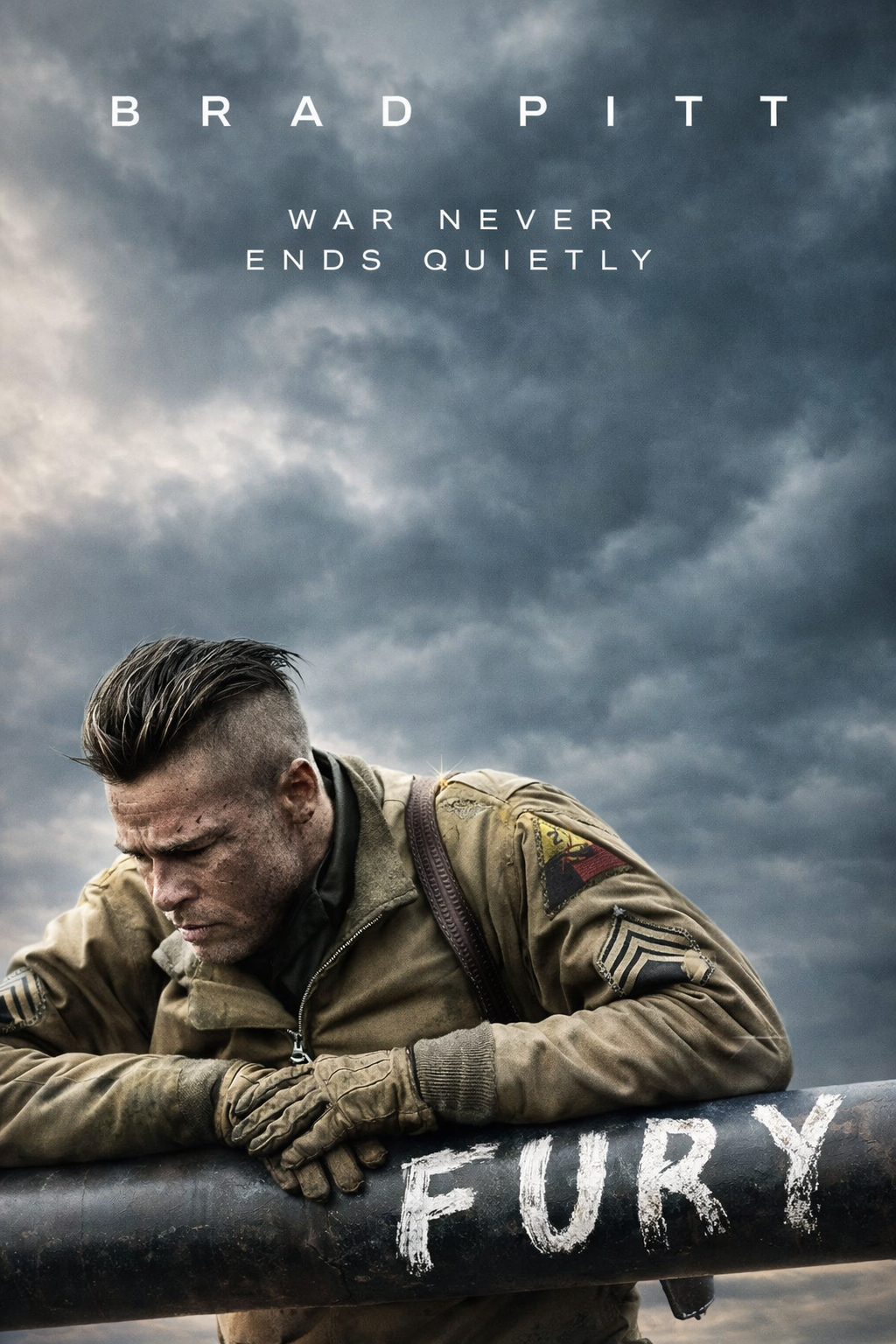
You know that feeling when a war movie tries so hard to be gritty that it forgets to be anything else? Fury, directed by David Ayer, flirts with that problem but mostly stays on the right side of the line. Released in 2014, this WWII drama follows a five-man American tank crew as they push deeper into Nazi Germany in April 1945. The war is almost over, but as the film constantly reminds us, that only makes the fighting more desperate and meaningless. Ayer, who wrote Training Day and directed End of Watch, clearly wanted to make a grimy, claustrophobic, and visceral experience—not a clean, heroic adventure. And for the most part, he succeeds. But the movie is also uneven, sometimes brilliant, and occasionally frustrating. One thing becomes clear early on: Ayer is not just making a war movie. He is trying to out-war the war movie that changed everything. Saving Private Ryan raised the bar for realistic combat violence in 1998, and ever since, directors have been chasing that opening Omaha Beach sequence. Fury spends its entire runtime trying to shove that bar even higher, especially in its final act, where the violence tips over from realistic into something almost performative—as if Ayer is daring you to look away.
The plot is simple. We meet Don “Wardaddy” Collier, played by Brad Pitt, as the seasoned commander of a Sherman tank nicknamed “Fury.” His crew includes Boyd “Bible” Swan (Shia LaBeouf), the religious gunner; Coon-Ass (Jon Bernthal), the volatile loader; and Grady (also Bernthal, though the character is actually Grady “Coon-Ass” Travis; the movie gives everyone a nickname). The crew loses their assistant driver in the opening scene, and they get a replacement: Norman Ellison (Logan Lerman), a young typist who has never fired a gun and has no intention of killing anyone. The rest of the film is basically a crash course in how war turns gentle men into monsters—or at least into effective killers.
What works best in Fury is the sense of being trapped inside a steel coffin. Ayer films almost everything from inside the tank or right next to it. You hear every shell clank, every engine strain, every bullet ping off the hull. The sound design is incredible—it’s the kind of movie where you feel the bass in your chest during combat scenes. And the tank battles are brutally realistic. There’s no slick choreography here. When a German Tiger tank shows up, the fight becomes static, clumsy, and terrifying. The Sherman isn’t some superhero; it’s outgunned and out-armored, and the crew wins only because they’re desperate and lucky. That sequence alone is worth the price of admission. You can feel Ayer’s respect for Saving Private Ryan in those moments—the same handheld cameras, the same sudden death, the same sense that no one is safe. But then the film goes further.
Brad Pitt gives one of his tougher, quieter performances. Wardaddy isn’t a philosopher or a hero. He’s a tired man who has seen too much and made too many compromises. He forces Norman to execute a German prisoner, not out of cruelty but out of a cold, broken logic: if Norman can’t kill, he’ll get the whole crew killed. Pitt sells the weight of that decision without grand speeches. Shia LaBeouf is surprisingly restrained as Bible, a character who prays before each battle but never preaches. The real surprise is Logan Lerman. He starts as a scared kid who vomits at the sight of corpses and ends the film doing things that would ruin anyone’s soul. His transformation is uncomfortable to watch, but that’s the point.
However, the movie has some clunky moments. One extended scene has Wardaddy and Norman sharing a meal with two German women in an abandoned apartment. It’s supposed to show a brief flash of normal life—eggs, music, a soft bed—but it feels oddly staged. The women are just props. They have no real personality except to be gentle and then get killed offscreen. It’s a rare moment where Ayer’s macho instincts flatten the story instead of deepening it. But the real problem is the final act. The crew holds a crossroads against an entire SS battalion of about 200 men, doing it with a broken-down tank that cannot move. Realistically, they’d be dead in minutes. But Ayer turns it into a grim last stand that feels more like a Western than a WWII movie. The Germans attack in waves like idiots, running straight into machine-gun fire. And here is where you sense Ayer’s real intention: he is not trying to be realistic anymore. He is trying to one-up Saving Private Ryan by making the violence not just brutal but excessive, almost numbing. Limbs fly. Faces get torn open. The camera lingers on wounds long past the point of necessary storytelling. It feels like Ayer is saying, “You thought Spielberg was intense? Watch this.” But instead of adding emotional weight, the violence starts to feel like a dare. The movie becomes less about these five men and more about proving it can stomach more than any other war film.
Thematically, Fury is about how institutions crush individuality. Norman was a decent person who typed letters and likely never hurt anyone. By the end, he is sitting in the commander’s seat, pulling triggers without hesitation. The movie doesn’t celebrate this—it presents it as a tragedy. But the final act undercuts that tragedy because it becomes so cartoonishly violent that you stop feeling for the characters and just wait for the bloodshed to end. Unlike Saving Private Ryan, which uses its famous opening sequence to establish horror and then pulls back for character moments, Fury seems to think that more gore equals more truth. It doesn’t. It just equals more gore.
If you’re looking for a clean story with clear good guys and bad guys, this isn’t it. The Germans are offscreen most of the time, and the real enemy is the war itself. Wardaddy even says, “The only thing that separates us from them is this uniform.” That’s a heavy line, and the film never really resolves it. It just lets it hang there. Some critics called Fury shallow because it raises moral questions without answering them. I’d argue that’s the point. War doesn’t come with footnotes. You just survive or you don’t. But the film’s desperate need to prove it is tougher than its predecessors does make it feel, at times, like a younger brother showing off.
On a technical level, the cinematography by Roman Vasyanov is beautiful in a grim way. Colors are desaturated—browns, grays, washed-out greens. Mud and blood look the same. The camera shakes when it needs to, but it’s not the hyperactive Bourne style. It’s controlled chaos. And the final shot, where the camera slowly pulls back from the dead tank, is haunting. It stays with you.
So, final verdict? Fury is a solid, often great war film that trips over its own ambitions in the last thirty minutes. It wants to be a small, character-driven horror show, then pivots to a heroic last stand that feels like it belongs in a different movie—one that cares more about shocking you than moving you. The comparison to Saving Private Ryan is unavoidable, and Fury clearly wants to be mentioned in the same breath. But where Spielberg used violence as a doorway into human cost, Ayer sometimes uses it as a blunt instrument. The performances are strong, the tank combat is second to none, and the atmosphere is suffocating in the best way. It’s not Come and See, but it’s also not Pearl Harbor. If you can handle the tonal whiplash and the occasional macho posturing, you’ll find a movie that respects its audience enough to leave them feeling dirty. Just don’t expect a clean exit—and don’t expect it to earn every drop of blood it spills.
I usually have a good idea of upcoming action films once they’ve been announced into production, but I have to admit that Keanu Reeve’s upcoming action film, John Wick, has been quite the ninja. I’ve not heard one thing about this project until I came across the just released trailer earlier today.
The trailer itself pretty much lays out what looks like a basic premise for the film. The title character seems to be some sort of retired badass who is brought out of it to get his revenge on the idiots who killed his cute little dog (given to him by his dying wife) during a home invasion robbery.
I know there are many whose brain starts to wander and/or seize up whenever they hear the name Keanu Reeves. I, fortunately, am not one of those people and I actually think that Reeves has been much-maligned throughout his career. For one thing he does seem to handle action scenes pretty well and this trailer for John Wick just continues to reinforce that thought.
John Wick will be setting wrongs right and bringing killer of dogs their just due this October 24, 2014.
I must admit that World War II films are a favorite of mine. Even bad ones I tend to enjoy. Whether it’s alternate fantasy fares like Tarantino’s Inglourious Basterds or something that combines historical accuracy with dramatic license like Spielberg’s Saving Private Ryan, the World War II genre always manage to hit straight and true to my film wheelhouse.
This October there looks to be another World War II film that seems almost tailor-fit for me. I’m talking about David Ayer’s follow-up to his underappreciated film End of Watch. This follow-up is Fury and tells the story of an American tank crew in the waning days of World War II in Europe. Just from the two trailer released I already know that I’m seeing this. Ayer looks to be exploring the bond of a tank crew that has seen war from the deserts of Africa and now to the urban and forested landscapes of Germany.
The film is already getting major buzz as a major contender for the upcoming awards season and I, for one, hope that it’s a well-deserved buzz. Even with Shia LaBeouf being part of the cast is not dampening my excitement for this film. Even if it doesn’t live up to the hype I know that I’ll probably still end up enjoying it.
This trailer looks to be selling the utter brutality and carnage of World War II’s final days in Europe when German forces were literally fighting for their homeland and that makes for a desperate enemy (who still had weapons and soldiers that were still hands down better than what the Allies had one-on-one).
On a side note, I like the fact that the tracers in the film actually look like tracers which means they look like freakin’ laser blasts. That’s how tracers behave.
Fury is set to hit theaters on October 17, 2014 in the United States and October 22, 2014 internationally.
Well, we all knew it would have to end someday and now, it’s over. The Harry Potter film series, which began way back in 2001, is concluding right now in a theater near you. On Friday night, me, Jeff, my sister Erin, and our friend Evelyn went down to the AMC Valley View and we saw Harry Potter and the Deathly Hallows, Part 2.
The cinematic story of Harry Potter is over and yes, I did cry as I watched it end. I didn’t just cry because of the movie, though the movie itself is one of the best of the year and it has one of those wonderful endings that just makes it impossible to remain dry-eyed. No, I cried because — with this film — an era of my life is truly over.
When the first Harry Potter film came out, I was only 16 and still trying to deal with the fact that I had been diagnosed as being bipolar just a few weeks earlier. I felt alone and broken and destined to spend the rest of my life on the outside looking in. The three hours that I spent watching Harry Potter and the Sorcerer’s Stone were three hours when I didn’t have to worry about suddenly bursting into tears and having everyone around me worrying about whether or not I was actually taking my hated medication. For three hours, I could escape to another world where those who were different were celebrated precisely because they were different. For three hours, I could imagine that just maybe I had a special purpose for existing too and maybe I had benevolent wizards and witches looking out for me too. And I’m sorry if all that sounds trite in retrospect but, when you’re 16 and you think you’re too damaged to love, anything that gives you hope and pleasure in the present is a precious treasure.
Over the years, I eventually came to realize that being bipolar was hardly a curse and, as I matured and grew up and discovered new things, there was always a Harry Potter film either playing or about to come out. Whether I was escaping high school, graduating college, or dealing with just every good or bad thing that makes up life, Harry Potter — this character who I first met (in book form) when I was 13 — was always there. So, at the risk of sounding overdramatic, the end of Harry Potter is the end of a chapter of my life.
One final personal note: As I watched Harry Potter and the Deathly Hallows, Part Two, I had three dolls (or action figures, as boys insist on calling them) in my purse. These dolls — Harry, Hermione, and Ron — came out around the same time as the second Harry Potter film and my mom (who collected dolls) ordered them off of Ebay three years ago, shortly before she entered the hospital for the final time. Now, my mom was not a huge fan of the Harry Potter series but she knew that I loved it and that’s why she made those dolls her final gift to me.
And those are some of the reasons why I found myself crying as I watched the finale of Harry Potter. However, there’s another reason why I cried and that’s that this is just a great film and the perfect conclusion to the series.
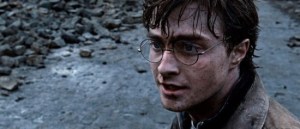
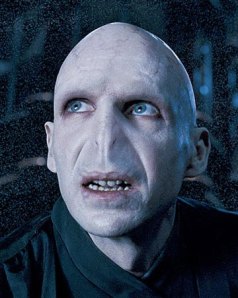
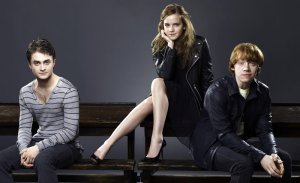
Essentially, Harry Potter and the Deathly Hallows, Part Two starts up immediately after the conclusion of Part One. Dobby is dead, Lord Voldemort (a wonderfully neurotic Ralph Fiennes) and the Death Eaters are intent on destroying everything, and Severus Snape (Alan Rickman, wonderful as always) is in charge of Hogwarts. After spending the first part of Deathly Hallows as fugitives, Harry Potter, Ron Weasley, and Hermione Granger (Daniel Radcliffe, Rupert Grint, and Emma Watson) return to Hogwarts to take a final stand against Voldemort. Things end in a surprisingly bloody battle (this film is not for children) that leaves several characters dead and ultimately reveals that one wizard wasn’t the saint we always assumed he was while another is revealed to be the secret hero of the entire series.
Let’s get one question out of the way right now: will non-Harry Potter fans be able to follow this film? Uhmmm…no. Sorry. Then again, why would a non-Harry Potter fan be at a film called Harry Potter and The Deathly Hallows Part Two anyway? I mean, seriously, if you’re just going to film because everyone else is doing it than who are you to bitch anyway? This is what you non-Harry Potter fans need to do. Stop reading this review. Go watch the previous Harry Potter films. Watch them in order. Take your time because Deathly Hallows is going to be in theaters for a while. And then, once you’ve become immersed in the story, go see how it all concludes. And then come back here and read rest of this review.
Okay, so is everybody up to date?
Cool.
One of the more interesting features of the Harry Potter series is that so many different directors (each with his own definite, individual style) have been involved in bringing these films to the screen. Among Harry Potter fans, hours can literally be spent debating the merits (and weaknesses) of Chris Columbus, Alfonso Cuaron, Mike Newell, and David Yates. My own theory is that each director was perfectly suited for each film he directed. The audience-friendly vision of Chris Columbus was what the first two films needed, just as Prisoner of Azkaban needed Cuaron’s far darker vision and Mike Newell’s attention to character made Goblet of Fire one of the best of the Harry Potter films. And while David Yates may not be as well-known (or critically acclaimed) as Newell or Cuaron, he brings exactly the right tone to Harry Potter and the Deathly Hallows, a perfect combination of spectacle and humanity. It is to Yates’ credit that the scenes in which the characters simply talk to each other are just as compelling as the dramatic sequences where Voldemort and the Death Eaters attack Hogwarts. Yates understands that this material could easily come across as silly or childish and to his credit, he never allows the audience to simply dismiss this film as a lot of blathering about wands and CGI magic. As opposed to other directors who have given us summer blockbusters, Yates takes his film seriously.
And, fortunately, so does his cast.
One of the great pleasures of the Harry Potter series is that it’s given American audiences the chance to discover (and rediscover) some of the great British character actors and a lot of them show up (some for only a matter of minutes) here in the finale. Maggie Smith, Jim Broadbent, Julie Walters, Robbie Coltrane, Gary Oldman, John Hurt, David Thewlis, Emma Thompson, and Jason Isaacs all put in appearances. Kelly MacDonald has a great scene playing a ghost, Helena Bonham Carter is perfect as the evil Bellatrix Lestrange, and Alan Rickman is brilliantly ambiguous as Severus Snape. (And yes, Snape’s actions are explained in this film and yes, I did cry.)
Ralph Fiennes plays so many villains that I now find myself expecting him to show up killing people in every movie I see. He’s like a British Christopher Walken. Still, it’s easy to take an actor like Fiennes for granted. For the entire Harry Potter series to work, Lord Voldemort can’t just be an ordinary villain. He’s got to be the sum total of all things evil and deadly. You’ve got to believe that people would be scared to speak his name. Great heroes need a great villain and Fiennes’ Voldermort is a great villain.
Ultimately, however, the true credit for the success of the Harry Potter series belongs to three actors who have literally grown up on the movie screen — Daniel Radcliffe, Rupert Grint, and Emma Watson. The producers are fortunate indeed that the cute kids that they cast over a decade ago have all grown up to be talented, attractive, and likable actors. If the first part of Harry Potter and the Deathly Hallows seemed to showcase both Grint and Watson (almost to Radcliffe’s expense), part 2 is most definitely centered on Harry Potter. That doesn’t mean that Watson and Grint aren’t good in this film. They are and they get to share one of the best movie kisses of 2011. (As well, for those who keep count, Grint says “Bloody Hell,” three times in the film.) But, for obvious reasons, this film is all about Harry and Radcliffe’s performance as Harry. It’s a challenge for Radcliffe and it’s a challenge that he more than succeeds at conquering. As the film ended, I realized that I was sad to know that the adventures of Harry Potter were done but I was excited to see what the future will hold for Radcliffe, Grint, and Watson.
Incidentally, Harry Potter and the Deathly Hallows Part 2 has been released in both 3-D and 2-D. We saw the 3-D version and if you have any knowledge of how I feel about 3-D (and how motion sick I tend to get while watching 3-D films) then that should show you just much I love the Harry Potter series. I loved it so much that I was even willing to overlook my hatred of 3-D. The 3-D here (which was added after the film has already been filmed) doesn’t really add much to the movie. There were a few cool moments where I was all like, “Look, I can reach out and grab a piece of Voldemort,” but otherwise, the 3-D was a negligible factor as far as the overall film was concerned.
Still, there was one interesting thing about the 3-D. The theater we saw the movie in was half-way empty. At the same time, the neighboring theater — in which the 2-D version was playing — had a line of people waiting to get in. They were not only waiting to see the 2-D version, they were waiting to see a showing that wouldn’t even begin until a full 90 minutes after the 3-D version started. I mention this because, in the wake of Avatar, so many people have taken it for granted that 3-D is the future of movies and soon, as long as a film is in 3-D, we won’t have to worry about the difficult stuff like an interesting plot or compelling characters. However, 3-D has become an overexposed gimmick. For every film like Cave of Dreams that uses 3-D to craft an actual artistic statement, there’s a 1,000 films like Priest which use 3-D just because it’s an easy way to trick sucks into spending an extra dollars to see a crappy film.
What so many filmmakers seem to forget is that the majority of film goers are not looking for 3-D. We’re just looking for a good film. And sometimes — like with Harry Potter and the Deathly Hallows — we get lucky and we find a great film.
(Oh, and one last thing: I know everyone always expects me to claim to be just like Hermione but actually, I’ve always related more to Ginny Weasley. Like her, I’m the youngest of four siblings, I’ve got red hair, and I always get my man, in the end.)
Since this weekend has turned into Green Lantern weekend due to the promotional blitz by Warner Brothers to hype up it’s upcoming live-action film of the same title I would be remiss not to include as part of his hype the upcoming animated film from Warner Premiere and DC Animation: Green Lantern: Emerald Knights.
This latest in DC animated films (all of which have been good to great. Not a stinker in them) is an anthology film which takes six stories of the greatest Green Lanterns and links them to the current danger threatening the Guardians (creator of the Green Lantern Corps), the GL Corps and the universe itself.
Before this weekend’s WonderCon footage for the live-action was shown I was more excited for Green Lantern: Emerald Knights than I was for the Ryan Reynolds live-action. It had a great voice cast with Nathan Fillion (fans’ first choice for live-action Hal Jordan) as Hal Jordan with Elisabeth Moss, Jason Isaacs, Kelly Hu, Henry Rollins and Steve Blum rounding out the ensemble cast.
I think with the batting average of the DC Animation being quite high I have high hopes that Green Lantern: Emerald Knights will follow in the footsteps of it’s predecessor and have critical and general success.