Horror Film Review: Split (dir by M. Night Shyamalan)


There are a lot of negative things that you can say about 2017.  In the future, when historians look back of the second decade of the 21st century, I imagine that they will point to 2017 as being one of the worst years in American history.  The country is divided.  The world seems like a scary and dangerous place.  The outlook for the future feels bleak.  It’s not so much that people are angry.  Instead, it’s that there doesn’t seem to be any end in sight for all the anger.  It’s difficult to imagine that the differences that currently divide the world are ever going to be resolved.

However, there is one thing that can be said about 2017.  It’s been a very good year for horror cinema.

Sure, there have been a few less-than-perfect films.  Rings left most people disappointed.  Does anyone remember The Bye Bye Man or have we said farewell to the memories of that unfortunate film?  While The Dark Tower was never specifically a horror movie, it’s still not easy to think of any other Stephen King adaptation that has been greeted with such indifference.  The less said about Tom Cruise’s The Mummy, the better.

But even with all that in mind, there have been some truly outstanding horror movies released this year.  Movies like Get Out, It, and The Belko Experiment will be well-remembered long after the more “traditional” films of 2017 have faded from the collective memory.  I would go as far as to argue that David Lynch’s revival of Twin Peaks should itself be considered an 18-hour horror movie.  Maybe it is because the world seems like such a dark place right now.  Maybe, at this point, horror movies are the only movies that accurately reflect the way many people are feeling about the present and the future.  For whatever reason, 2017 has been a great year for horror.

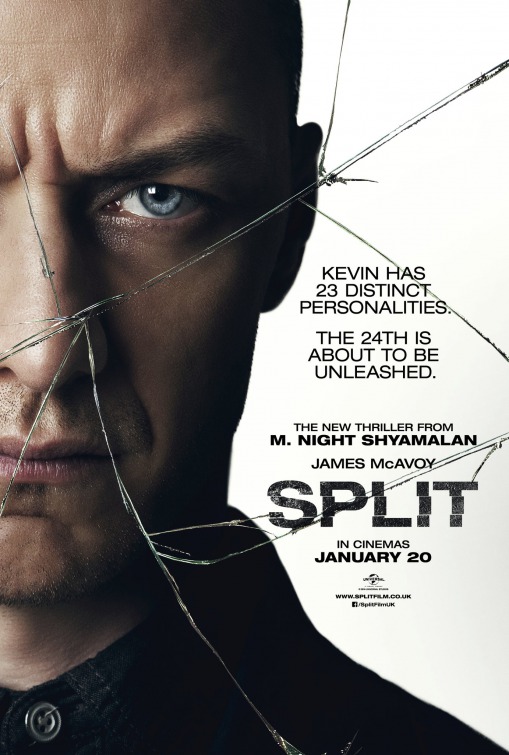
Really, we wouldn’t be surprised.  Way back in January, things got off to a good start with the release of Split.  Split was a film that not many people were expecting to be impressive.  Just consider: the film was coming out in January, which is when the worst films are usually released.  (The theory is that everyone’s too busy with the Oscars to notice that studios are desperately trying to write off all of the losers that they misguidedly greenlit for production the previous year.)  Split was directed by M. Night Shyamalan, a formerly respected director whose last few films had been disappointing.  Finally, the film’s plot just didn’t sound that good: James McAvoy plays a man with multiple personalities who kidnaps three teenage girls (Anya Taylor-Joy, Haley Lu Richardson, and Jessica Sula) and holds them captive.  Throughout the film, McAvoy cycles through his different personalities and the girls try to find a way to escape before McAvoy turns into the Beast.

And yet somehow, Split works.  It’s a genuinely scary and unsettling film, one that left me feeling paranoid for days after I watched it.  From the minute that the film started, it grabbed hold of me and it did not let go for two hours.  I watched the movie and I wondered what would happen if I ever found myself in the same situation as the kidnapped girls.  Would I be able to survive?  Would I be able to escape?  Or would I just be another victim of the Beast?  It’s a deeply frightening film, one that feels like a waking nightmare at its most intense.

Obviously, a lot of credit has to go to James McAvoy, who is brilliant in a role that would have brought out the worst instincts in a lesser actor.  It’s a showy role and there had to be considerable temptation to go overboard.  And there are a few times when McAvoy embraces the more theatrical possibilities of the role.  However, in his best scenes, McAvoy is surprisingly subtle.  Yes, he does a lot of different voices.  Yes, his body language alters from personality to personality.  But McAvoy is at his best when he just allows his facial expression to subtly suggest that he has turned into someone else.  McAvoy is frightening but, at times, he’s also rather pathetic.  Whenever McAvoy shows up, you never know what he’s going to do.  He keeps you off-balance.

As good as McAvoy is, M. Night Shyamalan also deserves a lot of credit for Split.  For a film about a man with 23 warring personalities, Split is refreshingly direct and straight forward.  There’s none of the cloying cleverness that cheapened some of Shyamalan’s other films.  Instead, Split is simply a good, scary film for a really scary world.
Review: Fury (dir. by David Ayer)


“Ideals are peaceful. History is violent.”

You know that feeling when a war movie tries so hard to be gritty that it forgets to be anything else? Fury, directed by David Ayer, flirts with that problem but mostly stays on the right side of the line. Released in 2014, this WWII drama follows a five-man American tank crew as they push deeper into Nazi Germany in April 1945. The war is almost over, but as the film constantly reminds us, that only makes the fighting more desperate and meaningless. Ayer, who wrote Training Day and directed End of Watch, clearly wanted to make a grimy, claustrophobic, and visceral experience—not a clean, heroic adventure. And for the most part, he succeeds. But the movie is also uneven, sometimes brilliant, and occasionally frustrating. One thing becomes clear early on: Ayer is not just making a war movie. He is trying to out-war the war movie that changed everything. Saving Private Ryan raised the bar for realistic combat violence in 1998, and ever since, directors have been chasing that opening Omaha Beach sequence. Fury spends its entire runtime trying to shove that bar even higher, especially in its final act, where the violence tips over from realistic into something almost performative—as if Ayer is daring you to look away.

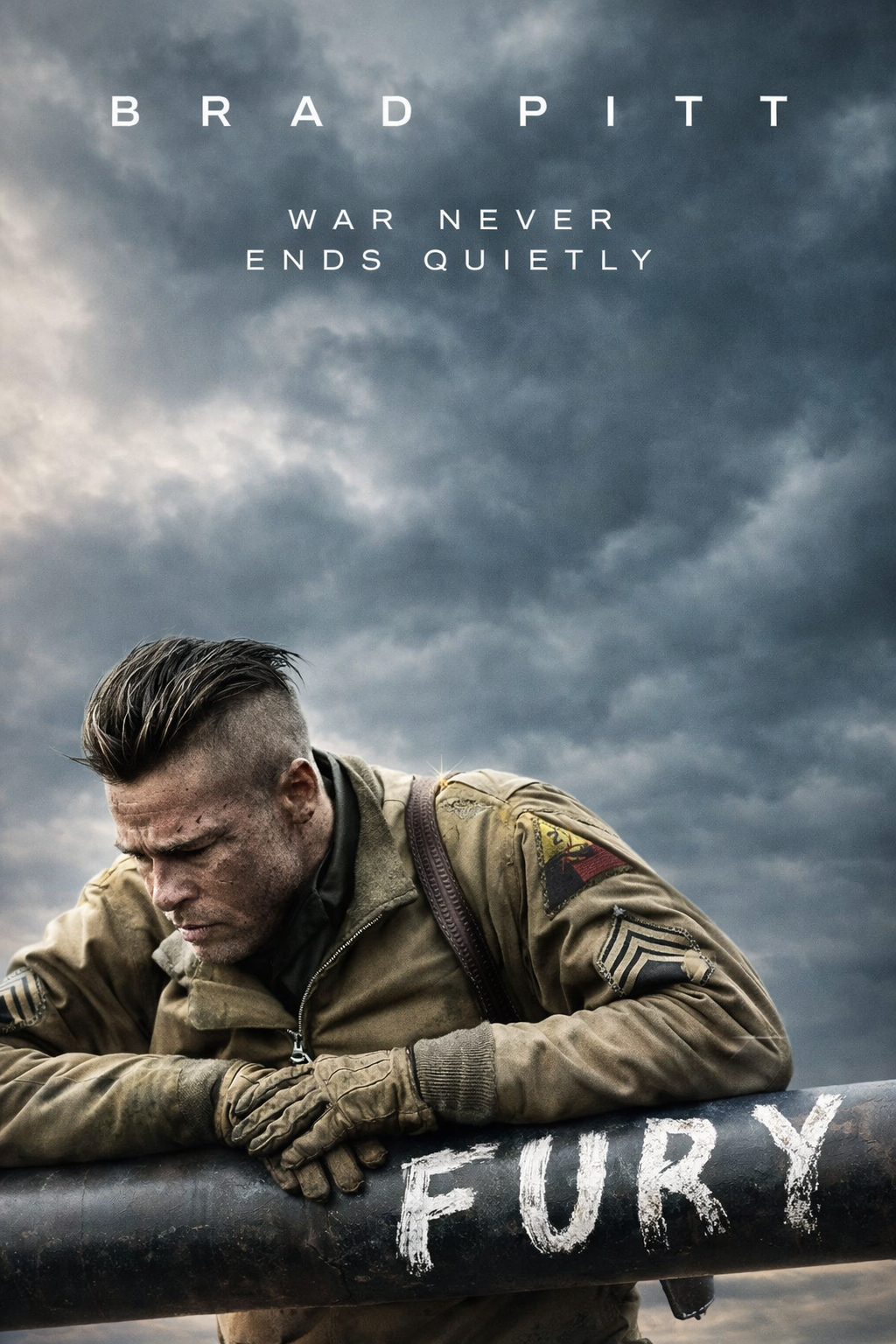
The plot is simple. We meet Don “Wardaddy” Collier, played by Brad Pitt, as the seasoned commander of a Sherman tank nicknamed “Fury.” His crew includes Boyd “Bible” Swan (Shia LaBeouf), the religious gunner; Coon-Ass (Jon Bernthal), the volatile loader; and Grady (also Bernthal, though the character is actually Grady “Coon-Ass” Travis; the movie gives everyone a nickname). The crew loses their assistant driver in the opening scene, and they get a replacement: Norman Ellison (Logan Lerman), a young typist who has never fired a gun and has no intention of killing anyone. The rest of the film is basically a crash course in how war turns gentle men into monsters—or at least into effective killers.

What works best in Fury is the sense of being trapped inside a steel coffin. Ayer films almost everything from inside the tank or right next to it. You hear every shell clank, every engine strain, every bullet ping off the hull. The sound design is incredible—it’s the kind of movie where you feel the bass in your chest during combat scenes. And the tank battles are brutally realistic. There’s no slick choreography here. When a German Tiger tank shows up, the fight becomes static, clumsy, and terrifying. The Sherman isn’t some superhero; it’s outgunned and out-armored, and the crew wins only because they’re desperate and lucky. That sequence alone is worth the price of admission. You can feel Ayer’s respect for Saving Private Ryan in those moments—the same handheld cameras, the same sudden death, the same sense that no one is safe. But then the film goes further.

Brad Pitt gives one of his tougher, quieter performances. Wardaddy isn’t a philosopher or a hero. He’s a tired man who has seen too much and made too many compromises. He forces Norman to execute a German prisoner, not out of cruelty but out of a cold, broken logic: if Norman can’t kill, he’ll get the whole crew killed. Pitt sells the weight of that decision without grand speeches. Shia LaBeouf is surprisingly restrained as Bible, a character who prays before each battle but never preaches. The real surprise is Logan Lerman. He starts as a scared kid who vomits at the sight of corpses and ends the film doing things that would ruin anyone’s soul. His transformation is uncomfortable to watch, but that’s the point.

However, the movie has some clunky moments. One extended scene has Wardaddy and Norman sharing a meal with two German women in an abandoned apartment. It’s supposed to show a brief flash of normal life—eggs, music, a soft bed—but it feels oddly staged. The women are just props. They have no real personality except to be gentle and then get killed offscreen. It’s a rare moment where Ayer’s macho instincts flatten the story instead of deepening it. But the real problem is the final act. The crew holds a crossroads against an entire SS battalion of about 200 men, doing it with a broken-down tank that cannot move. Realistically, they’d be dead in minutes. But Ayer turns it into a grim last stand that feels more like a Western than a WWII movie. The Germans attack in waves like idiots, running straight into machine-gun fire. And here is where you sense Ayer’s real intention: he is not trying to be realistic anymore. He is trying to one-up Saving Private Ryan by making the violence not just brutal but excessive, almost numbing. Limbs fly. Faces get torn open. The camera lingers on wounds long past the point of necessary storytelling. It feels like Ayer is saying, “You thought Spielberg was intense? Watch this.” But instead of adding emotional weight, the violence starts to feel like a dare. The movie becomes less about these five men and more about proving it can stomach more than any other war film.

Thematically, Fury is about how institutions crush individuality. Norman was a decent person who typed letters and likely never hurt anyone. By the end, he is sitting in the commander’s seat, pulling triggers without hesitation. The movie doesn’t celebrate this—it presents it as a tragedy. But the final act undercuts that tragedy because it becomes so cartoonishly violent that you stop feeling for the characters and just wait for the bloodshed to end. Unlike Saving Private Ryan, which uses its famous opening sequence to establish horror and then pulls back for character moments, Fury seems to think that more gore equals more truth. It doesn’t. It just equals more gore.

If you’re looking for a clean story with clear good guys and bad guys, this isn’t it. The Germans are offscreen most of the time, and the real enemy is the war itself. Wardaddy even says, “The only thing that separates us from them is this uniform.” That’s a heavy line, and the film never really resolves it. It just lets it hang there. Some critics called Fury shallow because it raises moral questions without answering them. I’d argue that’s the point. War doesn’t come with footnotes. You just survive or you don’t. But the film’s desperate need to prove it is tougher than its predecessors does make it feel, at times, like a younger brother showing off.

On a technical level, the cinematography by Roman Vasyanov is beautiful in a grim way. Colors are desaturated—browns, grays, washed-out greens. Mud and blood look the same. The camera shakes when it needs to, but it’s not the hyperactive Bourne style. It’s controlled chaos. And the final shot, where the camera slowly pulls back from the dead tank, is haunting. It stays with you.

So, final verdict? Fury is a solid, often great war film that trips over its own ambitions in the last thirty minutes. It wants to be a small, character-driven horror show, then pivots to a heroic last stand that feels like it belongs in a different movie—one that cares more about shocking you than moving you. The comparison to Saving Private Ryan is unavoidable, and Fury clearly wants to be mentioned in the same breath. But where Spielberg used violence as a doorway into human cost, Ayer sometimes uses it as a blunt instrument. The performances are strong, the tank combat is second to none, and the atmosphere is suffocating in the best way. It’s not Come and See, but it’s also not Pearl Harbor. If you can handle the tonal whiplash and the occasional macho posturing, you’ll find a movie that respects its audience enough to leave them feeling dirty. Just don’t expect a clean exit—and don’t expect it to earn every drop of blood it spills.

Trailer: Fury (International)


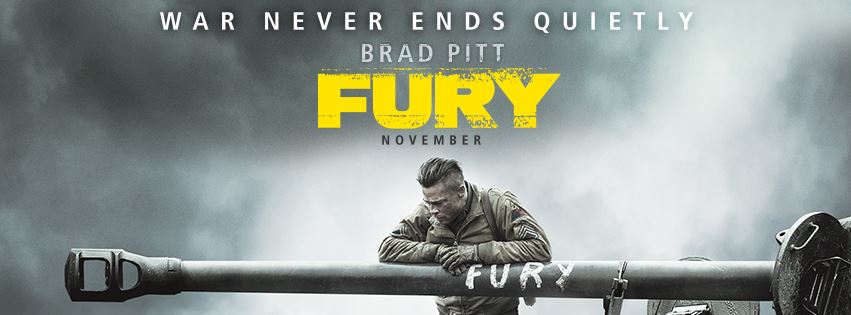
Fury-2014-Movie-Banner-Poster

I must admit that World War II films are a favorite of mine. Even bad ones I tend to enjoy. Whether it’s alternate fantasy fares like Tarantino’s Inglourious Basterds or something that combines historical accuracy with dramatic license like Spielberg’s Saving Private Ryan, the World War II genre always manage to hit straight and true to my film wheelhouse.

This October there looks to be another World War II film that seems almost tailor-fit for me. I’m talking about David Ayer’s follow-up to his underappreciated film End of Watch. This follow-up is Fury and tells the story of an American tank crew in the waning days of World War II in Europe. Just from the two trailer released I already know that I’m seeing this. Ayer looks to be exploring the bond of a tank crew that has seen war from the deserts of Africa and now to the urban and forested landscapes of Germany.

The film is already getting major buzz as a major contender for the upcoming awards season and I, for one, hope that it’s a well-deserved buzz. Even with Shia LaBeouf being part of the cast is not dampening my excitement for this film. Even if it doesn’t live up to the hype I know that I’ll probably still end up enjoying it.

This trailer looks to be selling the utter brutality and carnage of World War II’s final days in Europe when German forces were literally fighting for their homeland and that makes for a desperate enemy (who still had weapons and soldiers that were still hands down better than what the Allies had one-on-one).

On a side note, I like the fact that the tracers in the film actually look like tracers which means they look like freakin’ laser blasts. That’s how tracers behave.

Fury is set to hit theaters on October 17, 2014 in the United States and October 22, 2014 internationally.