Horror on the Lens: The Last Man on Earth (dir. by Ubaldo Ragona and Sidney Salkow)


Hi there and Happy October 25th!  For today’s treat from the ranks of horror films that have fallen into the public domain, I present to you one of the most important films in horror history.  Though it wasn’t appreciated when it was first  released back in 1964, The Last Man On Earth was not only the 1st Italian horror film but George Romero has also acknowledged it as an influence on his own Night of the Living Dead.

It’s easy to be a little bit dismissive of The Last Man On Earth.  After all, the low-budget is obvious in every scene, the dubbing is off even by the standards of Italian horror, and just the name “Vincent Price” in the credits leads one to suspect that this will be another campy, B-movie.  Perhaps that’s why I’m always surprised to rediscover that, taking all things into consideration, this is actually a pretty effective film.  Price does have a few over-the-top moments but, for the most part, he gives one of his better performances here and the black-and-white images have an isolated, desolate starkness to them that go a long way towards making this film’s apocalypse a convincing one.  The mass cremation scene always leaves me feeling rather uneasy.

The film is based on Richard Matheson’s I Am Legend and no, it’s nowhere as good as the book.  However, it’s a lot better than the Will Smith version.

If you have 87 minutes to kill, please enjoy The Last Man On The Earth.

Horror Film Review: Shadows of the Dead (dir by John Ross)


shadowsofthedead_hero_movie

You know what?

If you’re in high school and you’re planning on skipping prom so that you can go hang out at the “anti-prom” (which is being held in a creepy old cabin) and drink beer and smoke pot and maybe have unprotected sex … well, then you’re probably guaranteeing yourself a lot of great memories.  But, even with that in mind, don’t do it at Shadow Creek.

Seriously, just the fact that it’s called Shadow Creek should be enough of a clue that you need to avoid the place.  It’s always possible that Shadow Creek was named after the famed explorer, Jean LeShadow, but it’s even more likely that Shadow Creek is in some way haunted.

And if you arrive at Shadow Creek and everyone is sitting around a campfire and telling a story about a murder that happened at Shadow Creek many, many years ago, that’s probably an indication that you should have just gone to the regular prom.  I mean, you might not have as much as fun at the regular prom as you would at the anti-prom but at least you would be hanging out with the rich kids and you wouldn’t run the risk of getting brutally murdered.

However, if you stay at Shadow Creek even after the campfire ghost story, one thing that you must NOT do is get offended over something and then run off by yourself.  And if you come across another cabin — especially if that cabin has a corpse in front of it, don’t go inside.  Don’t go anywhere near it.

That’s the main lesson to be learned from Shadows of the Dead, which, last Saturday, became the latest film to premiere as a part of SyFy’s 31 Days of Halloween.  Shadows of the Dead was an occasionally atmospheric, occasionally effective, and often rather silly horror film.

Shadows of the Dead opens up with the anti-prom at Shadow Creek and then goes on to follow several teenagers as their stalked by a shadowy monster.  I have to admit that I was never quite sure what the shadow monster was exactly.  (A lot of people on twitter speculated that it was Lost‘s smoke monster.)  The movie established that it could only attack people when they were alone and when they were in the dark.  Apparently, after attacking, the monster would enter its victim’s body and stay there until it eventually decided to burst back out.  As a result, we got a lot of scenes of people literally exploding.  It got messy after a while.

But oddly, the Shadow Monster’s powers tended to change from scene to scene.  Essentially, the monster could do whatever was needed to move a scene along.  As well, the monster was pretty much invulnerable until the film needed to end, at which point it suddenly became vulnerable.  There was no real consistency to this shadow monster but then again, Shadows of the Dead is not the type of film that demands consistency.  The monster had its frightening moments and its ever-shifting powers led to some nicely surreal moments.  Ultimately, your enjoyment of this film will depend on how seriously you take it.  (Needless to say, taking it seriously in any way would be a mistake.)

That said, the most interesting thing about Shadows of the Dead was how much of it appeared to have been lifted from It Follows.  Considering that the same can be said about The Crooked Man, it appears that It Follows has emerged as the new template for low-budget horror movies.

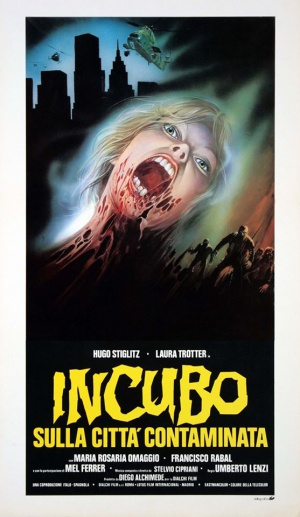
The TSL’s Daily Horror Grindhouse: Nightmare City (dir by Umberto Lenzi)


incubo-sulla-citta-contaminata

Since Case just reviewed 28 Days Later, this seems like the perfect time to say a few words about the 1980 Italian horror film, Nightmare City!  Though Nightmare City has never been as critically acclaimed or as popular with audiences, it is regularly cited as probably being one of the main inspirations for 28 Days Later.

Now, don’t get me wrong.  I can’t say for sure whether it was an influence or not.  I listened to the entire Danny Boyle/Alex Garland commentary track on my DVD of 28 Days Later and neither of them ever mentioned Nightmare City.  As well, there are some pretty big differences between Nightmare City and 28 Days Later.  For one thing, 28 Days Later is a hyperkinetic Danny Boyle film whereas Nightmare City is obviously an Umberto Lenzi film, filled with over the top gore, gratuitous nudity, and nonstop violence.  For that matter, the Infected in 28 Days Later still look human whereas all of the infected humans in Nightmare City are covered with what appears to be burned oatmeal.  (I’m going to guess that it’s meant to be radiation scarring.)

And yet, despite all of that, it’s impossible to watch Nightmare City without thinking about 28 Days Later and vice versa.  Both Nightmare City and 28 Days Later are commonly mislabeled as being zombie films, despite the fact that both of them are about people who have been driven mad by a military accident/experiment.  Where you really see the influence that Nightmare City had on 28 Days Later is in the scenes in which various “infected” humans run through the streets, savagely attacking and killing anyone that they come across.  For all the attention that was given to 28 Days Later‘s “fast zombies,” Nightmare City got there first.  Call them human, call them infected, or call them zombies, the monsters in Nightmare City are relentless, unstoppable, and blood thirsty.  Whatever flaws the movie may have, Nightmare City‘s zombies truly do belong in a nightmare.

(Except for that one scene in which a zombie extra is seen to be kicking a soccer ball while a dog chases after him but you have to look closely to notice…)

But before I say too much more about Nightmare City, I’m going to ask you to watch this tribute to the hero of Nightmare City, journalist Dean Miller:

Dean Miller was played by Spanish actor Hugo Stiglitz.  (If that name sounds familiar, it may be because Quentin Tarantino named a character after him in Inglourious Basterds.)  To be honest, the first time I ever saw Nightmare City, I thought that Stiglitz’s performance was one of the worst in the history of horror cinema.  No matter how violent or bloody the film gets, Stiglitz rarely seems to react.  He might occasionally arch an eyebrow.  But, for the most part, he doesn’t seem to care.  But, after subsequent viewings, I’ve come to respect the fact that, while everyone else in the film was overacting, Siglitz distinguished himself by refusing to act at all.

Nightmare City is a relentless and nonstop film.  It starts out with Dean Miller being sent down to the local airport.  His job is to cover the arrival of a scientist who has been assigned to investigate a recent nuclear accident.  From the minute that the plane lands and a horde of hatchet-wielding zombies stream out onto the tarmac, Nightmare City is nonstop mayhem.

And, quite frankly, a lot of it doesn’t make much sense.  At one point, the zombies enter a television studio and attack what appears to be the most boring dance show in the world and, as bloody and borderline disgusting as the action got, I still couldn’t get over how boring the dance show was before the zombies showed up.  The other thing that struck me about that scene was that nobody at the television studio seemed to be that upset about a bunch of radiation-scarred zombies literally massacring hundreds of people on camera.  Dean may have arched an eyebrow but even he didn’t seem that concerned.

(Fortunately, Dean manages to escape by grabbing a TV and throwing it at the zombies.  Apparently, televisions explode if you throw them, even if they’re not plugged in at the time.)

Then the zombies attack a hospital and it’s the hospital attack that always disturbs me.  There’s a scene where a nurse comes across a zombie raiding a blood bank and he shakes his head almost apologetically.  Oddly, almost all of the doctors turn out to be self-defense experts.  One elderly doctor even throws a scalpel at a zombie with all the skill of an Agent of SHIELD (or perhaps even …. HYDRA!)

Meanwhile, the military is supposed to be doing something but I’m not sure what.  We get a lot of scenes of a general (played by Lenzi regular Mel Ferrer) staring down at a model of the city but he doesn’t ever actually seem to do anything.  His assistant, meanwhile, is worried about his sculptor girlfriend being at home alone.  He should be since there are two zombies in the basement, though we’re never quite sure how they got there without anyone else in the house noticing.

And the mayhem continues.  There’s a zombie priest.  There’s a zombie attack at an amusement park.  There’s many scenes of Hugh Stiglitz staring off in the distance.  At one point, his girlfriend falls off a roller coaster and we are briefly amazed at the sight of an obviously fake dummy crashing to the pavement below.  But fear not because … it’s all a dream!

That’s right, Dean Miller wakes up in bed!

OH MY GOD, LISA, YOU JUST SPOILED THE MOVIE!

No, I didn’t.  Believe it or not, the movie’s nowhere close to being over yet…..

Nightmare City is a hard film to review because, while it might not be good in any traditional sense, it’s also very much a one-of-a-kind movie.  This is one of those relentless and shameless exploitation films that works despite itself.  It’s preposterous, it’s silly, it’s often offensive, and yet it’s never less than watchable.  If you’re into Italian horror, you have to see this film.  If you’re into zombie cinema, you have to see this film.  (If you’re not into either, you probably stopped reading this review a while ago.)

And, while you watch it, I dare you not think about 28 Days Later…

(This trailer is NSFW so watch at your own risk…)

4 Shots From Horror History: Henry: Portrait of A Serial Killer, Candyman, Buffy The Vampire Slayer, Cronos


This October, I’m going to be doing something a little bit different with my contribution to 4 Shots From 4 Films.  I’m going to be taking a little chronological tour of the history of horror cinema, moving from decade to decade.

Today, we start the 90s!

4 Shots From 4 Films

Henry: Portrait of a Serial Killer (1990, dir by John McNaughton)

Henry: Portrait of a Serial Killer (1990, dir by John McNaughton)

Candyman (1992, dir by Bernard Rose)

Candyman (1992, dir by Bernard Rose)

Buffy the Vampire Slayer (1992, dir by Fran Rubel Kuzui)

Buffy the Vampire Slayer (1992, dir by Fran Rubel Kuzui)

Cronos (1993, dir by Guillermo del Toro)

Cronos (1993, dir by Guillermo del Toro)

Horror on the Lens: The Little Shop of Horrors (dir by Roger Corman)


little_shop_of_horrors_2

(It’s tradition here at the Lens that, every October, we watch the original Little Shop of Horrors.  And always, I start things off by telling this story…)

Enter singing.

Little Shop…Little Shop of Horrors…Little Shop…Little Shop of Terrors…

Hi!  Good morning and Happy October the 25th!  For today’s plunge into the world of public domain horror films, I’d like to present you with a true classic.  From 1960, it’s the originalLittle Shop of Horrors!

When I was 19 years old, I was in a community theater production of the musical Little Shop of Horrors.  Though I think I would have made the perfect Audrey, everybody always snickered whenever I sang so I ended up as a part of “the ensemble.”  Being in the ensemble basically meant that I spent a lot of time dancing and showing off lots of cleavage.  And you know what?  The girl who did play Audrey was screechy, off-key, and annoying and after every show, all the old people in the audience always came back stage and ignored her and went straight over to me.  So there.

Anyway, during rehearsals, our director thought it would be so funny if we all watched the original film.  Now, I’m sorry to say, much like just about everyone else in the cast, this was my first exposure to the original and I even had to be told that the masochistic dentist patient was being played by Jack Nicholson.  However, I’m also very proud to say that — out of that entire cast — I’m the only one who understood that the zero-budget film I was watching was actually better than the big spectacle we were attempting to perform on stage.  Certainly, I understood the film better than that screechy little thing that was playing Audrey.

The first Little Shop of Horrors certainly isn’t scary and there’s nobody singing about somewhere that’s green (I always tear up when I hear that song, by the way).  However, it is a very, very funny film with the just the right amount of a dark streak to make it perfect Halloween viewing.

So, if you have 72 minutes to kill, check out the original and the best Little Shop of Horrors…

What If Awards Season Began And Lisa Totally Missed It? Here Are The Gotham Nominations!


The_Witch_poster

As proof of how busy I’ve been over the past few days, just consider this: On October 20th, awards season kicked off and I totally missed it!

That’s right.  On October 20th, the nominations for the 2016 Gotham Awards were announced.  The Gothams honor independent films and they actually have some pretty strict guidelines regarding what they consider to be independent.  So, a lot of this year’s potential Oscar nominees are not eligible for the Gotham Awards.

That said, over the past few years, the Gothams have slowly emerged as a somewhat helpful precursor.  While getting a Gotham nomination does not guarantee any film an Oscar nomination, it certainly doesn’t hurt.  That may especially be true this year as 2016 has, for the most part, not been the great cinematic year that 2015 was.  With no real favorites having yet to emerge, every precursor counts.

So, with that in mind and just a few days late, here are the Gotham nominations!

Best Feature

Certain Women
Kelly Reichardt, director; Neil Kopp, Vincent Savino, Anish Savjani, producers (IFC Films)

Everybody Wants Some!!
Richard Linklater, director; Megan Ellison, Ginger Sledge, Richard Linklater, producers (Paramount Pictures)

Manchester by the Sea
Kenneth Lonergan, director; Kimberly Steward, Matt Damon, Chris Moore, Lauren Beck, Kevin J. Walsh, producers (Amazon Studios)

Moonlight
Barry Jenkins, director; Adele Romanski, Dede Gardner, Jeremy Kleiner, producers (A24)

Paterson
Jim Jarmusch, director; Joshua Astrachan, Carter Logan, producers (Amazon Studios)

Best Documentary

Cameraperson
Kirsten Johnson, director; Marilyn Ness, producer (Janus Films)

I Am Not Your Negro
Raoul Peck, director; Rémi Grellety, Raoul Peck, Hébert Peck, producers (Magnolia Pictures)

O.J.: Made in America
Ezra Edelman, director; Caroline Waterlow, Ezra Edelman, Tamara Rosenberg, Nina Krstic, Deirdre Fenton, Erin Leyden, producers (ESPN Films)

Tower
Keith Maitland, director; Keith Maitland, Megan Gilbride, Susan Thomson, producers (Kino Lorber, Independent Lens)

Weiner
Josh Kriegman, Elyse Steinberg, directors and producers (Sundance Selects and Showtime Documentary Films)
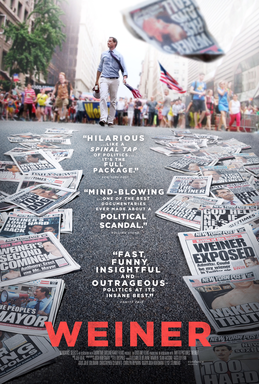
Weiner_(film)

Bingham Ray Breakthrough Director Award

Robert Eggers for The Witch (A24)

Anna Rose Holmer for The Fits (Oscilloscope Laboratories)

Daniel Kwan & Daniel Scheinert for Swiss Army Man (A24)

Trey Edward Shults for Krisha (A24)

Richard Tanne for Southside with You (Roadside Attractions and Miramax)

Best Screenplay

Hell or High Water, Taylor Sheridan (CBS Films)

Love & Friendship, Whit Stillman (Amazon Studios)

Manchester by the Sea, Kenneth Lonergan (Amazon Studios)

Moonlight, Story by Tarell Alvin McCraney; Screenplay by Barry Jenkins (A24)

Paterson, Jim Jarmusch (Amazon Studios)

Best Actor*

Casey Affleck in Manchester by the Sea (Amazon Studios)

Jeff Bridges in Hell or High Water (CBS Films)

Adam Driver in Paterson (Amazon Studios)

Joel Edgerton in Loving (Focus Features)

Craig Robinson in Morris from America (A24)

Best Actress*

Kate Beckinsale in Love & Friendship (Amazon Studios)

Annette Bening in 20th Century Women (A24)

Isabelle Huppert in Elle (Sony Pictures Classics)

Ruth Negga in Loving (Focus Features)

Natalie Portman in Jackie (Fox Searchlight Pictures)

Breakthrough Actor*

Lily Gladstone in Certain Women (IFC Films)

Lucas Hedges in Manchester by the Sea (Amazon Studios)

Royalty Hightower in The Fits (Oscilloscope Laboratories)

Sasha Lane in American Honey (A24)

Anya Taylor-Joy in The Witch (A24)

* The 2016 Best Actor/Best Actress and Breakthrough Actor nominating panels also voted to award a special Gotham Jury Award for ensemble performance to Moonlight, “in which actors at all levels of experience give outstanding performances that speak eloquently to one another both within and across each chapter of the story.” The awards will go to actors Mahershala Ali, Naomie Harris, Alex Hibbert, André Holland, Jharrel Jerome, Janelle Monáe, Jaden Piner, Trevante Rhodes, and Ashton Sanders.
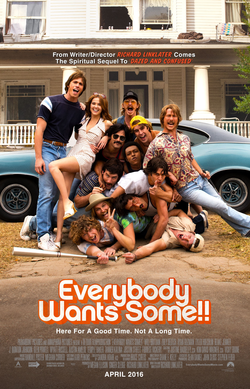
everybody_wants_some_poster

(AWARDS SEASON HAS BEGUN!!!)


4 Shots From Horror History: The Fly, Near Dark, Evil Dead 2, The Church


This October, I’m going to be doing something a little bit different with my contribution to 4 Shots From 4 Films.  I’m going to be taking a little chronological tour of the history of horror cinema, moving from decade to decade.

Today, we complete the 80s!

4 Shots From 4 Films

The Fly (1986, dir by David Cronenberg)

The Fly (1986, dir by David Cronenberg)

Near Dark (1987, dir by Kathryn Bigelow)

Near Dark (1987, dir by Kathryn Bigelow)

Evil Dead 2 (1987, dir by Sam Raimi)

Evil Dead 2 (1987, dir by Sam Raimi)

The Church (1989, dir by Michele Soavi)

The Church (1989, dir by Michele Soavi)

Horror on the Lens: Carnival of Souls (dir by Herk Harvey)


Carnivalofsoulsposters

Much like watching Plan 9 From Outer Space, Night of the Living Dead, Treevenge, or Santa Claus Conquers The Martians, watching the 1962 independent film Carnival of Souls is a bit of a holiday tradition here at the Shattered Lens.

And you know how much I love tradition!

Directed in a dream-like fashion by Herk Harvey (who also directed several of the educational short films that I’ve occasionally shared on this site, including Cheating, The Show-Off, andThe Gossip), Carnival of Souls tells the story of Mary (Candace Hilligoss) who, after a car accident, finds herself haunted by visions of ghostly figures.  Independently produced and distributed, Carnival of Souls did not get much attention when it was originally released but it is now generally acknowledged as a horror classic.  Reportedly, David Lynch loves this movie and, when you watch it, you’ll be able to see why!

It’s October.  It’s 9 more days ’til Halloween.  It’s time to watch Carnival of Souls!

The TSL’s Daily Horror Grindhouse: Amityville II: The Possession (dir by Damiano Damiani)


amityville_ii_the_possession

Agck!

The 1982 “prequel” Amityville II: The Possession is a film that is so grimy and icky and yucky and disgusting that you’ll want to take a shower right after you watch it.  And then you’ll probably end up taking two more showers, just to be sure that you’ve washed the film away.

Seriously, this is an amazingly disturbing film.

Claiming to show how that infamous house in Amityville, New York came to be haunted in the first place, this film opens with The Montelli Family moves into a big house with quarter moon windows.  The family patriarch is Anthony (Burt Young), a former cop who walks with a cane.  Anthony is an angry monster, an abusive husband, and a terrible father.  His wife, Dolores (Rutanya Alda), lives her life in denial, insisting that a new house means a new beginning and continually praying that her family will find peace.  Anthony and Dolores have four children.  The two youngest are at the mercy of their angry father.  Teenagers Patricia (Diane Franklin) and Sonny (Jack Magner) are both looking forward to the day that they can escape their family.

As soon as the Montellis move in, strange things start to happen.  It turns out that there’s a strange tunnel in the basement, one that appears to lead to nowhere.  When obscene messages appear on the walls of the house, Anthony starts to beat the youngest children but, fortunately, Sonny grabs a rifle and points it at his father’s head.  When the local priest, Father Adamsky (James Olson), shows up to bless the house, he ends up getting so disgusted at Anthony that he leaves without finishing.

In fact, Father Adamsy is a remarkable ineffectual priest.  When he attempts to talk to Sonny, he simply assumes that Sonny isn’t talking because he’s rude.  What Adamsky doesn’t suspect is that Sonny’s being rude because he’s been possessed by a demon for the basement!  When Patricia confesses that she and Sonny have been having sex, Adamsky doesn’t do anything about it.  When Patricia tries to call him to let him know that her brother appears to be possessed, Adamsky refuses to answer the phone and instead goes skiing for the weekend.

And, of course, while Adamsky is gone, Sonny grabs that rifle and, in a nightmare-inducing series of scenes, kills everyone in the house…

Of course, when Father Adamsky returns, he feels guilty and he decides to perform an exorcism.  MAYBE HE SHOULD HAVE DONE THAT EARLIER!  But no … he had to go skiing…

Anyway, Amityville II: The Possession is a deeply icky film.  It’s undeniably effective and has a lot of scary moments but it’s not an easy film to sit through.  Between Anthony beating his family and Sonny walking into Patricia’s room and asking her to “play a game,” this is a film that really gets under your skin.  You’ll never forget it but, at the same time, you’ll also never want to watch it again.

Interestingly enough, Amityville II was directed by Damiano Damiani, an Italian director who is probably best known for movies like A Bullet For The General and Confessions of a Police Captain, genre films that often featured a subversive political subtext.  Though Amityvile II is not overly political, the film’s portrait of the suburban Montelli family as a ticking time bomb does definitely fit in with Damiani’s other work.  Damiani reportedly set out to make the most disturbing film that he possibly could and he succeeded.

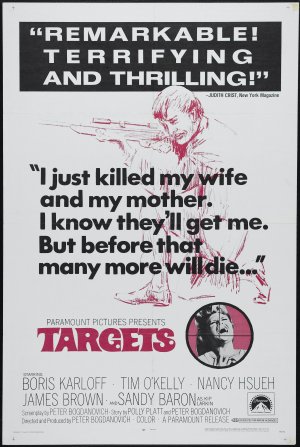
Horror Film Review: Targets (dir by Peter Bogdanovich)


targetsposter

The year was 1968 and legendary producer Roger Corman had aging horror star Boris Karloff under contract.  Karloff still owed Corman two days of work and Corman was never one to let an opportunity pass him by.  Corman approached film critic Peter Bogdanovich and made him an offer.  Corman would finance any film that Bogdanovich wanted to make, on the condition that he stayed under budget, used Boris Karloff, and included some scenes from The Terror.  Bogdanovich agreed and the end result was one of the best films of Karloff’s long career.

Karloff plays Byron Orlok.  Orlok (named, of course, after the vampire in Nosferatu) is a veteran horror star who now finds himself working almost exclusively in B-movies.  When the film starts, he’s just announced his retirement.  Orlok is bitter that Hollywood never fully appreciated his talents but, beyond that, he’s come to believe that horror movies can never hope to compete with the horrors of the real world.  People have become so desensitized to horror that it’s impossible to scare them, he believes.  Orlok plans on making one final promotional appearance at a drive-in that will be showing his final film.  (His final film, of course, is The Terror.)

Meanwhile, there’s a man named Bobby Thompson (Tim O’Kelly) and he’s about to shock the world.  Bobby has just recently returned from Vietnam.  He works as an insurance agent and his cheerfully bland countenance hides the fact that Bobby is going insane.  He is struggling to pay the bills and he resents the fact that his wife is now working and that they have to live with his parents.  His strict and taciturn father continues to criticize him, especially after Bobby points a rifle at him during target practice.  Bobby, incidentally, loves his guns.  After he murders both his wife and his mother, Bobby uses that gun to start shooting at strangers.

Bobby starts his rampage by shooting at cars on the freeway but eventually, he ends up at the drive-in.  While The Terror plays out on the big screen, Bobby shoots at the men, women, and children who have gathered to watch the movie, proving Orlok’s point that cinematic horror cannot hope to match the horror of everyday life…

Even though it was made 48 years ago, Targets is a film that feels extremely relevant today.  As I watched the film, I couldn’t help but think about not only James Holmes’s 2012 rampage in Aurora, Colorado but also the more recent sniper attacks in my hometown of Dallas.  For me, it was interesting to see that apparently this stuff was going on even in 1968.  (We tend to think of mass shooting as being a recent phenomena.)  Targets is an open plea for gun control (which, again, is something that we tend to think of as being a relatively new thing).  I’ll leave the political debate for others to consider and instead just say that Targets is a chilling portrait of both madness and violence.

However, Targets also works brilliantly as a tribute to Boris Karloff.  Though he may have never been as bitter as Orlok, Karloff is basically playing himself in Targets.  He’s portrayed as a cultured and kindly man who just happened to be very good at playing scary characters and Karloff gives perhaps his best performance in the role. Some of the best scenes in Targets are the scenes where Orlok (and, by extension, Karloff) discusses his career with his friend, Sammy Michaels (played by Bogdanovich).  You find yourself really wishing that you could have hung out on the set of Targets just to hear the stories that were told while the cameras weren’t rolling.

(Incidentally, Sammy Michaels was named after famed director Sam Fuller, who helped to write the film’s screenplay and provided a good deal of free advice to Bogdanovich.)

Targets works as both a horror film and a tribute to a great actor.  If for no other reason, watch it for Boris.