The TSL Horror Grindhouse: The Phantom of the Opera (dir by Dwight H. Little)


1989’s The Phantom of the Opera opens in what was then-modern day Manhattan.

Christine Day (Jill Schoelen) is a young opera singer who is searching for the perfect audition piece.  Her friend, Meg (Molly Shannon), suggests that she use an obscure opera piece called Don Juan Triumphant.  The opera was written by Erik Destler, a mysterious composer who was accused of murdering several opera singers in the 1800s.  That morbid fact only makes Christine all the more convinced that she should use the piece in her audition and you know what?  I would probably feel the same way.  If nothing else, it would certainly appeal to my subversive side.

Even after Christine imagines seeing blood seeping off the pages of the opera, she remains committed to auditioning with it.  Unfortunately, at the audition, a sandbag falls on her head.  She’s knocked unconscious and, when she wakes up, she finds herself in 1885 London.  She’s an understudy for a diva named La Carlotta (Sharon Lawrence).  Carlotta has skill and technique but her singing lacks emotion.  She hits each note perfectly but she brings no deeper meaning to her performances.  Christine may lack Carlotta’s polish but she sings with emotion.  For that reason, Carlotta is jealous of Christine.  Meanwhile, Erik Destler (Robert Englund), who lives in the sewers of London’s opera house and who wears a mask over his disfigured face, feels that Christine is the only one who can do his work justice and he’s willing to go to any length to make sure that she’s the one who performs on stage.

At the time he made The Phantom of the Opera, Robert Englund was still regularly playing Freddy Krueger.  The film’s version of Erik Destler does owe a bit to Krueger.  Erik is as ruthless as Freddy, he’s good with a quip, he’s just as willing to kill, and, needless to say, he also has a face that will haunt your nightmares.  That said, Erik is also a creative artist, which is something that Freddy never was.  If Freddy was motivated by revenge, Erik is motivated by a desire to see his work come to life the way that he’s always imagined it.  Erik murders to help Christine (regardless of whether or not Chrsitine actually wants the help) whereas Freddy killed because he enjoyed it.  Englund gives a good performance as Erik, occasionally playing the role with the type of broadness that is to expected from a B-horror film but also still offering hints of the artist that Erik once was.  Englund is well-matched with Jill Schoelen, who brings a likable energy to Christine.

Produced by Menahem Golan and Harry Alan Towers, The Phantom of the Opera is an entertaining B-movie, one that is obviously not meant to be taken too seriously.  Director Dwight H. Little keeps the action moving at a steady pace, the sets and the costumes are to die for, the kills are unapologetically bloody, and the film even manages to put an interesting twist on the whole “it was all dream!” thing.  The Phantom of the Opera is an enjoyably macabre showcase for two of the best horror performers of the 80s and 90s, Jill Schoelen and Robert Englund.
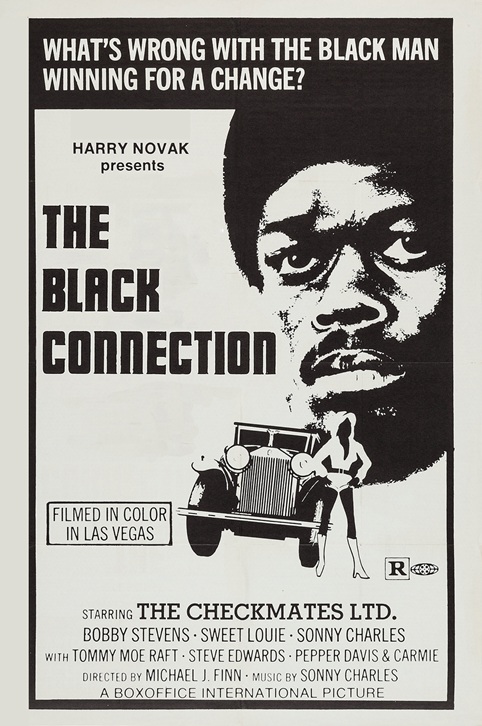
 

The TSL Grindhouse: The Black Connection (dir by Michael Finn)


Miles Carter (Bobby Stevens) is a smooth-talking Vegas drug dealer who owes the Mafia a good deal of money due to some missing cocaine.  Knowing that he’s in trouble but still confident that he can outsmart a bunch of goombahs in ill-fitting suits, Miles heads to Albuquerque so he can make another drug deal that will net him enough money to pay off the mob.  But Miles isn’t actually planning on paying back the mob.  Instead, he’s planning on taking whatever money he makes and then fleeing to Mexico.  However, the Mafia has an assortment of overweight hit men with bad haircuts and they’ve all been sent to take down Miles.

That’s the plot of 1974’s The Black Connection.  Or, at least, I think that’s the plot.  It’s not a particularly easy film to follow.  The film starts out with nearly thirty minutes of minor characters talking to each other and making phone calls.  Once Miles does finally show up, it’s difficult to really know what he’s trying to pull because 1) the dialogue is so muddled that it’s nearly impossible to make out and 2) Bobby Stevens was not a particularly good or compelling actor.  Instead, he was the lead singer for a band called The Checkmates, ltd.  His bandmates appear in minor roles and also perform the film’s rather generic score.  Bobby Stevens supposedly came up with the story for The Black Connection but it’s interesting to note that, in the opening credits, there’s no “written by” credit.  Instead, someone is credited with being a script supervisor.   That would perhaps explain why the film doesn’t really seem to be complete story as much as it’s just a bunch of random scenes that have been strung together.

The Black Connection is not a long film but I would still say that it’s probably about 60% filler.  This is one of those films where no one does anything without announcing that they’re going to do it and then debating whether or not they should actually do it before doing it.  It’s revealed that phones make Miles paranoid and yet the entire film is full of people talking and talking and talking on the phone.  I lost track of how many shots there were of people dialing a landline and then waiting for someone to answer.  There were also multiple shots of people in phone booths.  At times, the film felt as if it should have been put in a time capsule so that, decades later, people could experience what it was like to live in the days before the invention of the iPhone.

There are a few scenes that work or, at the very least, are watchable.  A scene in which a fat mobster shows off his karate skills is interesting because …. well, he’s a fat mobster.  A scene in which two other mobsters grin while firing their guns into a car is notably gruesome and made all the more disturbing by the joy that the mobsters take in their work.  Finally, the film ends on a downbeat note that would probably be more effective if not for the buckets of fake blood that were apparently splattered around right before the director shouted, “Action!”

This film was produced by the infamous Harry H. Novak.  It’s nowhere near as sleazy as some of Novak’s other films.  That’s actually kind of a shame.  Sometimes, sleaze is the only thing that can save a film this inept.

The TSL Grindhouse: The Student Nurses (dir by Stephanie Rothman)


When my mom was dying in 2008 and then when my Dad was in hospice care in 2024, I learned just how important nurses were.

While the doctors that I dealt with were often brusque and overworked, the nurses were the ones who always took the time to answer my questions.  While the doctors took an attitude of, “Death happens,” the nurses were the ones who were willing to show compassion.  They were the ones who seemed to understand the pain that both myself and my sisters were going through.  The nurses were the ones who seemed to care.  Even when it comes to something simple like getting my ADHD prescription renewed, I always feel more relaxed when I’m dealing with a nurse than dealing with a doctor.

(Don’t get me wrong.  I understand why doctors so often avoid a personal connection with their patients.  As Doctor Warshaw (Richard Stahl) puts it in 1970’s The Young Doctors, “mourning is reserved for loved ones.”  It may sound cold but it’s the truth.)

When my Dad was in home hospice, we had a nurse the came by the house every day.  She was cool and professional but still always seemed to care.  She was also a chain-smoker and there were more than a few days that I stepped outside with her.  She always had an extra cigarette for me.  Usually, I don’t smoke because I have asthma but, at that time, I was so stressed that the calming effect of smoking made the risk worth it.  Knowing that the nurse would always arrive early in the morning helped me deal with a very difficult time.  At a time when everything felt like it was spinning out of control, the nurse was someone upon whom I could depend.  After my father died, I struggled to adjust to a lot of things, including the absence of the nurse.  I discovered I missed the nurse’s professional presence.  I missed talking about my feelings while burning a cigarette down to its filter.

In short, I have a lot of respect for nurses.  They have a difficult job, one that I certainly could not do.  But I’m thankful for all that they’ve done for me, my family, and other people’s families.

With all that in mind, I watched 1970’s The Student Nurses earlier today.

The Student Nurses tells the story of four women who are studying to be nurses while working at the local hospital.  Phred (Karen Carlson) is introduced when she’s attacked by a crazed patient.  Later, she falls for a doctor named Jim (Lawrence P. Casey).  Sharon (Elaine Giftos) grows close to a terminally ill patient (Darrell Larson) and discovers the wisdom of Dr. Warshaw’s admonition about mourning.  Priscilla (Barbara Leigh), who is regularly admonished for the length of her skirt and for never wearing a bra, meets a charismatic drug dealer named Les (Richard Rust).  Les is all about dropping the acid on the beach but he’s not about sticking around when his girlfriend gets pregnant.  And finally, Lynn (Brioni Farrell) meets a Latino political activist named Victor Charlie (Reni Santoni) and discovers that some people just aren’t rich enough to go to the hospital.  When Victor shoots a cop during a raid on his headquarters, Lynn is forced to make a difficult decision.

The Young Nurses is almost legendary because of its status as a politically-themed exploitation film.  It’s a Roger Corman production so there’s a lot of nudity.  But director Stephanie Rothman used the genre to explore themes of class conflict and feminism.  All four of the nurses are portrayed as being strong and independent women who have sex because they want to and who feel no shame about their decisions.  For a 1970 film, that was a big deal.  Interestingly, considering the film’s reputation, it’s actually fairly even-handed when it comes to the differing worldviews of the nurses.  One of the nurses decides that she wants to serve in the Army Nurse Corps, even if that means going to Vietnam.  Another ends up bragging about the gun that she’s carrying in her glove compartment, just in case anyone tries to stand in the way of the revolution.  The film treats both of their decisions with respect.  The important thing, the film seems to be saying, is that all of them are in control of their own future.

It’s an exploitation film, make no doubt about it.  Today, we might talk about the film’s politics and its feminist subtext but I kind of doubt that’s what made the film a box office success in 1970.  That said, Stephen Rothman brings some imagination to even the film’s most exploitive scenes.  When Priscilla drops acid on the beach, Rothman slowly introduces more and more people to the scene, leaving us to wonder, just as Priscilla does, whether they’re real or their just a part of her trip.  All four of the lead actresses are well-cast and fans of great character actors will probably enjoy seeing Reni Santoni playing someone other than a cop or a doctor.

Finally, like so many exploitation films, The Student Nurses is a true time capsule.  The music, the clothes, the groovy slang, this is a film that proudly announces that it was made in 1970.  We may not have time machines but at least we have the movies.

I have no idea if The Student Nurses is a realistic portrayal of what it was like to be a student nurse in 1970.  That said, it’s an entertaining film and, in its grindhouse way, a tribute to the nurses who do so much.


The TSL Grindhouse: Grizzly (dir by William Girdler)


In 1976’s Grizzly, something is making a national park a lot less inviting.

Campers are turning up dead.  Bloody body parts are being found buried underneath leaves.  It’s obvious that a bear is to blame but reports seem to indicate that this isn’t just any bear.  This is a super bear, standing 8 feet tall and capable of knocking down an observation tower and picking up a helicopter.  This is the most dangerous bear known to man and the park has to be closed.

Closing the park during tourist season!?  Surely not!

Does this all sound familiar?  Grizzly came out a year after Jaws.  In all fairness to Grizzly, there were a lot of movies that ripped-off Jaws.  As a matter of fact, there are still movies ripping off Jaws.  The Jaws films eventually ended up ripping off themselves with three sequels.  Still, it’s hard to ignore just how blatantly Grizzly rips off Jaws.  We get shots from the bear’s point of view.  Christopher George plays the sheriff who keeps demanding that the park be closed down until the bear has been taken care of.  Andrew Prine is the hippie bear expert.  Richard Jaeckel is the crotchety old man who knows more about bears that just about anyone else in the world.  In Jaws, they needed a bigger boat.  In Grizzly, they need a bigger helicopter.  Jaws features scenes of people fleeing from the water.  Grizzly features an unintentionally funny shot of hundreds of panicked campers fleeing down the side of a mountain.

Grizzly is Jaws, without the water and without the wit.  And yet, in its own grim way, it works well enough.  The fact of the matter is that bears are scary and the bear in Grizzly is really, really big.  The gore effects are memorably grotesque and, perhaps even more so than Jaws, Grizzly goes out of its way to establish that anyone can die.  As for the actors, I’ve always enjoyed seeing Christopher George in films like this.  He was one of those actors who always seemed to try to give a convincing performance, even when he was appearing in a film that no one would mistake for a classic.  Richard Jaeckel and Andrew Prine also do their best to bring their characters to life.

Finally, I should mention that the film ends on a properly silly and over-the-top note.  Actually, it’s not that much different from the ending to Jaws.  It’s just that Jaws was made with such skill that even the silly moments worked.  Grizzly was directed by William Girdler, who was no Steven Spielberg.  At the end of Grizzly, I found myself shouted, “Why didn’t someone just do that in the first place!?”  Then again, if they had, we never would have gotten all of those point of view shots of the bear wandering through the forest while growling like an 70s obscene phone caller.

As a final note, I defy anyone to watch Grizzly without imagining Werner Herzog narrating the bear’s activities.  It cannot be done!

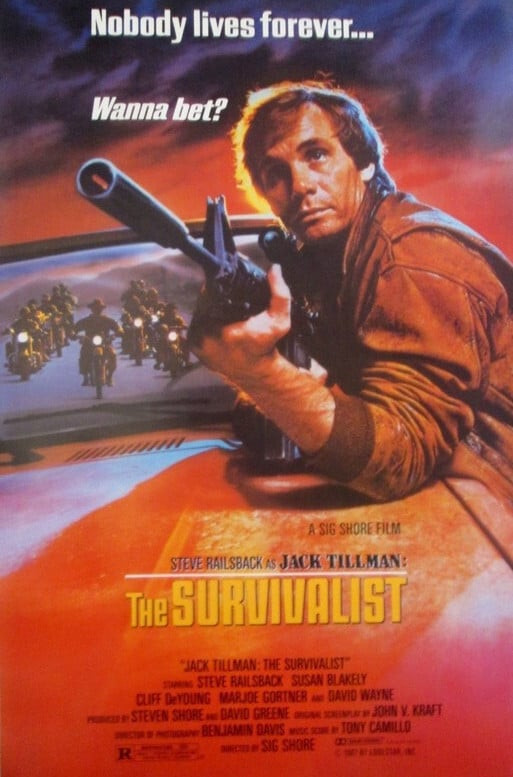
The TSL Grindhouse: The Survivalist (dir by Sig Shore)


1987’s The Survivalist opens with a mushroom cloud forming over a frozen landscape.

In America, a nervous-looking newscaster announces that someone has set off a nuclear bomb in Siberia.  The bomb was apparently a “suitcase bomb” and it was probably set off by a group of terrorists who figured bombing one of the most desolate and sparsely-populated places on Earth would make their point.  However, the Russians are convinced that America was behind the bomb.  Nuclear war is eminent.

People go into a panic.  Civil disorder breaks out.  Even a small town in South Texas finds itself in the grip of societal collapse.  Fortunately, independent builder Jack Tilman (Steve Railsback) has spent his life preparing for this moment.  He has hundreds of guns and explosives and he’s prepared to take his family into the desert while civilization collapses.  When a desperate neighbor comes back Jack’s house and asks for a gun, Jack gives him a shotgun and then reacts with shocks when his friend reveals that he’s never fired a gun before.  Considering that they live in South Texas, I’m surprised too.

(Seriously, how do they scare off the coyotes?)

Jack leaves his home to get some gasoline for their trip.  While he’s out, he’s harassed by the motorcycle riding Lt. Youngman (Marjoe Gortner).  Youngman is with the National Guard and, apparently, the National Guard has turned into a motorcycle gang.  Youngman is declaring martial law and setting himself up as a warlord.  With his perpetual smirk and his feathered hair, Lt. Youngman epitomizes the arrogance of authority.  Jack has no use for him.  Jack also has no use for anyone who wants to keep him from getting his money out of the bank.  Jack has access to a bulldozer, after all.

Unfortunately, while Jack is arguing with Youngman and smashing into the bank, a group of hippies are breaking into his house and killing his family.  A half-crazed Jack kidnaps two of his friends — Dr. Vincent Ryan (Cliff DeYoung) and his wife, Linda (Susan Blakely) — and he takes them into the desert with him.  When Vincent demands to know why they’ve been kidnapped, Jack says that he’s trying to protect them.  Linda gets it.  Unfortunately, Vincent doesn’t.

Last night, I was searching for some Marjoe Gortner films to review.  I came across The Survivalist on Letterboxed and I also came across some amazingly vitriolic reviews, largely from Leftists who accused the film of being a paranoid right-wing fantasy.  I read those reviews and I thought to myself, “It stars Steve Railsback and Marjoe Gortner and it annoys the commies?  I have to watch this!”  I was able to track the film down on YouTube and I proceeded to spend 90 minutes watching civilization collapse.

Is it a good film?  It depends on how you define good.  It’s a low-budget, unashamedly trashy film that was clearly meant to appeal to people with a very definite worldview, one that the filmmakers may not have shared.  (Most films are made solely to make money and any message that is selected is selected out of the hope that it will be profitable.)  The government is corrupt.  Most of the citizens have become complacent and aren’t prepared to handle any sort of crisis.  When civilization collapses, only men like Jack Tilman and Lt. Youngman will thrive because they’re willing to be ruthless.  To try to rationalize the situation, as Dr. Ryan does, is an often fatal mistake.  In short, The Survivalist is a very paranoid film.  That said, its story and its worldview really isn’t all that different from One Battle After Another.  

I enjoyed The Survivalist, precisely because it is such a shameless film.  This is the type of movie where the National Guard rides motorcycles and blow up random buildings for fun.  It’s the type of film where one gunshot can cause a car to explode.  It’s the type of film where actors like Cliff DeYoung and Susan Blakeley attempt to find some sort of deeper meaning in their awkward dialogue while Steve Railsback does his Clint Eastwood impersonation.  Best of all, it’s got Marjoe Gortner going totally over-the-top as a smug authority figure.  It’s a fun movie, a trashier version of Red Dawn.

What’s not to love?

The TSL Grindhouse: Record City (dir by Dennis Steinmetz)


1977’s Record City opens with a montage of rear-focused close-ups of women wearing short shorts and that pretty much tells you all that you really need to know about the film.  It’s crass, shameless, and very much a product of its time.

The film takes place over the course of one day at a California vinyl record shop.  It’s tempting to compare the film to something like Empire Records but, unlike Empire Records, Record City suggests that working in a record store is perhaps the worst thing that could ever happen to anyone.  The store is dirty and grimy.  The customers are rude and played by vaguely familiar comedy actors, all of whom seem to have been bitten by the overacting bug before stepping in front of the camera.  The employees all seem to hate each other.  Marty (Tim Thomerson) keeps getting slapped and kicked by Vivian (Deborah White).  Vivian keeps getting groped by almost every customer and employee who walks by her.  The only thing that Vivian hates more than men is other women.  The store’s owner (Jack Carter) is in trouble with the mob.  The store’s manager (Michael Callan) is lech who wears gold chains, keeps his shirt unbuttoned, and who expects the new cashier, Lorraine (Wendy Schaal), to sleep with him because, after all, he did hire her.  Danny (Dennis Bowen) is the shy guy with a crush on Lorraine.  Rupert (Stuart Goetz) is the nerdy virgin who goes from wearing a bowtie to dressing like a swinger but he still can’t get laid.  Both the customers and the employees are paranoid about “fairies” coming into Record City.  Pokey (Ed Begley, Jr.) wants to hold the place up and who can blame him?  Really, the only likable employee is a black man known only as The Wiz and that’s just because he’s played by Ted Lange.  (Yes, Isaac the Bartender from The Love Boat.)  Lange gets to perform a song at the end of the film.

When the film isn’t focused on the antics inside Record City, it’s all about the talent show that’s taking place in a nearby parking lot.  The talent show is hosted by radio DJ Gordon Kong (Rick Dees) and it gives the film an excuse to trot out a bunch of cameos, some of whom are more recognizable than others.  For instance, Gallagher — the comedian with the sledgehammer — shows up.  Kinky Friedman also shows up, playing himself and looking for records at Record City.  When he spots a woman with a blonde bowl cut and glasses, he accuses her of being John Denver and then grabs her breasts.  And to think — less  than 30 years later, Kinky Friedman would run for governor of my homestate.

Anyway, this is a terrible and rather boring movie but I did find it interesting for one reason.  It’s the reason why I find so many grindhouse films to be interesting.  Shot on location and for no other reason than to make money, Record City is a true product of its time.  There’s no attempt to try to make the 70s look nicer than they were.  There’s no attempt to try to make the record store look like anything more than a tacky establishment.  There’s an honesty to how low-rent the whole thing is.  Watching the movie is like stepping into a time machine and getting a chance to experience the past firsthand.  I was born long after the 70s but, after watching this film, I now feel like I’ve been there.

6 Bronsonrific Trailers


Today is Charles Bronson’s birthday!  I sent the trailer kitties out to gather the trailers for this week’s edition of Lisa Marie’s Favorite Grindhouse and Exploitation Film Trailers with one mission in mind.  Make it Bronsonriffic!  Let’s see how they did!

1) Once Upon A Time In The West (1968)

2) Someone Behind The Door (1970)

3) Death Wish (1974)

4) From Noon Till Three (1976)

5) Telfon (1977)

6) 10 to Midnight (1983)

What do you think, Trailer Kitty?

6 Roger Corman Trailers For Halloween


Happy Halloween!  Today, in order to celebrate, we have a special Roger Corman-themed edition of Lisa Marie’s Favorite Grindhouse and Exploitation film trailers!  Here are 6 Roger Corman trailers for Halloween!

1. The Day The World Ended (1955)

2. Bucket of Blood (1959)

3. Little Shop of Horrors (1960)

4. The Terror (1963)

5. The Masque of the Red Death (1964)

6. Frankenstein Unbound (1990)

6 Terrifying Trailers For October 25th, 2025


It’s only 6 days until Halloween!

Are you still struggling to get into the mood?

Don’t you worry!  The latest edition is Lisa Marie’s Favorite Grindhouse Trailers is here to help you out!

Presented without comment, here are 6 classic trailers that are guaranteed to get you in the scary season mood….

  1. Carnival of Souls (1962)

2. Night of the Living Dead (1968)

3. The Texas Chainsaw Massacre (1974)

4. Halloween (1978)

5. Dawn of the Dead (1978)

6. Zombie (1979) (a.k.a. Zombi 2)

What do you think, Trailer Kiity?

I agree!  Those trailers gave us a lot to think about!

The TSL Horror Grindhouse: The Fifth Floor (dir by Howard Avedis)


In 1977’s The Fifth Floor, Dianne Hull plays Kelly McIntyre.

Kelly is a college student by day and a disco dancer by night!  Unfortunately, after someone spikes her drink at the discotheque and she suffers an overdose, she becomes a full-time patient at a mental asylum.  Neither the head doctor (Mel Ferrer) nor the head nurse (Julia Adams, who once swam with The Creature From The Black Lagoon)  believes her claim that her drink was spiked.  Judged to be suicidal and delusional, Kelly is sent to the Fifth Floor!

While her boyfriend (John David Carson) tries to convince the authorities that she’s not insane, Kelly adjusts to life on the Fifth Floor.  She befriend Cathy (Patti D’Arbanville).  She encourages her fellow patients to dance and enjoy themselves.  She tries to escape on multiple occasions.  She draws the unwanted attention of a male orderly named Carl (Bo Hopkins, giving a wonderfully sinister performance).  A sadist equipped with down-home country charm, Carl has got all of his co-workers convinced that he’s a great guy.  The patients, though, know that Carl is a petty authoritarian who enjoys showing off his power.  (“I’m just doing my job,” is the excuse whenever he’s challenged.)  Carl takes an obsessive interest in Kelly and soon, Kelly is not only trying to get her life back but also trying to escape from Carl’s cruel intentions.

Most film directories list The Fifth Floor as being a horror film and certainly, there are elements of the horror genre to be found in the film.  The smooth-talking and nonchalantly cruel Carl is certainly a horrific character and Kelly’s attempts to escape from the asylum capture the very primal fear of not having any control over one’s life.  That said, The Fifth Floor owes greater debt to One Flew Over The Cuckoo’s Nest than to the typical slasher film.  Kelly is a rebel who brings the patients in the ward together.  Much as in Cuckoo’s Nest, the nurses and the orderlies use the threat of electro-shock treatment to keep the patients under control.

It’s not a bad film, though it definitely has its slow spots and I do wish the film had embraced its own sordidness with a bit more style.  I’m a history nerd so I appreciated the fact that The Fifth Floor was so obviously a product of its time.  Any film that features the heroine showing off her disco moves before being taken to a mental hospital is going to hold my interest.  That said, the most interesting thing about the film are some of the familiar faces in the cast.  For instance, Earl Boen — who played so many authority figures over the course of his career and appeared as a psychiatrist in the early Terminator films — plays a patient who wears a NASA jacket.  The always intimidating Anthony James plays the most violent patient.  Michael Berryman and Tracey Walter appear as background patients.

And then you’ve got Robert Englund, cast here as Benny.  Benny is the most gentle of the patients, a prankster who befriends Kelly.  It’s always so interesting to see the type of roles that Englund played before he was cast as Freddy Krueger in A Nightmare On Elm Street.  In this film, Englund is so goofy and friendly that you actually find yourself worrying about something happening to him.  Englund’s role is small but his amiable nerdiness definitely makes an impression.

The Fifth Floor opens and ends with a title card telling us that the film is based on a true story.  Sure, it was.