The TSL Horror Grindhouse: Point of Terror (dir by Alex Nicol)


In the 1971 film Point of Terror, Peter Carpenter plays Tony Trelos. Tony is a hip, cool, swinging hep cat. He’s got a job singing at the Lobster House in Santa Monica, California. Everyone wants a piece of Tony because he has got the swagger of Sinatra and the voice of Tom Jones. When he meets Andrea (Dyanne Thorne), it’s lust at first sight. Andrea is married to Martin (Joel Hilliard), a wealthy and bitter record producer who is confined to a wheelchair. When Andrea murders Martin, it brings Martin’s daughter, Helayne (Lori Hansen), back to Santa Monica, and soon Tony is sleeping with her too. However, Tony has reason to be concerned because it appears that there might be another murderer stalking all of them. Or maybe there isn’t. The plot of this Crown International production is not always easy to follow.

Who was Peter Carpenter? I am honestly not sure, but this film appears to have been some sort of vanity production for him. He gets to sing several songs, and everyone he meets either wants to sleep with him or hang out with him. He gets a lot of big dramatic scenes, the majority of which he really didn’t have the acting ability to pull off. Tony is meant to be charismatic, mysterious, and a little bit dangerous, but as played by Peter Carpenter, he comes across as a second-rate lounge act who got lucky. Carpenter both co-produced the film and came up with the story. To be honest, you almost have to respect the amount of confidence in his own abilities that Carpenter apparently possessed. One can just imagine Carpenter turning to someone like Wayne Newton and telling him to scream, because there was only one actor/singer who was good enough to star in Point of Terror. Carpenter apparently died shortly after this film was released, and that is indeed a shame. Who knows how many ego-driven projects he could have given us?

Point of Terror is definitely a film of its time, which is to say that there’s a lot of polyester and a lot of nudity that was probably considered daring in 1971 but which is just kind of tame in 2026. The film does attempt to play around with the audience’s sense of perception and encourage them to wonder whether Tony is truly seeing what’s happening or if he’s just imagining things. For that reason, it sneaks across the line dividing psychological horror and neo-noir. It’s one of those films that’s probably more entertaining than it should be, just because it is such a film of its time. Someone could probably retitle this film 1971 and re-release it as a Paul Thomas Anderson-style satire.

Point of Terror was distributed by Crown International Pictures. Whenever I see the Crown International logo on an old movie, I know I’m in for a good time. Dyanne Thorne, it should be said, does a pretty good job as the femme fatale. That said, the true star of this film is definitely 1971.
The TSL Horror Grindhouse: House of the Damned (dir by Maury Dexter)


1963’s House of the Damned tells the story of an isolated mansion.  It’s a place that many people have tried to live in but no one has ever been willing to stick around for too long.  There are rumors that the mansion is haunted.  In fact, you could even make the claim that the mansion is a house of the damned!  Of course, we all know that there’s no such thing as ghosts, right?

Joseph Schiller (Richard Crane), the new owner of the mansion, calls architect Scott Campbell (Rob Foster) and tells him to go up to the house and check the place out.  Scott points out that he was planning on celebrating his anniversary with his wife, Nancy (Merry Anders).  Joseph say that there is no better way to celebrate an anniversary than to visit a house that might be haunted.  Scott and Nancy (who  is amazingly understanding) head for the house, where all sorts of strange things happen.

What type of strange things?  Keys disappear.  There are weird noises.  Sometimes, it seems like something or someone might be lurking in the shadows.  Could the house be haunted?  While Scott and Nancy try to figure out what’s going on, Joseph shows up with his wife, Loy (Erika Peters).  When Loy disappears, it becomes obvious that something is happening in the house of the damned!

House of the Damned is a briskly paced and occasionally effective haunted house story.  It was directed by Maury Dexter, who was a director who was so fast and so capable of stretching a low budget that, at his best, he gave Roger Corman a run for his money.  House of the Damned is only 63 minutes long and the film’s story isn’t particularly complex but Dexter still manages to create a properly ominous atmosphere and he does keep you guessing as to whether or not the house is actually haunted.  The house itself was the former estate of infamous gangster Bugsy Siegel.  Dexter reportedly spent ten days filming the movie at the Spiegel estate.  Hopefully, he was not bothered by Bugsy’s ghost.

None of the characters are particularly well-developed but they are well-cast and the actors are all likable.  The best performance comes from Erika Peters, who plays Loy as being slightly self-absorbed but ultimately good-hearted.  She also gets to wear a bathing suit that is simply to die for.  This film also features a very early performance from the great Richard Kiel, playing “The Giant.”  It’s always nice to see Richard Kiel in a movie.  Shortly before he passed away in 2014, Kiel visited my Alamo Drafthouse for a showing of The Spy Who Loved Me.  Though it was obvious that he wasn’t in great health, he still took time to answer questions and to show off a rather charming smile.  When a certain redhead told him that she loved him in a beloved 90s golf comedy, he smiled and said, “I believe that jacket belongs to Mr. Gilmore.”

House of the Damned was a nice surprise.  We need more 62-minute films.

The TSL Horror Grindhouse: Back From The Dead (dir by Charles Marquis Warren)


In 1958’s Back From The Dead, pregnant Mandy Anthony (Peggie Castle) is on a California vacation with her husband Dick (Arthur Franz) and her sister, Kate (Marsha Hunt).

While staying at Dick’s vacation home (which overlooks the ocean), a tired Mandy grimaces when Dick starts playing a record.  Dick insists that it’s her favorite record but Mandy’s reaction would seem to indicate the opposite.  While the droning orchestral music plays, Mandy has a sudden seizure and passes out.  Dick rushes her to the bedroom while Kate smashes the record.  A doctor (Ned Glass) comes to check on Mandy and announces that she’s had both an epileptic seizure and a miscarriage.  When Mandy wakes up, she’s suddenly demanding to be called Felecia and referring to Dick by an odd nickname, “Deacon.”  Dick rushes out of the bedroom and refuses to reenter.  When Kate demands to know what’s wrong, Dick reveals that Mandy is actually his second wife.  His first wife was named Felecia and she always used to call him “Deacon.”

Soon, Mandy is demanding to be taken to see “her” parents, who are actually Felecia’s parents.  Felecia’s mother (Ada Bradley) is revealed to be some sort of witch who apparently cast a spell that caused Felicia’s spirit to possess Mandy as soon as she entered the vacation home.  (It turns out that terrible record that Dick insisted on playing was Felecia’s favorite.)  Along with Dick’s neighbor (Marianne Stewart), Felecia’s mother is a member of a Satanic cult that is led by the mysterious Renault (Otto Reichow)  The possessed Mandy is soon threatening not only Dick but also all of Dick’s friends.  She even murders Dick’s dog.  (Boo!)

There’s an interesting subtext to Back From The Dead, though I’m not sure it was intentional on the part of the filmmakers.  Even before Mandy is possessed, Dick is hardly the model husband.  He comes across as being cold and uncommunicative and when both Mandy and Kate say that they don’t want to listen to the record, he ignores them and insists that they both love it.  Dick also doesn’t seem to be particularly upset by the loss of the baby.  As well, he’s never even told his wife that he was married before.  The only time that Dick really shows emotion is when he realizes that he can no longer control Mandy.  Mandy spends the entire film either being ordered around by Dick or being possessed by Dick’s dead first wife.  In the end, it isn’t Dick or any of the other men in the film who fights for Mandy’s freedom.  Instead, it’s Kate, Mandy’s sister.  Kate is the only person in the film who seems to care that Mandy has basically lost control over her own life.  In the end, the film becomes about just how far one sister will go to protect the other.  Kate fights to give Mandy back her life but it’s hard not to feel that it’s not much of a life to begin with.  Much like Nicholas Ray’s Bigger Than Life, Back From The Dead ends with a false sense of happiness.  For Mandy and Dick and Kate, nothing is ever going to be truly the same again.

Now, I should note that Back From The Dead is definitely a B-movie.  It has the look of a well-produced episode of a 50s anthology show.  All it really needed was Boris Karloff to host.  Arthur Franz is a bit on the dull side as Dick but that’s largely the fault of a script that doesn’t allow him to do much other than seethe and glower.  The film’s heart belongs to Masha Hunt’s fierce performance as Kate.  Kate is a fighter and a protector and it’s impossible not to root for her.  I can only hope to be as good as a sister as Kate but, then again, I don’t think any of my sisters are going to be possessed this holiday season.  Let’s hope not!

The film has its slow spots but, for the most part, Back From The Dead is a 50s B-movie that holds your interest.  You’ll never want to listen to vinyl record again.

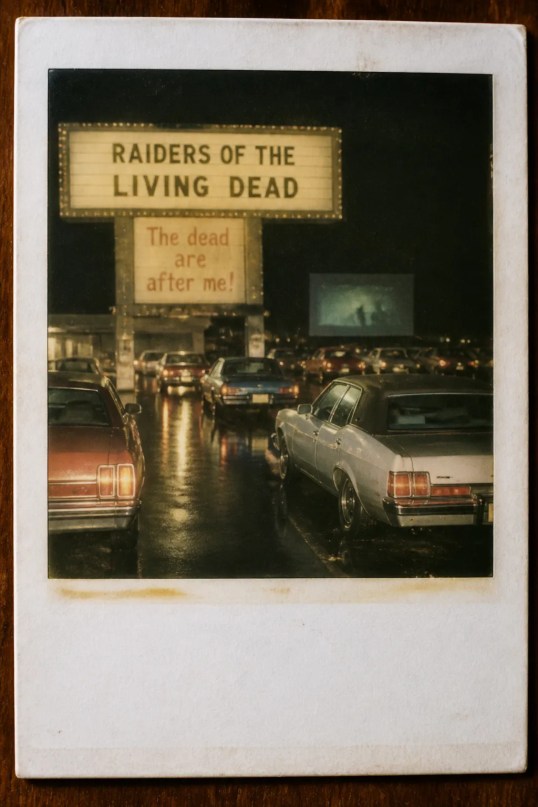
Horror on the Lens: Raiders of the Living Dead (dir by Samuel M. Sherman and Brett Piper)


Hi there and welcome to October!  This is our favorite time of the year here at the Shattered Lens because October is horror month.  For the past three years, we have celebrated every October by reviewing and showing some of our favorite horror movies, shows, books, and music.  That’s a tradition that I’m looking forward to helping to continue this year.

Today, we’ve got the 1986 zombie/sci-fi/action epic, Raiders of the Living Dead!

It’s the story of a creepy boy, a laser gun, a reporter, and a bunch of zombies.  There’s a mad scientist involved, too.  There always is.  The movie opens with a truck being hijacked and then the action shifts to a power plant and, honestly, I have no idea what any of it means.  If nothing else, it’s a film that you watch and you can’t help but admire the fact that it somehow got made and went on to find a small but kind of appreciative cult audience.  It’s just a very strange film and one that simply most be watched in October.

Enjoy!

October Hacks: Buried Alive (dir by Gerard Kikoine)


1990’s Buried Alive may be the worst Edgar Allan Poe adaptation ever filmed.

The film takes place at the Ravenscroft Institute, a former mental asylum founded by the fearsome Jacob Julian (John Carradine). Jacob’s son, Gary (Robert Vaughn), took over the Institute after his father’s death, treated his patients with kindness and compassion, and preached about the need for “freedom.” Now, Gary has transformed Ravenscroft into an all-girls school for juvenile delinquents. The students worship him because he tells them that nothing is their fault and that they deserve to live the life they want. His newest teacher, Janet (Karen Lorre), is a fan as well. In fact, she soon finds herself falling in love with Gary.

However, from the minute Janet shows up at Ravenscroft, she starts having strange visions. She sees thousands of ants crawling over her feet. She hears strange sounds in the walls. At one point, an arm reaches out of a toilet and tries to grab her. She thinks she sees a distinguished Shakespearean character actor sealed behind a wall. Is she losing her mind, or has she stumbled across something more sinister?

Now, when I say that Buried Alive is one of the worst Edgar Allan Poe adaptations I’ve ever seen, understand that it is not the fault of the cast. There are some truly talented people in this film. A young Nia Long plays a student named Fingers. Ginger Lynn Allen has fun playing a bully named Debbie. Robert Vaughn is appropriately intense as Gary, and John Carradine is… well, he’s John Carradine. This was one of Carradine’s final films, and he actually died before it was released. Obviously, Carradine doesn’t do much, but, as was often the case, his intimidating screen presence meant that he didn’t have to do much to make an impression. He just had to exist. Donald Pleasence plays Dr. Schaeffer, a German-accented member of the staff who wears round glasses and an ill-fitting toupee and who pops up occasionally to tell Janet not to wander around at night. Pleasence was obviously not in the best of health when he played Schaeffer, but, much like Carradine, his eccentric presence gives the film some much-needed atmosphere, and there is a fairly effective twist involving his character. Finally, there’s an absolutely adorable black cat that randomly appears throughout the film. It’s the film’s way of acknowledging Edgar Allan Poe, I imagine.

No, the failure of Buried Alive is not due to the cast. It’s really not even due to the script, which borrows the idea of someone being buried alive and not much else from the Poe story. Instead, the fault almost entirely rests with the film’s direction. The story unfolds with little momentum, some scenes meander while others are over far too quickly, and the director seems to think that filming anyone in an extreme close-up will automatically make them creepy. There are a few gross sequences involving a bunch of ants and the film has a few slasher moments, like the silencing of one annoying victim via a garden tool to the forehead , but otherwise there’s little horror and next to no suspense. I actually found myself getting angry over how poorly directed this film was.

The cast deserved better.

The TSL Horror Grindhouse: American Rickshaw (dir by Sergio Martino)


1989’s American Rickshaw opens in Florida. Scott Edwards (played by Olympic gymnast Mitch Gaylord) is a college student who pays the bills by pulling a rickshaw through the streets of Miami. One day, he sees an elderly Asian woman (Michi Koba) sitting by herself at a bus stop. When it starts to rain, he offers her a free ride home. Though Scott was just being nice, it turns out that this is the most important thing he’s ever done. The woman is a witch, and when Scott is subsequently implicated in the murder of the son of televangelist Rev. Mortom (Donald Pleasence), she uses her powers to help him escape both the police and the hitman trying to track him down. The witch, aided by both a cat and a cobra, has a history of her own with the duplicitous Rev. Mortom.

American Rickshaw is an odd hybrid of a film. In many ways, it’s a standard action film. Gaylord plays Scott as a lovable loser who gets set up by a stripper named Joanna (Victoria Prouty) and Jason Mortom (Gregg Todd Davis). While Joanna seduces Scott on a boat, Jason hides behind a two-way mirror with a video camera. When Scott hears Jason behind the mirror, he breaks Jason’s camera and leaves the boat with a videotape he thinks features him and Joanna. Only later does he discover that he grabbed the wrong tape. When Scott returns for the correct tape, he discovers that Jason has been murdered. With the hitmen determined to get the tape Scott did take, he ends up getting chased all over Miami.

At the same time, it’s a horror film. The witch uses her powers to help Scott, which means there are scenes of hitmen suddenly seeing a snake approaching them. The witch’s cat also shows up and stares at the ocean until Scott finally realizes he’s meant to dive in so he can find a clue. It’s established that the witch has a magical past with the demonic Rev. Mortom and that Mortom himself is involved in his own son’s murder. “He’s the devil!” Mortom’s wife (Judy Clayton) yells at one point, and it turns out she’s pretty much right.

This, of course, is all a polite way of saying that the film doesn’t make much sense, but anyone familiar with the films of Sergio Martino will not be surprised to hear that. Like many of the great Italian horror and thriller directors, Martino was always more interested in a few strong set pieces than in a coherent plot. American Rickshaw is more about the chase than the destination, and there are enough weird moments to keep things entertaining. Mitch Gaylord is just as blandly engaging here as he was in American Anthem. (“Steve Tevere has thrown a tripus!”) What Gaylord may have lacked in range, he made up for with earnestness.

Of course, the main attraction here is Donald Pleasence, playing the televangelist with an appropriately predatory glint in his eyes. Pleasence doesn’t get a lot of scenes, but, as always, he’s a memorable presence and he commands the screen whenever he does show up. The reverend is such a strange character that it’s hard to think of any actor other than Donald Pleasence in the role.

American Rickshaw is one of those films that seems to get a lot of bad reviews, largely from people who aren’t familiar with the unique style of Italian exploitation films. Personally, I think it’s impossible not to enjoy something as weird as this film. Seriously, how can anyone resist Donald Pleasence and Mitch Gaylord in the same movie?

The TSL Horror Grindhouse: Amityville La Llorna (dir by Jamie Grefe)


In 2025’s Amityville La Llorona, a couple (played by director Jamie Grefe and Sloane Tower) move into a house and spend the entire time arguing about every little thing.  Eventually, the husband has visions of a mysterious woman (Skya Theobold) and a strange figure who keeps shouting, “Mama!  Mama!”  The film is only 63 minutes.  Unfortunately, the dialogue is largely improvised and it takes forever for anything to actually happen in the movie.  I felt every one of those 63 minutes.

Since there’s really not a helluva lot to say about the film, let’s talk about La Llorona.

The legend of La Llorona is a well-known one in Mexico and the southwestern half of the United States.  It’s a story that I was told by both my mom and my aunts and, as a result, I never went off with a stranger while I was growing up.  Of course, I also had some pretty intense nightmares but that’s kind of the point.  If someone tells you the story of La Llorona and you don’t end up having a nightmare about being drowned by a weeping woman, they didn’t tell the story correctly.

La Llorona was originally named Maria.  She lived, in a rural village, with her family and she was famous for both her beauty and her virtue.  When a wealthy nobleman saw her and immediately proposed to her, Maria accepted.  However, the nobleman’s father was upset that his son was marrying into a poor family and he refused to accept Maria as his daughter-in-law.  Maria and her husband ended up having two sons and living in a house by the river.  Maria’s husband doted on their sons but he ignored her and eventually, Maria learned that he was having an affair.

In a fit of blind rage, Maria drowned her children in the river.  After realizing what she had done, Maria died of grief.  However, when she arrived at the gates of Heaven, she was asked why her children were not with her.  When Maria explained that she had lost them, she was told that she would not be allowed to enter Heaven until she found them.  Now, known as La Llorona (or “the weeping woman”), she wanders the Earth, crying and looking for her children.

Where does one find La Llorona?  It depends on who is telling the story.  Some stories say that you’ll only see her near a body of water.  My mom used to tell me that La Llorona could be anywhere, including under my bed or in the bedroom closet.  Regardless of where you might find her, La Llorona is always wearing her wedding dress and she’s always sobbing.  Approach her and she’ll grab you and either kidnap you or drown you, all the while begging for forgiveness.  Many have seen La Llorona but few have survived to tell the story.

“And that is why we do not talk to strangers,” my mother would say while I looked out the bedroom window, searching for the sight of La Llorona walking through the Texas night.

Though Skya Theobold’s character is credited as being La Llorona in Amityville La Llorana, she doesn’t have much in common with the true La Llorona.  Then again, this film also has nothing to do with any of the previous Amityville films.  Amityville, as either a town or franchise, is never mentioned in this film.  Normally, I’m willing to cut an exploitation film a little bit of slack when it comes to having a misleading title.  Usually, that’s just a part of the game.  In this case, though, it just serves to remind me of how cool a film about the real La Llorona visiting the real Amityville house would have been.

As I mentioned earlier, the dialogue in this film appears to have been improvised.  One of the unfortunate things about improv is that everyone thinks that can they do it.  They think that as long as they’re given a scene to play, they’ll be able to come up with appropriately compelling dialogue.  This film proves that is not always the case.  As I watched Amityville La Llorona, I found myself hoping that Michael Scott would kick open a door and shout, “MICHAEL SCARN, FBI!”

Michael Scarn in Amityville.  Now that would be a movie!

Previous TSL Amityville Reviews:

  1. The Amityville Horror (1979)
  2. Amityville II: The Possession (1981)
  3. The Amityville Cure (1990)
  4. The Amityville Haunting (2011)
  5. Amityville Death House (2015)
  6. Amityville Toolbox (2016)
  7. Amityville: The Awakening (2017)
  8. The Amityville Murders (2018)
  9. Amityville Cop (2021)
  10. Amityville Emanuelle (2023)
  11. Amityville A.I. (2024)

The TSL Horror Grindhouse: Psychomania (dir by Don Sharp)


In 1973’s Psychomania, Tom Latham (Nicky Henson) is the leader of The Living Dead, a motorcycle gang identified by their skull masks, their bad attitude, and their bizarre love of folk music. Under Tom’s leadership, the members of The Living Dead terrorize the small English town in which they live. They also spend a lot of time hanging out at the cemetery. Tom is death-obsessed. While talking to his girlfriend, Abby (Mary Larkin), Tom suggests that they should kill themselves. “Not that again, Tom,” Abby sighs.

One of the more clever aspects of Psychomania is that, for all of his attempts to be a nihilistic rebel who refuses to conform to the demands of society, Tom is actually a spoiled rich kid who is devoted to his mother (Beryl Reid) and who is still looked after by his butler, Shadwell (George Sanders). Tom’s followers may all be from the lower classes, but Tom most definitely is not. Instead, Tom is very much aware that his mother and Shadwell worship a toad god that can give its followers eternal life, but only if they kill themselves first. After Tom does kill himself, the members of The Living Dead bury him sitting on his motorcycle. He later bursts out of the ground on that same motorcycle and leads his followers on a rampage. Soon, nearly every member of The Living Dead has committed suicide and come back to life as an immortal. The only holdout is Abby.

Psychomania is an enjoyable, chaotic combination of genres. When they first appear, Tom and The Living Dead feel as if they came straight over from one of the many British films about the ’60s rivalry between the rockers and the mods. The Living Dead love their motorcycles and their leather jackets, and they’re not going to let anyone tell them what to do. They’re the type of characters who have appeared in countless biker films. It’s easy to imagine Tom looking at himself in a mirror and trying to imitate Marlon Brando as he says, “What have you got?” However, the film then adds a dash of the witchcraft films popularized by Hammer and Amicus in the late ’60s. Indeed, Tom’s fussy mother and the urbanely sinister Shadwell almost feel like parodies of the type of characters who appeared in those films. (It’s impossible not to smile when the giant toad appears.) The Living Dead then literally become the living dead and prove themselves to be just as relentless as the zombies in the films of George Romero. (That said, the self-amused bikers have more in common with the sanity-deprived characters in Romero’s The Crazies than with the shambling corpses of Night of the Living Dead.) The film ends on a note of sudden reversal, one that brings to mind countless Roger Corman films that featured villains who just didn’t know when to quit.

With all those different genres mashed together, it’s no surprise that Psychomania’s tone is all over the place. Moments of humor and parody are mixed with scenes of the resurrected Living Dead terrorizing their small town and Tom’s mother worrying, along with Shadwell, that perhaps Tom was too immature to be given immortality. Between the suicide montage, the giant toad, and the sight of Tom being buried while sitting on his motorcycle, Psychomania is relentlessly strange and all the more enjoyable for it. Director Don Sharp doesn’t let the action lag, and the film’s mix of bright color, biker imagery, and campy magic combine to make it a truly enjoyable work of pop art.

George Sanders committed suicide shortly after completing this film. He left behind a note that reportedly read, “I’m bored.” He doesn’t have a huge role in Psychomania, but his performance is one of the most memorable things about the film. He imbues Shadwell with a wonderful sense of arch disdain. He may have raised Tom, but that doesn’t mean he has to like him.

The TSL Horror Grindhouse: Amityville A.I. (dir by Matt Jaissle)


Let’s give some credit to the Amityville franchise. It simply does not stop.

 In November 1974, 23-year-old Ronald DeFeo Jr., a heroin user, murdered his entire family in their home at 112 Ocean Avenue in Amityville, New York. After realizing no one was going to buy his original claim that the Mafia killed everyone but left him alive, he eventually said a demon had possessed him. Some people believed that story because some people will believe anything that involves demonic possession.

A family called the Lutzes moved into the Amityville murder house, lasted a few weeks, then fled and claimed they’d been haunted by the same demons that drove DeFeo to kill. It was a stupid story, but it fed the 1970s obsession with the apocalypse and demonic possession. That was the decade of The Exorcist and The Omen. A “non-fiction” novel was published and became a bestseller. In 1979 a movie was made and became a hit. In the years since, there have been dozens upon dozens of films with “Amityville” in the title. Some are actual Amityville films. Most are generic low-budget horror that just borrowed the name. What they all have in common is the claim that DeFeo was possessed by Satan and that the Lutzes weren’t lying about the house being haunted. If there really is an Amityville Demon, it’s probably furious by now. These films do not make it look good.

In 2024’s Amityville A.I., Stuart Birdsall (William Childress) is the latest person to move into a house in the Amityville area. (It doesn’t appear to be the original house, though a few shots suggest they share the same attic windows.) Stuart is developing an A.I. and he’s convinced he’ll get the work done in the new place. Unfortunately the house is possessed, and soon so is his program. Even worse, the demon starts possessing the other electronic devices in the neighborhood. Stuart’s neighbor owns a sex doll that is soon running around saying, “Do you want to have sex?” while flashing a knife.

Amityville A.I. mixes demonic possession with the current moral panic around artificial intelligence and data centers. To be honest, Stuart’s A.I. doesn’t seem particularly practical. Its name is VIC 3000 and it is clearly riffing on HAL 9000 from 2001: A Space Odyssey. Setting Vic up means lugging around a lot of bulky equipment. There are several scenes of Stuart staring at diagrams on his laptop, and it’s never quite clear what any of it has to do with VIC or why anyone would pick VIC over the other A.I. options out there. Perhaps that’s why the demon starts messing with him. Hubris, not artificial intelligence, will be the downfall of .… well, it feels a bit too dramatic to say humanity. How about Amityville? Hubris will be the downfall of Amityville.

That said, I actually enjoyed Amityville A.I. It’s a low-budget movie that looks like a low-budget movie, but it commits to the bit. The sight of Stuart being chased by a psychotic, smiling sex doll belongs in the Amityville Hall of Fame. Whether it’s the demon, the A.I., or just his own twisted mind, Stuart is put through the wringer, and the film does tap the fear a lot of people have right now: that A.I. is both convenient and destined to destroy us.

If the first Amityville film’s message was that you should just leave the house, this one suggests you should consider disconnecting. Good luck with that.

Previous TSL Amityville Reviews:

  1. The Amityville Horror (1979)
  2. Amityville II: The Possession (1981)
  3. The Amityville Cure (1990)
  4. The Amityville Haunting (2011)
  5. Amityville Death House (2015)
  6. Amityville Toolbox (2016)
  7. Amityville: The Awakening (2017)
  8. The Amityville Murders (2018)
  9. Amityville Cop (2021)
  10. Amityville Emanuelle (2023)


6 Trailers From October 2nd


Every Horrorthon, I like to bring out an old favorite of mine.  Lisa Marie’s Favorite Grindhouse and Exploitation Film Trailers used to be a regular feature here on the Shattered Lens.  Every week, I would share some of my favorite grindhouse and exploitation film trailers.  Unfortunately, it turned out that YouTube only had a limited amount of good trailers and I soon found myself having to reuse trailers to keep the series going.  As a result, this feature went from being a weekly thing to a holiday thing.

Well, it’s the holidays!

Here are six of my favorite horror trailers!  I will definitely be watching all six of these this October!

(Be warned, some of the trailers are not safe for work and feature quite a bit of blood and violence.)

  1. I Drink Your Blood (1971)

2. Messiah of Evil (1974)

3. Dawn of the Dead (1978)

4. Shock (1977)

5. Zombi 2 (1979)

6. Inferno (1980)

What do you think, Trailer Kitties?