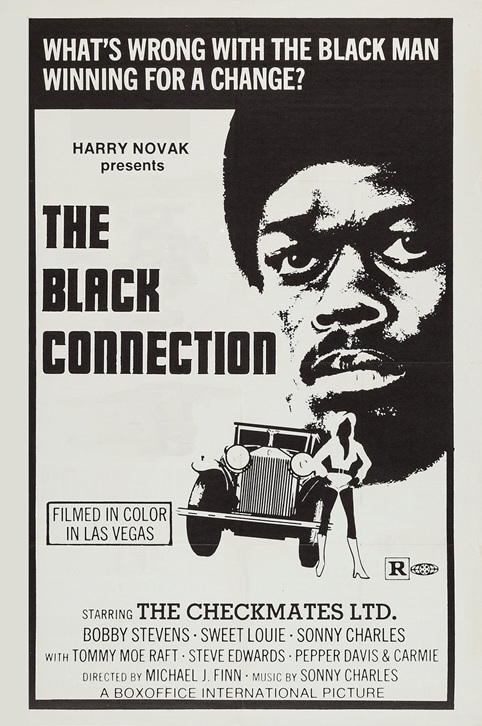
Miles Carter (Bobby Stevens) is a smooth-talking Vegas drug dealer who owes the Mafia a good deal of money due to some missing cocaine. Knowing that he’s in trouble but still confident that he can outsmart a bunch of goombahs in ill-fitting suits, Miles heads to Albuquerque so he can make another drug deal that will net him enough money to pay off the mob. But Miles isn’t actually planning on paying back the mob. Instead, he’s planning on taking whatever money he makes and then fleeing to Mexico. However, the Mafia has an assortment of overweight hit men with bad haircuts and they’ve all been sent to take down Miles.
That’s the plot of 1974’s The Black Connection. Or, at least, I think that’s the plot. It’s not a particularly easy film to follow. The film starts out with nearly thirty minutes of minor characters talking to each other and making phone calls. Once Miles does finally show up, it’s difficult to really know what he’s trying to pull because 1) the dialogue is so muddled that it’s nearly impossible to make out and 2) Bobby Stevens was not a particularly good or compelling actor. Instead, he was the lead singer for a band called The Checkmates, ltd. His bandmates appear in minor roles and also perform the film’s rather generic score. Bobby Stevens supposedly came up with the story for The Black Connection but it’s interesting to note that, in the opening credits, there’s no “written by” credit. Instead, someone is credited with being a script supervisor. That would perhaps explain why the film doesn’t really seem to be complete story as much as it’s just a bunch of random scenes that have been strung together.
The Black Connection is not a long film but I would still say that it’s probably about 60% filler. This is one of those films where no one does anything without announcing that they’re going to do it and then debating whether or not they should actually do it before doing it. It’s revealed that phones make Miles paranoid and yet the entire film is full of people talking and talking and talking on the phone. I lost track of how many shots there were of people dialing a landline and then waiting for someone to answer. There were also multiple shots of people in phone booths. At times, the film felt as if it should have been put in a time capsule so that, decades later, people could experience what it was like to live in the days before the invention of the iPhone.
There are a few scenes that work or, at the very least, are watchable. A scene in which a fat mobster shows off his karate skills is interesting because …. well, he’s a fat mobster. A scene in which two other mobsters grin while firing their guns into a car is notably gruesome and made all the more disturbing by the joy that the mobsters take in their work. Finally, the film ends on a downbeat note that would probably be more effective if not for the buckets of fake blood that were apparently splattered around right before the director shouted, “Action!”
This film was produced by the infamous Harry H. Novak. It’s nowhere near as sleazy as some of Novak’s other films. That’s actually kind of a shame. Sometimes, sleaze is the only thing that can save a film this inept.

