When my mom was dying in 2008 and then when my Dad was in hospice care in 2024, I learned just how important nurses were.
While the doctors that I dealt with were often brusque and overworked, the nurses were the ones who always took the time to answer my questions. While the doctors took an attitude of, “Death happens,” the nurses were the ones who were willing to show compassion. They were the ones who seemed to understand the pain that both myself and my sisters were going through. The nurses were the ones who seemed to care. Even when it comes to something simple like getting my ADHD prescription renewed, I always feel more relaxed when I’m dealing with a nurse than dealing with a doctor.
(Don’t get me wrong. I understand why doctors so often avoid a personal connection with their patients. As Doctor Warshaw (Richard Stahl) puts it in 1970’s The Young Doctors, “mourning is reserved for loved ones.” It may sound cold but it’s the truth.)
When my Dad was in home hospice, we had a nurse the came by the house every day. She was cool and professional but still always seemed to care. She was also a chain-smoker and there were more than a few days that I stepped outside with her. She always had an extra cigarette for me. Usually, I don’t smoke because I have asthma but, at that time, I was so stressed that the calming effect of smoking made the risk worth it. Knowing that the nurse would always arrive early in the morning helped me deal with a very difficult time. At a time when everything felt like it was spinning out of control, the nurse was someone upon whom I could depend. After my father died, I struggled to adjust to a lot of things, including the absence of the nurse. I discovered I missed the nurse’s professional presence. I missed talking about my feelings while burning a cigarette down to its filter.
In short, I have a lot of respect for nurses. They have a difficult job, one that I certainly could not do. But I’m thankful for all that they’ve done for me, my family, and other people’s families.
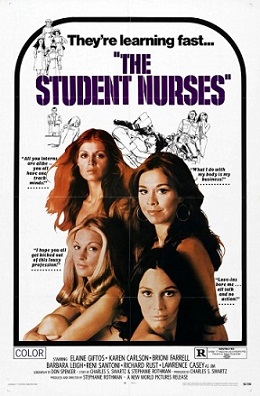
With all that in mind, I watched 1970’s The Student Nurses earlier today.
The Student Nurses tells the story of four women who are studying to be nurses while working at the local hospital. Phred (Karen Carlson) is introduced when she’s attacked by a crazed patient. Later, she falls for a doctor named Jim (Lawrence P. Casey). Sharon (Elaine Giftos) grows close to a terminally ill patient (Darrell Larson) and discovers the wisdom of Dr. Warshaw’s admonition about mourning. Priscilla (Barbara Leigh), who is regularly admonished for the length of her skirt and for never wearing a bra, meets a charismatic drug dealer named Les (Richard Rust). Les is all about dropping the acid on the beach but he’s not about sticking around when his girlfriend gets pregnant. And finally, Lynn (Brioni Farrell) meets a Latino political activist named Victor Charlie (Reni Santoni) and discovers that some people just aren’t rich enough to go to the hospital. When Victor shoots a cop during a raid on his headquarters, Lynn is forced to make a difficult decision.
The Young Nurses is almost legendary because of its status as a politically-themed exploitation film. It’s a Roger Corman production so there’s a lot of nudity. But director Stephanie Rothman used the genre to explore themes of class conflict and feminism. All four of the nurses are portrayed as being strong and independent women who have sex because they want to and who feel no shame about their decisions. For a 1970 film, that was a big deal. Interestingly, considering the film’s reputation, it’s actually fairly even-handed when it comes to the differing worldviews of the nurses. One of the nurses decides that she wants to serve in the Army Nurse Corps, even if that means going to Vietnam. Another ends up bragging about the gun that she’s carrying in her glove compartment, just in case anyone tries to stand in the way of the revolution. The film treats both of their decisions with respect. The important thing, the film seems to be saying, is that all of them are in control of their own future.
It’s an exploitation film, make no doubt about it. Today, we might talk about the film’s politics and its feminist subtext but I kind of doubt that’s what made the film a box office success in 1970. That said, Stephen Rothman brings some imagination to even the film’s most exploitive scenes. When Priscilla drops acid on the beach, Rothman slowly introduces more and more people to the scene, leaving us to wonder, just as Priscilla does, whether they’re real or their just a part of her trip. All four of the lead actresses are well-cast and fans of great character actors will probably enjoy seeing Reni Santoni playing someone other than a cop or a doctor.
Finally, like so many exploitation films, The Student Nurses is a true time capsule. The music, the clothes, the groovy slang, this is a film that proudly announces that it was made in 1970. We may not have time machines but at least we have the movies.
I have no idea if The Student Nurses is a realistic portrayal of what it was like to be a student nurse in 1970. That said, it’s an entertaining film and, in its grindhouse way, a tribute to the nurses who do so much.

