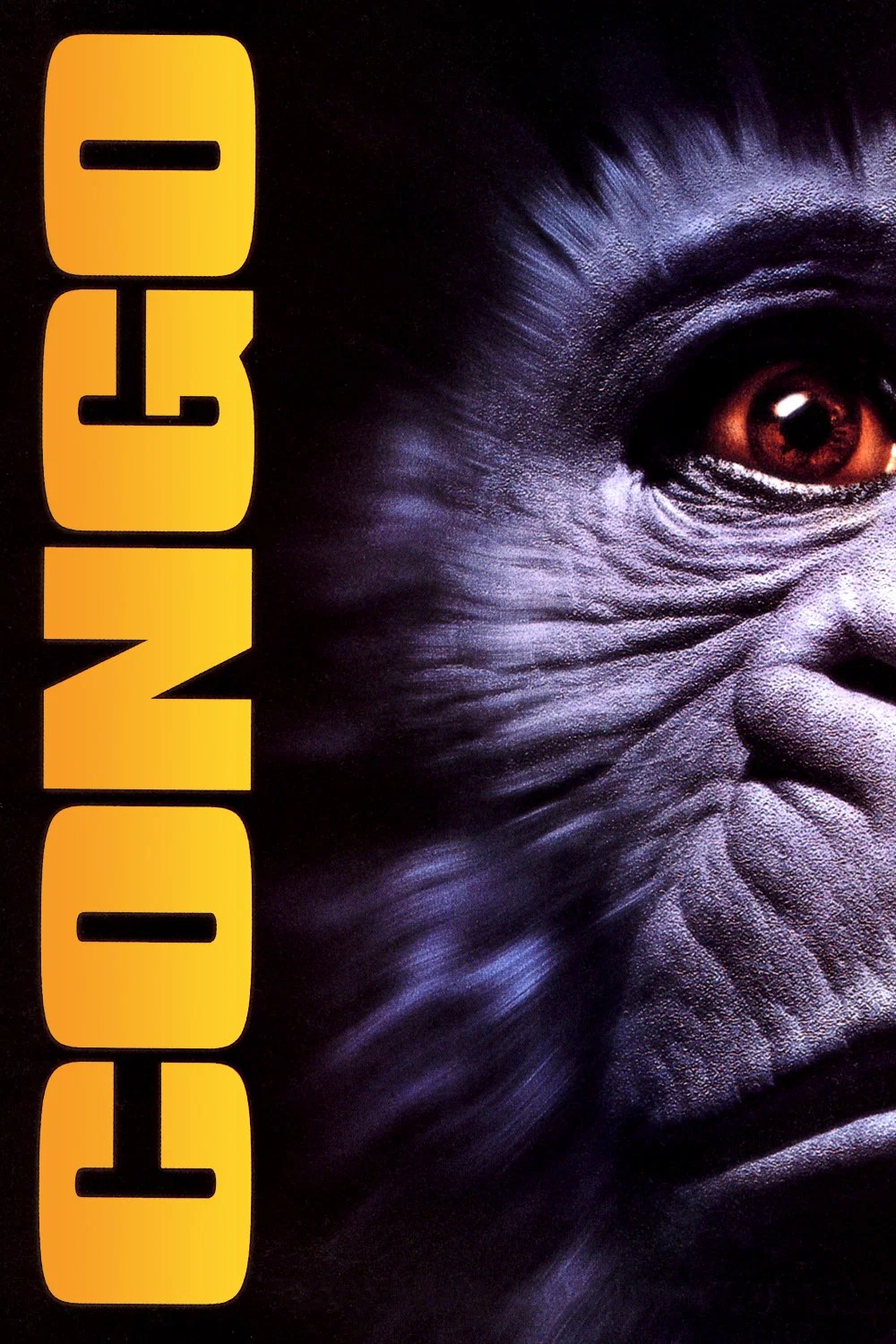
Congo is the kind of movie that makes perfect sense as a guilty pleasure because it is always hovering just above the level of complete nonsense, yet it has enough energy and conviction to remain enormously watchable. Directed by Frank Marshall, the 1995 film turns Michael Crichton’s jungle-thriller premise into a sprawling mixture of monster movie, treasure hunt, corporate conspiracy, technological anxiety, and old-fashioned adventure serial. It is loud, messy, often ridiculous, and loaded with moments that should not work at all. But that is the pleasure of Congo: it commits so completely to its bizarre material that the movie becomes difficult to dislike.
The setup is wonderfully overstuffed. A corporate expedition disappears while searching for a legendary diamond mine in the Congo, apparently after encountering some mysterious, deadly force. At the same time, primatologist Peter Elliot is preparing to return Amy, a gorilla he has raised and taught sign language, to the wild. Amy has recurring dreams—or perhaps memories—of a strange jungle city, and she communicates through a glove that translates her signs into a robotic voice. Before long, Peter, Amy, corporate representative Karen Ross, Romanian explorer Herkermer Homolka, and a mercenary guide named Captain Munro Kelly are all headed toward the same lost city, where diamonds, ancient ruins, and murderous white gorillas await.
That synopsis alone explains why Congo has developed such a devoted guilty-pleasure reputation. It is a movie where satellites, laser weapons, genetically engineered guard apes, corporate greed, sign-language research, volcanoes, and ancient African mythology all exist in the same story without anyone pausing to question the sheer overload of it. The movie treats every development with sincere urgency, even when the audience is watching Amy the gorilla say “Amy good gorilla” through a computerized voice device. It is impossible not to admire the confidence. Congo never winks at the audience, never admits that its premise is wild, and never cuts itself down to a more manageable size. It simply keeps adding more adventure-movie ingredients until the whole thing becomes strangely hypnotic.
Laura Linney’s Karen Ross and Dylan Walsh’s Peter Elliot are meant to anchor all of that craziness, but they are also among the film’s blandest elements. Linney is a talented actress, and she brings a professional focus to Karen’s corporate mission, but the character is written in such functional terms that she rarely feels like more than the person carrying the plot’s technological and business-related exposition. Karen is competent, determined, and occasionally vulnerable, but she never develops a particularly distinctive personality. Linney plays her with a seriousness that fits the film’s overall tone, yet that seriousness can make her feel oddly distant. She is there to make sure the satellite plot, the diamond plot, and the rescue plot keep moving, rather than to provide much spark on her own.
Walsh has an even tougher assignment as Peter. He is essentially the emotional center of Amy’s story, and the film needs the audience to believe in his paternal, almost codependent relationship with her. But Peter is such a mild, generic protagonist that he often gets swallowed by the movie’s more eccentric ideas. Walsh is not bad, exactly; he is simply too subdued for a film filled with volcanic eruptions, killer gorillas, and Tim Curry speaking every line as though he is announcing the end of civilization. His performance has a sincere gentleness that helps the scenes with Amy, but it also makes him feel like he wandered in from a quieter, more conventional family adventure. When the movie becomes bigger and stranger, Peter’s personality does not expand with it.
That blandness becomes especially noticeable because Ernie Hudson and Tim Curry are having such an obviously fantastic time in their roles. Hudson plays Captain Munro Kelly with the relaxed confidence of someone who knows he is the coolest person in the room. Munro is a professional guide, a fighter, a pilot, and a survivor, but Hudson does not turn him into a grim action-movie cliché. He gives the character humor, charisma, and a reassuring calm under pressure. Whenever the group faces another disaster—whether it is hostile terrain, dangerous animals, mercenaries, or the increasingly unhinged situation inside the lost city—Hudson makes Munro feel like the one person who might actually know what he is doing.
Hudson’s performance also gives Congo a sense of fun that the central characters sometimes lack. He has an easy screen presence, and he seems to understand that the film works best when it leans into the pleasures of a grand, pulpy adventure. Munro is not a particularly deep character, but Hudson makes him memorable through timing, attitude, and sheer likability. The movie becomes livelier whenever he takes charge, whether he is negotiating with people in the field or calmly reacting to another completely absurd revelation. If Karen and Peter are the story’s functional leads, Munro is the character who gives the audience someone to enjoy following.
Then there is Tim Curry as Herkermer Homolka, who delivers what can only be described as a masterclass in hammy, scenery-chewing entertainment. Curry does not merely play Homolka; he devours the role with a kind of operatic enthusiasm. Every line is delivered in his grand Romanian accent with the force of a proclamation, and every gesture suggests that Homolka believes he is the hero of the greatest expedition in history. Curry appears to be enjoying himself so much that it becomes infectious. He is not interested in realism, restraint, or subtle characterization. He is there to make every scene larger, louder, and more theatrical.
Homolka is already a ridiculous figure on the page: a pompous explorer with a famous family name, an exaggerated ego, and a dramatic flair that makes him seem less like a real adventurer than a flamboyant villain from a lost serial. Curry recognizes that the only correct way to play him is at maximum volume. His performance turns every bit of dialogue into an event. He gives the impression that he has spent years preparing speeches for this exact jungle expedition, waiting for the chance to announce his discoveries to the world. Even when Homolka is making selfish or foolish decisions, Curry makes him too entertaining to hate.
The contrast between Curry and the more restrained leads is one of the reasons Congo feels so odd. Linney and Walsh approach the material with a level of seriousness that suggests they are trying to preserve some emotional credibility. Hudson and Curry, by contrast, seem to recognize that credibility is not really the point. Hudson brings a cool, knowing charm, while Curry turns the movie into a one-man theatrical spectacle whenever he appears. Neither approach is necessarily wrong, but the difference creates a tonal imbalance. The film’s heroes feel flat because its supporting players are so much more alive.
The killer gorillas, of course, are another major source of the film’s guilty-pleasure appeal. These are not normal gorillas defending their territory. They are pale, vicious creatures bred to protect the diamond city of Zinj, and they attack with the exaggerated menace of monsters in a haunted-house ride. The effects have not aged gracefully. The suits and animatronics are visible, the movements can be stiff, and the creatures are often more amusing than frightening. Yet they remain memorable because the movie gives them a distinct, nightmarish look: white fur, glowing eyes, sharp teeth, and sudden appearances from dark corridors or jungle fog.
Frank Marshall directs the action with enough pace and polish to keep Congo from collapsing under the weight of its own silliness. The jungle setting, the ruined city, the expedition equipment, the satellite imagery, and the volcanic finale all give the movie a bigger sense of scale than its reputation might suggest. It feels like a genuine studio blockbuster from a time when Hollywood would spend serious money on an unapologetically strange idea. The film is not elegant, and it is certainly not believable, but it is never boring for long.
As a conventional adventure movie, Congo is uneven. Its African setting is often treated as a vague, dangerous backdrop, and its plot is overloaded with enough corporate jargon and techno-babble to distract from the more entertaining monster-movie material. But as a guilty pleasure, it is hard to beat. The movie is too bizarre to be generic and too sincere to feel cynical. Laura Linney and Dylan Walsh may be stuck playing bland characters at the center of the chaos, but Ernie Hudson and especially Tim Curry make the journey worth taking. Curry’s performance alone is a treasure: a joyous, magnificent display of overacting that turns Congo from a merely strange blockbuster into something genuinely unforgettable.
Previous Guilty Pleasures
- Half-Baked
- Save The Last Dance
- Every Rose Has Its Thorns
- The Jeremy Kyle Show
- Invasion USA
- The Golden Child
- Final Destination 2
- Paparazzi
- The Principal
- The Substitute
- Terror In The Family
- Pandorum
- Lambada
- Fear
- Cocktail
- Keep Off The Grass
- Girls, Girls, Girls
- Class
- Tart
- King Kong vs. Godzilla
- Hawk the Slayer
- Battle Beyond the Stars
- Meridian
- Walk of Shame
- From Justin To Kelly
- Project Greenlight
- Sex Decoy: Love Stings
- Swimfan
- On the Line
- Wolfen
- Hail Caesar!
- It’s So Cold In The D
- In the Mix
- Healed By Grace
- Valley of the Dolls
- The Legend of Billie Jean
- Death Wish
- Shipping Wars
- Ghost Whisperer
- Parking Wars
- The Dead Are After Me
- Harper’s Island
- The Resurrection of Gavin Stone
- Paranormal State
- Utopia
- Bar Rescue
- The Powers of Matthew Star
- Spiker
- Heavenly Bodies
- Maid in Manhattan
- Rage and Honor
- Saved By The Bell 3. 21 “No Hope With Dope”
- Happy Gilmore
- Solarbabies
- The Dawn of Correction
- Once You Understand
- The Voyeurs
- Robot Jox
- Teen Wolf
- The Running Man
- Double Dragon
- Backtrack
- Julie and Jack
- Karate Warrior
- Invaders From Mars
- Cloverfield
- Aerobicide
- Blood Harvest
- Shocking Dark
- Face The Truth
- Submerged
- The Canyons
- Days of Thunder
- Van Helsing
- The Night Comes for Us
- Code of Silence
- Captain Ron
- Armageddon
- Kate’s Secret
- Point Break
- The Replacements
- The Shadow
- Meteor
- Last Action Hero
- Attack of the Killer Tomatoes
- The Horror at 37,000 Feet
- The ‘Burbs
- Lifeforce
- Highschool of the Dead
- Ice Station Zebra
- No One Lives
- Brewster’s Millions
- Porky’s
- Revenge of the Nerds
- The Delta Force
- The Hidden
- Roller Boogie
- Raw Deal
- Death Merchant Series
- Ski Patrol
- The Executioner Series
- The Destroyer Series
- Private Teacher
- The Parker Series
- Ramba
- The Troubles of Janice
- Ironwood
- Interspecies Reviewers
- SST — Death Flight
- Undercover Brother
- Out for Justice
- Food Wars!
- Cherry
- Death Race
- The Beast Within
- Girl Series
- Gone in 60 Seconds
- Swordfish
- Marked For Death
- The Internship
- The Angry Red Planet
- 2012
- Old School
- No Escape
- In Death Series
- Alligator
- Little Annie Fanny
- Wicked Wanda

