Scenes I Love: Punisher: War Zone


PunisherWarZone

In honor of Jon Bernthal being cast as the latest in a line of Frank Castles aka the Punisher for Marvel’s Daredevil series on Netflix, I thought I’d share with all my favorite scene from the only Punisher film worth the name. The film this scene is from was Punisher: War Zone by Lexi Alexander.

While the casting of Jon Bernthal looks to be a near perfect stunt-casting by Marvel for Daredevil‘s upcoming second season on Netflix, I thought Ray Stevenson’s portrayal as the psychotic antihero in Punisher: War Zone was the best one comic book fans have gotten. Dolph Lundgren was the first Punisher and the less said about him the better. Then Thomas Jane took a stab on portraying the character to some success though still not doling out enough punishing in my book.

With Ray Stevenson we got a Frank Castle who was well into his vigilante killing-spree of the criminal underworld. This was a man possessed to kill in as brutal and efficient manner every violent criminal he comes across. The film itself was so over-the-top that too many thought it was too campy in a violent sense when Lexi Alexander actually tapped into what made the Punisher tick and put it up on the screen. It also helped that Ray Stevenson owned the role he was given.

Jon Bernthal has some big shoes to fill, but with the success of Daredevil the series I do believe he has a chance to make the character his own.

Embracing the Melodrama Part II #109: There Will Be Blood (dir by Paul Thomas Anderson)


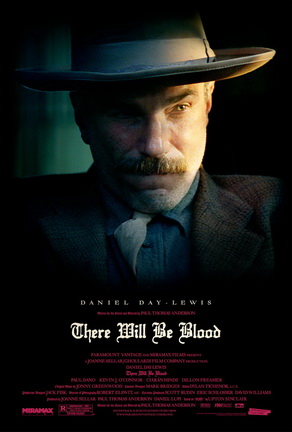
There_Will_Be_Blood_PosterYou know how there are some films that you really want to love and that you know that, given your taste in cinema, you probably should love but yet you somehow just cannot bring yourself to actually love?

To a certain extent, that’s the way I feel about the 2007 best picture nominee There Will Be Blood.  It’s a film that I greatly respect, as I tend to respect all of Paul Thomas Anderson’s movies.  He’s one of the best director working today and also one of the most consistently interesting.  (He’s also probably the only contemporary filmmaker who would actually base a two and half hour epic on the first 150 pages of a forgotten novel by Upton Sinclair.)  And I think that There Will Be Blood is a well-made and well-directed film.  I also think it’s well-acted, though I do think Daniel Day-Lewis goes a bit too far over-the-top at the film’s conclusion.   (If anything, Paul Dano is the one who actually deserved to win an Oscar for his work in this film.)  There Will Be Blood is an original work of cinematic art.  I’m thankful that it was made and that Anderson stayed true to his vision.

But, with all that in mind, it’s never been a film that I’ve been able to love.  Unlike Anderson’s earlier Boogie Nights, There Will Be Blood holds the audience at a distance.  We remains outsiders looking in.  As a result, the film engages intellectually but not emotionally.  It’s a film that earns respect without necessarily winning the audience’s love.

Speaking of respect, that’s something that you have to give to both Daniel Day-Lewis and Paul Thomas Anderson.  From the start of the film, Daniel Plainview (played by Day-Lewis) is a cruel and self-centered bastard and that characterization remains consistent throughout.  Briefly, it does seem that Plainview might truly care about his deaf, adopted son but, by the end of the film, Plainview has even proven that to be wishful thinking on our part.  (The only other character to whom Plainview is consistently pleasant is a young girl named Mary but Day-Lewis plays those scenes with such a corrupt twinkle in his eye that the subtext becomes increasingly creepy.)  Give Anderson and Day-Lewis credit.  They commit to portraying Daniel Plainview as being an almost Satanic character and, at no point, does either one of them waver in that commitment.  As we watch Plainview ruthlessly buy up all the land and drill all the oil that he can find, we wait for him to have some moment of redemption.  It took guts for neither Anderson nor Day-Lewis to allow him one.

Paul Dano plays Eli Sunday, an evangelical preacher who stands in the way of Plainview’s efforts to buy up all the land around the Sunday family farm.  The film presents Eli and Plainview as being two sides of the same coin.  Plainview hides his moral emptiness behind his money.  Eli hides behind his religion.  The two characters hate each other because they alone truly recognize what they truly are.  Dano, who also plays Eli’s brother, gives a mesmerizing performance, one that unfortunately has been overshadowed by Day-Lewis’s work.

It all ends, as all things must, with violent death in a bowling alley.  I know that a lot of my fellow cineastes think that the bowling scene is the highlight of the film but, to be honest, this was the point where the film lost me.  To me, this was the scene where Daniel Day-Lewis’s performance crossed the line from being flamboyant to shrill.  The end just did not work for me.

However, two things that did definitely work for me: Johnny Greenwood’s wonderfully ominous and atmospheric score and Robert Elswit’s amazing cinematography, which made the film’s landscape appear both beautiful and threatening at the same time.  The mix of Greenwood’s music with Elswit’s cinematography created some truly haunting moments.

In the end, There Will Be Blood is a lot like Daniel Plainview.  It is powerful, memorable, unpredictable, flamboyant, overbearing, and at times a little frightening.  And, again much like Daniel Plainview, it’s a film that’s easy to respect and difficult to love.

Katniss is back! Here’s the Trailer For The Hunger Games: Mockingjay Part 2!


Katniss Everdeen returns in The Hunger Games: Mockingjay Part 2!  If that title seems to be a little long and unwieldy, why not just do what we do hear at the TSL bunker and call it, “The Hunger Games: Jennifer Lawrence Kicks Ass…Again.”

The Measure of a Man: The Life and Career of Rocky Balboa


rocky-and-apollo-02

Have you heard the rumor?

Rocky Balboa, also know as the Italian Stallion and the former heavyweight champion of the world, is going to die.
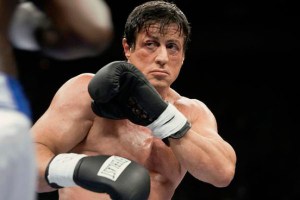
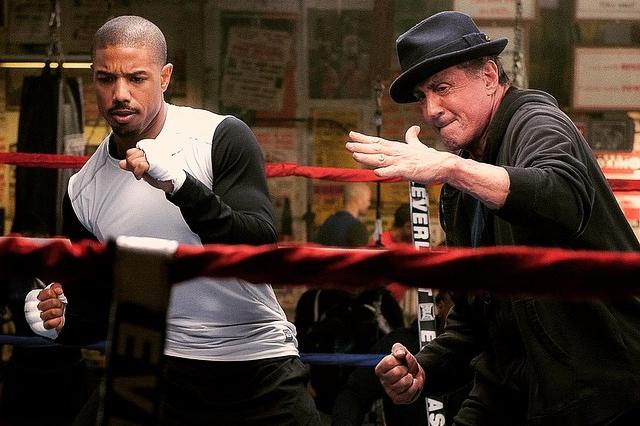
2013Rocky_SylvesterStallone_PA-14110031250713At least that is what some people think after reading the official plot synopsis of the upcoming boxing film Creed.  Here is the press release from MGM and Warner Brothers:

From Warner Bros. Pictures and Metro-Goldwyn-Mayer Pictures comes award-winning filmmaker Ryan Coogler’s “Creed.” The film explores a new chapter in the “Rocky” story and stars Academy Award nominee Sylvester Stallone in his iconic role. The film also reunites Coogler with his “Fruitvale Station” star Michael B. Jordan as the son of Apollo Creed.

Adonis Johnson (Jordan) never knew his famous father, world heavyweight champion Apollo Creed, who died before he was born. Still, there’s no denying that boxing is in his blood, so Adonis heads to Philadelphia, the site of Apollo Creed’s legendary match with a tough upstart named Rocky Balboa.

Once in the City of Brotherly Love, Adonis tracks Rocky (Stallone) down and asks him to be his trainer. Despite his insistence that he is out of the fight game for good, Rocky sees in Adonis the strength and determination he had known in Apollo—the fierce rival who became his closest friend. Agreeing to take him on, Rocky trains the young fighter, even as the former champ is battling an opponent more deadly than any he faced in the ring.

With Rocky in his corner, it isn’t long before Adonis gets his own shot at the title…but can he develop not only the drive but also the heart of a true fighter, in time to get into the ring?

Sylvester-Stallone-creedMany have interpreted that to mean that, while training Adonis, Rocky will be battling cancer.  With the exception of the first one and Rocky V, every installment in the Rocky franchise has featured a character either dying or coming close.  Since Paulie will apparently not be appearing in Creed, that leaves Rocky himself as the most likely candidate to tragically pass away before or after the big fight.  In death, Rocky would not only pass on his legacy Adonis Creed but Sylvester Stallone would pass on the Rocky franchise to Ryan Coogler and Michael B. Jordan.

With his days possibly numbered, I decided to take a look back at Rocky Balboa’s amazing career.

Rocky (1976)

Sylvester Stallone was just another out-of-work actor when, one night in 1975, he saw a little known boxer named Chuck Wepner go 15 rounds against the reigning heavyweight champion, Muhammad Ali.  Inspired by the fight, Stallone wrote the first draft of Rocky in three days.  When he sold his script, he did so with one condition: that he be allowed to play Rocky Balboa.  You know the rest of the story: Directed by John G. Avildsen, Rocky became a huge box office hit, won the Oscar for best picture of the year, and made Sylvester Stallone into an unlikely star.
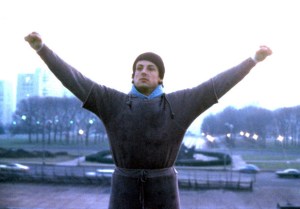
618_movies_rocky_10Rocky Balboa is an aging boxer and a collector for Philadelphia loan shark, Tony Gazzo (Joe Spinell).  The current heavyweight champion, Apollo Creed (Carl Weathers), is scheduled to fight a match in Philadelphia in honor of America’s bicentennial.  When his opponent injures his hand, Apollo decides to give a local boy a chance and the unknown Rocky gets a once-in-a-lifetime shot at the title.  Nobody gives Rocky a chance, except for Rocky.  With the help of grizzled trainer Mickey (Burgess Meredith) and alcoholic best friend, Paulie (Burt Young), Rocky prepares for the fight.  After a training montage (the first of many) that ends with Rocky running up the steps of the Philadelphia Museum of Art, Rocky shocks everyone by going the distance against Apollo.  Though he loses by a split decision, Rocky wins both his self-respect and the love of Paulie’s sister, Adrian (Talia Shire).

Rocky holds up as one of the best boxing movies ever made and it set the standard by which almost all future underdog sports movies have been judged.  Rocky may have ended with Rocky ready to take off his gloves and concentrate on his life with Adrian but the box office demanded that Rocky get another once-in-a-lifetime shot.

Rocky II (1979)

The first Rocky may have ended with Apollo saying there would be no rematch and Rocky replying that he did not want one but the film’s box office success said otherwise.  In Rocky II, Apollo is stung by criticism over how he nearly lost his first fight against Rocky and demands a rematch.  At first, Rocky refuses but, with no prospects and a wife, son, and alcoholic brother-in-law to support, Rocky finally agrees to a rematch.  What follows is largely a repeat of the first film, except this time Rocky has a lot more fans following him through the streets of Philadelphia during his training montage and Rocky actually wins the fight, becoming the heavyweight champion of the world.
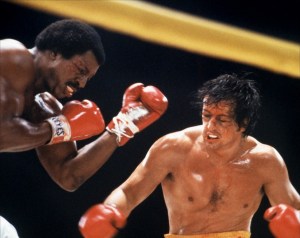
rocky-ii-1979-01-gThe best thing about Rocky II is that it fleshes out the character of Apollo.  No longer is he just the cocky villain from the first film.  Instead, he is revealed to be a proud man, a fierce competitor, and a worthy opponent. Though he may lose the final fight, Apollo regains the respect that he sacrificed as the end of the first film.

Rocky II is also notable for being the first film in the franchise to be directed by Sylvester Stallone.  Stallone would direct all of the subsequent installments, with the exception of the John G. Avildsen-directed Rocky V.

Rocky III (1982)
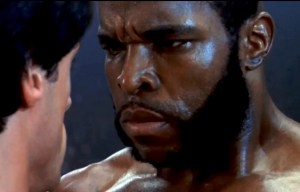
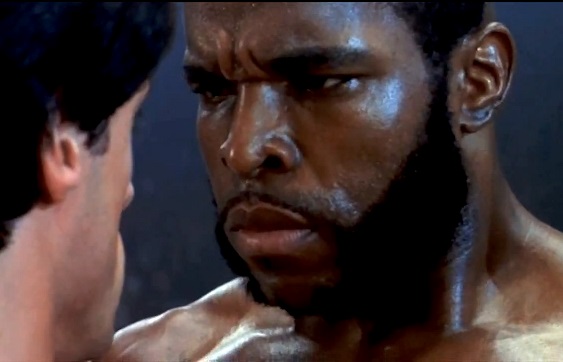
mr-t-plays-clubber-in-rocky-iiiRocky III has the best opening of the franchise.  While Rocky does commercials and trades jokes with Kermit and Miss Piggy on The Muppet Show, Clubber Lang (Mr. T) relentlessly trains and savagely knocks out every opponent that he faces in the ring.  The premise of the first two films has been reversed.  Now, Rocky is the overconfident champion who does not take his latest fight seriously while Clubber Lang is the challenger who is hungry for victory.  Clubber has the “eye of the tiger” and is determined to win.  Rocky is busy doing charity events with Hulk Hogan and bailing alcoholic freeloader Paulie out of jail.

Rocky III features the first death of the franchise, when Clubber shoves Mickey so hard that Mickey ends up having a heart attack and dying almost immediately after Clubber defeats Rocky and becomes the new heavyweight champion of the world.  As if Rocky needed another reason to demand a rematch, Mickey’s death makes it personal.  Unfortunately, Rocky has lost his hunger.  He no longer has the eye of the tiger.

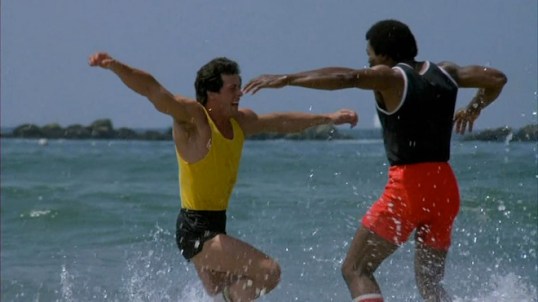
Fortunately, Rocky’s former rival, Apollo Creed, is there to help him get it back.  Taking over as Rocky’s trainer, Apollo gets the former champion back into fighting shape.  This means that it is time for a training montage!  This one ends with a great moment in bromance history as Rocky and Apollo embrace while jumping up and down in the ocean.

2009654-rocky_iii_l_oeil_du_tigre_1983_07_gRocky III ends with what may be the best fight in the history of the franchise.  It is also the only fight to be shown straight from beginning to end, without jumping to future rounds.  From the start of the fight, it is obvious that Clubber is stronger than Rocky but, taking a page from the rope-a-dope strategy that Muhammad Ali used on George Foreman in Zaire, Rocky knows that Clubber is so aggressive that he will tire himself out before the end of the fight.  Once Clubber has exhausted himself, Rocky sends him down to the canvas.

At the end of the film, Rocky and Apollo square off one last time to see who is truly the best boxer.  The film ends before the first punch is thrown and we never find out who won.  I like to think that it was Apollo, if just because I know what is going to happen to him in Rocky IV.

Rocky IV (1985)
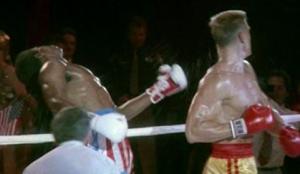
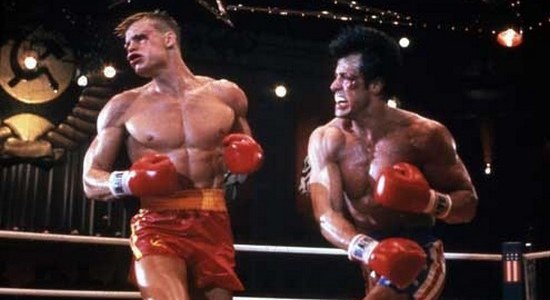
Ivan_kills_ApolloHaving defeated every contender in the U.S., it only made sense that Rocky’s next opponent would come from the evil empire itself, the Soviet Union.  But before Rocky could battle Ivan Drago (Dolph Lundgren), someone had to die.  This installment’s sacrificial victim was none other than Apollo Creed.  Apollo dies in the ring, beaten to death by the robotic Russian.  Of all the deaths in the Rocky franchise, Apollo’s was the most shocking and the most traumatic.  After Apollo falls face forward onto the mat, his body is still twitching even as Ivan says, “If he dies, he dies.”

Knowing that he should have been in the ring instead of Apollo, Rocky challenges Drago to a rematch, to be held in Moscow on, of all days, Christmas.  Leaving behind his mansion, his son, and his robot (yes, Rocky owns a robot in this one), Rocky goes to Siberia and that means that it is time for a training montage!  While Drago trains with machines and shoots steroids, Rocky trains by chopping wood and running in the snow.
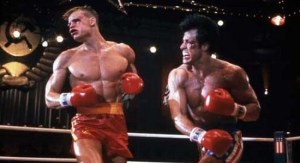
lXRPTbIt’s a tough fight.  At first, Drago does not even seem to feel Rocky’s punches.  The Soviet audience (including someone who looks a lot like Mikhail Gorbachev) chants Drago’s name.  Just like in Philadelphia, Rocky refuses to go down.  The crowd starts to chant Rocky’s name.  When Drago’s manager demands that he win the fight in the name of communism, Drago shouts that he does not fight for the Soviet Union, he fights for himself.  Finally, with seconds left in the final round, Rocky knocks Drago out.
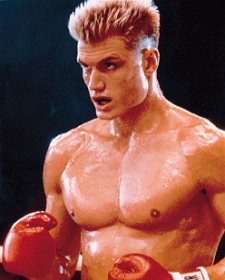
Lundgren_Ivan_DragoAs a bloody Drago looks on, Rocky literally wraps himself in an American flag and gives a speech.  Rocky thanks the Americans and the Soviets for supporting him and then says, “”If I can change, and you can change, then everybody can change!”  Gorbachev stands and applauds.  Is it just a coincidence that, four years later, the Berlin Wall fell and the Cold War ended?

Rocky IV may be the best remembered of all of the Rocky films.  Ivan Drago was Rocky’s greatest and most imposing opponent and it is not surprising that, despite killing Apollo, he still has a strong fan base.  Unlike Clubber Lang, Ivan is a cold and methodical machine.  Rocky’s improbable win over him is not just a victory for America but a victory for humanity as well.

Rocky V (1990)

Is Rocky V canonical?  A lot of fans consider this to be the weakest film in the franchise.  Despite writing the film’s screenplay, Sylvester Stallone reportedly hates Rocky V and ignored it when he made Rocky Balboa.
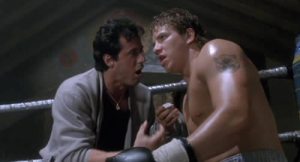
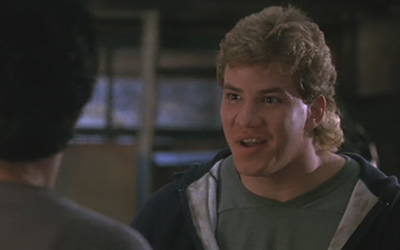
rocky-5Rocky V starts with Rocky retiring after being told that his battle with Drago has left him with permanent brain damage.  Paulie, proving once again that he’s the worst best friend that anyone could hope for, loses all of Rocky’s money.  Rocky, Adrian, and Rocky, Jr. (now played by Sage Stallone) move back to the old neighborhood.  Following in the footsteps of Mickey and Apollo, Rocky trains a mulletheaded young boxer named Tommy Gunn (Tommy Morrison).  Instead of a training montage, we get a fight montage as Tommy becomes a champion but rejects Rocky’s management and signs with Don King George Washington Duke (Richard Gant).  Tommy and Rocky eventually face off in a street fight.  Originally, the plan was for Rocky to die at the end of the fight but, fortunately, someone in production realized that nobody would want to see Rocky Balboa beaten to death by Tommy Morrison.
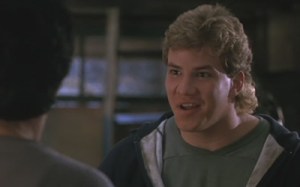
551-3Tommy Morrison was a real-life boxer.  Rocky V was his only film role and he’s almost too convincing as the dim-witted Tommy Gunn.  In the real world, Tommy Morrison was suspended from boxing in 1996 when he tested positive for HIV.  He spent the rest of his life loudly insisting that the test was a false positive and trying to make a comeback.  He was 44 years old when he died of AIDS in 2013.

Rocky V suffers because Tommy Gunn and George Washington Duke cannot begin to compare to great Rocky opponents like Clubber Lang and Ivan Drago.  However, Rocky V does feature one of the franchise’s best endings.  Rocky and Rocky, Jr. jog up the steps of the Philadelphia Museum of Art and, father and son together, they finally decide to enter the building and discover what’s inside.

Rocky Balboa (2006)

After the critical and box office failure of Rocky V, it seemed like Rocky Balboa had retired for good.  However, after 16 years of well-deserved retirement, Rocky followed the path of George Foreman, Larry Holmes, and Riddick Bowe and decided to make a comeback.

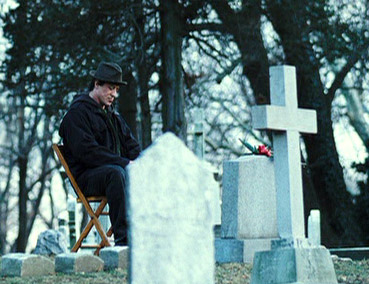
guide_cemeteryAs Rocky Balboa begins, Rocky is a widower and owns an Italian restaurant named Adrian’s, where he spends most of his time telling patrons stories about his fighting career.  He is estranged from his son, who now wants to be called Robert and is played by Milo Ventimiglia, but Rocky still has his best friend Paulie.  If not for Rocky, Paulie would probably be living in a cardboard box.  After a computer simulation suggests that Rocky, in his prime, could have defeated the reigning heavyweight champion, Mason Dixon (Antonio Tarver), Rocky comes out of retirement for one last fight.  With the help of Apollo’s former trainer, Duke (Tony Burton), Rocky proves that he can still go the distance, even though he ultimately loses the fight in a split decision.

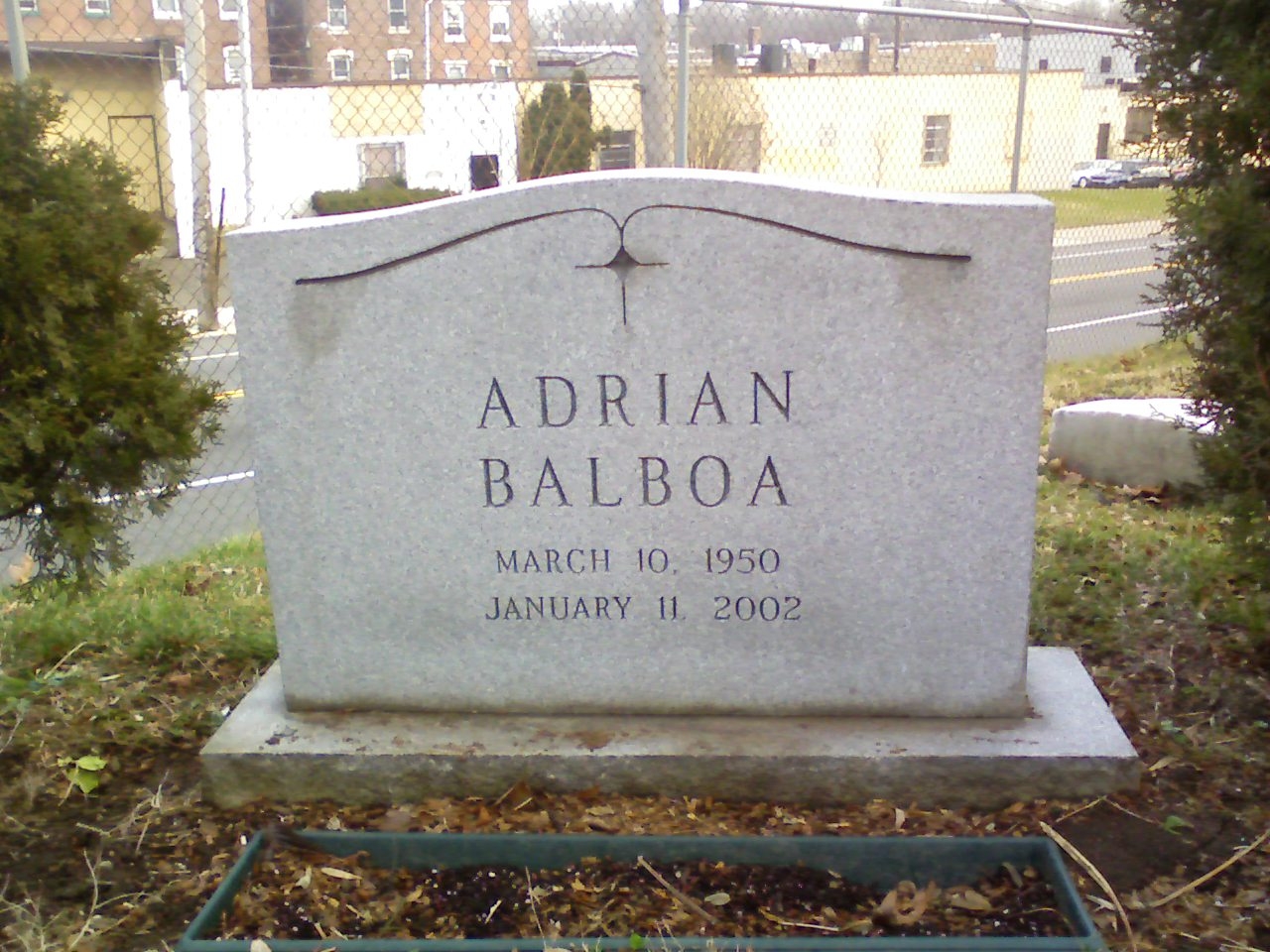
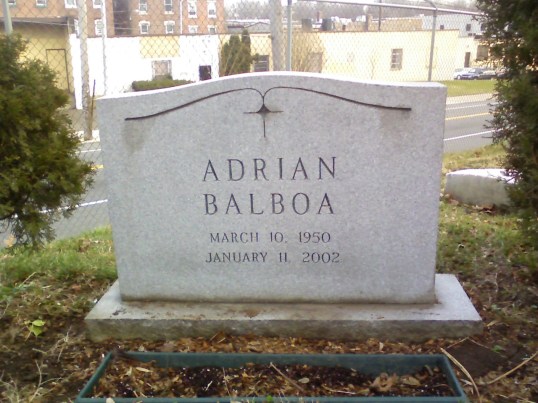
At the start of the film, Adrian has been dead for four years.  However, her ghost haunts the film.  Rocky regularly visits her grave and the film ends with him at her grave and saying, one last time, “Yo Adrian, we did it.”  Stallone may be the battered face of the Rocky franchise but Talia Shire was the heart.  Though she’s only seen in flashback, Rocky Balboa is a tribute to the way that Talia Shire brought Adrian to life.

Sentimental and nostalgic, Rocky Balboa felt like the perfect way to end the franchise.  However, Rocky will be returning for at least one more fight when Creed is released on November 25th.
01070815061

Embracing the Melodrama Part II #108: The Brave One (dir by Neil Jordan)


Brave_one_2007For our next entry in Embracing the Melodrama Part II, we take a look at Jodie Foster in the 2007 film The Brave One.  And…

Well, how to put this delicately?

I hate hate hate hate HATE this movie, with every last fiber of my being.  I hated it the first time that I saw it and I hated it when I recently rewatched it and right now, I’m hating the fact that I even decided to review this damn film because it means that I’m going to have to think about it.  I’m going to try to get this review over with quickly because, with each minute that I think about this film, I doubt my commitment to cinema.  That’s how much I hate this movie.  If I’m not careful, I’m going to end up joining a nunnery before I finish this review…

So, in The Brave One, Jodie Foster plays Erica Bain.  Erica lives in New York and hosts one of those pretentious late night radio shows that are always popular in movies like this but which, in real life, nobody in their right mind would waste a second listening to.  Erica spends her time musing about life in the big city and hoping that we can all just love one another and expressing a lot of other thoughts that sound like they’ve been stolen from an automated twitter account.

Erica also has a boyfriend.  His name is David and he’s played by Naveen Andrews.  That means that he looks good and he has a sexy accent and when he first shows up, you hope that he’ll stick around for a while because otherwise, you’re going to have to listen to move of Erica’s radio monologues.  But nope — one night, while walking through Central Park, David and Erica are attacked.  David is killed.  Erica is raped.  And their dog is taken by the gang!

(And the film doesn’t seem to know which it thinks is worse…)

When Erica gets out of the hospital, she is, at first, terrified to leave her apartment.  Or, at least, she’s terrified to leave her apartment for about five minutes.  But then she does find the courage to go outside and, of course, the first thing she does is buy a gun.  At first, she’s buying the gun for her own state of mind but, almost immediately after purchasing her firearms, she happens to stumble across a convenience store robbery.

Bang!  Bang!  Erica’s a vigilante now!

But, of course, she’s not really sure if that’s what she wants to be.  Even though she eventually ends up sitting on a subway and waiting for a guy to approach her so she can shoot him, Erica is still never really that comfortable with the idea of seeking vengeance.  And this is why I hated The Brave One.  The film is so damned wishy washy about Erica’s motivations.  Instead of allowing Erica to get any sort of satisfaction or emotional fulfillment out of her actions, The Brave One has her constantly doubting whether or not violence is the answer.  And don’t get me wrong, I’m not saying that violence is the answer.  But if you’re going to make a film about a female vigilante who is out looking for vengeance, why don’t you at least allow her to get some sort of empowerment out of her actions?  That doesn’t mean that the film itself can’t be ambiguous about what she’s doing.  But by having Erica constantly questioning her actions, it makes her into a weak character and it lets the men who raped her and the ones who subsequently threaten to do the same off the hook.  It allows them to be seen as victims, as opposed to products of a society where men are raised to believe that women will never fight back.

There’s a far superior New York-set film that has almost the same plot as The Brave One.  The title of that film was Ms. 45.  It was made for a hundred times less money than The Brave One and, at the same time, it was and remains a hundred times better.  (I previously wrote about Ms. 45 and The Brave One in my essay, Too Sordid To Ever Be Corrupted.)

The difference between the two films can be summed up by the film’s tag lines.  The Brave One was advertised with, “How many wrongs to make it right?”  Ms. 45 was advertised with: “She was abused and violated … IT WILL NEVER HAPPEN AGAIN!”   Ms. 45 features a vigilante who never doubts her actions and, as a result, she becomes a symbol not of violence but of empowerment.  Meanwhile, Jodie Foster is so constantly wracked with guilt and doubt that the film almost seems to be criticizing her for not staying in her apartment and trusting the police (represented by Terrence Howard and Nicky Katt) to do their job.

Oh!  And, of course, at the end of the film, Erica gets her dog back.  Because nobody ever permanently loses their dog in a big budget studio film…

And really, that’s why The Brave One is such a failure.  It takes a subject that was tailor-made for the grindhouse and attempts to give it the slick and self-important studio approach.  And part of that approach is that no one can be offended.  This is a film that both wants to celebrate and condemn at the same time.

And that’s why I say, “Give me Ms. 45!”

At least that movie knows what it wants to say…

The Martian Arrives With An All-Star Cast


TheMartian

Ridley Scott, master filmmaker with a talent for visual storytelling, has had an uneven string of films the last decade or so. His last couple of films have either been underwhelming or divisive. One thing that hasn’t failed him has been the look of his films which continue to be great.

His last film, Exodus: Gods and Kings, wasn’t what one would call a great film. One could even say it wasn’t even a decent one. Hopefully, his latest will break his prolonged streak of misses and get him back on the hit column. This film is the adaptation of the Andy Weir best-selling novel, The Martian.

Ridley Scott has Drew Goddard’s screenplay adaptation to work with not to mention a star-studded cast led by Matt Damon and Jessica Chastain (the inclusion of the latter already makes this a must-see for one of the site’s writers). From the first released trailer we seem to be getting a film that brings back memories of Apollo 13 and Cast Away.

The Martian is set for a November 25, 2015 release date.

Embracing the Melodrama Part II #107: No Country For Old Men (dir by the Coen Brothers)


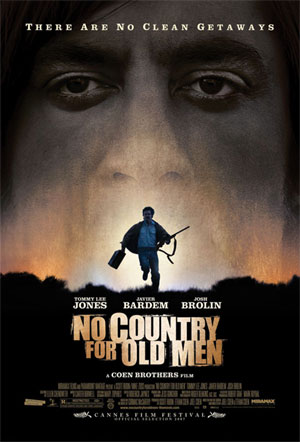
No_Country_for_Old_Men_posterI love my home state of Texas and I love movies. Therefore, it has always upset me that most movies set in Texas get the state totally wrong.  That’s not exactly shocking.  Unlike the rest of the states, there’s actually a lot of variety to Texas.  We’re a big state and we’re home to a lot of people.  Unlike some place like Vermont, Texas is a world all its own and it’s not surprising that most outsiders are incapable of getting their mind around that and instead find themselves embracing simple-minded clichés and stereotypes.  That’s perhaps why the best films about Texas tend to be ones that were actually made by Texans.  If you want to see the real Texas — flaws and all — than I suggest watching the films of Richard Linklater or perhaps Wes Anderson’s Rushmore.

And yet, it took two outsiders to write, produce, and direct one of the best films ever made about Texas.  The 2007 best picture winner No Country For Old Men was largely the work of two brothers from Minnesota, Joel and Ethan Coen.  It’s not only one of the best films about my home state but it’s also one of the best films of the past decade.

Based on a novel by Cormac McCarthy, No Country For Old Men tells the story of three determined men in South Texas whose lives are interconnected despite the fact that three of them spend almost the entire movie one step behind each other.  In fact, despite a few brief encounters where their paths meet, it can be argued that, at no point, do any of them truly interact with each other face-to-face.

Llewelyn Moss (Josh Brolin) is the type of person that anyone who has ever lived in Texas will have met.  He’s a hard-working, plain-spoken man, the type who drives a pickup, owns a gun, and likes to begin and end the day with a beer.  He lives in a trailer with his wife, Carla Jean (Kelly MacDonald, who may be Scottish but speaks here with an almost flawless Texas accent).  Llewelyn’s not a bad guy but he’s not as smart as he thinks and, like a lot of folks down here, he doesn’t like the idea of being told what to do.  In fact, he’d almost rather die for his trouble than admit to making a mistake.  When Llewleyn comes across the aftermath of a drug deal turned violent, he takes off with a suitcase that contains $2,000,000.  After barely escaping the remaining drug dealers (and the scene where Llewelyn is chased by a pit bull is a classic), Llewelyn sends Carla Jeans to stay with her sick mother and then he grabs the suitcase and heads over to the next county.  It quickly becomes apparent, to the viewers at least, that Llewelyn has absolutely no idea how to get out of the mess that he’s found himself in.

And it’s quite a mess because Anton Chigurh (Javier Bardem) has been hired to track down the money.  Perhaps one of the greatest movie villains of all time, Chigurh is an almost unstoppable force of death and destruction.  Chigurh pursues Llewelyn across Texas, killing almost everyone who he meets along the way.  Interestingly enough, just as Llewelyn continually makes excuses for his own greed, Chigurh also makes excuses for his murderous activities, seeming to obsess over the role of fate and chance.  Whereas Llewelyn refuses to give up the suitcase, even though it means that he’s putting his own wife in danger, because he insists that he can figure out a way to keep the money, Chigurh occasionally dodges responsibility for his own actions by flipping a coin and putting the blame on fate.

And finally, there’s Sheriff Ed Tom Bell (Tommy Lee Jones), who is both the most decent and the most ineffectual male character to be found in the film.  He’s an old-fashioned lawman, the type who, had this film been made in the 50s or the 60s, would have been played by Gary Cooper and would have both vanquished Chigurh and given Llewelyn and Carla Jean marriage advice as well.  In the world of No Country For Old Men, however, Ed is almost always one step behind both Chigurh and Llewelyn.  Instead of saving the day, Ed spends most of the movie shocked and saddened by the violence around him.  As the film draws to its conclusion, he’s left to wonder whether any one man can make a difference.  He’s left to literally wonder whether his area of South Texas has truly become no country for old men.

I recently rewatched No Country For Old Men on TCM and I was surprised to discover just how well this film holds up, even after repeat viewings.  If anything, the film actually improves on repeat viewings.  Once you know how the story is going to end (and, in a fashion typical of both the Coens and Cormac McCarthy, No Country For Old Men does not have a traditional ending), it’s easier to see all of the things that you may have been too overwhelmed to appreciate the first time, like Kelley McDonald’s performance as Carla Jean and Stephen Root’s cameo as Chigurh’s shady employer.

However, for me, the main reason that I appreciate No Country For Old Men is because it is one of the few films that actually manages to get South Texas right.  My mom was born and grew up in South Texas, in the town of Benavides to be exact.  I’ve spent a lot of time down there.  The portrait that No Country For Old Man paints of South Texas is not always flattering but it is largely accurate.  No County For Old Men captures both the region’s terrifying violence and its natural beauty.  It’s honest about the fact that there are men like Anton Chigurh but, at the same time, you occasionally meet an Ed Tom Bell as well.  And, of course, there’s a Llewelyn Moss in every town.  He’s the one who you meet and you hope — often against your better instincts — that he won’t get in over his head.

The Academy named No Country For Old Men the best film of 2007.  For once, the Academy was right.

Embracing the Melodrama Part II #106: The Queen (dir by Stephen Frears)


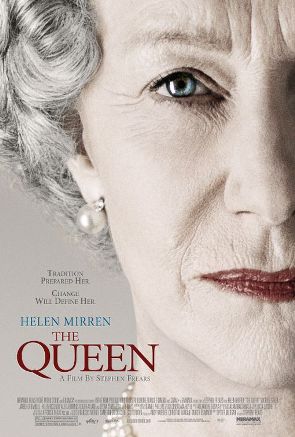
The_Queen_movieIt recently occurred to me that, if you were so inclined, you could reconstruct the entire history of the British royal family by watching movies that have been nominated for best picture.

You would start, of course, by watching Becket.  Then you’d move on to The Lion In Winter.  After The Lion in Winter, you’ll enjoy a double feature of Ivanhoe and The Adventures of Robin Hood.  After that, it’s time to watch Henry V.   When it comes to Henry VIII, you’ve actually got three films to choose from: The Private Life of Henry VIII, A Man For All Seasons, or Anne of The Thousand Days.  I suggest that you go with the Private Life of Henry VIII and then follow it up with a double feature of Elizabeth and Shakespeare in Love.  After that, you’ll jump forward in time a bit.  You’ll watch The Madness of King George and Mrs. Brown because, even though neither was nominated for best picture, they both feature Oscar-nominated royal performances.  Finally, you’ll watch Chariots of Fire and The King’s Speech.  And, after all of that, you’ll end things by watching the 2006 Best Picture nominee The Queen.

And what a way to end!  The Queen is perhaps the best of the many Oscar-nominated films to be made about British royalty.  While the Queen is rightly known for being the film that finally won the great Helen Mirren an Oscar, it’s also a witty and frequently poignant look at how a group of entrenched people are forced to adapt to a changing world.  It’s a film that works not just because Helen Mirren gives a good performance in the role of Queen Elizabeth II but also because she humanizes Elizabeth, turning her into a character to whom viewers can relate.

The film opens with the death of Princess Diana in Paris.  As the world mourns, the British royal family struggles with how to deal with the tragedy.  Prince Charles (Alex Jennings) worries about the well-being of his sons.  Prince Philip (James Cromwell) is rather haughtily unconcerned with how the general public feels about Diana or the rest of the royal family.  The Queen Mother (Syliva Syms) continues to insist that the Royal Family is just as important as it has always been.  Only Queen Elizabeth (Helen Mirren) seems to truly understand that the Royal Family cannot continue to cut itself off from the rest of the world.  Even though Elizabeth understands that the world outside of Buckingham Palace has changed, she’s still unsure about what her place in this new world will be.

Of course, not only does Elizabeth have to adjust with the changing values of the British public but she also has to deal with a new prime minister.  Tony Blair (Michael Sheen) has been swept into office, pledging that he’s going to “modernize” British society.  While the politically savvy Blair is determined to treat Elizabeth with respect, some of his closest advisers do little to disguise the contempt with which they view the royal family.  This include Tony’s own wife, Cherie (Helen McCrory).

And so, while self-styled reformer Blair finds himself in the strange position of defending tradition, Elizabeth tries to figure whether those traditions still matter in changing times.

The Queen is a film that demands an intelligent audience, one that is capable of enjoying a film based solely on the basis of good acting and intelligent dialogue.  The Queen‘s triumph is that it humanizes an iconic figure and reminds us that even the biggest events are both historical and personal.  I have no idea whether the real Elizabeth is anything like the character played by Helen Mirren but I certainly hope she is.

Embracing the Melodrama Part II #105: Million Dollar Baby (dir by Clint Eastwood)


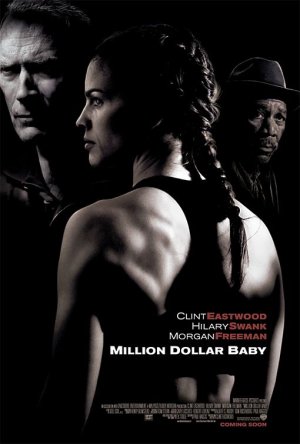
Million_Dollar_Baby_poster

(This review and the Spanish trailer below are dedicated to mi madre, who saw Million Dollar Baby when it was first released and told me that, even though the film had been nominated for lots of Oscars, I shouldn’t watch it until I was in a better and more stable place emotionally.  She was right.)

Two months ago, I started Embracing the Melodrama Part II.  At the time, I announced that I would be reviewing 126 cinematic melodramas and I would get it all done in 3 weeks time!  Well, here we are 8 weeks into it and we are just now approaching the finish line.  That’s okay, though.  Even if it’s taken me longer than I thought it would, I’ve still been having fun writing and sharing these reviews.

I’ve been posting these reviews in chronological order.  Though it may be hard to remember, we started with a 1927 silent classic called Sunrise.  From Sunrise, we’ve worked our way through history and we’ve taken a look at films that are both famous and obscure.  And now, 104 reviews later, we finally reach the 2004 best picture winner, Million Dollar Baby.

When I first saw Million Dollar Baby, I had two reactions.  On the one hand, I thought it was a great film.  I thought it was a film that featured great performances and which gave me a chance to experience a world that I did not know much about.  I thought to myself, “This is a film that future directors will cite as an influence.  This is a film that proves that, even if he does sometimes make movies like Hereafter or Jersey Boys, Clint Eastwood still deserves to be known as a great American filmmaker.”  On the other hand, I thought to myself, “This film is so damn depressing that there’s no way I’m ever going to watch it again.”

And really, it is an amazingly sad film.  When the film starts, of course, you don’t think it’s going to be sad.  You think it’s going to be your standard sports film, the one where the underdog beats the odds and becomes a champion.  For one thing, the film is narrated by Morgan Freeman and Morgan’s got that voice that makes you believe that there is some justice to the universe.  Secondly, Hillary Swank is so appealing in the role of Maggie, a waitress who wants to become a boxer, that you just know she deserves a happy ending.  At first, veteran trainer Frankie (Clint Eastwood) refuses to work with her but her determination wins him over.  And soon, Frankie — who, in typical Clint movie fashion, has a strained relationship with his daughter — becomes a father figure for Maggie.

And as you watch Maggie find success as a boxer, you’re so happy for her.  I certainly was, despite the fact that I know next to nothing about boxing beyond the fact that it’s something that I would never want to do.  And when Clint starts to soften up to her, you’re not surprised.  After all, he’s craggly old Clint Eastwood.  He’s scary but we all know he has a heart of gold.  Add to that, Morgan Freeman’s still telling the story and surely the voice of God would not allow anything bad to happen…

And then … tragedy.  By the time that I finally saw Million Dollar Baby, I already knew the story’s big twist.  I knew that, as a result of a brutal fight, Maggie would be left paralyzed.  I knew that she would beg Frankie to euthanize her.  But seriously, imagine what a shock it must have been for audiences when this film first came out.

I mean, everything’s going perfectly and then suddenly, it’s not.

To a certain extent, I was jealous of those who got to see Million Dollar Baby without any advanced knowledge of the tragedy that defines the final third of the film.  When I watched the film, I found myself dreading the thought of enjoying any of Maggie’s triumphs because I knew what was going to happen.  Those who watched the film with know knowledge may have been shocked but at least they got to believe, for a few scenes, that Maggie could find that perfect sports film ending.

Then again, Million Dollar Baby is a great film because it refuses the temptation to give us the ending that we all want and expect.  Instead, it’s a movie that celebrates the people who will be there for you even when thing’s suddenly aren’t perfect.

That’s why Million Dollar Baby works as well as it does.  Unfortunately, it’s also why it’s a film that I could only watch once.

Scenes I Love: Saving Private Ryan


SavingPrivateRyan

Today marks the 71st Anniversary of the Normandy Landings on D-Day. As the day winds down I thought it best to share one of my favorite scenes from a film that tried to capture the chaos and death of the fateful day on June 6, 1944. The film in question is Steven Spielberg’s Saving Private Ryan. This is the film which won him his second Best Director Oscar (I still think the film should’ve won Best Picture over Shakespeare In Love) and the film which helped redefine not just how war films were shot from 1998 on, but also de-glorify World War II on film.

This scene showed the opening moments of the D-Day Landings on Omaha Beach in Normandy, France. It’s a scene that’s over 22-minutes in length and shows the utter chaos and destruction heaped on American troops as they attempted to land on the beach to take their objectives. While there have been war film before Saving Private Ryan that depicted war as the hell it truly is they were mostly about the Vietnam War. Rarely did we ever get a World War II-based war film which showed war in realistic fashion. Spielberg broke that taboo by making the battle scenes in his film — especially this extended opening sequence — done as realistic as possible without actually having people killed for real on-screen.

When this film first came out in the summer of 1998 no one knew what to make of it. This opening sequence became the talk of everyone who went to see the film. To say that they were shocked by what they saw was an understatement. Even now with over a decade since the film was released and people having seen this scene over and over again it still retain it’s impact. It’s not even the grand scale of the production required to film this action sequence which made this scene so memorable. It were the little things. Like a mortally wounded American GI crying out to his mother while trying to keep his blown out insides from spilling out. Then there’s the scene of another young soldier praying furiously with his rosary beads as men around him die by the score.

This scene also showed what most World War II films of the past failed to do. It showed both sides behaving barbarically. In the past, only the Germans were shown in a bad light. In Saving Private Ryan, we see that American soldiers were also prone at shooting surrendering troops and/or not mercy-killing enemy soldiers being burned alive (actions that have been well-documented by historians). This scene also showed just how courageous the young men of this generation which Tom Brokaw has called “The Greatest Generation”. Men who went off to war not for material gains, but for an idea that they had to stop evil (Nazi and Hitler) from taking all of Europe and, maybe, the world itself.

There’s a reason why Saving Private Ryan is in my list for greatest films of all-time and why this scene remains one of my all-time favorites.