Cleaning Out The DVR #23: The Adventures of Robin Hood (dir by Michael Curtiz)


(For those following at home, Lisa is attempting to clean out her DVR by watching and reviewing 38 films by this Friday.  Will she make it?  Keep following the site to find out!)

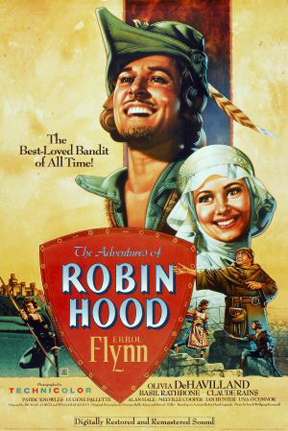
Robin_hood_movieposter

Flamboyant.  Athletic.  Joyous.  Determined.  Handsome.  Outspoken.  Bigger than life.  Revolutionary.  Anarchist.  Sexy.  Libertarian.  Is there any doubt why Errol Flynn remains the definitive Robin Hood?

And. for that matter, is there any doubt why the 1938 film The Adventures of Robin Hood remains not only the definitive Robin Hood film but also one of the most influential action films in history?

The Adventures of Robin Hood tells the story that we’re all familiar with.  The King of England, Richard The Lionhearted (Ian Hunter), is captured while returning from the Crusades.  His brother, King John (Claude Rains, in full autocratic villain mode), usurps the throne while Richard is gone and immediately raises taxes.  He claims that he’s only doing this to raise the money to set Richard free.  Of course, the real reason is that John is a greedy tyrant.

The only nobleman with the courage to openly oppose John is Sir Robin of Locksely (Errol Flynn).  Sir Robin protects his fellow citizens from John’s main henchman, Sir Guy of Gisbourne (Basil Rathbone, also in full autocratic villain mode).  In fact, Robin is so brave that, on multiple occasions, he even enters Sir Guy’s castle so that he can specifically tell King John and Sir Guy that he has no use for their laws.  This, of course, always leads to Robin having to make a dramatic escape while arrows flies and swords are unsheathed all around.

And through it all, Robin Hood keeps smiling and laughing.  He’s a wonderfully cheerful revolutionary.  He may be fighting a war against a ruthless and unstoppable enemy and he may be the most wanted man in England but Robin is determined to have fun.  One need only compare Robin to his humorless foes to see the difference between freedom and bureaucracy.

(We could use Errol Flynn’s Robin Hood today, though I suspect our government would just blow him up with a drone and then issue a statement about how, by stealing money from the rich and giving it to the poor, Robin was keeping the government from being able to rebuild bridges and repair roads.)

When Robin isn’t exposing the foolishness of organized government, he’s hanging out in Sherwood Forest.  He’s recruiting valuable allies like Friar Tuck (Eugene Pallette) and Little John (Alan Hale, Sr.)  He’s playing constant pranks and promoting revolution and, to his credit, he’s a lot more fun to listen to than that guy from V For Vendetta.  He’s also romancing Maid Marian (Olivia de Havilland) and good for him.  Two beautiful people deserve to be together.

Even better, he’s doing it in glorious Technicolor!  There’s a lot of great things about The Adventures of Robin Hood.  The action scenes are exciting.  The music is thrilling.  The film is perfectly cast.  Errol Flynn may not have been a great actor but he was a great Robin Hood.  But what I really love about the film is just the look of it.  We tend to take color for granted so it’s interesting to watch a film like The Adventures of Robin Hood, one that was made at a time when color film was something of a novelty.  For those of us who spend a lot of time talking about how much we love old school black-and-white, The Adventures of Robin Hood is a film that says, “Hey, color can be great too!”

But what I mostly love about The Adventures of Robin Hood is just the pure joy of the film.  Just compare this Robin Hood to the grimly tedious version played by Russell Crowe.

(True, nobody in The Adventures of Robin Hood shouts, “I declare him to be …. AN OUTLAAAAAAAAAAAAWWWWWWWW!”  Actually, now that I think about it, Ridley Scott’s Robin Hood would have worked much better if Oscar Isaac and Russell Crowe had switched roles.)

The Adventures of Robin Hood was nominated for best picture and it probably should have won.  However, the Oscar went to Frank Capra’s You Can’t Take It With You.

Cleaning Out The DVR #22: The Good Earth (dir by Sidney Franklin)


(For those following at home, Lisa is attempting to clean out her DVR by watching and reviewing 38 films by this Friday.  Will she make it?  Keep following the site to find out!)

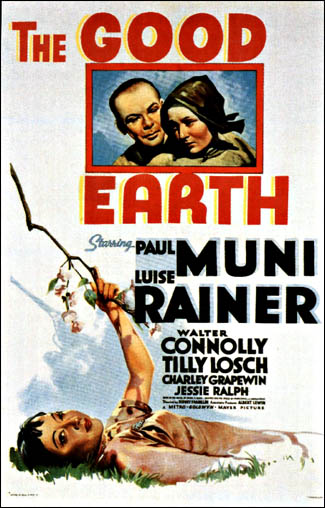
Good_earth_(1937)

The 1937 film The Good Earth is a strange one.

It’s a big, epic film about life in China in the years before World War I.  It opens with a poor farmer named Wang (Paul Muni) marrying a servant girl named O-Lan (Luise Rainer).  O-Lan is quiet but strong and, with her support, Wang eventually starts to prosper.  He buys land and they have children.  Together, Wang and O-Lan manage to survive both famine and a political upheaval.  In fact, it’s China’s volatile politics that occasionally allow the family to survive.  When a revolutionary mob loots a mansion, O-Lan joins in just long enough to come across a bag of diamonds that the Wang uses to eventually buy the biggest house in town.  Once he’s become wealthy and complacent, Wang ends up taking on a younger, second wife (Tilly Losch) and O-Lan finds herself competing for his attention.  Ultimately, it’s only when Wang is again forced to tend to the Earth that he understands what is really important.

So, here’s the weird thing about The Good Earth.  It’s a film about China.  It covers several years of Chinese history and the story itself is rooted in Chinese culture.  All of the characters are meant to be Chinese.  When the movie was filmed, China was at war with Japan so it’s not surprising that the film was shot in California.  But what is interesting (though not really surprising when you consider the history of Hollywood) is that there are very few Chinese people in the cast and none of them play any of the major roles.

Instead, Wang was played by Austria-born, Chicago-raised Paul Muni.  O-Lan was played by German Luise Rainer.  Wang’s comic relief uncle was played by American character actor Walter Connolly while his father was played by a former vaudeville star from Ohio named Charley Grapewin.  All of the actors are heavily made up so that they’ll look Chinese but none of them act or sound Chinese.  It makes for a very strange viewing experience.

And it’s a bit unfortunate because there are some very good scenes in The Good Earth.  Technically, it’s a very strong film.  Towards the end, there’s a locust invasion that is still thrilling to watch.  The sets look great.  The costumes look great.  If you’re a history nerd like me, the story has the potential to be interesting.  But, whenever you start to get sucked into the film’s story, Wang starts to speak and sounds totally like a guy from Chicago and it takes you out of the movie.  The uneven mix of quality and miscast actors makes for a rather disjointed viewing experience.

As a big epic, it’s probably not surprising that The Good Earth was nominated for best picture.  However, it lost to another Paul Muni film, The Life of Emile Zola.

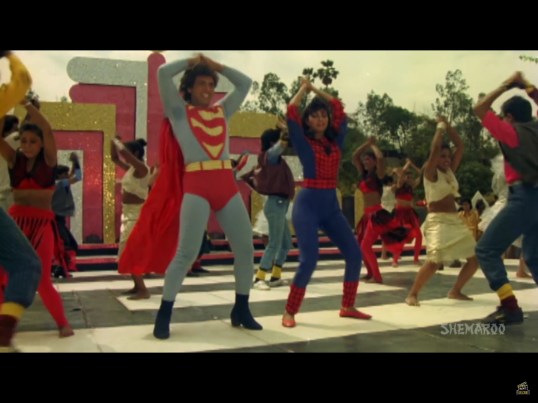
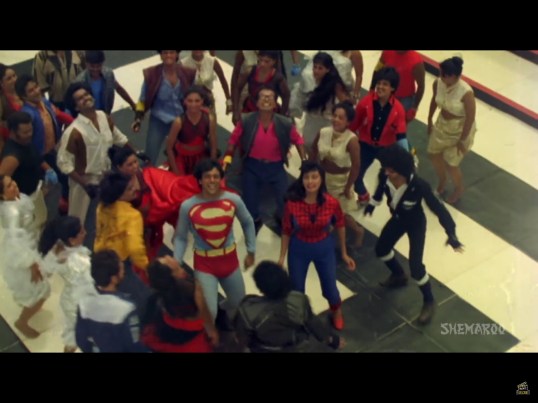
Superman, Spider-Woman, Dallas, Badminton Brawling, and More! It’s Dariya Dil (1988, dir. K. Ravi Shankar)


IMG_4599

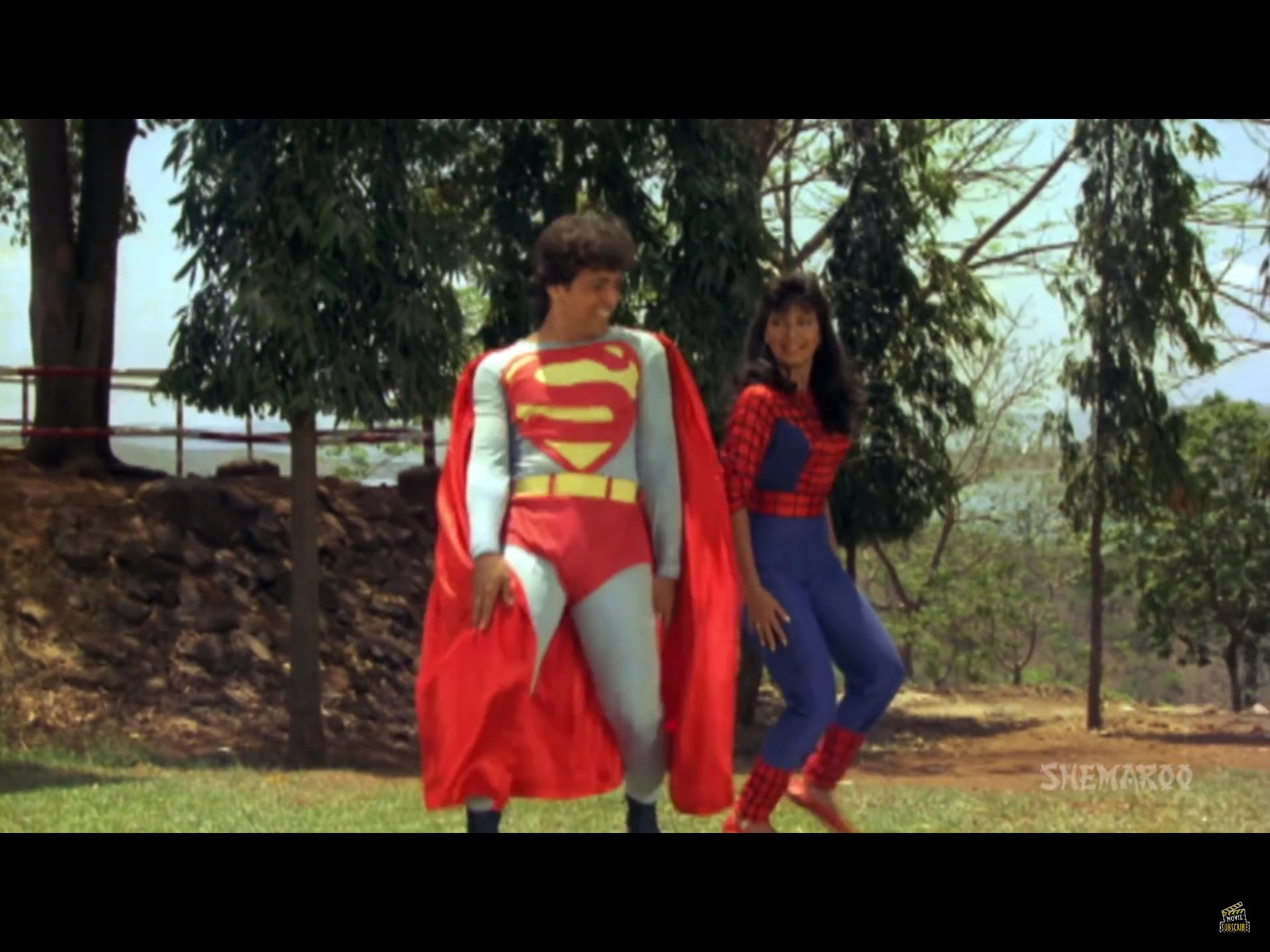
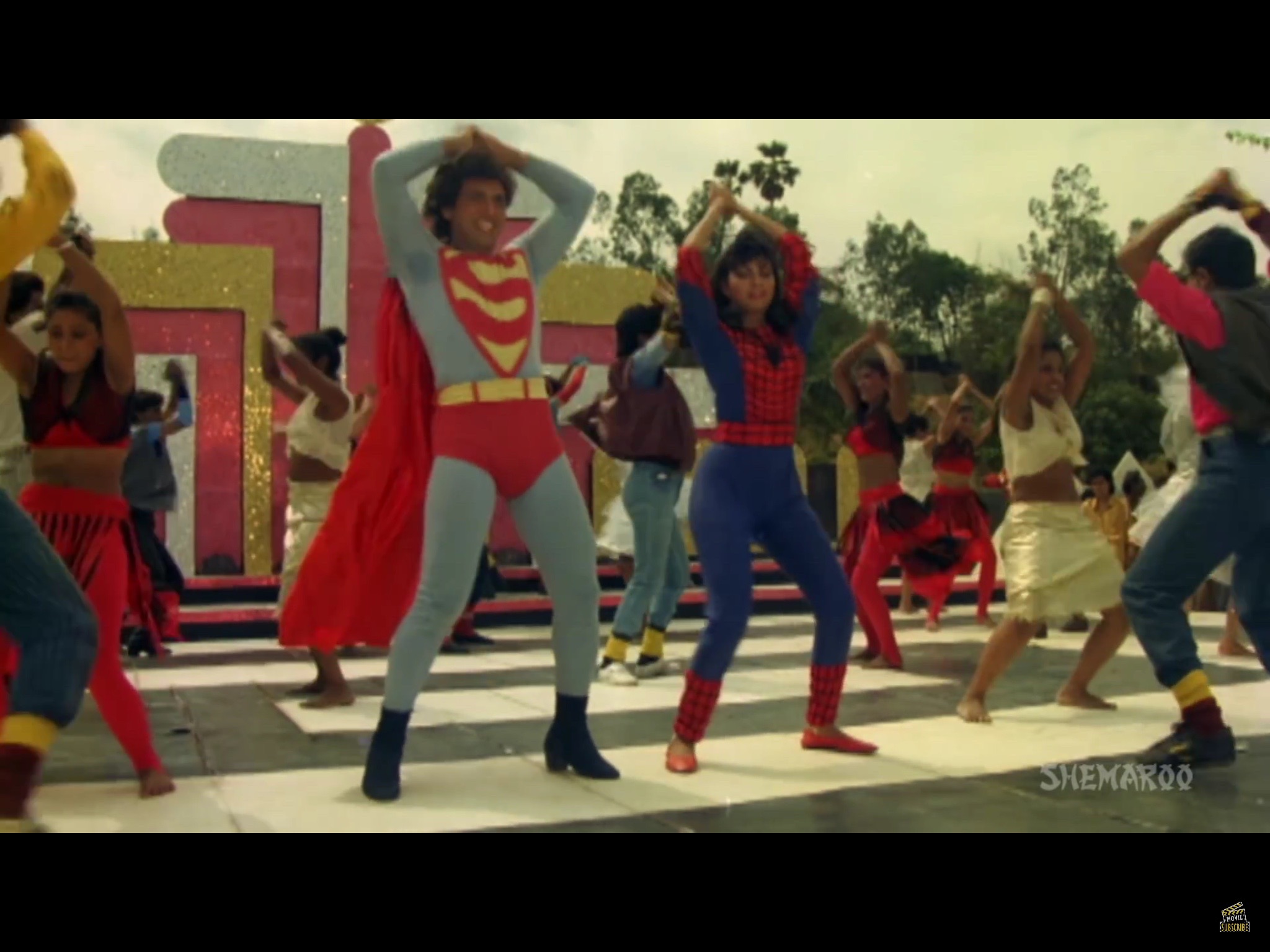
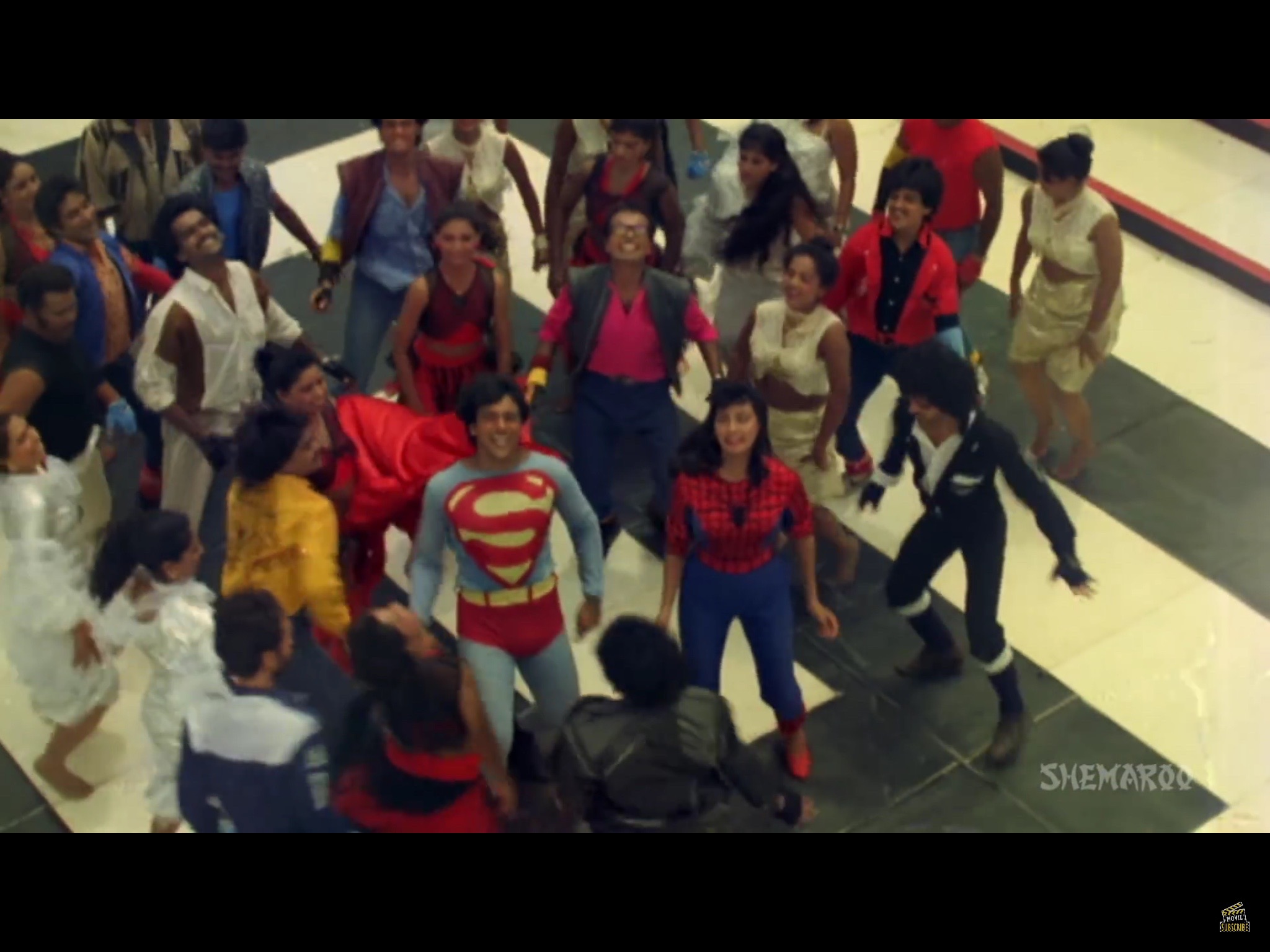
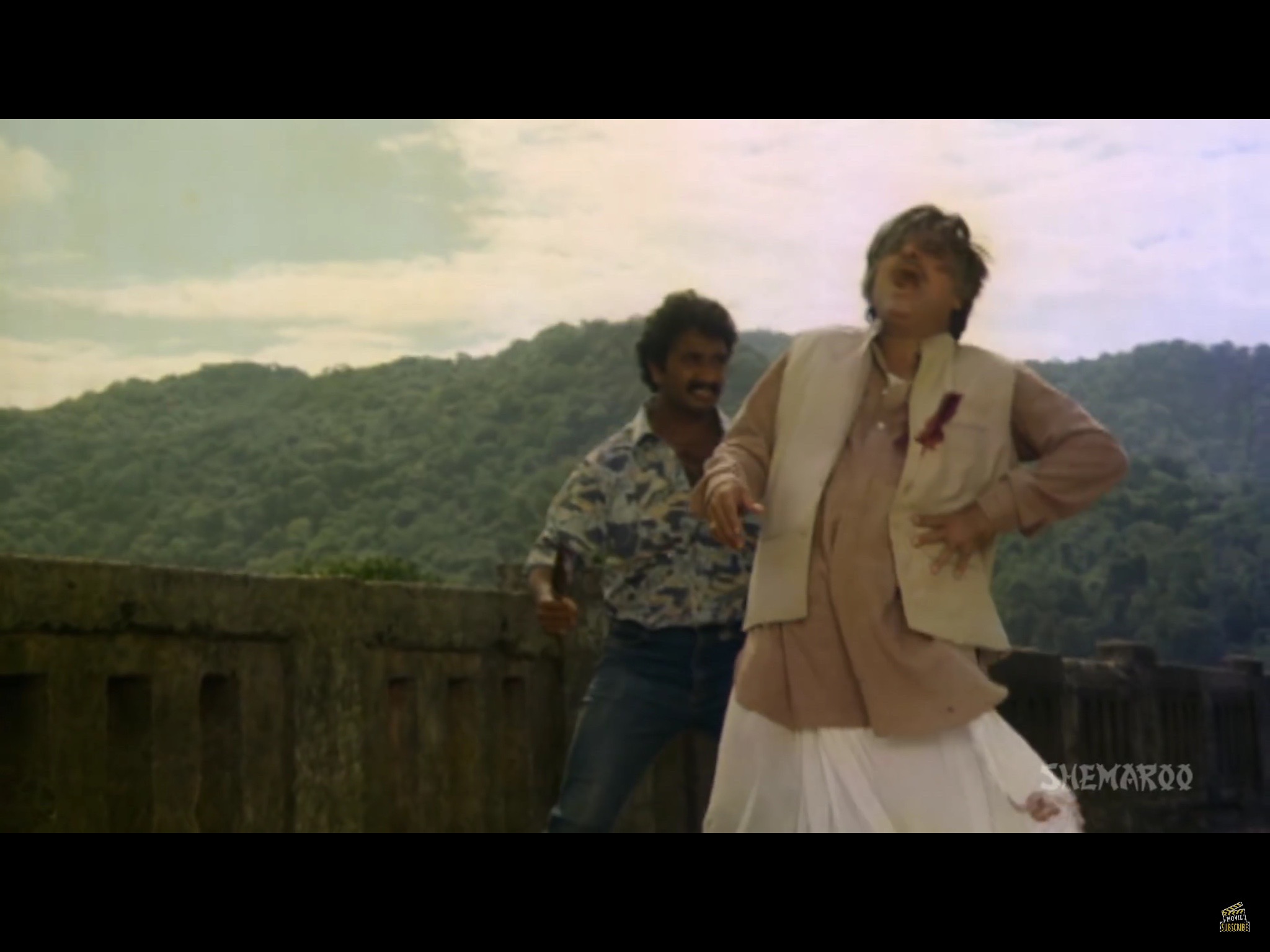
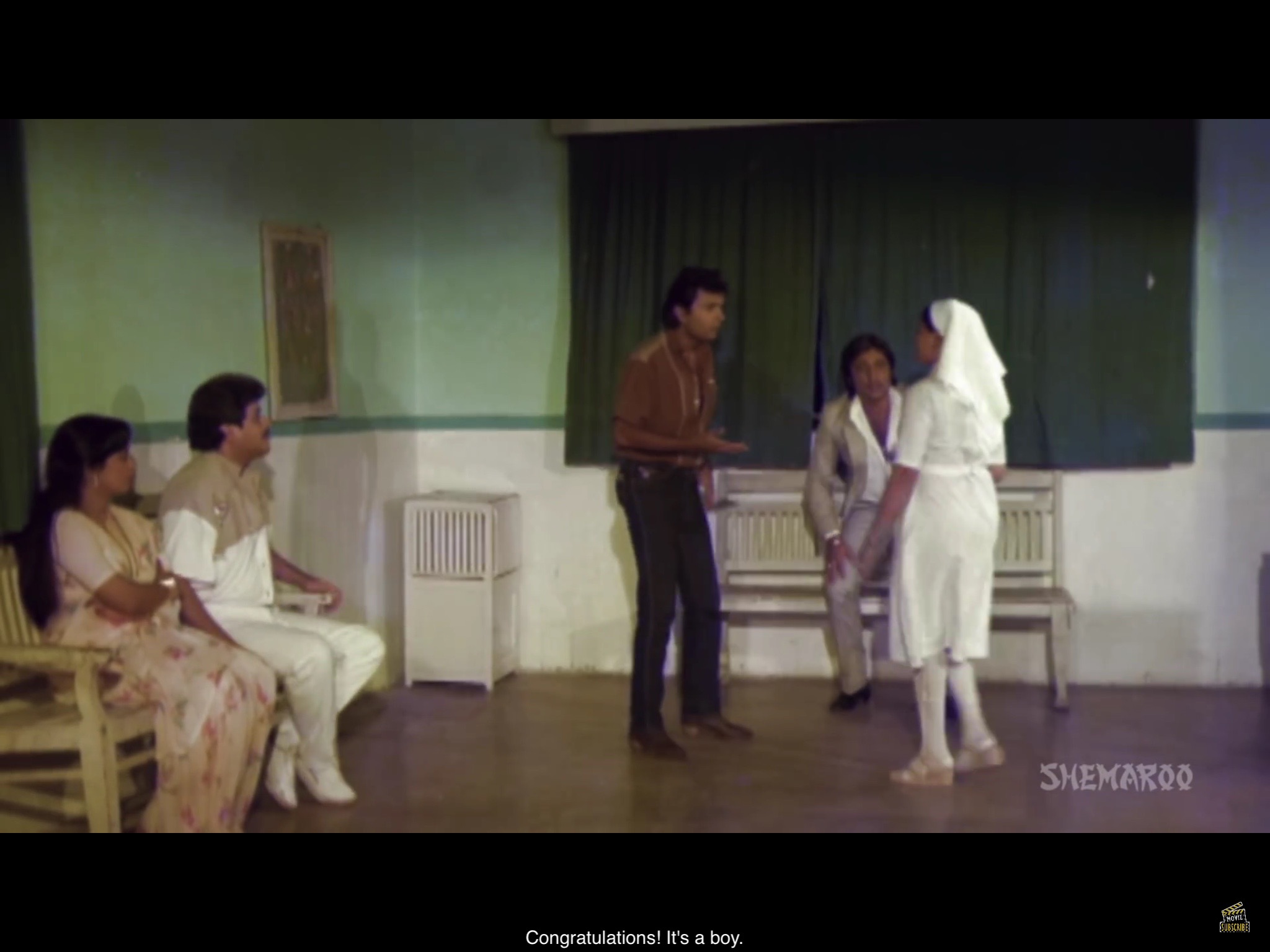
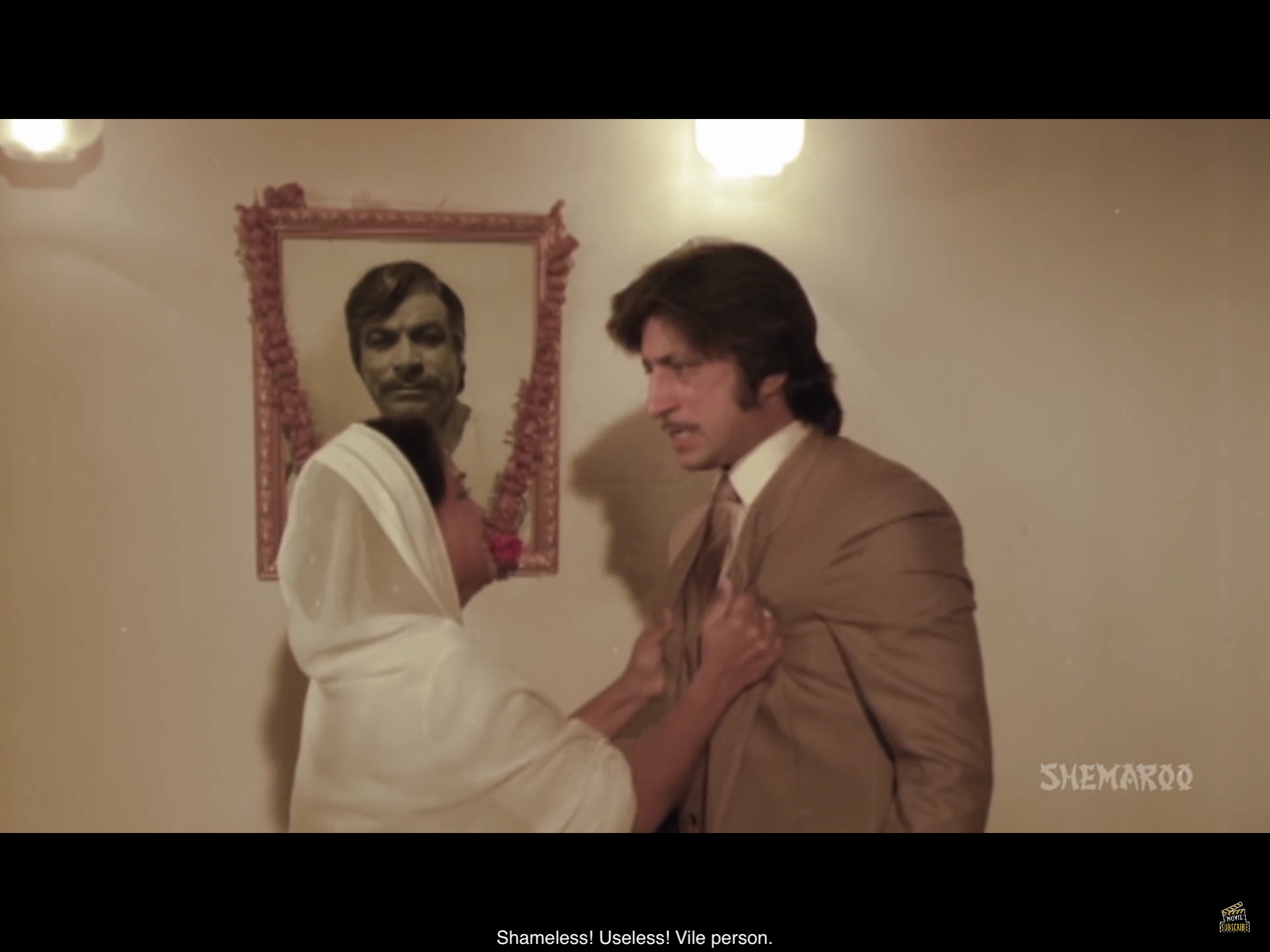
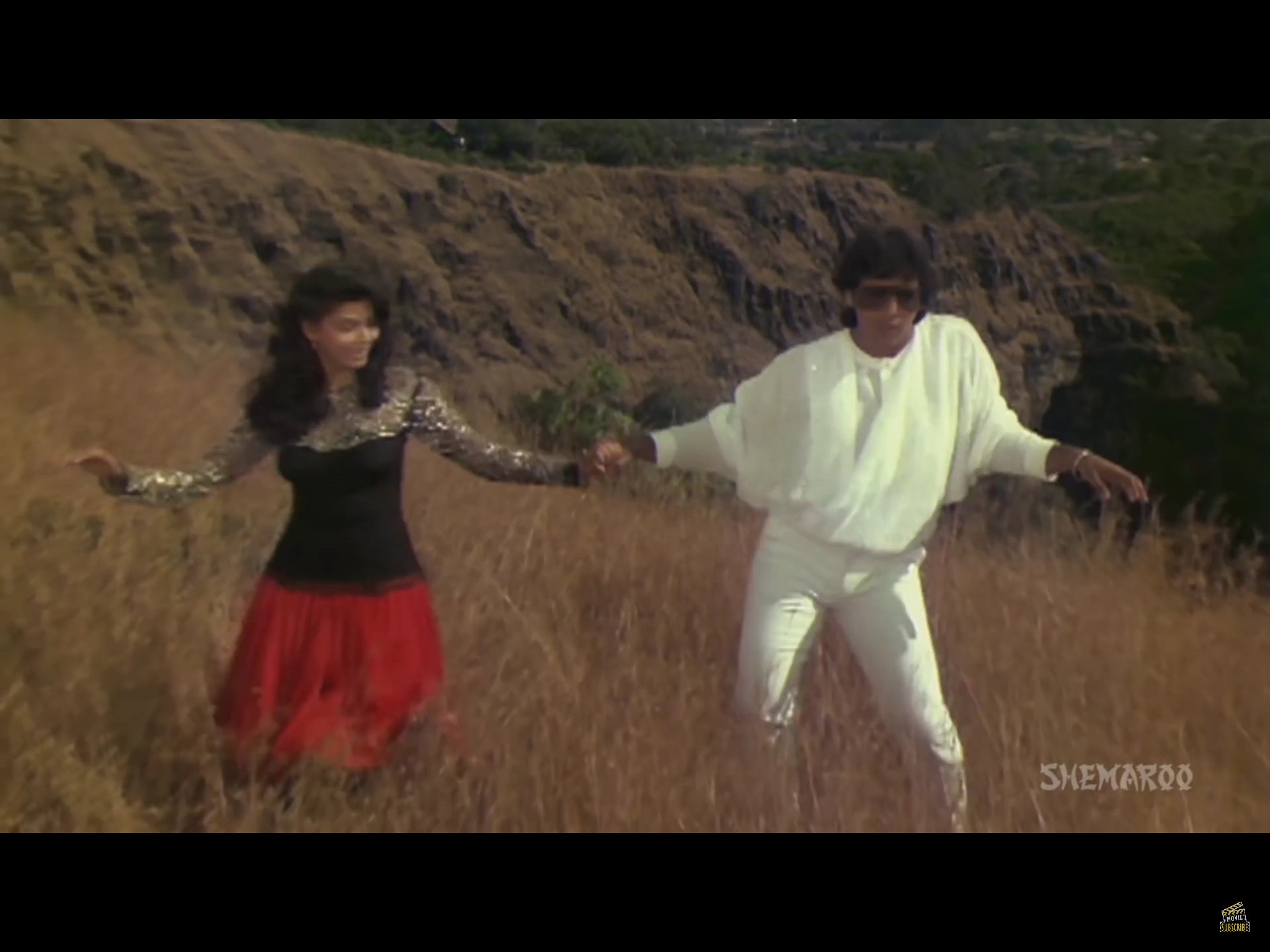
When you first reach out on the Internet to find foreign knockoffs of American superheroes you will most likely come across something referred to as the Indian Superman and Spiderwoman. That movie is called Dariya Dil. Funny enough, there was a literal remake of Superman that came out one year prior to this from India as well. It was just called Superman, but is one of the many superhero knockoff movies for which I haven’t found English subtitles. However, every one of the mentions of this movie that I have seen appear to have been written by people who have only seen just the Superman and Spiderwoman scene. They will even reference the IMDb plot summary, which doesn’t even mention Superman or Spiderwoman, as if they are in disbelief that it could be the right movie. The plot summary is right, and so are the people who talk about how great the superhero scene is in the movie. Yet, they both don’t do justice to this film. I hope I can. I also have linked to the full film at the end of this review. Thanks to Shemaroo Films, at the time of writing this, it is up on YouTube legally. I’m sorry about the black bars in my screenshots. That’s where YouTube puts the tiny subtitles. I normally work around this for review purposes, but this was not one that made it easy.
IMG_4692

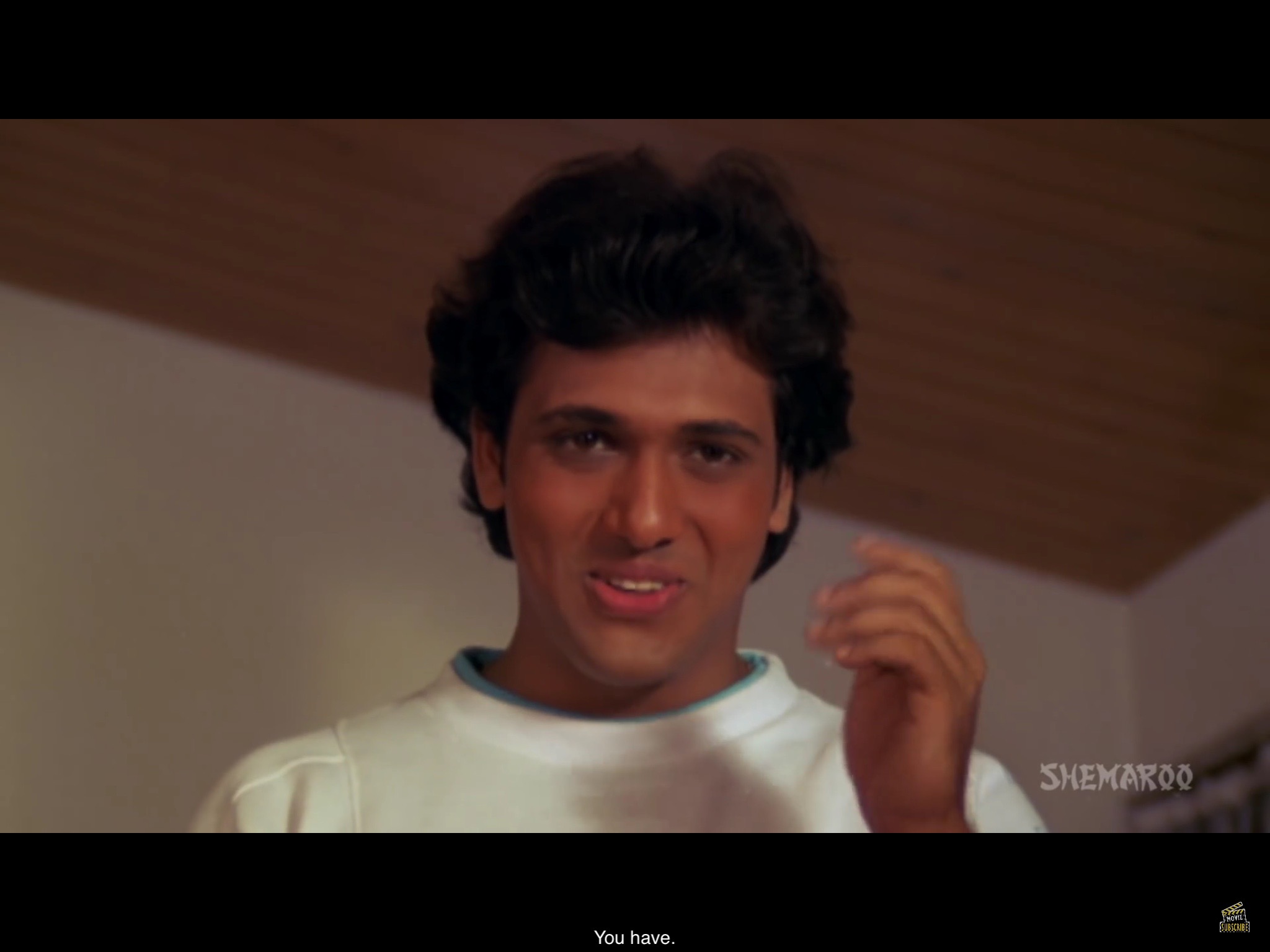
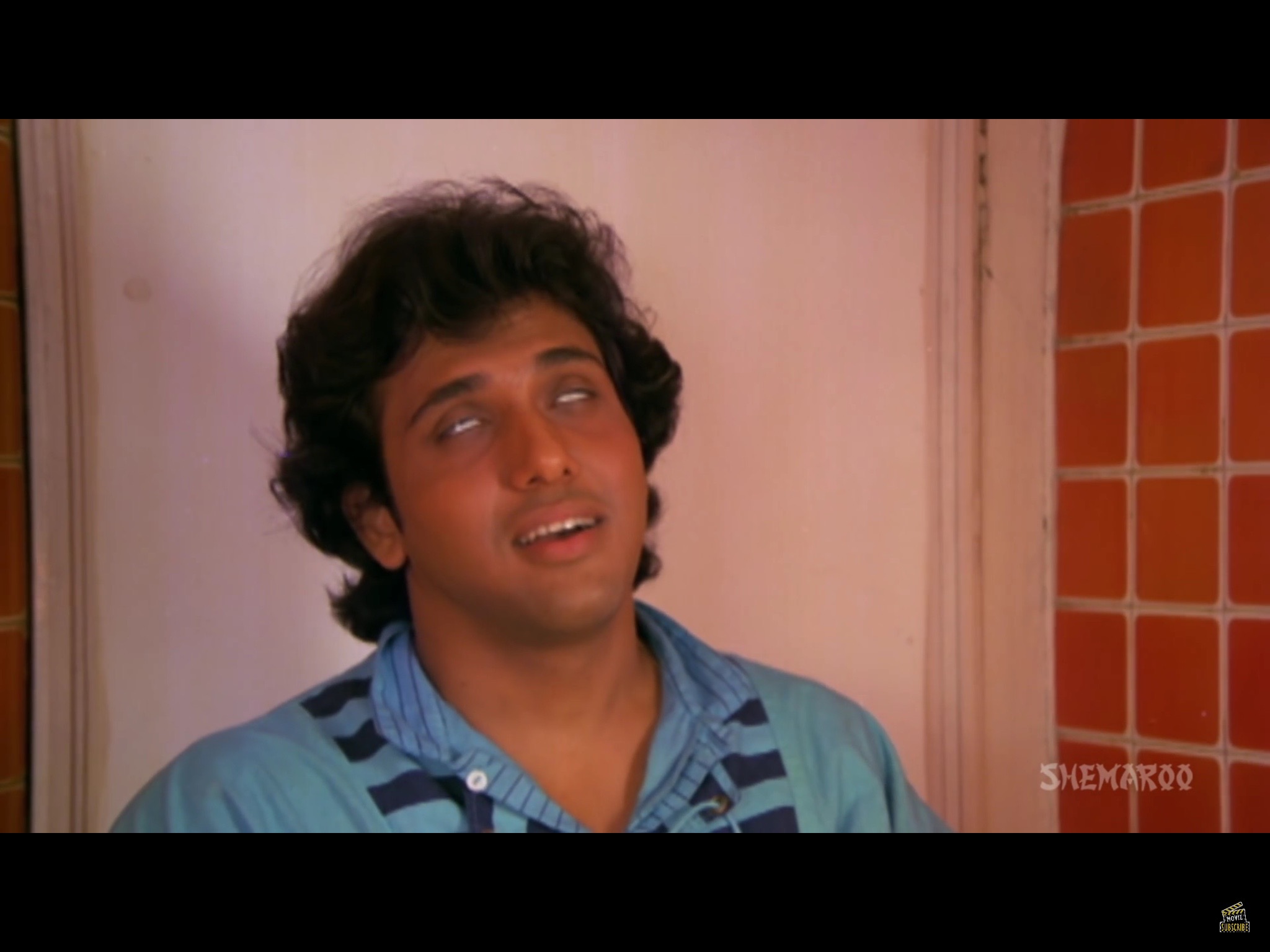
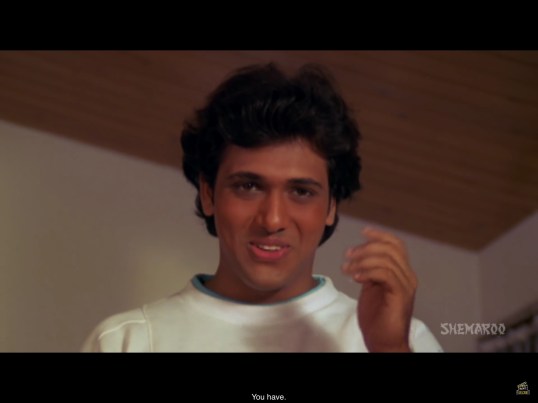
The movie starts out and we are introduced to the hero of the film named Ravi who is played Govinda. He’s here to tell his Dad named Dhaniram (Kader Khan) that he needs to cut back on the sugar so that we know he is the son who listens to his Dad.
IMG_4688

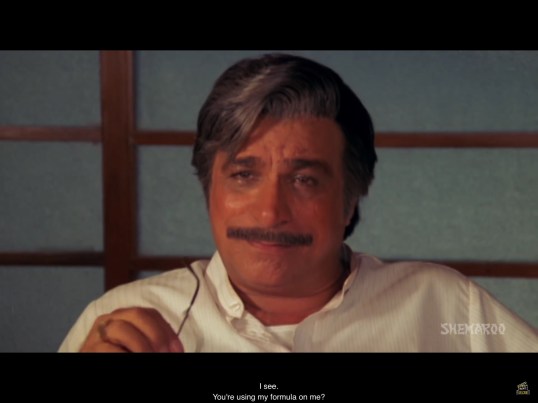
You can think of the Dad in this as Larry Hagman from Dallas. Although, he won’t get shot like J.R.

Now Ravi goes to wake one of his brothers and sisters-in-law.
IMG_4711

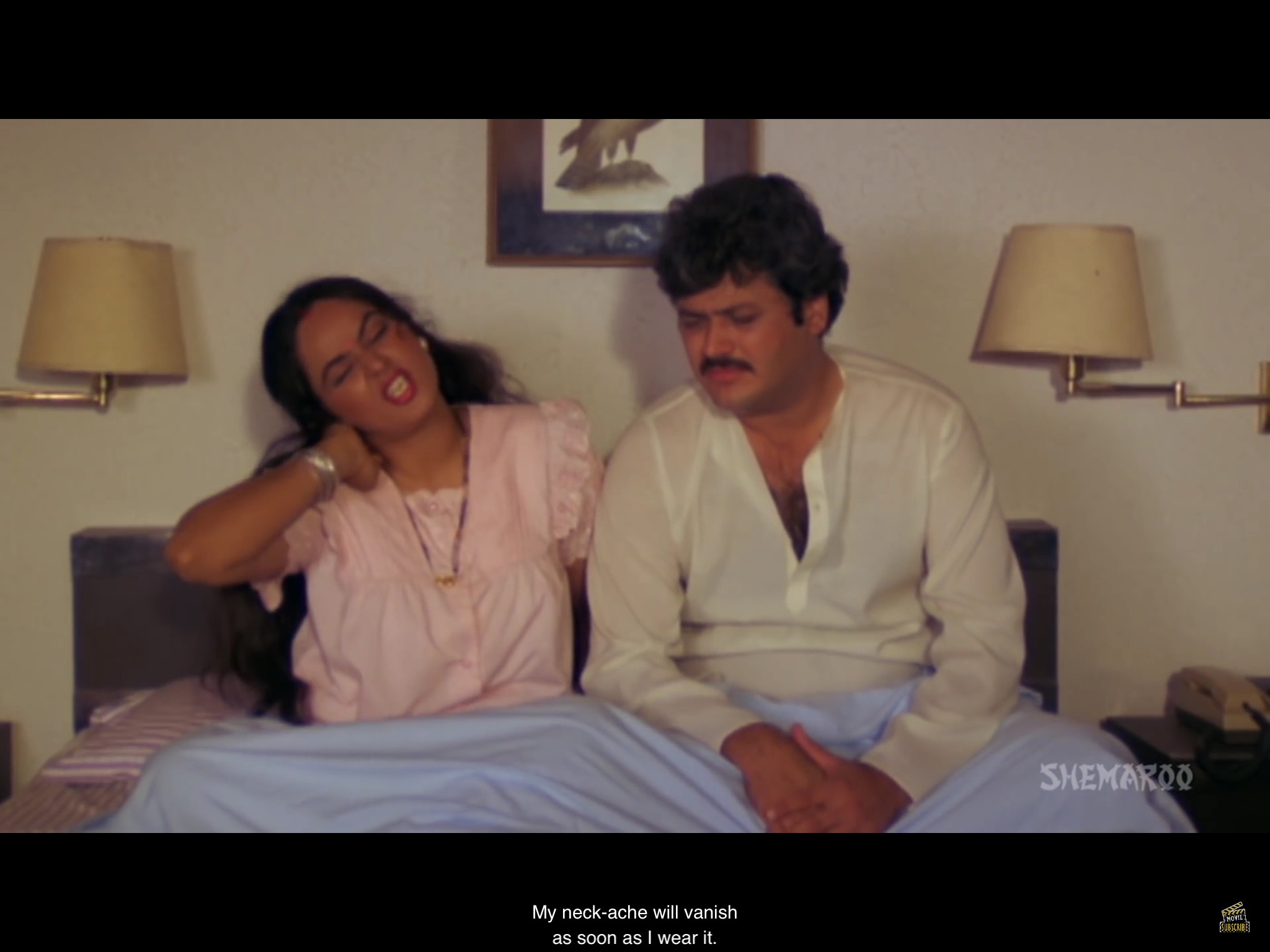
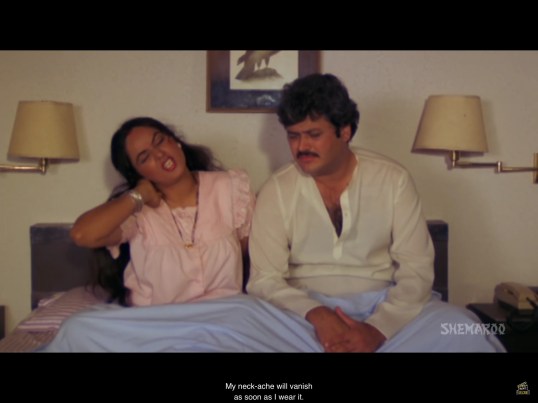
I love the dialog that leads up to that line about her neck-ache. Ravi tells them that God grants wishes to early risers. Sapna (Shoma Anand) says that her husband is an image of God, but that regardless of telling him three hundred times a day about the pain in her neck, he doesn’t help. Her husband says that the treatment for her neck is very expensive. Don’t feel bad though because the treatment is “just an ordinary diamond necklace.” This is when the film makes it clear that other than Ravi, the rest of the family is going to be scheming against Dad. Also, we find out that the father apparently has a lot of money he is sitting on.

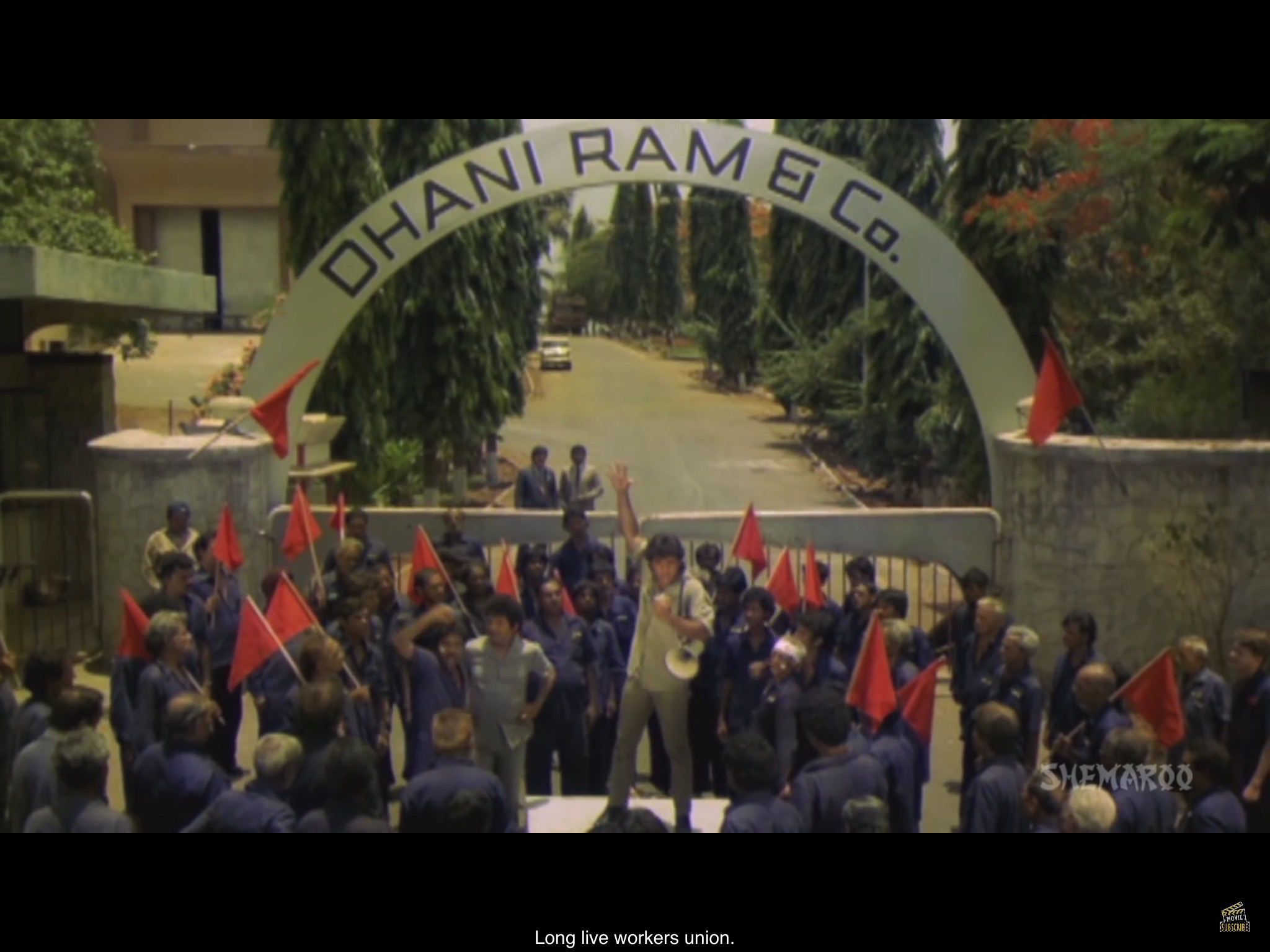
After Ravi wakes his brother Ajay (Shashi Puri), we cut to the family factory of Shani Ram & Co.
IMG_4728

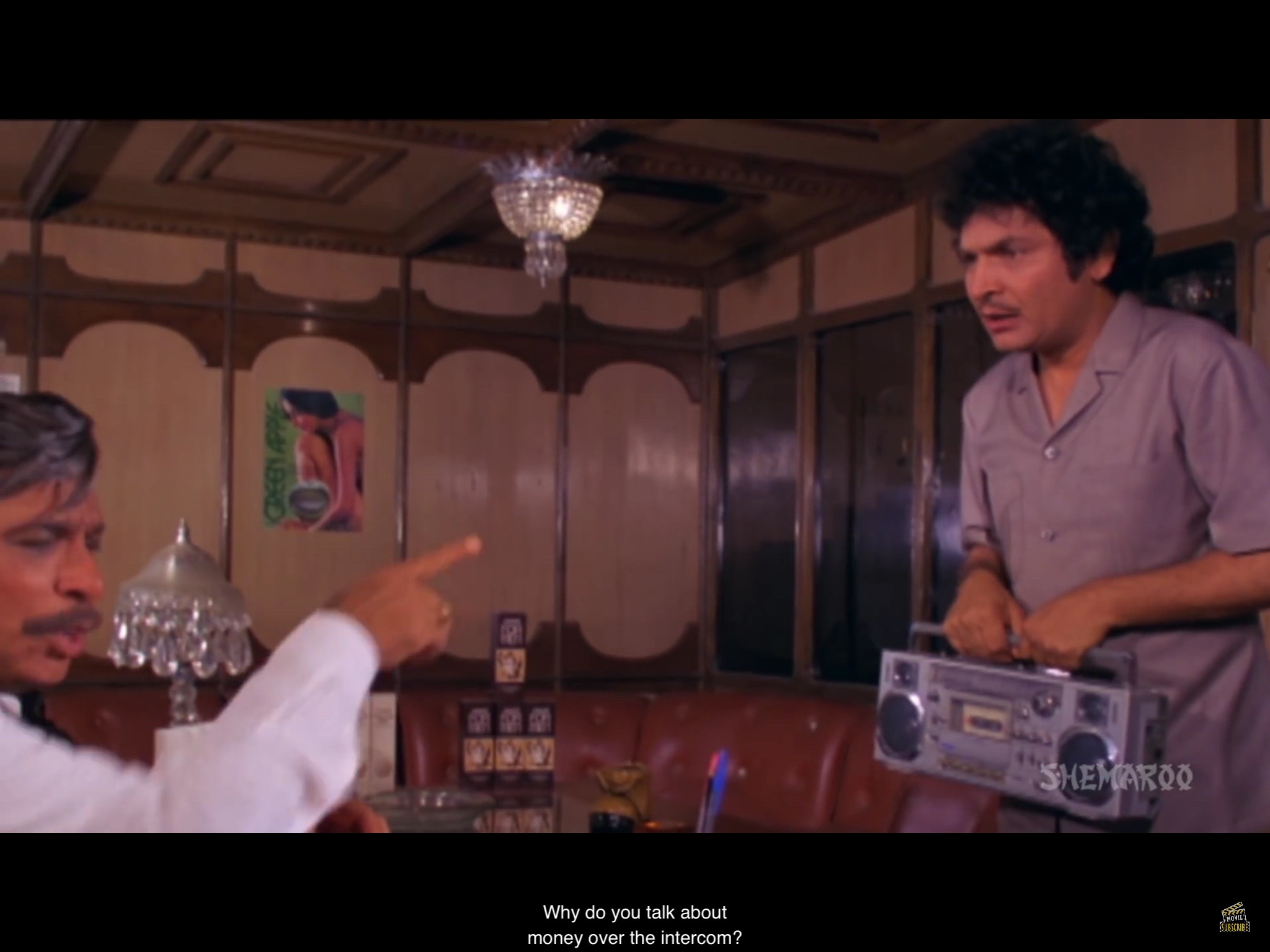
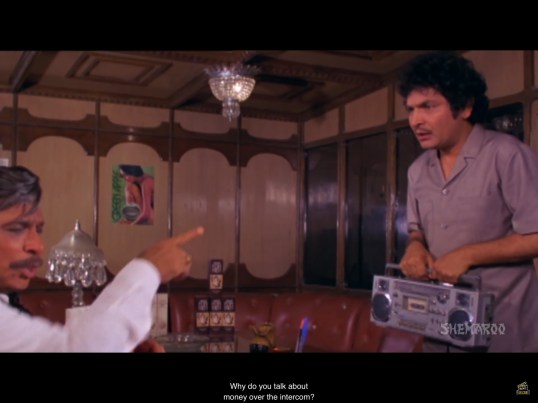
Since there is a boombox onscreen at this point, it’s as a good a time as any to mention the music in this movie. I don’t mean the musical numbers, but the score. There are two noteworthy things about it. First, it has odd timing to say the least. Sometimes it makes sense, but other times it will get all dramatic even though something very minor has happened on screen. Sometimes I swear nothing happens, but the music doesn’t seem to know that fact. I’m sure they were doing this on purpose because the only other movie I have seen that tries harder to make fun of soap operas is Soapdish (1991).

The second thing is the choice of scores. Often it sounds like this almost futuristic synthesizer music. It kept reminding me of background music I would hear in the Trancers movies. Like everything else in this movie, the score is very 80’s.

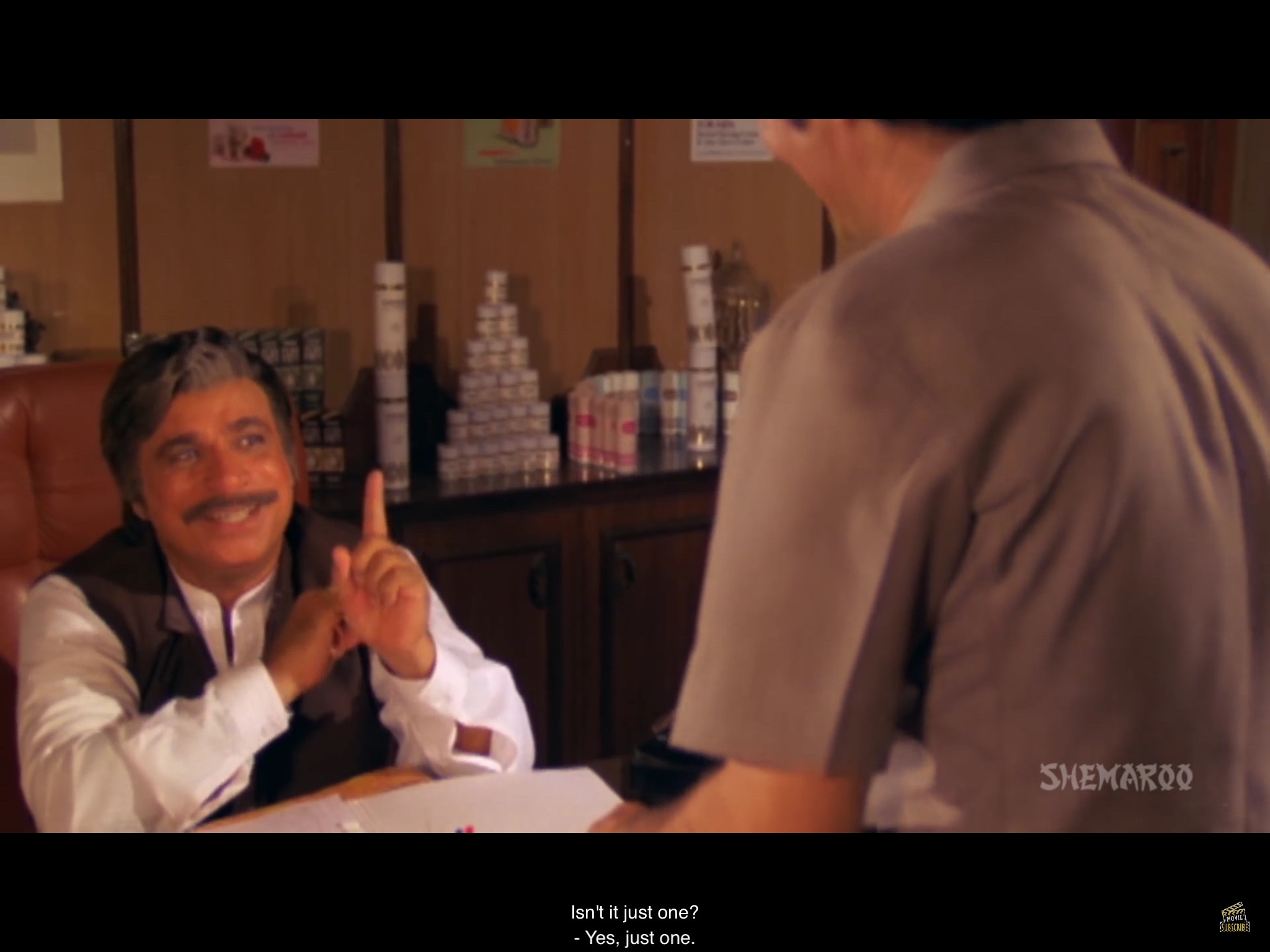
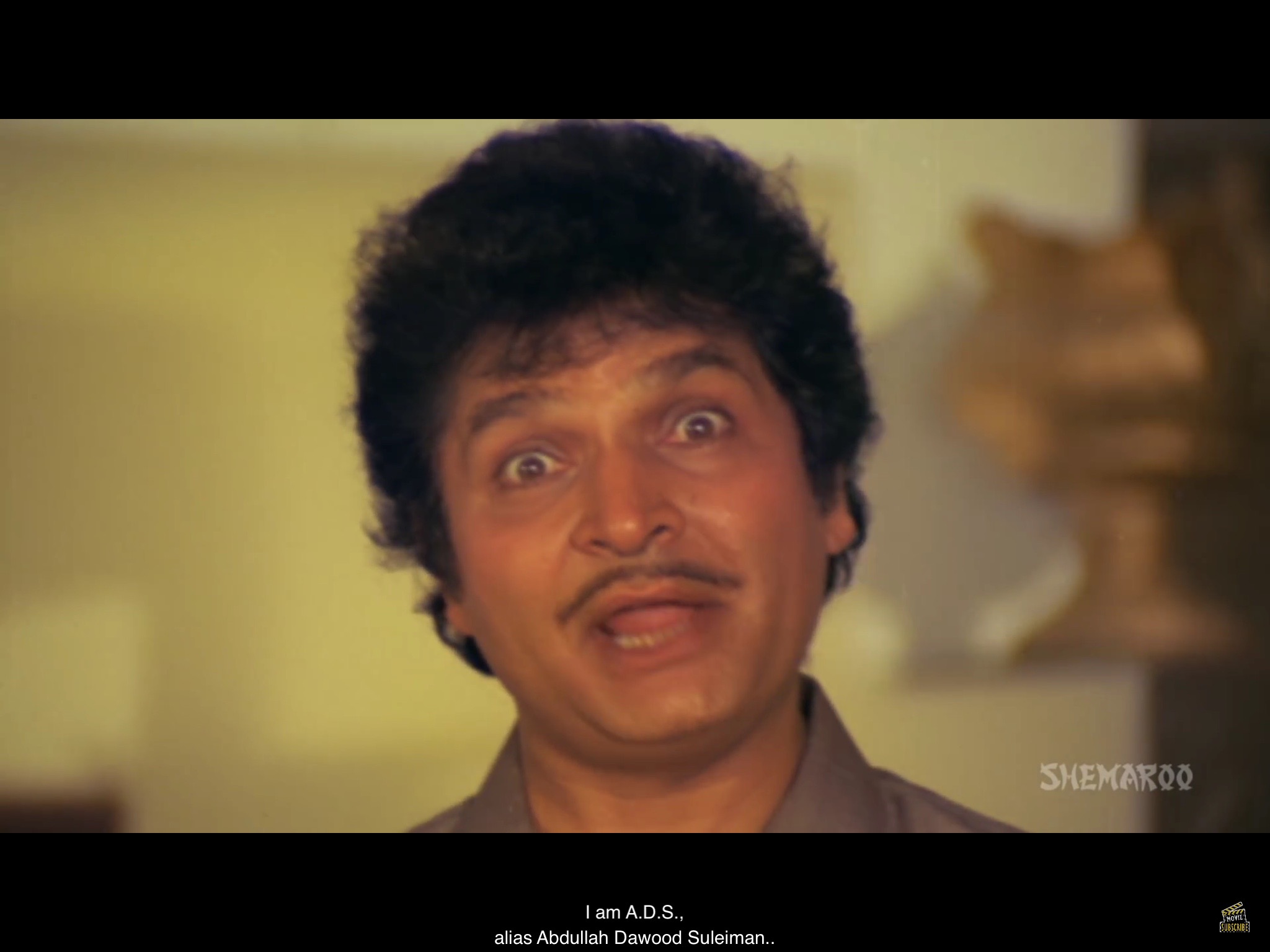
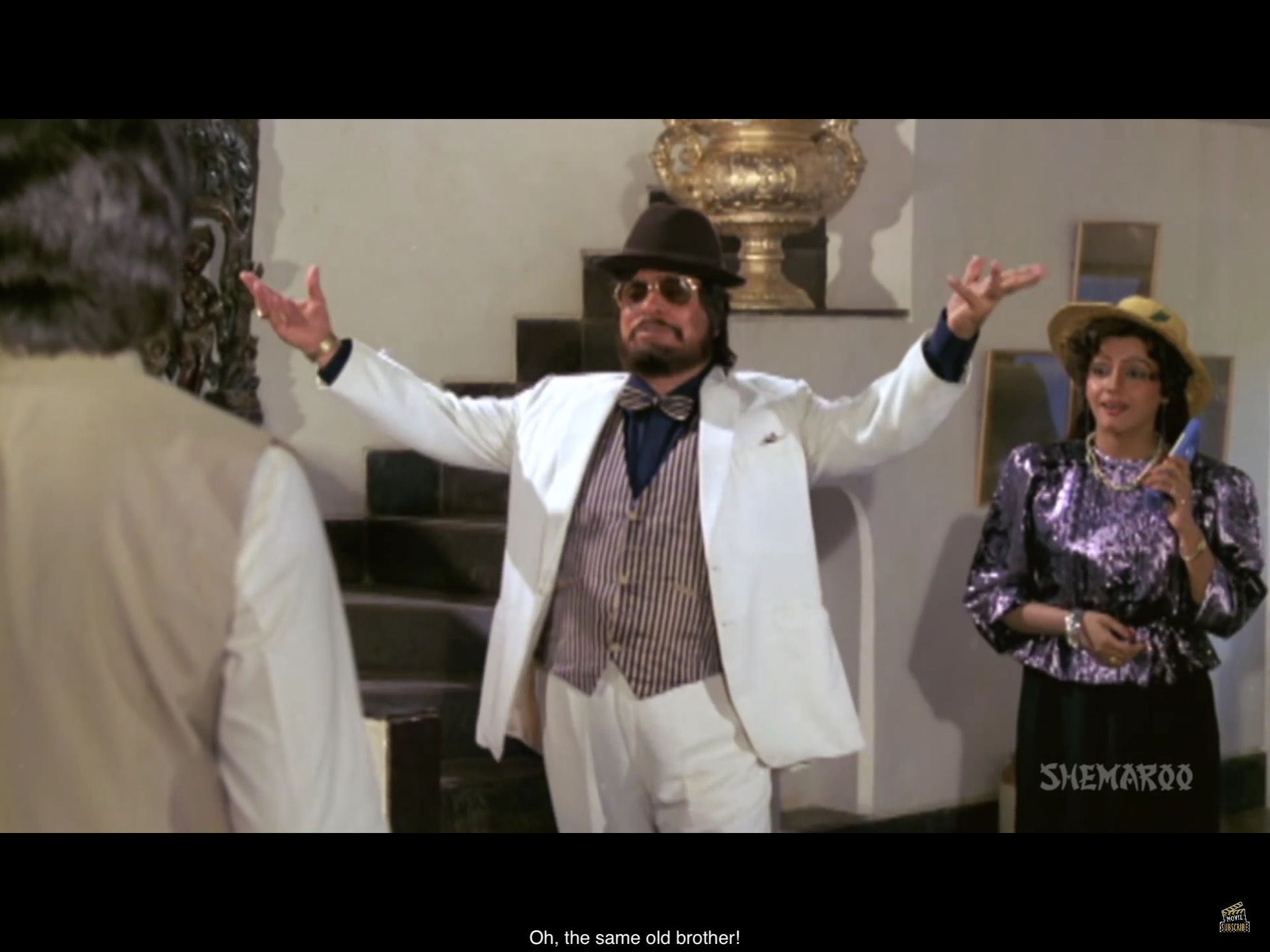
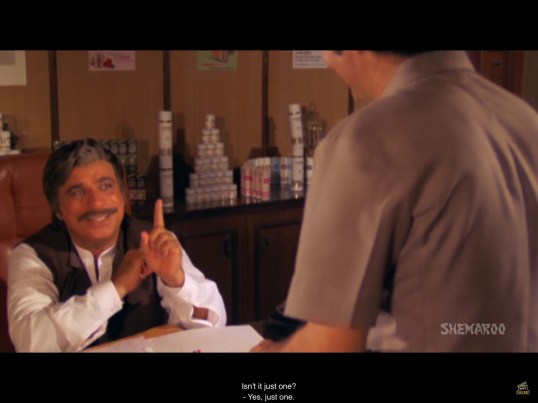
Back to the movie. This guy has come in to do his Saturday Night Live audition. He tells Dhaniram that he is his A.D.S. (Asrani) By that he means assistant-driver-secretary. He explains that since he does three jobs, he should be getting three salaries. It’s pretty funny as Dhaniram explains that he actually is just an assistant who knows driving and can do the job of a secretary. Thus, it’s only one job in reality.
IMG_4771

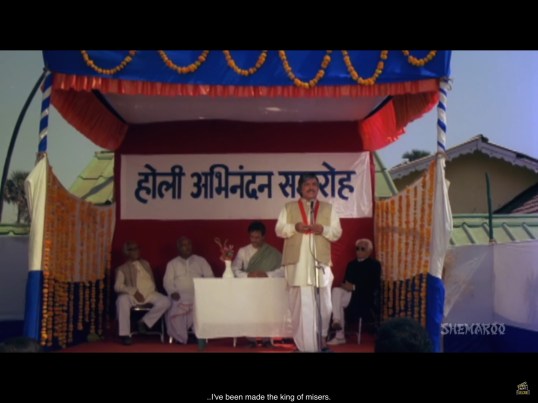
The main plot line for this movie is how the father appears to be very greedy with his money, but actually will turn out to be a good guy. He just doesn’t throw his money around for no reason, and isn’t afraid if people want to call him a miser. Heck, he’ll even proudly accept an award as “the king of misers.”
IMG_4989

The soap opera of the scheming family and rich Dad continues at home. Then it cuts to an office where a guy hands Ajay some money. Then dramatic zoom…
IMG_5168

and abrupt cut to the horse track.

IMG_5169

This movie has a thing for abrupt cuts. Apparently, the wipe transition was not in the director’s cinematic vocabulary. Well, he does use one late in the movie. I’m not sure where it came from, but it’s there. The rest of the time scenes will just end. It’s kind of like getting a jump scare each time the scene needs to change. When you add that to everything else in this movie, I love it!

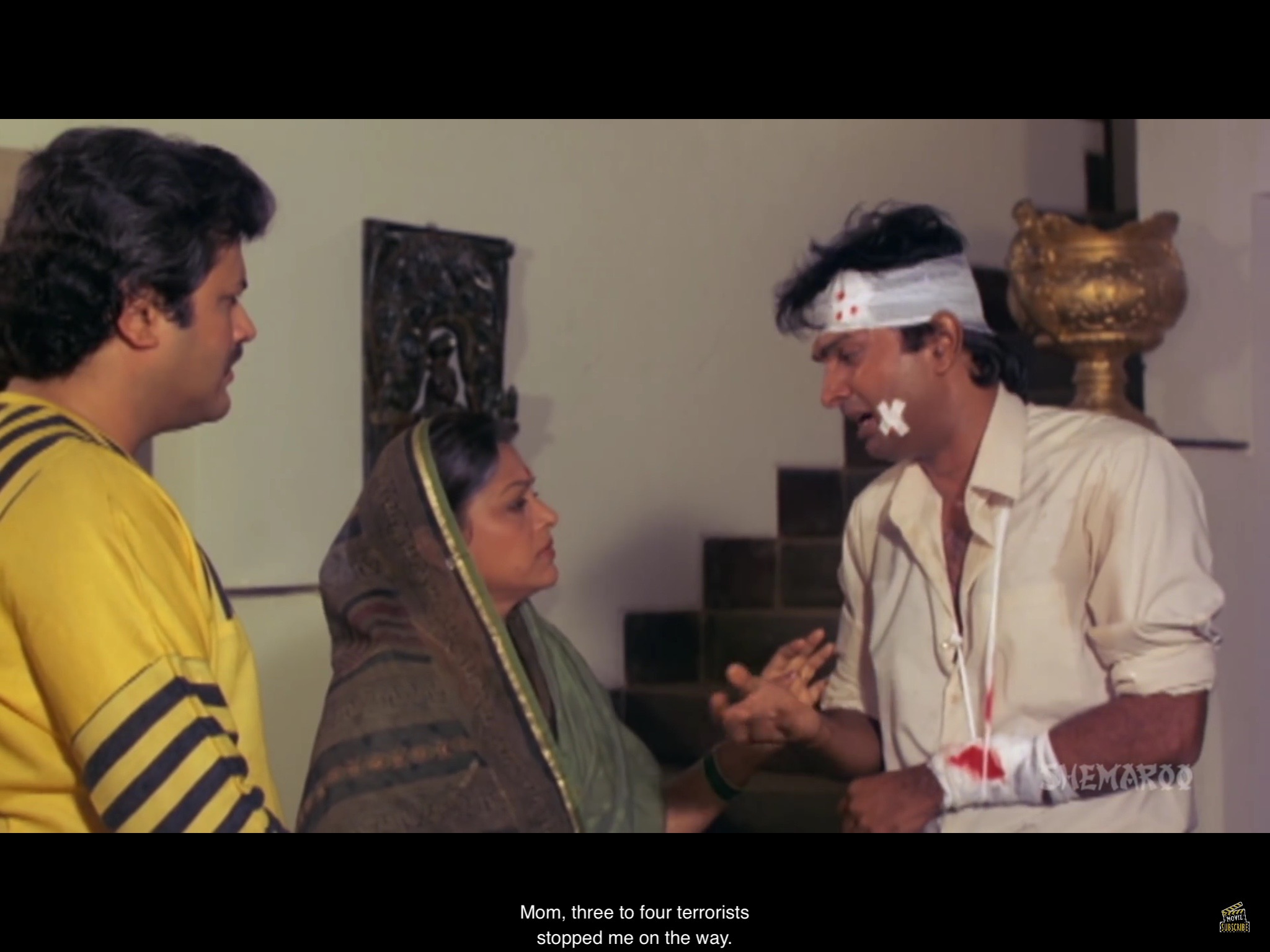
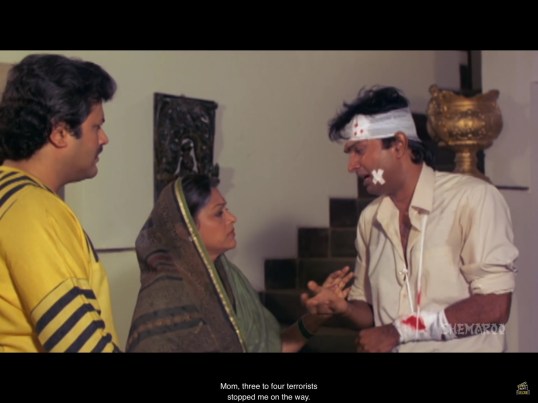
Ajay took the money to the track and lost it. So he does what any irresponsible person would do. He uses the old terrorists beat me up and took the money routine.
IMG_5211

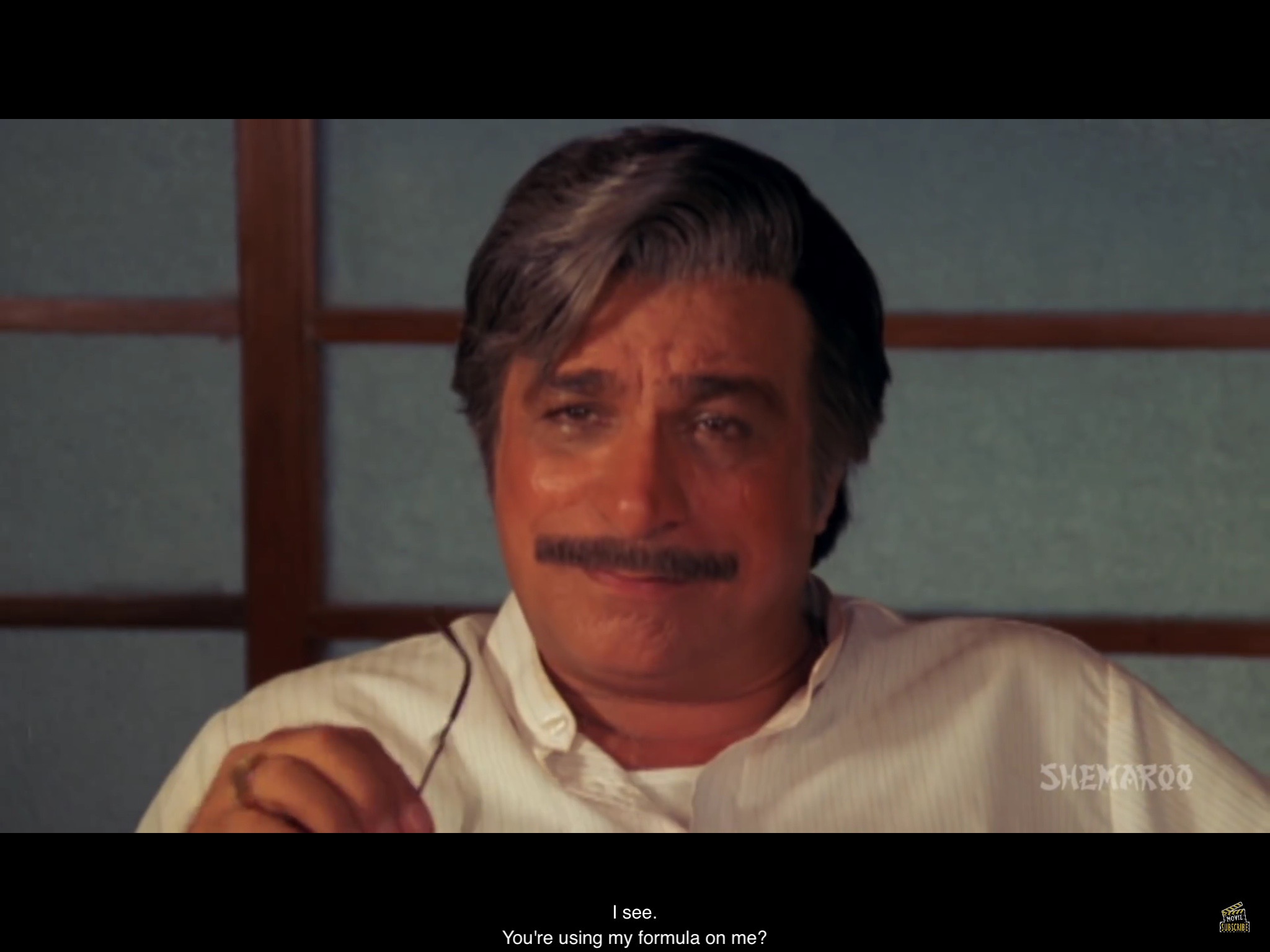
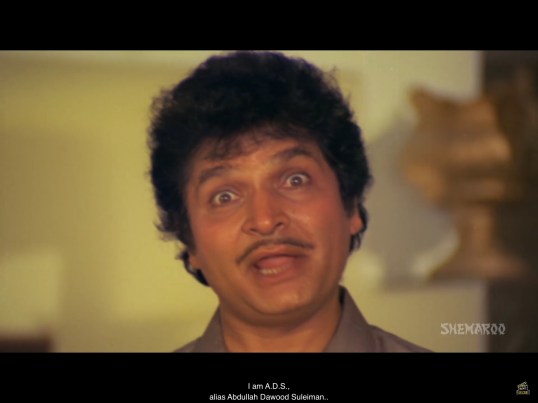
Those are the actual subtitles. I don’t know what I like better. The fact that he actually says terrorists took the money. His brother’s yellow-jacket sweater. Nope, it’s the comedy routine that Dhaniram and his A.D.S. go into about what actually happened. I really enjoy how the father says we need to make sure we really know exactly who these “looters” were. Were they “terrorists, extremists, activists, optimists or pessimists?” Dhaniram and his A.D.S. go into cricket umpire mode so that they will remain unbiased.
IMG_5271

This is when A.D.S. and other members of the family launch into a standup performance before stripping Ajay of his fake bandages. Cut!

IMG_5344

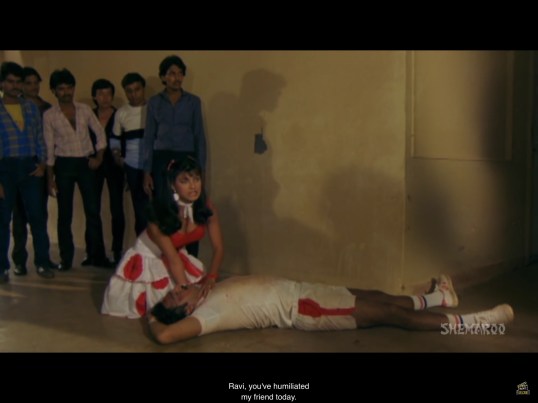
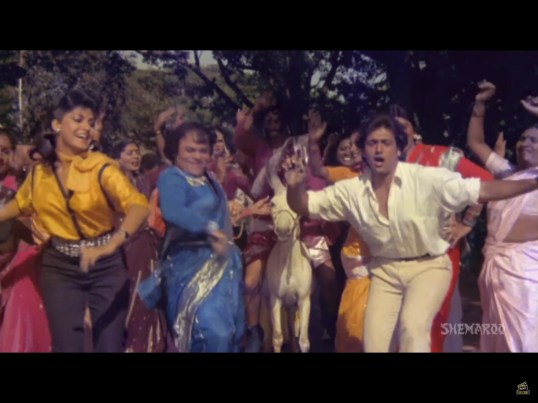
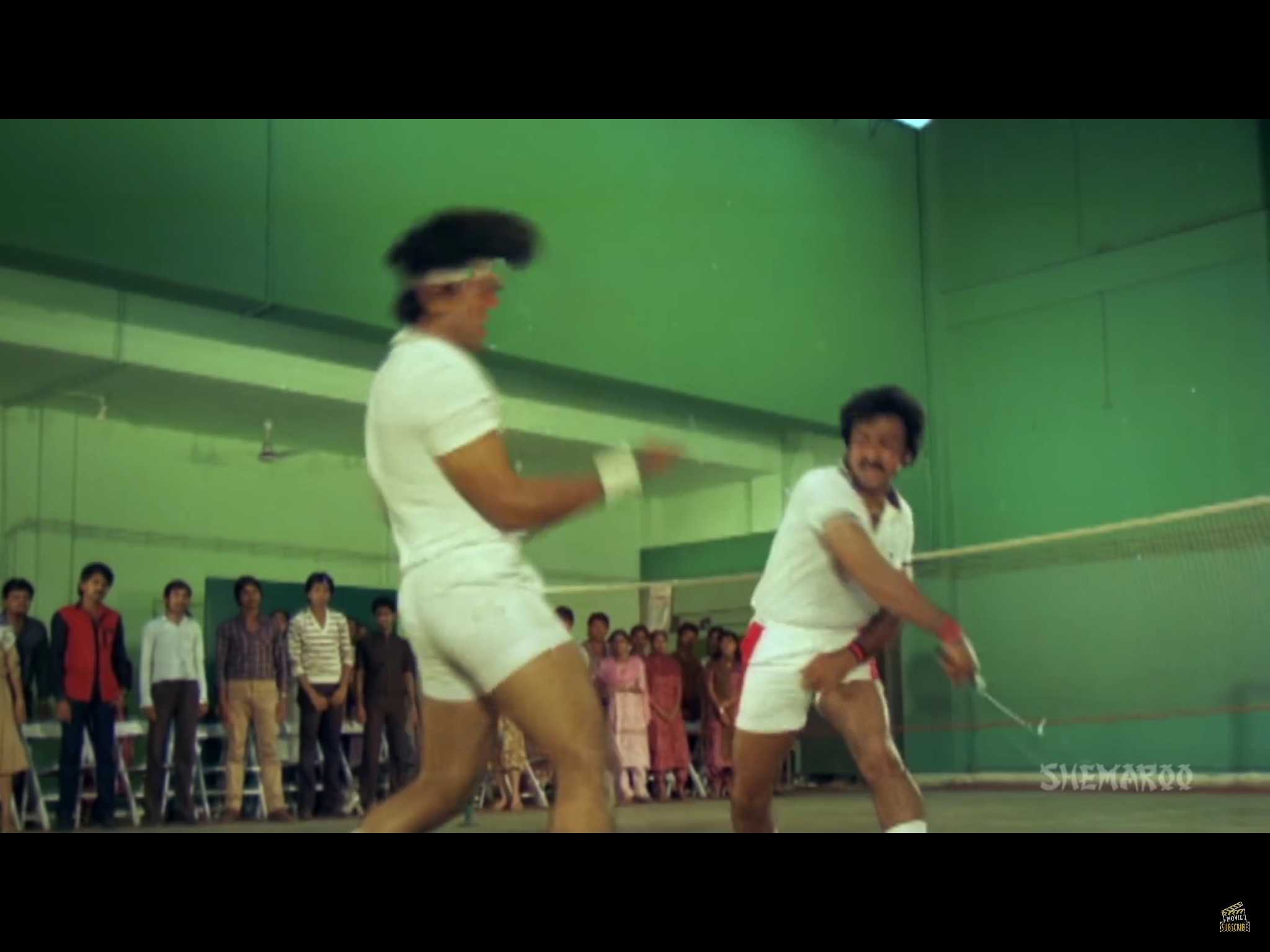
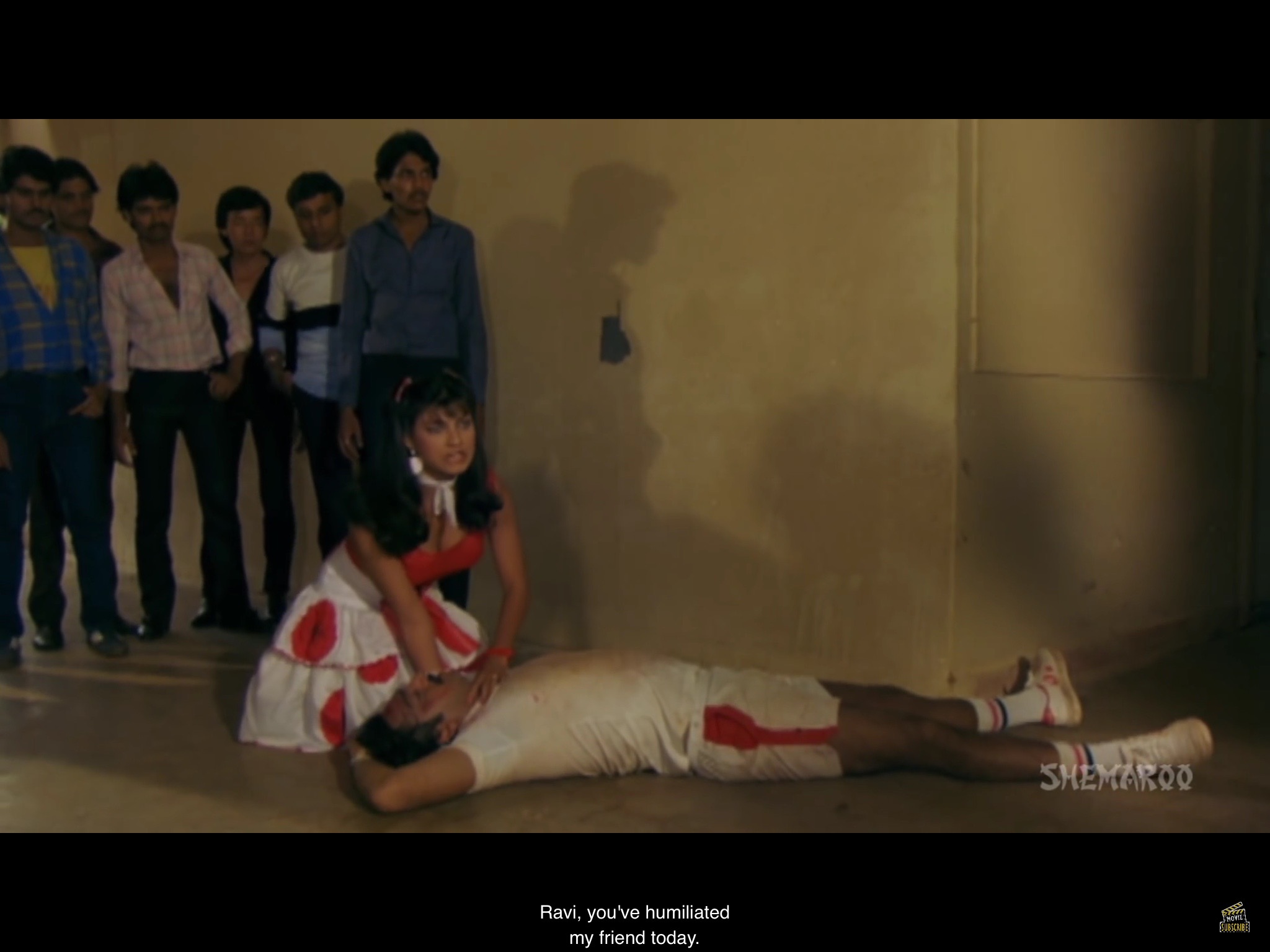
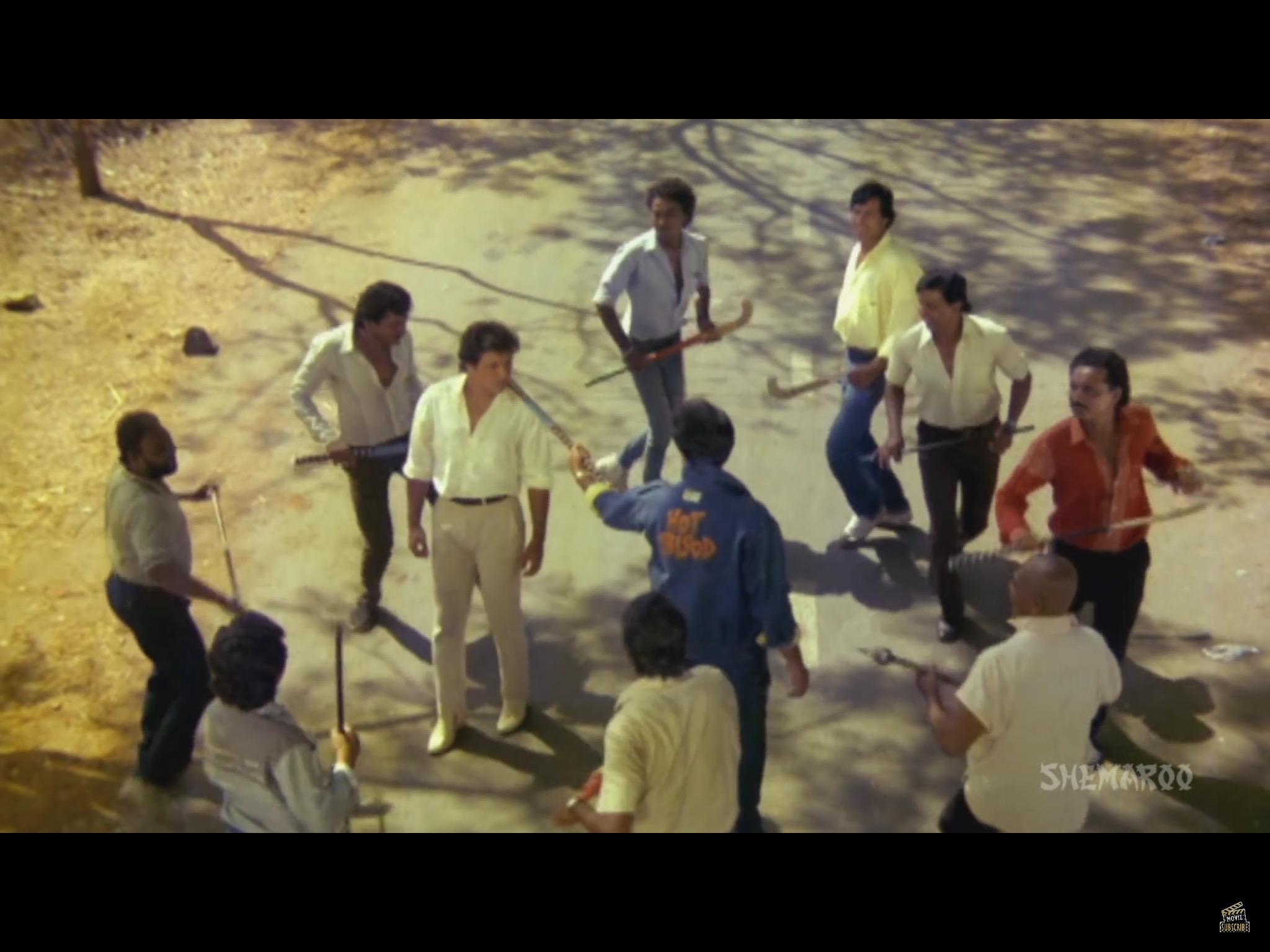
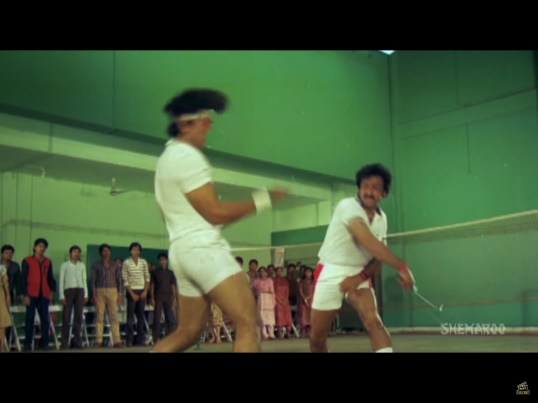
A littler earlier in the movie we met Radha (Kimi Katkar) on a bus. She will be our heroine for the movie. She’s the future Spiderwoman and Indian Natlie Wood. There’s a West Side Story (1961) musical number and one that appears to reference Splendor in the Grass (1961), so why not? This is the scene of the badminton match between Ravi and the guy Radha came with who is determined to take Ravi down. Let’s cut to the chase. Ravi finds out that an iron ball has been put inside the shuttle cork. It’s on, and I think the filmmakers might have seen Turkish Star Wars.

IMG_5394

IMG_5398

IMG_5413

IMG_5455

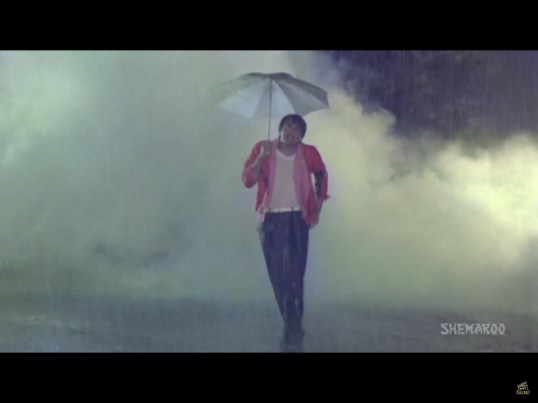
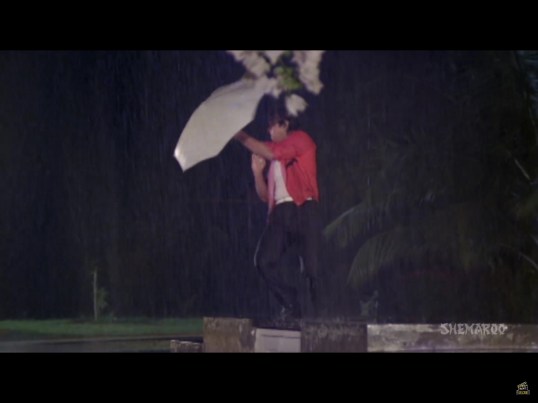
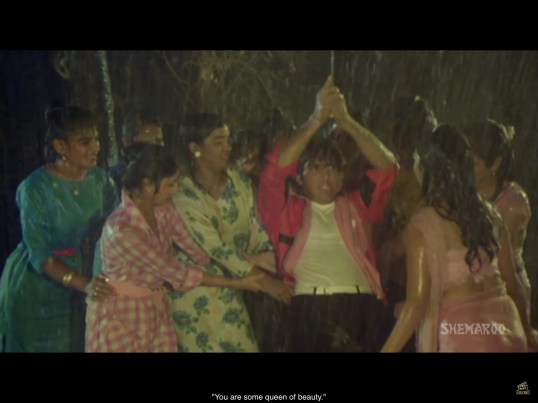
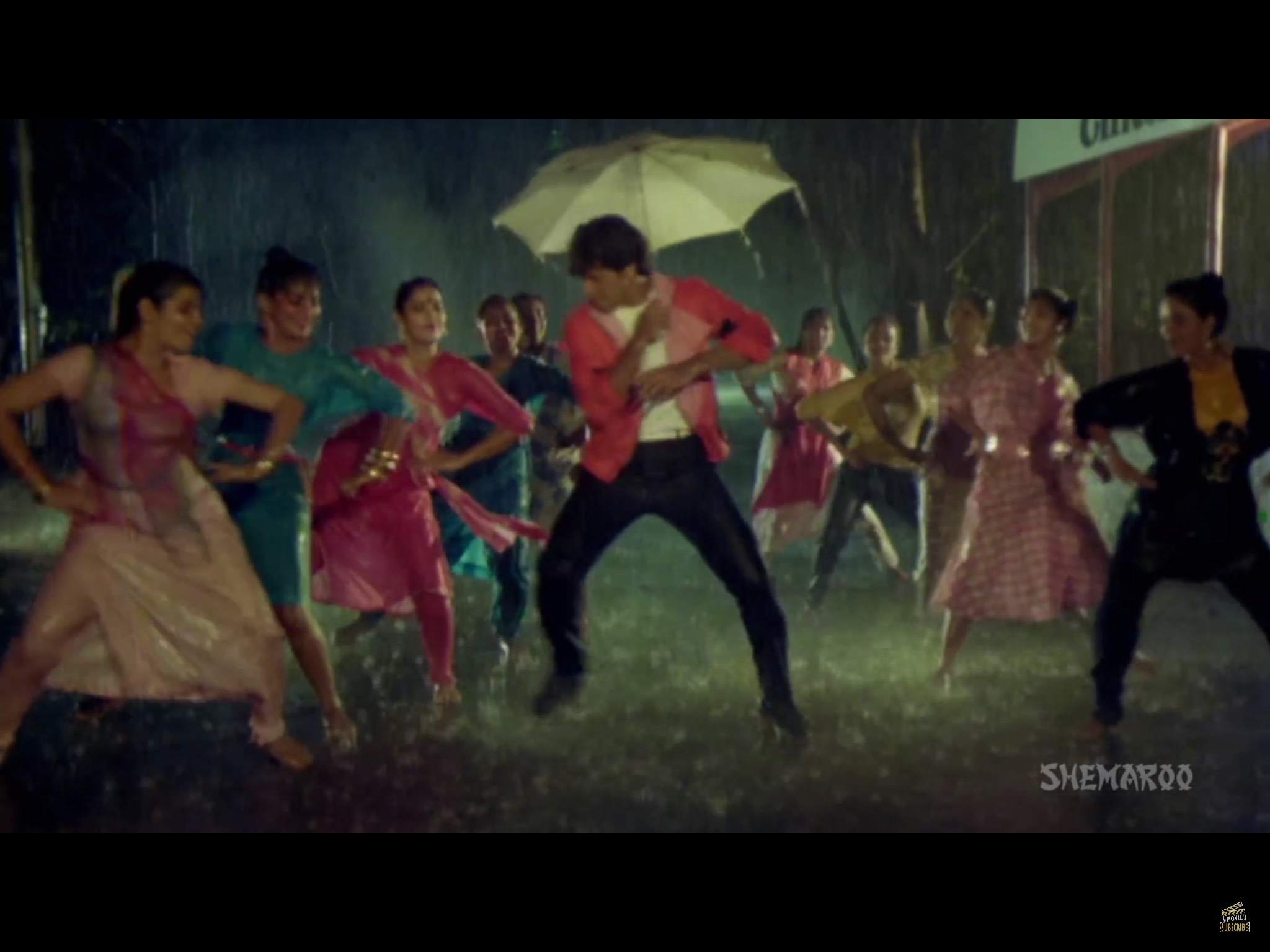
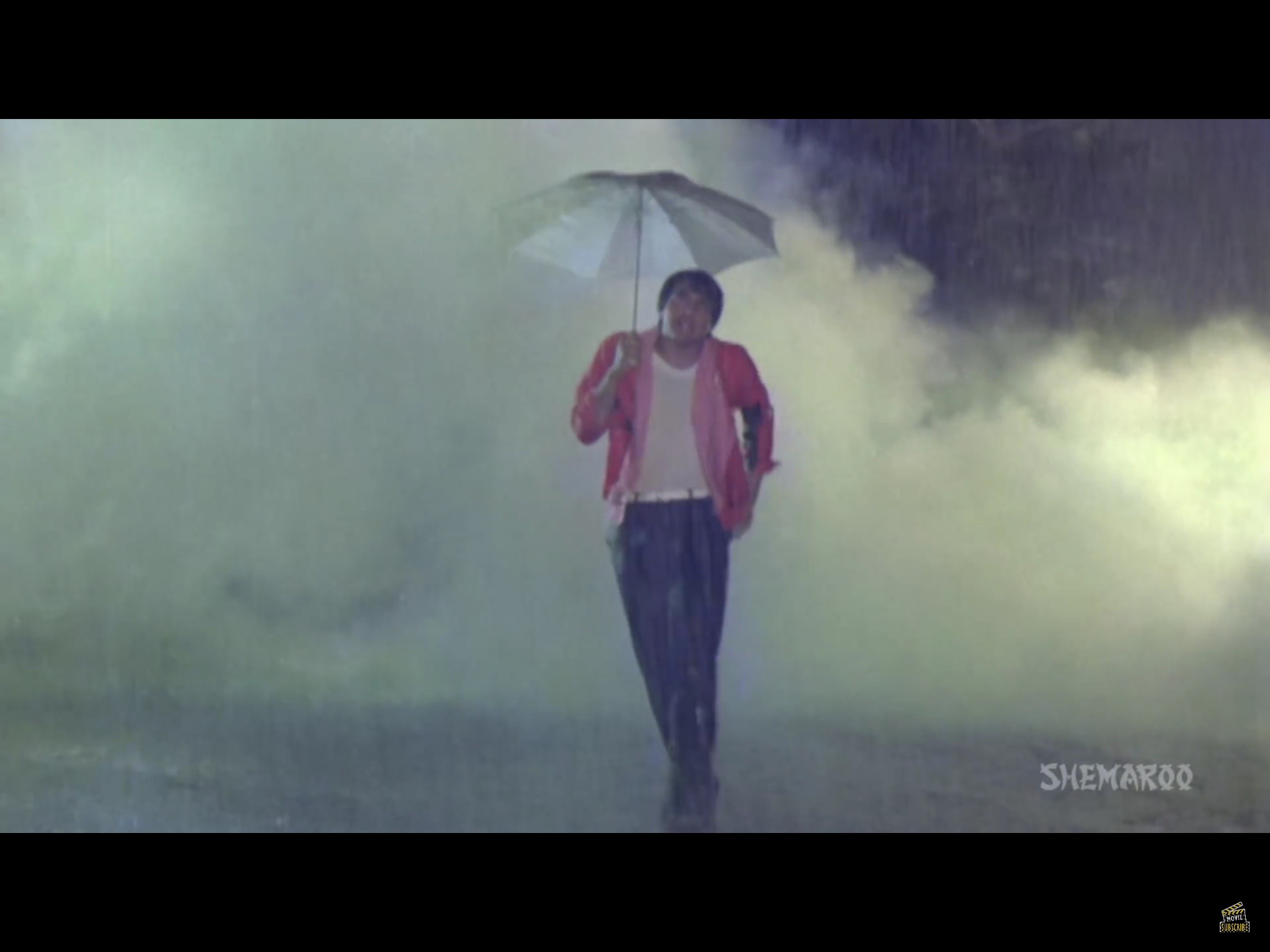
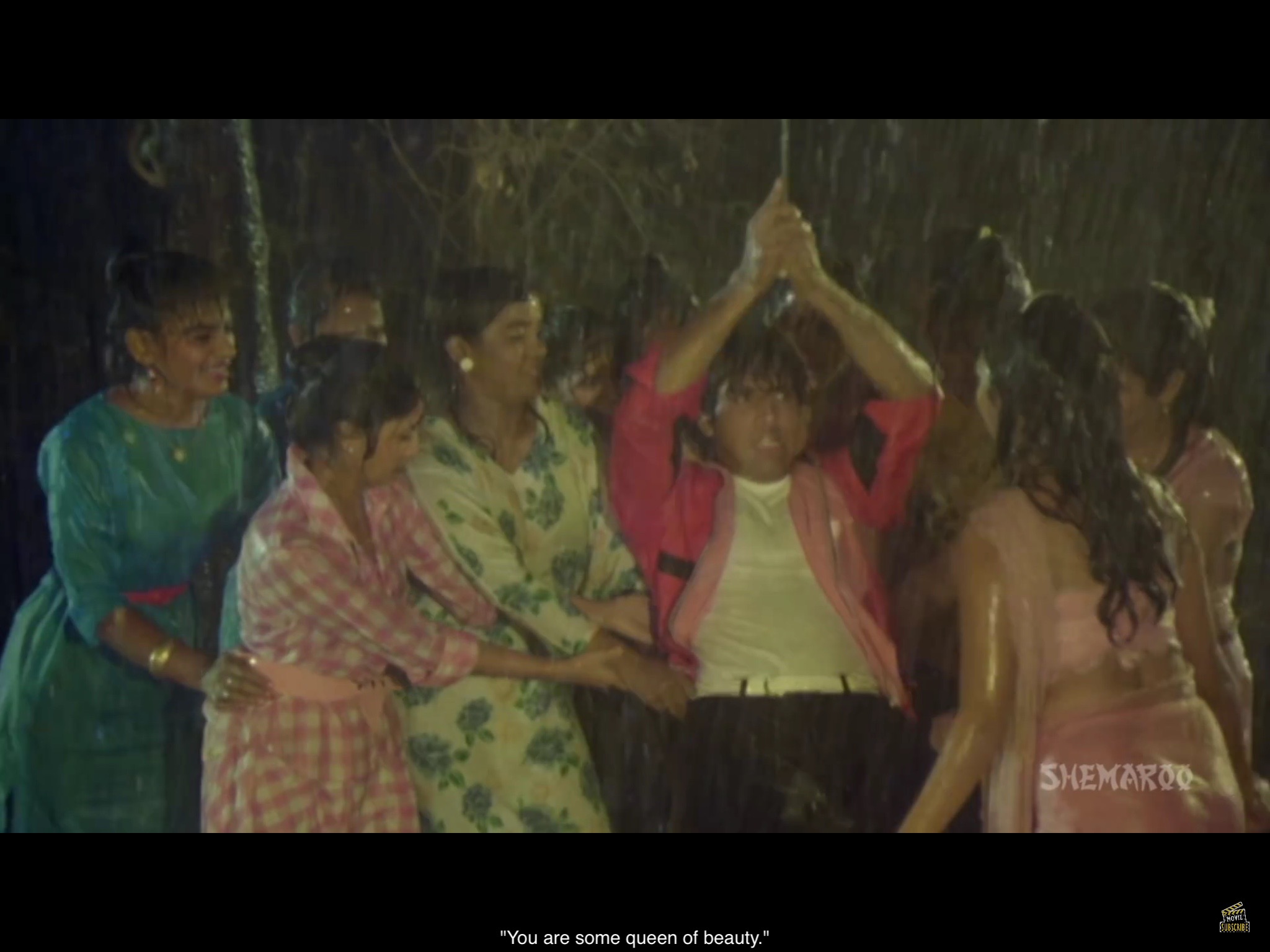
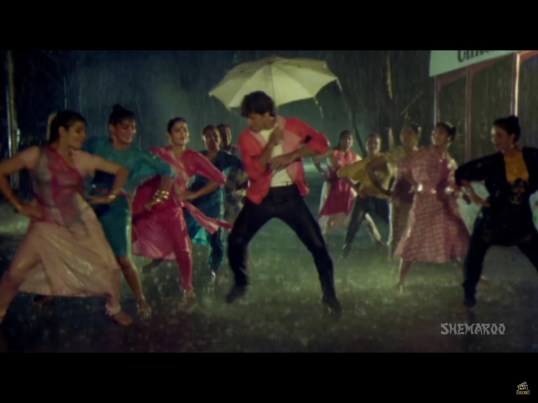
And cut! Cut to what? Why Singin’ In The Rain (1952) of course!
IMG_5479

IMG_5519

IMG_5595

IMG_5501

I’m sure the fact that the jacket resembles the one Michael Jackson wore in Thriller is a total coincidence. The musical numbers in this are actually pretty good. It helps a lot that Shemaroo Films bothered to give us subtitles on the songs. I’m pretty sure that every old Bollywood movie I’ve watched never bothered to do that. Can you imagine watching something like The Sound of Music (1965) without subtitles on any of the songs?

As soon as Ravi is literally strung up with rope, it cuts back to more family scheming. Two of the brothers decide to hatch a plan to get at their father’s wealth. Now we meet D.O. Gogi, the shady Doggie Income Tax Officer.
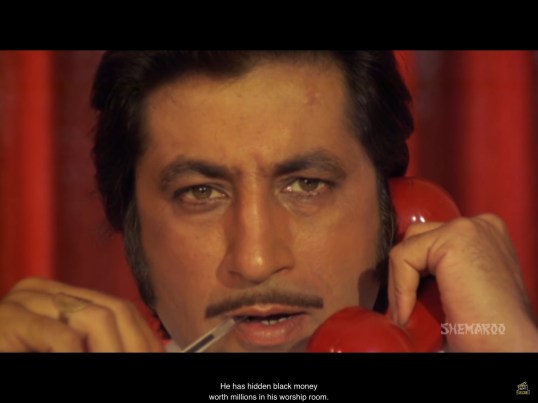
IMG_5698

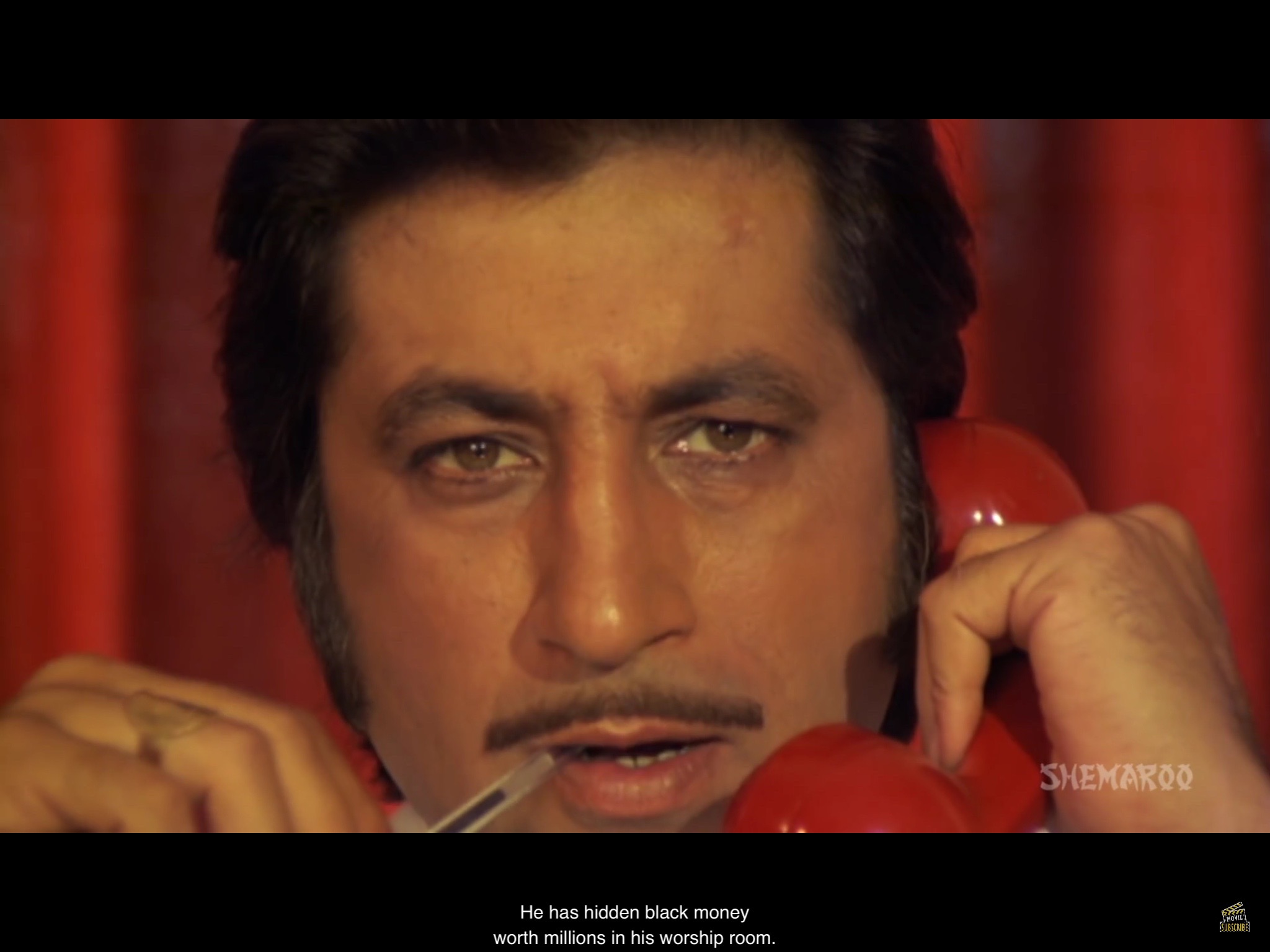
The Dad will refer to him as Doggie later on in the movie. The brothers tell him that their Dad has a bunch of “black money”. Apparently, by turning him in they will get 10% of it. Doggie tries to get a bribe out of the Dad, and he agrees to it. I love how it instantly cuts from Doggie turning to leave the room to Doggie waiting at a construction site for his money. No wasted time in Dariya Dil! Dad shows up, Doggie takes his money, and the cops arrest Doggie. Scene!

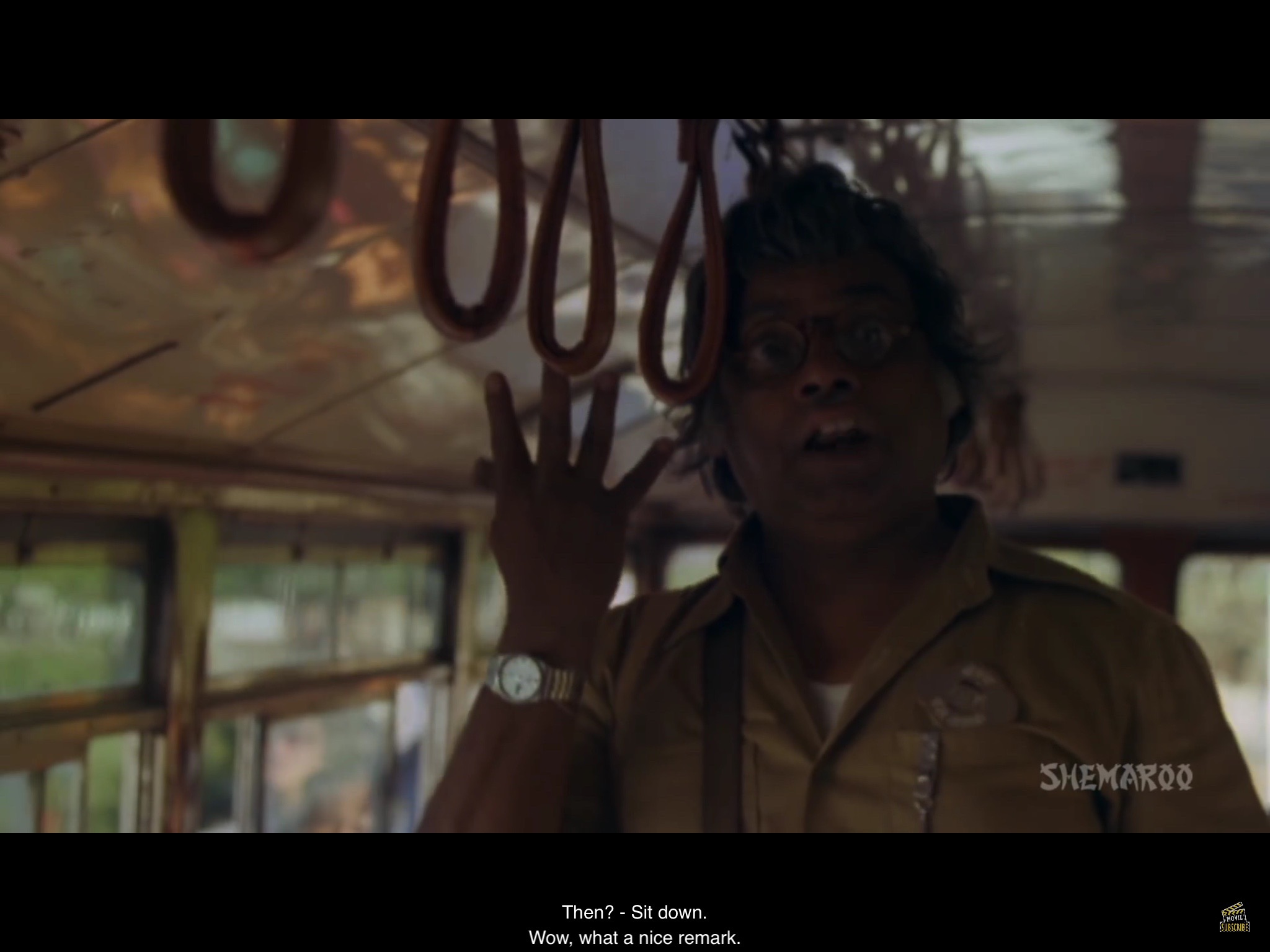
Oh, before I continue. Earlier in the movie when we first met Radha, there was a little sequence on a bus. Dariya Dil breaks the fourth wall a few times, and…
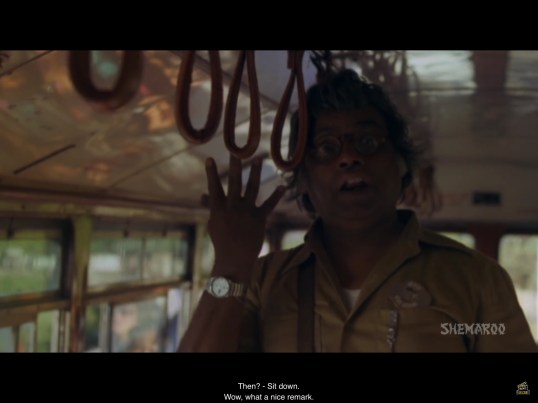
IMG_4883

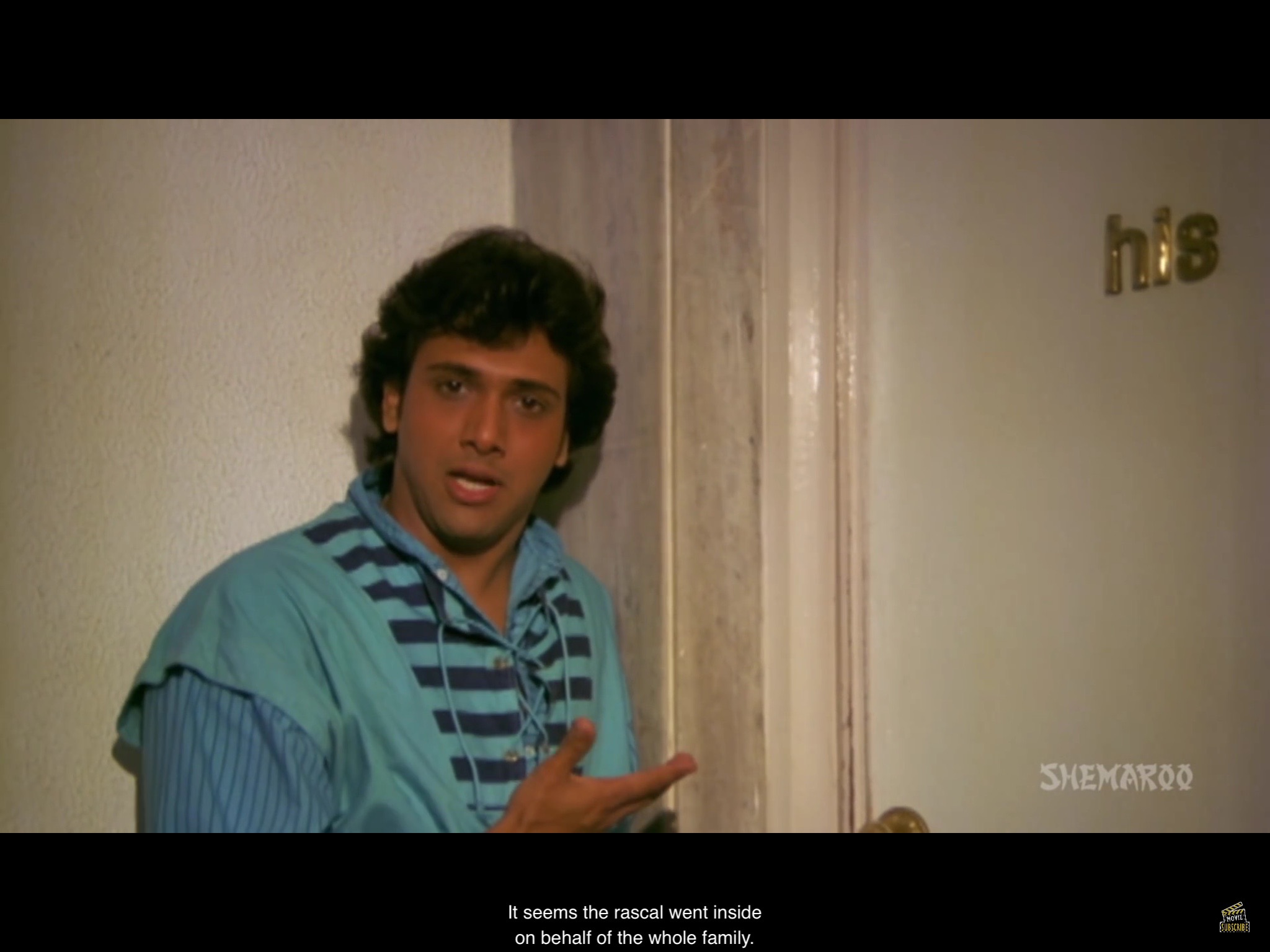
the first time it does it, it’s kind enough to hold up four fingers to make sure you get it. I bring it up because Ravi needs to complain in the next scene about the “his” room being occupied.
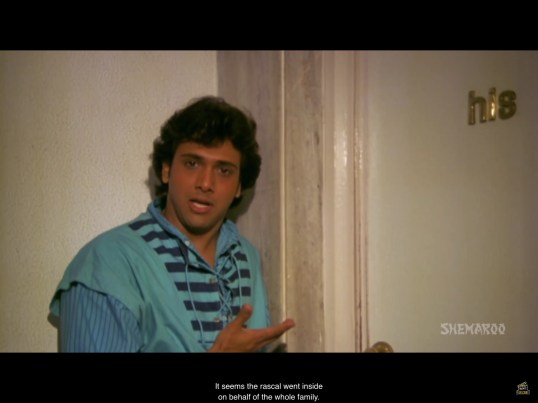
IMG_5809

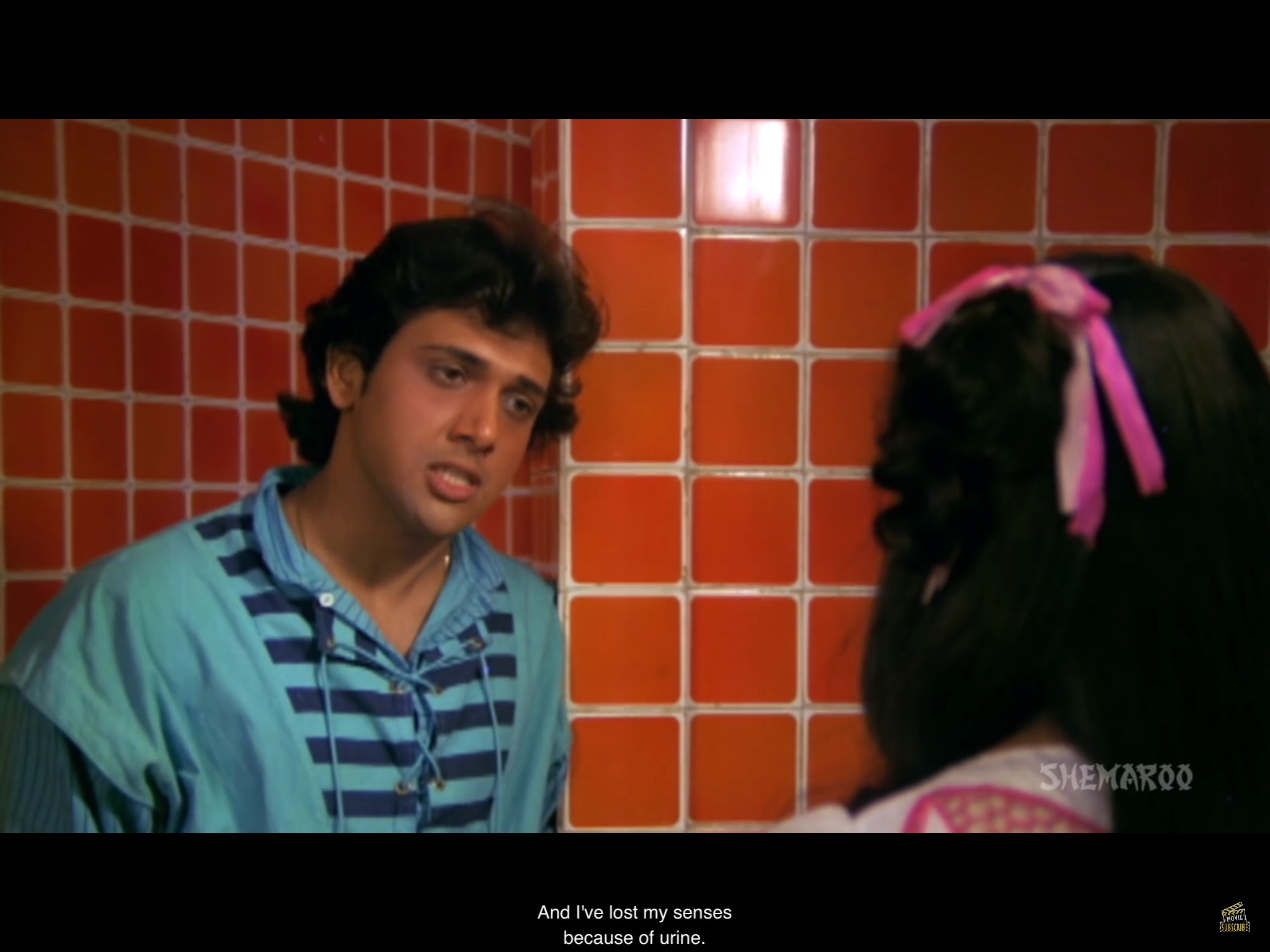
Ravi decides he has no choice and goes into the “her” room. Of course Radha is in there. If you watch Dariya Dil, then you will often find yourself saying, “Well, of course that just happened. Of course!” Such as these wonderful lines about being intoxicated by urine.

IMG_5837

She initially freaks out, but Ravi isn’t going to put up with her backwards bathroom rules. He goes into fast motion to get past her, and then ah!
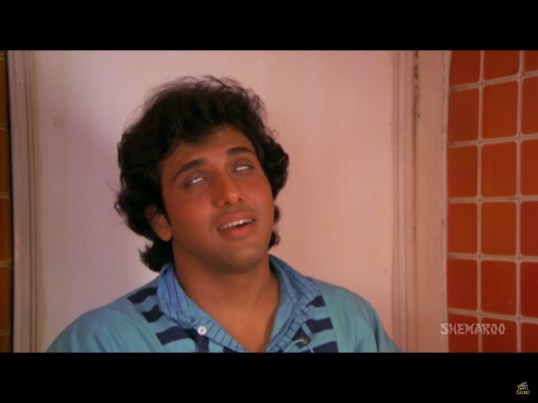
IMG_5859

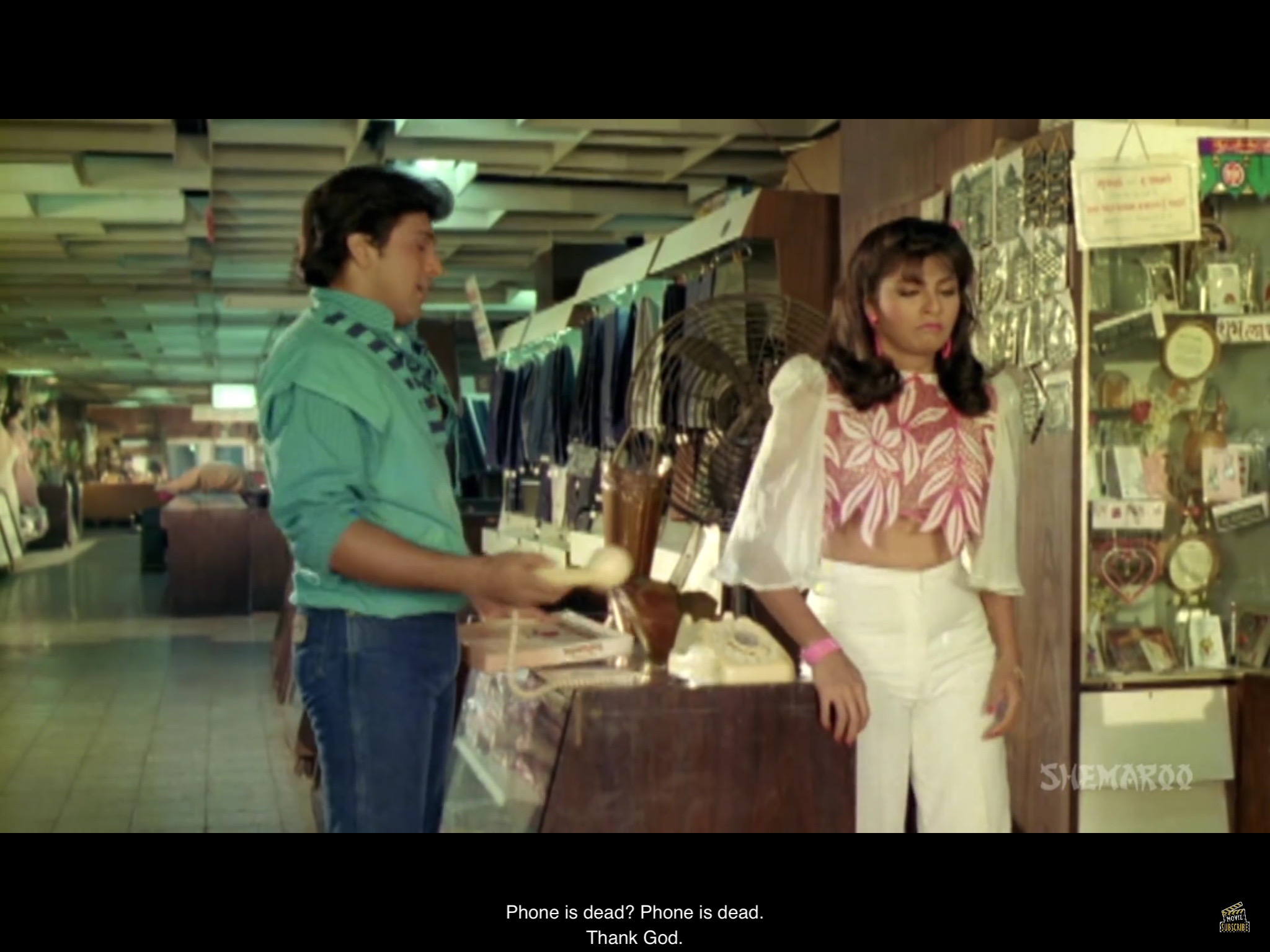
Once again, of course, he comes out of the bathroom to find Radha is still there because the two of them are locked in the department store. I’m sure that if this movie came out after 1991, then it would have found some way to reference the Frank Whaley/Jennifer Connelly locked in a Target store movie called Career Opportunities. Instead, she threatens him with a sword, then falls asleep next to it. She has a bad dream that he gets drunk, and tries to take advantage of her. She wakes up to find that it’s not a good idea to go to bed next to a sword where you can easily pick up the blade by mistake. He bandages her hand and of course…

IMG_6070

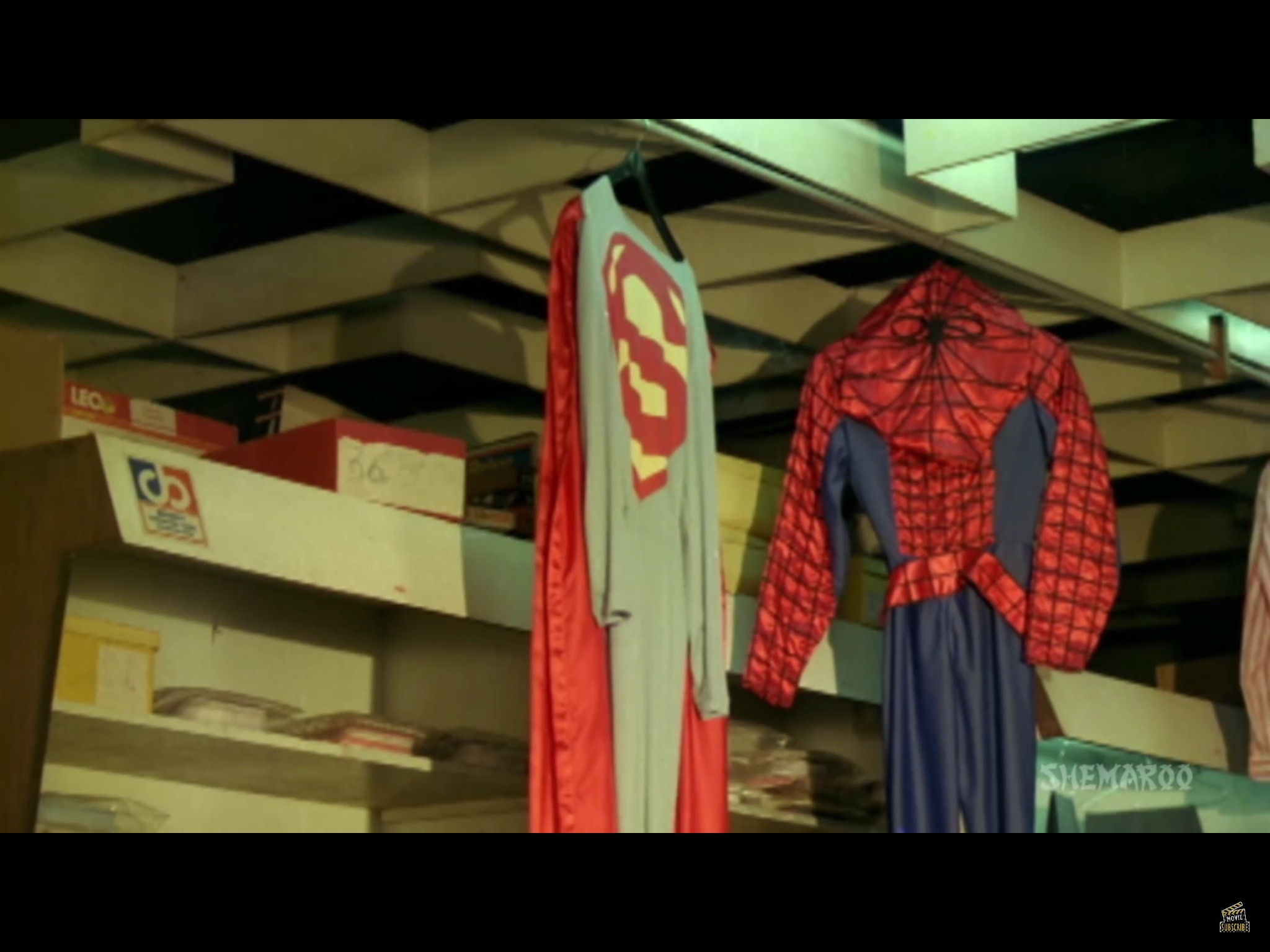
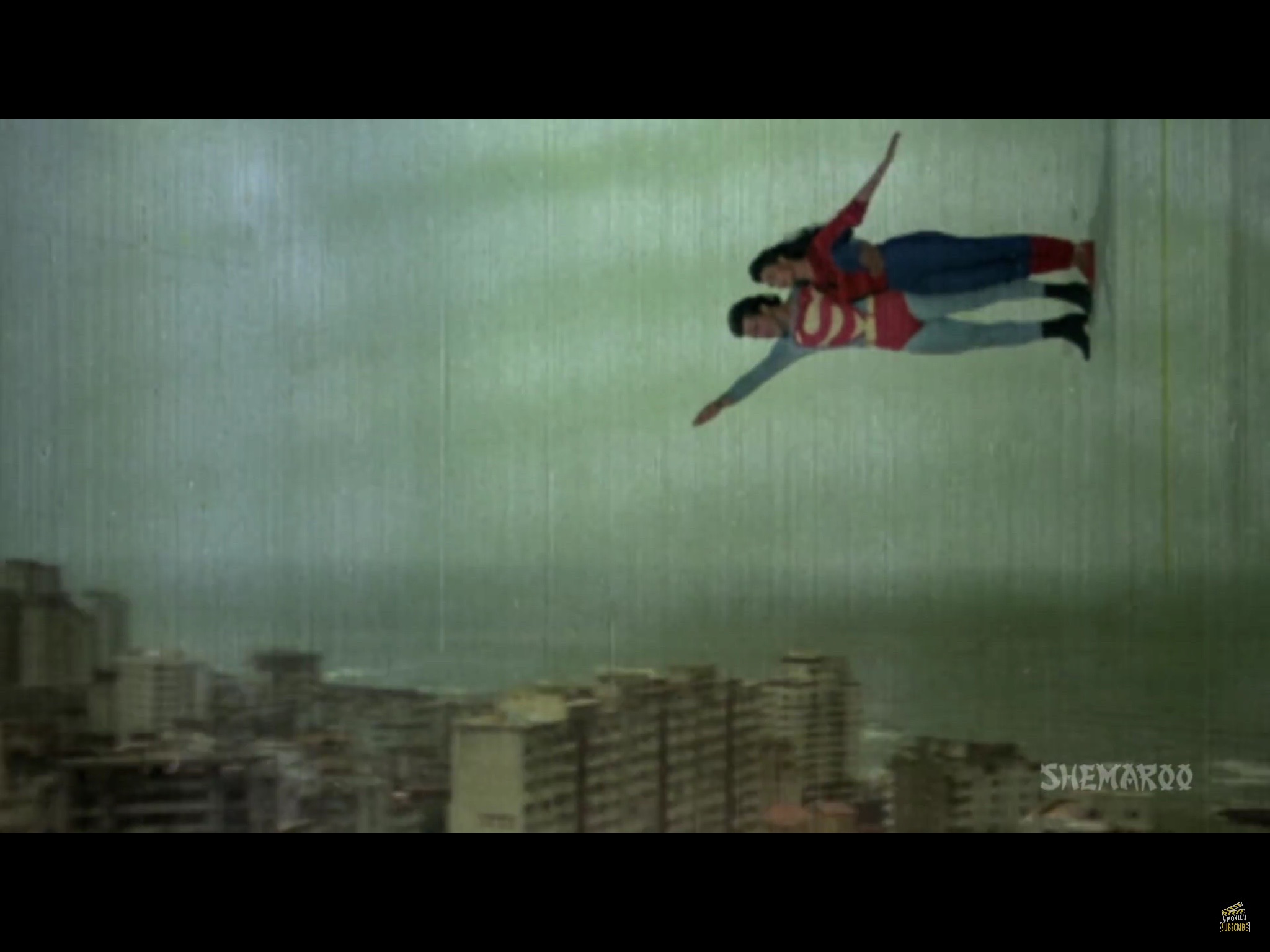
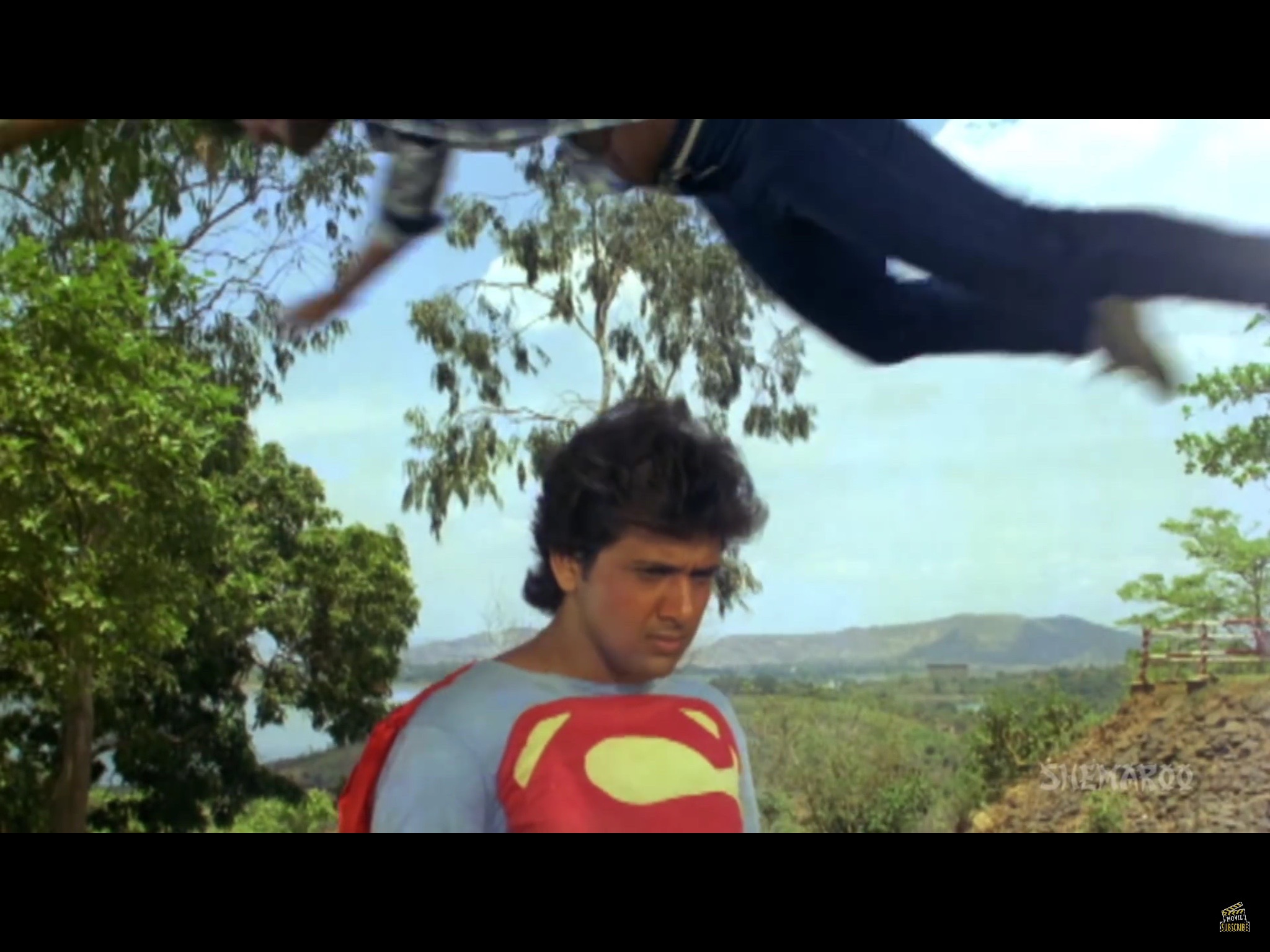
Superman and Spiderwoman costumes are hanging right next to them. This is the part of the film that has made it famous. I’ll try to give you some highlights.
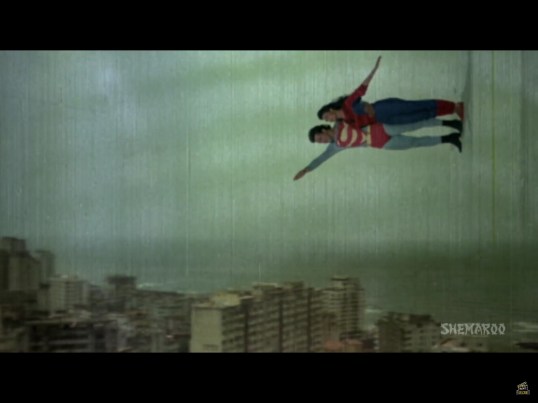
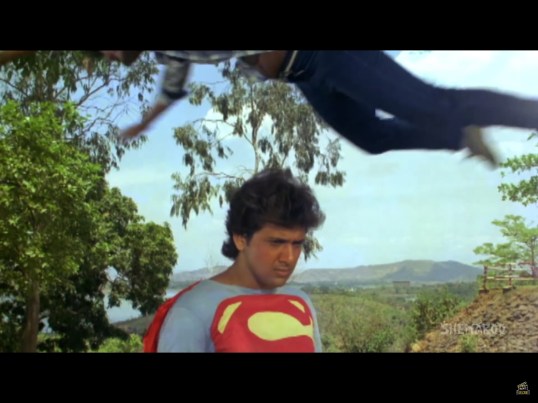
IMG_6072

IMG_6188

IMG_6198

IMG_6246

IMG_6253

Then like everything else in the movie, it suddenly cuts to the next scene. This is when I’d say the soap opera portion kicks into high gear. Up till now it’s been rather comical, but it’s going to get a bit more serious. By that, I mean more scheming children. However, we now find out that the father is anything but a miser when A.D.S. catches him coming out of the post office with a bunch of money orders. The father has his reasons for keeping it a secret. A.D.S. respects him for it. This is when we really know the Dad is a good guy, and does have money.

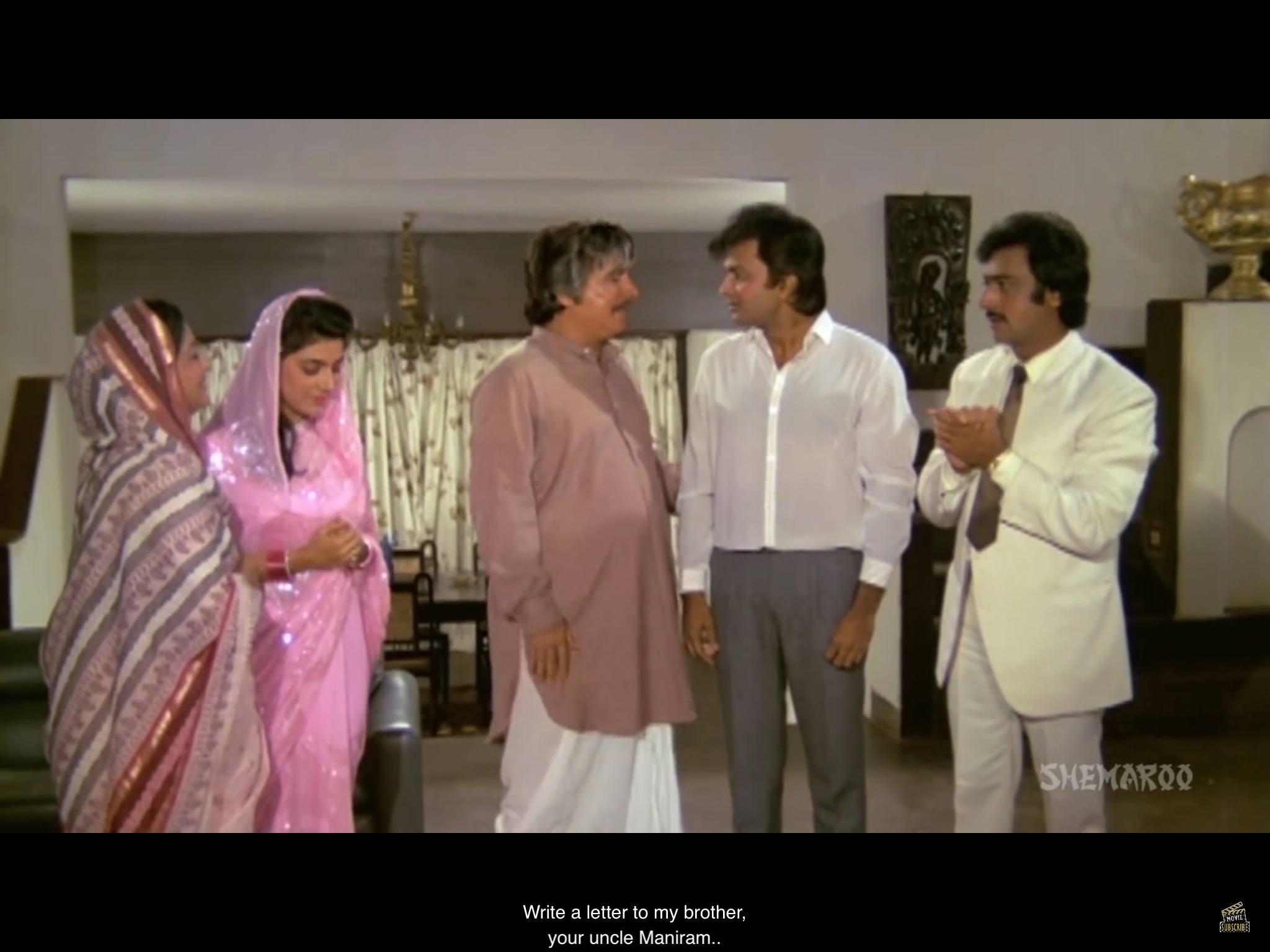
Need more no nonsense, no time wasted material? We find out now that Ajay is going to get married to a pink lady.

IMG_6606

This means a letter needs to be written to Dhaniram’s brother in London. Cut to plane, and boom! He’s there.
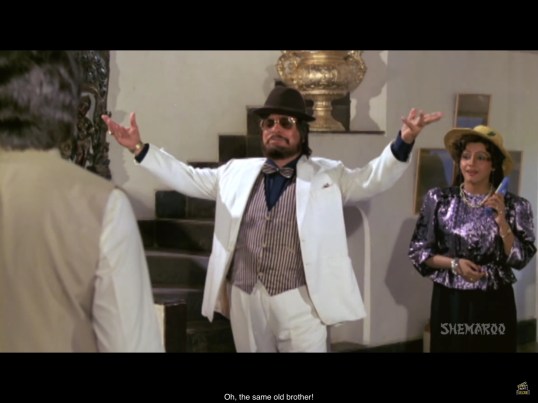
IMG_6615

I’m not sure which one of these outfits on the girls are worse. That one, or…
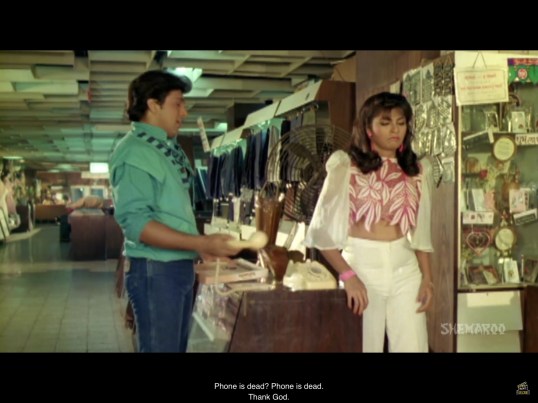
IMG_5890

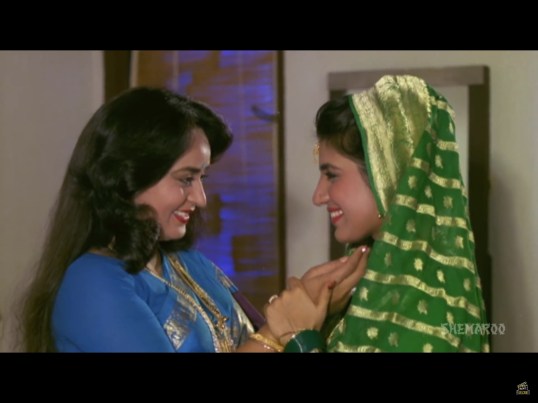
this one earlier. While the men’s outfits aren’t much better, the women’s outfits in this movie are so 80’s it hurts. After a few more scenes, we get one I honestly thought meant these two girls were going to turn out to be lesbians.
IMG_6795

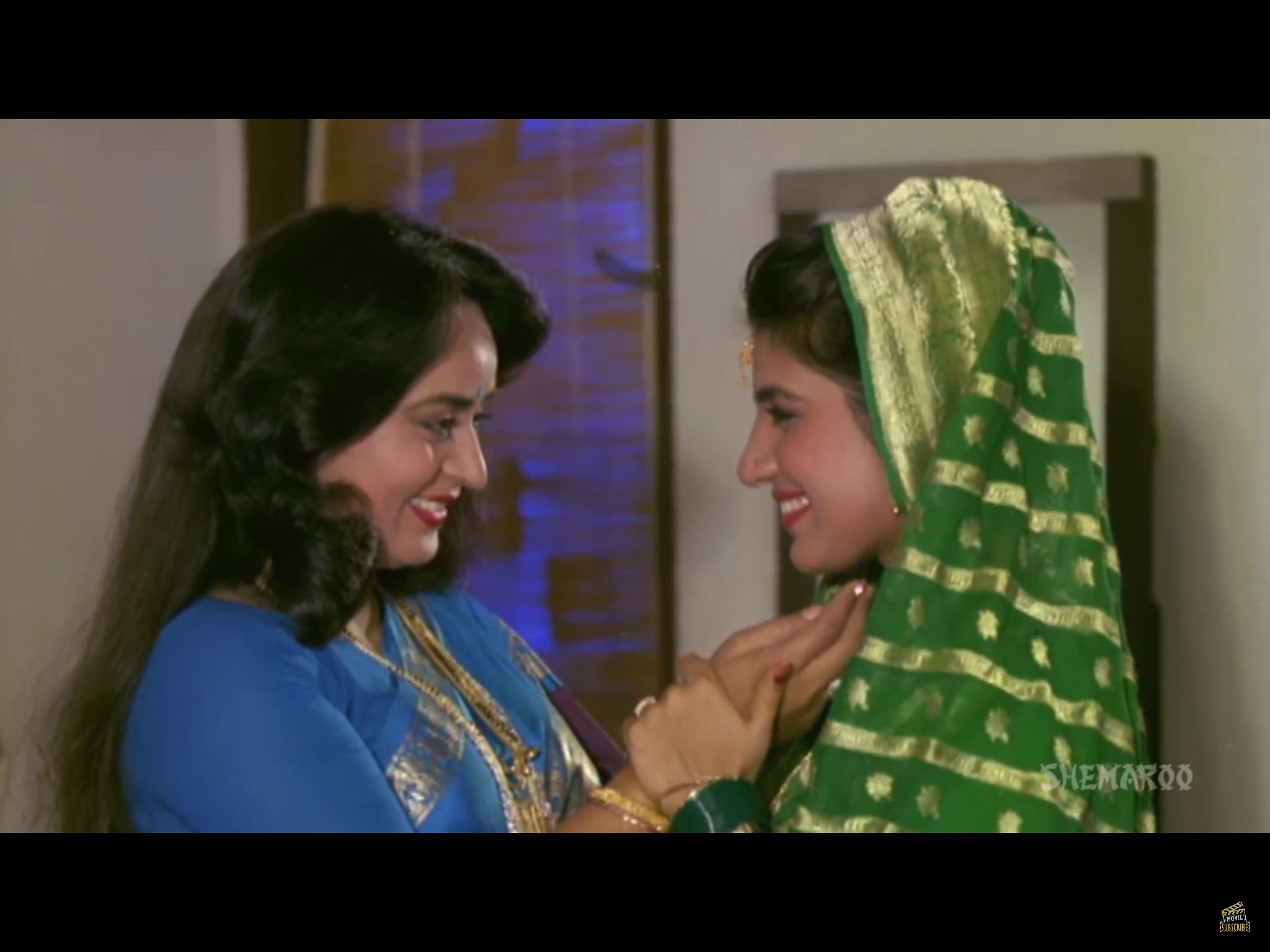
The dialog here, the way these two ladies act, and that this scene comes after all the crazy stuff we’ve already talked about really had me thinking that could be a possibility. In fact, considering a musical number later in the film, I’m surprised they didn’t turn out to be lesbians. In reality, they are two ladies that are going to also be plotting against the Dad through the Mom. Oh, and it will only take a foot massage in the scene immediately following this one for the scene immediately following that one to be Mom going to Dad in order to get money for the kids from him. Again, it’s No Time Wasted Dariya Dil!

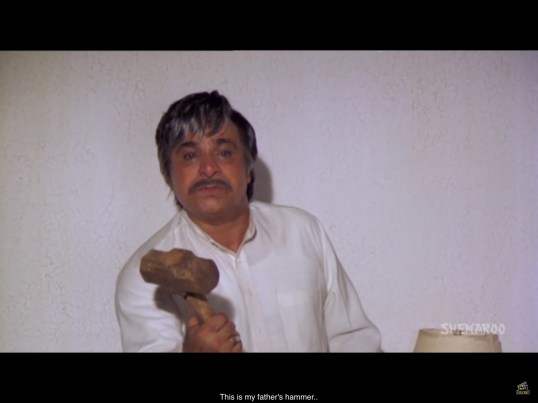
This is when Dhaniram goes into super-dramatic mode.
IMG_7037

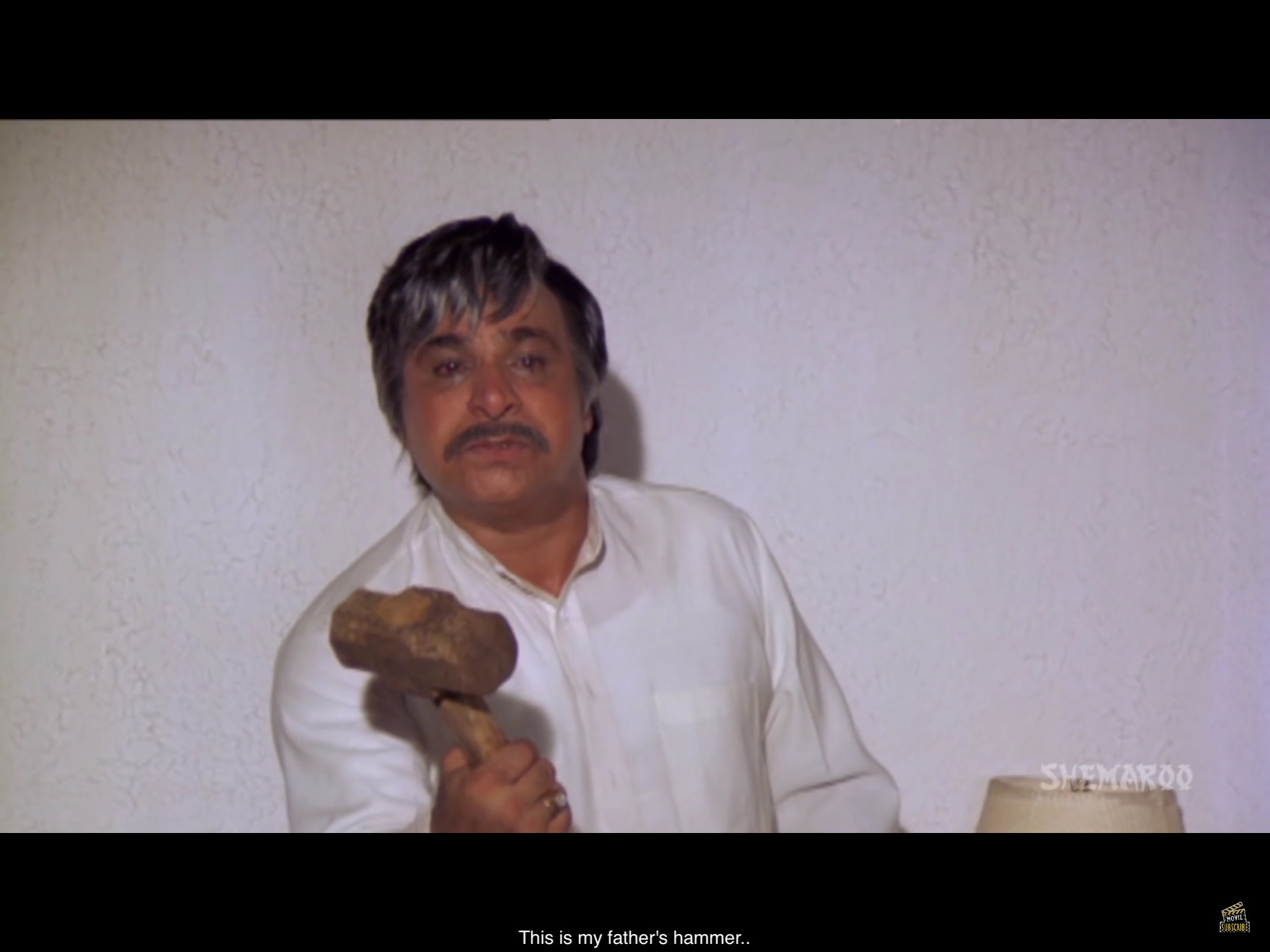
He finally takes us inside the prayer room. This is where the father allegedly was sitting on a bunch of money like he was the guy Rainbow was referring to in their song Man On The Silver Mountain. Inside, we find it empty except for a few keepsakes. He picks up the items and gives the backstory on them. He in fact calls his family to come forward and share this wealth with him that he worships. I mentioned it before, but let me elaborate here. The film is as much about the father as it is about his children learning not only about their father and his principles, but also why their father is hesitant to just hand out money to them.

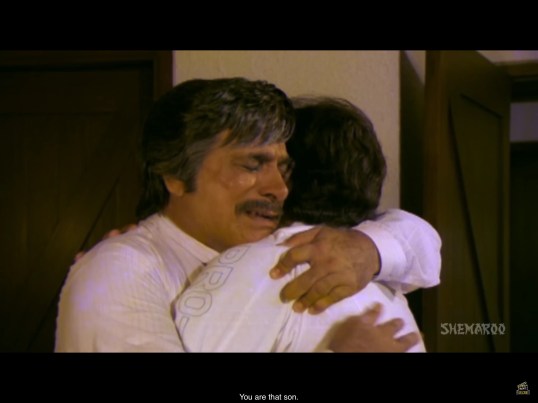
The mother continues her pleading. Dhaniram does give in. He gives his sons money to start their own businesses. Ravi is the only one who doesn’t accept it. He tells his father that his lessons are the wealth he has given him. Just as we have this tender moment between father and son…
IMG_7218

the movie instantly cuts to…

IMG_7220

a woman vomiting. Talk about ruining the moment. This is to tell us she is pregnant. I would show you just how fast we get to her having this baby, but there are some very crucial scenes in between.

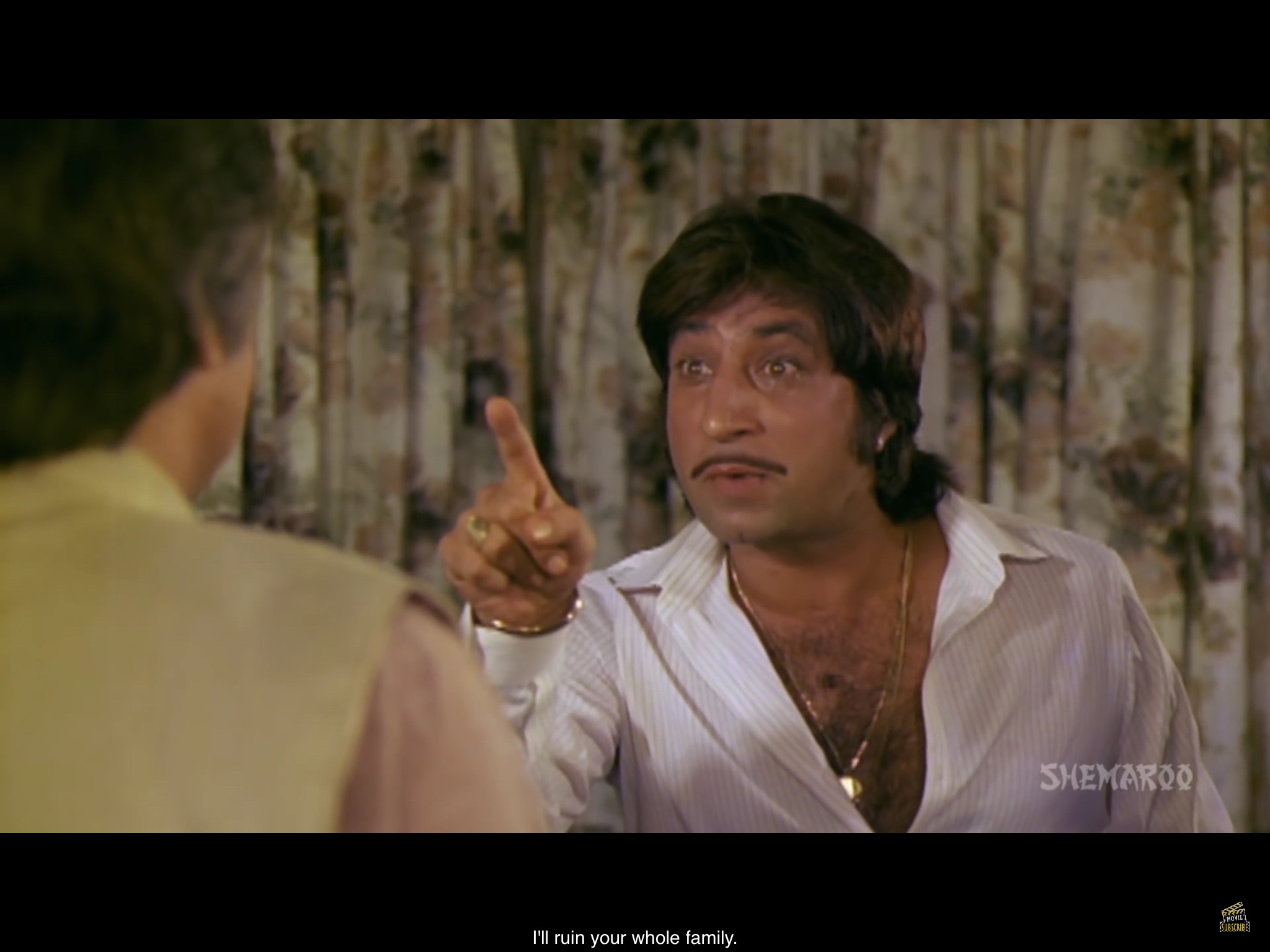
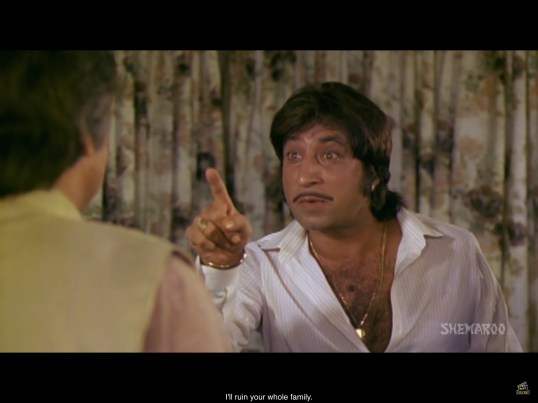
First, we get a staged show put on to make Doggie look good by rescuing the brothers from a bad deal. Doggie was bailed out by his brother. A brother that is marrying into the family. One of the girls, who is Doggie’s sister, is also marrying into the family. I think. It gets confusing as any good soap opera should. The point is that Dad catches them all having a conversation about the fake bad business deal. He confronts them. We get this reaction from Doggie.
IMG_7387

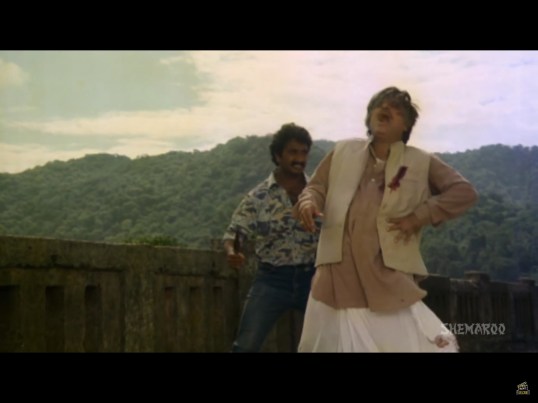
That’s all you really have to know about this part.  Now we cut to Dhaniram pulling up to help some people stranded on the side of the road. He doesn’t see that they are waiting for him. This happens to him.
IMG_7432

See! I keep my promises. He did not get shot like J.R. He was stabbed instead, then tossed in the water to die. Totally different!

After a few scenes to tell us everyone is still dirty and the bad guys have taken control of the family, the baby is born.

IMG_7626

In terms of runtime, it’s only a few minutes after we found out she was pregnant in the first place.

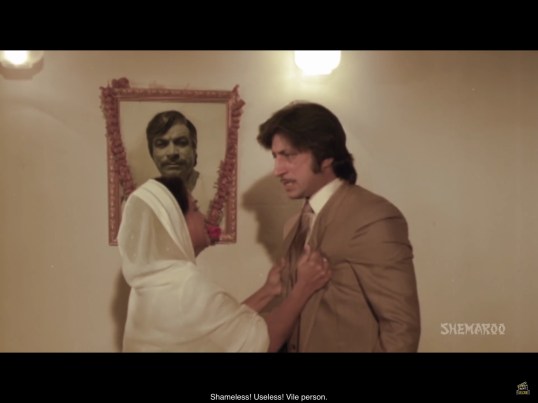
Now we cut to a funeral/baby shower? I don’t know. However, we get this scene.
IMG_7668

Believe it or not, this movie had me wondering what crazy stuff would happen to the point that I didn’t even notice the major clues this movie was dropping about who shot J.R. … I mean stabbed Dhaniram.

Ravi takes his mother away to a house run by his uncle. He finds that it’s actually a home his Dad funded to help the “old and helpless.” Rhana shows up to support the mother.

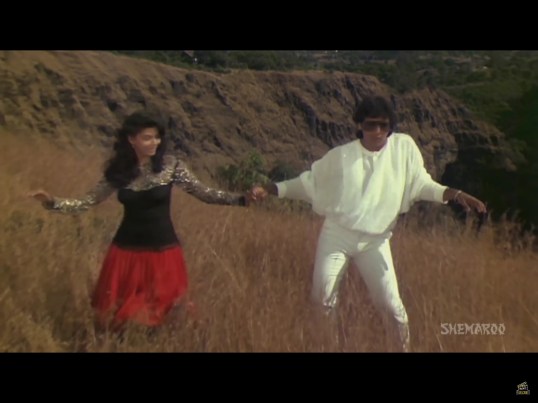
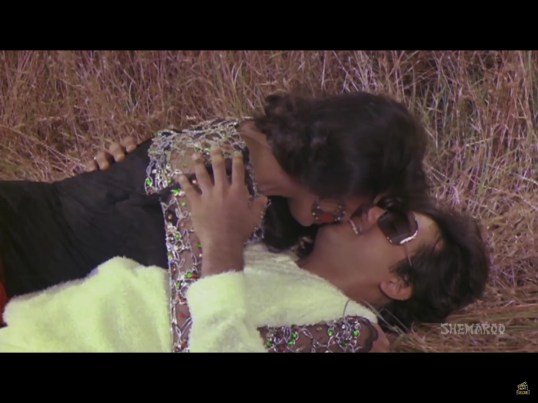
Now we get an even more random musical number than the Singin’ In The Rain one. It starts with who I believe is a college teacher talking to himself about whether Shakuntala or Vasantsena was more beautiful. I’ve taken a course in both Comparative Religion and Religion in Early India, but I have no clue who they are. Doesn’t matter because he discovers Ravi and Rhana under a tree. Then the Splendor in the Grass musical number begins.
IMG_7991

IMG_8004

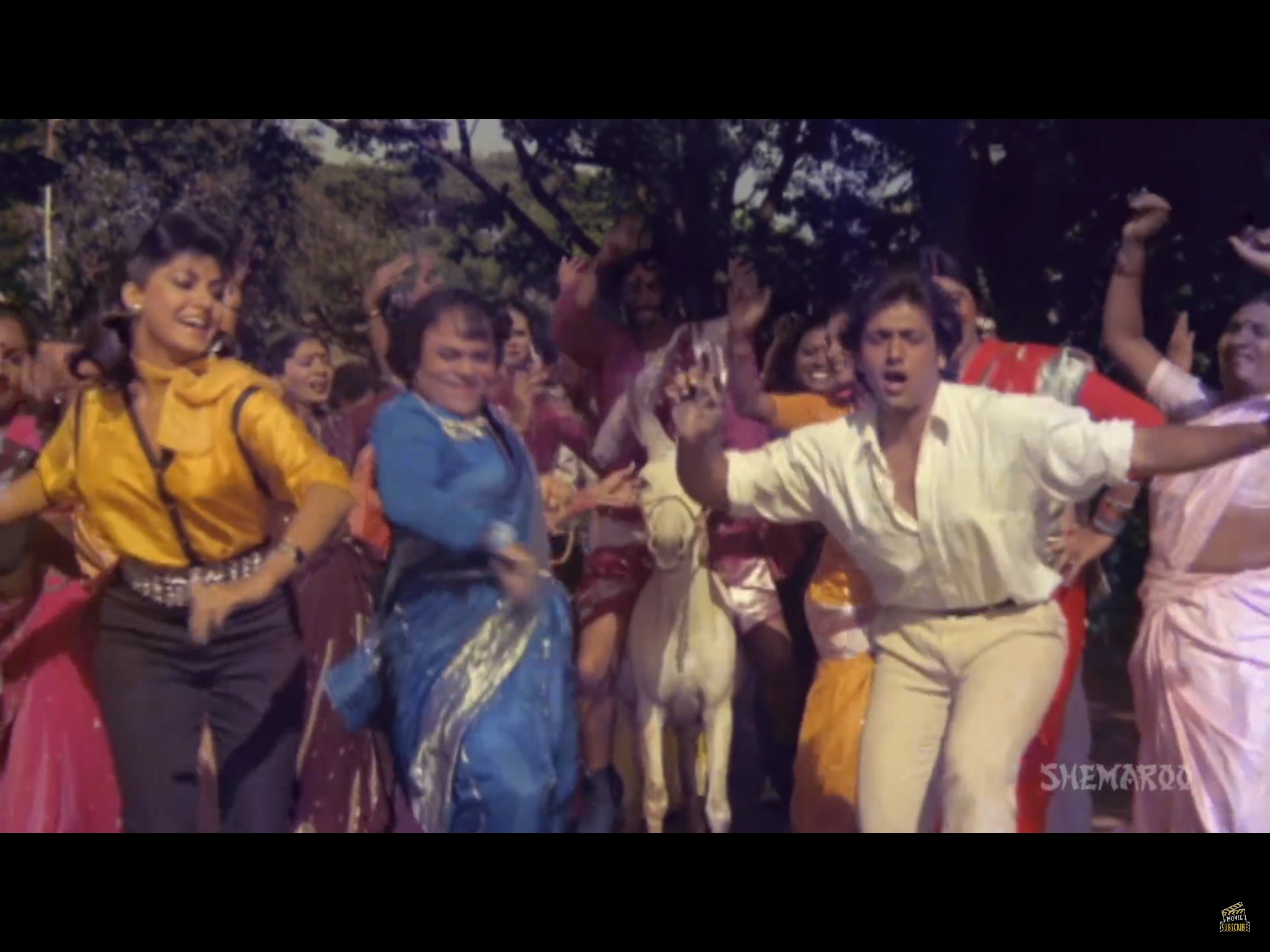
That then goes to a ugly sweater and flamingo dance.
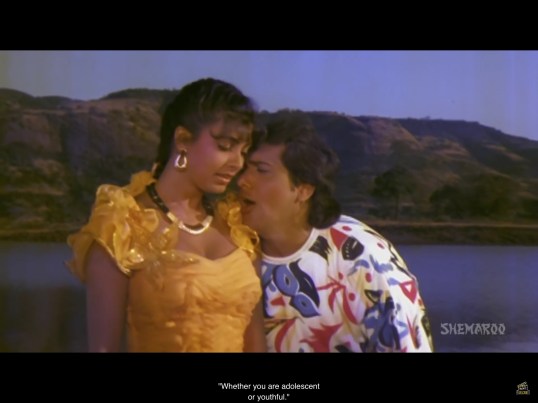
IMG_8097

Then it finally settles on whatever the heck he’s wearing and one of the few non-Sari women’s outfits that I like in this movie
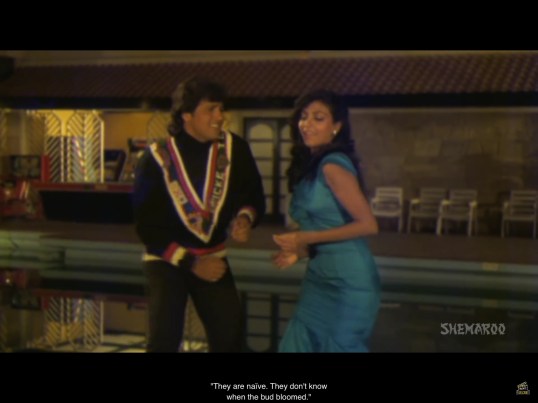
IMG_8167

Now we cut to the factory to find that when the workers complain, then Doggie whips them with his belt.
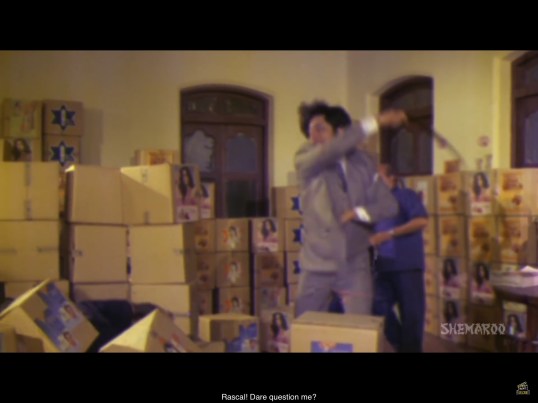
IMG_8207

It’s been awhile since I watched Ran (1985), but I do remember the lady near the end who goes on a vicious rant about how much she hates the family before they behead her. I would not be surprised if this film is also borrowing from King Lear. Sadly, I have never read the play. My only exposure is through Kurosawa. Ravi witnesses this so…
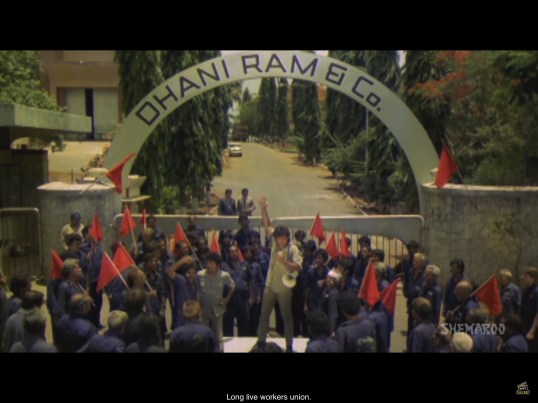
IMG_8271

the movie is now Norma Rae (1979), The Working Class Goes To Heaven (1971), Sister Stella L. (1984). Take your pick.

The bad guys try to shut down the house for the helpless. Not sure if they are sucessful or not. A.D.S. seems to show up to stop it after Ravi puts up an actually fight. Doesn’t matter because this happens next.
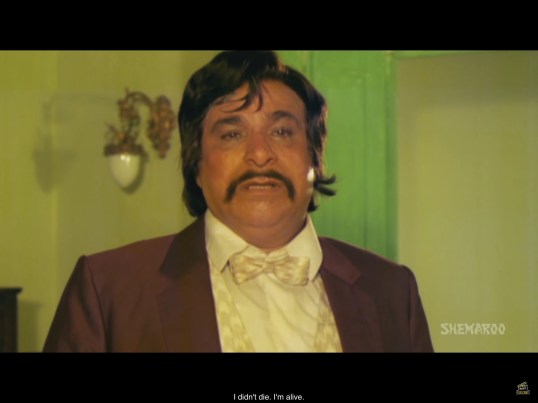
IMG_8472

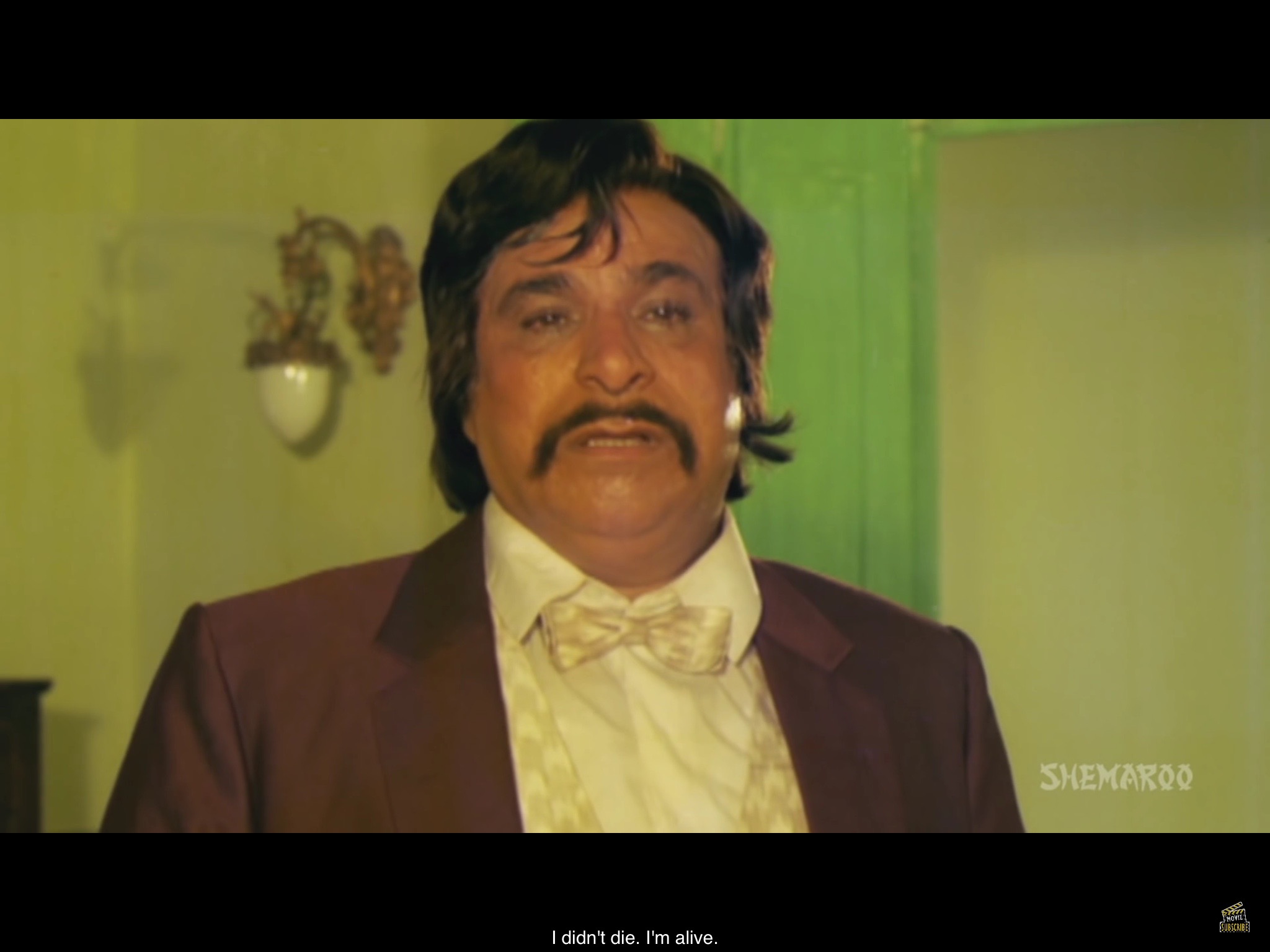
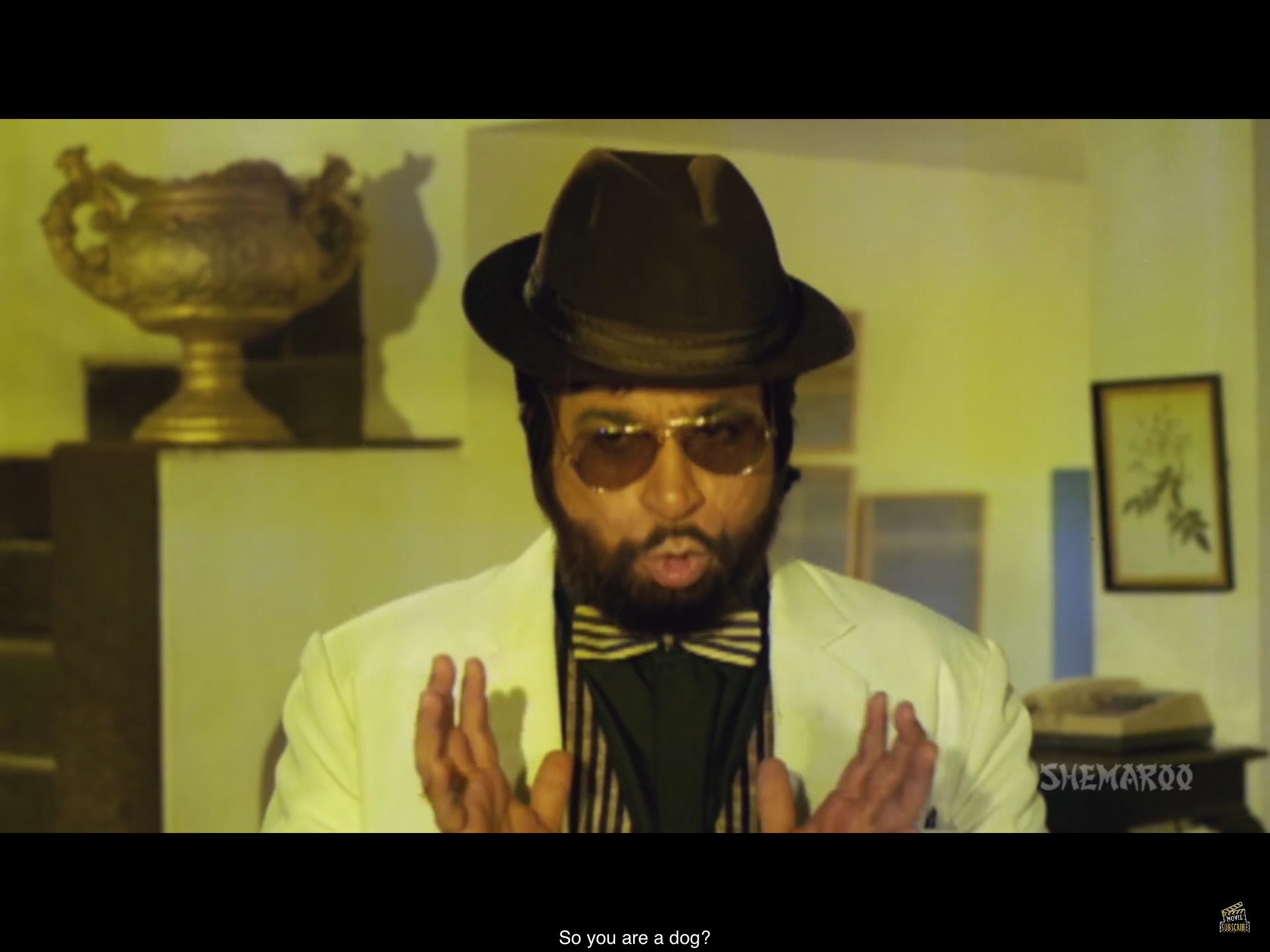
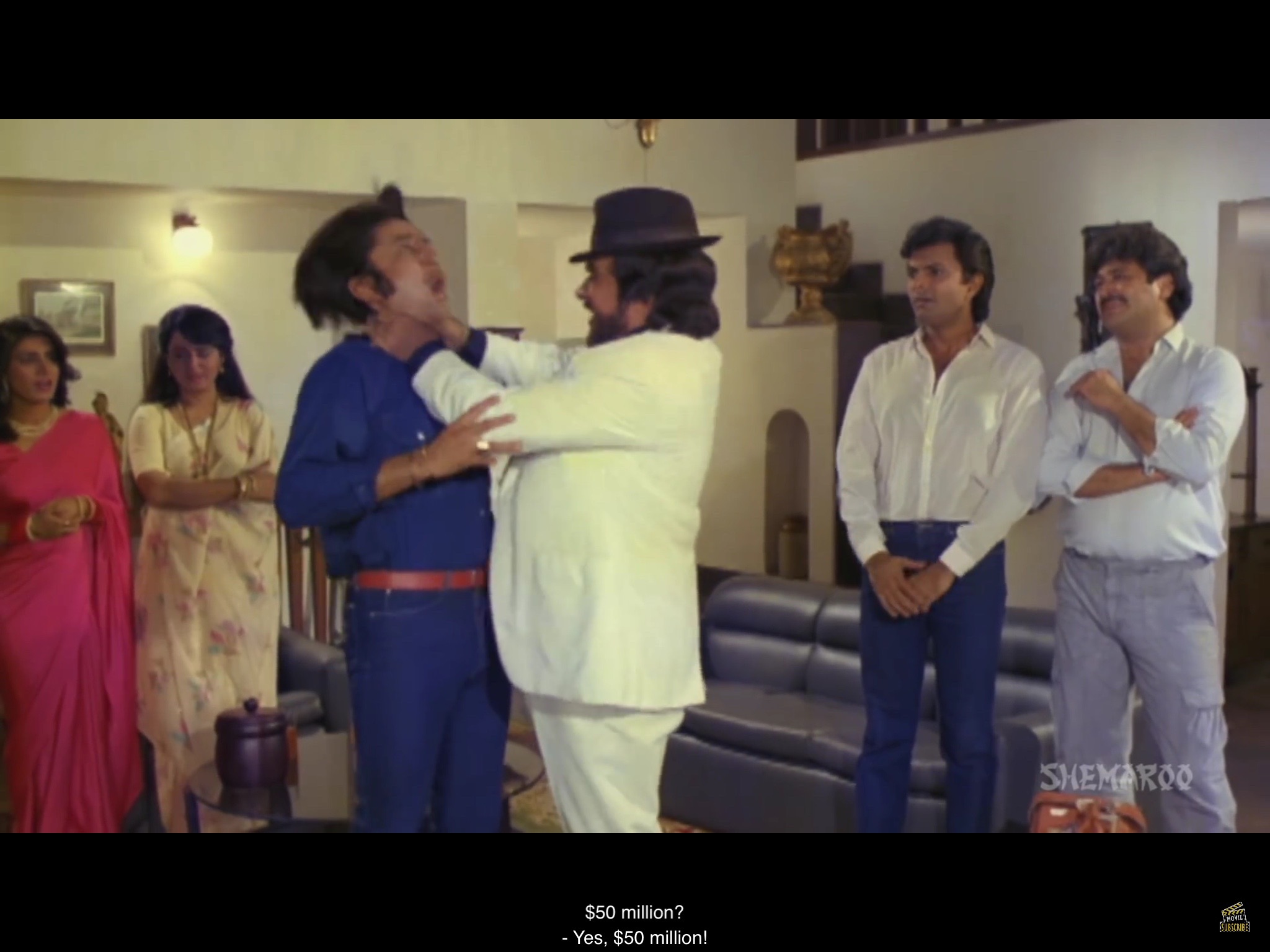
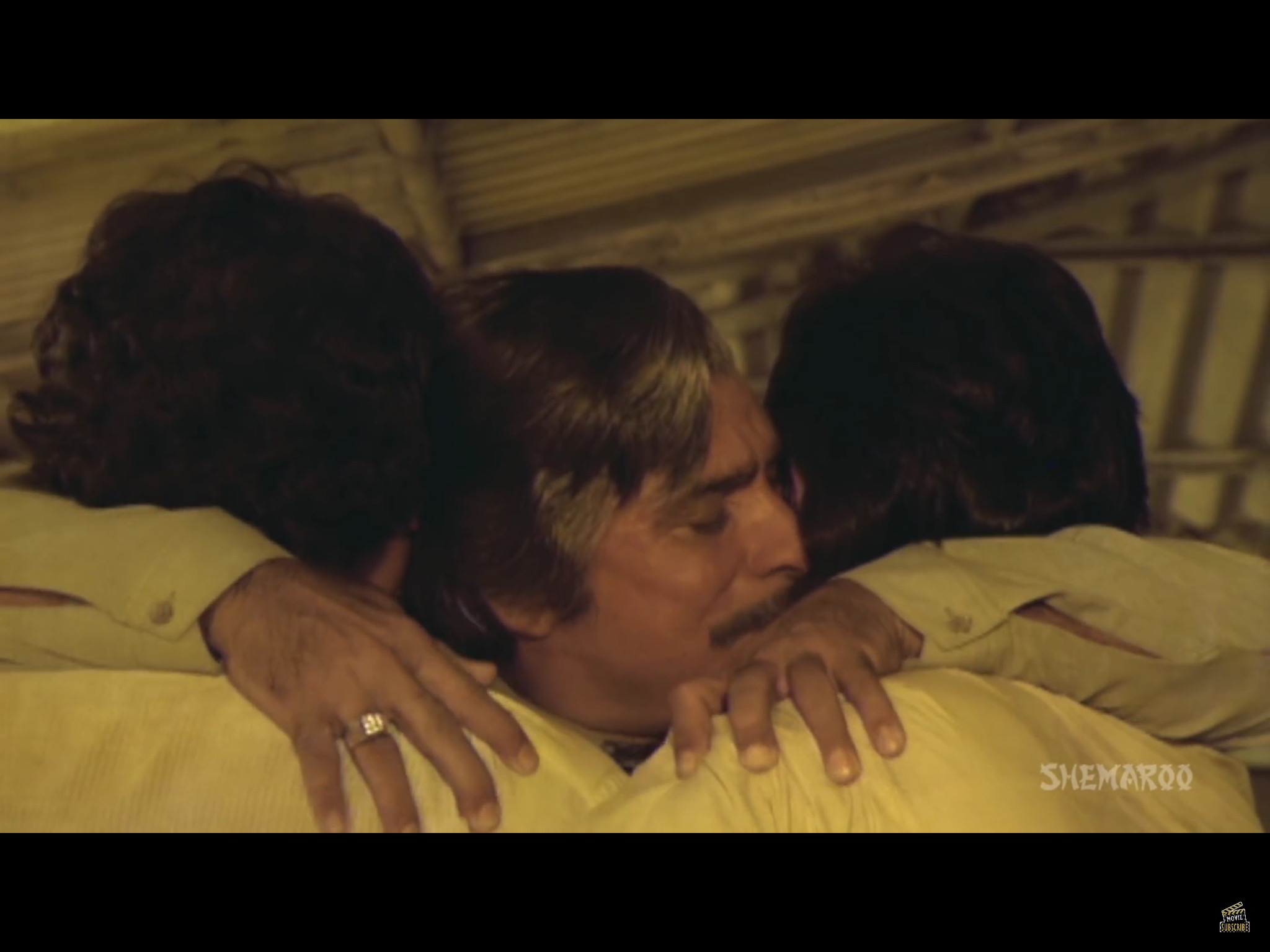
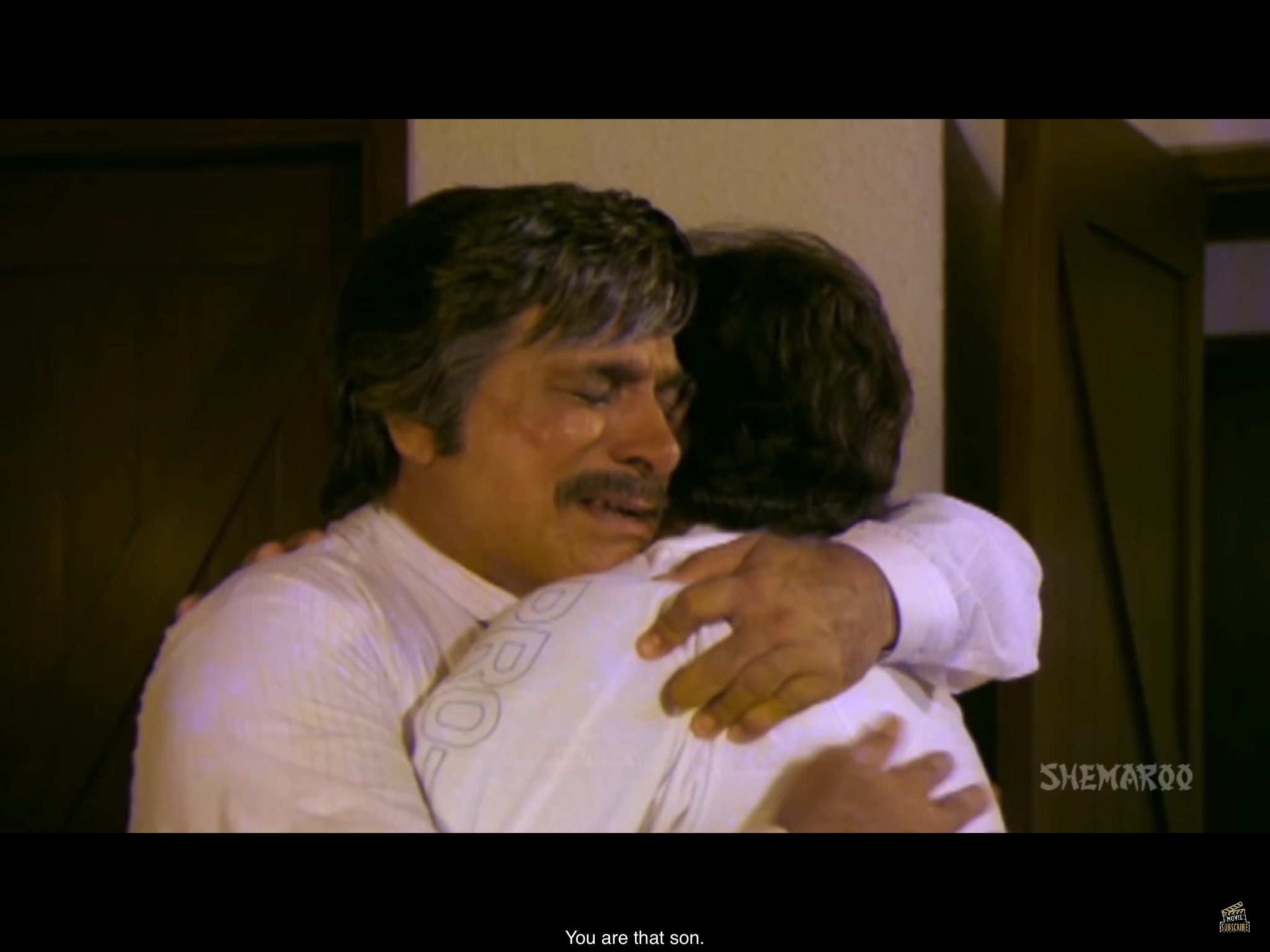
Dhaniram shows up and is alive! I guess he was pretending to be his brother during this time. I don’t recall seeing the brother after he showed up initially. Doesn’t matter cause Dad is back. He comforts his wife, then goes to visit Ravi as his brother. However, Ravi sees right through it. He knows it’s his father. He tells him so, and they hug. But if you think actor Kader Khan is going to give up a chance to play the flamboyant brother some more, then you are wrong. No, we finally get Dhaniram actually saying what I have been saying from the beginning. “D.O. Gogi? You mean doggie?”
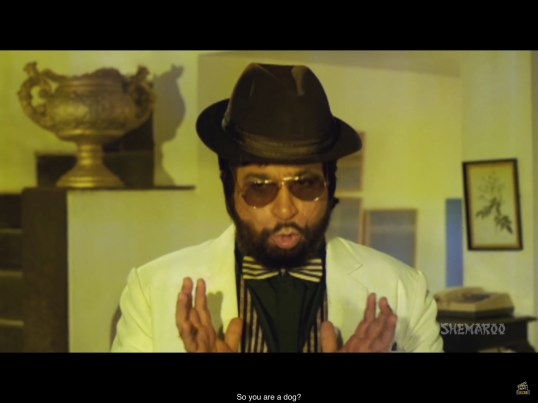
IMG_8636

He takes it further too. After doggie corrects him, Dhaniram doesn’t care, and says it sounds better that way. Every dog needs a collar!
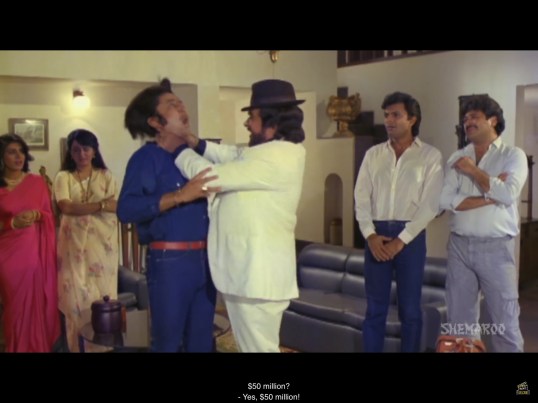
IMG_8655

Dhaniram has a great idea for Doggie. He tells him that to combat Ravi, he should kiss up to the workers. He tries to do just that.

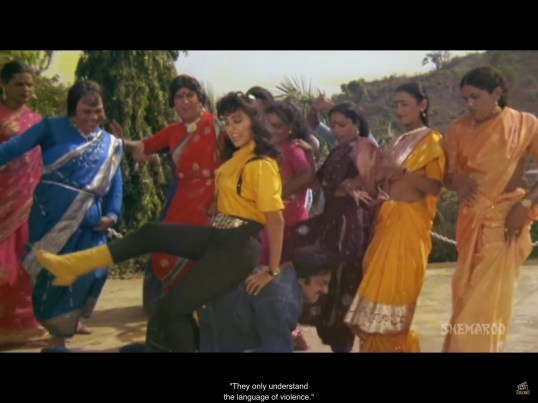
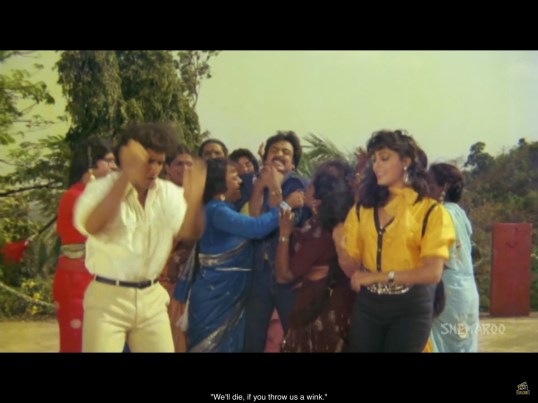
Now comes the final, and most bizarre musical number in the film. It’s the West Side Story one. Ravi is wandering down the street when he is confronted by a gang out to get him.
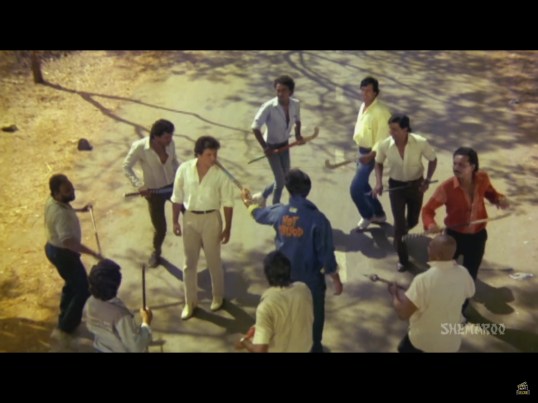
IMG_8793

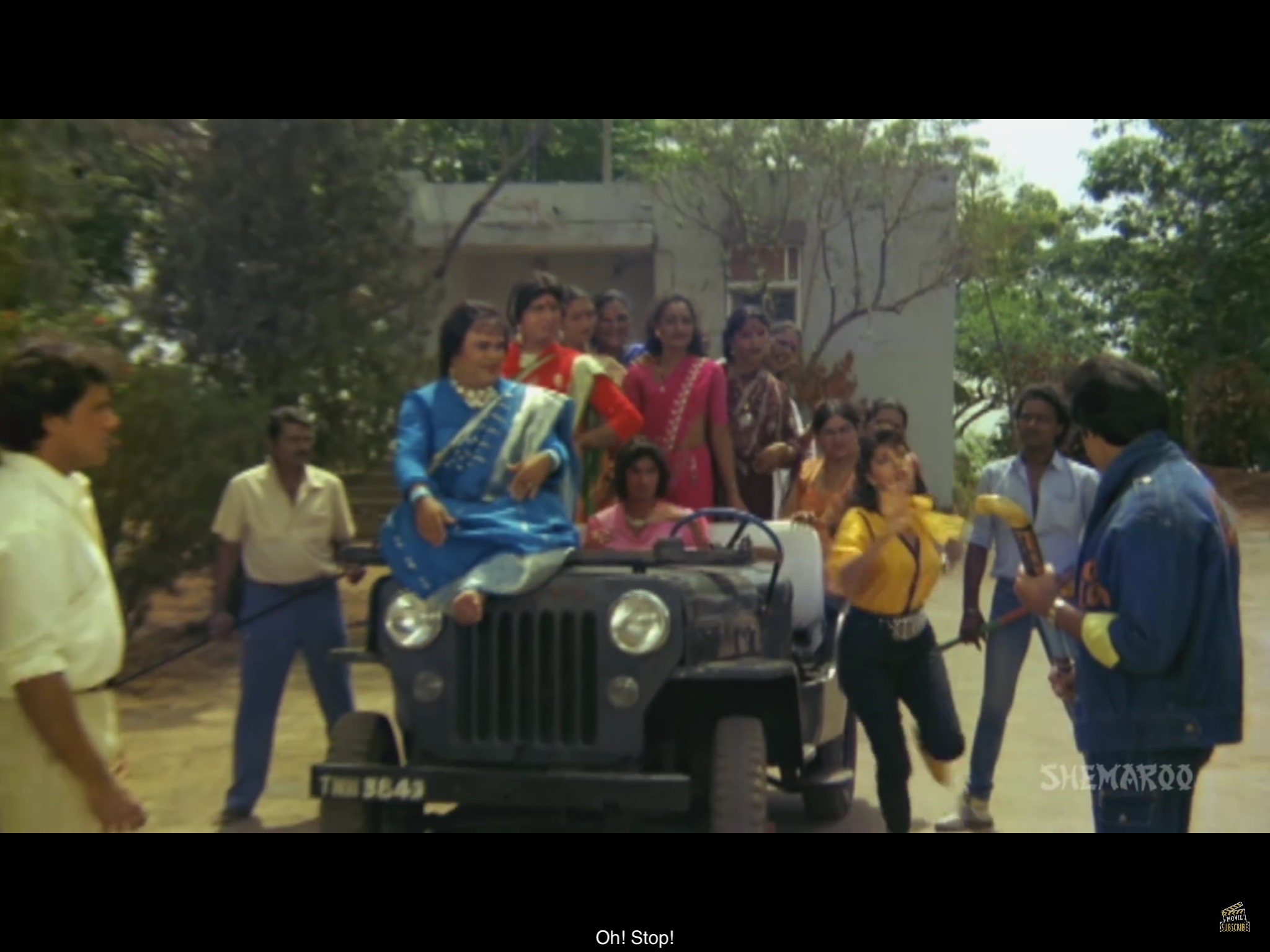
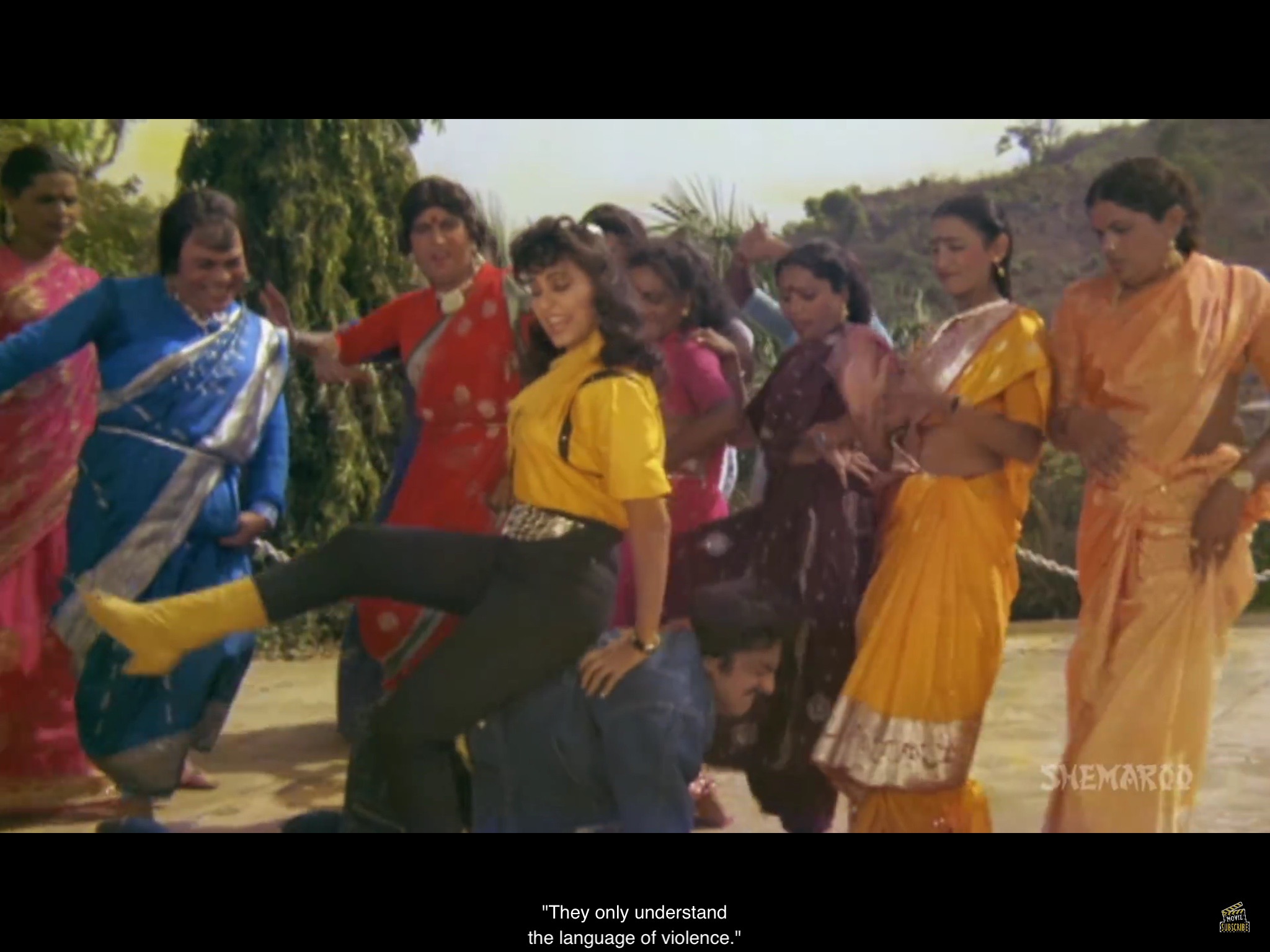
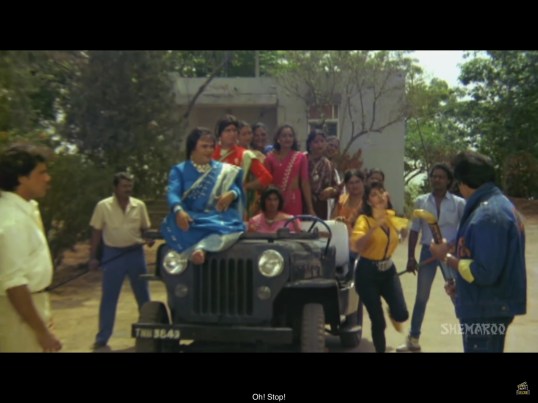
Boy! Ravi is in trouble. If the fact that a posse of cisgender women, transgender women, and Radha show up to rescue him doesn’t surprise you, then I have done justice to how crazy this movie is.

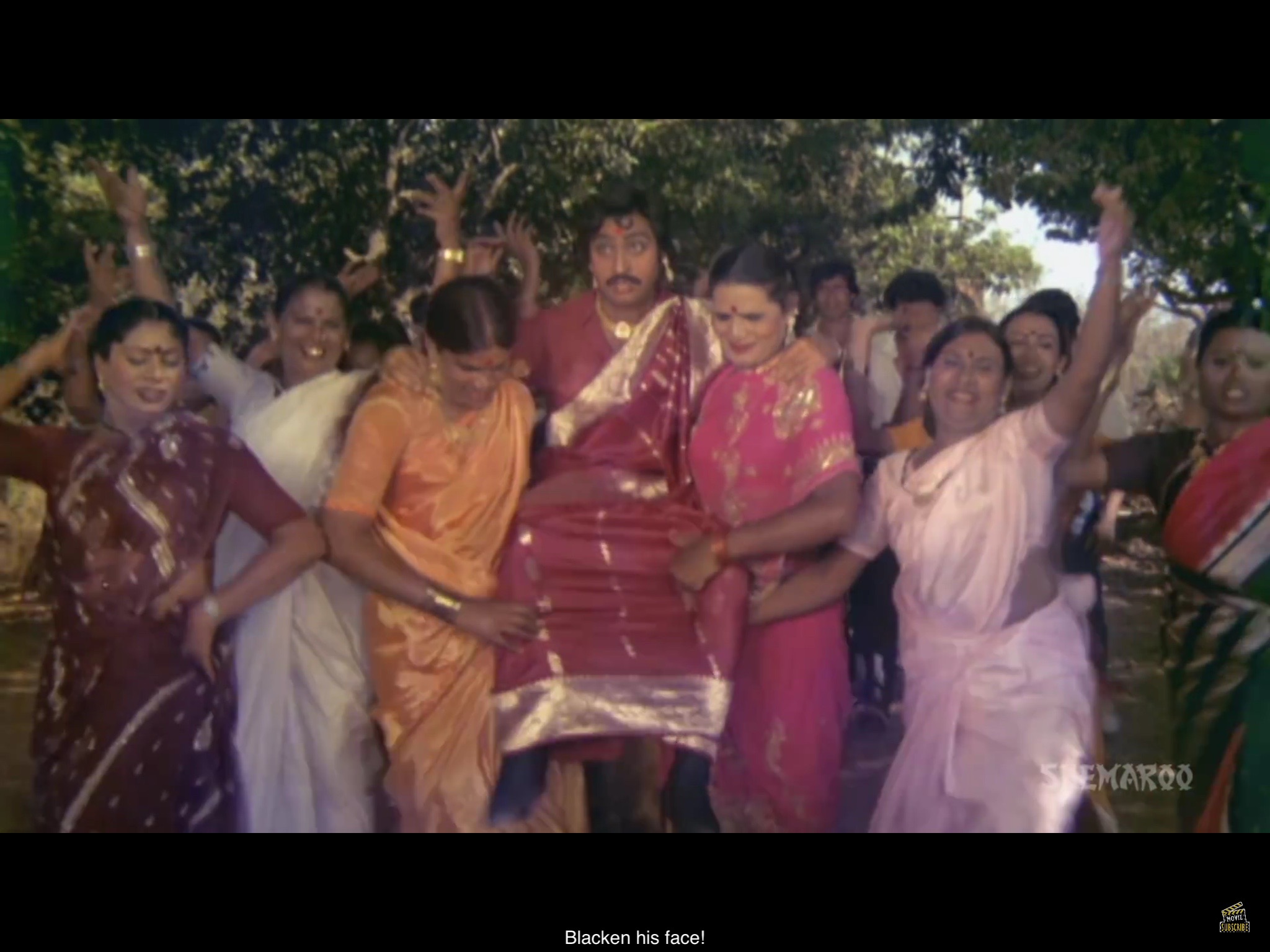
They do a combination of an advocation of non-violence while gladly humiliating these guys by drawing on their homophobia and transphobia to make them squirm.
IMG_8815

IMG_8867

IMG_8876

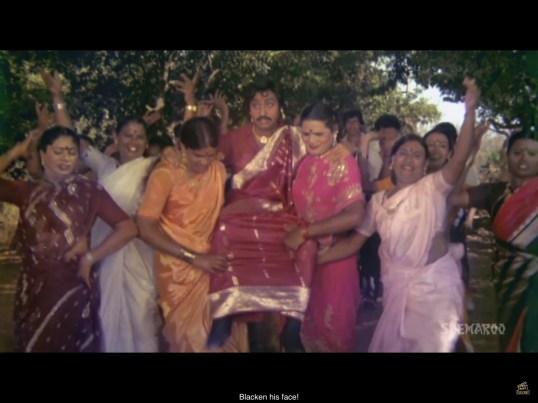
They even dress up one of the guys as a woman and make him ride a mule like the jackass he is.
IMG_8959

IMG_8965

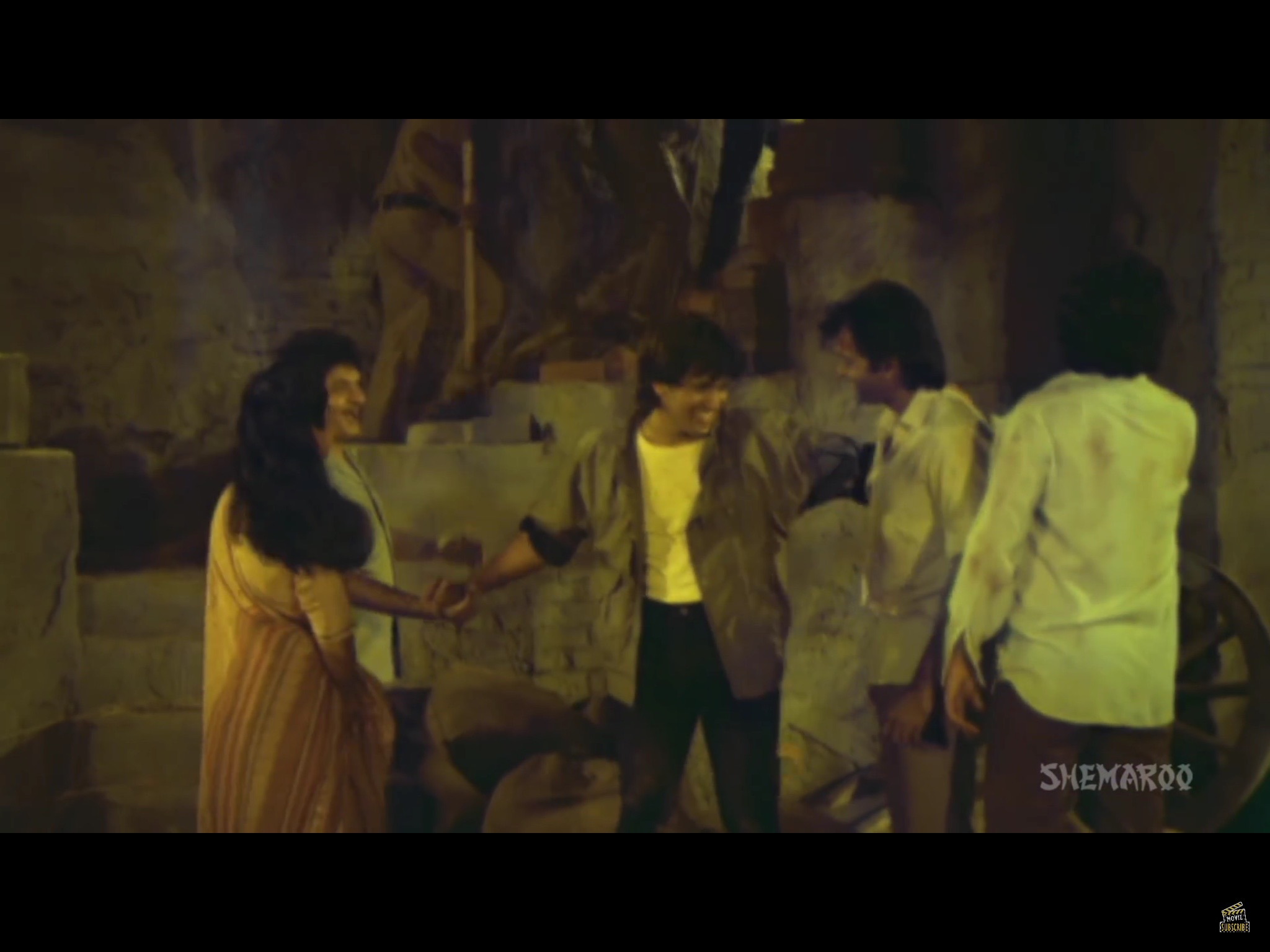
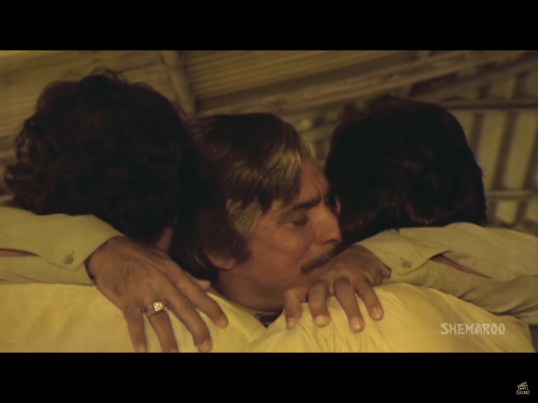
The remainder of this film can basically be described as the father using his business skills and his inner circle to bring down Doggie. His sons are ultimately left in ruin. However, this is when the Dad reveals to them that he is still alive. The father doesn’t oust them or anything. He reunites his family.
IMG_9502

The brothers finally get the point there father was trying to get across to them. The father also seems to have learned that maybe he was a little too hard on everyone when it came to his ideals. This is also when we find out that the sons didn’t know about how their father died. Of course it was Doggie.
IMG_9601

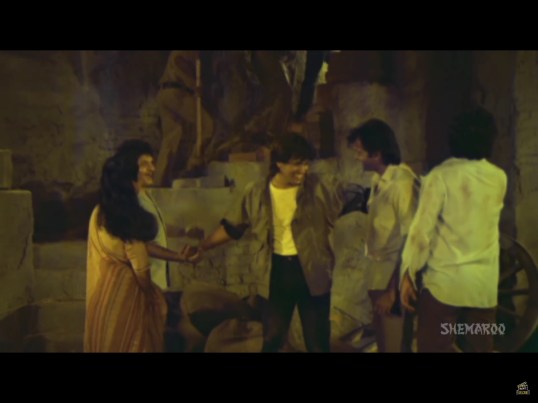
Ravi and family bring him to justice. Even Doggie’s sister is redeemed. Earlier in the film after she was in the poor house, she came to her brothers. They pretended like they didn’t even know her. They weren’t there when she needed them, so she sure does the same thing to them when they need her. They kind of had to do this with the story. I mean the message of the film would have felt a little funny if the woman with Dad’s grandchild was kicked to the curb.

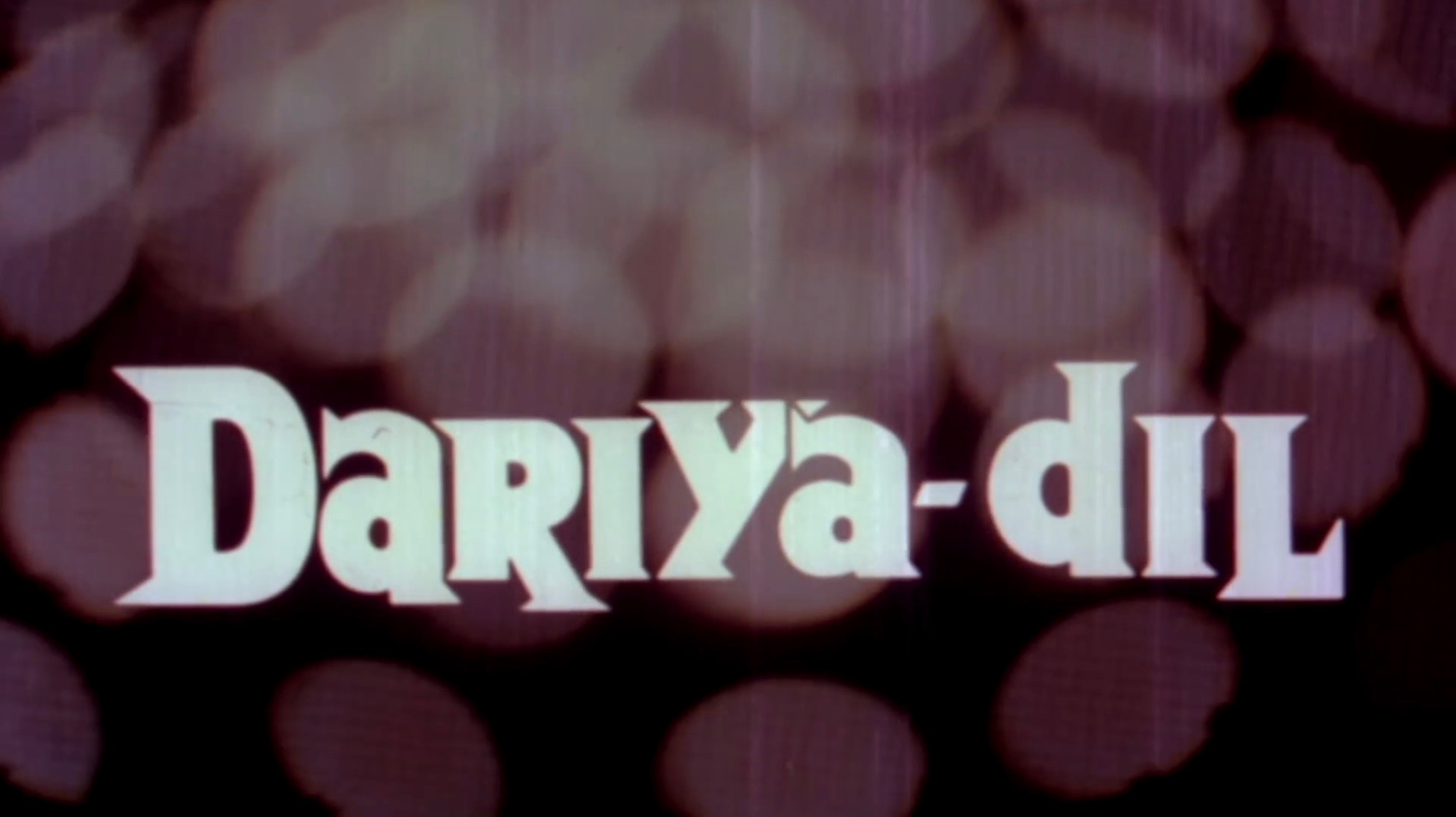
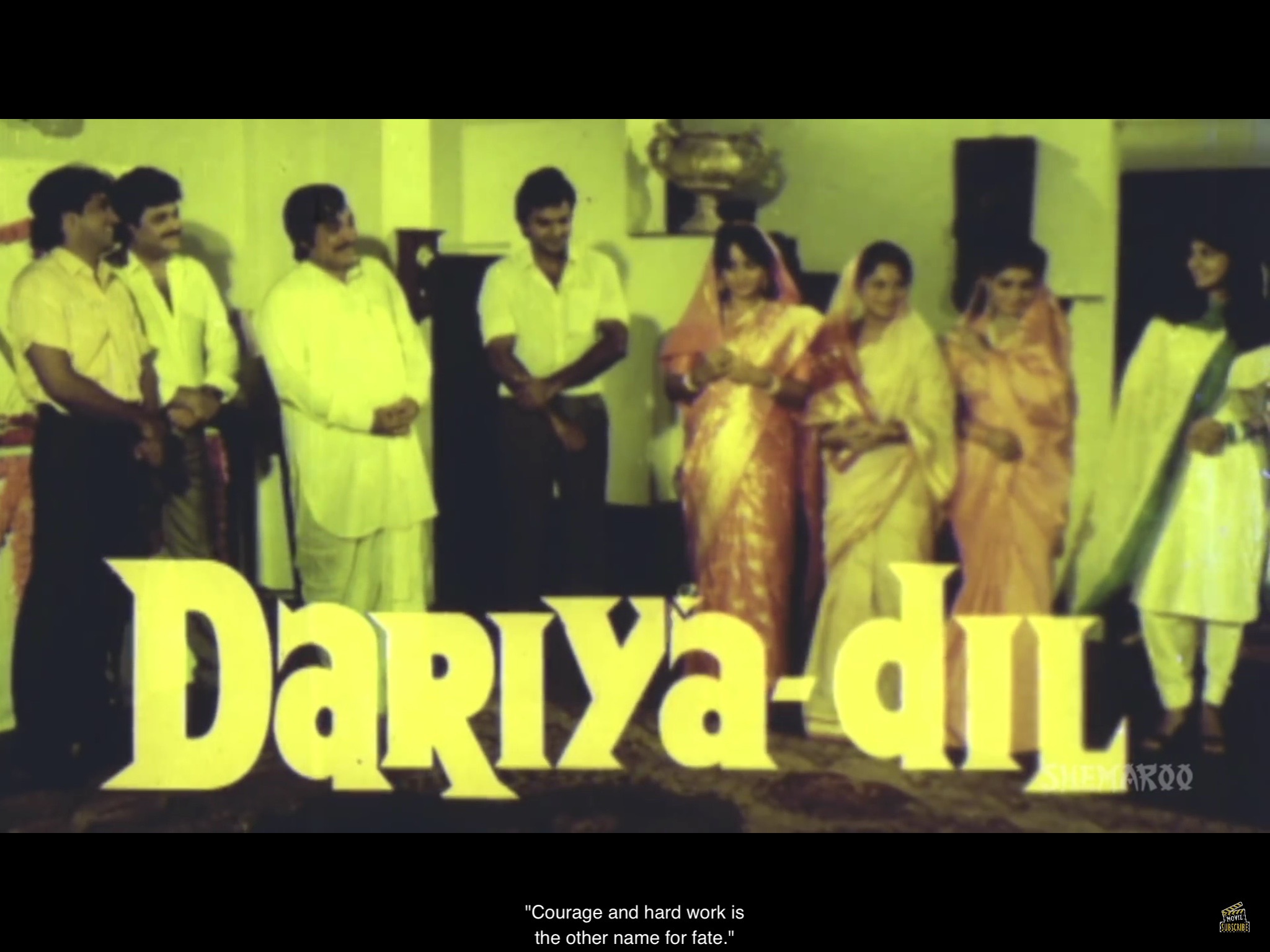
With the story over, the remaining cast kindly poses for the ending title card.
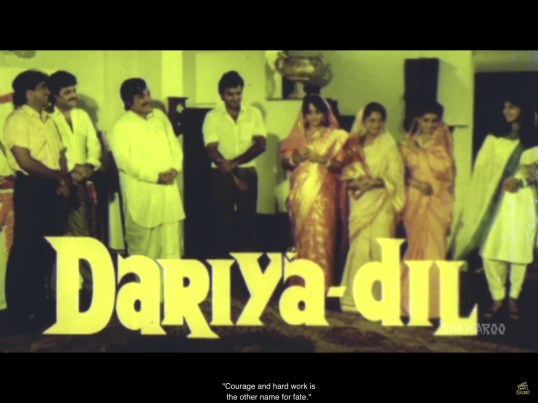
IMG_9636

That’s the end! That’s Dariya Dil! It’s a movie known for a short musical number that happens to feature Superman and Spiderwoman. It’s a movie that has an ultimately simple story about selfless charity and not taking the easy path to wealth. Especially when taking that path hurts others, family or otherwise. It’s also a movie that is filled with so many other things that make it so worth watching. I really enjoyed this film. I might come across another one of these foreign superhero movies that I’ll like, but I don’t think any of them will top this.

Here is the full film. Not sure why they felt the need to disable embedding, but they did.
Cleaning Out The DVR #21: Wuthering Heights (dir by William Wyler)


(For those following at home, Lisa is attempting to clean out her DVR by watching and reviewing 38 films by this Friday.  Will she make it?  Keep following the site to find out!)

Wuthering_Heights_(1939_film)

Check out the film poster above and ask yourself, “Was the 1939 version of Wuthering Heights a love story or a horror movie?”

Because, seriously, the poster above looks like it belongs to a horror movie, doesn’t it?  You’ve got beautiful Merle Oberson looking concerned.  And then looming behind her, you’ve got a wild-eyed Laurence Olivier, staring at her with a possessive stare.  The sky above is overcast and there’s a hint of the desolate landscape in the background.  Right under Olivier and Oberon, there’s another picture of two men holding back another man while a woman stares on in shock.  It looks perfectly horrific, does it not?
Well, Wuthering Heights is not a horror movie, though it certainly opens like one, with a traveling stranger named Lockwood (Miles Mander) seeking shelter in a menacing mansion and then later witnessing a ghostly woman walking across the moors.  The master of the estate is the rude and brusque Heathcliff (Laurence Olivier) who, after presenting himself as being cold and unconcerned with Lockwood, gets quite emotional when he sees the woman on the moors.  After the woman calls to him, Heathcliff runs out into the storm to be with her.  It’s only after this that Lockwood learns the story Heathcliff and Cathy Earnshaw (Merle Oberon).

The film flashes back to 40 years earlier.  Heathcliff is found on the streets by Mr. Earnshaw (Cecil Kellaway) and is brought home to live on his estate, Wuthering Heights, along with his children, Cathy and Hindley (Hugh Williams).  Cathy and Heathcliff grow close and, at they grew up, they eventually become lovers.  However, the arrogant Hindley resents Heathcliff and, after Mr. Earnshaw dies, he does everything that he can to split Cathy and Heathcliff apart.

One night, while Cathy and Heathcliff are out walking together, they come across a party being given by the wealthy Linton family.  While Cathy is immediately attracted to the Lintons and their wealth, Heathcliff resents them.  When Edgar Linton (David Niven sans mustache) starts to court Cathy, Heathcliff runs away and disappears for two years.

When Heathcliff returns, he is now wealthy and, on the surface at least, he has given up his wild ways.  However, he discovers that Edgar and Cathy are now married.  Heathcliff buys Wuthering Heights from the now alcoholic Hindley and soon, he has married Edgar’s innocent sister, Isabella (Geraldine Fitzgerald).  Heathcliff and Cathy claim to no longer love one another but, of course, we all know better…

Wuthering Heights is definitely a love story.  In fact, it could be argued that it is the love story.  Every gothic romance novel ever written owes a debt to Emily Bronte’s original novel.  In some ways, the 1939 film is a rather loose adaptation of that novel.  For one thing, Cathy and Heathcliff are childless in the film whereas their children played a major role in the second half of the novel.  As well, Isabella’s fate is different in the film (and that’s fine with me because Isabella was always my favorite character).  But, even if it does make changes to the plot, the film stay true to the novel’s soul.

It’s a great film, full of atmosphere, romance, and melancholy.  Director William Wyler, who was one of the best directors of Hollywood’s golden age, keeps the story moving at a compelling pace and Oberon and Olivier are about as perfect a Heathcliff and Cathy as you could hope for.  (For lovers of old movies, it’s also interesting to see David Niven playing such an earnest and ultimately clueless character.  Poor Edgar!)

Wuthering Heights was one of the many great films to be released in 1939.  It was nominated for best picture but it lost to Gone With The Wind.  Interestingly enough, Gone With The Wind starred Olivier’s lover (and soon-to-be wife) Vivien Leigh.  Originally, Leigh was offered the role of Isabella in Wuthering Heights but, desiring to play Cathy, she turned it down.  When Olivier came to the States to play Heathcliff, he left Leigh behind in London but she would soon join him in Hollywood after she was cast as Scarlett O’Hara.


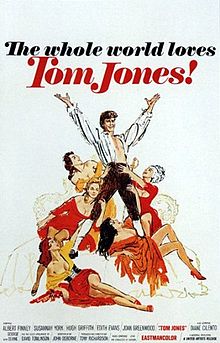
Cleaning Out The DVR #20: Tom Jones (dir by Tony Richardson)


(For those following at home, Lisa is attempting to clean out her DVR by watching and reviewing 38 films by this Friday.  Will she make it?  Keep following the site to find out!)

220px-Poster_-_Tom_Jones_01

Oh, how I wanted to love Tom Jones!

No!  Not that Tom Jones.

I’m talking about Tom Jones, the British film from 1963.  Based on a novel by Henry Fielding, Tom Jones was a huge box office success and it was one of the few comedies to ever win the Oscar for best picture.  Whenever you watch a documentary about the British invasion of the early 60s, chances are that you’ll see at least a clip or two from Tom Jones.  The film (or perhaps I should say the film’s box office success) is a part of 60s pop history, right up there with The Beatles on The Ed Sullivan Show and Sean Connery shooting that guy in cold blood in Dr. No.

Up until last night, I had heard about Tom Jones but I had never seen it.

And I really wanted to love it.

The film takes place in 18th century England and it tells the story of young Tom Jones (Albert Finney).  It starts with a lengthy sequence that plays out like a silent film, complete with title cards.  Upright Squire Allworthy (George Devine) comes home and discovers that a baby has been left in his bed.  He assumes that the child was born to two of his servants and declares that he will raise Tom Jones to be a good and worthy man.

Two decades later, Tom Jones has grown up and now he’s being played by Albert Finney (who, it must be said, was quite a handsome man when he was young).  Because Tom is good-looking and kind-hearted, every woman in England lusts after him.  But Tom is in love with innocent Sophie Western (Susannah York).  However, Sophie is a member of the upper class and Tom is a “bastard,” at a time when that actually means something.

Indeed, Sophie’s aunt and uncle (played by Edith Evans and Hugh Griffith) demand that Sophie have nothing to do with Tom Jones.  They decide that she will marry Blifil (David Warner, young but already typecast as a villain).  Through clever lies and manipulations, Blifil convinces Squire Allworthy that Tom has turned bad and must therefore be exiled from his home.  Does Blifil want to get rid of Tom just so he can marry Sophie or is it possible that there’s more to Blifil’s scheming?

Before we get the answer to that question, we spend a while following the exiled Tom as he wanders around England and attempts to prove himself worthy of Sophie.  Along the way, Tom serves briefly in the army, gets into numerous fights, and has several affairs.  One of those affairs is with Mrs. Walters (Joyce Redman), who he briefly thinks might be his mother.  Eventually, Tom ends up as the lover to the decadent Lady Bellaston (Joan Greenwood).  Through Blifil’s scheming, he also ends up framed for attempted murder and facing the gallows…

And, as melodramatic as that may all sound, Tom Jones is definitely a comedy.  It doesn’t take itself seriously and there’s hardly a single scene that isn’t played for laughs.  Director Tony Richardson goes out of his way to make sure that you never forget that you’re watching a movie.  There are freeze frames.  There’s plenty of characters around to supply sarcastic commentary.  There’s even a few cases of fourth wall breaking.

As I watched Tom Jones, it was hard for me not to compare it to Stanley Kubrick’s Barry Lyndon.  After all, both films take place during the same period of time and both deal with a young man making his way through European society.  I would even argue that, in its way, Barry Lyndon is far more satirical than Tom Jones.  The main difference between the two films is that Barry Lyndon is all about subtext whereas everything that happens in Tom Jones happens right on the surface.

As I said, I really wanted to like Tom Jones but, seen today, the entire film seems to be trying a little bit too hard.  Tony Richardson’s direction is so manic that it gets a bit exhausting after a while.  That said, I can understand why the film was such a success when it was first released.  I’m sure in 1963 — after having to deal with decades of pompous costume dramas — viewers probably found Tom Jones to be a breath of fresh air.  Not only was it a British film released at a time when all things British were in style but it was also a film that, by the standards of 1963, dealt frankly with sex.  In short, Tom Jones is definitely a film of its time.  If it doesn’t hold up as well today, that’s because it wasn’t made for 2016.  It was made for 1963.

And obviously, if the judgment of the Academy is to be trusted, Tom Jones was the perfect film for 1963.  That said, I would have given best picture to another British film, From Russia With Love.

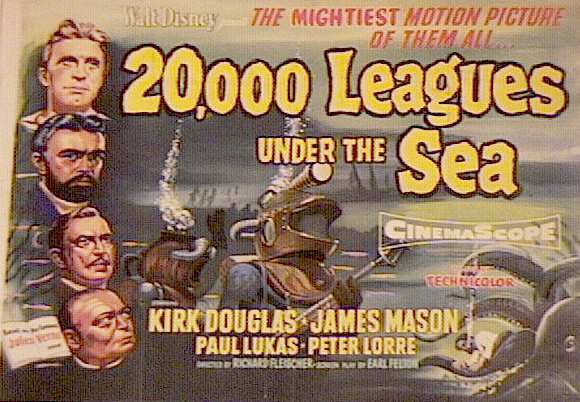
Steampunk Disney: 20,000 LEAGUES UNDER THE SEA (Walt Disney Productions 1954)


gary loggins's avatarcracked rear viewer

twenty1

When TCM aired this movie last week, I just had to watch. It was one of my favorites as a kid, and I was curious to see how well it held up with the passage of time. To my delight, 20,000 LEAGUES UNDER THE SEA is even more enjoyable in adulthood, a joyous sci-fi adventure film thanks to the fine cast and the genius of Walt Disney.

twenty2

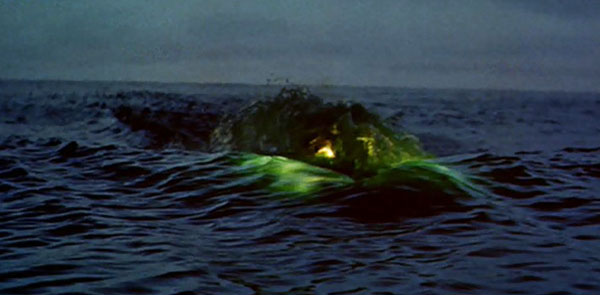
Based on the Jules Verne novel, 20,000 LEAGUES UNDER THE SEA takes us back to 1868, where rumors of a sea monster attacking ships are running rampant. Eminent scientist Professor Aronnax and his protégé’ Counseil are invited to join a voyage to investigate the matter, along with the free-spirited harpoonist Ned Land. They encounter the beast and are shipwrecked, only to discover the monster is actually a fantastic, futuristic submarine, The Nautilus. The sub is commanded by Captain Nemo, who picks up Aronnax, Counseil, and…

View original post 383 more words

Cleaning Out The DVR #19: The Awful Truth (dir by Leo McCarey)


(For those following at home, Lisa is attempting to clean out her DVR by watching and reviewing 38 films by this Friday.  Will she make it?  Keep following the site to find out!)

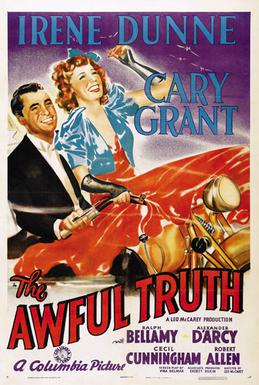
Theawfultruth1937

First released way back in 1937, The Awful Truth is one of the most delightful comedies that I’ve ever seen.  In fact, if I could recommend one movie for you to make an effort to see, it would be The Awful Truth.  This is definitely the best film to ever have the word “awful” in the title.

(Speaking of being the best, The Awful Truth is also the rare screwball comedy to receive a nomination for best picture.  However, it lost to the far more serious The Life of Emile Zola.)

Jerry (Cary Grant) and Lucy Warner (Irene Dunne) are young, married, stylish, and rich.  They seem to have it all but, as the result of Jerry’s lies and a misunderstanding concerning Lucy and her music teacher (Alexander D’Arcy), they end up getting a divorce.  Fortunately, they still share a common bond.  They both love their dog, Mr. Smith (played by Skippy, the same adorable and incredibly talented dog who played Asta in The Thin Man).  Lucy wins custody of Mr. Smith and takes him with her when she moves in with her eccentric Aunt Patsy (Cecil Cunningham).

(It’s not a screwball comedy without an eccentric aunt.)

Jerry, however, has weekly visitation rights with Mr. Smith.  It’s during once such visit that Jerry discovers that, with only two months to go before the final divorce decree, Lucy has become engaged to her next door neighbor, Dan (Ralph Bellamy).  Dan is from Oklahoma and spends most of his time wistfully talking about tumbleweed, oil, and cattle.  He also can’t wait to marry Lucy so that they can both move back to Oklahoma City.  Dan is a nice guy but he’s no Cary Grant.  (He’s also dominated by his judgmental mother.)  Realizing that he still loves Lucy, Jerry wants to reconcile with her but complications and misunderstandings ensue.

(It’s not a screwball comedy without complications and misunderstandings.)

Eventually, in order to prove that he is over Lucy, Jerry starts to date a vacuous heiress, Barbara Vance (a hilariously shallow performance from Molly Lamont).  Suddenly, Lucy finds herself in the same situation that Jerry was in with her and Dan.  Now, it’s her turn to try to break up Barbara and Jerry…

Meanwhile, the day of the final divorce decree approaches…

There’s a lot of reasons to love The Awful Truth.  There’s the snappy dialogue, the physical comedy (at one point, three different men are scurrying around Aunt Patsy’s apartment, two trying to hide from each other and one totally oblivious to everything going on around him), and Leo McCarey’s fast paced direction.  There’s Mr. Smith, a dog so talented that even a confirmed cat person like me loved watching his performance.  There’s the wonderful supporting turns of Ralph Bellamy and Molly Lamont.

But the main reason to see the film is because of the wonderful chemistry between Cary Grant and Irene Dunne.  Grant is so smooth and effortless in his charm that it’s a lot of fun to watch him having to deal with the progressively strange world that he finds himself living in.  The Awful Truth works best when Grant simply reacts to all the craziness around him.  Grant could do more with one look than most actors could do with a Shakespearean monologue.  Meanwhile, Irene Dunne … well, who wouldn’t want to get in a time machine, go back to 1937, and be Irene Dunne for a day?  She’s lively, she’s beautiful, she’s witty, she’s classy, and she’s just neurotic enough to be relatable.

The Awful Truth is pure joy.  If you haven’t seen it, you’re missing out.  If you have seen it, watch it again.

Cleaning Out The DVR #18: How Green Was My Valley (dir by John Ford)


(For those following at home, Lisa is attempting to clean out her DVR by watching and reviewing 38 films by this Friday.  Will she make it?  Keep following the site to find out!)

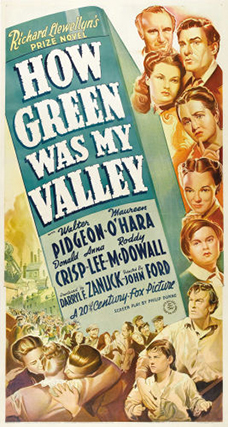
How_Green_Was_My_Valley_poster

Before I really get into this review, I should admit that I watched How Green Was My Valley with a bias.

Before the movie started, I was expecting to be disappointed with it.  I think that a lot of film lovers would have felt the same way.  How Green Was My Valley won the 1941 Oscar for best picture.  In doing so, it defeated three beloved films that have only grown in popularity and renown since they were first released: Citizen Kane, The Maltese Falcon, and The Little Foxes.  (As well, just consider some of the 1941 films that weren’t even nominated for best picture: Ball of Fire, The Devil and Daniel Webster, Dr. Jekyll and Mr. Hyde, High Sierra, The Lady Eve, Never Give A Sucker An Even Break, The Sea Wolf, The Wolf Man, and Sullivan’s Travels.)  Because it defeated so many great films and since we’re all used to the narrative that the Academy always screws up, there’s a tendency to assume How Green Was My Valley was really bad.

Well, after years of assumptions, I finally actually watched How Green Was My Valley?  Was it bad?  No, not really.  Was it great?  No, not all.  If anything, it felt rather typical of the type of films that often win best picture.  It was well-made, it was manipulative enough to be a crowd-pleaser while serious enough to appeal to highbrow critics, and, perhaps most importantly, it never really challenged the viewer.  Unlike Citizen Kane and The Maltese Falcon, How Green Was My Valley is a film that doesn’t require that you give it too much thought and, as such, it really shouldn’t be surprising that it was named the best picture of the year.

How Green Was My Valley was directed by John Ford and, as you might expect from Ford, it deals with a changing way of life and features good performances and a few impressive shots of the countryside.  Taking place in the late 1800s, How Green Was My Valley tells the episodic story of the Morgans, a large family of Welsh miners.  The film is narrated by Huw (Roddy McDowall), a youngest member of the family.  Though Huw’s eyes, we watch as his once idyllic and green village is transformed by the growing mining industry and blackened with soot, poverty, and death.

The film starts out as a fairly even mix of sentiment and drama.  Huw has a crush on his brother’s fiancee.  His sister, Angharad (Maureen O’Hara), has a flirtation with the new preacher, Mr. Gruffydd (Walter Pidgeon).  Much emphasis is put on communal gatherings.  There is a wildly joyful wedding celebration.  We often see the villagers in church and hear them singing both hymns and folk songs.  In their isolate village, they are are united against a changing world.

Or, at least, they think they are.  As the mining industry grows, that united front and sense of community starts to vanish.  A strike sets family members against each other, as each miner is forced to decide whether to side with management or with his fellow workers.  Each year, the wages become lower.  When management realizes that its cheaper to just continually hire new miners, several of the veteran workers are fired and end up leaving the village to seek a living elsewhere.  As new people come to the village, even Mr. Gruffydd finds himself the subject of gossip.

As for Huw, he grows up.  He goes to school, deals with a sadistic teacher, and learns how to defend himself against bullies.  And eventually, like everyone in his family, he is sent down into the mines and soon, his once innocent face is covered in soot.

And, of course, there’s a big tragedy but you probably already guessed that.  How Green Was My Valley is not a film that takes the viewer by surprise.

For the most part, it’s all pretty well done.  The big cast all inhabit their roles perfectly and Roddy McDowall is extremely likable as Huw.  Maureen O’Hara shows why she eventually became a star and even Walter Pidgeon gives a surprisingly fiery performance.  How Green Way My Valley is a good film but it’s too conventional and predictable to be a great film, which is why its victory over Citizen Kane and The Maltese Falcon will always be remembered as a huge Oscar injustice.

But, taken on its own terms and divorced from the Oscar controversy, How Green Was My Valley may be a conventional but it’s not a bad film.  It’s just no Citizen Kane.

Hallmark Review: Flower Girl (2009, dir. Bradford May)


IMG_2172

Before I start talking about the movie I need to mention a couple of funny things.

First, I kind of like actress Marla Sokoloff. I first saw her on an episode of Melissa & Joey where she played a chiropractor that Joey Lawrence’s character goes to see. I enjoyed her performance. Her and Joey end up in a relationship together. It turns out she’s a virgin. As I recall, he can’t follow through with it. It was humorous to me given the title of this film.

Another coincidence that is similar to that one is another place I had seen Marla before watching this film. The previous film I saw her in was Scents and Sensibility (2011). In this movie Marla’s character will bring up that she enjoys more serious books rather than things like romance novels. There is even a scene where they mention Jane Austen who of course wrote Sense and Sensibility.

Weird that not only were both of those things done after Flower Girl, but that they were the only two other places I had seen her before, which also happen to somehow tie back to this film. Bizarre!

The second thing is something that only someone like myself who, for some reason, has now seen 164 Hallmark movies would notice. All but 5 of which have been since last July.

Screen Shot 2016-03-13 at 8.51.32 PM

I think IMDb nailed it here. Let’s go through those recommendations:

  1. Perfect On Paper is about a girl who is given a job editing romance novels. She is encouraged to date men who are perfect on paper. She eventually comes around to the guy who isn’t perfect on paper, but perfect for her. This movie has romance novels at the center of it, and Marla is encouraged to date a doctor because he is perfect on paper. Also, the actor playing the right guy in this movie is the wrong guy in Perfect On Paper. His last name in that was Cooper, which just so happens to be the last name of the right guy in this movie.
  2. So You Said Yes is about a girl who runs a bridal shop that tries to cater more to the brides actual wants rather than just whatever is the standard wedding they are told they want by the owner. Marla will several times talk about how she does just that. She listens to her clients and uniquely tailors the flowers to be used at the wedding even when that includes something like matching flowers to biker tattoos.
  3. Recipe For Love is about a girl who is given a chance to help ghostwrite a cookbook for a famous cook who is hiding behind a persona that isn’t the real him. Someone ghostwriting books is an important part of this film. That person is also using someone else to pretend that they are the person who is writing the books.
  4. My Boyfriends’ Dogs is about a girl who goes through a series of boyfriends accumulating the dogs they buy together along the way. During all this she passes through a dog store where she keeps running into a guy that winds up being for her. Okay, the connection here is a little weak, but it was written by Gary Goldstein, and he has written both of the Flower Shop Mystery movies.
  5. Bridal Wave is about a girl who is going to be married to a doctor, but at the last minute leaves him for another guy. They will break up when they both realize that they were getting married because it seemed like the next logical step. They both worked together all the time with him as the doctor and her as his assistant. In this movie, one of the two men Marla is dating is a doctor. She will also break it off with him because she thinks both of them were rushing into a possible marriage because they were both just looking for someone. Also, just as in Bridal Wave, they will never make the wrong guy out to be a jerk. He is just not the right guy for her.
  6. In The Wish List, a girl starts the movie as a little girl who is very organized and drawing pictures of her prince charming. It then cuts to her in the present as an adult. She will proceed to make a big list of the things that must be in a guy for him to be perfect for her. She will end up choosing between a doctor and a barista. To try and decide between the two, she makes a list comparing the two of them. The doctor will go away to South America at one point in the movie. This movie also starts off with Marla as a little girl. She is in her grandma’s flower shop before cutting to the present where she now runs the place. Her grandma will even tell her to make a list comparing the two guys she meets. One of them is a doctor. Oh, and yes, the doctor is going to go to South America in this one too.

Like I said, I think IMDb nailed it this time with their recommendations.

I think I’ve nearly laid out the whole plot right there for you. I’ll try to be brief.

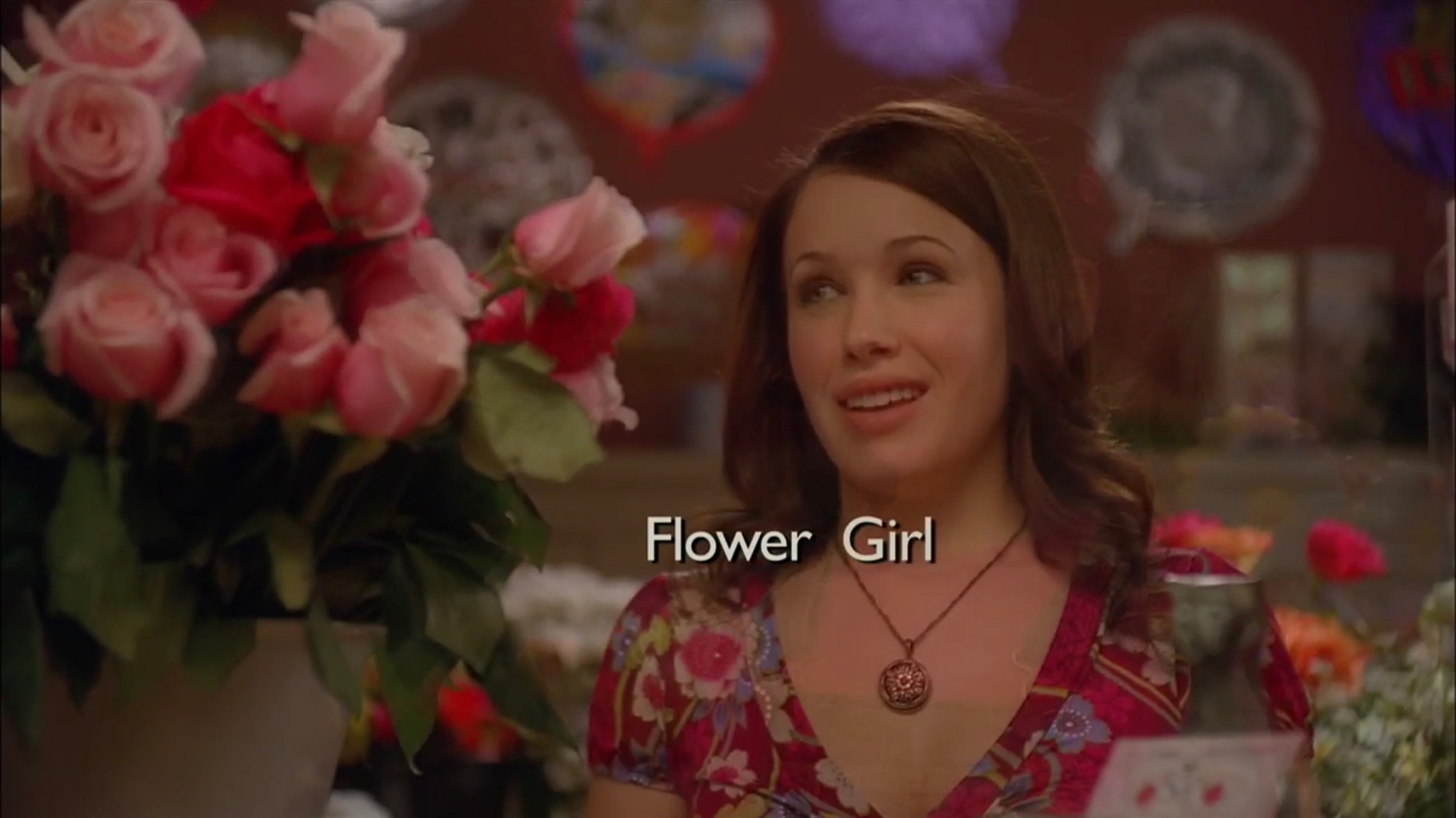
The film begins by showing us Laurel Haverford (Marla Sokoloff) as a little girl for what I think was about two seconds. It’s actually kind of cute. When the little girl is onscreen it only says “Flower”, but when it then cuts to Laurel it adds “Girl” to give us the full title. Marla does flowers for weddings.

We are quickly introduced to the two main ladies in Laurel’s life. One is her grandmother Rose (Marion Ross). The other is a friend named Brooke oddly enough played by Brook Kerr. I’m not reading that off of IMDb either. It says it in the credits that the character is Brooke with an ‘e’ and the actress is Brook without an ‘e’. I have no idea why. To add even further confusion to this, the captions say her name is Brook without an ‘e’.

IMG_2814

The introductions are over a wedding as well as a run with Rose and Brooke. Grandma Rose wants her daughter to get hooked up. Brooke might as well be Sarah Fischer from The Wish List cause she has her list of things that must be present in a guy. Well, at least things that show he is up for commitment and jobs he can’t have. Sorry wedding photographers who moonlight as guitar playing bartenders, but Brooke says you won’t do. I actually did know a community college speech teacher who moonlit as a bartender. He was a wonderful teacher.

IMG_2289

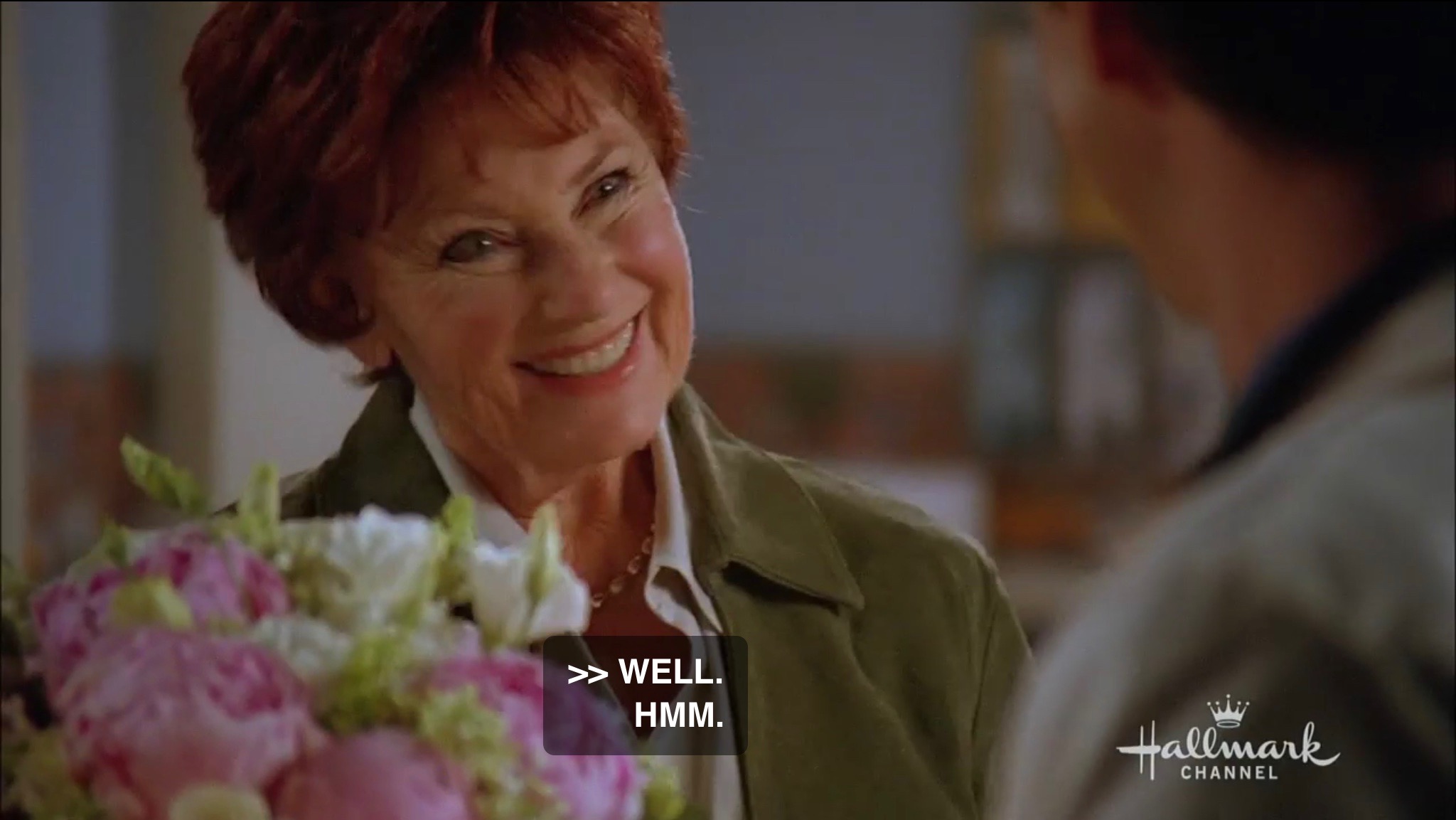
This movie wastes no time. Grandma runs right into Dr. Evan Cooper (Terry Maratos) as she is finishing up delivering some flowers. I love the looks on Marion Ross’ face here as she talks with the doctor. First it’s surprise that he knows the Latin name of the flowers. Then it’s kind introductions. That’s followed by a sly look and a question about his marital status. After she finds out he’s not married, she springs up with this face.

IMG_2356

The next major plot point is when Laurel runs into Stephen Banks (Kieren Hutchison) at a wedding. He will be kind of a man of mystery throughout this film. She later runs into him at a table with a bunch of books on it. Stephen suggests a book by Victoria Darling (Bonnie Root).

IMG_3077

I’m not even going to take a guess at what the guy on the cover is holding. I don’t think I want to know.

That’s it for setup. There is a small subplot with an older guy named Gavin played by Nicolas Coster. If you look at Nicolas Coster’s filmography, then you will find that he seems to have been in everything. He’s probably most notable for being on the soap opera Santa Barbara. However, you can also see him in Betsy’s Wedding (1990) that a cross country coach I had liked to Goldengirl (1979) that The Cinema Snob put an impassioned plea out to get it a proper release when he reviewed it to All The President’s Men (1976). In this movie, he might as well not be there.

The remainder of the film is a series of dates with Stephen and Evan. I kind of already gave away the surprise earlier about the romance novels, but trust me, it’s not much of a surprise. The movie really sends you clear messages about it. In the end, she decides to be with Stephen. The film ends with them being married, then getting into a pretty neat looking carriage.

IMG_4552

So, do I recommend it? Honestly, I have to say no. It has things to like about it sure. I really do like Marla. They obviously didn’t have a big budget for the movie, but tailored the film to fit that budget. They didn’t try to fake things like in Bradford May’s film Cloudy with a Chance of Love. Still, for the life of me, I can’t recommend it to anyone off the street. If you happen to turn it on with nothing else to watch, then sure. I do recommend though if you like Marla Sokoloff.

Cleaning Out The DVR #17: Don’t Wake Mommy (dir by Chris Siverston)


render

This morning, as I struggled to adjust to the tyranny of Daylight Saving Time, I watched yet another movie off of my DVR.  As our regular readers know, I am currently in the process of cleaning out the DVR by trying to watch 38 films by Friday.  Don’t Wake Mommy was film #17.

(Of course, what I didn’t realize, as I watched Don’t Wake Mommy this morning, was that the Lifetime Movie Network would be reshowing the film in just a few hours time.)

Don’t Wake Mommy premiered on Lifetime on January 3rd.  It was the first Lifetime film of 2016 and somehow, that seems appropriate.  When most people think of the stereotype of a Lifetime film, chances are that they’re thinking of something like Don’t Wake Mommy.

Ashley Bell, who was so good in the Last Exorcism films, plays Molly.  Molly has a wonderful husband (Dean Geyer) and a great career (though don’t ask me to explain what she does, beyond the fact that she works in one of those generic Lifetime offices).  However, ever since giving birth to her daughter, Molly has had to put her life on hold.  Suffering from extreme postpartum depression, she joins an online support group and ends up meeting Beth (Sara Rue).

At first, Beth seems like she’s perfect.  In fact, she’s too perfect.  If you’re a veteran Lifetime viewer like I am, you’ll know that Beth is trouble from the first minute she offers to help Molly out.  (The film also starts with a rather unnecessary prologue, in which Beth harasses another couple.)  Beth is all smiles and good advice but soon, she is literally running Molly’s life.

While Molly’s husband is away, Beth moves into the house.  She keeps Molly constantly medicated and insists on taking care of Ava herself.  When Molly’s BFF stops by, Beth tells her that Molly no longer needs her around.

And then one day, Ava disappears…

Don’t Wake Mommy is a fairly predictable film.  After the 1st 15 minutes or so, you will have figured out everything that is going to happen.  That’s not necessarily a bad thing when it comes to Lifetime films.  In many ways, their familiarity is a part of their appeal.  But being familiar does not necessarily mean that a film should feel generic and, far too often, Don’t Wake Mommy feels generic.

That said, Sara Rue does a great job playing the unstable Beth and Ashley Bell proves that she’s a capable actress even when she isn’t playing someone possessed by the devil.  Here’s hoping that both actresses get a lot more opportunities in the future to show off what they can do.