Continuing my effort to watch 38 films in 10 days (and, as of today, I only have 6 days left!), I spent part of last night watching the 1948 film Johnny Belinda.
Johnny Belinda takes place in Canada, on Cape Breton Island. The residents of the island are a hearty, no-nonsense group of people. They work hard, they don’t play hard because they never play, they farm, and they don’t have much use for outsiders. When a new doctor, Robert Richardson (Lew Ayres), arrives on the island, he has to work hard to earn their trust.
Dr. Richardson is fascinated by Belinda McDonald (Jane Wyman), a young woman who is deaf and mute. Belinda lives on a farm with her father (Charles Bickford) and her aunt (Agnes Moorehead). Everyone in the community assumes that Belinda is a simple-minded and, because her mother died giving birth to her, she is resented by her father. Only Dr. Richardson believes that Belinda is in any way intelligent and, over her father’s objections, he teaches Belinda sign language.
Dr. Richardson’s secretary, Stella (Jan Sterling), falls in love with him and grows angry when it becomes apparent that he’s more interested in taking care of Belinda than pursuing an adulterous romance with Stella. Meanwhile, Stella’s husband, a viscous alcoholic named Locky (Stephen McNally), gets drunk and rapes Belinda. 9 months later, when Belinda gives birth to a boy that she names Johnny, everyone assumes that Dr. Richardson is the father. Soon, both Richardson and the McDonald family are being shunned by the judgmental community.
Locky, meanwhile, is determined to keep anyone from finding out about his crime, to the extent that he’s willing to commit murder. Both Locky and Stella are determined to take Johnny away from Belinda and it all eventually leads to further tragedy and, somewhat inevitably, a dramatic murder trial.
Much like Random Harvest, Johnny Belinda is another film that I could imagine being remade for Lifetime. It’s a well-made melodrama that appeals to all of the emotions and features a cast of talented actors doing good work playing characters that are probably just a bit too familiar. In fact, there’s really not a single moment of Johnny Belinda that will take you by surprise but, despite that, the film still works. Jane Wyman does such a good job playing the silent Belinda that it makes the entire movie worth watching. (It’s interesting to contrast Wyman’s innocent, vulnerable, and sympathetic performance here with her far more severe work in The Yearling.) Reportedly, Wyman devoted so much time and effort to her performance that it was cited as a reason for her divorce from future President Ronald Reagan. For Johnny Belinda, Wyman lost the chance to be first lady but she did win an Oscar.
(And, for the record, Wyman voted for Reagan in 1980 and 1984, saying that it wasn’t often that you got to vote for your ex-husband.)
Johnny Belinda was nominated for best picture of the year and, with 10 nominations, it was the most nominated film of 1947. Though it won an Osar for Wyman, it lost best picture to Laurence Olivier’s Hamlet.
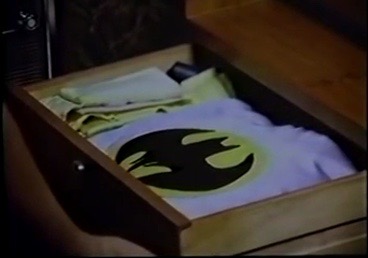
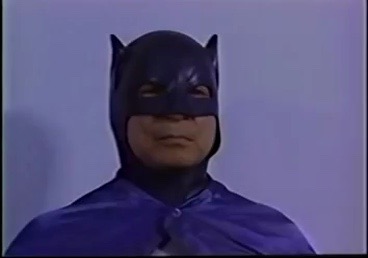
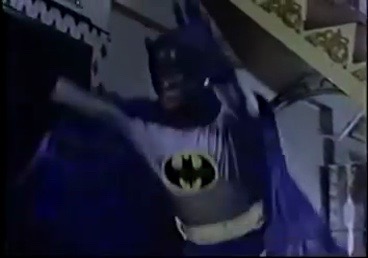
A Filipino Batman. Of course! There’s Turkish Supermen. There’s an Indonesian Lady Terminator. There’s Brazilian Star Wars. There’s a Mexican Batwoman. There’s a dancing Indian Superman and Spiderwoman. So why not a Filipino Batman? Actually, this is one of three that I know about. There is another one with the same title as this film from 1965, which I don’t have, and a movie called James Batman from 1966 that I do have. I’ll review that one later.
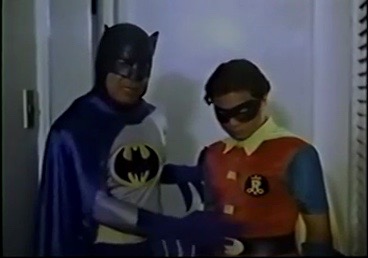
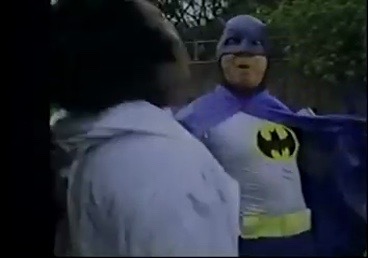
Let’s talk about this particular Filipino Batman. The title literally translates to Alias Batman and Robin, which is actually a very appropriate title. While the movie does have Batman, Robin, Joker, Penguin, Catwoman, and numerous other superheroes that show up at the end, they are all regular people who take up the roles rather than actually being the real characters.
The movie of course opens with the Batman TV Show theme song playing. However, it’s like almost all the lifted songs in this movie. It’s not the exact song. It’s not like if you watch the Taiwanese film King Of Snake (1984). In that film you will hear the main theme from The Terminator (1984) and music from Once Upon A Time In The West (1968) unaltered. In this movie, the songs will be tweaked or sampled, and have new lyrics. There is one exception, but we’ll get to that.
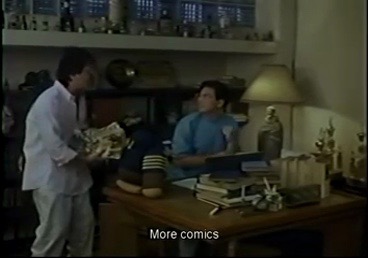
I’m gong to just cut through the very beginning of this movie cause the film sure does, and it doesn’t make a lot of sense. The movie opens up and we meet our future Batman (Joey de Leon) and Robin (Keempee de Leon).
As far as I can tell they are supposed to be high school or college students. The only person they are really clear about is the guy who becomes the Penguin. Now we meet our future Joker (Rene Requiestas) reading about the character.
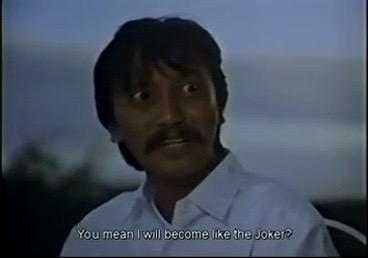
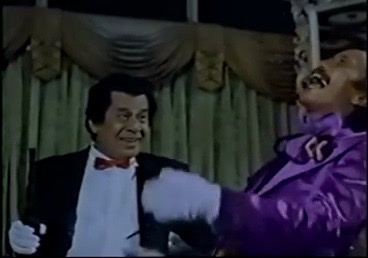
I’m going to say it here. He has a great maniacal laugh. It never feels like there’s a psycho or a really bad guy behind it like you see in The Dark Knight (2008) or Batman (1989). Nevertheless, it still is pretty great, and he does it a lot. He also does great crazy eyes.
There are some girls here, some rivalry, and some fighting. None of it really matters. Trust me. Even the film will tell you later how meaningless these opening scenes are to the movie. The next thing you know Joker’s uncle gets out of jail and this happens.
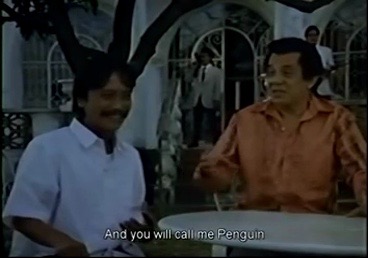
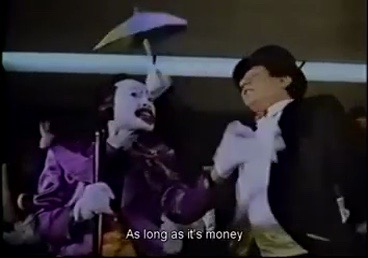
There you go! Now we have Joker and Penguin (Panchito). They immediately go to rob the Treasury Office, but first!
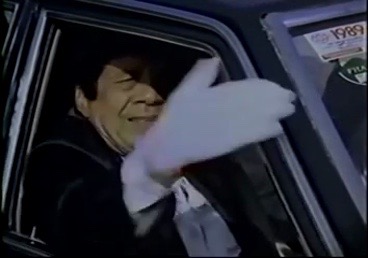
The director of this movie made other films like this such as Bobo Cop (1988), Goosebuster (1991), and his own line of Tarzan films. I seriously doubt that sticker having the year Tim Burton’s Batman came out is just a coincidence.
Anyways, they rob the treasury and gloat about it.
They also talk about hiring some goons.
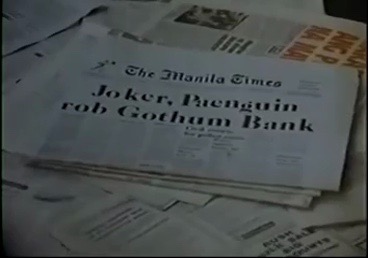
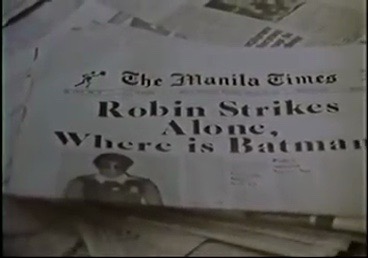
After our future Batman and Robin read about the robbery, we get Kabuki Joker.
Now the Joker and Penguin start hitting more places including apparently Gotham Bank.
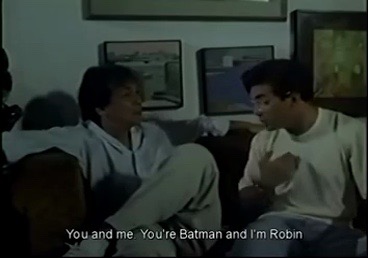
I always suspected Gotham was really Manila. Now they’ve gone too far!!! The brothers decide to become Batman and Robin.
Well, to be fair. The brother who will be Batman actually wants to be Starzan. Starzan is this movie’s director’s Tarzan knockoff. Do I have to tell you? The actor who plays the brother is the actor who plays Starzan. However, future Robin tells him he can’t do that because it will turn “this movie into shit”.
Meanwhile, we need Catwoman (Almira Muhlach). So here she is with her posse.
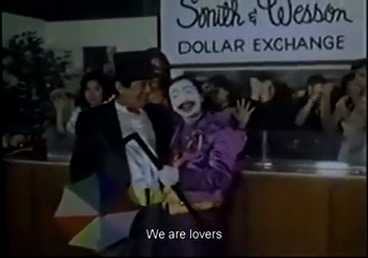
After quoting the title of Bobby McFerrin’s Don’t Worry Be Happy, they are off to rob the Smith & Wesson Dollar Exchange! Now we get our first musical number.
My original sentences here were going to be that I couldn’t figure out where the song is from, but a friend came through. The song they use is Bird Dog by The Everly Brothers.
While I may have had trouble with that song, I sure as hell knew what the next one was! After Joker and Penguin rob a jewelry store, we get a montage of Batman and Robin becoming Batman and Robin.
“Do you still remember from your comic book. The series of the Dynamic Duo. The Caped Crusader and the Wonder Boy. They fight all the goons. Holy smoke, Batman and Robin. Oh my God, Batman and Robin. Praise the Lord, Batman and Robin. Shoot now, shoot. Batman and Robin. Let’s do Bruce Wayne now and Dick Grayson now. They are a part of me.”
In other words: “Let’s go surfin’ now. Everybody’s learning how. Come on a safari with me.” It’s Surfin’ Safari by The Beach Boys with lyrics about Batman and Robin.
It is glorious!!! I love the next one too!
Now the Joker and Penguin pull up to rob a place and that riff sure sounded familiar to me. It’s because it’s a riff from Oh, Pretty Woman. The lyrics are totally different.
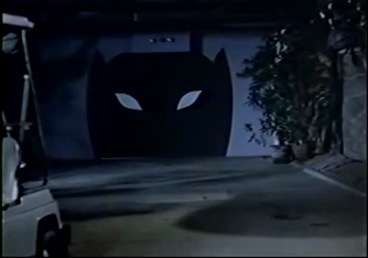
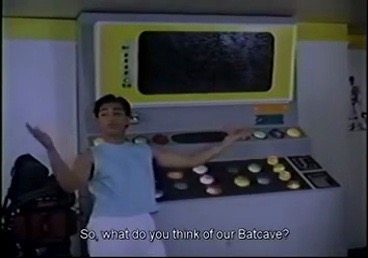
But we have more important things now. To the Batcave!
Now the Joker and Penguin are going to strike again, but this time Batman and Robin are on the case. Oh, there’s also a little in-joke here about two Filipino production companies called VIVA and Regal. It’s not important.
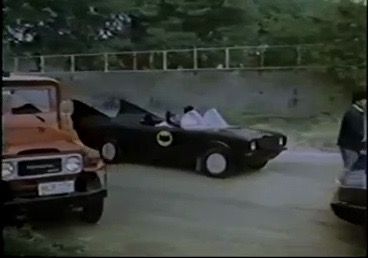
To the Batmobile!!!
Action!
Oh, and some days you just can’t get rid of a coconut.
Now Batman goes where Batman always goes. No, not to the Bat Room. That’s later. He goes to the girl (Dawn Zulueta) he is interested in while dressed at Batman.
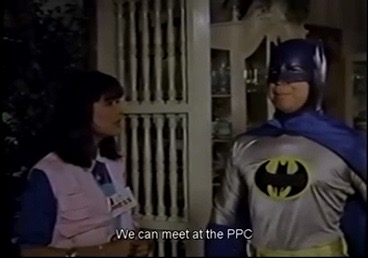
He asks her to meet him at the PPC. Apparently, PPC stands for Paco Park Cemetery. Why there? Your guess is as good as mine because before she can ask, he’s out the door.
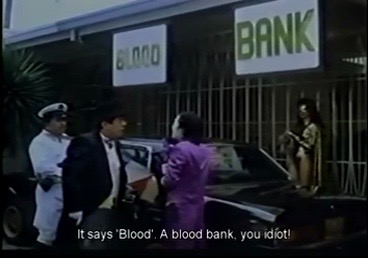
Now we get reminded that Joker and Penguin aren’t the brightest of people. Well, the Joker that is cause they try to rob a Blood Bank.
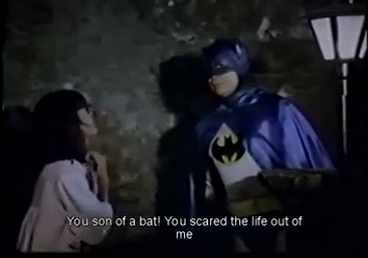
Meanwhile, at the cemetery, Batman is resorting to jump scares.
While I was dishappiest, to quote Pat Buttram in Texans Never Cry (1951), with the jump scares in the awful Ex Machina (2015), I like the line “You son of a bat!” he gets from her after jumping out at her.
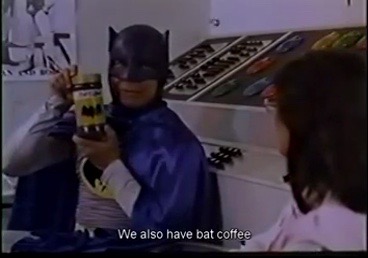
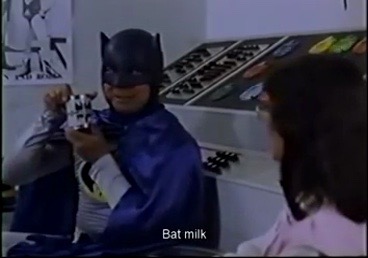
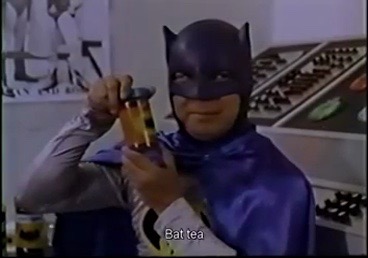
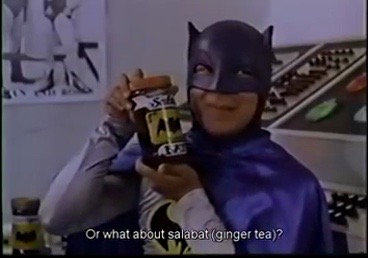
They go back to the Batcave now. She works for the Daily Planet…I mean the Daily Star. While he may be a son of a bat, he is a good host. He offers her something to drink.
Look! Batcaves are expensive and he needs to recoup costs somehow. She goes with Bat Tea. She asks if he can “take that off?” So of course this happens.
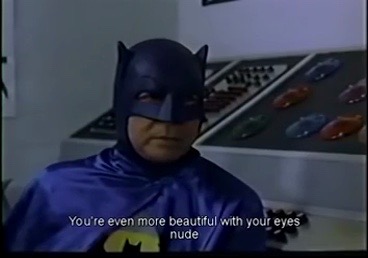
She meant his mask. He then asks her to take it off. She’s offended. Of course Batman meant her glasses, and he compliments her.
Given how this film is, I totally believe Batman told her she’s “even more beautiful with [her] eyes nude.” Now she asks the next logical question: “Can you tell me how Batman and Robin began?” Good question! I’d like to know that too. That’s when a Batarang flies across the screen…
because I’m pretty sure the film doesn’t understand how that happened either. Batman says they won’t stop till the super villains are stopped, and she asks to use the Bat Room. Scene!
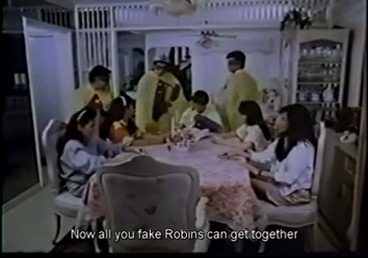
Now we get a pointless part that amounts to Robin not being able to get his girl by telling her he’s Robin because it’s just as easy for anyone else to make a Robin uniform so this happens.
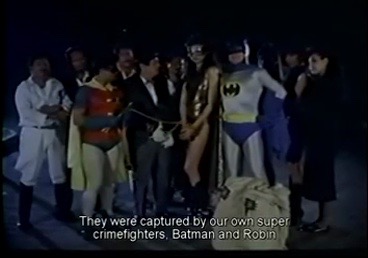
Well, it didn’t take them long because in the next scene Batman and Robin capture Penguin and Catwoman. Joker is still free.
Honestly, this is when the film begins to drag because it starts to try and take itself seriously. Batman and Robin try to get the girls they like. In fact, Robin shares a musical number with the girl (Vina Morales) he likes. This time around they didn’t bother to change anything. The song is Until Forever by Evan Rogers and D’Atra Hicks off the soundtrack to the movie Everybody’s All-American (1988).
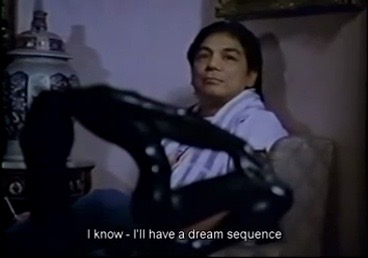
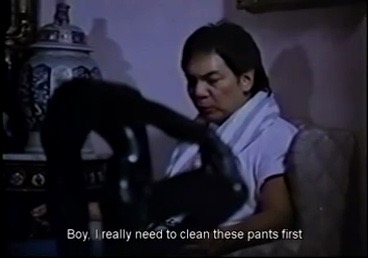
Now we go over to Batman, and this is one movie that’s kind enough to tell you when a dream sequence is going to begin.
Unfortunately, it’s one of those dreams as realizes after waking up.
There’s another really immature moment next where we see Batman’s package through his underwear. I’m not showing that.
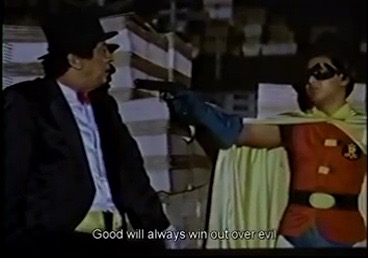
Now for no real reason at all, Penguin breaks out of prison and flies away in a helicopter. Batman decides he doesn’t want to play the part anymore. This leaves Robin to go fight crime alone.
Like I said before, this is where the film started to lose me. It will pick up at the very end, but till then the fun starts to stop.
Now Robin tries to protect himself against Joker and Penguin…
but he is beaten and Batman’s girl is taken prisoner while Robin is sent to the hospital. Batman must once again don the suit.
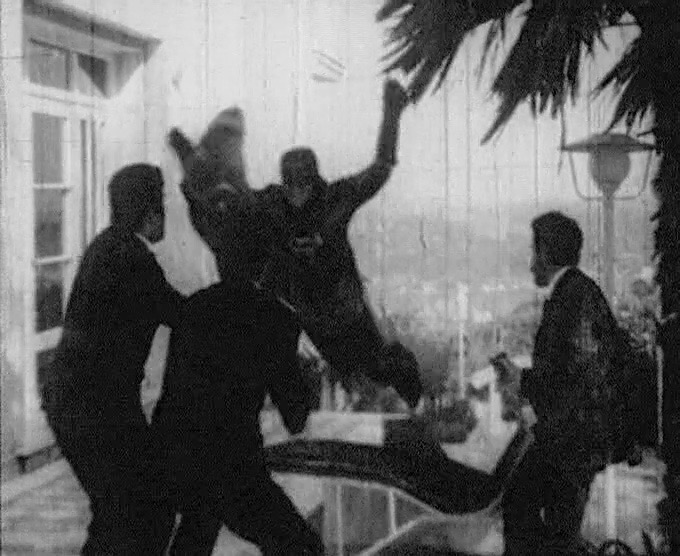
Now Batman goes to rescue his girl, and apparently does the same diving jump as Superman did in Kilink in Istanbul.
Kilink in Istanbul (1967, dir. Yilmaz Atadeniz)
Everything goes fine. The Joker and Penguin are now in jail. However, after crazy eyes…
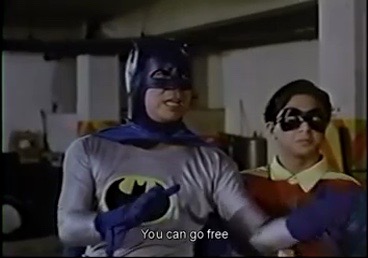
they dig out the toilet and escape through the hole. Now you’d think the film would stop already, but no. There’s still a little left. Joker and Penguin decide to dress up as Batman and Robin to commit crimes, and blame it on them. The real Batman and Robin catch up with them and tell them as long as they return what they stole with interest, then they can go free.
After a stupid conversation between Batman, Robin, Joker, and the Penguin, Batman, out of the suit, goes to take out his girl, but look!
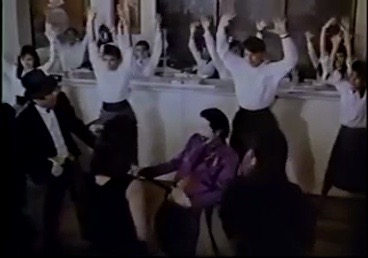
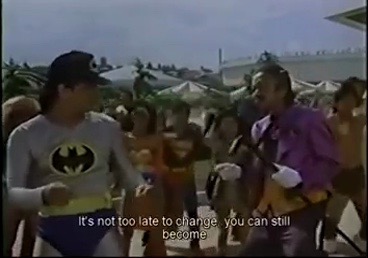
Now begins the final dance number and I think we all know this one. It’s Rock ‘n’ Roll Is Here To Stay by Danny & The Juniors, but of course we all remember it as performed by Sha-Na-Na in Grease (1978).
Everyone gets in on this number. Like mini-Spiderman here!
We know Batman and Superman are rivals, but for at least one dance they were able to put aside their differences.
If anyone knows who these two are, then tell me.
In the end, all that matters is that we’ll always be together!
My final thoughts on this movie are that I enjoyed it and would recommend it. The stuff near the end does take you out of the fun, and it really can’t pull of being serious, but that’s short-lived. It doesn’t ruin the movie. I know that some people cry foul whenever they see something like this and get outraged. I’m not one of them. The movie never felt like it was being mean spirited. It feels like a group of comedians with a love of 50’s and 60’s music got together and made a humorous Batman movie largely for fun. I always find it interesting to see such tightly controlled properties in new and interesting places. If that kind of thing bothers you, then don’t watch it. If it doesn’t, then check it out.
This morning, as a part of my continuing effort to watch 38 films by Friday and clean out the DVR, I watched Random Harvest, a romantic melodrama from 1942.
And when I say that Random Harvest is a melodrama, I’m not exaggerating. During the first hour of the film, I found myself thinking that if Random Harvest were made today, it would probably be a Lifetime movie. By the time the second hour started, I realized that it would actually probably be one of those heavily hyped miniseries that ends up being broadcast on A&E, Bravo, and Lifetime at the same time. This is one of those big, epic stories where, every few minutes, a new plot twist emerges.
When the film opens during the first World War, John Smith (Ronald Colman) is a patient at a British asylum. He knows that he was once a soldier. He knows that he was gassed during a battle. He knows that he’s recovering from extreme shell shock and it’s still a struggle for him to relate to other human beings. He knows that he will probably spend the rest of his life as a patient at the asylum. He also knows that his name is not John Smith. He’s not sure what his real name is because he suffers from amnesia.
One night, a message comes to the asylum. The war has ended! All of the doctor and orderlies go out to celebrate, leaving Smith unguarded. Smith simply walks out of the asylum and eventually makes his way to a nearby town. It’s there that he meets Paula (Greer Garson), a kind-hearted singer who invites Smith to join her traveling theatrical troupe.
Paula and Smith fall in love, end up getting married, and have a child together. Paula encourages Smith to become a writer and eventually, a publisher in Liverpool asks to meet with him. However, when Smith goes to Liverpool, he ends up getting hit by a car. When he regains consciousness, he suddenly knows that his name is Charles Rainier and that he’s rich! However, he no longer remembers that he was once named John Smith, that he’s married to Paula, or that he has a child.
The years pass. Charles returns to his old life of servants, money, and political ambition. His stepniece, Kitty (Susan Peters), falls in love with him but Charles, for his part, cannot stop wondering about what happened between getting gassed in World War I and getting hit by that car in Liverpool.
Meanwhile, Paula refuses to believe that Smith had abandoned her. Even after she has him legally declared dead, she continue to believe that he’s out there. And then one day, she sees a picture of Charles Rainier. She also learns that Rainier needs an executive secretary, which just happens to be what Paula does when she’s not singing…
Just from reading that plot, you probably think that Random Harvest is an incredibly silly film, that type that, if it were made today, would star Katharine Heigl and maybe a British guy who had a minor role on Game of Thrones. But, dammit, Random Harvest works! Filmmakers in the 30s and 40s knew how to make this type of melodrama totally compelling and believable. There’s not a hint of snarkiness or cynicism to be found in Random Harvest and, as a result, it feels almost churlish to criticize the plot for being implausible. Sincerity saves this film.
Random Harvest was nominated for Best Picture but it lost to another film starring Greer Garson, Mrs. Miniver.However, Garson gave a far better performance in Random Harvest than she did in Miniver. When you watch most of her film today, Greer Garson always comes across as talented but a little boring and obvious in her technique. (She was the Meryl Streep of her day.) In Random Harvest, Garson actually gets to sing and danger and laugh and behave like a human being. After seeing her in Blossoms In The Dust, Mrs. Miniver, and Sunrise at Campobello, watching her performance in Random Harvest is akin to an acting revelation.
Meanwhile, Ronald Colman also does a great work at both Smith and Charles (and they really are two separate characters). Admittedly, Colman does come across as being a little bit too old for the role (and the age difference between him and Susan Peters does add a certain odd subtext to the scenes between Charles and Kitty) but, otherwise, he’s totally and completely credible as the character. When he’s Smith, he speaks in a halting, uncertain tone and he walks like he’s still learning how to put one foot in front of the other. When he becomes Charles, he’s definitely more confident but he still moves like a man who feels as if it’s his duty to carry the weight of the world on his shoulders.
(I have to admit that I’ve always found it strange that Margaret Mitchell apparently wanted Ronald Colman to play Rhett Butler in Gone With The Wind. Watching his performance here, I still could not see Colman as Rhett but he would have made a great Ashley Wilkes.)
The beautiful Susan Peters was nominated for best supporting actress for her performance as Kitty. Random Harvest was her first major role and she gives such a great and likable performance that it makes it all the more tragic that her career was cut short. Just three years after appearing in Random Harvest, Susan was accidentally shot by her husband. Though she survived, she would never walk again. When she died, at the age of 31 in 1952, the official cause was pneumonia but it was also said that she had stopped eating and drinking and had literally lost the will to live. Whether you love Random Harvest or you think it’s just a silly melodrama, you should watch it just to see Susan Peters’s great performance and to consider what could have been.
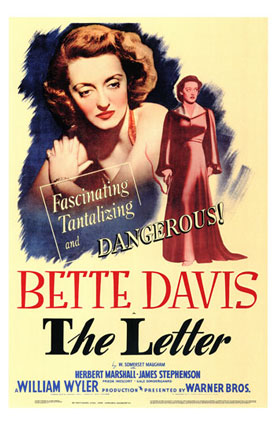
After watching Break-Up Nightmare, I watched one more film that was sitting on my DVR. That film was 1940’s The Letter. I had recorded it off of TCM and, up until last night, I had never seen it before. I’m happy to say that I’ve seen it now because it’s a great movie, featuring a fascinating mystery, feverish atmosphere, excellent supporting performances, and a ferociously brilliant performance from the great Bette Davis.
Filmed in a dream-like noir style by William Wyler, The Letter opens on a rubber plantation in Malaysia. It’s night and the camera pans over the native workers all trying to sleep through the hot night. Eventually, the camera reaches the big house, where the plantation’s wealthy and, of course, white manager lives. (The contrast between the wealthy Europeans interlopers and the natives who work for them is a reoccurring theme throughout The Letter.) A gunshot rings out. A man stumbles out of the house. Following after him is Leslie Crosbie (Bette Davis). She is carrying a gun and, as we watch, she shoots the man a few more times. She shoots him until she’s sure that he’s dead.
Leslie is the wife of Robert Crosbie (Herbert Marshall, who also played Davis’s husband in The Little Foxes) and the man that she just killed is Geoff Hammond, a respected member of Malaysia’s European community. When the police arrive, Leslie explains that Hammond “tried to make love to me” and that she was forced to kill him in self-defense. Leslie is arrested for the crime and will have to face trial but everyone knows that she will be acquitted. After all, Leslie and her husband are members are well-connected members of the upper, European class.
However, Leslie’s lawyer, Herbert Joyce (James Stephenson), has doubts about Leslie’s story. He points out that she sounds just a little too rehearsed. His suspicions are confirmed when his clerk, Ong Chi Seng (Sen Yung), tells him about the existence of a letter that Leslie wrote on the day that Hammond was killed. In the letter, Leslie orders Hammond to come see her and threatens to reveal the details of their relationship if he doesn’t. Ong explains that he only has a copy of the letter. The original is in the hands of Hammond’s widow (Gale Sondergaard) and she’s willing to sell the letter for a substantial price.
Not surprisingly The Letter is dominated by Bette Davis but, for me, the most memorable character is the outwardly obsequies but inwardly calculating Ong Chi Seng. Sen Yung plays him with such a polite manner and a gentle voice that it’s actually incredibly shocking when he reveals his true nature. And yet, even after he’s been exposed as a potential blackmailer, his manner never changes. Meanwhile, Gale Sondergaard only appears in a handful of scenes but she steals every one of them with her steely glare.
In order to get the letter away from Ong and Mrs. Hammond, Leslie and Joyce have to convince Robert to give them the money without allowing him to learn the letter’s content. But, what neither one of them realizes, is that Mrs. Hammond has plans that go beyond mere blackmail.
The Letter is an atmospheric melodrama that plays out almost like a fever dream and it also features one of Davis’s best performances. It was nominated for best picture but it lost to another atmospheric melodrama, Alfred Hitchcock’s Rebecca.
After I tried to watch Bad Sister, the next film on my DVR was Break-Up Nightmare, a film which premiered on Lifetime on March 6th.
Break-Up Nightmare is a film from The Asylum, the same wonderful people who have given us the Sharknado films, Wuthering High School, and Santa Claws. As I’ve made clear on this site, I absolutely love Asylum films. Though their films may be low-budget, they’re often more entertaining than the big budget epics that are released by the major studios. Full of inside jokes and deliberately over-the-top storylines, Asylum films are the perfect party movies. These are movies that demand to be seen with a group of your closest and snarkiest friends. Needless to say, when Break-Up Nightmare opened with that “The Asylum presents…” credit, I was excited.
Break-Up Nightmare is actually a little bit more serious than your typical Asylum film but then again, it’s not about flying sharks or talking kittens. Instead, Break-Up Nightmare deals with a serious subject. Or, I should say, at the least first 45 minutes deal with a serious subject.
Recent high school graduate Rachel (Celesta DeAstis) is taking a year off before going to college, mostly so she can work and actually be able to afford to go to the best music school possible. Her jerky jock boyfriend, Troy (Mark Grossman), has received a football scholarship and will be leaving in the fall. However, before Mark leaves, he convinces Rachel to pose for some pictures (yep, those type of pictures) so he won’t forget her while he’s away. Rachel later asks him to delete the pictures but soon discovers that Troy didn’t do so. She also discovers that Troy has been getting texts from another girl and she dumps him. When Troy starts to get belligerent, Rachel’s mother — Barbara (Jennifer Dorogi) — kicks him out of the house.
Free of Troy, Rachel looks forward to getting on with her life. Except, of course, people are looking at her strangely. At work, scummy frat boys show up and ask her provocative questions. At the movies, a creepy middle-aged man sits down behind her and asks, “How’s it going?” Finally, Rachel’s best friend, Ryan (Freeman Lyon), shows her a revenge porn site called LifeRuinerz.com. On the site, Rachel sees the pictures that Troy took of her.
Rachel’s life starts to spiral out of control as, apparently, everyone in the world has either seen the picture or heard about them. When she goes to the police, she’s told that the cops are busy solving real crimes and don’t have time to help someone who voluntarily posed for smutty pictures. At church, the sermon is about the dangers of lust and a judgmental old woman glares at Rachel and tells her that she should dress more modestly. (Been there.) Someone breaks into the house and spray paints “Whore” on the garage door. When Barbara demands that the site remove her daughter’s pictures, she soon finds that her face has been photoshopped into a pornographic image and she loses her teaching job.
And, through it all, Troy continues to deny having put the pictures on the site. It’s easy to suspect Troy because he’s such a jerk but then suddenly, he’s arrested on child pornography charges. Rachel only has to look at one picture to realize that, just as happened to Barbara, Troy’s face has been photoshopped onto someone else. But if Troy isn’t the one responsible, who is?
Meanwhile, pervs across the world are sitting in front of their laptops and watching Barbara undress, the result of a hidden webcam that someone has placed in the house…
So, Break-Up Nightmare starts out as a fairly serious look at revenge porn and it actually makes a lot of important points, the big one being that the whole “pay us and we’ll remove your picture” thing is a scam. There were certain parts of Break-Up Nightmare that hit close to home and made me cringe because, quite frankly, we’ve all been there and we’ve all done things without considering the consequences. But, of course, this is an Asylum Film and, once the important lessons have been taught, the film goes totally batshit crazy in that way that we all love. Suddenly, the film isn’t just about revenge porn. It’s about a diabolical stalker who has come up with a needlessly complicated scheme to accomplish a single goal.
And you know what?
We wouldn’t expect or want anything less from either The Asylum or Lifetime. All you people who complain about plausibility or plot holes, you can go watch another network and think about how you’ve got it all figure out. It’s the implausible melodrama that makes a movie like Break-Up Nightmare fun.
That said, the main reason I liked Break-Up Nightmare was because of the very realistic and truthful depiction of the loving, protective, and occasionally testy relationship between Barbara and Rachel. Jennifer Dorogi and Celesta DeAstis were totally believable as mother and daughter. Barbara may have been overprotective but she was also not going to let anyone get away with hurting her daughter. Barbara basically spent the entire movie kicking ass and it was a lot of fun to watch.
Last night, after I finished with Going My Way, I decided to stick with the Catholic theme by rewatching Bad Sister. Bad Sister aired on Lifetime on January 3rd. Having seen several wonderfully sordid commercials, I watched it and I loved every minute of it. I was really looking forward to watching it again but apparently, there was some sort of screw-up with my usually ultra-dependable DVR. It only recorded bits and pieces of Bad Sister.
I was so disappointed! Fortunately, however, I still remember Bad Sister well enough to review it. For instance, who could forget this scene?
Okay, technically, that was a scene from the episode of King of the Hill where Peggy pretends to be a nun so she can get a job teaching at a Catholic school. (“Sister Peggy, will my cat go to heaven?” “Well, I’ve heard that all dogs go to Heaven so I’m pretty sure that cats do not.”) For whatever reason, I couldn’t find any Bad Sister clips on YouTube but really, the movie has pretty much the same plot. It’s just, in the case of the movie, the fake nun is also a sociopath who starts to obsess on one of her students.
From the minute Sister Sophia (Alyshia Osche) shows up at her new job as a teacher at a Catholic boarding school, it’s obvious that she’s not like the other nuns. For one thing, she’s awfully enthusiastic about her students, especially the male ones. Plus, there’s not many nuns who specifically make it a point to strip down to sexy red lingerie while being watched by a teenage boy. Even beyond that, Sophia refuses to take part in Morning Prayer and she doesn’t seem to know much about … well, anything Catholic. Is Sister Sophia just young and naive or is it possible that she’s actually an escaped mental patient named Laura? And could it be that, perhaps at the start of the movie, Laura murdered the real Sister Sophia and stole her identity?
Well, this is a Lifetime movie so, of course, that’s exactly what happened!
As a result of seeing him sing on YouTube, Sister Sophia is obsessed with Jason (Devon Werkheiser, the star of Ned’s Declassified School Survival Guide, all grown up). Jason’s a student who dreams of being the next Justin Bieber. However, to get to Jason, Sister Sophia has to deal with not only Jason’s girlfriend (Sloane Avery) but also Jason’s suspicious sister, Zoe (Ryan Newman). And, of course, there’s Sister Rebecca (Helen Eigenberg), another nun who is starting to suspect that Sophia might not be who she says she is…
Bad Sister was a totally over-the-top masterpiece of Lifetime moviemaking. Director Doug Campbell is one of my favorite Lifetime directors and he doesn’t disappoint with Bad Sister, playing up the sordid melodrama while, at the same time, never making the mistake of taking this story too seriously. Alyshia Osche was brilliant as Sister Sophia. One of the most entertaining parts of the film was watching her switch back and forth from being the enthusiastic Sister Sophia and the perpetually annoyed Laura. (Just watch the scene where she goes through the real Sister Sophia’s stuff and discovers the boring, dowdy underwear that she’s expected to wear. The look of total and thorough annoyance that flashes across her face is absolutely brilliant acting on Osche’s part and, within seconds, totally and completely defines the character of Laura/Sister Sophia.)
Bad Sister was the first great Lifetime film of 2016! Keep an eye out for it.
(I should add that you probably don’t have to come from a Catholic background to enjoy Bad Sister. But it definitely helps!)
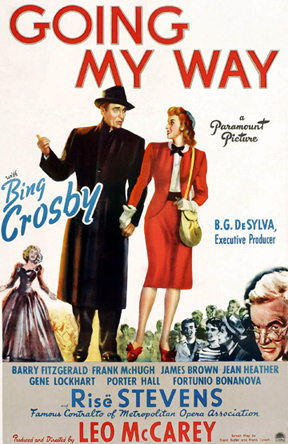
Last night, continuing my effort to watch 38 movies in 10 days (and, for the record, I have 7 days left as of today), I watched the 1944 musical-comedy-drama Going My Way.
Going My Way tells the episodic story of Father Chuck O’Malley (Bing Crosby), a priest from St. Louis who is assigned to take charge of a struggling parish in New York City. O’Malley is meant to replace Father Fitzgibbon (Barry Fitzgerald), a stubbornly old-fashioned priest who is struggling to keep up with a changing world. Though O’Malley is to take charge of the parish’s affairs, Fitzgibbon is to remain the pastor. However, the compassionate O’Malley doesn’t tell Fitzgibbon about the arrangement and allows Fitzgibbon to believe that O’Malley is only meant to be his assistant.
It’s obvious from the start that Fitzgibbon and O’Malley have differing approaches. Fitzgibbon is a traditionalist. O’Malley, on the other hand, is a priest who sings. He’s a priest who understands that the best way to prevent the local teens from forming a street gang is to convince them to start a choir instead. When it appears that 18 year-old Carol (Jean Heather) is “living in sin,” it is the nonjudgmental O’Malley who convinces her to marry her boyfriend.
And, slowly but surely, Fitzgibbon and O’Malley start to appreciate each other. O’Malley is even able to convince Fitzgibbon to play a round of golf with him, while Fitzgibbon tells O’Malley about his love for his mother in Ireland.
What’s interesting is that we learn very little about O’Malley’s past. In many ways, he’s like a 1940s super hero or maybe a less violent and far more ethical version of one of Clint Eastwood’s western heroes. He shows up suddenly, he fixes things, and then he moves on. Instead of a cape or a poncho, he wears a collar.
(And, of course, he doesn’t kill anyone. Actually, that’s probably a lousy analogy but I decided I’d give it a try anyway…)
At one point, O’Malley does run into an opera singer named Genevieve Linden (Rise Stevens). He and Genevieve (whose real name is Jenny) talk briefly about their past and it becomes obvious that they once had a romantic relationship. We don’t learn the exact details but it does bring some unexpected melancholy to an otherwise cheerful film. It reminds us of what O’Malley gave up to become a priest.
Fortunately, Genevieve is more than happy to help out with O’Malley’s choir, even arranging for them to meet with a record executive (William Frawley). The executive doesn’t have much interest in religious music but then he hears Bing O’Malley sing Swinging On A Star.
It’s a bit strange to watch Going My Way today because it is a film that has not a hint of cynicism. There’s no way that a contemporary, mainstream film would ever portray a priest as positively as Father O’Malley is portrayed in this film. Indeed, it says something about the world that we live in that I instinctively cringed a little whenever O’Malley was working with the choir, largely because films like Doubt and Spotlight have encouraged me to view any film scene featuring a priest and an pre-teen boy with suspicion. O’Malley is the ideal priest, the type of priest that those of us who were raised Catholic wish that we could have known when we were young and impressionable. Bing Crosby does a pretty good job of playing him, too. Watching Going My Way felt like stepping into a time machine and going to a simpler and more innocent time.
In the end, Going My Way is a slight but watchable film. It doesn’t add up too much but, at the same time, it’s always likable. Though the film may be about a priest, the emphasis is less on religion and more on kindness, charity, and community. Going My Way was a huge success at the box office and even won the Oscar for best picture.
Personally, I would have given the Oscar to Double Indemnity but Going My Way is still a likable movie.
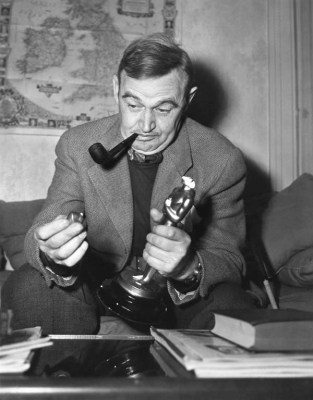
Speaking of likable, the Academy was so impressed with Barry Fitzgerald’s performance that they actually nominated it twice! He got so many votes in both categories that Fitzgerald ended up nominated for both Best Actor and Best Supporting Actor. Subsequently, the Academy changed the rules and decreed that a performance could only be nominated in one category. As for Fitzgerald, he won the Oscar for best supporting actor. He later broke the Oscar while practicing his golf swing.
Barry and Oscar
(Don’t worry. The Academy sent him a replacement.)
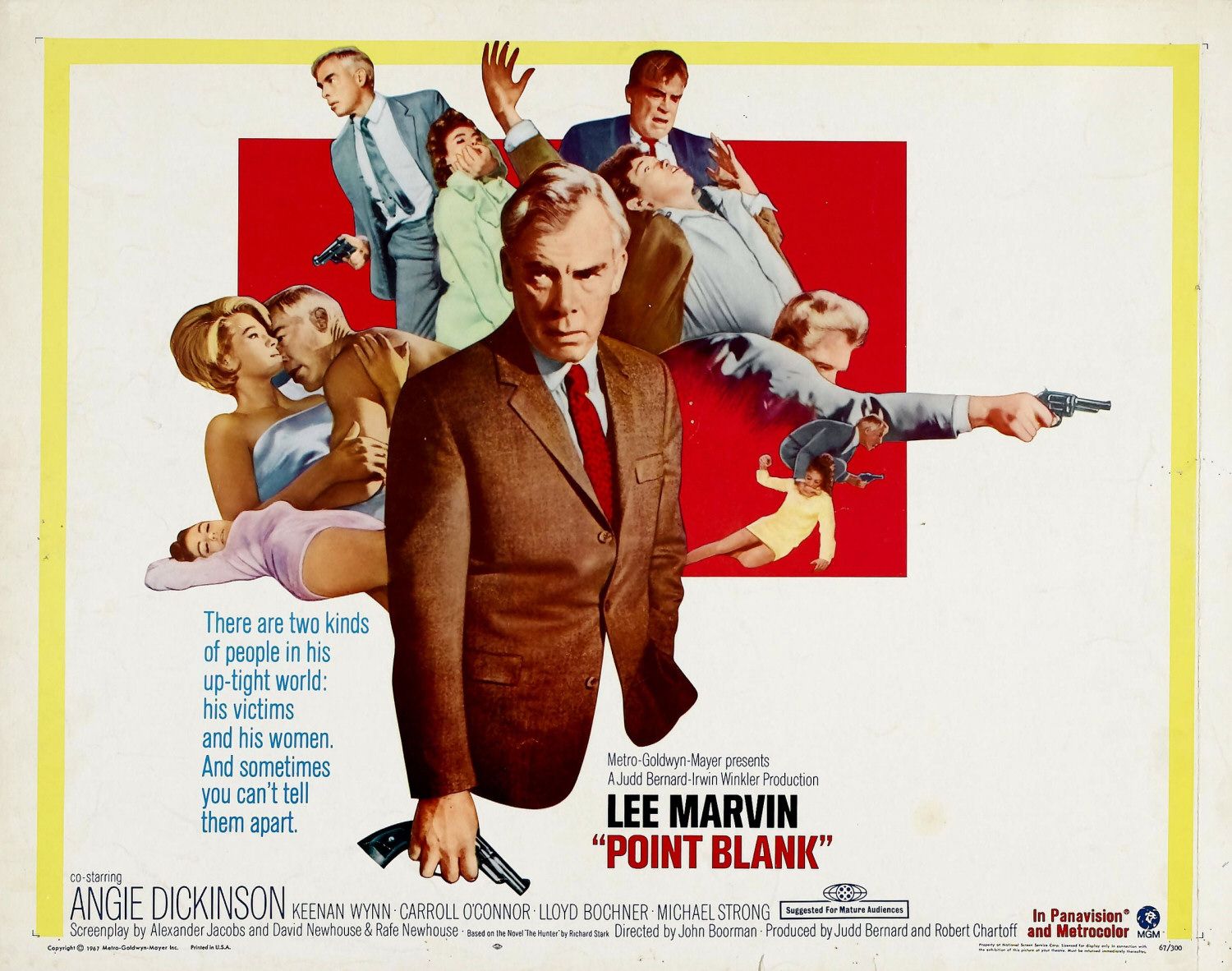
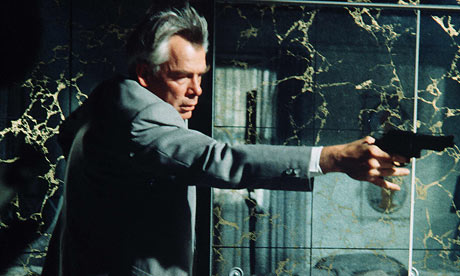
Lee Marvin was one tough son of a bitch both onscreen and off, awarded the Purple Heart after being wounded by a machine gun blast in WWII. The ex-Marine stumbled into acting post-war, and Hollywood beckoned in the 1950’s. His imposing presence typecast him as a villain in films like HANGMAN’S KNOT, THE BIG HEAT , and BAD DAY AT BLACK ROCK. A three season stint in TV’s M SQUAD brought Marvin more acclaim, and he solidified that with his Oscar-winning role in CAT BALLOU, parodying his own tough-guy image. Marvin was now a star that could call his own shots, and used that clout in POINT BLANK, throwing out the script and collaborating with a young director he had faith in, John Boorman.
POINT BLANK is a highly stylized revenge drama centering on Marvin’s character of Walker. The nightmarish opening sequence shows how Walker was left for dead on deserted Alcatraz Island by…
After I finished Abduction: The Jocelyn Shaker Story, I decided to watch a film that was shown on TCM as a part of the 31 Days Of Oscars. When I started the 1946 film, The Yearling, I thought it was going to be a sweet and heartwarming little movie about a country boy raising a deer. Instead, it turned out to be a rather dark movie about how much it sucks to grow up in the country. I can only imagine how many childen, back in 1946, were scarred for life by this movie.
The movie is actually about two yearlings. The main one is Jody (Claude Jarman, Jr.), who lives in the bayous of 1878 Florida. His family is a farming and hunting family. They live in a small shack and struggle to make ends meet. His father, Penny Baxter (Gregory Peck) is … well, he’s Gregory Peck. He’s stern but warm and speaks with that deep voice that lets you know that you better pay attention to everything he says. While Penny is generally laid back and enjoys a good laugh, his wife, Ora (Jane Wyman), is far more serious and severe. Ora has lost three children and, as a result, she is both overprotective and emotionally distant from Jody.
Jody desperately wants a pet but Ora says that they can’t afford to feed any animals. However, one day, Penny is bitten by a snake. Apparently, the organs of a deer can be used to draw out snake venom. (Seriously, until I watched The Yearling, I had no idea this was the case. I once nearly stepped on a rattlesnake in New Mexico and it totally freaked me out. It’s good to know that if I ever do get attacked by a snake, all I have to do is kill a deer.) Penny shoots a doe and has Jody cut out its heart and liver. After doing so, Jody notices that the doe had a fawn. He begs to be allowed to adopt it and, overruling Ora, Penny says that he can.
After getting his deer, Jody goes to visit his best friend, Fodderwing (Donn Gift) and ask him what he thinks a good name would be. However, Fodderwing’s father informs Jody that his friend has just died. And really, that scene pretty much epitomizes what The Yearling is about. Because it’s told almost entirely from Jody’s point of view, the film may occasionally look like an old school Disney film. But death and hardship are very real in the world of The Yearling. People die, even children. Having a pet may make the reality easier to take but it doesn’t change the reality.
Jody names the deer Flag. As the film progresses, both Jody and Flag grow up. Unfortunately, as Flag gets older and bigger, he causes more and more trouble for both his family and the neighbors. He eats crops and he destroys fences. After Penny is injured, Jody is the one who ends up replanting the corn and fixing all the damage. But, even after all of Jody’s hard work, Flag still knocks down another fence. That’s when Jody is told that he must shoot his beloved pet…
And that’s why I went, “Agck! What type of movie is this!?”
Well, it’s a coming-of-age movie and, unfortunately, Jody is living at a time when growing up means giving up childish things. (That’s always been my least favorite verse in the Bible, by the way.) The Yearling itself is a pretty good film, though I do have one major problem with it. The film looks great and both Jane Wyman and Gregory Peck are expertly cast. If you keep an eye out, you’ll even spot Henry Travers — Clarence the Angel from It’s A Wonderful Life — in a small role.
That said, my main objection to The Yearling — the thing that keeps it from being quite as good as it could be — is the performance of Claude Jarman, Jr. In the role of Jody, Jarman goes so totally over-the-top with his line readings and his facial expressions that it immediately takes the viewer out of the film’s reality. Whenever anything happens — whether its Penny getting attack by a snake or his mother throwing a plate at his deer or Flag knocking over a fence — Jarman responds by standing there with his eyes and mouth wide open. His lines are delivered with a rushed enthusiasm that can’t hide the complete lack of authentic emotion in his performance. Claude Jarman tries really hard but it’s not surprising to discover that, after The Yearling, he only appeared in a few more films before joining the Navy and then subsequently moving behind the camera as a producer.
Then again, the Academy thought highly enough of Jarman’s performance to give him an honorary Oscar. The Yearling itself was nominated for best picture but it lost to another sad film about giving up childish things, The Best Years of Our Lives.
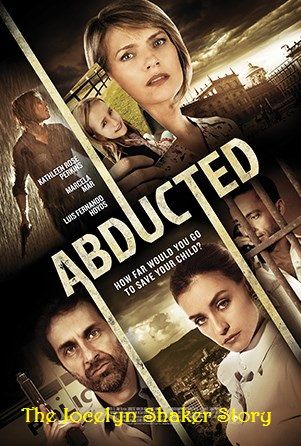
Last night, as a part of my continuing effort to watch 38 movies in 10 days, I watched Abducted: The Jocylen Shaker Story. Abducted originally aired February 14th on Lifetime. That’s right — this movie premiered on Valentine’s Day! I was in San Antonio when it aired, enjoying a romantic night down on the Riverwalk, so I missed the original showing. Fortunately, the DVR saves all.
And really, Abducted is a strange movie to show on Valentine’s Day. It’s not a romantic film at all. Instead, it’s a missing child thriller. Caitlin Shaker (Kathleen Rose Perkins) is an American who has married a wealthy Colombian businessman, Javier (Kamar de los Reyes). While Caitlin and Javier are visiting a resort in the rain forest, their daughter, Jocelyn, vanishes.
Suddenly, Caitlyn and Javier find themselves suspected of having done something to Jocelyn. Though one Colombian detective, Susanna (Eileen Roca Torralva), believes that Caitlin is innocent, she is ignored by her sexist superiors. The head of the investigation, Captain Rojas (Luis Fernando Hoyos), declares that Javier must be guilty and has him arrested for murder.
Caitlin knows that her husband is innocent but she can’t convince anyone to help her look for her child. The Colombian authorities want to close the case as quickly as possible. The American media declares that, even if they are innocent, Caitlin and Javier are still to be blamed for taking Jocelyn to a foreign country in the first place.
Eventually, only Susanna is willing to help Caitlin investigate Jocelyn’s disappearance…
The best thing about Abducted is that it gives Kathleen Rose Perkins a starring role. If you’ve ever seen the Showtime series Episodes, you will immediately recognize Perkins from her role as the wonderfully neurotic and often stoned network executive, Carol Rance. Episodes is a fairly terrible show but Perkins has always been one of the few bright spots. In Abducted, she really throws herself into the role of Caitlin, delivering her lines with an emotional intensity that always feels authentic and real. She is totally sympathetic in the role and elevates the entire film.
As for the film itself, it starts out as your standard Lifetime abduction film but the final 15 minutes, after the real villain has been revealed and Caitlin and Susanna are trying to rescue Jocelyn while rain pours around them, are exciting and well-executed. It helps that Perkins gives such a great performance that she makes even the most melodramatic and heavy-handed dialogue sound totally and completely credible. You won’t necessarily be surprised when you discover who the real villains is but you’ll still be happy to see them get their comeuppance.
(Comeuppance … that’s a strange word, no?)
Finally, Abducted was shot on location in Colombia. Reportedly, the Colombian government has been trying to attract filmmakers, with the hope of changing the country’s international image. Colombia is a beautiful country and Abducted takes full advantage of all that breathtaking scenery.