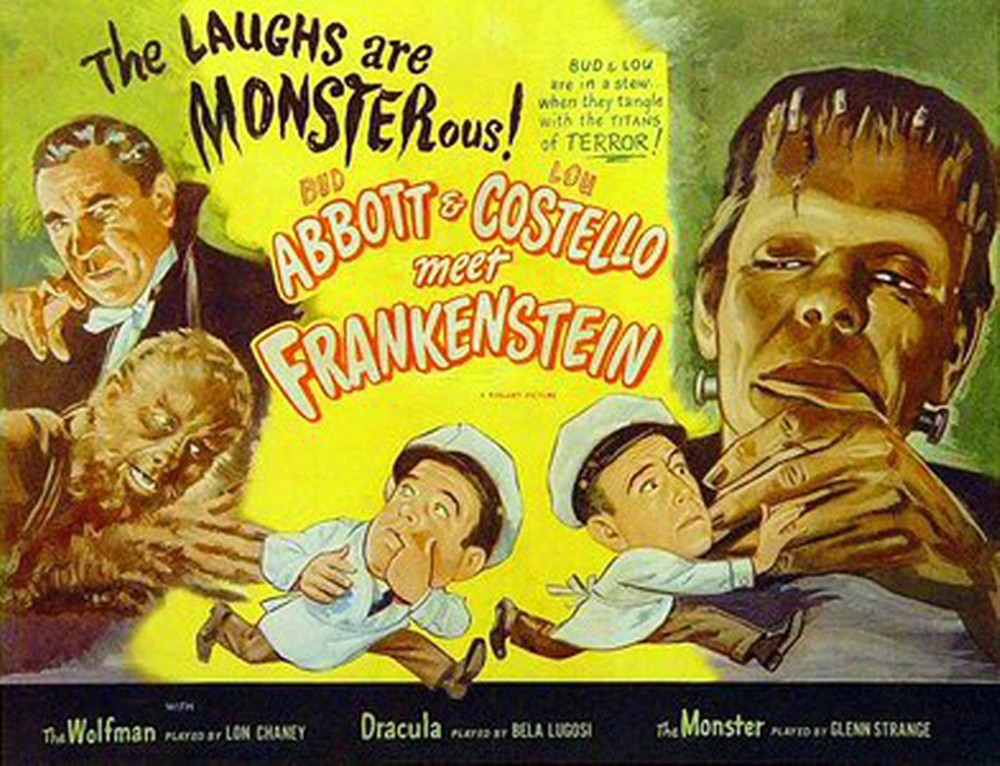
It’s Halloween, and we’ve finally made it to the Universal Classic Monsters! Frankenstein’s Monster, Dracula, and The Wolf Man had last appeared onscreen in 1945’s HOUSE OF DRACULA. Shortly thereafter, Universal merged with International Pictures and decided to produce only “prestige” pictures from then on, deeming their Gothic creature features no longer relevant in the post-war, post-nuclear world. The comedy team of Bud Abbott and Lou Costello were also in danger of becoming irrelevant, victims of their own success, as audiences were beginning to grow tired of them after twenty movies in a scant eight years.
That “prestige” thing didn’t work out so well, and Universal went back to what they did best…. producing mid-budget movies for the masses. Producer Robert Arthur developed a script called “The Brain of Frankenstein”, giving it over to Frederic Rinaldo and Robert Lees. Lou Costello hated it, and the team’s gag writer John Grant was brought it to punch things…
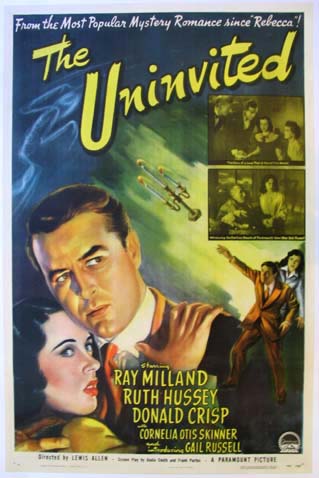
If you want to see a really good haunted house movie, allow me to recommend that you track down the 1944 film, The Uninvited. The Uninvited may not have been the first movie about a haunted house but it’s definitely one the best and one of the most influential. None other than Guillermo Del Toro has regularly cited The Uninvited as an inspiration and, as I watched the film last night, I could definitely see where the film had influence Del Toro’s Crimson Peak.
The Uninvited tells the story of Rick Fitzgerland (Ray Milland) and his sister, Pamela (Ruth Hussey). They’ve just purchased a long-empty seaside house and, incredibly, they were able to get it at an amazingly low cost! The house’s owner, the frail Commander Beech (Donald Crisp, alternating between being menacing and sympathetic), was apparently desperate to get rid of it.
Far less happy about the selling of the house is Beech’s granddaughter, the mysterious Stella (Gail Russell). As Stella explains it, she grew up in the house, her mother died in the house, and Stella is still attached to the house. Beech has ordered Stella to stay away from the house but, with Rick falling in love with her, Stella is soon visiting on a regular basis.
Of course, Stella isn’t the only unexpected visitor that the Fitzgeralds get to know. It quickly becomes obvious that there’s something strange about the house. Rick and Pamela discover an artist’s studio that is always cold. They both hear the sound of a woman crying. Beech claims that it’s nothing to worry about. Old house make weird noises, he informs them. However, Rick and Pamela start to become convinced that the house is haunted.
Stella not only agrees that the house is haunted but she also informs them that she knows the identity of the ghost. It’s Stella’s mother! But if that’s true, why does the ghost constantly seem to be encouraging Stella to put her life at risk? Why does Stella go into a trance and, much as her mother did 16 years earlier, attempt to jump over the side of a cliff?
Is Stella’s mother trying to manipulate her daughter into joining her in death? Or is there something even more sinister happening?
Well-acted and perfectly paced, The Uninvited is an effectively creepy film, one that remains memorable even 72 years after it was initially released. Visually, The Uninvited resembles a film noir and, if not for a brief scene towards the end of the film, viewers would be justified in wondering if the house really is haunted or if everyone in the film is just letting the isolation and the shadowy atmosphere get to them. It’s that hint of ambiguity that elevates The Uninvited and makes it a truly thought-provoking haunted house story.
Paul Lavond (Lionel Barrymore) was just your ordinary Parisian bank owner until he was wrongly convicted of robbery and murder. Sentenced to Devil’s Island and estranged from his beloved daughter, Lorraine (Maureen O’Sullivan), Paul spends 16 years plotting how to clear his name and progressively growing more bitter and angry.
He also befriends a scientist named Marcel (Henry B. Walthall). Marcel has figured out the formula for shrinking people. He’s convinced that shrunken people will eat less, use less fossil fuels, and take up a lot less space on the planet. They’ll probably also be less likely to wage war on each other. That’s right — the secret to world peace is shrinking the population.
However, Paul has other plans for that shrinking formula! What better way to clear his name and seek revenge than by using a shrunken army of henchmen?
Uhmmm — okay, it sounds a little bit overcomplicated to me but who am I to doubt the wisdom of Lionel Barrymore?
(Yes, I know he’s Paul Lavond but, honestly, Lionel Barrymore is Lionel Barrymore regardless of who he’s playing.)
Anyway, Paul and Marcel escape from Devil’s Island but Marcel dies shortly afterward. Paul, however, forms a partnership with Marcel’s widow, Maleta (Rafaela Ottiano). Disguising himself as an elderly woman, Paul returns to Paris. Not only does he use his disguise to watch over his daughter (who doesn’t realize that the kindly old woman is actually her father) but he also starts to develop quite a reputation for selling incredibly realistic dolls…
The Devil-Doll is an odd little mix of comedy and melodrama and, to be honest, it’s a bit too uneven to really work. That said, the film is definitely worth watching just for the sight of Lionel Barrymore playing an elderly woman. (Classic film lovers will immediately notice that, when in disguise, Lionel greatly resembles his sister, Ethel.) This Christmas, when I’m watching It’s A Wonderful Life for the 100th time and Mr. Potter is cackling and plotting to put the Bailey Building and Loan out of business, I’ll have a hard time not thinking about The Devil-Doll.
The Devil-Doll was one of the final films to be directed by the legendary horror specialist, Tod Browning. I’ve read that Browning’s later films suffered because Browning plunged into depression after the death of Lon Chaney, Sr. and he never quite recovered. And, really, The Devil-Doll feels like a film that would have been perfect for Chaney’s unique talent.
But, that said, Lionel Barrymore appears to be having a lot of fun as Paul and his performance is the main reason to watch the film today.
For the longest time, I thought that George Melies’s The Haunted Castle was the first horror film.
However, as I did my research for my History of Horror series, I discovered a horror film that actually predated The Haunted Castle. Produced by Thomas Edison and first released in 1895, The Execution of Mary Stuart is an 18-second film that recreates the beheading of Mary, Queen of Scots.
Along with perhaps being the first horror film, this was also the first films to use editing for the purpose of special effects. There’s an edit about halfway through this film, one that allows Robert Thomae, the actor playing Mary, to be replaced by a mannequin. That may not seem like a big deal today and the editing is rather obvious to modern eyes but, in 1895, that sort of thing literally had never been done before.
So, with all that in mind, here is the first horror film: 1895’s The Execution of Mary Stuart!
Well, as another horrorthon draws to a close, it’s time for another Shattered Lens tradition! Every Halloween, we share one of the greatest and most iconic horror films ever made. For your Halloween enjoyment, here is George Romero’s Night of the Living Dead!
The 1943 film The Leopard Man is set in a small town in New Mexico. It’s a place that seems to be hidden away from much of the modern world and where the cultures of Mexico and America mix, occasionally with unease. Jerry Manning (Dennis O’Keefe) is an American publicity agent who is dating a nightclub performer named, Kiki (Jean Brooks). Kiki has a rivalry with another performer, the far more flamboyant (read: interesting) Clo-Clo (Margo). Jerry, however, feels that he’s come up with the perfect way for Kiki to upstage Clo-Clo. Jerry has rented a leopard!
Unfortunately, it soon becomes obvious that neither Jerry nor Kiki knows how to handle a leopard. Clo-Clo startles the leopard with her castanets, causing the leopard to escape and flee into the desert. Now, Jerry has two problems. Not only is Kiki mad at him but the leopard’s owner, Charlie (Abner Biberman), expects Jerry to pay for the missing animal.
Actually, make that three problems. Soon after the leopard escapes, a teenage girl is chased to the front door of her house. When she bangs on the door and begs her mother to let her in, her mother assumes that her daughter is making up a lie to get out of helping around the house. The mother ignores her until suddenly, her daughter screams and blood starts to seep in from under the door…
All of the locals believe that the girl was killed by the leopard. Soon, more people in town are also killed. The police are sure that it’s the leopard but Jerry soon comes to think that something else might be happening. Could it be that something or someone else is committing the murders and attempting to frame the leopard?
A moody and rather fatalistic film that looks truly impressive for a B-movie that was shot on the studio backlots, The Leopard Man is really more of a mystery than a traditional horror film. That said, the film is full of atmospheric and creepy scenes, particularly a lengthy sequence in which the townspeople commemorate the anniversary of a centuries-old massacre. The specter of death, both past and future, hangs over both the town and the film. That’s not surprising when you consider the The Leopard Man was produced by Val Lewton and directed by Jacques Tourneur, the same time that previously created the original Cat People. Much like Cat People, The Leopard Man is a film that’s power comes as much from what we don’t see as what we do see. The Leopard Man is a triumph of atmosphere and tension.
While neither Jerry non Kiki are very interesting characters, the film is full of memorable character roles. The citizens of that small town in New Mexico are all vividly drawn and portrayed, with the film perfectly capturing the quiet desperation of being both poor and forgotten in American society. My favorite character was Clo-Clo. As played by Margo, she is fierce, determined, and — in a few small moments — rather tragic. If they ever remake The Leopard Man, I’m claiming that role right now.
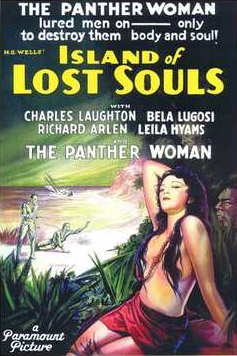
In the 1932 film Island of Lost Souls, Ruth Thomas (Leila Hyams) has reason to be concerned. She’s on the island of Samoa, awaiting the arrival of her fiancée, Edward Parker (Richard Arlen). When Parker’s boat doesn’t show up, it can only mean one thing. He’s been shipwrecked! Did he survive or was he lost at sea?
Well, Ruth need not worry. Parker did survive being shipwrecked. He was picked up by a freighter carrying a wide selection of animals to an isolated island. Unfortunately, when Parker complained about the way that Parker was abusing some of his admittedly odd-looking passengers, the captain responded by dumping Parker on that island as well.
On the island, Parker becomes the guest of Dr. Moreau (Charles Laughton) and his assistant, Montgomery (Arthur Hohl). Parker also meets and finds himself becoming attractive to the seemingly naive Lota (Kathleen Burke). Though Moreau seems to be a good host, Parker grows suspicious of him. It turns out that there’s a room in Moreau’s compound, a room that Lota calls “the house of pain.” At night, Parker can hear horrifying screams coming from the room.
Initially believing the Moreau is torturing the island’s natives, Parker soon discovers an even more disturbing truth. Moreau has been experimenting with trying to transform animals into humans. Lota, it turns out, was once a panther and the woods surrounding the compound are full of other Moreau creations. Though Moreau claims that his intentions are benevolent, he rules his island like a dictator. The animal-men are kept in line by the Sayer of the Law (Bela Lugosi) and any transgressions are punished in the House of Pain…
The Island of Lost Souls was the first cinematic adaptation of H.G. Wells’s The Island of Dr. Moreau. (Perhaps the most famous adaptation came out in 1996 and is the subject of Lost Souls, a fascinating documentary that, I believe, can still be found on Netflix.) I watched it last night on TCM and I have to admit that I had a mixed reaction to it. On the one hand, the film’s atmosphere of mystery and danger is palpable and Charles Laughton’s performance definitely set a standard for all misguided scientists to follow. The human-animals are fantastic creations and the film’s ending still has some power. Bela Lugosi’s performance of the Sayer of the Law was superior to his work as Dracula. (As shown by both this film and Ninotchka, Lugosi was an outstanding character actor.) Kathleen Burke also does a great job as Lota, which makes it all the more interesting that she was apparently cast as a result of winning a contest that was sponsored by Paramount Pictures.
(On a personal note, I always find it amusing that pre-code films always feature at least one scene of an actress removing her stockings, even if the scene itself has next to nothing to do with the rest of the film. In this case, the legs belong to Leila Hyams.)
On the negative side, Richard Arlen is not a particularly interesting hero and, from a contemporary point of view, Island of Lost Souls is a rather slow-moving film. Watching it today requires modern audiences to make a bit of an adjustment to their expectations.
With all that in mind, I still recommend Island of Lost Souls. Watch it for Charles Laughton and Bela Lugosi. Watch it as a valuable piece of cinematic history.
Hi, everyone! I want to take a small break from talking about horror movie and Halloween to tell you about 4 Quarters of Silence, a short documentary film that may not be scary but is definitely very inspiring. It’s a 16-minute film that I was lucky enough to see this weekend and, halfway through the movie, I had tears in my eyes.
And I thought to myself, “Lisa, don’t you dare start crying…”
And I kept watching the movie. And those tears did not go away and by the end of it all, I had given up on not crying. However, those weren’t tears of sadness. 4 Quarters of Silence tells an incredibly inspiring little story, one that earned the tears that I shed.
The film opens with a title card that informs us that there are 1,483 high school football teams in Texas. As a native Texan, I can definitely believe that. However, there is only one football team that is totally made up of deaf players. That team, located in Austin, is the Texas School for the Deaf’s Rangers. 4 Quarters of Silence follows the Rangers as they prepare for and play a game against a high school from San Antonio.
However, the emphasis really isn’t on who wins the game. For the film, if not the coaches and the players, the game is almost a secondary concern. Instead, 4 Quarters of Silence concentrates on the players and their coach, John Moore, as they refuse to allow their disability to keep them from doing something that they love.
John Moore is truly the star of the show, a passionate and inspiring coach who expects as much from his players off the field as on. One of my favorite parts of the film contrasts the bombastic half-time speech of the San Antonio coach with Coach Moore’s equally passionate signed speech in the TSD locker room.
The love that Coach Moore has for both the game and his players is truly inspiring and I’m glad that 4 Quarters of Silence documented it. It’s a truly touching film and one that successfully challenges many of the common assumptions that the hearing are too quick to make about the deaf. Keep an eye out for it!
Bela Lugosi ( see yesterday’s post ) wasn’t the only horror icon who starred in a series of low-budget shockers. Boris Karloff signed a five picture deal with Columbia Pictures that was later dubbed the “Mad Doctor” series and, while several notches above Lugosi’s “Monogram Nine”, they were cookie-cutter flicks intended for the lower half of double feature bills. The first of these was THE MAN THEY COULD NOT HANG, which sets the tone for the films to follow.
Karloff plays Dr. Henry Savaard, inventor of a new surgical technique that requires the patient to die, then reviving him with a mechanical heart after performing the operation. This later became standard operating procedure during open-heart surgery, but back in 1939 was considered science fiction! Anyway, Savaard’s young assistant Bob agrees to go through the experimental procedure, but his girlfriend freaks out and calls the cops, claiming Savaard is about to murder…