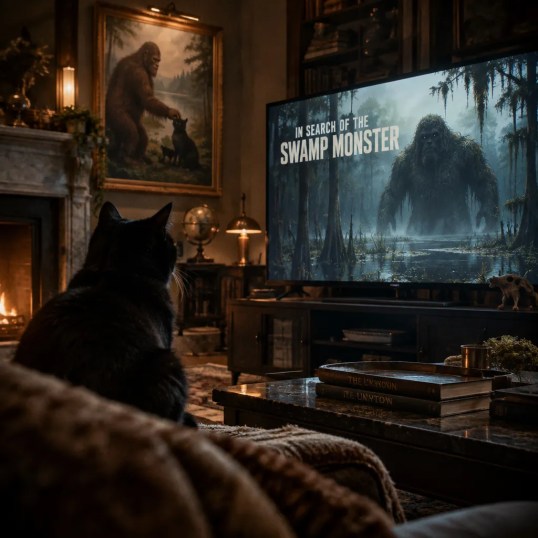
Tonight, on In Search Of…., Leonard Nimoy guides us through an investigation of swamp monsters!
Tonight, on In Search Of…., Leonard Nimoy guides us through an investigation of swamp monsters!
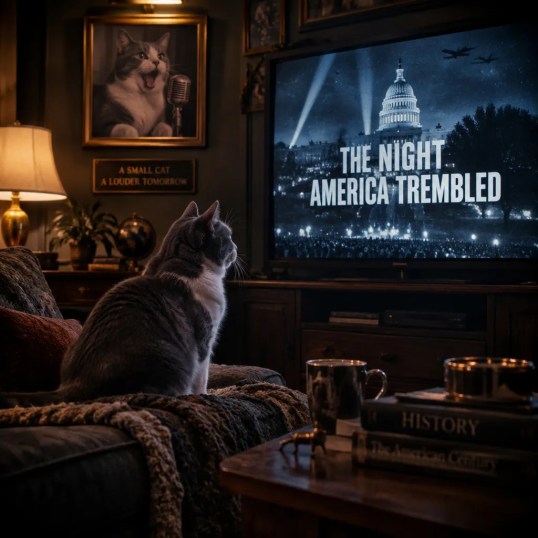
Filmed in 1957 for a television program called Westinghouse Studio One, The Night America Trembled is a dramatization of the night that Orson Welles terrified America with his radio adaptation of War of The Worlds.
For legal reasons, Orson Welles is not portrayed nor is his name mentioned. Instead, the focus is mostly on the people listening to the broadcast and getting the wrong idea. That may sound like a comedy but The Night America Trembled takes itself fairly seriously. Even pompous old Edward R. Murrow shows up to narrate the film, in between taking drags off a cigarette.
Clocking in at a brisk 60 minutes, The Night America Trembled is an interesting recreation of that October 30th. Among the people panicking: a group of people in a bar who, before hearing the broadcast, were debating whether or not Hitler was as crazy as people said he was, a babysitter who goes absolutely crazy with fear, and a group of poker-playing college students. If, like me, you’re a frequent viewer of TCM, you may recognize some of the faces in the large cast: Ed Asner, James Coburn, John Astin, Warren Oates, and Warren Beatty all make early appearances.
It’s an interesting little historical document and you can watch it below!

On October 30th, 1938, Orson Welles and the Mercury Theater On The Air broadcast an adaptation of H.G. Wells’s War of the Worlds and, legend has it, they scared the ever-loving heck out of America.
Actually, there’s some debate as to just how panicked America got when they heard the Mercury Theater On The Air’s adaptation of War of the Worlds. There was definitely some panic but there are differing reports on just how wide spread it was. For our purposes, let’s assume that the entire country was terrified at the same time and that everyone was loading up a shotgun and planning to go out and look for aliens. With his adaptation of War of the Worlds, Orson Welles managed to invent the whole found footage genre that would later come to dominate horror cinema in the late 90s and the aughts. Every found footage horror film owes a debt to what Orson Welles accomplished with War of the Worlds. Ultimately, it’s just another example of how far ahead of his time Orson Welles was.
H.G. Wells, the original author of War of the Worlds, and Orson Welles only met once, while they were both in San Antonio, Texas in 1940. (Orson Welles and H.G. Wells hanging out in San Antonio? To be honest, that sounds like it would make a good movie.) They were interviewed for a local radio station. H.G. Wells expressed some skepticism about the reports of Americans panicking while Welles compared the radio broadcast to someone dressing up like a ghost and shouting “Boo!” during Halloween. Both Wells and Welles then encouraged Americans to worry less about Martians and more about the growing threat of Hitler and the war in Europe.
I’ve shared this before but this just seems like the time to share it again. Here, for Halloween Eve, is the 1938 Mercury Theater On The Air production of The War of the Worlds!
Welcome to Retro Television Reviews, a feature where we review some of our favorite and least favorite shows of the past! On Fridays, I will be reviewing St. Elsewhere, a medical show which ran on NBC from 1982 to 1988. The show can be found on Daily Motion.
In this special two-part episode, 50 years of St. Elsewhere are documented in just two hours.
Episodes 4.17 and 4.18 “Time Heals”
(Dir by Mark Tinker, originally aired on February 19th and February 20th, 1986)
Aired over two nights, “Time Heals” uses St. Eligius’s 50th anniversary to give us 50 years of history. While the staff prepares to observe half a century of serving Boston, the episode skips back and forth in time.
In 1935, a young and enthusiastic priest named Joseph McCabe (Edward Herrmann) prepares for the opening of a hospital that he hopes will serve the downtrodden and forgotten of Boston. Monsignor Senti (Norman Burton) views McCabe as a troublemaker. Meanwhile, a young Donald Westphall watches as his father helps bring a wounded man named Patrick O’Casey (William Russ) to the hospital. Later, Westphall’s sister and mother are killed in a house fire.
In 1945, a young liver specialist named Daniel Auschlander (James Stephens) is brought on staff and meets an angry teenage Donald Westphall (Michael Sharrett). Donald shines shoes in the hospital lobby. When Donald is caught stealing, Father McCabe takes him to the hospital’s gym and gives him a boxing lesson. As for Auschlander, he allows a returning serviceman named Patrick O’Casey to see his young daughter, who is suffering from polio and has been placed in an isolation ward.
In 1955, the Archdiocese sells the hospital to the city and Father McCabe is fired. McCabe gets drunk. Auschlander says that he intends to resign in protest. McCabe replies that that would be a mistake—Auschlander is the man McCabe has recommended as his replacement. Meanwhile, Patrick O’Casey’s daughter dies after spending ten years in an iron lung, and a cocky intern named Mark Craig (William Daniels, sans mustache) has a panic attack while performing his first operation. The demanding Dr. David Domedion (Jackie Cooper) orders Craig back into the operating room. Later, Craig tells another resident, Donald Westphall (Ed Flanders, his hair dyed black but still looking quite middle-aged), that he’s been offered a position at Boston General and will never return to St. Eligius.
In 1965, Dr. Craig returns to St. Eligius, bitter that he was passed over for chief of surgery at Boston General. While a young Luther Hawkins sits in the waiting room, a newly arrived nurse named Helen Eisenberg helps Dr. Westphall deal with Terence O’Casey (Brian Kerwin), a young man having a bad acid trip. “Get a haircut, hippie,” Dr. Craig says at one point.
In 1975, Terence O’Casey is back in the hospital, waiting as Dr. Craig performs open-heart surgery on his father, Patrick. Donald Westphall is appointed hospital administrator. The same night, his wife, Maureen (Anita Gillette), is in an auto accident that leaves her brain-dead. Westphall is the one who has to decide to remove her breathing tube and allow her to pass on.
In 1985, high school principal Terence O’Casey is brought to the hospital with sudden paralysis. His doctor, Jack Morrison, struggles to diagnose Terence’s condition until he goes down to the basement, looks through the earliest hospital records, and reads about Terence’s sister, who died in an iron lung. Jack diagnoses Terence with Guillain-Barré syndrome, a paralyzing condition that can resemble polio.
Meanwhile, Jack’s son, Pete, is apparently abducted by a man at the hospital. I say “apparently” because the plotline feels a bit underdeveloped. The episode ends with the police returning Pete to Jack during St. Eligius’s anniversary party. Pete seems to be physically unharmed, and we’re not really given any details as to who abducted him or how the police tracked him down.
The subplot featuring Morrison’s son being abducted is oddly undeveloped, but that’s really the only flaw to be found in “Time Heals.” This is not only a great episode of St. Elsewhere; it’s also one of the greatest episodes of television I’ve ever seen. That said, it isn’t just a great episode of television. It’s a great work of art, period, from the excellent performances to the way the episode seamlessly mixes the flashbacks so that they come together to tell one epic story of the 20th century. Featuring both the story of the hospital and the story of the O’Caseys, “Time Heals” is a portrait of how times change and how they remain the same.
A few random notes:
For those who think Dr. Craig is too hard on his residents, this episode shows that Craig’s mentor was equally hard on him, and that it helped turn Craig into the surgeon he is today. That said, it’s also amusing to see that young Mark Craig was just as obnoxious as Victor Ehrlich.
I’ve often complained about how depressed Westphall always seems to be. This episode shows that Westphall has a lot of reasons to be depressed. The man’s life has been one tragedy after another.
One cannot overlook the importance of the O’Caseys to this episode’s power. The O’Caseys represent the community St. Eligius is meant to serve. The hospital is part of the family’s life. History repeats itself throughout the O’Casey storyline. In 1935, Patrick O’Casey is injured and nearly killed in a fight. By 1945, he’s married and a member of the U.S. Army. In 1965, Patrick’s son, Terence, is a drug-abusing member of the counterculture. By 1985, he’s a conservative high school principal who has an estranged relationship with his gay son, Kevin (John Scott Clough). All of the male O’Caseys have more in common than they realize.
Each decade is shot in a different visual style, which helps us keep track of things. The 1935 scenes are shot in black and white. The 1945 scenes feature muted colors. As we move through time, the colors become clearer and more vibrant until we finally find ourselves in 1985.
“Time Heals” is touching, powerful, and even funny. It’s a true work of art.
The dead are coming back to life! When her brother, Johnny (Bill Moseley), is killed by a zombie at the cemetery, Barbara (Patricia Tallman) flees and makes her way to an isolated farmhouse. It’s there that she’s joined by Ben (Tony Todd), a traveling salesman who is also fleeing from the zombies. Also hiding out at the farmhouse are young lovers Tom (William Butler) and Judy (Katie Finneran) and Harry (Tom Towles), his wife (McKee Anderson), and daughter (Heather Mazur). While the living dead lay siege to the house, Ben and Harry argue over whether it would be better to hide in the basement or to stay upstairs. Even in the face of an unimaginable crisis, the living just can’t stop bickering.
If the plot sounds familiar, it should. Unfortunately, this is not George Romero’s original Night of the Living Dead. This is a remake that came out in 1990. Apparently, when the original film was made, Romero forgot to include a copyright notice on the film and that, combined with a long court battle over the film’s profits, meant that he made next to no money off of its subsequent popularity. (In Romero’s defense, no one originally suspected that his low-budget zombie movie would go on to become a cultural phenomenon.) In the late 80s, when Romero heard that Menahem Golan was considering doing a remake, Romero contacted him and signed on to write the script and serve as an executive producer. Romero’s plan was to establish his copyright over the material while heading off a potentially terrible remake. And, of course, Romero hoped to finally make some money off of the whole thing. Tom Savini was originally brought in to do the special effects but Romero subsequently persuaded him to direct the film. Savini later said that directing the film was a nightmare. While Romero was supportive of Savini’s ideas for the film, the other producers were not and Savini estimated that only 40% of the film was his vision. Once filming was finished, Savini was contractually obligated to cut some of the film’s most gory moments to get an R rating.
Unfortunately, the remake doesn’t really work. Shooting the film in color robs the film of the harsh atmosphere and the almost documentary-style realism that made the first film such a nightmare-inducing success. What was once subtext is made explicit by the film’s script. As opposed to ending with a series of increasingly grainy still shots that bring to mind the records of real-life war atrocities, this film features Barbara watching a trigger-happy posse and literally saying that the living are just like the dead.
The biggest update is that Barbara no longer spends the entire movie in a state of shock. Instead, she grabs a rifle and turns out to be the best shot in the movie. Of course, after spending 90 minutes watching her shoot zombies in the head, it’s a bit hard to take seriously the idea that she would be offended by the sight of the posse. The remake tries to make Barbara a stronger character but then they cast someone who gave an absolutely terrible, one-note performance in the role, which kind of negates the whole thing. In the original film, Ben shoots Harry and it’s a sad moment because it shows that people cannot work together. In the remake, Barbara shoots Ben and we’re supposed to cheer because it’s a 90s film. Beyond that, though, one of the reasons why the first Night of the Living Dead was so effective is because Barbara had the reaction that we all secretly suspect we would have. I may not be happy to admit it but if the dead did come back to life, I’d probably be catatonic as well. Most people would. Not everyone is going to turn into an action hero whenever a crisis breaks out. I would be totally worthless in the face of a zombie apocalypse and so would you. The original Night of the Living Dead had the courage to admit that. The remake does not and that’s why the remake is ultimately just another zombie film.
(Of course, one could argue that by taking the original and spelling out its subtext and making Barbra into a stereotype, this film actually predicted everything from American Horror Story to Mike Flanagan’s Carrie.)
When it comes to the Dead, stick with the Romero originals.
In general, I’m not really a huge fan of science fiction. A lot of that is because I tend to get bored with the huge mythologies that come along with most science fiction franchises. I don’t care who the best Star Trek captain is. Some of the Star Wars films were enjoyable, but I roll my eyes whenever I meet people who are pedantic about referring to the first movie as A New Hope. My dislike of Avatar is well-known, though it’s actually softened a bit now that everyone else seems to dislike it as well. (I find much of the current dislike to be performative, whereas mine was sincere. I disliked Avatar before it became cool to do so.) Most of the science fiction films that I have enjoyed have either poked fun at the genre (like the Guardians of the Galaxy films), were directed by Ridley Scott (Alien, Blade Runner), have featured giant monsters that were created by radiation, or are Italian (like Starcrash).
That said, I absolutely love Forbidden Planet.
First released in 1956, Forbidden Planet stars a young, handsome, and stalwart Leslie Nielsen as John J. Adams, the commander of the starship C-57D. Adams and his crew are on a mission to investigate what happened to an expedition to the planet Altair IV. As C-57D approaches the planet, they get a message warning them not to land on the planet for safety reasons. Adams ignores the message. When the ship—which rather charmingly is made up to look like a classic flying saucer—lands, Adams and his crew are met by a robot named Robby who takes them to meet his creator, Dr. Edward Morbius (Walter Pidgeon). Morbius explains that he and his daughter Altaira (Anne Francis) are the only survivors of the expedition and that there is an unseen force on the planet that attacks anyone who lands on the surface… anyone other than Morbius and his daughter. Morbius politely suggests that Adams should go back to Earth. Adams says that he can’t do anything until he gets orders…
Despite all of the grim talk about an unseen presence, Forbidden Planet actually starts off as being almost a comedy. With the exception of Commander Adams, Doc (Warren Stevens), and Lt. Jerry Farman (Jack Kelly), the C-57D seems to be exclusively manned by goofy guys who can’t get over the fact that there’s a woman on the planet. (Adams mentions that the crew has been in space for nearly two years.) The Cook (Earl Holliman) wants some alcohol and Robby the Robot knows just how to make it. Fortunately, Leslie Nielsen didn’t have his trademark white hair when he appeared in this film. Otherwise, I don’t know if I’d be able to handle his deadpan, dramatic delivery.
Things change when the unseen attack turns out to be real and starts attacking the ship. A lot of those likably goofy characters end up dying. And when Adams discovers what is truly the source of the monster… well, let’s just say that I imagine the subtext was missed by a lot of the kids who probably made up the film’s initial audience. There’s no silliness to be found in the film’s final moments, with the monster burning away a door that was supposed to be impenetrable and Morbius finally confronting the truth of what really happened to the expedition.
I can’t really remember how old I was when I first saw Forbidden Planet. It came on television one October night and I watched it with my Dad. I thought Robby the Robot was adorable, but what truly stuck with me was the scene where the monster walks into an electrified force field and is suddenly visible.
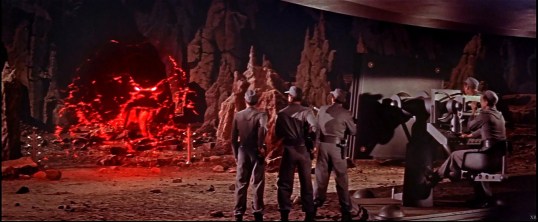
The way the monster roars and swats at the crew of the ship has always stuck with me. And once we discover the true origins of the monster, the scenes take on an entirely new meaning.
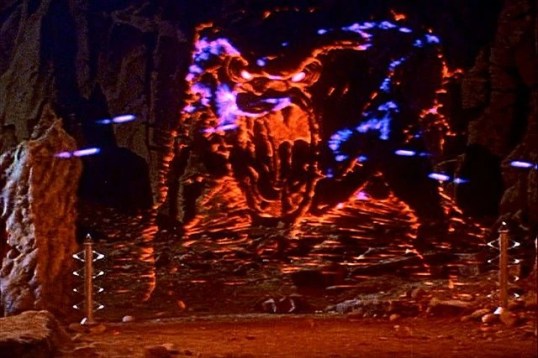
(The monster is so terrifying that even Robby the Robot shuts down rather than face it. It’s an underrated moment of fright. If even Robby can’t battle the monster, what hope is there for anyone else on the planet?)
Leslie Nielsen is likable but a little boring as the male lead. Anne Francis overacts a bit as Altaira. It doesn’t matter. Walter Pidgeon’s intense performance is the one that you remember. Forbidden Planet is an intelligent and thought-provoking film, one that holds up even today. I may not like science fiction, but I will watch it every October.

The 1974 film Silent Night, Bloody Night is an oddity.
On the one hand, it’s pretty much a standard slasher film, complete with a menacing mansion, a horrible secret, a twist ending, and John Carradine playing a mute newspaper editor.
On the other hand, director Ted Gershuny directs like he’s making an underground art film and several of the supporting roles are played by actors who were best known for their association with Andy Warhol.
Personally, I like Silent Night, Bloody Night. It has a terrible reputation and the film’s star, Mary Woronov, has gone on record calling it a “terrible movie” but I like the surreal touches the Gershuny brought to the material and the sepia-toned flashbacks have a nightmarish intensity to them. The film makes no logical sense, which actually makes it all the more appealing to me. As the saying goes, your mileage may vary.
Watch and decide for yourself!
 With only one day left until Halloween, I wanted to make sure that I continued an important tradition here at the Shattered Lens by sharing this film with our faithful and wonderful readers. Messiah of Evil was first released in 1973 and, since it’s in the public domain, it has since been included in a countless number of bargain box sets from Mill Creek.
I can still remember the first time that I saw Messiah of Evil. It was on a Monday night, many years ago. I had recently picked up a 10-movie DVD box set called Tales of Terror and I was using the movies inside to try to deal with a bout of insomnia. I had already watched The Hatchet Murders (a.k,a. Deep Red) and The House At The Edge of the Park and, at two in the morning, I was faced with a decision. Should I try to sleep or should I watch one more movie?
Naturally, I chose to watch one more movie and the movie I chose was Messiah of Evil. So, there I was at two in the morning, sitting at the edge of my bed in my underwear and watching an obscure horror movie while rain fell outside.
And, seriously — this movie totally FREAKED me out!
Messiah of Evil tells the story of Arletty (Marianna Hill), a neurotic woman who drives to an isolated California town in order to visit her father. Her father is an artist who specializes in painting eerie pictures of large groups of black-clad people. However, once she arrives at his home, Arletty discovers that her father has vanished and left behind a diary where he claims that a darkness has overtaken the town.
Meanwhile, a mysterious man named Thom (Michael Greer) is wandering about town with two groupies (played by Anita Ford and Joy Bang) and interviewing random townspeople. One crazed man (Elisha Cook, Jr.) explains that “the dark stranger” is returning. After meeting Arletty, they all end up moving into her father’s house.
But that’s not all. There’s also an odd albino man who shows up driving truck and who eats mice….
Messiah of Evil is literally one of the strangest films that I’ve ever seen. It’s shot in a dream-like fashion and the much of the film is left open to the viewer’s interpretation. There are two classic scenes — one that takes place in a super market and one that takes place in a movie theater and the movie’s worth watching for these two scenes alone.
Messiah of Evil is a film that will be appreciated by all lovers of surrealism and intelligent horror and I’m happy to share it with you today.
As some of our regular readers undoubtedly know, I am involved in a few weekly watch parties. On Twitter, I host #FridayNightFlix every Friday and I co-host #ScarySocial on Saturday. On Mastodon, I am one of the five hosts of #MondayActionMovie! Every week, we get together. We watch a movie. We tweet our way through it.
Tonight, at 10 pm et, I will be hosting #FridayNightFlix! Join us for Mario Bava’s Black Sabbath!
If you want to join us this Friday, just hop onto twitter, find Black Sabbath on Prime, start the movie at 10 pm et, and use the #FridayNightFlix hashtag! I’ll be there happily tweeting. It’s a friendly group and welcoming of newcomers so don’t be shy.
See you there!
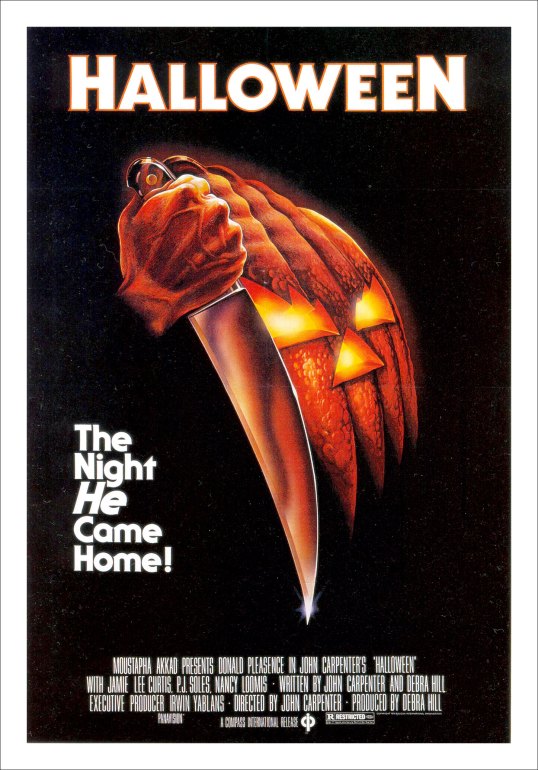
Today’s song of the day probably seems like an obvious choice. That’s okay, though. Thanks to John Carpenter, this sweet little song about teen love became an anthem of impending horror. None of the Chordettes are with us anymore. I would love to know what they may or may not have thought about Carpenter’s use of their song in Halloween.
I’d like to think they would have appreciated it. Michael Myers may not have had hair like Liberace but he did have a mask that looked a lot like William Shatner.
Mr. Sandman, bring me a dream (bom, bom, bom, bom)
Make him the cutest that I’ve ever seen (bom, bom, bom, bom)
Give him two lips like roses and clover (bom, bom, bom, bom)
Then tell him that his lonesome nights are over
Sandman, I’m so alone (bom, bom, bom, bom)
Don’t have nobody to call my own (bom, bom, bom, bom)
Please turn on your magic beam
Mr. Sandman, bring me a dream
Mr. Sandman, bring me a dream
Make him the cutest that I’ve ever seen
Give him the word that I’m not a rover
Then tell him that his lonesome nights are over
Sandman, I’m so alone
Don’t have nobody to call my own
Please turn on your magic beam (woah)
Mr. Sandman, bring me a dream
Mr. Sandman (yes?) bring us a dream
Give him a pair of eyes with a “come-hither” gleam
Give him a lonely heart like Pagliacci
And lots of wavy hair like Liberace
Mr. Sandman, someone to hold (someone to hold)
Would be so peachy before we’re too old
So please turn on your magic beam
Mr. Sandman, bring us
Please, please, please, Mr. Sandman
Bring us a dream
Songwriters: Clifford Smith / Robert F. Diggs / Jason S. Hunter

