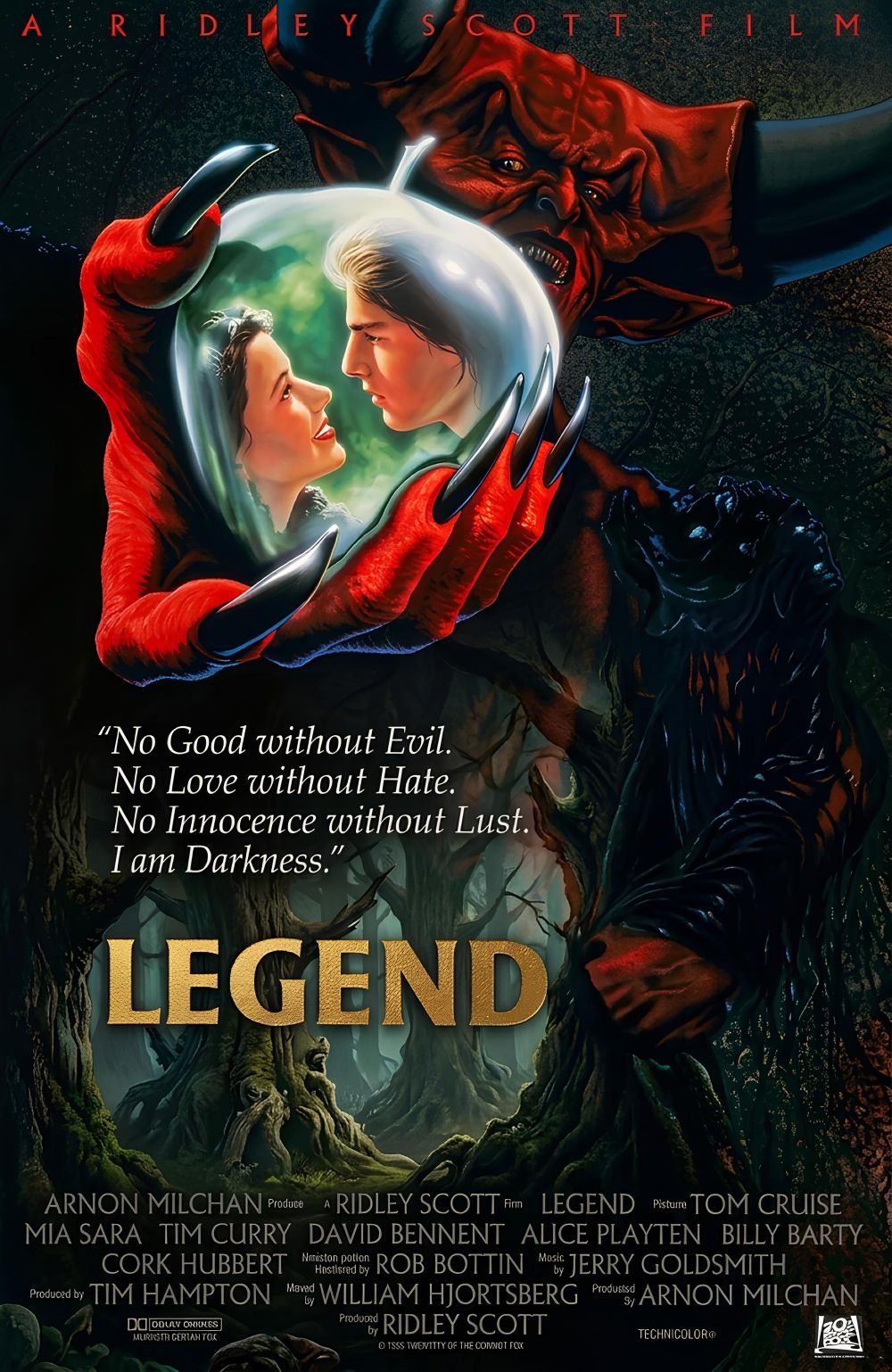
“What is light without dark? What are you without me? I am a part of you all. You can never defeat me. We are brothers eternal!” — Darkness
Legend is one of those films that feels like it should be a masterpiece even before it begins. It has Ridley Scott behind the camera, an extravagant fantasy premise, elaborate practical effects, striking production design, and a cast that includes a young Tom Cruise, Mia Sara, and Tim Curry. Released in 1985, the film arrived as a dark fantasy event that had been heavily anticipated, especially because Scott had already earned a reputation for visually stunning films. Alien and Blade Runner had established him as a director who could make entire worlds feel tactile, mysterious, and overwhelming. The idea of Scott applying that sensibility to unicorns, goblins, forest sprites, demonic lords, and fairy-tale mythology was exciting on paper. Unfortunately, while Legend is often gorgeous to look at, it becomes an uneven mess that is only saved from becoming a major disappointment by Tim Curry’s performance as Darkness.
The setup is familiar enough to sound almost deliberately archetypal. In a magical forest, Jack, played by Cruise, is a woodland boy who lives in harmony with nature and has fallen in love with the innocent Princess Lili, played by Sara. The world’s balance is tied to a pair of unicorns, embodiments of purity and light. Darkness, a devil-like ruler who wishes to plunge the world into permanent night, sends his goblin servants to kill the unicorns and take one of their horns. Lili’s fascination with the unicorns sets the tragedy in motion, and once one of the creatures is slain, winter and darkness descend upon the land. Jack must rescue Lili, restore the horn, defeat Darkness, and return light to the world.
There is nothing inherently wrong with a simple fairy-tale plot. In fact, Scott’s strongest instinct in Legend is treating fantasy with a sense of visual seriousness. The forest does not look like a clean studio set built for children; it looks damp, overgrown, foggy, and vaguely dangerous. The trees loom like ancient creatures, shafts of light break through the branches in painterly bursts, and even the beautiful areas of the film carry an eerie quality. Scott and cinematographer Alex Thomson create images that often resemble illustrated storybooks poisoned by a nightmare. The film’s environments are its greatest achievement. Whether it is the glowing forest, the icy wasteland after the unicorn’s death, or Darkness’ fire-lit underworld, Legend makes a serious effort to create a fully realized fantasy space rather than simply dressing actors in costumes and placing them in generic medieval scenery.
That visual commitment is why the film remains so fascinating despite its flaws. You can pause almost anywhere and find something worth admiring: a strange creature in the background, smoke drifting through a cavern, an enormous set textured with roots and stone, or a costume that looks handmade rather than mass-produced. Scott’s eye for atmosphere is undeniable. The film has an unusual physicality, too. Its magic is created through prosthetics, makeup, puppetry, matte work, and elaborate sets, so even when some effects have aged, they retain a handmade charm. Modern fantasy often has the advantage of digital flexibility, but Legend has the kind of tactile design that makes its world feel like it has dirt under its fingernails.
Still, visual beauty cannot completely compensate for a story that never finds a consistent rhythm. Legend often feels less like a fully developed narrative than a collection of spectacular images and half-formed fairy-tale ideas. Characters appear with little introduction, emotional shifts happen abruptly, and major story developments can feel rushed or strangely underexplained. The theatrical cut in particular carries the sense that important connective material has been removed. There are moments when the movie seems to expect emotional investment simply because the images are grand or the music swells, but the script has not done enough to earn that reaction.
Jack is also an unusually bland hero for a film that needs a strong center. Cruise was still early in his career, and there are flashes of the screen presence that would soon make him a major star. He is physically committed and looks believable racing through forests, climbing ruins, and confronting danger. But Jack is written as a generic pure-hearted fantasy protagonist, and Cruise never gets enough material to make him feel specific. He is brave because the story says he is brave, romantic because the story says he loves Lili, and destined to save the world because that is what these stories require. He does not have much inner conflict beyond the expected guilt and determination.
Lili is similarly underwritten, although Mia Sara does bring a dreamy, otherworldly quality to the role. The film wants her to embody innocence, temptation, and romantic idealism, but it does not give her much agency until she becomes corrupted by Darkness’ influence. Her transformation into a dark bride is visually memorable, especially in the elaborate black gown and makeup, but it also highlights the film’s habit of prioritizing imagery over character. The sequence is beautiful, eerie, and loaded with gothic fantasy appeal, yet Lili’s emotional journey into that role feels more decorative than dramatically convincing.
The supporting characters are more colorful but not always more useful. The dwarfs, elves, and forest companions give the story occasional energy, particularly the sarcastic fairy Oona and the armored dwarf Gump. Yet their presence can make the film feel tonally scattered. Sometimes Legend wants to be haunting and mythic; sometimes it wants broad comic relief; sometimes it drifts toward romantic melodrama. Those modes do not always blend. The result is a movie that can move from an ominous demonic ritual to a goofy side-character exchange without establishing a stable tone.
Then there is Tim Curry, who walks into the movie and immediately makes every other problem less important. His Darkness is one of the most iconic fantasy villains ever put on screen, and it is not difficult to understand why. The makeup design alone is astounding: massive horns, red skin, cloven hooves, muscular proportions, and a towering silhouette that makes him look like a medieval illustration of Satan brought to life. But the design would be nothing without Curry’s performance. He does not merely hide beneath the prosthetics; he gives Darkness a voice, posture, and seductive intelligence.
Curry plays Darkness as both monstrous and theatrical. His deep, measured delivery turns lines about night, desire, and evil into something genuinely alluring. He understands that the character should not simply roar or sneer. Darkness is persuasive. He offers Lili beauty, power, and escape from innocence, which makes him more interesting than a villain who only threatens destruction. His scenes with Sara have a strange, almost operatic energy, mixing horror, seduction, and camp in a way that fits the film’s most ambitious visual impulses. Curry makes Darkness feel ancient, vain, cruel, romantic, and weirdly funny all at once. He gives Legend its pulse.
The famous confrontation between Jack and Darkness should be the film’s crowning achievement, and visually it almost is. Darkness’ lair, lit by flames and surrounded by infernal architecture, gives Scott room to indulge his talent for monumental images. Curry’s villain towers over Cruise, making the hero look small and vulnerable. Yet even here, the fight is more memorable for its atmosphere than its dramatic construction. It is a good example of the whole film: rich in aesthetic invention, less persuasive as storytelling.
The music also reflects the movie’s fractured identity. Different versions of Legend are associated with different scores, most notably the Jerry Goldsmith score and the Tangerine Dream soundtrack used in the American theatrical release. The Goldsmith material feels more classically mythic and orchestral, while Tangerine Dream’s electronic music gives the film a distinctly 1980s dream-pop atmosphere. Both have their supporters, and both alter the experience considerably. That split feels appropriate for a movie that has always existed in multiple forms and competing moods. Legend is never quite one thing.
In the end, Legend is a flawed cult fantasy rather than a lost masterpiece. Its reputation rests largely on its imagery, its practical craftsmanship, and Curry’s towering performance, not on the strength of its plot or its emotional depth. Ridley Scott clearly wanted to make a dark fairy tale that felt ancient and sensual, but the finished film too often gets trapped between mythic grandeur, children’s fantasy, gothic romance, and broad adventure comedy. It is an uneven mess, but it is a beautiful one. And every time Tim Curry’s Darkness enters the frame, Legend briefly becomes the extraordinary film it was always trying to be.


A fantastic film. Rip Tim Curry x
LikeLike
Curry’s role was the highlight of this movie – I also liked her black dress.
LikeLike
yeah, Lili in her goth princess look was appealing.
LikeLike
Pingback: Lisa Marie’s Week In Review: 8/24/26 — 8/30/26 | Through the Shattered Lens