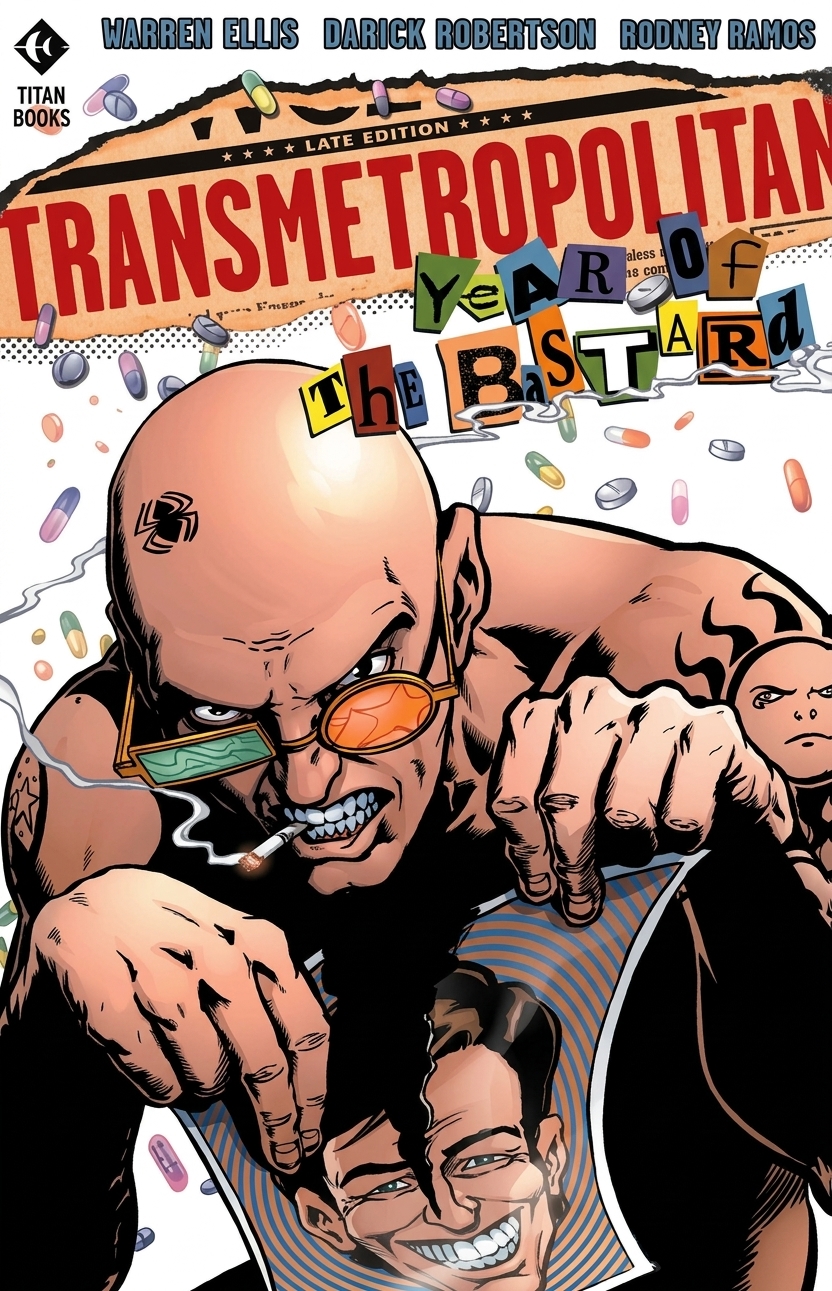
“Journalism is just a gun. It’s only got one bullet in it, but if you aim right, that’s all you need. Aim it right, and you can blow a kneecap off the world.” — Spider Jerusalem
Transmetropolitan Vol. 3: Year of the Bastard is where Warren Ellis and Darick Robertson’s series fully locks into its political purpose. The earlier volumes establish the wild, filthy, hilarious, and relentlessly overstimulating future world of the City, while also introducing Spider Jerusalem as one of comics’ most aggressive and unconventional protagonists. This third collection gives that chaos a more direct target. Spider’s reporting increasingly centers on President Gary Callahan, known as “the Beast,” and the book becomes a sharper examination of political corruption, media manipulation, public apathy, and the ugly necessity of speaking truth to power.
Spider remains the main reason Transmetropolitan works as well as it does. He is not a conventionally likable hero, and the series has no interest in sanding down his worst edges. Spider is arrogant, filthy, confrontational, casually cruel, and frequently unbearable to everyone around him. He insults his assistants, attacks people with little warning, abuses his position as an employer, and seems to approach most conversations as though they are a competition he needs to win. His anger is not performative, though. Spider is furious because he sees how the City works, how easily people are exploited, and how often institutions that are meant to serve the public instead exist to preserve wealth, influence, and power.
That is what separates Spider from a standard rebellious antihero. He does not simply dislike authority because it tells him what to do. He hates authority when it becomes insulated from consequence. His journalism is not neutral in the shallow sense of pretending that every side of an issue deserves equal moral consideration. Spider believes that facts matter, that evidence matters, and that powerful people deserve aggressive scrutiny. He wants documents, interviews, proof, and a story solid enough to survive legal threats and political spin. But he also wants that story to make its target feel exposed. For Spider, journalism is both a public service and an act of combat.
Year of the Bastard makes that approach feel especially urgent through the arrival of Gary Callahan. The Beast is an amalgamation of all the worst traits associated with the fictional politician: narcissistic, shameless, opportunistic, cruel, dishonest, charismatic when it suits him, and utterly willing to use ordinary people as tools in his pursuit of power. He is the kind of leader who can speak in a language of public service while treating the public as disposable, who can turn fear into political currency, and who can rely on supporters to dismiss his most obvious sins as either necessary strength or a conspiracy against him.
Callahan is exaggerated in the way that much of Transmetropolitan is exaggerated, but that does not make him feel safely distant from reality. The series filters him through dystopian satire, giving him the monstrous nickname, the heightened rhetoric, and the almost grotesque confidence of a villain who believes consequences are for other people. Yet the deeper qualities behind him are painfully familiar. He thrives on division, contempt for truth, resentment, spectacle, and the belief that accountability is something to be attacked rather than accepted. In recent memory, that has only made the Beast feel more unsettling. Political figures with traits that once seemed too bluntly villainous for anything but fiction have repeatedly demonstrated how easily cruelty can be reframed as authenticity, dishonesty as strategy, and public anger as a route to power. The book’s details are futuristic and extreme, but its political instincts feel less like prediction than recognition.
Spider recognizes Callahan for what he is long before the system is ready to confront him. That is where the volume’s central conflict becomes stronger than a simple “reporter versus corrupt president” story. Spider is not just investigating a bad man; he is fighting the machinery that allows bad men to flourish. The City’s citizens are overwhelmed by media noise, consumer distractions, social trends, technological novelty, and the endless stream of minor scandals competing for their attention. In such an environment, truth can be buried not only by censorship but by excess. A revelation does not have to be disproven if it can simply be drowned beneath louder, stupider, more entertaining material.
The City continues to be one of the series’ best creations because it is more than a colorful science-fiction backdrop. It is a civilization that has commodified every aspect of life. Identity can be altered, sold, copied, upgraded, discarded, and turned into another lifestyle product. Entertainment is invasive and often grotesque. Technology has expanded human possibility without necessarily expanding human empathy. Politics has become entertainment as well, reduced to personality contests, public outrage, tribal loyalties, and marketable images. The City is often funny in a deliberately ridiculous way, but the humor always has a sour edge. Its people are not simply stupid targets for Spider’s contempt. They are citizens living under a system designed to exhaust their attention and turn their frustration into something profitable.
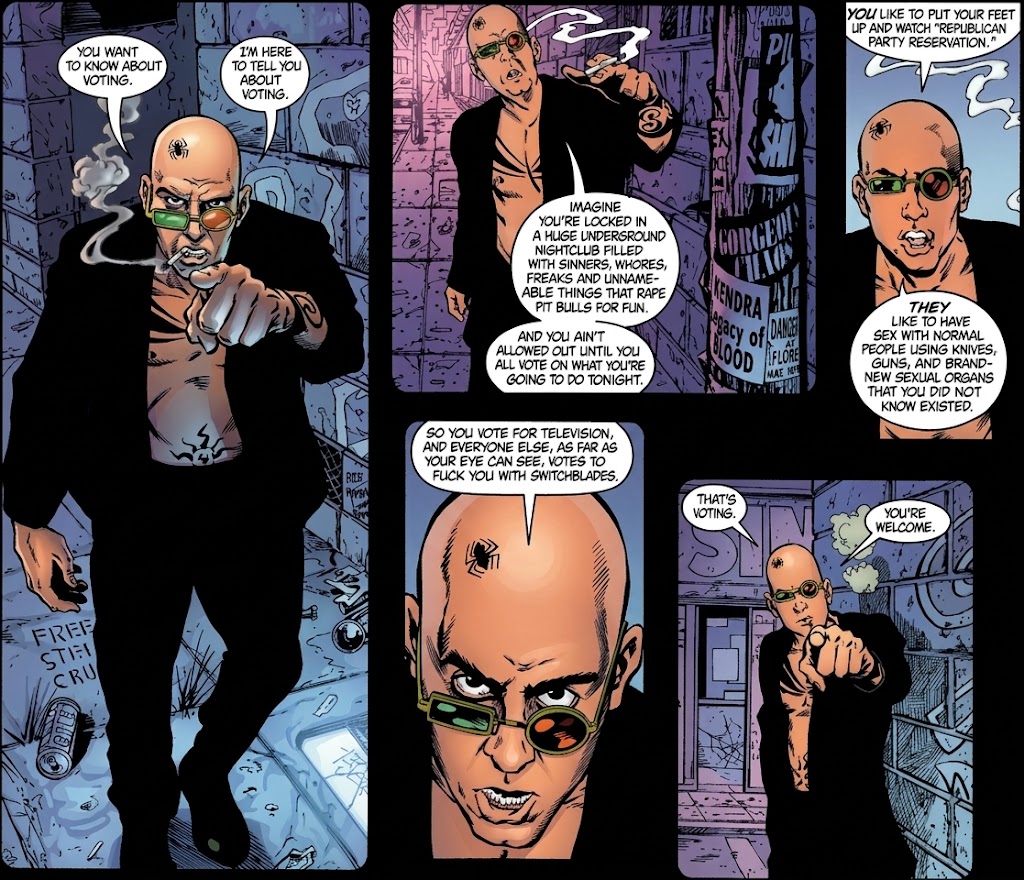
That context complicates Spider’s relationship to the public. He clearly cares about people, especially the people who are harmed by the City’s power structures, but he also finds people maddening. Spider’s rage at ignorance, conformity, and complacency can make him seem almost as contemptuous of the public as the politicians he despises. The difference is that Spider’s contempt is not rooted in a desire to dominate them. He wants them to wake up, pay attention, and demand better, even when he expresses that desire through insults, threats, and spectacularly unhealthy behavior. His empathy is real, but it is buried beneath layers of cynicism and hostility.
That is why Channon Yarrow and Yelena Rossini remain so important to the book. They keep Spider from becoming a purely self-contained force of rage. Channon often brings a more immediate human response to the stories they cover. She can be tough and sarcastic, but she has not completely absorbed Spider’s defensive habit of treating emotional vulnerability as weakness. Her presence highlights the people behind the headlines, which is essential in a series where the main character can sometimes become so consumed by the larger fight that he risks forgetting the individual lives at stake.
Yelena offers a different kind of balance. As Spider’s editor, she understands the importance of his work, but she also has to deal with the consequences of his methods. She recognizes his talent and his instincts, while refusing to indulge every destructive impulse as if it were a sign of genius. Their relationship is built on tension, professional respect, and mutual exasperation. Yelena knows that Spider can find the story nobody else wants to touch, but she also knows that his self-destructive behavior can jeopardize the very work he believes in. She is one of the few people capable of treating him as both an indispensable journalist and a deeply difficult human being.
The visual side of Year of the Bastard remains a major strength. Darick Robertson makes the City feel constantly alive, crowded, unpleasant, and funny in equal measure. Every street scene suggests a thousand strange subcultures, consumer products, body modifications, and private disasters unfolding at once. Robertson’s detail is not merely there to make the book look weird. It reinforces the idea that this is a society drowning in visual information. The City is so busy that horror can pass as background decoration, and the reader has to look closely to notice what its inhabitants have learned to ignore.
Robertson’s Spider is equally effective. The sunglasses, tattoos, bald head, cigarettes, and permanent scowl make him immediately recognizable, but the art also captures how tired he is. Spider does not look like a sleek futuristic revolutionary. He looks worn down, unhealthy, and held together by stimulants, spite, and a professional obligation he cannot escape. That physical exhaustion matters because it keeps him from becoming an invulnerable fantasy figure. For all his bravado, Spider is a man who is being consumed by the same world he is trying to expose.
The volume still carries the abrasive humor and deliberately offensive energy that define Transmetropolitan, and that will remain a dividing line for readers. Ellis often pushes jokes, imagery, and dialogue to extremes. Sometimes that excess adds to the punk-rock force of the series, making the City feel like a place where every cultural impulse has been turned up beyond the point of sanity. At other times, the shock-heavy approach can feel like it is fighting for attention with the book’s more serious political and emotional material. Even so, Year of the Bastard benefits from its willingness to be ugly. A story about corruption, exploitation, and media spectacle would lose something if it presented its world too cleanly.
Ultimately, Transmetropolitan Vol. 3: Year of the Bastard is a strong escalation of the series because it gives Spider Jerusalem a political enemy worthy of his fury. The Beast represents the worst kind of public figure: someone who turns cruelty into strength, dishonesty into strategy, and division into a campaign platform. Spider, for all his cruelty and instability, becomes compelling because he refuses to accept that kind of power as normal. He may be an awful boss, a reckless friend, and a man whose personal life is largely a disaster, but he understands that journalism has to do more than politely record the world’s failures. Sometimes it has to expose the bastards responsible for them.
Transmetropolitan Volume Reviews


Pingback: Lisa Marie’s Week In Review: 8/31/26 — 9/6/26 | Through the Shattered Lens