Today is Spike Lee’s birthday so today’s scene that I love is the rather random ending of Lee’s 1991 film, Jungle Fever. I’ve seen this referred to as being the best worst ending of a movie and I don’t now if I’d go quite that far but it’s definitely in contention.
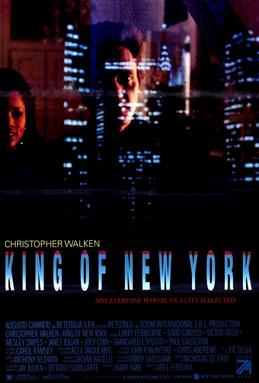
Drug kingpin Frank White (Christopher Walken) has been released from prison and is again on the streets of New York City. Frank might say that he’s gone straight but, as soon as he’s free, he’s partying with his old crew (including Laurene Fishburne, Steve Buscemi, Giancarlo Esposito, and others). While Frank’s agent (Paul Calderon) goes to all of the other city’s gangsters and explains that they can either get out of Frank’s way or die, three detectives (Victor Argo, David Caruso, and Wesley Snipes) make plans to take Frank out by any means necessary. Meanwhile, Frank is donating money to politicians, building hospitals, and presenting himself as New York’s savior.
KingofNewYork is the epitome of a cult film. Directed by Abel Ferrara, the dark and violent King of New York was originally dismissed by critics and struggled to find an audience during its initial theatrical run. (It was lumped in with and overshadowed by other 1990 gangster films like Goodfellas and Godfather Part III.) But it was later rediscovered on both cable and home video and now it’s rightly considered to be a stone cold crime classic. Walken gives one of his best performances as Frank White and that’s not a surprise. The film was clearly made to give Walken a chance to show off what he could do with a lead role and Walken captures Frank’s charisma and humor without forgetting that he’s essentially a sociopath. Walken gives a performance that feels like James Cagney updated for the end of the 80s. What’s even more impressive is that all of the supporting characters are just as memorable as Walken’s Frank White. From Laurence Fishburne’s flamboyant killer to David Caruso’s hotheaded cop to Paul Calderon’s slippery agent to Janet Julian’s morally compromised attorney, everyone gives a strong performance. (I’m usually not a Caruso fan but he’s legitimately great here.) They come together to bring the film’s world to life. Everyone has their own reason for obsessing on Frank White and his return to power. I’ve always especially appreciated Victor Argo as the weary, veteran detective who finds himself trapped by Caruso and Wesley Snipes’s impulsive plan to take down Frank White. Frank White and the cops go to war and it’s sometimes hard to know whose side to be on.
Director Abel Ferrara has had a long and storied career, directing films about morally ambiguous people who are often pushed to extremes. Personally, I think KingofNewYork is his best film, a portrait of not just a criminal but also of a city that combines the best and the worst of human nature. The action is exciting, the cast is superb, and Frank’s justifications for his behavior sometimes make a surprising amount of sense. Thought there’s occasionally been speculation that it could happen, there’s never been a sequel to King of New York and it doesn’t need one. KingofNewYork is a film that tell you all that you need to know about Frank White and the city that he calls home.
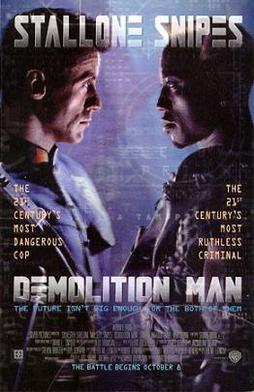
In the near future, law-breakers and other destructive types are not put in prison but are instead cryogenically frozen and left in suspended animation until they’ve served out their sentences. The most fearsome criminal in the world, Simon Phoenix (Wesley Snipes) has been frozen but so has his nemesis, Detective John Spartan (Sylvester Stallone).
In the far future, Los Angeles is a part of a megalopolis named San Angeles. Envisioned and watched over by a seemingly benign dictator named Cocteau (Nigel Hawthorne), San Angeles is a wannabe utopia where cursing leads to an automatic fine and all of the restaurants are Taco Bell. When he’s thawed out for a parole hearing, the suddenly super-powered Phoenix makes his escape. The police, no longer knowing how to deal with violence, make the reluctant decision to thaw out John Spartan. Assigned to work with the enthusiastic Lenina Huxley (Sandra Bullock), Spartan must navigate this strange future to defeat Phoenix.
For some reason, DemolitionMan never seems to get the respect that it deserves. Made at a time when both the Rambo and the Rocky franchises appeared to be over, DemolitionMan features one of Stallone’s most appealing performances as he deals with a society where just saying a bad word can cause a scandal. Just as Spartan proves that his brand of destructive police work still has its place in the future, Stallone proved that he could still carry an action movie in 1993. There’s a lot of knowing humor to Stallone’s performance. After a series of failed comedies in the 80s, DemolitionMan was the movie that proved that Stallone could be intentionally funny. Stallone is also surrounded by one of his strongest supporting casts. Wesley Snipes attacks his villainous role with gusto while Denis Leary breaks out his stand-up routine as Edgar Friendly, the leader of San Angeles’s rebels. This is also the film that led to Sandra Bullock getting cast in Speed and she’s so incredibly adorable here that even Stallone breaks out into a smile while acting opposite her
(In 1993, you couldn’t turn on television without seeing Sandra Bullock saying, “All restaurants are Taco Bell.”)
DemolitionMan is an action film and it lives up to its name, with all the demolition that a viewer could want. Even more so, It’s also a satire, of both Stallone’s previous films and what was then known as “political correctness.” DemolitionMan’s portrayal of a sterile society where everyone had been programmed to be docile and inoffensive wasn’t that far off from what a lot of politicians were then promoting for America at large. Luckily, John Spartan was around to put an end to that. The end result is one of Sylvester Stallone’s most memorable films.
In The Art of War, Wesley Snipes plays Neil Shaw, an UN operative who is framed for the assassination of a Chinese diplomat and who must uncover the real conspiracy while also proving his innocence. Proving his innocence means engaging in a lot of conflict while using investigation techniques that were cribbed from the Mission Impossible films.
Featuring a lot of war but not much art, The Art of War has a few good action scenes and an overly convoluted storyline that sometimes makes the film feel like a retread of another film in which Snipes was framed for a crime he did not commit, U.S. Marshals. It’s hard to take seriously any action hero who works for the United Nations but Wesley Snipes is credible in the action scenes and he could deliver a one-liner with the best of them. (Of all the bad things you can say about the IRS, the worst is that it put one of our best action stars in prison. Unforgivable!) The supporting cast is good, featuring Donald Sutherland, Maury Chaykin, Anne Archer, and Michael Biehn. The final battle between Snipes and the person who is revealed to be the main villain is exciting but, overall, The Art of War is overlong and overcomplicated. Neil Shaw is cool but he’s no Blade.
Welcome to Retro Television Reviews, a feature where we review some of our favorite and least favorite shows of the past! On Mondays, I will be reviewing Miami Vice, which ran on NBC from 1984 to 1989. The entire show can be purchased on Prime!
This week, Bill Paxton and Wesley Snipes walk the streets of Miami!
Episode 3.10 “Streetwise”
(Dir by Fred Walton, originally aired on December 5th, 1986)
I was excited to see that this week’s episode of Miami Vice featured guest turns from not only Wesley Snipes but Bill Paxton as well! Then I remembered that guest stars never survive their episode and I felt a little bit sad. I know what was coming. Miami Vice is not a show that features happy endings. Anyone who gets involved in Miami’s vice trade is destined to end up dead, regardless of how innocent or guilty they may be. It’s a dark world in Miami.
Paxton plays Vic Romano, a vice cop from a neighboring precinct who is arrested during a prostitution bust. Romano has been having an affair with Carla Cappoletti (Alice Adair), an emotionally fragile prostitute who is abused by both her pimp, Silk (Wesley Snipes), and almost all of her clients. She knows that Vic is a cop and Vic knows that she’s a prostitute but neither one of them cares. As Vic puts it, they’re in love.
The Vice Squad is shocked to find that Carla is carrying cocaine that is almost totally pure. Trying to track down who is supplying Silk with the cocaine, the squad discovers that neither Carla nor Vic want to cooperate. While Vic tries to explain things to his wife, Tubbs goes undercover as a pimp. He bails Carla out of jail and tells her that she works for him now. When Silk shows up to object, Tubbs easily beats him up. Silk may talk tough but, without a gun to back him up, he’s not much of a fighter.
When Tubbs demands that Carla go to Silk and find out where he’s been getting his cocaine from, Carla refuses. Tubbs, still pretending to be a pimp, proceeds to yell at her and tear up a hotel room. A sobbing Carla begs Tubbs not to hurt her “too much,” and Tubbs realizes that he’s gone too far in trying to maintain his cover. He shows Carla his badge. It’s always kind of easy to laugh at the way that Tubbs trots out his fake Caribbean accent whenever he’s pretends to be Rico Cooper but Thomas does a really good job in this episode and he is genuinely frightening when he starts yelling at Carla. I found myself wondering just how far Tubbs actually would go to maintain his cover and I was actually relieved when he pulled out that badge.
It ends, as things often do with this show, in a shootout. Silk is gunned down by Crockett and Tubbs but not before Romano is shot by Silk. Romano dies in Carla’s arms and I felt a little teary-eyed. Bill Paxton was a wonderful actor and he gave a likable and sincere performance as Vic Romano. Watching the episode, I never once doubted Romano’s love for Carla. Both Snipes and Paxton were well-cast as their doomed characters. Neither one survived the hour but I doubt anyone who watched the show ever forgot them.
I was going to pick another heavy metal video for today but then Lisa told me that today is Martin Scorsese’s birthday and I realized which video I had to pick. I was actually surprised to see that no one had ever picked Bad for music video of the day in the past. This is one of those videos that epitomized an era and it was directed by Martin Scorsese.
Here’s the long version, which was rarely played on MTV.
Here’s the shorter version for the Too Long, Didn’t Watch crowd.
You can’t fault Scorsese’s gritty direction, especially in the early black-and-white half of the video. Michael Jackson is not really convincing as someone who was ever considered to be “bad,” especially when he’s going up against Wesley Snipes, but there’s not much Scorsese could have done about that. Snipes is not the only familiar actor to appear in this video. The drug dealer is played by Paul Calderon, who played the bartender in Pulp Fiction. The voice of Michael Jackson’s mother is supplied by Roberta Flack. Cinematographer Michael Chapman and editor Thelma Schoonmaker, two regular Scorsese collaborators, also worked on this video. The script was written by novelist Richard Price.
I can’t hear this song without thinking about Weird Al Yankovic.
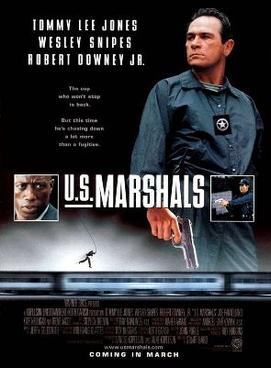
Mark Roberts (Wesley Snipes), formerly of the Diplomatic Security Service and wanted for murder, escapes when his prison transport aircraft crashes into an Illinois swamp. U.S. Marshal Sam Gerard (Tommy Lee Jones) was on the same flight and quickly assembles his team so that they can track down and capture the fugitive. That’s what Sam Gerard does. He’s the best fugitive hunter around. Complicating matters is that an inexperienced DSS agent named John Royce (Robert Downey, Jr.) has been assigned to the team. Royce says that the men that Mark killed were friends of his and this hunt is personal for him. However, Sam suspects that Mark might not be as guilty as he seems. Considering that the last high-profile fugitive that Sam chased was also innocent, I have to wonder why Sam has any faith in the system at all.
Based on the classic televisions how, The Fugitive was one of the biggest film hits of 1993 and it also became one of the few action films to receive an Oscar nomination for Best Picture of the Year. Even though the film starred Harrison Ford as a doctor wrongly convicted of murdering his wife, it was Tommy Lee Jones who got all the best lines and all the critical attention. Tommy Lee Jones was also the one who received an Oscar for his work on the film. The Fugitive was such a hit that it was pretty much guaranteed that there would be a sequel. Since there were only so many times that Richard Kimble could reasonably be wrongly convicted of murder, it also made sense that future films were focus on Sam Gerard and his team.
U.S. Marshals was the first Fugitive sequel and, as a result of terrible reviews and a lackluster box office performance, it was also the only sequel. I saw U.S. Marshals when it was first released in 1998. I enjoyed it but I was also a teenage boy. Back then, I liked everything as long as it featured a car chase, a gunfight, and a leggy female lead. Last night, I rewatched the film for the first time since it was originally released and I still enjoyed it but I could also understand why U.S. Marshals didn’t lead to a Sam Gerard franchise.
The plane crash was as cool as I remembered. So was the scene where Wesley Snipes escaped from Sam by jumping onto a train. (That scene was featured in all of the commercials.) The scenes of Tommy Lee Jones getting frustrated with incompetent local law enforcement were still entertaining, as were the scenes of him interacting with his team. I even liked the much-criticized cemetery stakeout. There was much about the film to like but the main problem was that Sam Gerard works better as a supporting player than as a leading character.
Harrison Ford really doesn’t get enough credit for the success of The Fugitive. One the main reasons why that film works is because Ford is so likable and sympathetic as Richard Kimble. It’s entertaining to check in on Sam and his team but it’s Ford who makes us care about the story. In U.S. Marshals, Wesley Snipes’s character is never as clearly defined as Kimble. We learn very little about him, other than he tries not to actually hurt anyone while escaping. There’s no emotional stakes to whether Mark is innocent or guilty and no real suspense as Sam goes through the motions of hunting him. Sam may still have a way with words but, in U.S. Marshals, he’s just doing his job. Things do get personal when Sam and his team are betrayed by one of their allies and a member of the team is killed but even then, it doesn’t make sense that the bad guy, who had been pretty careful up until that point, would mess up his plans by impulsively killing someone who hadn’t really witnessed anything that incriminating.
I think U.S. Marshals missed its calling. Sam and his team were entertaining enough that, if they had starred in a weekly television show called U.S. Marshals, it probably would have run for ten seasons. As a movie, though, it can’t escape the long shadow of The Fugitive.
Yesterday, I told my sister that I wanted to watch a good baseball movie.
“How about The Fan?” she said, “It’s on Starz.”
“Is The Fan really a baseball movie?” I asked.
“It’s got people with baseball bats in it.” she said.
The Fan does have people with baseball bats. Wesley Snipes is a baseball player who is getting paid a lot of money to swing a bat for the Giants but he’s in a slump because Benicio del Toro won’t let him wear his old number. Robert de Niro is a Giants fan who uses a baseball bat to beat to death his best friend after de Niro kidnaps Snipes’s son and demands that Snipes play better. Snipes has to win a game, even though it’s raining and he has terrible stats against the opposing pitcher. De Niro sneaks on the field as an umpire and makes bad calls on purpose, which proves everything that I’ve ever said about umpires.
The Fan wasn’t bad. I liked the baseball scenes and I also liked the scenes where de Niro would just start overreacting to anyone saying anything bad about the Giants because everyone knows a fan like that. (Where I live, most of them are Cowboys fans.) Whenever de Niro started to go crazy, Nine Inch Nails would play on the soundtrack, which was funny but also too obvious. There was a lot about the movie that didn’t make any sense. At the end of the movie, it’s raining so hard that there’s no way the game would have been allowed to continue but I guess once you accept that de Niro could sneak on the field dressed like an umpire, you have to accept that a baseball game would continue in the middle of a flash flood. But we all know fans like the one played by de Niro. At the start of the movie, I actually felt bad for him because it was so obvious that baseball was the only thing he had. He still had all of his pictures from Little League and he wanted his son to be as big a baseball fan as he was because that was the only way that he knows how to relate to other people. But then he started killing people and giving baseball fans everywhere a bad name.
Josh Hamilton once said that Dallas wasn’t a “real baseball town,” which hurt the feelings of fans like me who had supported him, through all of his struggles, when he was a member of the Rangers. Whenever Hamilton would return to Arlington to play against the Rangers, everyone in the stands would chant, “Baseball town,” whenever he stepped up to the plate. I still think it was rude for Hamilton to say what he said but he was right that Dallas doesn’t produce the type of baseball fans who will disguise themselves as umpires and take the field with a knife hidden in their cleats. Rangers fans aren’t “the crazy fans,” like the ones who Snipes says he can’t stand in The Fan. I hope that never changes but I also hope the Rangers get it together this upcoming season. Support the team without kidnapping or killing anyone, that’s the duty of every true fan. GO RANGERS!
The Wesley Snipes comeback continues in the upcoming series True Story. This series will also feature Kevin Hart in a serious role. To be honest, I think Kevin Hart can handle a serious role. It’ll be interesting to see if I’m right.
True Story drops on November 24th, on Netflix. Here’s the trailer:



 Through the Shattered Lens