Retro Television Review: Fantasy Island 6.21 “Remember When….”


Welcome to Retro Television Reviews, a feature where we review some of our favorite and least favorite shows of the past!  On Tuesdays, I will be reviewing the original Fantasy Island, which ran on ABC from 1977 to 1984.  Unfortunately, the show has been removed from most streaming sites.  Fortunately, I’ve got nearly every episode on my DVR.

This week …. oh no!

Episode 6.21 “Remember When”

(Dir by Philip Leacock, originally aired on May 7th, 1983)

After crashing his little car, Tattoo ends up in the Fantasy Island hospital.  Roarke cancels all of the weekend’s fantasies so that he can stay by Tattoo’s side and keep Tattoo cheerful until it’s time for him to have life-saving surgery.  Roarke and Tattoo share memories and …. YEP, IT’S A CLIP SHOW!

Actually, for a clip show, it’s not that bad.  Yes, there’s a lot of awkward dialogue.  “Boss, remember that time Mickey Gilley opened up his place?”  That said, the clips are well-selected and they all feature Herve Villechaize at his best, turning this episode into a Tattoo tribute.  At the end of the episode, Tattoo says that he’s never going to leave Fantasy Island.  Which …. well, we’ll get to season 7 in a few weeks.

Anyway, clip shows are pretty much impossible to review.  Let’s just be happy that Tattoo pulls through.  That accident looked serious!


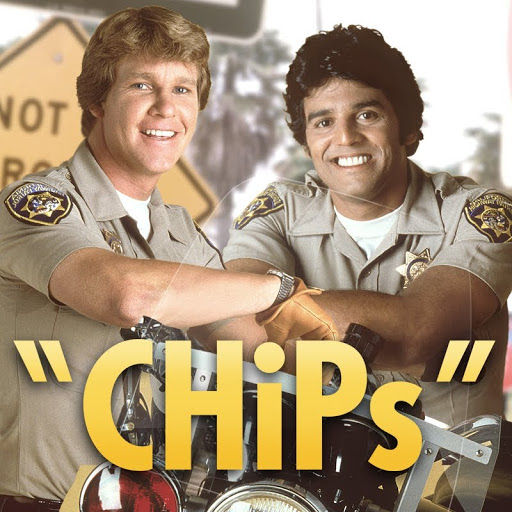
Late Night Retro Television Review: CHiPs 4.1 “Go-Cart Terror”


Welcome to Late Night Retro Television Reviews, a feature where we review some of our favorite and least favorite shows of the past!  On Mondays, I will be reviewing CHiPs, which ran on NBC from 1977 to 1983.  The entire show is currently streaming on Prime!

It’s time for the fourth season!  Ponch and Baker — but especially Ponch — continue to keep Los Angeles safe for pedestrians and motorists.

Episode 4.1 “Go-Cart Terror”

(Dir by John Florea, originally aired on September 21st, 1980)

It’s time for season 4 of CHiPs, a.k.a The Ponch Show!

Seriously, if there’s anything that really stuck out about the fourth season premiere, it’s that Baker’s character was pretty much superfluous.  Yes, Baker was out there on his motorcycle and helped Ponch catch this week’s bad guys, two thieves played by Larry Storch and Sonny Bono.  But, ultimately, it was Ponch who did the important things.

Who coached the CHP-sponsored go-cart team to victory over the fire department’s?  Ponch!

Who rescued a woman from a van after she crashed into a lake?  Ponch!

Who always knew the right thing to say?  Ponch!

Who did everyone talk to when they had a problem?  Ponch!

This episode established that Frank ‘Ponch” Poncherello is the greatest human being who ever lived.  Baker …. well, he tries.  Baker’s nice and dedicated to the job but, in the end, he can only watch with amazement as Ponch solves all of the world’s problems.

I read over on the imdb that Larry Wilcox did not enjoy working with Erik Estrada and he felt that Estrada was the producer’s pet.  Watching this episode, I can see why Wilcox would have felt like that.  It’s hard to believe that, when this show first started, Baker was the competent one while Ponch was the nervous screw-up who kept making mistakes and who always seemed to be on the verge of getting written up.  The fourth season premiere celebrates Ponch as being the supercop who the rest of Los Angeles looked up to.  Sorry, Mr. Wilcox …. you may be the better actor but it’s hard to compete with the Estrada of it all.

As for the episode itself, it was typical CHiPs.  The criminals were captured after being chased on the freeway and a bunch of kids learned an important lesson about proper go-cart safety.  When the go-cart team had to raise money to compete in the next race, Ponch told all the adults that the kids had to come up with a plan because it was their team and the whole point of the go-cart experience was to learn responsibility.  You tell ’em, Ponch!  I mean, goddamn, Ponch is the man!  Anyway, the kids held a car wash and I think the only reason they did that was so the show could have an excuse to have Randi Oakes show up in short shorts and get sprayed by a hose.  I hope Ponch talked to the producers about treating Randi Oakes with respect.

I liked this episode, even though I did feel bad for Larry Wilcox.  It was silly and fun.

Late Night Retro Television Review: Degrassi High 2.8 “Home, Sweet Home”


Welcome to Late Night Retro Television Reviews, a feature where we review some of our favorite and least favorite shows of the past!  On Sunday, I will be reviewing the Canadian series, Degrassi High, which aired on CBC and PBS from 1989 to 1991!  The series can be streamed on YouTube and Tubi

This week, everyone is sick of Wheels.

Episode 2.8 “Home, Sweet Home”

(Dir by Kit Hood, originally aired on January 7th, 1991)

Oh, Wheels!  Always in trouble, that one.

Ever since getting kicked out of his grandma’s house, Wheels has been staying with Joey but, after several weeks, Joey and his parents are sick of their houseguest.  Wheels easts all the food, never says thank you, and has yet to even to start to look for his own place.  Instead, he steals a bunch of money from Joey’s mom’s purse.  As a result, Wheels not only gets kicked out of the Jeremiah residence but Snake’s parents announce that Wheels can’t stay with them either.  Trapped outside during a thunderstorm, Wheels calls his grandmother and promises to obey her rules if she allows him to come home.

“I don’t believe you,” she replies before hanging up on him.

OUCH!  Though, to be honest, she’s right about Wheels’s sincerity.  Wheels is a pathological liar who takes advantage of anyone who trusts him.  It’s been a while since he was the cool kid that everyone wanted to date.

Wheels eventually crashes on Snake’s back porch.  (“My parents cannot know you’re back here,” Snake says.)  The next day, at school, Wheels promises Joey that he will pay back the money he owes.  Joey turns his back on Wheels and walks off.

And, again, Wheels really has no one to blame for but himself.  And those of us who know our Degrassi history know that things are soon going to get even worse for Derek Wheeler.

Meanwhile, Michelle returns home so she can have a quiet place to study.  She is shocked to find her father is at the house.  (She thought he would be at cooking class.)  Michelle agrees to move back in but on the condition that she pay rent and that her father stop trying to control her life.  Her father reluctantly agrees.  I guess, now that she’s broken up with BLT, it no longer matters that her father was previously portrayed as being a raging racist.

This episode was okay but it felt very familiar.  We’ve done the whole Wheels-is-awful thing already.  Add to that, as terrible as Wheels is, I don’t really agree with Grandma’s decision to refuse to allow him to come home.  Wheels promised to abide by his grandmother’s rules and that was the condition that Grandma set for his return.  Wheels is a handful and undoubtedly was being insincere but I think Grandma is going back on her word here.  If Wheels had come home, she could have at least continued to talk to him and kept trying to get him to go to therapy.  Instead, she left him out in the middle of Toronto in a rainstorm.  Shame on her for that.

Some characters are just doomed no matter what and that’s certainly the case with Wheels.

Retro Television Review: Homicide: Life On The Street 3.15 “End Game”


Welcome to Retro Television Reviews, a feature where we review some of our favorite and least favorite shows of the past!  On Sundays, I will be reviewing Homicide: Life On The Street, which aired from 1993 to 1999, on NBC!  It  can be viewed on Peacock.

This week, the Homicide detective finally arrest the shooter but can they get a confession?

Episode 3.15 “End Game”

(Dir by Lee Bonner, originally aired on February 10th, 1995)

Finally, the Homicide detectives have figured out who actually shot Bolander, Howard, and Felton.  Gordon Pratt (Steve Buscemi), who lived at the apartment that the detectives were accidentally sent to, is a gun-obsessed pseudo-intellectual whose apartment is full of books that he’s probably never read and a picture of himself posing like Lee Harvey Oswald with the rifle he used to kill JFK.  Pratt also has an outstanding warrant for his arrest, explaining why he panicked when the cops accidentally knocked on his door.

Here’s my question.  Why exactly did it not occur to anyone to see who lived in Apartment 201 when the shootings first happened?  I understand that they were focused on a different suspect but it still seems strange that, with all the detectives assigned to the case, no one bothered to check out the guy who lived in Apartment 201.

Anyway, Bayliss and Mitch Drummond drop in on Pratt’s parents, who own a farmhouse and insist that Gordon would never shoot anyone.  Meanwhile, Pratt’s co-workers all talk about how much they hate his guts with one guy mentioning that Pratt went out of his way to antagonize people.  Pratt is finally tracked down at a massage parlor.

The majority of this episode centers around Pembleton and Bayliss interrogating Pratt.  It’s an obvious attempt to recapture the intensity of the first season’s Three Men and Adena and it actually succeeds, thanks to some smart writing and the performances of Andre Braugher, Kyle Secor, and especially Steve Buscemi.  Buscemi plays Pratt as being the ultimate uneducated know-it-all, someone who has picked bits and pieces of philosophy and who has learned that, if you deliver your mundane thoughts with a sneering contempt, some people will assume that you’re smarter than you actually are.  Pembleton and Bayliss have fun picking apart Pratt’s arrogance but — and this is what sets Homicide apart from so many other cop shows — Pembleton ultimately goes too far.  When he takes a look at Pratt’s copy of Plato’s The Republic and realizes that it’s written in Greek, Pembleton can’t help but taunt Pratt and point out that, unlike Pratt, he can actually read ancient Greek because he was educated by “the Jesuits,” while Pratt didn’t even mange to graduate high school.

“I want a lawyer!” Pratt shouts.

At this point, I realized that I had gotten so wrapped up in the interrogation scene that I had totally forgotten about the fact that all of the evidence linking Pratt to the shooting was circumstantial.  Without a gun or a confession, there’s not enough evidence to hold Pratt.  He pleads out to his outstanding assault warrant and he’s free within a few hours.

“You got too cute, Frank,” Munch says, leading to Pembleton physically attacking Munch and then storming out of the station.  Munch goes to the hospital to see Bolander (who has woken up from his coma but who has no memory of who Much actually is) and Bayliss is the only person left to take the call when Gordon Pratt turns up dead in the lobby of his apartment building, shot in the head.

Who murdered Gordon Pratt and was it a cop?  That’s what Bayliss — who sarcastically declares “I love my job!” before heading to the crime scene — will have to figure out.

Great episode!  Not only was it wonderfully performed but, just when you thought to yourself, “There’s no way Pembleton could get away with this in real life,” it turns out that Pembleton couldn’t get away with it on Homicide either.  That’s what makes Frank Pembleton such a fascinating character.  He’s a brilliant detective but, in this episode, he let his desire to embarrass Pratt get in the way of doing his job.  “He who loses control loses,” Pembleton says and, in this episode, he lost control.  Pembleton’s reaction is to storm out of the station in a huff, leaving Bayliss the task of figuring out who killed Gordon Pratt.

My money’s on Munch, just because of how upset he was when Pratt walked and also that it would make sense for Munch to avenge Bolander’s head wound by shooting Pratt in the head.  We’ll see if I’m correct next week!

Late Night Retro Television Review: Check It Out! 3.20 “Smotherly Love”


Welcome to Late Night Retro Television Reviews, a feature where we review some of our favorite and least favorite shows of the past!  On Saturdays, I will be reviewing the Canadian sitcom, Check it Out, which ran in syndication from 1985 to 1988.  The entire show is currently streaming on Tubi and Peacock!

This week, Christian’s mother comes to visit.

Episode 3.20 “Smotherly Love”

(Dir by Alan Erlich, originally aired on January 31st, 1988)

Christian’s mother (Marilyn Peppiatt) flies from Florida to Canada so she can visit her favorite son.  It turns out that Christian has been lying to his mother, telling her that he’s the manager of Cobb’s and that Marlene is his fiancée!  Howard and the rest of the staff reluctantly play along with Christian’s lies but when it turns out that his mother is planning on sticking around, Howard tells Christian that he needs to tell her the truth.

(Christian doesn’t tell her the truth but it comes out anyway after she overhears him talking to Howard and Edna about how he doesn’t want to disappoint her.)

Meanwhile, the very pregnant Mrs. Viker (Marcia Bennett) hangs out at the story until her water breaks and it’s time for Viker to rush her to the hospital.  Later, Edna reveals that Viker actually took his wife to the Holiday Inn.

This was a good episode because it focused on two of the most consistently funny characters on the show, Jeff Pustil’s Jack Christian and Gordon Clapp’s Viker.  Pustil is always at his best in those rare scenes where Christian reveals that he has a conscience while Gordon Clapp’s portrayal of Viker’s sincere stupidity has always been one of the best things about the show.  Viker’s joy over being a father mixed with Christian’s relief upon learning that his mom didn’t hate him made this a surprisingly heartfelt and sweet episode.

As for Christian telling his mom that he and Marlene are engaged, Jeff Pustil and Kathleen Laskey actually did get married after the show ended.  Personally, I’ve always found them to be a cute couple whenever they interacted with each other on the show, even if their characters were supposed to be mortal enemies.

Two more episodes to go!

Retro Television Review: The American Short Story #4 “Almos’ A Man”


Welcome to Retro Television Reviews, a feature where we review some of our favorite and least favorite shows of the past!  On Saturdays, I will be reviewing The American Short Story, which ran semi-regularly on PBS in 1974 to 1981.  The entire show can be purchased on Prime and found on YouTube and Tubi.

This week, we have an adaptation of a Richard Wright short story.

Episode #4 “Almos’ A Man”

(Dir by Stan Lathan, originally aired in 1976)

David (LeVar Burton) is a black fifteen year-old living in the Deep South in the 1930s.  He works on his family’s farm and takes care of a mule named Jenny.  He considers himself to be almost a man.  His mother (Madge Sinclair) and his father (Robert DoQui) disagree.

David knows the one thing that he need to make himself a man.  He needs a gun and, this being the 1930s, he finds one that he can order from a Sears & Roebuck catalogue.  His mother says that there’s no way she’s letting him get a gun.  His father is a bit more open to it.  David secretly sends away for the gun and, as you can probably guess, tragedy ensues.

This was a downbeat adaptation of a similarly downbeat Richard Wright short story.  David obsession with being a man makes sense when you consider that he lives in a world where everyone — from his parents to the menacing white people who show up towards end — calls him a “boy.”  The white people even call his father “boy” and it’s a reminder of how that term was used to dehumanize and degrade black men, even someone like David’s father who has raised a family, takes care of his farm, and who is, in every way imaginable, a man.

Nicely done, this one, with good performance from Burton, Sinclair, and Doqui.  As for Richard Wright, he had been dead for 16 years by the time this premiered.  He died in Paris, having left the United States in 1946.  He’s remembered for his novel Native Son and his memoir, Black Boy.  Personally, I would add that he should also be remembered for his essay that appeared in the anti-Communist collection, The God That Failed.  This adaptation of AlmosA Man does a good job paying tribute to Wright’s voice and legacy.

Brad’s Town of the Day – Bronson, Missouri!


My wife Sierra and I have had a lot of stress in our life lately, so I decided to take her on a little getaway this weekend to Branson, MO. This afternoon we’ve got tickets to the Sight and Sound production of “David,” and tonight we’re going to cruise Table Rock Lake on The Branson Belle.

As good as all of this sounds, my dream town would be the place imagined by THE SIMPSONS called Bronson, MO! That has to be the safest town in the world!!

Late Night Retro Television Review: Friday the 13th: The Series 3.17 “Jack-In-The-Box”


Welcome to Late Night Retro Television Reviews, a feature where we review some of our favorite and least favorite shows of the past! On Fridays, I will be reviewing Friday the 13th: The Series, a show which ran in syndication from 1987 to 1990. The entire series can be found on YouTube!

This week’s episode is a sad one.

Episode 3.17 “Jack-In-The-Box”

(Dir by David Winning, originally aired on April 23rd, 1990)

After her lifeguard father drowns, a young girl named Megan (Marsha Moreau) uses a cursed jack-in-the-box to get revenge of those who she blames for his death.  Seeing the jack in the box when it opens leads to people drowning.  A janitor drowns in a pool.  One guy drowns in a car wash.  The deaths are grisly but it brings back the spirit of Megan’s death father.  Or, at least, that’s what Megan thinks.  Personally, I think the spirt was a demon in disguise because some of the things he suggested were really out there.

This was a really sad episode.  In an amazing coincidence, Micki knew the lifeguard’s family and she spent most of this episode on the verge of tears.  Meanwhile, Megan’s mother dealt with her sadness by becoming an alcoholic and Megan killed  a number of people just so she could spend some time with her “father.”  This episode was well-acted and well-written and really not the right sort of thing for me to watch at a time when the one-year anniversary of my Dad’s passing is quickly approaching.  This was an episode that not only left Micki in tears but it left me in tears as well.

Okay, enough sadness!  This was a good episode.  The third season has been uneven and I still miss Ryan’s character but this episode showed that Friday the 13th was still capable of being effective even as the show came to a close.

Retro Television Review: St. Elsewhere 2.4 “Qui Transtulit Sustinet”


Welcome to Retro Television Reviews, a feature where we review some of our favorite and least favorite shows of the past! On Fridays, I will be reviewing St. Elsewhere, a medical show which ran on NBC from 1982 to 1988.  The show can be found on Hulu and, for purchase, on Prime!

This week. Dr. Craig finally gets to perform his first heart transplant.

Episode 2.4 “Qui Transtulit Sustinet”

(Dir by Victor Lobl, originally aired on November 16th, 1983)

It’s a busy day at St. Eligius.

While Morrison struggles to come to terms with the death of his wife, her heart is transplanted into Eve Leighton.  Morrison tells Westphall that he wants to keep working at the hospital and that he doesn’t need any time off.  Westphall tells Morrison that he’s too distraught to be trusted with patients and that he has to take some time off.  Westphall actually has a point, even if he does come across as being a bit cold when talking to Morrison.  Even Peter White, that drug-addicted sleazebag, tells Morrison that he’s needs to take some time.  Seriously, I think this is the first time that Dr. White’s been correct about anything since this show began.

Dr. Craig finally gets to perform a heart transplant but afterwards,  in a wonderfully-acted scene, he tells Westphall that he feels a bit let down.  After all the anticipation and the preparation, Craig isn’t sure what to do now that he’s actually performed the surgery.  For once, he doesn’t want to talk to the press, regardless of how much the city of Boston expects him to.  It’s a nicely human moment, one that we don’t often get from Dr. Craig.

Nurse Rosenthal attempted to console another breast cancer patient and met with Mark Harmon’s Dr. Caldwell to discuss getting breast reconstruction surgery.  Nurse Rosenthal’s breast cancer storyline has consistently been well-acted and well-written and it has also been consistently difficult for me, as someone who lost her mother to cancer, to watch and write about.  That was certainly the case for me with this episode.

Meanwhile, Fiscus and Luther pool their money to make an investment in silver but, at the last minute, Fiscus pulls out of their investment.  His nerves get the better of him.  Luther makes a lot of money.  Fiscus doesn’t.  Hey, guys — Morrison’s wife is dead.  Show some respect and save the comedy for another episode.

This was an intense episode but it ended on a beautiful note, with Dr. Morrison listening to the sound of his wife’s heart beating in someone else’s body.  A beautiful note but also a very sad one.  I’m worried about Jack Morrison.  I’m worried about the recipient of the heart.  I’m worried about Helen Rosenthal.  I’m worried about the entire hospital!

Here’s hoping for happier days ahead.


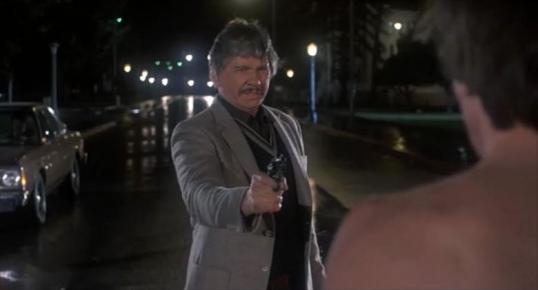
Brad reviews FAMILY OF COPS III: UNDER SUSPICION (1999) – Charles Bronson’s final film! 


Legendary actor Charles Bronson ended his five-decade career by starring in a series of made-for-TV movies, FAMILY OF COPS (1995), BREACH OF FAITH: A FAMILY OF COPS II (1997), and FAMILY OF COPS III: UNDER SUSPICION (1999). I was in my mid-twenties as this series played out, and I enjoyed each of the installments. Today, I’m going to take a look at the final film in the series, and the final film in Charles Bronson’s career.

FAMILY OF COPS III: UNDER SUSPICION opens with Milwaukee Police Inspector Paul Fein (Charles Bronson) and his detective son, Ben Fein (Joe Penny), investigating the double murder of a wealthy banker, Phillip Chandler, and his wife. Their initial suspect, the couple’s son Evan Chandler (Greg Spottiswood), is later found murdered, so they have to keep digging. They eventually uncover a money laundering scandal involving the current Chief of Police (Sean McCann) that may go all the way up to the Mayor (Art Hindle)! As usual, this series includes additional storylines involving other members of the family. One of the subplots involves Paul’s youngest son Eddie (Sebastian Spence), who’s racked with guilt over a S.W.A.T. raid gone wrong. Unable to open the warehouse door at the appropriate time, Eddie blames himself for the deaths of two cops. The other primary subplot involves Paul’s oldest daughter Kate (Barbara Williams), who finds herself pregnant with the child of her social worker boyfriend. Determined to have the baby whether her boyfriend hangs around or not, Kate must navigate their relationship and all the family drama while preparing for the possibility of being a single mother. 

As far as I’m concerned, the fact that this is Charles Bronson’s final film should make it a must watch for any person who considers themselves to be a fan of the icon. Making his debut in 1951 in the Gary Cooper film YOU’RE IN THE NAVY NOW, because he could “belch on cue,” Bronson’s final film would debut on CBS on January 10th, 1999, when he was 77 years old. At such an advanced age, Bronson still commanded the screen even though he was at the end of his career, and as time would tell, near the end of his life. He would be diagnosed in 2001 with Alzheimer’s disease and would pass away on August 30th, 2003. I savor every moment of this film, and while it makes me sad in some ways, in other ways I consider it my favorite of the series. Joe Penny steps up and takes a co-lead role in the film. He’s tough and sensitive, which adds another layer of depth to the foundation that Bronson had established in the first two movies. The series wouldn’t get another movie without Bronson, but I would have definitely been down for a Joe Penny led follow-up! This movie has a stronger sense of humor than we’ve seen in the earlier films, and I also like the main story as Paul Fein and his son take on systemic corruption in Milwaukee. While it’s still formulaic, I found the primary storyline to be more interesting than the generic crime stories in the first two installments. The subplots involving Eddie and Kate add some depth to the Fein family dynamics, but other than the fact that Kate is determined to keep her baby with or without her boyfriend’s help, the subplots didn’t make much of an impact for me. Also, there is one major departure in this installment, as Angela Featherstone does not return as the youngest daughter, Jackie Fein. Nicole de Boer steps into the role, and while she’s cute as a button, the character isn’t given much to do.

Overall, while FAMILY OF COPS III: UNDER SUSPICION is not in the same league as the great films made during Charles Bronson’s prime, it’s still a respectable close to his iconic career. It features good, committed performances, especially from Bronson and Joe Penny. The final shots of Charles Bronson looking over his movie family and smiling as they enjoy each other and share a meal together is a fitting end to his movie career, and one final celluloid glimpse into the man underneath the legendary facade.